
Medical Tourism Blog
Korea Cosmetic Disfigurement Solutions: Eyelid Retraction Repair Procedures

Table of contents
- Understanding Cosmetic Disfigurement: "Aesthetically Unappealing Appearance"
- Eyelid Retraction Repair: A Detailed Medical Overview
- Medical Tourism in South Korea: Your Journey for Eyelid Retraction Repair
- Which Are the Best Clinics in Korea for Cosmetic Disfigurement?
- Cost Analysis: Eyelid Retraction Repair in South Korea vs. Global Destinations
- Patient Experiences and Outcomes: Addressing Cosmetic Disfigurement
- Conclusion
- References
Considering treatment in Korea? Everything you need to know e.g. — how to avoid scams, visas, interpreters, recovery tips — in our Medical Tourism Master Guide. Plan with confidence in minutes, not weeks!
More people are turning to the internet to find answers and solutions for cosmetic issues, especially those affecting the face. Eyelid retraction is one such condition that not only changes how someone looks but can also cause serious discomfort and functional problems. This guide is designed to provide patients with clear, trustworthy information about Eyelid Retraction Repair, including the procedure itself, costs, and the benefits of seeking treatment as a medical tourist in South Korea.
By offering a well-organized, expert-backed resource, this report helps patients cut through the confusing and often unreliable information found online. Having one reliable source makes it easier to understand complex medical details and make informed choices. This is especially important for significant surgeries like eyelid retraction repair, where traveling abroad for treatment adds another layer of complexity. Empowering patients with knowledge turns them into active participants in their healthcare, boosting confidence and easing the stress of making medical decisions far from home.
Understanding Cosmetic Disfigurement: "Aesthetically Unappealing Appearance"
Cosmetic disfigurement refers to changes in a person’s appearance caused by various factors such as birth defects, injuries, skin diseases like Eka Kushta or Shwitra, or complications from previous surgeries. While these changes mainly affect looks, they can also cause functional problems, as seen in eyelid retraction.
Patients might come across different terms describing similar issues, including "physical deformity," "facial deformity," and "cosmetic deformity." The phrase "aesthetically unappealing appearance" fits within this group. Knowing these terms helps patients find the most relevant and complete information during their research.
The impact of cosmetic disfigurement goes beyond appearance. It often affects mental and emotional health, causing distress, low self-esteem, and social anxiety. Many seek treatment not just for looks but to relieve these emotional and social burdens. Recognizing this helps patients see cosmetic procedures as a valid way to improve overall well-being, reducing any stigma and encouraging them to pursue treatment as a path to better mental health and social confidence.
Eyelid Retraction Repair: A Detailed Medical Overview
What is Eyelid Retraction?
Eyelid retraction happens when the upper or lower eyelid (or both) pulls away from the eye, sitting higher than normal and exposing more of the eye’s surface. This condition can arise from trauma, previous eyelid surgeries like blepharoplasty, Graves' Disease, tumors, facial nerve palsy, other eye diseases, or radiation therapy.
Because more of the eye is exposed, patients often experience irritation, dryness, pain, and a "wide-eyed" look that affects appearance. Sometimes, excessive tearing occurs due to poor tear drainage. If left untreated, eyelid retraction can prevent proper eye lubrication and protection, risking long-term damage. The eyelid plays a vital role in eye health, so repairing retraction is essential not just for looks but to restore function and prevent complications.
Goals of Eyelid Reconstruction and Repair
The main goals of eyelid retraction repair are to restore eyelid function and achieve a natural, symmetrical appearance while minimizing surgical risks. This includes ensuring the eyelid can close properly, maintaining tear film health, and preserving clear vision. Surgeons aim to recreate a balanced, natural look with minimal scarring and complications.
Surgical Techniques and Approaches
Eyelid reconstruction is complex and tailored to each patient’s specific defect and needs. Surgeons assess whether the problem involves the anterior lamella (skin and muscle), posterior lamella (cartilage and lining), or both, and use similar tissues to repair the eyelid.
For upper eyelid retraction repair, common methods include lengthening the eyelid with spacer grafts (using the patient’s own tissue like hard palate or ear cartilage, or synthetic materials), Mullerectomy (weakening Müller's muscle to lower the eyelid), and the Lateral Tarsal Strip technique (tightening the outer eyelid corner).
For lower eyelid retraction repair, techniques include midface lifting to support the eyelid, spacer grafts like alloderm to lengthen the eyelid, and canthoplasty to tighten or reposition the eyelid corner. Surgeons may access the eyelid internally or externally to release scar tissue or tighten structures.
Eyelid fat grafting is increasingly popular, using the patient’s own fat to restore volume and support the eyelid. Fat is harvested via liposuction, processed, and injected carefully to improve contour and function. This method reduces risks of rejection and can be less invasive than other grafts, though it carries risks like lumps or swelling.
Eyelid retraction repair is often combined with other procedures such as blepharoplasty, ptosis repair, brow lifts, or midface lifts to enhance both function and appearance. In cases where bulging eyes cause retraction, orbital decompression may be needed first. Because each case is unique, patients should expect a personalized treatment plan from an experienced surgeon skilled in multiple techniques.
Medical Tourism in South Korea: Your Journey for Eyelid Retraction Repair
Why South Korea for Eyelid Retraction Repair?
South Korea is a global leader in cosmetic and reconstructive surgery, with Seoul’s Gangnam district known for top-tier clinics like THE PLUS Plastic Surgery, Made Young Plastic Surgery Clinic, and Okay Plastic Surgery Clinic. These centers are praised for their expert surgeons, comprehensive care, and personalized treatment plans, making South Korea a top choice for complex eyelid retraction repairs.
The Process: From Initial Consultation to Post-Operative Care for Medical Tourists
Medical tourists can expect a structured process:
- Initial Contact and Virtual Consultation: Many clinics offer online consultations to discuss concerns, review photos, and provide preliminary advice before travel.
- Preoperative Assessment and Planning: Upon arrival, patients undergo detailed medical and eye exams, photography, and discussions about goals and surgical plans. Additional tests may be done as needed.
- The Surgical Procedure: Skilled, often board-certified oculoplastic surgeons perform the surgery under appropriate anesthesia.
- Immediate Post-Operative Care: Patients may experience swelling and bruising, managed with cold compresses and medications to prevent infection and ease pain.
- Recovery and Follow-Up: Patients follow activity restrictions and attend follow-ups to monitor healing and eyelid position. Recovery can take weeks to months for full stabilization.
Key Considerations for International Patients
Planning for medical tourism involves more than surgery. Patients should budget for flights, local transport, and accommodation. While many clinics have English-speaking staff and coordinators, language barriers outside the clinic can occur. A sufficient stay is necessary to cover assessments, surgery, and initial recovery. Visa arrangements should be made well in advance.
South Korean clinics often offer bundled packages covering medical and logistical services, simplifying planning and reducing hidden costs. Patients should confirm exactly what is included in their quoted price to avoid surprises. Successful medical tourism depends on careful planning of both medical and non-medical aspects to ensure a smooth, stress-free experience.
Which Are the Best Clinics in Korea for Cosmetic Disfigurement?
Listed below are some of the best clinics in Korea for cosmetic disfigurement.
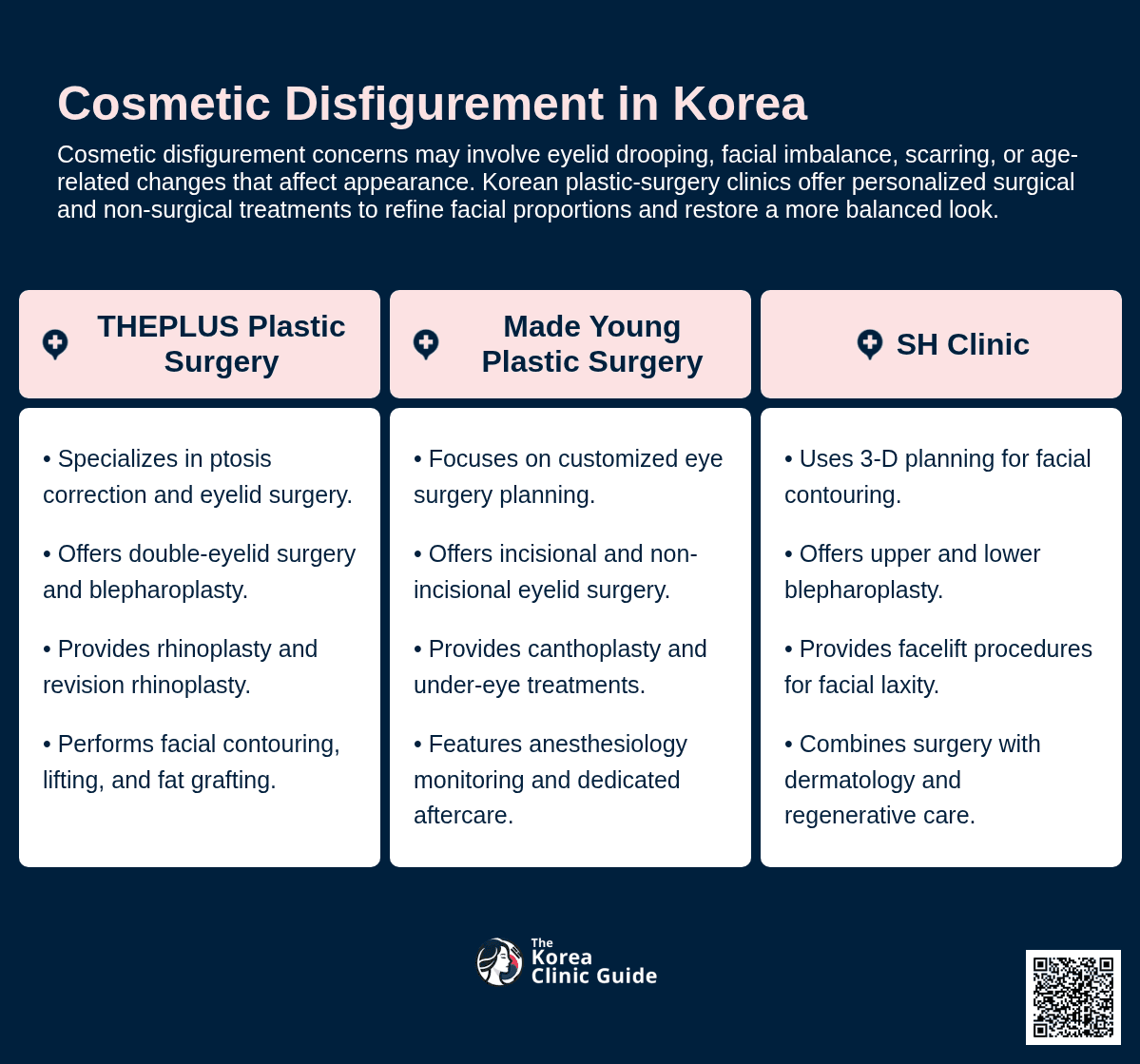
1. THEPLUS Plastic Surgery
For concerns related to a drooping or heavy upper eyelid, you can consider THEPLUS Plastic Surgery for ptosis correction, which is described as addressing the muscle that opens the eye to create a brighter-looking eye area. The clinic also offers related eyelid procedures and a broad surgical range for facial balance and contour refinement.
- URL: THEPLUS Plastic Surgery Website
- Location: Gangnam-gu, Seoul
- Eye procedures:
- Ptosis correction is offered for drooping upper eyelids, with the aim of improving a heavy or tired-looking appearance.
- Double-eyelid surgery creates an upper-eyelid crease designed to suit your facial features.
- Blepharoplasty adjusts excess eyelid skin and tissue for a smoother eye contour.
- Facial surgery options:
- Rhinoplasty and revision rhinoplasty are offered with attention to both nasal appearance and structure.
- Full-face contouring, cheekbone surgery, square-jaw surgery, chin surgery, and facial implants are available for facial proportion concerns.
- Facelift, thread lift, and facial fat grafting are available for sagging or volume loss.
- Surgeon background:
- Dr. Kim is described as a board-certified plastic surgeon with research awards involving 3D implants, with expertise in rhinoplasty and facial contouring.
- Dr. Jeong is described as President of the Korean Society of Plastic Surgeons and as a rhinoplasty specialist who emphasizes function alongside appearance.
- Dr. Lee is described as a board-certified plastic surgeon specializing in breast augmentation, with prior experience as a surgery specialist at Seoul National University Hospital.
2. Made Young Plastic Surgery
For eyelid concerns that can affect your appearance, including ptosis, Made Young Plastic Surgery offers customized eye surgery led by Dr. Park Byung-Chan, who is described as having 15 years of experience exclusively in eye surgery. Your incision approach, eyelid-crease height, eyelid thickness, and intended overall eye image can be tailored during planning.
- URL: Made Young Plastic Surgery Website
- Location: Seocho-gu, Seoul
- Eye procedures:
- Ptosis correction is offered to repair drooping eyelids by tightening the lifting muscle.
- Both non-incisional and incisional double-eyelid surgery are available.
- Upper blepharoplasty addresses excess upper-eyelid skin and fat; lower blepharoplasty addresses under-eye fat and loose lower-lid skin.
- Canthoplasty and dark-circle treatments are also listed among the eye-focused options.
- Safety and aftercare:
- The clinic states that full-time board-certified anesthesiologists are on site.
- Its stated monitoring model assigns one anesthesiologist to continuous monitoring for each person, with a multi-anesthesiologist cross-check response system for emergencies.
- The clinic reports CCTV coverage of procedures and a separate dedicated aftercare center.
- Additional surgical options:
- Facial contouring options include cheekbone reduction, V-line procedures, genioplasty, and jaw-reduction surgery, including metal-free cheekbone and V-line techniques.
- Rhinoplasty, revision rhinoplasty, reconstruction rhinoplasty, and nasal implant removal are offered.
- Face, neck, forehead, sub-brow, and double-chin lifting procedures are listed, alongside non-surgical lifting options such as thread lift, Shurink, and Ultherapy.
3. SH Clinic
You may consider SH Clinic if your cosmetic-disfigurement concerns involve facial proportions, eyelid heaviness, under-eye puffiness, or age-related facial laxity: its plastic-surgery services include facial contouring with 3-D planning, upper and lower blepharoplasty, and facelift procedures. The clinic also combines these services with aesthetic dermatology and regenerative-medicine offerings.
- URL: SH Clinic Website
- Location: Seocho-gu, Seoul
- Facial and eyelid surgery:
- Face-contouring surgery can reshape the jaw, cheekbones, or chin, with 3-D planning described as guiding natural-looking symmetry.
- Upper blepharoplasty creates a defined eyelid crease while addressing excess eyelid skin.
- Lower blepharoplasty repositions or removes under-eye fat and tightens loose lower-lid skin.
- Facelift surgery addresses deeper facial and neck layers, with incisions described as placed along hairlines and natural folds.
- Non-surgical aesthetic options:
- Laser lifting, thread lift, skin-booster injections, Botox, dermal fillers, and physician-guided skin care are listed for skin quality, volume, lines, and laxity concerns.
- Liposuction and hair transplantation are also available among the clinic's cosmetic plastic-surgery services.
- Broader services:
- The clinic offers stem-cell and regenerative-medicine services, including stem-cell hair-loss treatment and BMAC stem-cell knee injections.
- Women’s health services include labiaplasty, vaginoplasty, vaginal HIFU rejuvenation, cancer screening, and urinary-incontinence treatment.
Cost Analysis: Eyelid Retraction Repair in South Korea vs. Global Destinations
South Korea's Cost Landscape for Eyelid Procedures
South Korea offers competitive pricing for eyelid surgeries, combining quality care with affordability. General blepharoplasty costs range from $2,500 to $6,700 USD, while eyelid retraction repair typically costs between $2,000 and $4,000 USD. Double eyelid surgery ranges from $1,000 to $5,000 USD depending on technique.
Costs usually cover surgeon fees, facility use, pre-op consultations, tests, and follow-up visits. Prices vary based on surgeon experience, clinic reputation, surgery complexity, and location (e.g., Gangnam district clinics may charge more). Additional fees may include consultation ($50–$150), anesthesia ($200–$500), and medications ($50–$100). Travel and lodging costs depend on the patient’s origin and stay duration.
Comparative Costs: A Medical Tourist's Perspective
Comparing costs worldwide helps patients balance quality and affordability. The USA generally has the highest prices, often two to three times more than South Korea. European countries are less expensive than the USA but still cost more than South Korea. Mexico, Turkey, and Thailand offer lower prices but may carry risks related to care quality, language barriers, and safety standards.
South Korea stands out by offering excellent care at a moderate price, making it a strong choice for patients seeking value without compromising safety. Patients should request detailed, itemized quotes covering all medical and non-medical expenses to avoid unexpected costs.
| Procedure Type | South Korea (USD) | USA (USD) | Mexico (USD) | Turkey (USD) | UK (USD) | Germany (USD) | France (USD) | Italy (USD) | Spain (USD) | Thailand (USD) |
|---|---|---|---|---|---|---|---|---|---|---|
| Eyelid Retraction Repair | $2,000 - $4,000 | N/A | N/A | N/A | N/A | N/A | N/A | N/A | N/A | N/A |
| Upper Eyelid Surgery | $2,500 - $6,700 | $3,000 - $6,200 | $1,200 - $2,740 | $1,500 - $3,700 | $2,500 - $7,000 | $1,500 - $4,000 | $2,000 - $4,500 | $2,000 - $4,500 | $1,800 - $4,000 | $1,000 - $4,000 |
| Lower Eyelid Surgery | $2,500 - $6,700 | $6,000 - $9,500 | $1,200 - $2,740 | $700 - $2,100 | $2,500 - $7,000 | $1,500 - $4,000 | $2,000 - $4,500 | $2,000 - $4,500 | $1,800 - $4,000 | $445 - $1,600 |
| Combined Upper & Lower Surgery | $2,500 - $6,700 | $6,000 - $12,000 | N/A | $1,400 - $3,000 | N/A | N/A | N/A | N/A | N/A | $3,074 |
| Blepharoplasty (General) | $2,500 - $6,700 | $4,100 - $5,000 | $1,600 - $4,199 | $1,283 - $4,000 | $580 - $4,100 | N/A | N/A | N/A | N/A | $445 - $2,660 |
| Double Eyelid Surgery | $1,000 - $5,000 | $1,000 - $3,600 | $1,000 - $3,600 | $4,300 - $4,800 | $5,000 - $12,000 | $3,000 - $7,000 | $4,000 - $8,000 | $4,000 - $9,000 | $3,600 - $8,000 | $1,814 |
| Droopy Eyelid Surgery | N/A | $6,200 - $6,300 | N/A | $949 - $2,890 | $4,490 | N/A | N/A | N/A | N/A | $1,012 - $8,796 |
Patient Experiences and Outcomes: Addressing Cosmetic Disfigurement
Eyelid retraction repair has shown remarkable success in improving both function and appearance for patients with cosmetic disfigurement.
One patient with lower eyelid retraction after prior surgery struggled with eyelid closure, tearing, and dryness. Revisional surgery combined fat grafting, canthoplasty, hard palate grafts, and midface fat grafting, resulting in significant symptom relief and improved eyelid function and appearance.
Another patient developed lower eyelid retraction from scarring after skin cancer removal. Surgery using an alloderm spacer graft, lid suspension, and midface suspension restored symmetry and corrected the deformity.
A third patient with trauma-related lower lid retraction and ectropion underwent ectropion and retraction repair with alloderm grafting and a midface lift, successfully repositioning the eyelid and relieving discomfort.
A 65-year-old woman with cicatricial eyelid retraction after melanoma removal experienced persistent pain and discomfort. Surgery to release scar tissue, tighten the eyelid, repair the outer corner, and add skin from the upper eyelid led to dramatic improvement and patient satisfaction.
These stories highlight how eyelid retraction repair not only fixes the "aesthetically unappealing appearance" but also restores essential eyelid function, easing discomfort and enhancing quality of life.
Conclusion
Eyelid retraction affects both appearance and eye health, causing symptoms like irritation, dryness, and tearing, along with psychological distress. Repairing this condition requires specialized surgical expertise to restore eyelid function and achieve a natural, symmetrical look. South Korea offers world-class care at competitive prices, making it an attractive option for medical tourists seeking quality and safety. Patient experiences confirm that eyelid retraction repair significantly improves comfort, function, and appearance, underscoring the importance of informed decision-making and personalized treatment plans for the best outcomes.
References
Frequently Asked Questions
Related Blogs
Fox Eye Surgery in Korea: Methods, Recovery, Risks and Travel Planning
Fox eye surgery may involve lateral canthopexy, canthoplasty, or a brow lift, selected after assessment of eyelid support, ocular surface health, and facial anatomy. The guide covers candidacy, recovery, travel planning for Korea, aftercare, alternatives, and urgent symptoms requiring in-person care.
Updated: Oct 21, 2026

Upper Blepharoplasty in Korea: Methods, Recovery, Risks, and Travel Planning
Upper blepharoplasty conservatively removes excess upper-lid skin and, when indicated, limited muscle or fat after assessment of ptosis, brow position, eyelid closure, and eye health. International patients should plan a 7–10-day stay in Korea, attend early follow-up, arrange flexible travel and aftercare, and seek urgent assessment for vision changes or severe swelling.
Updated: Oct 13, 2026
Lower Canthoplasty in Korea: Methods, Recovery, Risks, and Travel Planning
Lower canthoplasty includes lower-eyelid-lowering and lateral canthal techniques, with candidacy based on lid support, ocular-surface health, and realistic anatomical goals. International patients can find guidance on technique clarification, 8–10 day travel planning, follow-up, aftercare, and urgent eye symptoms.
Updated: Oct 13, 2026
Upper Canthoplasty in Korea: Methods, Recovery, Risks and Travel Planning
Upper canthoplasty releases or redrapes the upper-medial epicanthal fold to improve visibility of an upper-eyelid crease, often alongside double-eyelid surgery. The article covers candidacy, surgical approaches, recovery, aftercare, travel planning for Korea, and warning signs requiring urgent eye care.
Updated: Oct 13, 2026
Clinics offering Eyelid Retraction Repair

SH Clinic: Comprehensive Women's, Men's & Couples' Health Services in Korea
Sinsa

THEPLUS Plastic Surgery Korea | Eye, Nose, Face & Body Surgery
Sinsa

Made Young Plastic Surgery: Rejuvenating Aesthetic Excellence in Korea for Face Lifts, Contouring and More
Gangnam Station
ID Hospital - Main Branch in Korea: Specializing in Safe & Customized Facial Plastic Surgery and Post-Care Services
Sinsa