
Medical Tourism Blog
Chin Surgery in Korea: Methods, Recovery, Risks, and Travel Planning
Table of contents
- Chin Surgery at a Glance
- What Is Chin Surgery?
- Who Is a Good Candidate for Chin Surgery?
- How Is Chin Surgery Performed?
- Why Visit Korea for Chin Surgery?
- Key Information for International Patients
- Which Are the Best Clinics in Korea for Genioplasty?
- How Much Does Chin Surgery Cost in Korea?
- Chin Surgery From Start to Finish
- Alternatives to Chin Surgery
- How Can I Prepare for Chin Surgery?
- Aftercare Advice
Considering treatment in Korea? Everything you need to know e.g. — how to avoid scams, visas, interpreters, recovery tips — in our Medical Tourism Master Guide. Plan with confidence in minutes, not weeks!
Last updated: August 2026
Chin Surgery at a Glance
- More than an implant — Chin surgery includes implants for modest projection, sliding genioplasty to move the chin bone in multiple directions, and bone reduction or reshaping for excess width, height, or prominence.
- Typical Korea cost — In Korea, quoted prices are ₩7,200,000–₩7,900,000 (about US$5,000–$5,500); the final price depends heavily on whether the plan uses an implant, bone cutting, fixation hardware, general anesthesia, or combined jaw treatment.
- Recovery timeline — Early recovery commonly takes 1–2 weeks, with the most visible swelling and bruising in the first few days; final contour settling can continue for months after bony genioplasty.
- Downtime and admission — A chin implant is often outpatient, while isolated sliding genioplasty may require overnight observation; uncomplicated desk-work return is often possible at about one week.
- Travel requirement — Plan to remain in Korea at least 10–14 days for assessment, surgery, early review, and surgeon clearance. General advice is to wait 7–10 days after facial cosmetic surgery before flying, but the operating surgeon should set the actual departure date.
- Best-fit treatment — Implants suit selected patients seeking modest forward projection, while bone surgery can change forward/backward position, height, width, and selected asymmetry. Neither option corrects a significant bite or jaw-position discrepancy.
- Key trade-off — Risk patterns differ: implants can cause infection, displacement, exposure, or removal needs, whereas bony genioplasty has a meaningful risk of temporary or persistent lower-lip and chin numbness.
What Is Chin Surgery?
Chin surgery is an operation that reshapes, augments, repositions, or reduces the chin to change its contour and balance. It addresses concerns such as a recessed, prominent, broad, uneven, or poorly proportioned chin, helping improve lower-face definition and profile harmony. Chin surgery is surgical, using an implant, reshaping of chin bone, or repositioning of the bone segment.
Who Is a Good Candidate for Chin Surgery?
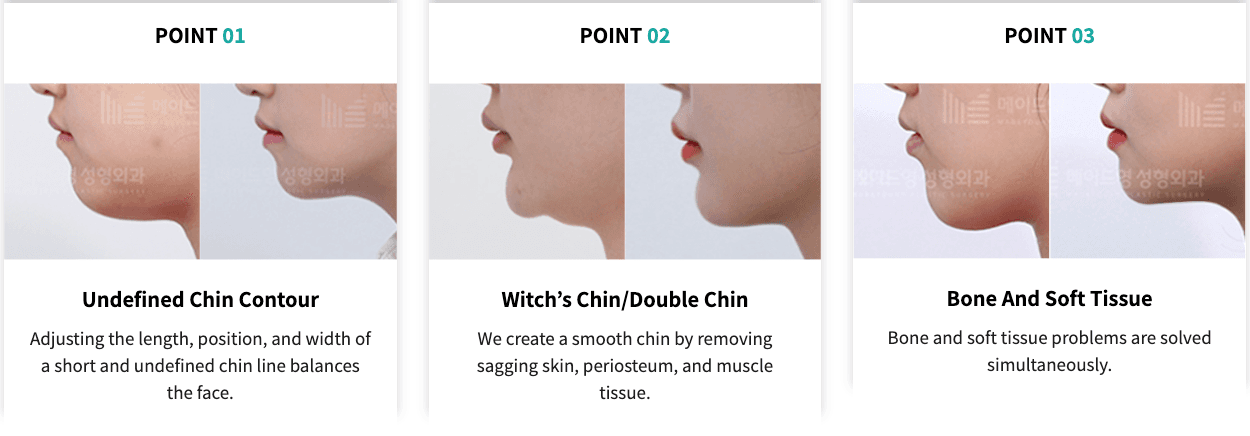
- Recessed or underprojected chin — Good candidates have microgenia or limited chin projection and want a balanced profile or stronger lower-face definition.
- Three-dimensional contour concern — Sliding or bony genioplasty can be considered when the goal involves chin height, width, forward/backward position, or selected asymmetry—not only added projection.
- Prominent or broad chin — Reduction, narrowing, or vertical-shortening procedures suit selected patients whose concern is excess bony projection, height, width, or point shape.
- Stable expectations — Candidates understand that surgery can improve facial proportion but cannot necessarily correct an abnormal bite, jaw-position discrepancy, or airway problem.
- Able to recover locally — International patients need time in Korea for in-person review, safe discharge support, and surgeon clearance before long-haul travel.
Active facial, dental, gum, or systemic infection should be treated before elective surgery, especially when an intraoral incision or fixation hardware is planned. Unassessed anesthesia risk, uncontrolled diabetes or hypertension, bleeding disorders, current nicotine use when cessation is not possible, and anticoagulant or antiplatelet use without a coordinated plan can make surgery unsafe; never stop prescribed blood thinners independently. Elective bony repositioning should wait until skeletal maturity. An overbite, underbite, obstructive-airway concern, major jaw discrepancy, or significant temporomandibular symptoms requires orthodontic and oral-maxillofacial assessment because isolated chin surgery does not reposition the tooth-bearing jaws. Pregnancy, acute illness, inability to remain for follow-up, unrealistic expectations, coercion, or untreated body-image concerns also warrant postponement or reconsideration.
How Is Chin Surgery Performed?
Chin surgery includes implant augmentation, bone repositioning, and bone reduction; it is not another name for an implant alone. The appropriate technique depends on facial proportions, chin soft tissue, bite and jaw relationship, asymmetry, desired direction of change, and prior facial surgery.
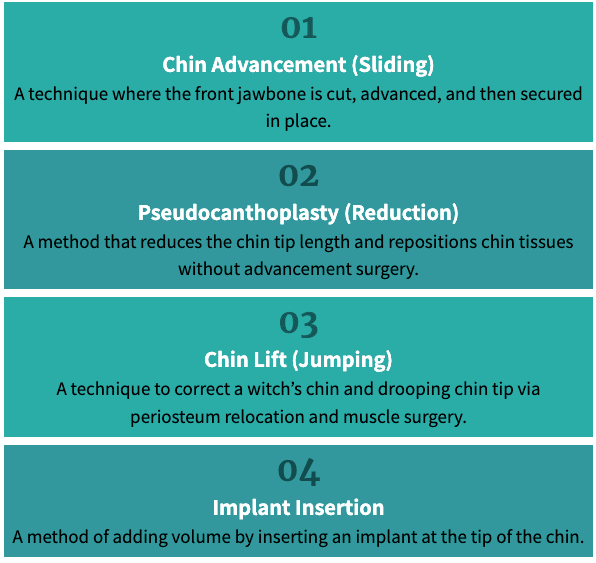
- Chin implant augmentation — A prefabricated alloplastic implant is inserted through an incision inside the lower lip or beneath the chin to add projection and contour. It is generally suited to selected patients seeking modest forward augmentation without cutting bone. Implant-specific concerns include infection, displacement, visibility or palpability, wound breakdown, bone change, and removal or revision.
- Sliding (osseous) genioplasty — Through an intraoral incision, the surgeon makes a controlled cut in the chin bone, moves the segment forward, backward, vertically, or side-to-side, then secures it with plates and screws. This provides broader three-dimensional correction than a standard implant, but temporary or persistent lower-lip and chin numbness is an important risk.
- Bony reduction or reshaping — The surgeon reduces, narrows, shortens, or contours chin bone to address excess projection, vertical height, broadness, point shape, or asymmetry. Reduction can be combined with repositioning when more than one dimension needs correction.
- Combined skeletal treatment — Orthodontics and double-jaw surgery can be more appropriate when malocclusion or a substantial upper- and lower-jaw discrepancy drives the facial imbalance. Chin surgery can camouflage a profile issue but does not correct the bite.
A systematic review of seven single-center studies involving 1,126 patients found high satisfaction with both implants and osseous genioplasty, while identifying different risk patterns: infection and wound-dehiscence concerns were more prominent with implants, and neurosensory changes with bone surgery. The review supports individualized selection rather than a universally “best” method.
Why Visit Korea for Chin Surgery?
Korea has a formal system for institutions that attract and treat foreign patients. Use it to verify the operating facility, but do not treat registration as proof of a surgeon’s chin-surgery outcomes or safety record. No high-quality comparative evidence shows that chin surgery in Korea produces superior safety, satisfaction, or revision outcomes versus other countries.
- Facility verification — Medical Korea provides foreign-patient registration resources. It states that registered institutions serving foreign patients must hold medical-malpractice liability insurance; this is a practical starting point for checking the facility itself rather than relying only on a broker or marketing company.
- Defined surgical planning — Request a written plan that states whether bone will be cut, the intended movement in each direction, incision location, implant material and manufacturer where relevant, fixation hardware, anesthesia plan, and emergency-transfer arrangements.
- Records for cross-border care — Before departure, obtain an English operative report, discharge summary, prescriptions, and implant card or plate-and-screw information. These records matter if infection, sensory symptoms, implant displacement, or revision questions arise after returning home.
- Evidence limitation — Recent reviews report generally high satisfaction and durable improvement across surgical methods, but heterogeneous techniques and inconsistent outcomes prevent reliable direct comparisons between approaches or countries.
Key Information for International Patients
- Minimum stay — Plan at least 10–14 days in Korea for an isolated implant or genioplasty, allowing for final assessment, surgery, early review, and a departure examination. Sliding or reduction genioplasty, combined jaw surgery, bleeding, infection, or delayed healing can require a longer stay.
- Flight timing — NHS guidance for cosmetic surgery abroad advises waiting 7–10 days after facial cosmetic procedures before flying, but this is general guidance rather than a universal chin-surgery clearance rule. Travel only after an in-person examination and explicit approval from the operating surgeon.
- Hospital stay and support — Chin implants are often outpatient procedures. Isolated sliding genioplasty can require overnight observation, depending on anesthesia and surgical extent. Arrange a responsible adult to accompany discharge and stay the first night after sedation or general anesthesia.
- Itinerary impact — Visible swelling and bruising are usually greatest in the first several days. Desk work is often feasible after about one week when recovery is uncomplicated; physical work and combined jaw operations require more time. Avoid scheduling business commitments, demanding tours, or a long flight immediately after surgery.
- Remote follow-up — Confirm the clinic’s English-language or virtual follow-up pathway before booking. Keep the clinic’s emergency contact route, discharge documents, prescribed medicines, and implant or hardware details in carry-on luggage, and identify a clinician at home for urgent assessment.
Travel note: A solo traveler should arrange post-anesthesia transport, nearby accommodation, and first-night supervision before surgery. Do not assume a hotel can provide clinical observation.
Which Are the Best Clinics in Korea for Genioplasty?
Listed below are some of the best clinics in Korea for genioplasty.
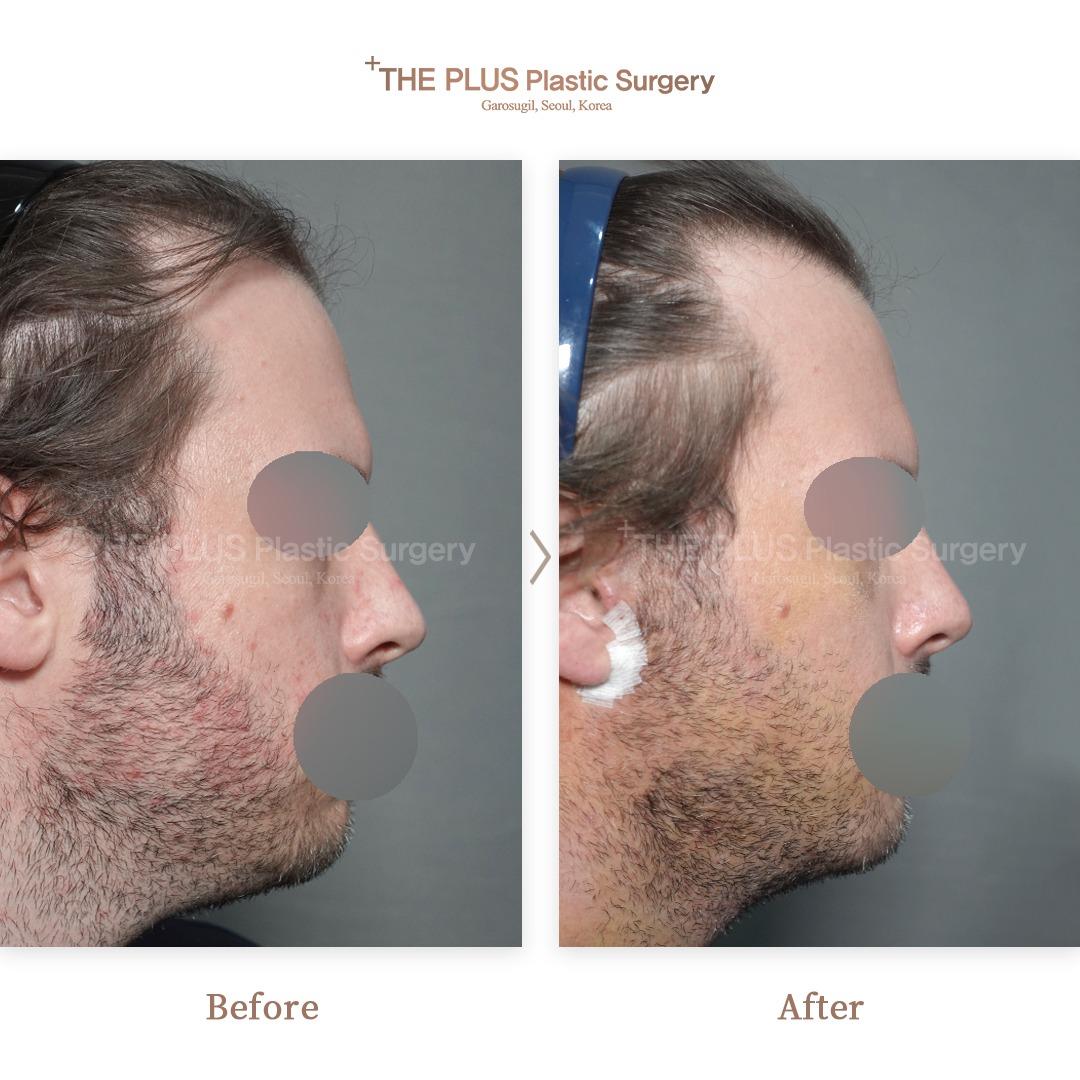
1. THEPLUS Plastic Surgery
If you are considering genioplasty, you can expect this clinic to approach chin surgery as part of overall facial contouring rather than as an isolated change. Their facial contouring practice emphasizes balancing the chin with your nose, lips, and jawline, and they also offer facial implants and broader contouring procedures when a change in projection or shape needs to fit the rest of your features.
- URL: THEPLUS Plastic Surgery Website
- Location: Gangnam-gu, Seoul
- Procedure details:
- Chin surgery is described as adjusting the size or projection of the chin to improve facial balance.
- The clinic also offers facial implants for added structure and definition when more projection is needed.
- Full face contouring, cheekbone surgery, and square jaw surgery are available for patients whose chin goals are tied to multiple facial areas.
- Surgeon expertise:
- Dr. Kim is a board-certified plastic surgeon with expertise in rhinoplasty and facial contouring.
- His research on 3D implants is especially relevant when facial structure and projection are part of surgical planning.
- Dr. Jeong is President of the Korean Society of Plastic Surgeons and is active in professional education and conference panels, with an approach that combines function and aesthetics.
- Care approach:
- The clinic emphasizes personalized aesthetic care with a focus on safety and research.
- Its stated philosophy centers on harmonious facial balance and natural-looking enhancement rather than changing one feature in isolation.
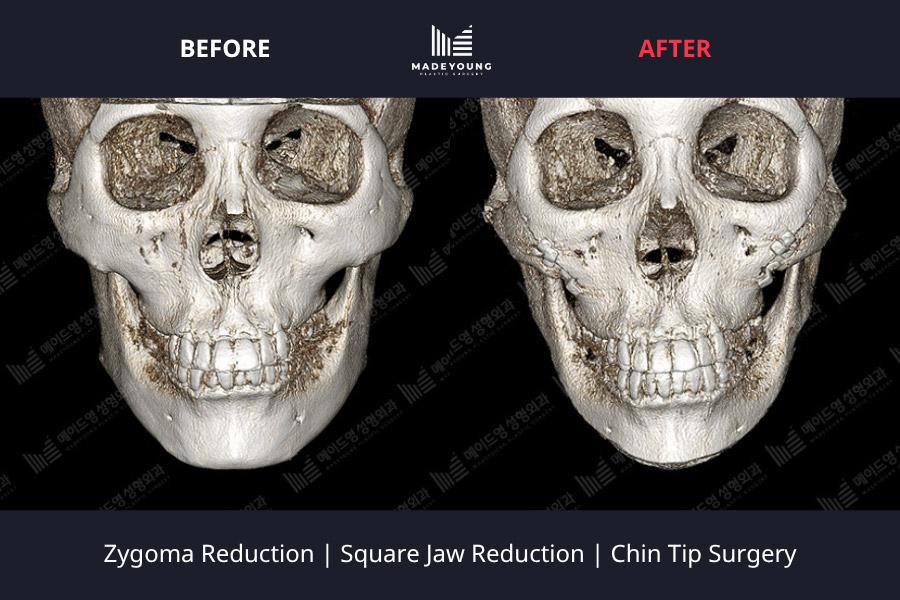
2. Made Young Plastic Surgery
If you are planning genioplasty, you can expect a clinic that explicitly offers chin surgery within a broader facial contouring program, with strong perioperative monitoring and structured aftercare. Your chin can be evaluated alongside the jawline and overall V-line so the change is planned for proportion, while the clinic’s on-site anesthesiology system and dedicated recovery support add a practical safety and follow-up framework.
- URL: Made Young Plastic Surgery Website
- Location: Seocho-gu, Seoul
- Procedure details:
- Chin surgery (genioplasty) is offered to enhance or reduce the size and shape of the chin for better facial proportion.
- Related contouring options include V-line surgery, metal-free V-line surgery, cheekbone reduction, metal-free cheekbone reduction, and jaw reduction surgery.
- A double chin lift is also available for patients who want a more defined jawline profile.
- Safety system:
- Full-time board-certified anesthesiologists are on site.
- A 1:1 dedicated monitoring system assigns one anesthesiologist to continuously monitor one person during procedures.
- A cross-check system is in place so multiple anesthesiologists can respond in an emergency.
- Procedure areas are covered by CCTV for transparency.
- Consultation and aftercare:
- The medical team provides direct consultation and diagnosis before any procedure.
- The clinic states that its doctors average more than 15 years of experience.
- A separate dedicated aftercare center supports systematic post-procedure care.
- Additional notes:
- The clinic was selected as an Outstanding Member of the Korean Society of Plastic and Reconstructive Surgeons.
- It is also certified by the Minimally Invasive Aesthetic Surgery Society.
3. Banobagi Plastic Surgery
If you are exploring genioplasty, you can expect an established plastic surgery hospital that frames facial changes within a dedicated facial contouring center and a 1:1 customized treatment model. The most concrete strengths described here are its long history, large multi-center setup, and a stated philosophy of avoiding unnecessary or excessive surgery, which may matter if you want a conservative, individualized evaluation of chin and lower-face balance.
- URL: Banobagi Plastic Surgery Website
- Location: Gangnam-gu, Seoul
- Clinic setup:
- The clinic includes a dedicated facial contouring center as part of a larger multi-specialty plastic surgery hospital.
- Its facilities include a 6-story main building and a 5-story annex with field-specific centers and equipment.
- The clinic states that each area uses professional medical equipment matched to its specialty.
- Care approach:
- Treatment is described as 1:1 customized rather than standardized across visitors.
- The clinic says it strictly avoids recommending unnecessary or excessive surgery.
- Its medical philosophy emphasizes warm, family-like care alongside surgical skill.
- Background:
- The clinic was established in 2000.
- It was founded by plastic surgery specialists from Seoul National University Hospital together with specialists in other fields.
- The clinic describes itself as having more than 20 years of accumulated know-how.
How Much Does Chin Surgery Cost in Korea?

Chin Surgery is quoted at ₩7,200,000–₩7,900,000 (approximately US$5,000–$5,500). Individual quotes vary because chin surgery can range from implant augmentation to bone cutting, repositioning, reduction, or combined skeletal treatment.
| Procedure Price | Korean Won (₩) | USD ($) |
|---|---|---|
| Low Price | ₩7,200,000 | $5,000 |
| High Price | ₩7,900,000 | $5,500 |
Exchange rate as of 2026-08-05: 1 KRW = 0.000700 USD.
What Affects the Price?
- Implant augmentation versus sliding genioplasty — A chin implant adds projection with a prefabricated implant, while sliding genioplasty requires an intraoral osteotomy, controlled movement of the chin segment, and plate-and-screw fixation. The bone operation requires more detailed skeletal planning, operating time, general anesthesia, fixation consumables, and sometimes overnight observation.
- Extent of bony movement or reshaping — Advancement, setback, vertical change, narrowing, reduction, or asymmetry correction can require different bone cuts and more extensive repositioning than a straightforward projection change. Multi-directional bony correction increases planning requirements, surgical complexity, operating time, and hardware use.
- Anesthesia and observation requirement — Chin implants may be performed with local anesthesia plus sedation or general anesthesia, whereas sliding genioplasty is generally performed under general anesthesia. General anesthesia requires anesthesia-team resources and may involve longer facility observation; isolated bony surgery may also require an overnight stay.
- Combined orthognathic treatment — When malocclusion or a substantial jaw-position discrepancy requires orthodontic and orthognathic treatment in addition to chin surgery, treatment extends beyond an isolated chin operation. Jaw surgery involves broader skeletal planning, longer operating time, more intensive facility care, and more extensive follow-up.
Cost tip: Request an itemized quote stating what is included, particularly the exact chin operation, anesthesia plan, implant or fixation hardware where relevant, facility use, and postoperative follow-up.
The USD conversion is approximate, based on an exchange rate of 0.0007 on 2026-08-05. Recheck the exchange rate when budgeting.
Chin Surgery From Start to Finish
- Remote inquiry and preliminary consultation — Send unfiltered frontal, oblique, and profile photographs, medical and allergy lists, medication and supplement lists, nicotine use, and prior operative reports. Provide orthodontic records and CT or X-rays when available. Ask whether English or virtual consultation is available; remote review is preliminary and does not replace an in-person assessment.
- In-person facial, bite, and imaging assessment — The surgeon evaluates chin projection, height, width, soft tissue, asymmetry, mentalis function, teeth, bite, jaw relationship, prior filler or implant treatment, and surgical history. Standardized photographs and skeletal imaging support planning, particularly for sliding, reduction, or asymmetry correction.
- Plan confirmation and consent — Confirm the exact operation in writing: implant versus osteotomy, planned bony movement, incision route, implant material and manufacturer, plates and screws, anesthesia clinician, expected admission status, major risks, and follow-up schedule. Patients with malocclusion, airway concerns, or major skeletal discrepancy may need orthodontic or oral-maxillofacial evaluation instead of isolated cosmetic treatment.
- Preoperative checks and travel coordination — The facility reviews medical fitness, anesthesia history, medications, fasting requirements, and infection risk. Finalize accommodation near the facility, post-anesthesia transport, first-night companion support, and a flexible departure date.
- Anesthesia and operation — Implant augmentation can use local anesthesia with sedation or general anesthesia. Sliding genioplasty is generally performed under general anesthesia. The surgeon places an implant or cuts, repositions, and fixes the chin bone with plates and screws; reduction procedures reshape or remove selected bone. Duration depends on the method and whether other facial or jaw procedures are combined.
- Observation and discharge — Implant patients often return to accommodation the same day after observation. Bony genioplasty can involve overnight monitoring. Leave only after receiving written medication, diet, oral-hygiene, incision-care, emergency-contact, and review instructions.
- Early postoperative review in Korea — Attend the scheduled examination so the operating team can assess swelling, incision healing, sensation, symmetry, and readiness for travel. Do not judge the result during this phase; residual swelling and contour settling can continue for months, especially after bone surgery.
- Overseas follow-up — Complete video or photo follow-up as scheduled and send the clinic any concerning changes promptly. Keep the English operative report and hardware or implant details available for clinicians at home.
Alternatives to Chin Surgery
The main tradeoff is permanence and range of correction versus recovery and risk. Non-surgical options can provide limited or temporary contour change, while implants and bone surgery offer more lasting structural change but carry procedure-specific complications. A bite or major jaw-position problem calls for skeletal assessment rather than choosing a cosmetic camouflage procedure alone.
Chin Filler
Chin filler can provide modest, temporary projection and contour without an operation.
- Best suited to — Patients testing a small profile change or seeking limited augmentation without bone surgery.
- Key limitation — Filler cannot move bone or reliably correct substantial skeletal asymmetry, vertical deficiency, or jaw discrepancy.
- Risk tradeoff — It avoids anesthesia and surgical recovery but has injection-specific vascular and aesthetic risks.
Chin Implant
A chin implant is a surgical alternative to sliding genioplasty when the main goal is modest forward projection.
- Best suited to — Selected patients with a recessed chin who do not need meaningful vertical, backward, or side-to-side skeletal repositioning.
- Key limitation — An implant has less capacity than osteotomy for three-dimensional correction.
- Risk tradeoff — It avoids cutting bone but introduces implant infection, displacement, exposure, and possible removal or revision.
Double-Jaw Surgery
Double-jaw surgery, usually planned with orthodontics, addresses the jaws and bite rather than only the chin point.
- Best suited to — People with clinically significant malocclusion, upper- or lower-jaw discrepancy, or selected airway-related skeletal concerns.
- Key limitation — It is substantially more extensive than isolated genioplasty, with a longer recovery and more complex treatment planning.
V-Line Surgery
V-line surgery reshapes the mandibular angle and jawline rather than primarily changing chin projection.
- Best suited to — Patients whose principal concern is a broad or angular lower jaw, sometimes alongside chin width or point shape.
- Key limitation — It does not substitute for forward chin augmentation or correct a bite discrepancy.
How Can I Prepare for Chin Surgery?
- Medical disclosure — Provide complete lists of prescription medicines, over-the-counter medicines, vitamins, herbal products, allergies, alcohol or recreational-drug use, nicotine exposure, prior surgery, and past anesthetic reactions. Send previous chin implant, jaw-surgery, orthodontic, CT, and X-ray records before travel where available.
- Bleeding-risk medicines — Tell the surgeon, anesthesia team, and prescribing clinician about anticoagulants, antiplatelet medicines, aspirin, NSAIDs, and bleeding-risk supplements. Follow an individualized plan; do not stop prescribed anticoagulants independently.
- Nicotine and alcohol — Stop smoking, vaping, and all nicotine products on the operating surgeon’s required schedule because nicotine impairs wound healing. Follow the clinic’s alcohol restriction before anesthesia and surgery.
- Dental and skin health — Treat dental, gum, facial, or systemic infection before an intraoral procedure. Report new illness, mouth ulcers, dental pain, fever, or facial skin infection immediately.
- Fasting — Follow the anesthesia team’s written food and fluid fasting instructions exactly. Do not use a generic online fasting schedule.
- Travel logistics — Book accommodation near the facility, arrange discharge transport, and secure an adult companion for the first night after sedation or general anesthesia. Keep flights flexible until the surgeon clears travel after postoperative examination.
- Documents and communication — Ask in advance for English consent materials, an English discharge summary, prescriptions, and an operative report. Confirm the clinic’s emergency contact method and remote follow-up process.
Travel note: Do not schedule surgery at the end of a short holiday. A 10–14-day Korea stay is a practical minimum for isolated surgery, and complications or bone surgery can extend it.
The treating surgeon’s and anesthesia team’s individualized instructions take precedence over general guidance; confirm all medication changes, fasting rules, and arrival requirements directly with the operating facility.
Aftercare Advice
Protect the surgical site, attend the early review, and treat worsening symptoms as urgent—not as a normal part of recovery.
- Swelling and positioning — Expect swelling, bruising, tightness, tenderness, and temporary altered sensation in the chin or lower lip. Use cold compresses and head elevation only as directed, and avoid direct pressure or sleeping on the chin. Prominent swelling often improves over 1–2 weeks; final contour settling can take months after bony genioplasty.
- Oral incision care and diet — For an intraoral incision, follow the prescribed mouth-rinse and oral-hygiene plan, avoid wound trauma, and progress from liquids or soft foods only as instructed. Combined jaw surgery usually requires stricter and longer diet restrictions.
- Activity and driving — Avoid strenuous exercise, heavy lifting, contact risk, and pressure on the chin until cleared. Do not drive while taking sedating pain medicine, and follow the anesthesia team’s rules after general anesthesia.
- Sun and skin protection — Keep external incisions protected from sun exposure. Once the surgeon permits skincare on healed skin, use broad-spectrum SPF 50 on exposed scars and avoid rubbing or massage unless specifically authorized.
- Warning signs — Seek urgent surgical assessment for increasing pain or swelling, uncontrolled bleeding, fever or chills, pus or foul drainage, wound separation, sudden asymmetry, apparent implant movement, trouble swallowing or breathing, chest pain, shortness of breath, or persistent or worsening sensory symptoms.
- Follow-up and records — Complete in-person and remote reviews. Keep the operative report, prescriptions, implant card, and plate/screw details accessible after returning home.
Follow the treating doctor’s instructions over general advice and contact the clinic promptly when healing appears to worsen or something feels wrong.
Frequently Asked Questions
Related Blogs

Facial Implant in Korea: Types, Recovery, Travel Planning and Alternatives
Facial implant surgery adds structural projection to the chin, cheeks, jawline, or paranasal area through an intraoral or discreet external incision, with standard or CT-planned custom implants depending on the concern. The article covers candidacy, alternatives, preparation, recovery, Korea travel timing, follow-up planning, and warning signs requiring urgent care.
Updated: Sep 11, 2026

Corner Mouth Lift in Korea: Methods, Scars, Recovery and Travel Planning
A corner mouth lift removes a small skin segment near the mouth corners, sometimes with DAO muscle treatment, to rotate downturned commissures upward; it leaves a permanent external scar. International patients can plan a 7–10-day stay for consultation, surgery, wound review, and suture removal, with recovery, scar care, travel clearance, and remote follow-up guidance.
Updated: Sep 11, 2026

V Line Surgery in Korea: Methods, Recovery, Risks and Travel Planning
V-line surgery contours the mandibular angle and jawline, with possible chin reshaping, using CT-based planning and intraoral surgery under general anesthesia. In Korea, it costs ₩9,900,000–₩15,500,000 (about US$7,300–$11,500); international patients should plan 10–14 days or longer for reviews, diet management, and fitness-to-fly clearance.
Updated: Sep 11, 2026
Chin Implant in Korea: Candidacy, Surgery, Recovery and Travel Planning
Chin implant surgery enhances projection through a silicone, porous polyethylene, or ePTFE implant placed via an intraoral or submental incision. In Korea, costs range from ₩4,400,000–₩6,000,000, with guidance on candidacy, travel stays, recovery, aftercare, and alternatives.
Updated: Sep 10, 2026
Clinics offering Chin Surgery

THEPLUS Plastic Surgery Korea | Eye, Nose, Face & Body Surgery
Sinsa

Made Young Plastic Surgery: Rejuvenating Aesthetic Excellence in Korea for Face Lifts, Contouring and More
Gangnam Station

Banobagi Plastic Surgery: A Pioneering and Trusted Plastic Surgery Clinic in Korea
Seolleung

Mind Plastic Surgery: Excellence in Cosmetic & Reconstructive Procedures in Korea
Sinnonhyeon Station