
Medical Tourism Blog
Eyelid Retraction Repair in Korea: Methods, Recovery, Travel Planning, and Alternatives
Table of contents
- Eyelid Retraction Repair at a Glance
- What Is Eyelid Retraction Repair?
- Who Is a Good Candidate for Eyelid Retraction Repair?
- How Is Eyelid Retraction Repair Performed?
- Why Visit Korea for Eyelid Retraction Repair?
- Key Information for International Patients
- Which Are the Best Clinics in Korea for Eyelid Retraction Repair?
- Eyelid Retraction Repair From Start to Finish
- Alternatives to Eyelid Retraction Repair
- How Can I Prepare for Eyelid Retraction Repair?
- Aftercare Advice
Considering treatment in Korea? Everything you need to know e.g. — how to avoid scams, visas, interpreters, recovery tips — in our Medical Tourism Master Guide. Plan with confidence in minutes, not weeks!
Last updated: September 2026
Eyelid Retraction Repair at a Glance
- Purpose — Eyelid retraction repair reconstructs an upper lid that sits too high and/or a lower lid that sits too low, aiming to improve closure and corneal protection while reducing scleral show, dryness, tearing, light sensitivity, and irritation.
- Tailored reconstruction — The operation may involve upper-lid levator or Müller muscle recession, lower-lid retractor release, or—when scarring or tissue shortage is substantial—a spacer graft, scar release, canthal tightening, skin graft, or midface support.
- Best candidates — Candidates have persistent lid malposition with exposure symptoms or meaningful asymmetry, often from stable thyroid eye disease, prior surgery, trauma, burns, or scarring; active eye inflammation, infection, unstable thyroid eye disease, or inadequate corneal protection must be treated first.
- TED sequencing — For thyroid eye disease, final eyelid repair is generally delayed until the disease and lid position are stable, and until any needed orbital decompression or [strabismus surgery](/blog/strabismus-surgery-korea) is completed because those procedures can change eyelid height.
- Recovery and results — Most limited repairs are outpatient procedures; tearing, blurred vision, light sensitivity, swelling, and bruising are common early, with visible swelling usually improving in 1–3 weeks, while lid height and contour are commonly reassessed at about 3 months.
- Travel planning — International patients should plan 10–14 days in Korea for an uncomplicated standalone repair and at least 14 days for grafts, revisions, combined procedures, or corneal concerns; flying home requires surgeon clearance after an early examination confirms stable vision, closure, and corneal protection.
- Korea-specific point — A Korean thyroid eye disease framework found that 84.4% of surveyed Korean oculoplastic surgeons perform eyelid-retraction surgery, indicating specialist availability, but there is no cited evidence that Korea has universally superior outcomes, lower revision rates, or fewer complications.
What Is Eyelid Retraction Repair?
Eyelid retraction repair is reconstructive surgery that repositions an upper eyelid sitting too high, a lower eyelid sitting too low, or both. It aims to improve eyelid closure and corneal protection while reducing dryness, irritation, tearing, light sensitivity, and visible scleral show. It is a surgical procedure, usually performed as an outpatient operation with the repair tailored to the cause and severity of lid malposition.
Who Is a Good Candidate for Eyelid Retraction Repair?
- Functional exposure symptoms — Good candidates have an upper lid that sits too high, a lower lid that sits too low, or both, causing scleral show, incomplete eyelid closure, dryness, tearing, light sensitivity, irritation, or corneal exposure.
- Stable thyroid eye disease — People with stable thyroid eye disease (TED, also called Graves’ orbitopathy) whose lid position remains functionally or cosmetically significant can be considered for rehabilitative repair after the orbital and muscle problems have been addressed in the correct sequence.
- Scar-related lower-lid retraction — Patients with cicatricial shortening after blepharoplasty, trauma, burns, or prior orbital surgery may need scar release, lower-lid retractor recession, spacer grafting, skin grafting, canthal tightening, or midface support rather than a simple lid adjustment.
- Persistent postoperative malposition — Revision candidates have documented lid malposition, ocular-surface symptoms, or asymmetry after earlier eyelid surgery and accept that reconstruction can require staged treatment.
Retraction is not ptosis: ptosis is a drooping lid, while retraction is a lid positioned too high or too low. Active or unstable TED, uncontrolled thyroid disease, active eye infection, uncontrolled blepharitis, ocular-surface inflammation, and an inadequately protected cornea require treatment before elective repair. Sight-threatening TED with optic-nerve involvement or corneal breakdown needs urgent specialist management, not cosmetic eyelid surgery; when orbital decompression or strabismus surgery is indicated, it is generally performed before final lid-position surgery because it can alter eyelid height. Assessment must also address proptosis, facial-nerve function, lid laxity, scarring, diplopia, bleeding risk, and whether local anesthesia, sedation, or general anesthesia is appropriate; no procedure can guarantee perfect symmetry or prevent recurrence. Korean TED clinical guidance supports deferring rehabilitative lid surgery until disease activity and lid position are stable.
How Is Eyelid Retraction Repair Performed?
The operation is tailored to the affected lid, the degree of tissue shortage or scarring, corneal exposure, and the underlying cause. One patient may need an isolated retractor recession; another needs several reconstructive steps in the same operation.
- Upper-lid levator or Müller muscle recession — The surgeon weakens or lengthens the tissues that elevate the upper lid. An internal conjunctival route or eyelid-crease incision can be used; graded recession and lateral adjustment address lid height and temporal flare.
- Upper-lid lengthening or spacer reconstruction — Severe, recurrent, or scarred upper-lid retraction can require a full-thickness blepharotomy or an interposed spacer to create more lid length.
- Lower-lid retractor release or recession — The capsulopalpebral fascia and other lower-lid retractors are released or recessed, often through a transconjunctival incision, allowing the lower lid to rise. Selected mild-to-moderate cases do not require a graft.
- Lower-lid spacer graft — Pronounced lower-lid retraction or posterior-lamella shortage can require a graft placed between the lower tarsus and recessed retractors. Options include hard-palate mucosa, auricular cartilage, donor sclera, acellular dermal matrix, dermis-fat, xenograft, and synthetic materials; a systematic review of spacer grafts found no material proven superior for every patient.
- Adjunctive reconstruction — Horizontal laxity can require canthoplasty; anterior skin shortage can require scar release and skin grafting; negative-vector anatomy or midface descent can require midface support. A temporary Frost traction suture or tarsorrhaphy can protect the cornea and support early lid position.
A retrospective comparison of 121 thyroid-related upper eyelids found improvement with three surgical approaches without a significant final difference in key lid-height and symmetry measures, reinforcing that technique selection should follow anatomy and surgeon expertise rather than a presumed universal best method. Read the comparative study.
Why Visit Korea for Eyelid Retraction Repair?
Korea is relevant for access to oculoplastic care within a TED-oriented treatment framework, not because evidence proves universally better eyelid-retraction outcomes than elsewhere. The operation requires corneal assessment, lid reconstruction planning, and, in TED, coordination with orbital, strabismus, and endocrine care. Confirm these services and the home-country follow-up plan before booking travel.
- Established oculoplastic practice in TED — A Korean society-endorsed clinical framework reports that 84.4% of surveyed Korean oculoplastic surgeons perform eyelid-retraction surgery. This indicates relevant specialist availability, not a comparative outcome advantage. See the Korean clinical-practice framework.
- Range of reconstructive approaches — The same framework describes tailored use of levator recession, Müller muscle recession, lower-lid spacer grafting, and adjunctive procedures for stable TED with functional or cosmetic lid retraction.
- Multidisciplinary sequencing matters — For TED with proptosis or restrictive double vision, ask how the hospital coordinates orbital decompression, strabismus surgery, ocular-surface treatment, endocrinology, and later eyelid reconstruction. Eyelid repair performed before indicated orbital or muscle surgery can require revision after lid position changes.
- Evidence limitation — Korea-specific comparative data on complication rates, revisions, wait times, and outcomes for international eyelid-retraction patients are not available in the cited framework. Choose based on the surgeon’s oculoplastic assessment, proposed technique, corneal-protection plan, and written follow-up arrangements.
Key Information for International Patients
- Minimum stay — Plan 10–14 days in Korea for an uncomplicated standalone repair. This allows an in-person examination, surgery, and early review of the cornea, wound, and lid position, including removal or review of non-absorbable or traction sutures when used.
- Longer-stay cases — Allow at least 14 days for spacer grafts, donor-site wounds, combined canthal or midface surgery, revision operations, general anesthesia, substantial dry eye, or corneal exposure.
- Flying home — No eyelid-retraction-specific evidence establishes one safe commercial-flight interval. General eye-surgery guidance distinguishes procedures involving intraocular gas, which prohibit flying until cleared, from other operations; for eyelid surgery, timing depends on vision, corneal protection, wound status, and local follow-up. Obtain explicit clearance from the operating surgeon after the early postoperative examination. General eye-surgery discharge guidance supports individualized advice.
- Itinerary impact — Expect blurred vision, tearing, light sensitivity, and visible swelling in the first several days. Avoid scheduling intensive sightseeing, long outdoor days, cosmetic treatments near the eyes, or activities that make lubrication and wound care difficult.
- Activity restrictions — Do not wear contact lenses for at least 2 weeks. Avoid swimming, strenuous exercise, and heavy lifting for about 4 weeks unless the surgeon gives different instructions.
- Remote follow-up — Arrange an ophthalmologist or oculoplastic clinician at home before travel. Before departure, obtain an English operative report, medication list, diagnosis, operated eyelid(s), graft and donor-site details, suture plan, and emergency contact instructions.
Travel note: Do not leave Korea solely because bruising has improved. The surgeon must confirm that vision is stable, the cornea is protected, the eyelid can close adequately, and any temporary sutures or donor-site concerns have been addressed.
Which Are the Best Clinics in Korea for Eyelid Retraction Repair?
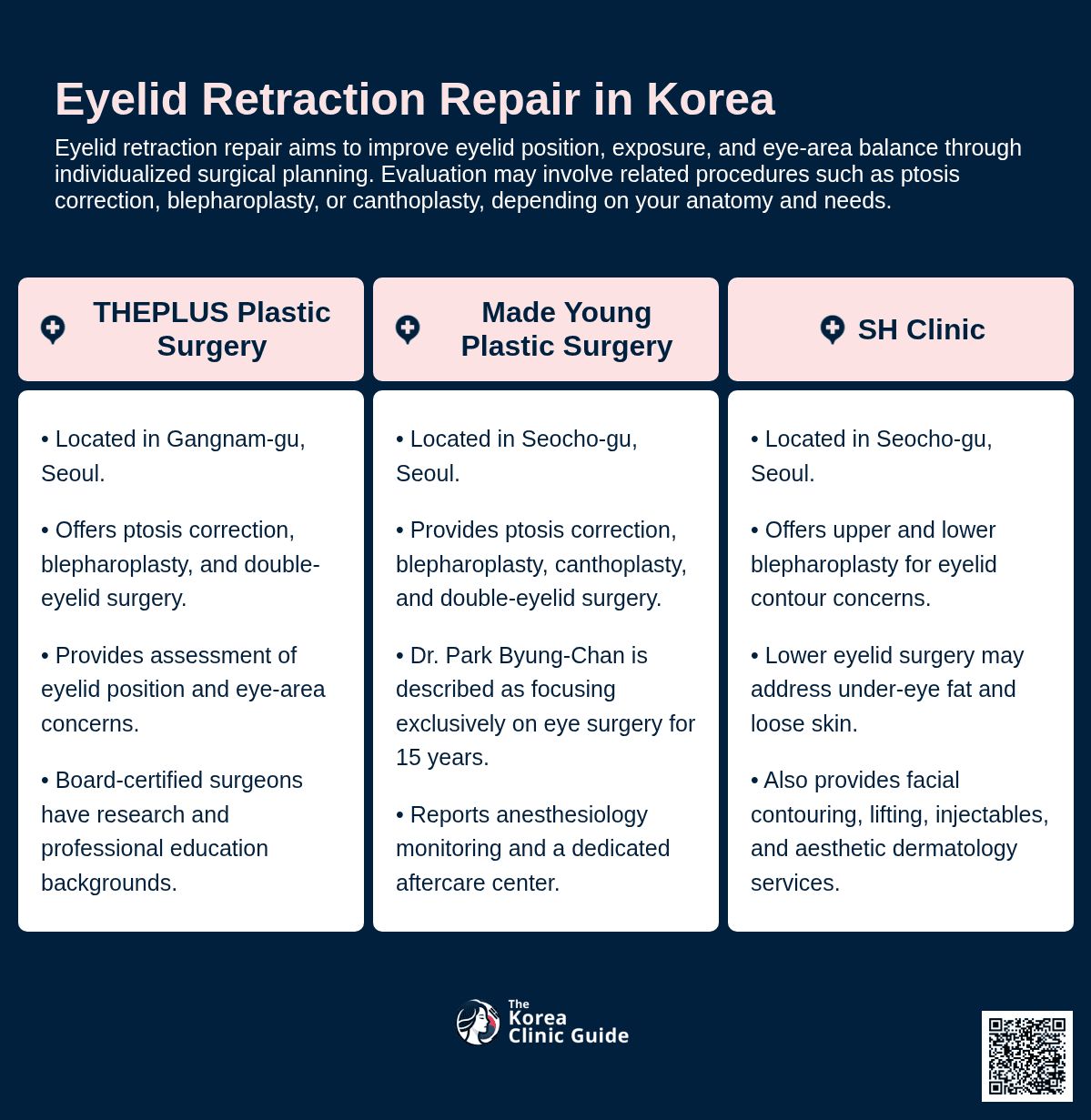
Listed below are some of the best clinics in Korea for eyelid retraction repair.
1. THEPLUS Plastic Surgery
For eyelid retraction repair, you can expect an eye-area assessment within a clinic that offers ptosis correction, double-eyelid surgery, and blepharoplasty. The available information does not specifically describe an eyelid-retraction technique, so your suitability and surgical plan would need to be determined in consultation.
- URL: THEPLUS Plastic Surgery Website
- Location: Gangnam-gu, Seoul
- Eye procedures:
- Ptosis correction addresses drooping upper eyelids by correcting the muscles that open the eyes.
- Blepharoplasty adjusts excess eyelid skin and tissue; double-eyelid surgery creates an upper-eyelid crease designed to suit your facial features.
- Clinical background:
- Dr. Kim is described as a board-certified plastic surgeon, with research recognition relating to 3D implants and professional education activity.
- Dr. Jeong is identified as President of the Korean Society of Plastic Surgeons and participates in professional presentations and educational sessions.
2. Made Young Plastic Surgery
For eyelid retraction repair, you can seek evaluation from a clinic with dedicated eye-surgery offerings, including ptosis correction, upper and lower blepharoplasty, canthoplasty, and incisional or non-incisional double-eyelid surgery. Although the provided information does not specify an eyelid-retraction repair method, Dr. Park Byung-Chan’s stated 15 years focused exclusively on eye surgery may be relevant when discussing your eyelid anatomy and treatment options.
- URL: Made Young Plastic Surgery Website
- Location: Seocho-gu, Seoul
- Eye-surgery options:
- Ptosis correction is offered to repair drooping eyelids by tightening the lifting muscle.
- Upper blepharoplasty removes excess upper-eyelid skin and fat, while lower blepharoplasty can remove or reposition under-eye fat and tighten skin.
- Canthoplasty is available to alter the outer corner of the eyelid; double-eyelid surgery is offered with incisional and non-incisional approaches.
- Eye-surgery focus:
- Dr. Park Byung-Chan is described as having 15 years of experience exclusively in eye surgery.
- The clinic states that incision lines, eyelid-crease height, eyelid thickness, and overall eye shape are customized.
- Safety and aftercare:
- The clinic reports full-time board-certified anesthesiologists, one-to-one anesthesiology monitoring, and a cross-check system for emergencies.
- A separate aftercare center is described as providing systematic post-procedure care.
3. SH Clinic
For eyelid retraction repair, SH Clinic’s listed eyelid procedures include upper and lower blepharoplasty, which may be relevant to an evaluation of eyelid skin, tissue, and contour. The supplied information does not confirm that the clinic performs a dedicated eyelid-retraction repair, so you would need a consultation to establish whether it offers an appropriate treatment for your concern.
- URL: SH Clinic Website
- Location: Seocho-gu, Seoul
- Related eyelid procedures:
- Upper blepharoplasty removes excess eyelid skin and creates a defined upper-eyelid crease.
- Lower blepharoplasty repositions or removes under-eye fat and tightens loose lower-eyelid skin.
- Other aesthetic services:
- The clinic also lists facial contouring surgery, facelift surgery, laser lifting, thread lifts, botulinum toxin injections, dermal fillers, and medical skin care.
- SH Clinic describes itself as a multi-specialty center with stem-cell, gynecologic, aesthetic dermatology, and plastic-surgery services.
Eyelid Retraction Repair From Start to Finish
- Remote screening and records review — Send straight-ahead and up/down-gaze photographs, prior operative reports, medication and allergy lists, and recent eye records. For TED, provide thyroid laboratory results, endocrinology records, orbital imaging when available, and details of double vision or prior orbital treatment. English-language or virtual screening can help travel planning but does not replace an in-person ocular examination.
- In-person oculoplastic assessment — The surgeon checks visual acuity, ocular motility and diplopia, corneal staining, tear-film disease, lagophthalmos, lid laxity, scleral show, facial-nerve function, scarring, and standardized lid measurements such as MRD1 and MRD2. The examination determines whether upper, lower, or combined repair is required.
- Surgical sequencing and consent — In TED, the team confirms disease stability, thyroid control, proptosis, and whether orbital decompression or strabismus correction should occur first. Discuss the planned incision, graft material and donor site when applicable, anesthesia, expected undercorrection or overcorrection risk, and the possibility of staged revision.
- Preoperative planning — The hospital reviews bleeding-risk medicines, fasting requirements, allergies, anesthesia history, and transport arrangements. Bring glasses rather than contact lenses and arrange an adult escort when sedation or general anesthesia is planned.
- Anesthesia and repair — Many limited repairs are day procedures under local anesthesia with or without sedation. Extensive bilateral, graft-based, donor-site, orbital, or combined procedures can require general anesthesia. Through an internal, eyelid-crease, subciliary, or combined incision, the surgeon releases or recesses retractor tissues, adds a spacer graft or structural support when needed, and may place temporary traction or closure sutures for positioning and corneal protection.
- Discharge and early review — Most patients leave the same day once vision and comfort are assessed. Use prescribed drops, ointment, and other medicines exactly as directed; attend the early review for corneal and wound assessment, lid-position monitoring, and suture management.
- Overseas follow-up — Send the requested photographs and report pain, redness, reduced vision, light sensitivity, inability to close the eye, discharge, or new double vision immediately. Arrange in-person assessment at home for any corneal-exposure concern rather than waiting for another international visit.
Alternatives to Eyelid Retraction Repair
Non-surgical measures can protect the ocular surface or offer temporary improvement but do not lengthen scarred eyelid tissue or reliably correct marked malposition. Surgical alternatives depend on the cause: an operation that addresses proptosis, diplopia, laxity, or scar shortage can be more appropriate than isolated lid retractor surgery.
Ocular-surface protection
- Best for — Mild exposure symptoms, temporary stabilization, or patients awaiting definitive assessment.
- Approach — Preservative-free tears, nighttime gel or ointment, moisture protection, and treatment of dry eye or blepharitis reduce corneal exposure but do not correct the structural lid position.
Temporary upper-lid treatment
- Best for — Selected upper-lid TED retraction when disease and anatomy make a temporary approach appropriate.
- Approach — Periocular botulinum toxin, triamcinolone injection, or hyaluronic-acid filler can be considered by an experienced clinician. Effects are temporary and these options are not suitable for every mechanism of retraction. Review of eyelid-retraction management.
Orbital decompression or strabismus correction
- Best for — TED with clinically important proptosis or restrictive double vision.
- Tradeoff — These procedures address the orbital or muscle cause and are generally sequenced before final eyelid repair because they can change eyelid position. They are more substantial operations than isolated lid reconstruction.
Canthal or scar-based reconstruction
- Best for — Lower-lid laxity, cicatricial shortening, skin shortage, or midface descent.
- Approach — Canthoplasty, lower canthoplasty, scar release, skin grafting, or midface support can be combined with or substituted for retractor recession depending on the anatomical deficit.
Revision eye surgery
- Best for — Persistent undercorrection, overcorrection, contour irregularity, graft contraction, or recurrent retraction after previous repair.
- Tradeoff — Revision eye surgery is more complex when scar tissue, donor-site limitations, active TED, or prior multiple operations are present; a longer observation period is often needed before deciding on further correction.
How Can I Prepare for Eyelid Retraction Repair?
- Provide complete records early — Send prior eyelid, orbital, and facial surgery reports; eye photographs; medication and allergy lists; and recent ophthalmology records. For TED, include thyroid results, endocrinology records, imaging, and documentation of proptosis or diplopia.
- Plan blood-thinning medicines safely — Tell both the operating team and the prescribing clinician about warfarin, apixaban, rivaroxaban, dabigatran, clopidogrel, aspirin, NSAIDs, and any other anticoagulant or antiplatelet medicine. Do not stop these medicines independently; the plan depends on the indication, clotting risk, procedure, and anesthesia.
- Disclose supplements and anesthesia-relevant products — Report fish oil, vitamin E, ginkgo, garlic, ginseng, turmeric/curcumin, St John’s wort, and all non-prescription medicines. The clinic will specify whether and when to stop them.
- Control thyroid and eye-surface disease — In TED, achieve and document stable thyroid management before rehabilitative planning. Treat active blepharitis, ocular-surface inflammation, or infection before surgery.
- Avoid nicotine — Stop smoking, vaping, and nicotine products for the period set by the surgeon, especially when skin grafting or other reconstruction is planned. Smoking is also a disease-specific concern in TED.
- Prepare the eye area — Bring glasses, not contact lenses, on surgery day. Arrive without eye makeup, false lashes, or products around the eyelids.
- Follow fasting and transport rules — Follow written fasting instructions when sedation or general anesthesia is planned. Arrange an adult escort and nearby accommodation after sedation or general anesthesia; do not plan to drive.
- Keep flights flexible — Book enough time for the early postoperative examination and possible suture removal. Do not book a non-changeable return flight based on a presumed universal flying interval.
Travel note: Stay in accommodation where prescribed drops, ointment, cold compresses, and head elevation are practical, and keep the clinic’s emergency contact method available at all times.
Confirm the operating hospital’s individualized requirements for medication changes, fasting, nicotine, alcohol, wound care, accommodation, and flight timing; those instructions take precedence over general guidance.
Aftercare Advice
Protecting the cornea and maintaining the repaired lid position are more important than judging symmetry during the first weeks of healing.
- Lubrication and prescribed medicines — Use prescribed lubricating drops, ointment, antibiotic medication, and other treatment exactly as directed. Do not substitute products or stop medication without contacting the surgical team.
- Swelling control and eyelid protection — Use cold compresses and sleep with the head elevated as instructed. Do not rub, pull, or press on the eyelids; wear sunglasses outdoors to reduce wind and light discomfort.
- Contact, makeup, and activity limits — Avoid eye makeup until cleared. Do not use contact lenses for at least 2 weeks, and avoid swimming, strenuous exercise, and heavy lifting for about 4 weeks unless the surgeon specifies a different timeline. Post-eyelid-surgery guidance also notes bruising and swelling commonly improve over 1–3 weeks, although bruising can persist for 3–4 weeks.
- Warning signs — Seek urgent ophthalmic assessment for reduced or changing vision, severe or increasing pain, marked redness, painful light sensitivity, inability to close the eye, significant bleeding, pus-like discharge, fever, increasing swelling, or new double vision. These can signal corneal exposure, infection, bleeding, pressure-related problems, or a lid-position complication.
- Result timing and review — Blurred vision, tearing, light sensitivity, swelling, stiffness, and fluctuating lid height are common early on. Do not judge final lid height or contour during early healing; reassessment around 3 months is common, while graft, scar, and TED cases can require longer observation before revision is considered.
Follow the treating doctor’s instructions over general advice and contact the clinic promptly whenever vision, corneal comfort, wound appearance, or eyelid closure appears wrong.
Frequently Asked Questions
Related Blogs
Discover Effective Eyelid Retraction Treatments in Korea: Eyelid Fat Grafting Solutions
Discover how Korea offers advanced treatments for eyelid retraction, including eyelid fat grafting and dermis-fat grafts. This comprehensive guide explains causes, symptoms, and the corrective procedures available in Korea to restore eyelid function and aesthetics. Learn about the step-by-step process for medical tourists, costs, and real patient outcomes. If you're considering eyelid retraction t
Updated: Sep 28, 2026

Korea's Top Solutions for Dark Circles Under Eyes: Blepharoplasty, Fat Removal & Grafting Procedures
Discover effective treatments for dark circles under eyes in Korea, including under-eye fat removal, repositioning, blepharoplasty, and eyelid fat grafting. These advanced procedures address underlying causes like hollows, sagging, and fat loss, restoring a youthful, refreshed look. Korea's expert surgeons, cutting-edge technology, and affordable prices make it a top destination for medical touris
Updated: Sep 28, 2026
Correcting Entropion & Ectropion: Revision Eye Surgery Options in Korea for Restored Eye Comfort
Discover how Korea leads in revision eyelid surgery for entropion and ectropion. This comprehensive guide covers causes, symptoms, and advanced procedures to correct eyelid malpositions. Learn why Korea is the top destination for high-quality, affordable eye reconstruction, offering expert surgeons, cutting-edge technology, and exceptional patient care. Whether addressing post-surgical complicatio
Updated: Sep 28, 2026
Scleral Show Treatment in Korea: Canthoplasty, Eyelid Retraction Repair & Laser Canthoplasty
Discover how Korea leads in surgical solutions for scleral show, including canthoplasty, eyelid retraction repair, and laser canthoplasty. This comprehensive guide explains causes, procedures, and benefits of treating scleral show in Korea's top clinics, renowned for advanced technology, skilled surgeons, and affordable prices. Whether addressing eyelid retraction or enhancing eye appearance, Kore
Updated: Sep 28, 2026
Clinics offering Eyelid Retraction Repair

SH Clinic: Comprehensive Women's, Men's & Couples' Health Services in Korea
Sinsa

THEPLUS Plastic Surgery Korea | Eye, Nose, Face & Body Surgery
Sinsa

Made Young Plastic Surgery: Rejuvenating Aesthetic Excellence in Korea for Face Lifts, Contouring and More
Gangnam Station
ID Hospital - Main Branch in Korea: Specializing in Safe & Customized Facial Plastic Surgery and Post-Care Services
Sinsa