
Medical Tourism Blog
Eyelid Fat Grafting in Korea: Candidacy, Recovery, Travel Planning, and Alternatives
Table of contents
- Eyelid Fat Grafting at a Glance
- What Is Eyelid Fat Grafting?
- Who Is a Good Candidate for Eyelid Fat Grafting?
- How Is Eyelid Fat Grafting Performed?
- Why Visit Korea for Eyelid Fat Grafting?
- Key Information for International Patients
- Which Are the Best Clinics in Korea for Eyelid Fat Grafting?
- Eyelid Fat Grafting From Start to Finish
- Alternatives to Eyelid Fat Grafting
- How Can I Prepare for Eyelid Fat Grafting?
- Aftercare Advice
Considering treatment in Korea? Everything you need to know e.g. — how to avoid scams, visas, interpreters, recovery tips — in our Medical Tourism Master Guide. Plan with confidence in minutes, not weeks!
Last updated: September 2026
Eyelid Fat Grafting at a Glance
- What it does — Eyelid fat grafting transfers a small amount of your own processed fat, usually harvested from the abdomen, flanks, thighs, or knees, to restore volume in hollow upper lids, tear troughs, or the lid-cheek junction.
- Best candidates — It is best suited to medically appropriate people with true volume loss, enough donor fat, stable weight, and realistic expectations about variable fat retention and the possible need for a later touch-up.
- Not for every dark circle — Fat grafting does not directly correct pigment-only or vascular dark circles, prominent lower-lid bags, major skin excess, ptosis, lid laxity, chronic edema, or festoons; these may need a different treatment such as blepharoplasty or fat repositioning.
- Recovery and results — Visible bruising, swelling, and temporary asymmetry commonly last 1–2 weeks, while lesser firmness or swelling can persist for about 6 weeks; assess the settled contour around 3 months, with touch-up decisions usually deferred until 3–6 months.
- Key risks — Possible problems include fat resorption, uneven contour, prolonged swelling, nodules, infection, and asymmetry; rare but serious injection-related complications can include tissue injury, vision loss, or neurologic harm.
- Korea travel planning — For standalone treatment in Korea, plan a flexible stay of at least 7–10 days for an early in-person review and surgeon-approved long-haul travel clearance; combined eyelid surgery or delayed healing may require longer.
- Korea-specific choice — No reliable evidence shows better eyelid-fat-grafting outcomes simply because surgery is performed in Korea, so prioritize the named surgeon’s anatomical assessment, anesthesia and facility safety, English records, after-hours access, and cross-border follow-up plan.
What Is Eyelid Fat Grafting?
Eyelid fat grafting transfers a small amount of your own fat to hollow areas around the eyes. It restores volume in sunken upper lids or under-eye hollows, helping soften shadowing and a tired appearance caused by volume loss. It is a surgical procedure because fat is harvested from one area of the body and placed around the eyelids.
Who Is a Good Candidate for Eyelid Fat Grafting?
- Upper-eyelid hollowing — Suitable candidates have a sunken upper lid or depleted brow-to-lid transition caused by congenital anatomy, aging, or previous surgery.
- Tear-trough or lid–cheek shadowing — Fat transfer can soften a hollow-related shadow and a sharp lid–cheek junction when true volume loss is the main finding.
- Stable weight and available donor fat — Candidates need enough safely harvestable fat, commonly from the abdomen, flanks, thighs, or knees, and should not be actively gaining, losing, or cycling weight.
- Realistic surgical goals — Good candidates accept that some transferred fat resorbs, early asymmetry is normal, and a later touch-up is possible rather than guaranteed.
Eyelid fat grafting is not a direct solution for pigment-only or vascular dark circles, prominent lower-lid bags, major skin excess, ptosis, lid laxity, chronic edema, festoons, or dry-eye disease. Active infection, rash, dermatitis, or an open wound at the eyelid or donor site requires postponement. Bleeding disorders, significant anemia, uncontrolled illness, immunosuppression, unmanaged anticoagulant or antiplatelet treatment, and ongoing nicotine use can increase surgical risk or impair healing. Pregnancy and breastfeeding generally warrant deferring elective surgery; an in-person assessment must also distinguish hollowing from prolapsed orbital fat and other anatomical causes.
How Is Eyelid Fat Grafting Performed?
The technique is tailored to the area requiring volume, the quality of eyelid skin, and whether lower-lid bags or excess skin also need surgical correction.
- Structural fat grafting / microfat — Processed fat containing living adipocytes is injected in small parcels to restore volume in the upper lid, tear trough, lid–cheek junction, brow transition, or cheek-support area.
- MAFT — Microautologous fat transplantation describes controlled delivery of very small fat parcels through multiple passes. The approach aims for even distribution, but MAFT terminology and equipment are not standardized across published studies.
- Nanofat — Mechanically emulsified and filtered fat is used mainly for superficial skin-quality applications. It has little to no durable structural volume compared with microfat and is not a substitute for volume restoration in a deep tear trough.
- Standalone or combined surgery — Fat grafting can be performed alone or with blepharoplasty. When orbital-fat prolapse, loose skin, or lid laxity is the main issue, lower-eyelid surgery or fat repositioning can be more appropriate than grafting alone.
Why Visit Korea for Eyelid Fat Grafting?
Korea is a significant destination for international medical care, particularly in Seoul. That access does not establish better eyelid-fat-grafting results by country; the operating surgeon’s anatomical assessment, safety systems, and follow-up plan remain more important than location. Treat this as cross-border surgery, not a short cosmetic stop.
- International-care infrastructure — Seoul reported more than 1 million international medical patients in 2024, indicating established demand for multilingual coordination and visiting-patient services, though this figure is not specific to eyelid fat grafting.
- Relevant surgical decision-making — A useful consultation should determine whether the concern is hollowing, skin excess, orbital-fat prolapse, lid laxity, ptosis, pigmentation, or a combination. This distinction matters because grafting and lower-lid fat repositioning are different operations with different indications.
- Continuity checks — Before booking, verify the named surgeon’s credentials, the anesthesia provider, facility licensing or accreditation, emergency-transfer arrangements, English-language consent and discharge information, after-hours contact, and record-transfer plan. Professional guidance for patients traveling for surgery supports agreeing on these arrangements before travel.
- Evidence limitation — No reliable comparative evidence shows that Korea, or any other country, produces superior outcomes solely because of location. Published retention and complication rates also cannot predict an individual result because injection planes, processing, volume, anatomy, and follow-up methods differ substantially.
Key Information for International Patients
- Minimum stay — Plan a flexible stay of at least 7–10 days for standalone treatment. This conservative planning interval allows an early examination, donor-site or incision review, and surgeon-directed travel clearance; combined blepharoplasty or delayed healing can require longer.
- Flight timing — There is no evidence-based fixed day for every patient to take a long-haul flight. Leave only after an in-person postoperative examination and surgeon approval, accounting for anesthesia, combined procedures, complications, and personal venous-thromboembolism risk.
- Visible recovery — Swelling, bruising, and temporary asymmetry are common for 1–2 weeks. Lesser swelling, firmness, or discoloration can persist for about 6 weeks, so avoid scheduling important photographs or public events immediately after surgery.
- Activity and itinerary — Keep the first days quiet. Donor-site tenderness can limit sightseeing, while bending, heavy lifting, strenuous exercise, swimming, saunas, alcohol, and facial treatments remain restricted until cleared.
- Remote follow-up — Obtain written English discharge instructions, generic medication names and doses, the operative record, postoperative photographs if available, and a direct after-hours contact method before departure. Arrange who will assess complications at home.
Travel note: Keep flights and accommodation changeable. Travel-for-surgery guidance emphasizes an agreed local-stay duration and cross-border postoperative-care plan rather than a package-based departure date.
Which Are the Best Clinics in Korea for Eyelid Fat Grafting?
Listed below are some of the best clinics in Korea for eyelid fat grafting.
1. THEPLUS Plastic Surgery
At THEPLUS Plastic Surgery, you can receive facial fat grafting as part of an approach centered on restoring volume and maintaining harmony among your facial features. For eyelid-volume concerns, the clinic’s listed eye-surgery options—including blepharoplasty and ptosis correction—may be relevant when your assessment identifies excess tissue, eyelid drooping, or hollowing as contributing factors.
- URL: THEPLUS Plastic Surgery Website
- Location: Gangnam-gu, Seoul
- Eye-area options:
- Blepharoplasty adjusts excess skin and tissue around the eyelids to smooth and refresh the eye contour.
- Ptosis correction addresses the muscles that open the eyes when upper-lid drooping contributes to a heavy or tired appearance.
- Double-eyelid surgery is offered to create an upper-eyelid crease designed around your facial features.
- Facial-volume approach:
- Facial fat grafting uses your own fat to restore fullness and soften hollow or flattened facial contours.
- The clinic describes facial planning in terms of balanced proportions and natural-looking expression.
- Clinical background:
- Dr. Kim is described as a board-certified plastic surgeon with research recognition for 3D implants and expertise in facial contouring.
- Dr. Jeong is identified as President of the Korean Society of Plastic Surgeons and as an educator at professional meetings.
2. Made Young Plastic Surgery
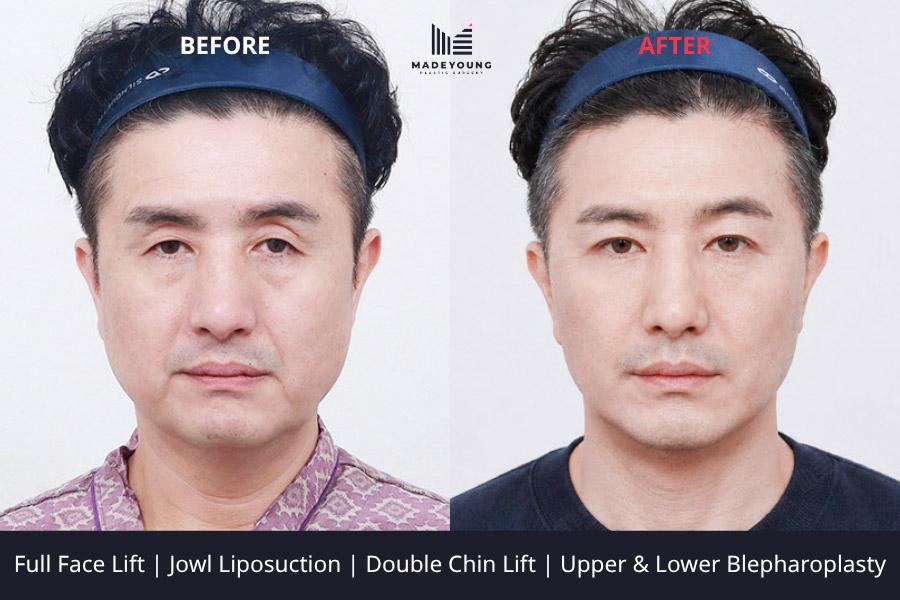
You may consider Made Young Plastic Surgery when you want eyelid-volume treatment considered alongside established eyelid procedures and individualized eye design. Its eye-surgery team tailors incision lines, double-eyelid height, eyelid thickness, and overall eye image, while the clinic lists upper and lower blepharoplasty, including lower-eyelid fat removal or repositioning, among its services.
- URL: Made Young Plastic Surgery Website
- Location: Seocho-gu, Seoul
- Eye-surgery experience:
- Dr. Park Byung-Chan is described as having 15 years of experience exclusively in eye surgery.
- Upper blepharoplasty addresses excess upper-eyelid skin and fat.
- Lower blepharoplasty may include removing or repositioning under-eye fat and tightening skin.
- Available double-eyelid approaches include non-incisional and incisional techniques, with ptosis correction and canthoplasty also listed.
- Safety and aftercare:
- Full-time board-certified anesthesiologists are on site, with one-to-one anesthesiologist monitoring described for procedures.
- The clinic describes emergency cross-checking by multiple anesthesiologists and CCTV coverage of procedures.
- A separate aftercare center provides structured post-procedure care.
3. LABOM Plastic Surgery
At LABOM Plastic Surgery, eyelid fat grafting is presented as a customized anti-aging option for hollow upper eyelids: your own fat is harvested, purified, and finely injected to restore soft, natural-looking volume while accounting for eye shape, left-right balance, and overall facial proportions. The clinic describes this approach as an alternative to filler for those seeking autologous tissue and volume that develops naturally over time.
- URL: LABOM Plastic Surgery Website
- Location: Gangnam-gu, Seoul
- Procedure details:
- Autologous fat is harvested from the abdomen or thighs, purified, and dispersed in small amounts into hollow upper-eyelid areas.
- Planning considers your eye shape, facial proportions, degree of aging, and left-right balance.
- The stated goal is to avoid excessive volume while creating a softer, more three-dimensional eye-area contour.
- The clinic estimates swelling at about one week, with a relatively quick return to daily activities.
- Autologous-fat considerations:
- Using your own tissue is described as reducing foreign-body sensation and rejection risk compared with introducing a foreign material.
- The clinic cites a soft texture, natural eye shape, and long-term volume retention after fat survival as intended benefits.
- Volume is described as settling and developing naturally over time.
- Specialist care and recovery:
- Plastic-surgery specialists dedicated to anti-aging surgery directly perform procedures; the clinic cites more than 30 years of clinical experience across facial and hand anti-aging care.
- Pre-operative diagnosis and surgical design are individualized and grounded in facial anatomy.
- The clinic lists autologous-fat purification technology, anesthesia and continuous-monitoring systems, and regular post-operative checks.
- Recovery support includes personalized plans for swelling, bruising, and scar management, as well as a dedicated system for international visitors.
- Related eyelid services:
- Blepharoplasty is offered for age-related upper- or lower-eyelid sagging, with technique selected according to the degree of laxity.
- Double-eyelid surgery is available through natural-adhesion, non-incisional, or full-incisional methods, with ptosis correction available when appropriate.
Eyelid Fat Grafting From Start to Finish
- Remote inquiry and preliminary consultation — Send clear, unfiltered photographs and medical history through the clinic’s secure process. Ask whether English consultation is available, but understand that video review cannot fully assess eyelid laxity, skin quality, orbital fat, or donor sites.
- In-person examination and planning — The surgeon examines upper-lid hollowing, tear troughs, lid position, skin excess, lower-lid bags, facial asymmetry, dry-eye symptoms, and donor-fat availability. Upright markings and standardized photographs help define conservative treatment areas.
- Medical and anesthesia review — Disclose prior eyelid surgery, filler, trauma, allergies, thyroid eye disease, medicines, supplements, smoking or vaping, and relevant medical conditions. The team determines whether local anesthesia with or without sedation, or general anesthesia, is appropriate for the extent of surgery.
- Fat harvest and processing — The surgeon harvests a limited amount of fat through small donor-site incisions, commonly at the abdomen, flanks, thighs, or knees. The fat is processed for reinjection.
- Micro-parcel placement — Using carefully selected planes and typically a cannula, the surgeon places small parcels of fat in the planned upper-lid, tear-trough, lid–cheek, brow, or cheek-support areas. The goal is measured volume restoration, not aggressive filling.
- Recovery-room monitoring and discharge — After observation, leave with an escort if sedation or general anesthesia was used. Confirm wound-care instructions, medication details, emergency contact information, and the date of the local review.
- Korea review and travel clearance — Attend the scheduled postoperative appointment before long-haul travel. The surgeon checks eyelid and donor-site healing, reviews symptoms, and confirms whether departure is appropriate.
- Overseas follow-up — Send scheduled photographs and report concerns promptly through the agreed channel. Reassess settled contour at about 3 months; discussions of undercorrection, asymmetry, or a possible touch-up are commonly deferred until 3–6 months.
Alternatives to Eyelid Fat Grafting
Non-surgical options avoid fat harvest and surgical recovery but do not correct substantial skin excess, fat prolapse, or lid laxity. Surgical alternatives can address structural problems more directly but involve their own recovery profile and risks.
Hyaluronic-Acid Filler
- Best role — A nonsurgical option for selected volume deficits where the clinician considers the anatomy suitable.
- Tradeoff — Hyaluronic-acid filler can be dissolved with hyaluronidase, but the tear-trough region is technically demanding and carries risks of prolonged edema, contour irregularity, blue-gray discoloration, and rare vascular injury.
- Related procedure — See under-eye filler.
Lower-Lid Fat Repositioning or Blepharoplasty
- Best role — Better suited to true lower-lid bags, loose skin, or a sharp lid–cheek junction caused by protruding orbital fat.
- Tradeoff — This is surgery rather than simple volume replacement and can be combined with conservative grafting when prolapse and hollowing coexist.
- Related procedures — See under-eye fat removal or repositioning and blepharoplasty.
Upper Blepharoplasty or Ptosis Correction
- Best role — Consider these procedures when upper-lid skin excess, lid-margin drooping, or functional ptosis drives the tired appearance.
- Tradeoff — Adding volume to a lid that primarily needs skin removal or lid-elevation surgery can produce an inappropriate result.
- Related procedures — See upper blepharoplasty and ptosis correction.
How Can I Prepare for Eyelid Fat Grafting?
- Medicines and supplements — Provide the complete list well before surgery, including anticoagulants, antiplatelet medicines, aspirin, NSAIDs, diabetes or weight-loss medicines, fish oil, vitamin E, ginkgo, garlic, ginseng, turmeric or curcumin, and St John’s wort. Do not stop prescribed blood thinners, diabetes medicines, or other long-term medicines without instructions from both the prescriber and surgeon.
- Nicotine and alcohol — Stop smoking and vaping for the surgeon’s required interval and remain nicotine-free through healing. Avoid alcohol as directed around anesthesia and postoperative medicines.
- Weight stability — Avoid crash dieting and major weight change before and after treatment, since retained fat volume can change with body weight.
- Fasting and arrival — Follow the facility’s exact fasting instructions when sedation or general anesthesia is planned. Arrive without eye makeup or contact lenses unless the clinic gives different instructions.
- Skin preparation — Avoid sunburn, tanning, irritating retinoids, aggressive exfoliation, and inflammatory treatments around the eyes before surgery. Report any rash, stye, infection, or open wound immediately.
- Transport and accommodation — Arrange a responsible adult to escort and stay with you after sedation or general anesthesia. Book accommodation close enough for the early review and retain flexible travel arrangements.
Travel note: Carry a printed medical summary and keep the clinic’s after-hours number available without relying on hotel Wi-Fi or a coordinator.
Confirm the treating surgeon’s clinic-specific medication, fasting, nicotine, companion, and local-stay requirements; those individualized instructions take precedence over general guidance.
Aftercare Advice
Protect the grafted eyelid area and attend the scheduled review; early swelling is not the final contour.
- Swelling and bruising — Expect visible swelling, bruising, and temporary asymmetry for about 1–2 weeks. Residual edema, firmness, or discoloration can remain for up to about 6 weeks; do not assess retained volume during this period.
- Pressure and contact — Do not rub, massage, press, use gua sha, or apply facial devices to grafted areas until the surgeon clears them. Do not apply ice or cold packs directly to the eyelids unless explicitly authorized, as pressure and excessive cold can be undesirable for a fresh graft.
- Activity and heat — Take gentle walks but avoid strenuous exercise, heavy lifting, repeated bending or straining, swimming, saunas, and alcohol until cleared. Donor-site restrictions also apply.
- Incision and skin care — Keep donor and injection-entry sites clean and dry exactly as directed. Use only prescribed or approved ointments, lubricants, antibiotics, and pain medicines. Once the surgeon permits normal skincare and sun exposure, use broad-spectrum SPF 50 around healing areas.
- Urgent warning signs — Seek urgent in-person assessment for sudden blurred or reduced vision, visual-field loss, severe or escalating eye pain, marked one-sided swelling, pain with eye movement, inability to close the eye, fever, spreading redness, pus-like drainage, chest pain, shortness of breath, fainting, unilateral leg swelling, or new neurologic symptoms.
- Follow-up and result timing — Attend the Korea review before departure and complete remote follow-up as arranged. A practical reassessment point is around 3 months; consider revision or additional grafting only after the contour stabilizes, commonly at 3–6 months. A systematic review of 39 studies and 4,046 cases reported pooled satisfaction of 90.9% and complications of 7.9%, but mostly case-series evidence and variable techniques mean these figures are not a personal forecast.
Follow the treating doctor’s instructions over general advice and contact the clinic promptly when anything appears wrong.
Frequently Asked Questions
Related Blogs
Discover How Laser Canthoplasty Costs in Korea Compete Globally: A Detailed Comparison with US, Australia, Turkey & Mexico
Discover the ins and outs of Laser Canthoplasty in Korea, where advanced techniques meet affordability. Explore the cost factors, benefits, and why this procedure is gaining popularity among international patients seeking subtle enhancements.
Updated: Oct 22, 2026
Fox Eye Surgery in Korea: Methods, Recovery, Risks and Travel Planning
Fox eye surgery may involve lateral canthopexy, canthoplasty, or a brow lift, selected after assessment of eyelid support, ocular surface health, and facial anatomy. The guide covers candidacy, recovery, travel planning for Korea, aftercare, alternatives, and urgent symptoms requiring in-person care.
Updated: Oct 21, 2026

Upper Blepharoplasty in Korea: Methods, Recovery, Risks, and Travel Planning
Upper blepharoplasty conservatively removes excess upper-lid skin and, when indicated, limited muscle or fat after assessment of ptosis, brow position, eyelid closure, and eye health. International patients should plan a 7–10-day stay in Korea, attend early follow-up, arrange flexible travel and aftercare, and seek urgent assessment for vision changes or severe swelling.
Updated: Oct 13, 2026
Lower Canthoplasty in Korea: Methods, Recovery, Risks, and Travel Planning
Lower canthoplasty includes lower-eyelid-lowering and lateral canthal techniques, with candidacy based on lid support, ocular-surface health, and realistic anatomical goals. International patients can find guidance on technique clarification, 8–10 day travel planning, follow-up, aftercare, and urgent eye symptoms.
Updated: Oct 13, 2026
Clinics offering Eyelid Fat Grafting

THEPLUS Plastic Surgery Korea | Eye, Nose, Face & Body Surgery
Sinsa

Made Young Plastic Surgery: Rejuvenating Aesthetic Excellence in Korea for Face Lifts, Contouring and More
Gangnam Station

LABOM Plastic Surgery: Expertise in Non-Surgical Nose, Facial Lifting & Anti-Aging Surgeries in Korea
Apgujeong

Banobagi Plastic Surgery: A Pioneering and Trusted Plastic Surgery Clinic in Korea
Seolleung