
Medical Tourism Blog
Chin Surgery in Korea: Types, Recovery, Risks, and Travel Planning

Table of contents
- Chin Surgery at a Glance
- What Is Chin Surgery?
- Who Is a Good Candidate for Chin Surgery?
- What Are the Different Types of Chin Surgery?
- Why Visit Korea for Chin Surgery?
- Key Information for International Patients
- Which Are the Best Clinics in Korea for Chin Surgery?
- How Much Does Chin Surgery Cost in Korea?
- Chin Surgery From Start to Finish
- Alternatives to Chin Surgery
- How Can I Prepare for Chin Surgery?
- Aftercare Advice
Considering treatment in Korea? Everything you need to know e.g. — how to avoid scams, visas, interpreters, recovery tips — in our Medical Tourism Master Guide. Plan with confidence in minutes, not weeks!
Last updated: September 2026
Chin Surgery at a Glance
- What it changes — Chin surgery reshapes projection, height, width, or selected asymmetry using either a contour implant or a bone-moving procedure called sliding/osseous genioplasty.
- Korea cost — Quoted prices are ₩7,200,000–₩7,900,000, approximately US$5,300–$5,900; confirm whether imaging, anesthesia, plates and screws or an implant, medicines, and follow-up are included.
- Best candidates — Suitable candidates have completed facial growth, have a chin-specific contour concern, are fit for anesthesia, and have no untreated dental infection or major bite/jaw-position issue.
- Recovery timeline — Swelling and bruising commonly peak on days 2–3, most visible swelling improves in about 2 weeks, and desk work is often possible around days 7–10; mild numbness or residual swelling can last months.
- Travel planning — Plan to remain in Korea at least 7–10 days after isolated surgery, or 10–14 days for bony genioplasty or long-haul travel, with an in-person postoperative review before surgeon clearance to fly.
- Important limitation — A chin-only procedure does not correct significant malocclusion, jaw-position problems, temporomandibular symptoms, or suspected sleep apnea; these require orthodontic and oral-maxillofacial assessment.
- Korea-specific check — Korea offers an official registered medical-institution system and modern 3D planning options, but neither proves better results; verify the named surgeon, facility, exact implant or hardware plan, and overseas complication pathway.
What Is Chin Surgery?
Chin surgery reshapes the chin using an implant or by repositioning its bone. It aims to improve facial balance by changing chin projection, height, width, or selected asymmetry. It is a surgical procedure.
Who Is a Good Candidate for Chin Surgery?
- Adults with stable facial growth — Good candidates have completed skeletal growth and want to change chin projection, height, width, or selected asymmetry.
- Chin-specific contour concerns — Isolated surgery suits microgenia, an overly prominent or long chin, or contour imbalance when the teeth and jaw relationship are otherwise appropriate.
- Fit for surgery and follow-up — Candidates can undergo anesthesia when needed, stop nicotine as directed, manage a soft-food and oral-hygiene routine, and remain in Korea for early review.
- Informed decision-makers — Candidates understand that computer morphing and virtual planning guide the operation but do not guarantee a particular soft-tissue result.
Elective bone surgery is generally deferred until facial skeletal growth is complete. Active dental, periodontal, skin, or intraoral infection, uncontrolled medical disease, unoptimized diabetes, a bleeding disorder, pregnancy, or unresolved medication-related bleeding risk require postponement or further assessment. A chin-only operation does not correct a significant bite discrepancy, jaw-position problem, temporomandibular symptoms, or suspected obstructive sleep apnea; these concerns require orthodontic and oral-and-maxillofacial evaluation first, as orthognathic treatment is indicated for defined skeletal and functional problems. Nicotine smoking, vaping, and other nicotine use impair wound and bone healing, while unrealistic expectations or untreated body-image concerns can make informed consent inappropriate.
What Are the Different Types of Chin Surgery?
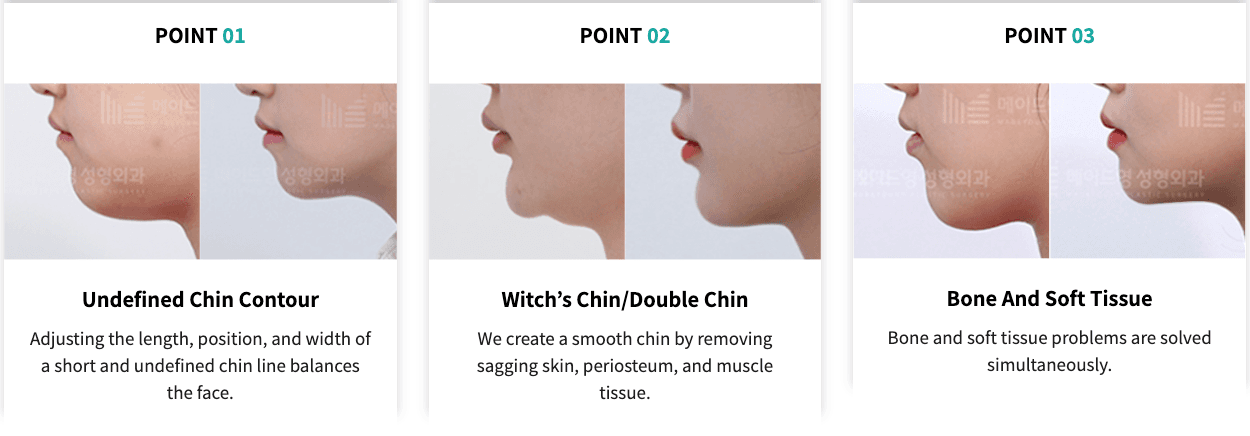
Chin surgery includes implant augmentation and operations that cut and reposition the chin bone. The correct choice depends on the required direction of change, chin anatomy, dental roots, mental nerves, bite, and the need for stable bony movement rather than added contour.
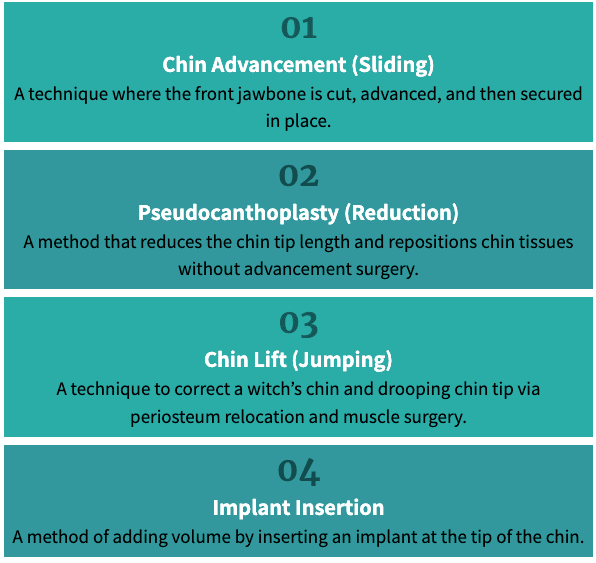
- Sliding or osseous genioplasty — Through an incision inside the lower lip, the surgeon makes a controlled bone cut, moves the chin segment forward, backward, vertically, sideways, or in rotation, then fixes it with plates and screws. This option can address multi-directional changes without a permanent contour implant, but introduces bone-healing, fixation, and lower-lip/chin sensory risks, as outlined in a recent surgical review.
- Implant-based chin augmentation — Silicone, porous polyethylene, PEEK, or another alloplastic implant adds projection and contour through an intraoral or under-chin incision. It avoids an osteotomy, but has implant-specific risks including infection, displacement, extrusion, wound separation, and bone erosion or resorption, described in this comparison of chin augmentation approaches.
- Reduction, vertical, and asymmetry genioplasty — Bone is removed, translated, rotated, or repositioned to reduce excess projection, alter chin height, narrow contour, or improve selected asymmetries. Safe design is limited by mandibular thickness, tooth roots, mental nerves, and soft tissue; photographs alone are not adequate planning.
- Digital planning for complex movement — Cephalometric and panoramic imaging, CT or cone-beam CT when indicated, virtual surgical planning, cutting guides, and three-dimensional printing can support multi-vector planning. Evidence suggests these tools can improve precision and reproducibility in selected cases, but they do not guarantee a better aesthetic result for every patient.
Why Visit Korea for Chin Surgery?
Korea has an established international-patient medical system and access to contemporary facial-surgery planning tools. Those advantages can make consultation logistics and surgical planning more accessible for visitors, but they do not prove that a Korean operation has better outcomes than treatment elsewhere. Choose the named surgeon and facility, not the destination alone.
- International-patient framework — Korea’s official Medical Korea service provides a registered medical-institution system, which patients can use as one part of facility verification.
- Planning capability — Contemporary genioplasty literature includes virtual planning, patient-specific guides, and three-dimensional workflows for selected complex movements; the evidence supports planning precision rather than a guaranteed cosmetic outcome.
- Verification remains essential — Confirm the operating surgeon’s specialty and credentials, facility registration, exact osteotomy or implant plan, hardware or implant material, anesthesia arrangements, and complication pathway before booking.
- Evidence limitation — No high-quality comparative evidence identified here shows that Korea has lower complication or revision rates, or superior genioplasty results, compared with the United States, United Kingdom, or other destinations. Published outcomes across methods are also limited by retrospective studies, mixed combined procedures, and nonstandardized reporting, as noted in a recent evidence review.
Key Information for International Patients
- Minimum stay — Plan at least 7–10 days in Korea after an isolated chin operation. For sliding/bony genioplasty or a long-haul return flight, 10–14 days is the more cautious travel-planning range so the team can review oral healing, hydration, pain control, swelling, and sensation.
- Flight timing — There is no universally validated genioplasty-specific interval for commercial long-haul flights. Do not book a non-changeable return: fly only after an in-person review and individualized clearance from the operating surgeon, especially after combined jaw surgery or with substantial swelling, infection, bleeding, poor oral intake, or uncontrolled pain.
- Early itinerary impact — Swelling and bruising are often greatest on days 2–3. Desk work and quiet sightseeing are often realistic around days 7–10 after isolated surgery, but strenuous activity, heavy lifting, and any chin-impact risk remain restricted until cleared.
- Follow-up visits — Expect an early in-person postoperative review before departure. Combined orthognathic surgery has a substantially greater recovery and travel burden than isolated genioplasty.
- Documents for home care — Obtain English discharge instructions, an operative report, imaging when available, implant or plate-and-screw details, medication names by generic name, and a direct contact route for postoperative questions.
- Remote follow-up — Agree before surgery on who will review photographs or video after return, how urgent symptoms will be triaged, and where to seek local emergency or oral-maxillofacial care if needed.
Travel note: A 7–14-day stay is a cautious operational recommendation, not a flight-safety rule. The operating surgeon’s assessment takes precedence.
Which Are the Best Clinics in Korea for Chin Surgery?
Listed below are some of the best clinics in Korea for chin surgery.
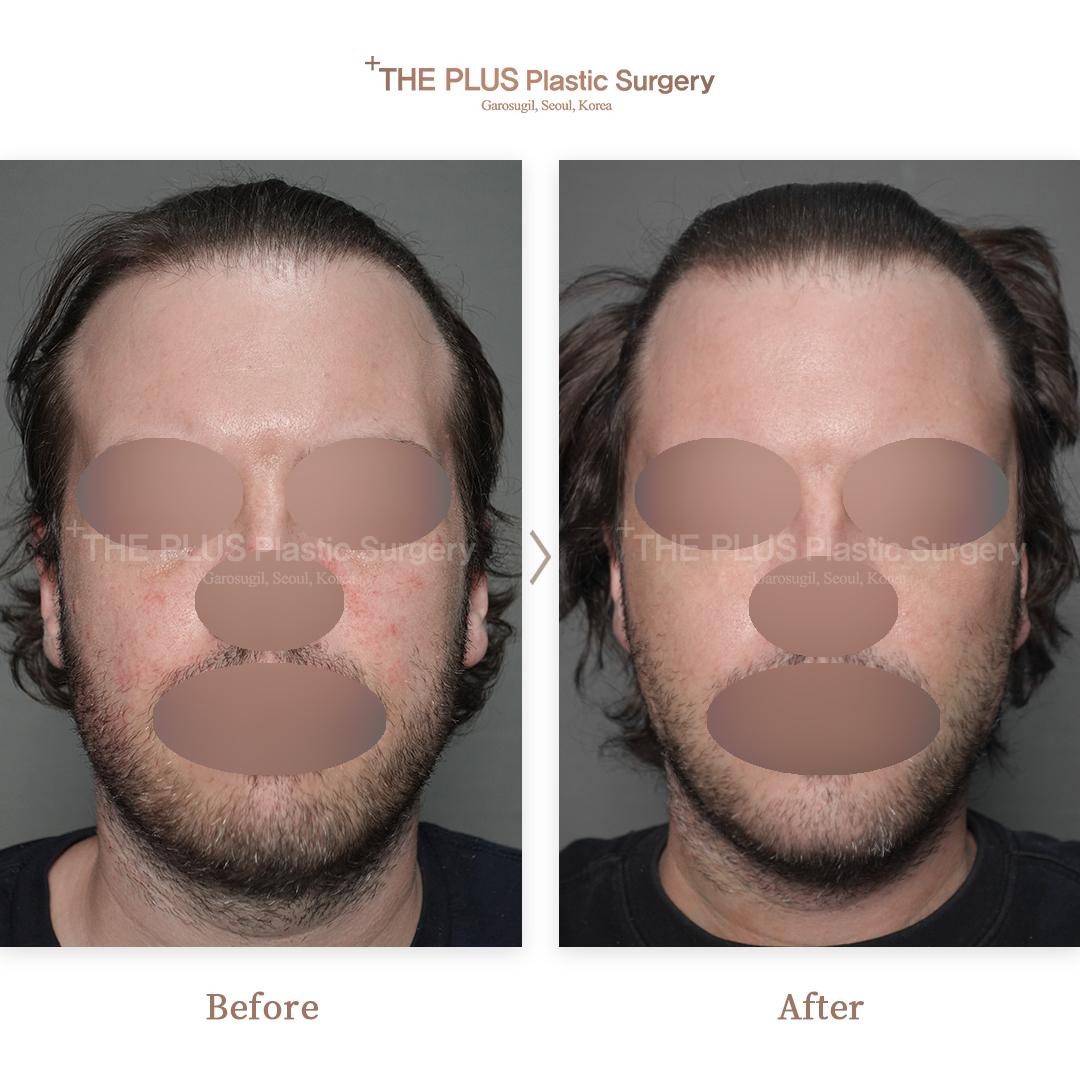
1. THEPLUS Plastic Surgery
You may consider THEPLUS Plastic Surgery for chin surgery if your goal is to adjust chin size or projection as part of an overall facial-contouring plan. Its approach frames chin positioning in relation to your nose, lips, and jawline, with facial-contouring expertise supported by Dr. Kim’s board certification and research recognition involving 3D implants.
- URL: THEPLUS Plastic Surgery Website
- Location: Gangnam-gu, Seoul
- Chin and facial contouring:
- Chin surgery is offered to adjust chin size or projection for more harmonious facial proportions.
- Full-face contouring, cheekbone surgery, square-jaw surgery, and facial implants are also available when multiple facial areas are being considered.
- Relevant surgical expertise:
- Dr. Kim is a board-certified plastic surgeon whose practice includes facial contouring and rhinoplasty.
- He has received awards for research on 3D implants and conducts annual educational sessions for other plastic surgeons.
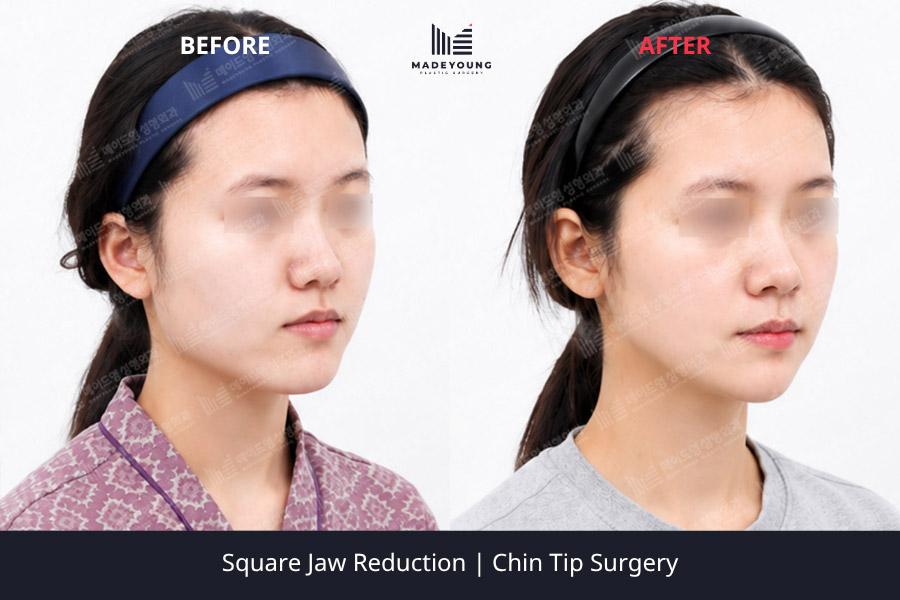
2. Made Young Plastic Surgery
You can expect a chin-surgery (genioplasty) consultation focused on changing the size or shape of your chin to improve facial proportion, with direct assessment by the medical team before treatment. Made Young also offers related jawline and facial-contouring procedures, while maintaining a stated perioperative safety system that includes full-time board-certified anesthesiologists and individual anesthesiologist monitoring.
- URL: Made Young Plastic Surgery Website
- Location: Seocho-gu, Seoul
- Procedure options:
- Chin surgery (genioplasty) is offered to enhance or reduce chin size and shape for improved facial proportion.
- Related contouring options include V-line surgery, metal-free V-line surgery, jaw reduction, and cheekbone reduction.
- Safety and monitoring:
- Full-time board-certified anesthesiologists are on site.
- Its stated 1:1 monitoring system assigns one anesthesiologist to continuous monitoring of one person during procedures.
- A cross-check system involves multiple anesthesiologists in emergency assessment and response.
- The clinic states that procedures have full CCTV coverage for transparency.
- Consultation and aftercare:
- The medical team provides direct consultation and diagnosis before a procedure.
- A dedicated aftercare center provides systematic post-procedure care.
3. Banobagi Plastic Surgery
You may consider Banobagi Plastic Surgery for chin surgery if you want care within a clinic that has a dedicated facial-contouring center and describes its treatment planning as one-to-one customized. Established in 2000 by plastic-surgery specialists from Seoul National University Hospital, the clinic states that it avoids recommending unnecessary or excessive surgery.
- URL: Banobagi Plastic Surgery Website
- Location: Gangnam-gu, Seoul
- Facial-contouring setting:
- Chin-surgery planning is supported by a dedicated facial-contouring center within the clinic.
- The clinic operates specialized centers for facial contouring, body contouring, breast surgery, wrinkle surgery, eye surgery, nose surgery, filler and special surgery, and obesity care.
- Care approach:
- The clinic describes its treatments as one-to-one customized, supported by professional medical equipment in each field.
- It states that it does not recommend unnecessary or excessive surgeries for clinic profit.
- Background:
- Banobagi was established in February 2000 by four medical professionals who were plastic-surgery specialists from Seoul National University Hospital.
- Its facilities include a six-story main building and a five-story annex.
How Much Does Chin Surgery Cost in Korea?
Chin Surgery is supplied at ₩7,200,000–₩7,900,000 (approximately US$5,300–$5,900). Individual quotes vary because implant augmentation, sliding/osseous genioplasty, and reduction or repositioning require different operative steps, materials, anesthesia, and follow-up.
| Procedure Price | Korean Won (₩) | USD ($) |
|---|---|---|
| Low Price | ₩7,200,000 | $5,300 |
| High Price | ₩7,900,000 | $5,900 |
Exchange rate as of 2026-09-06: 1 KRW = 0.000741 USD.
What Affects the Price?
- Implant augmentation versus osseous genioplasty — A chin implant requires implant selection and placement through an intraoral or submental incision, including the implant itself as a consumable. Sliding or osseous genioplasty requires a controlled bone cut, planned movement of the chin segment, and fixation with plates and screws, increasing operating complexity and hardware requirements.
- Extent and direction of bony movement — Advancement, setback, vertical shortening or lengthening, narrowing, translation, rotation, and asymmetry correction require different osteotomy designs and levels of intraoperative adjustment. Multi-vector repositioning or reduction must account for tooth roots, mental nerves, chin thickness, and mandibular anatomy, adding planning and operating time.
- Imaging and surgical planning requirements — Cases needing cephalometric imaging, panoramic radiography, CT or cone-beam CT, virtual surgical planning, cutting guides, or three-dimensional printing require additional diagnostic and planning resources. These tools are especially relevant for complex movements and asymmetry correction.
- Anesthesia and postoperative observation — Isolated sliding genioplasty is commonly performed under general anesthesia, while implant augmentation may use general anesthesia, sedation, or local anesthesia depending on the plan and facility. The anesthesia approach and any need for overnight observation add facility and recovery-monitoring resources.
Cost tip: Request an itemized quote stating what is included, with the exact procedure type, planned chin movement or implant material, imaging and virtual planning, anesthesia, facility or observation charges, plates and screws or implant costs, medications, and scheduled postoperative follow-up clearly identified.
The US$5,300–$5,900 conversion is approximate, based on the supplied exchange rate dated 2026-09-06. Check the exchange rate again when budgeting.
Chin Surgery From Start to Finish

- Remote enquiry and consultation — Send standardized front, profile, and three-quarter photographs plus medical, dental, orthodontic, medication, allergy, and prior-surgery history. Ask whether English consultation is available and request the proposed procedure, limitations, recovery plan, and after-hours contact process in writing.
- In-person facial and bite assessment — On arrival, the surgeon assesses facial proportions, chin and lower-lip sensation, dental occlusion, jaw relationship, prior orthodontics, and the concern behind the request. A bite, airway, or major jaw-position issue can change the recommendation from chin-only surgery to orthognathic assessment.
- Imaging and operative planning — The team uses cephalometric and panoramic imaging, with CT or cone-beam CT when indicated, to evaluate bone, roots, and mental-nerve location. For a planned osteotomy, the written plan should state the intended movement, incision, fixation, and whether virtual planning or guides are used.
- Pre-anesthesia review and consent — The anesthesia team reviews health conditions, medicines, fasting, and prior anesthesia reactions. Sliding genioplasty is commonly done under general anesthesia; implant augmentation can use general anesthesia, IV sedation, or local anesthesia depending on the procedure and facility.
- Surgery — In sliding genioplasty, the chin bone is exposed through the lower lip, cut, repositioned, and stabilized with plates and screws. In implant augmentation, the surgeon creates a pocket through an intraoral or submental incision and positions the agreed implant; operation time depends on the technique and whether other procedures are combined.
- Recovery and discharge — Isolated procedures can be outpatient or involve overnight observation, based on the operation, anesthesia, medical history, and immediate recovery. Leave only when vital signs are stable, nausea and pain are manageable, oral fluids are tolerated, and a responsible adult is available after general anesthesia or IV sedation.
- Early postoperative review in Korea — Attend the scheduled review for incision healing, swelling, hydration, diet tolerance, pain control, and lower-lip/chin sensation. The surgeon then makes the individualized fit-to-fly decision.
- Overseas follow-up — Continue the agreed video or photo follow-up after returning home. Contact the Korean team promptly for worsening symptoms and seek urgent local assessment when advised.
Alternatives to Chin Surgery
The best alternative depends on whether the concern is skeletal position, soft-tissue volume, lower-face width, or a tooth-bite and jaw relationship. Non-surgical choices avoid osteotomy and have shorter downtime, but cannot replicate stable bony repositioning; jaw surgery addresses function and skeletal discrepancies but is far more extensive.
Chin Filler
- Best for — Temporary projection or contour refinement when an osteotomy or permanent implant is not wanted.
- Tradeoff — Hyaluronic-acid and calcium-hydroxylapatite fillers do not move bone and require maintenance. Injectable filler also carries rare but serious vascular complications; see chin filler.
Chin Implant
- Best for — Selected augmentation goals where added projection is needed but multi-vector bony movement is not.
- Tradeoff — It avoids bone cutting but leaves a permanent implant with risks of infection, displacement, extrusion, and bone change. Read about chin implant surgery.
Double-Jaw Surgery
- Best for — Malocclusion, substantial maxillary or mandibular skeletal discrepancy, functional problems, or airway-related jaw positioning.
- Tradeoff — This is not a cosmetic substitute for isolated chin surgery: it changes jaw position and involves a much longer recovery. Explore double-jaw surgery.
V-Line Surgery
- Best for — A concern centered on mandibular angle or lower-jaw width rather than chin projection or vertical chin position.
- Tradeoff — Mandibular contouring does not correct a bite discrepancy and addresses different anatomy from genioplasty. See V-line surgery.
How Can I Prepare for Chin Surgery?
- Medical and dental disclosure — Give the surgeon and anesthesia team a complete list of conditions, allergies, previous operations, dental and orthodontic history, and every prescription, over-the-counter medicine, vitamin, herbal product, and supplement.
- Bleeding-risk medicines — Discuss anticoagulants, antiplatelet drugs, NSAIDs, and supplements with bleeding effects well before surgery. Never stop prescribed anticoagulants, diabetes medicines, psychiatric medicines, steroids, or blood-pressure medicines without a plan agreed by the prescribing clinician and surgical team.
- Dental infection — Complete treatment for active dental, periodontal, skin, or intraoral infection before an intraoral operation. Bring relevant orthodontic records, retainers, dentures, or dental imaging when requested.
- Nicotine, alcohol, and substances — Stop smoking, vaping, nicotine products, alcohol, cannabis, and recreational substances for the exact period in the surgical and anesthesia team’s written instructions; nicotine can compromise wound and bone healing.
- Fasting and medicines on surgery day — Follow the facility’s exact fasting and morning-medication instructions. These differ by anesthesia plan and institution.
- Accommodation and support — Book accommodation near follow-up with space for head elevation, fluids, and soft-food preparation. Arrange a responsible adult to take you back and stay the first night after general anesthesia or IV sedation.
- Flexible travel — Schedule the early postoperative appointment before purchasing the return flight, keep travel plans changeable, and avoid combining surgery with a demanding itinerary.
Travel note: Bring enough routine medication for the full stay plus extra days, carried in original labeled containers with a medication list.
Confirm clinic-specific fasting, medication, oral-rinse, diet, compression, and travel requirements with the treating doctor; their instructions take precedence over general guidance.
Aftercare Advice
Protect the incision, maintain hydration and oral hygiene, and treat swelling as a normal early recovery feature while acting quickly on signs of infection or bleeding.
- First 72 hours — Expect tightness, swelling, bruising, discomfort, and temporary lower-lip or chin numbness/tingling; swelling commonly peaks on days 2–3. Use cold therapy, head elevation, prescribed medicines, fluids, and gentle walking exactly as directed.
- Oral incision and diet — Use only the specified mouth rinse and tooth-cleaning method, and do not disturb intraoral sutures. Start with liquids or soft foods when instructed, then advance only when cleared; avoid forceful chewing and foods that can traumatize the incision.
- Activity and contact risk — Avoid heavy lifting, strenuous exercise, deep bending that worsens swelling, and any activity that could strike the chin. Desk work is often possible in about 7–10 days, but sliding genioplasty needs bony healing before contact sports or impact-risk exercise; obtain explicit surgeon clearance.
- Warning signs — Seek urgent medical advice for fever, chills, pus or foul drainage, rapidly worsening or markedly one-sided swelling, uncontrolled bleeding, escalating pain, wound separation, inability to maintain fluids, persistent vomiting, breathing difficulty, chest pain, fainting, new facial weakness, or worsening sensory loss.
- Results and review — Structural change is immediate, but swelling hides the early contour. Most visible swelling improves over about two weeks; mild residual swelling and altered sensation can take months to settle. Long-term bony and soft-tissue stability varies by movement direction and study design, although isolated advancement genioplasty is generally reported as sagittally stable.
Follow the treating doctor’s written instructions over this general guidance, and contact the clinic promptly whenever healing appears wrong.
Frequently Asked Questions
Related Blogs

Discover South Korea's Competitive Edge: Double Chin Tightening Cost Comparison Across Leading Countries
Discover the latest on double chin tightening procedures in Korea, exploring various techniques and their costs. Learn how these advanced treatments can help you achieve a more contoured facial profile while considering your budget.
Updated: Sep 25, 2026
Discover the Global Cost Breakdown for Chin Implants: Is Korea Your Best Bet?
Discover the affordability and quality of chin implants in Korea, a popular destination for cosmetic surgery. This article explores the average costs, factors influencing prices, and why Korea is a top choice for enhancing facial aesthetics.
Updated: Sep 25, 2026
Cheekbone Reduction in Korea: Methods, Recovery, Risks, and Travel Planning
Cheekbone reduction uses bone shaving, partial cuts, or L-shaped osteotomy with repositioning to narrow prominent zygomatic body or arch contours. In Korea, costs range from ₩5,500,000–₩18,000,000; international patients should plan 10–14 days locally for recovery and postoperative review.
Updated: Sep 20, 2026
Masseter Reduction in Korea: Candidacy, Surgery, Recovery, Risks, and Travel Planning
Masseter reduction removes a planned portion of deep chewing muscle through an intraoral incision after confirming muscle-driven lower-face width and assessing dental, bite, jaw, and anesthesia factors. International patients can review Korea provider registration, plan at least 10–14 days after isolated surgery, attend follow-ups, arrange flexible flights, and obtain operative records and emergen
Updated: Sep 19, 2026
Clinics offering Chin Surgery

THEPLUS Plastic Surgery Korea | Eye, Nose, Face & Body Surgery
Sinsa

Made Young Plastic Surgery: Rejuvenating Aesthetic Excellence in Korea for Face Lifts, Contouring and More
Gangnam Station

Banobagi Plastic Surgery: A Pioneering and Trusted Plastic Surgery Clinic in Korea
Seolleung

Mind Plastic Surgery: Excellence in Cosmetic & Reconstructive Procedures in Korea
Sinnonhyeon Station