
Medical Tourism Blog
Fox Eye Surgery in Korea: Methods, Recovery, Risks and Travel Planning
Table of contents
- Fox Eye Surgery at a Glance
- What Is Fox Eye Surgery?
- Who Is a Good Candidate for Fox Eye Surgery?
- How Is Fox Eye Surgery Performed?
- Why Visit Korea for Fox Eye Surgery?
- Key Information for International Patients
- Which Are the Best Clinics in Korea for Fox Eye Surgery?
- Fox Eye Surgery From Start to Finish
- Alternatives to Fox Eye Surgery
- How Can I Prepare for Fox Eye Surgery?
- Aftercare Advice
Considering treatment in Korea? Everything you need to know e.g. — how to avoid scams, visas, interpreters, recovery tips — in our Medical Tourism Master Guide. Plan with confidence in minutes, not weeks!
Last updated: October 2026
Fox Eye Surgery at a Glance
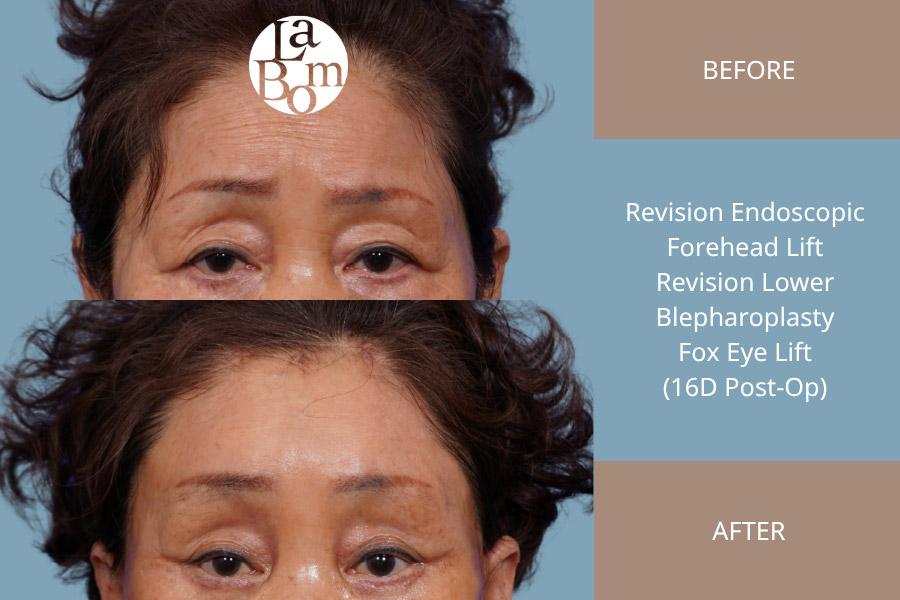
- What it involves — Fox Eye Surgery is a marketing term rather than one standard operation; it may use lateral canthopexy, lateral canthoplasty, a temporal brow lift, or combined eyelid surgery to create a modest upward-outward outer-eye appearance.
- Best candidates — Suitable candidates are adults with stable lower-lid tone, full eyelid closure, and a healthy ocular surface who want an anatomically realistic change; brow descent, ptosis, or upper-lid heaviness may call for a different procedure.
- Eye-safety limit — The desired tilt cannot compromise corneal coverage: dry eye, incomplete closure, thyroid eye disease, prominent eyes, or significant lower-lid laxity can raise the risk of exposure, retraction, ectropion, and vision-threatening corneal problems.
- Recovery timeline — Bruising and swelling are usually most noticeable for 1–2 weeks, external sutures are commonly removed around days 5–7, and one lateral-canthoplasty series found over 90% of swelling resolved by 1 month; redness and tissue settling can last 2–3 months or longer.
- Korea travel stay — Plan at least 7–10 days in Korea for stand-alone canthoplasty, including in-person assessment and early review; 10–14 days is more cautious for combined surgery, revision cases, dry-eye risk, or long-haul travel.
- Evidence and durability — Results and longevity vary by anatomy and technique, and evidence is mainly retrospective case series rather than comparative trials; reported canthoplasty lengthening was 2.3–4.2 mm in one series, while recurrence or lateral-corner deformity can require revision.
- Korea-specific check — Korea offers Ministry of Health and Welfare registration for institutions serving foreign patients and multilingual support, but this does not prove better fox-eye outcomes; verify current registration, surgeon credentials, the exact planned technique, and follow-up arrangements.
What Is Fox Eye Surgery?
Fox Eye Surgery is a cosmetic procedure that reshapes or supports the outer eye area to create a more upward-outward appearance. It aims to refine a downturned or tired-looking outer eye while preserving comfortable eyelid closure and eye-surface protection. It is surgical, though the exact operation ranges from limited eyelid support to more extensive brow or eyelid surgery.
Who Is a Good Candidate for Fox Eye Surgery?
- Adults seeking a subtle outer-eye change — Good candidates want a modest upward-outward outer-eye direction and accept that natural asymmetry and lower-eyelid anatomy limit the safe degree of change.
- Stable lower-lid support — Adequate lid tone, full eyelid closure, and a healthy ocular surface are important because the lower lid must continue to protect and lubricate the cornea.
- An anatomy-led goal — Lateral canthoplasty or canthopexy suits an outer-corner or lower-lid support concern; a temporal lift can be more appropriate when lateral brow descent causes the heavy or downturned appearance.
- Informed surgical candidates — Suitable patients understand that this is not a standardized operation, that results are constrained by eye safety, and that revision is sometimes needed.
Active conjunctivitis, eyelid dermatitis, periocular inflammation, or acute systemic illness require postponement. Significant dry eye, exposure keratopathy, incomplete closure, poor Bell’s phenomenon, active thyroid eye disease, or prominent eyes need an oculoplastic assessment; surgery can worsen exposure and corneal risk. Uncontrolled diabetes or hypertension, bleeding disorders, and anticoagulant or antiplatelet treatment that cannot be safely managed with the prescribing clinician also rule out elective surgery. Pregnancy, recent or planned LASIK, SMILE, or LASEK without coordinated timing, unrealistic expectations, and a requested tilt that would destabilize the lower lid are further reasons to defer or decline treatment.
How Is Fox Eye Surgery Performed?
“Fox eye surgery” is a marketing term, not a single standardized technique. The consultation must establish whether the target is the outer canthus, lower lid, upper lid, lateral brow, or several structures.
- Lateral canthopexy — Sutures or internal fixation reinforce existing lateral-canthal tissue. This is generally a subtler, less invasive lower-lid support approach and does not necessarily lengthen the eye opening to the degree of canthoplasty.
- Lateral canthoplasty — The surgeon releases, reshapes, and reattaches structures at the outer corner, sometimes using canthotomy/cantholysis and fixation of the tendon or tarsus. It can alter outer-corner direction and palpebral-fissure length, but lower-lid closure and corneal protection set firm safety limits. Published cosmetic series are retrospective and technique-specific: one reported 2.3–4.2 mm lengthening, while another larger series recorded later reoperation for recurrent malposition or lateral-corner deformity in 18 patients; these data do not predict an individual outcome or prove one technique superior. The evidence review and revision case series show why conservative planning matters.
- Temporal or endoscopic brow lift — A temple-based lift elevates the lateral brow; an endoscopic brow lift addresses broader forehead and brow descent. It does not correct true lower-lid laxity, and adds scalp-incision, numbness, hair-loss, asymmetry, and facial-nerve risks.
- Combined eyelid surgery — Upper blepharoplasty, ptosis correction, lower blepharoplasty, fat repositioning, or epicanthoplasty can address skin excess, true ptosis, bags, folds, or lid-cheek anatomy. Combining procedures increases swelling, operative extent, and ocular-surface assessment needs.
Why Visit Korea for Fox Eye Surgery?
Korea has formal infrastructure for overseas patients, but that does not demonstrate better fox-eye outcomes at a particular clinic. Choose the operation and surgeon based on anatomical assessment, relevant credentials, clear consent, and an emergency/follow-up plan—not the procedure label.
- Foreign-patient registration — Korea operates a Ministry of Health and Welfare registration system for institutions serving foreign patients. Verify a prospective institution’s current registration before paying a deposit.
- International-patient support — The Medical Korea framework provides multilingual patient-facing information and provider-search resources, which can help with communication and travel logistics. It is not a quality ranking and does not validate a clinic’s complication rate.
- Procedure transparency — Ask for the operating surgeon’s specialty credentials, the precise procedure name, incision plan, anesthesia type, who performs each operative step, and written consent in a language understood by the patient.
- Evidence limit — No Korea-wide registry or reliable comparative dataset establishes superior outcomes for Fox Eye Surgery in Korea. A literature review of lateral canthoplasty found a limited, technique-focused evidence base rather than high-quality comparative trials.
Key Information for International Patients
- Minimum stay — Plan at least 7–10 days for stand-alone canthoplasty or eyelid surgery: in-person assessment, surgery, early review, and external-suture removal commonly around days 5–7. A 10–14-day stay is more cautious after a brow lift, combined surgery, revision surgery, dry-eye risk, or long-haul travel.
- Flight timing — Do not book a non-flexible return before the postoperative review. Cosmetic eyelid surgery normally does not involve an intraocular gas bubble, but dry cabin air and distance from urgent care are practical concerns; aviation guidance does not provide a universal wait time for cosmetic canthoplasty. Obtain surgeon clearance after examination.
- Recovery and itinerary — Bruising and swelling are usually most visible for 1–2 weeks. More than 90% of swelling had resolved by one month in one lateral-canthoplasty series, but incision redness can persist for 2–3 months and combined brow or eyelid surgery takes longer.
- Activity restrictions — Keep sightseeing light in the first week. Avoid strenuous exercise, heavy lifting, swimming, hot tubs, eye makeup, contact lenses, and pressure on the outer eye until cleared.
- Follow-up abroad — Leave Korea with operative records, medication instructions, emergency contact details, a remote-review schedule, and a named local ophthalmologist or oculoplastic clinician for urgent assessment.
Travel note: Arrange a responsible adult to accompany you after sedation or general anesthesia and remain available overnight. Do not plan solo travel immediately after surgery.
Which Are the Best Clinics in Korea for Fox Eye Surgery?
Listed below are some of the best clinics in Korea for fox eye surgery.
1. LABOM Plastic Surgery
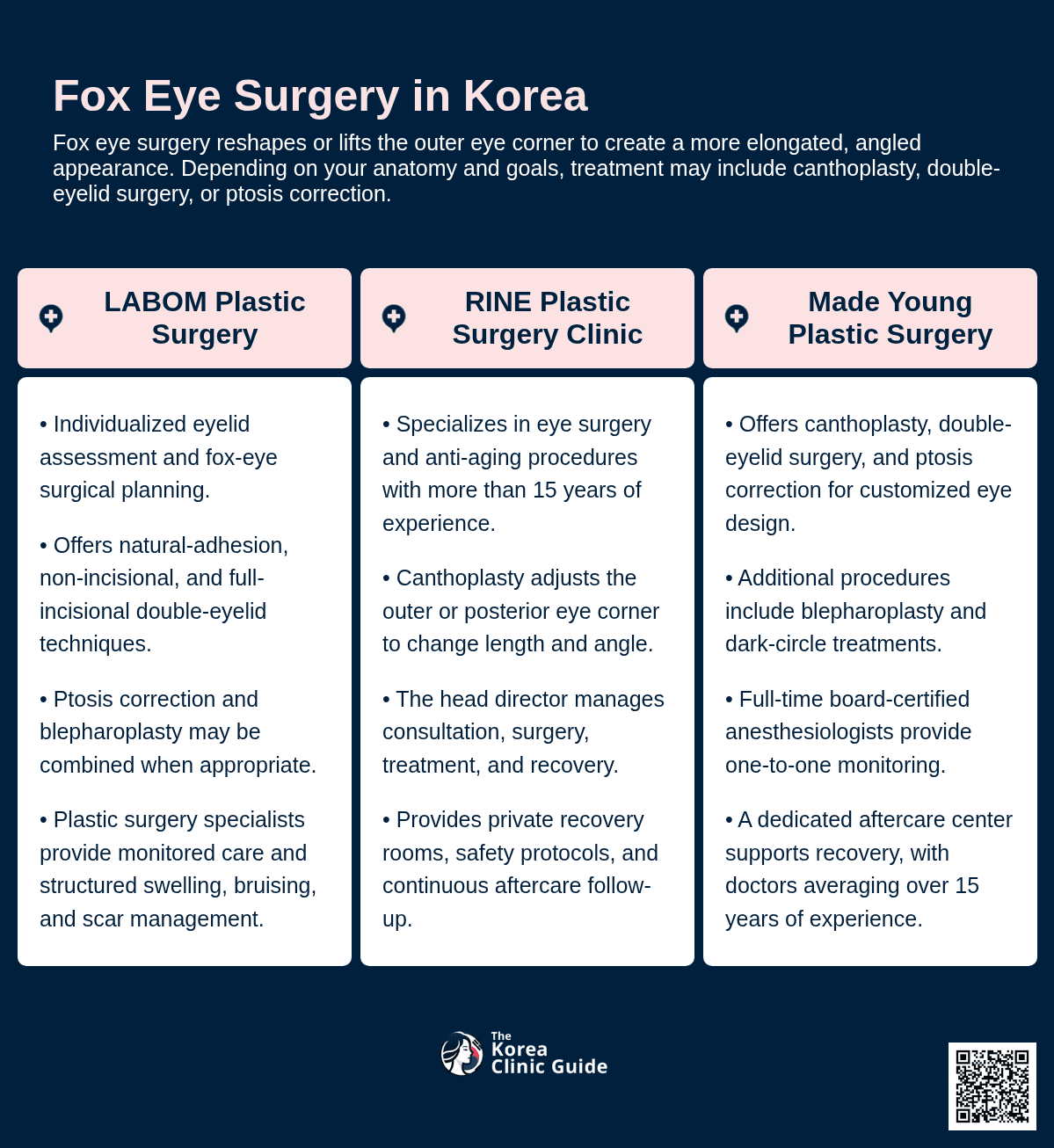
For a fox-eye–oriented eye-shape plan, LABOM Plastic Surgery offers individualized eyelid assessment and surgical design based on your eye characteristics, facial anatomy, and overall facial balance. Its available eye procedures include double-eyelid surgery with non-incisional, natural-adhesion, or full-incisional approaches, with ptosis correction considered when appropriate; the clinic emphasizes avoiding excessive correction to preserve natural expression.
- URL: LABOM Plastic Surgery Website
- Location: Gangnam-gu, Seoul
- Eye-procedure planning:
- Your eyelid technique is selected according to your individual eye characteristics, with micro-incision natural adhesion, non-incisional suturing, and full-incision options described.
- Double-eyelid surgery may be combined with ptosis correction when eyelid drooping is present.
- Blepharoplasty options address upper- or lower-lid sagging; upper-lid treatment may also help when excess skin obstructs vision.
- Surgical approach:
- Plastic surgery specialists directly perform procedures, with more than 30 years of clinical experience across facial and hand anti-aging procedures.
- Planning is based on facial anatomy, tissue position, structural concerns, and the degree of aging rather than a one-size-fits-all design.
- The clinic considers whole-face harmony and seeks to preserve a natural shape and expression.
- Care and recovery support:
- You receive a customized consultation and pre-operative diagnosis, with individualized surgical planning.
- Safety infrastructure includes anesthesia and continuous monitoring systems, plus high-definition endoscopic equipment.
- Postoperative care includes regular progress checks and structured swelling, bruising, and scar-management programs; a dedicated system is described for international visitors.
2. RINE Plastic Surgery Clinic
At RINE Plastic Surgery Clinic, you can discuss a fox-eye–style change through canthoplasty, which adjusts the outer or posterior eye corner to alter horizontal eye length or outer-corner angle. The head director personally manages your consultation, surgery, treatment, and recovery, using a one-to-one design based on your facial proportions, skin condition, and individual features.
- URL: RINE Plastic Surgery Clinic Website
- Location: Seocho-gu, Seoul
- Eye-shape options:
- Canthoplasty is offered for lateral or posterior corner adjustment to extend horizontal eye length or modify the outer-corner angle.
- Related eye procedures include non-incisional double-eyelid surgery, ptosis correction, under-eye fat repositioning, and revision eye surgery.
- The clinic also offers epicanthoplasty revision for concerns such as excessive tear-duct exposure or an unnatural inner-eye contour after prior surgery.
- Experience and surgical setting:
- The clinic specializes in eye surgery and anti-aging procedures and cites more than 15 years of clinical experience.
- Stryker full-HD endoscopy, FDA-approved Endotine, and WhiteLite bipolar equipment are listed among its technology.
- Safety measures include infection-control protocols, surgical safety procedures, and emergency preparedness.
- Continuity and aftercare:
- The director handles care from consultation through recovery rather than transferring stages of care to different clinicians.
- You can recover in a private one-person recovery room.
- A continuous aftercare system is described through the period of healing and result follow-up.
3. Made Young Plastic Surgery
For a fox-eye–oriented consultation, Made Young Plastic Surgery offers canthoplasty to lift or reshape the eye through adjustment of the outer eyelid corner, alongside double-eyelid and ptosis procedures that may be relevant to your overall eye design. The medical team provides direct consultation and diagnosis before treatment, with plans tailored to your needs.
- URL: Made Young Plastic Surgery Website
- Location: Seocho-gu, Seoul
- Eye surgery options:
- Canthoplasty is available to lift or reshape the eye by altering the outer corner of the eyelid.
- Double-eyelid surgery is offered in non-incisional and incisional forms.
- Additional eye procedures include ptosis correction, upper and lower blepharoplasty, and dark-circle treatments that may involve fillers, fat repositioning, or laser-based methods.
- Monitoring and safety:
- Full-time board-certified anesthesiologists are on site.
- A one-to-one monitoring system assigns one anesthesiologist to continuous monitoring of one person during a procedure.
- The clinic describes a cross-check process involving multiple anesthesiologists for emergency assessment and response, as well as full CCTV coverage of procedures.
- Aftercare and clinical team:
- A separate dedicated aftercare center provides systematic post-procedure care.
- The clinic states that its doctors average more than 15 years of experience.
- Its stated recognitions include selection as an Outstanding Member of the Korean Society of Plastic and Reconstructive Surgeons and certification by the Minimally Invasive Aesthetic Surgery Society.
Fox Eye Surgery From Start to Finish
- Remote screening — Send unfiltered front, oblique, and side photographs with eyes open and closed. Disclose dry-eye symptoms, contact-lens use, thyroid disease, CPAP use, prior facial or eyelid procedures, LASIK/SMILE/LASEK history, medicines, supplements, nicotine use, allergies, and bleeding history. Virtual or English-language consultation can screen suitability, but photographs cannot replace an eye examination.
- In-person assessment — The surgeon confirms the exact procedure, realistic degree and direction of lift, incision locations, baseline asymmetry, and expected durability. Examination should assess lower-lid tone, closure, ocular surface, brow position, scleral show, corneal protection, and whether brow descent or upper-lid anatomy—not the canthus—is the actual concern.
- Preoperative clearance — The clinic reviews medical history, vital signs, anesthesia suitability, and medication management. Pregnancy testing, focused eye assessment, or additional tests are used when history, anesthesia, prior surgery, trauma, or medical conditions warrant them; imaging is not routine for uncomplicated cosmetic cases.
- Surgery — A limited canthopexy or canthoplasty is usually outpatient under local anesthesia with or without oral or IV sedation. Larger combined eyelid or brow operations more often use general anesthesia. The surgeon protects the cornea during surgery and checks eyelid position and closure before discharge.
- Discharge day — Expect ointment-related blurred vision, tearing, tightness, swelling, bruising, and discomfort. Receive written instructions for lubrication, ointment or drops, pain medicine, wound care, emergency contact, and follow-up in a language you understand.
- Early review in Korea — Attend the planned postoperative check. External sutures are commonly removed at day 5–7; remaining locally for this assessment is strongly preferable.
- Remote follow-up — Submit photographs and symptom updates on the clinic’s schedule after returning home. Seek local urgent care rather than waiting for remote advice if vision changes, severe pain, rapidly increasing swelling, inability to close the eye, or infection symptoms occur.
Alternatives to Fox Eye Surgery
The best alternative depends on what creates the downturned or tired appearance. Non-surgical options are temporary and cannot reconstruct lower-lid support; surgery can create a more structural change but carries functional eye risks and longer recovery.
Botulinum Toxin Brow Lift
- Best for — A subtle, temporary lateral-brow elevation in suitable anatomy.
- Tradeoff — Facial Botox cannot lengthen the eye opening, repair lower-lid laxity, or reliably reposition the lateral canthus.
Thread Lift
- Best for — A temporary temple or lateral-brow effect without incisional surgery.
- Tradeoff — A fox eye thread lift does not provide the structural lower-lid support of canthopexy or canthoplasty.
Brow or Forehead Lift
- Best for — Lateral brow descent causing upper-lid heaviness or an outwardly downturned appearance.
- Tradeoff — Eyebrow lift, temporal lift, or forehead lift targets the brow rather than a true lower-lid or outer-canthus problem.
Eyelid Surgery or Ptosis Repair
- Best for — Upper-lid skin excess, true eyelid droop, bags, fat prolapse, or lid-cheek hollowing.
- Tradeoff — Double eyelid surgery, upper blepharoplasty, or ptosis correction can better match the anatomy but does not automatically create a fox-eye shape.
How Can I Prepare for Fox Eye Surgery?
- Medication review — Give the surgeon and prescribing clinicians a complete list of prescription medicines, over-the-counter drugs, supplements, allergies, and bleeding history. Do not independently stop anticoagulants, antiplatelets, blood-pressure medicines, diabetes medicines, or psychiatric medicines.
- Bleeding-risk products — Many surgeons request a surgeon-specified pause for aspirin, ibuprofen, naproxen, vitamin E, fish oil/omega-3, ginkgo, ginseng, garlic, ginger, and St John’s wort. Confirm the exact stop period with the treating surgeon and prescribing clinician.
- Nicotine and alcohol — Stop smoking, vaping, and all nicotine exposure well before surgery and throughout healing as directed; nicotine impairs wound healing. Avoid alcohol in the immediate preoperative period and while taking sedating medication.
- Eyes and skin — Attend without contact lenses, eye makeup, false lashes, or periocular cosmetic products unless instructed otherwise. Bring glasses and report redness, discharge, dermatitis, sunburn, tanning, or skin irritation around the eyes immediately.
- Fasting and transport — Follow the clinic’s fasting instructions exactly when sedation or general anesthesia is planned. Arrange an adult escort and overnight support after sedation or general anesthesia.
- Travel readiness — Book flexible flights, accommodation near the clinic through the early review, and enough time for suture removal. Carry your passport, medication list, insurance details, surgeon contact information, and a home-country urgent-care plan.
Travel note: Avoid scheduling surgery immediately before a major tour, business event, or long-haul return flight. Visible bruising and swelling commonly last 1–2 weeks.
The treating doctor’s individualized instructions take precedence; confirm the clinic’s medication, fasting, testing, and arrival requirements before travel.
Aftercare Advice
Protecting eyelid closure and the corneal surface is more important than judging cosmetic symmetry during the first weeks.
- Lubrication and medicines — Use prescribed ointment, eye drops, antibiotics, and pain medicine exactly as directed. Expect temporary blur after ointment, but report worsening rather than improving vision.
- Swelling control — Use short, protected cold-compress intervals and sleep with the head elevated during the early recovery period. Do not press, rub, pull, or sleep directly on the outer eye.
- Activity and exposure — Avoid strenuous exercise, bending or straining, heavy lifting, swimming, hot tubs, nicotine, contact lenses, eye makeup, and false lashes until the surgeon clears them. Wear sunglasses outdoors; after wounds have closed and the clinician approves, use SPF 50 around healed incision areas.
- Follow-up and results — Attend suture removal around days 5–7 when applicable. Bruising and swelling usually improve over 1–2 weeks; scar redness, tissue tension, altered sensation, and eyelid position can continue maturing for 2–3 months or longer, particularly after combined surgery.
- Urgent warning signs — Seek immediate in-person care for sudden or worsening vision loss, severe eye pain or pressure, rapidly increasing one-sided swelling, a bulging eye, uncontrolled bleeding, inability to close the eye, new double vision, pus, fever, or a painful red watery eye with light sensitivity. These symptoms require prompt assessment for bleeding, infection, corneal injury, or exposure.
Follow the treating doctor’s instructions over general guidance and contact the clinic promptly when anything appears wrong.
Frequently Asked Questions
Related Blogs

Upper Blepharoplasty in Korea: Methods, Recovery, Risks, and Travel Planning
Upper blepharoplasty conservatively removes excess upper-lid skin and, when indicated, limited muscle or fat after assessment of ptosis, brow position, eyelid closure, and eye health. International patients should plan a 7–10-day stay in Korea, attend early follow-up, arrange flexible travel and aftercare, and seek urgent assessment for vision changes or severe swelling.
Updated: Oct 13, 2026
Lower Canthoplasty in Korea: Methods, Recovery, Risks, and Travel Planning
Lower canthoplasty includes lower-eyelid-lowering and lateral canthal techniques, with candidacy based on lid support, ocular-surface health, and realistic anatomical goals. International patients can find guidance on technique clarification, 8–10 day travel planning, follow-up, aftercare, and urgent eye symptoms.
Updated: Oct 13, 2026
Upper Canthoplasty in Korea: Methods, Recovery, Risks and Travel Planning
Upper canthoplasty releases or redrapes the upper-medial epicanthal fold to improve visibility of an upper-eyelid crease, often alongside double-eyelid surgery. The article covers candidacy, surgical approaches, recovery, aftercare, travel planning for Korea, and warning signs requiring urgent eye care.
Updated: Oct 13, 2026
Epicanthoplasty in Korea: Methods, Recovery, Risks and Travel Planning
Epicanthoplasty is an outpatient procedure that releases and redrapes inner-eye-corner tissue to permanently reduce an epicanthal fold, with technique selected for anatomy, scar risk, and treatment goals. International patients should plan a 7–10-day stay for assessment and early wound review, follow aftercare restrictions, and arrange local eye-care follow-up after travel.
Updated: Oct 13, 2026
Clinics offering Fox Eye Surgery
RINE Plastic Surgery Clinic | Facelift and Eye Rejuvenation Surgery
Nonhyeon

THEPLUS Plastic Surgery Korea | Eye, Nose, Face & Body Surgery
Sinsa

Made Young Plastic Surgery: Rejuvenating Aesthetic Excellence in Korea for Face Lifts, Contouring and More
Gangnam Station

Seojin Plastic Surgery Clinic Korea: Pioneering Advanced Cosmetic Procedures for Personalized Aesthetic Transformation
Apgujeong