
Medical Tourism Blog
Square Jaw Surgery in Korea: Types, Recovery, Risks, and Travel Planning
Table of contents
- Square Jaw Surgery at a Glance
- What Is Square Jaw Surgery?
- Who Is a Good Candidate for Square Jaw Surgery?
- What Are the Different Types of Square Jaw Surgery?
- Why Visit Korea for Square Jaw Surgery?
- Key Information for International Patients
- Which Are the Best Clinics in Korea for Jaw Surgery In?
- How Much Does Square Jaw Surgery Cost in Korea?
- Square Jaw Surgery From Start to Finish
- Alternatives to Square Jaw Surgery
- How Can I Prepare for Square Jaw Surgery?
- Aftercare Advice
Considering treatment in Korea? Everything you need to know e.g. — how to avoid scams, visas, interpreters, recovery tips — in our Medical Tourism Master Guide. Plan with confidence in minutes, not weeks!
Last updated: September 2026
Square Jaw Surgery at a Glance
- What it does — Square jaw surgery, or mandibular angle reduction, permanently removes or reshapes bone at the back-lower jaw through intraoral incisions to narrow a bone-driven broad or angular lower face without an external jaw scar.
- Korea price — Isolated square jaw surgery in Korea is listed at ₩5,500,000–₩8,800,000, approximately US$4,100–$6,500; long curved reduction, lateral cortex work, or added chin surgery can increase the quote.
- Best candidates — It is intended for medically fit adults with completed facial growth and prominent mandibular bone, not lower-face width caused mainly by enlarged masseter muscles, fat, skin laxity, or a bite-position problem.
- Recovery and results — Swelling commonly peaks around days 3–7; public-facing activity often takes 10–14 days, desk work about 2–4 weeks, and the more stable contour emerges over 6–12 months as swelling and bone remodeling settle.
- Korea stay — International patients should plan at least 10–14 days in Korea for preoperative assessment and early reviews; a 2–3 week stay is more prudent when genioplasty, V-line work, or other facial bone procedures are combined.
- Key limitation and risk — This cosmetic bone-contouring procedure does not reliably correct malocclusion, jaw protrusion or retrusion, sleep apnea, or TMJ disease; important risks include bleeding, fracture, infection, bite change, asymmetry, and temporary or permanent lower-lip or chin numbness.
- Korea distinction — Korea has substantial procedure-specific literature and surgeon experience in mandibular-angle contouring, but clinic quality is not assured by location; confirm the named surgeon, imaging-based plan, anesthesia coverage, emergency transfer plan, and English postoperative records.
What Is Square Jaw Surgery?
Square jaw surgery is a cosmetic operation that reshapes or removes bone at the back corners of the lower jaw. It addresses a broad, angular lower face caused mainly by prominent jawbone, creating a smoother and narrower jawline. It is a surgical procedure, usually performed under general anesthesia through incisions inside the mouth.
Who Is a Good Candidate for Square Jaw Surgery?
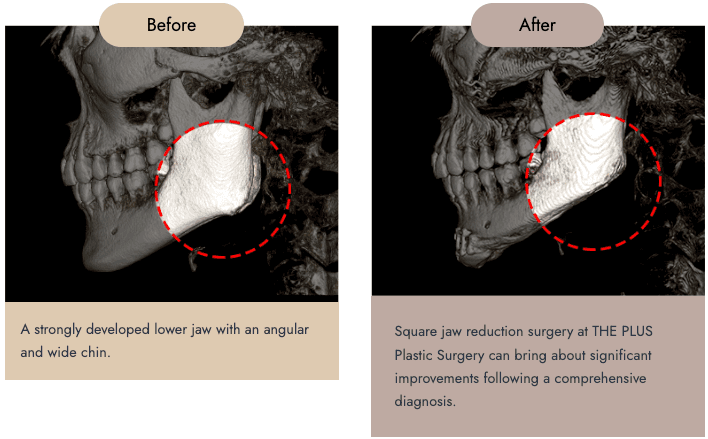
- Bone-dominant lower-face width — Good candidates have a visibly prominent mandibular angle (gonial angle) or lateral jawbone flare rather than lower-face fullness caused mainly by the masseter muscle or fat.
- Stable adult facial anatomy — Candidates are medically fit adults whose facial growth is complete and who want permanent refinement of a broad or angular jawline.
- Realistic structural goals — The aim is a smoother, narrower lower-face contour; bone reduction cannot reliably correct a bite problem, jaw protrusion or retrusion, sleep apnea, or temporomandibular-joint (TMJ) disease.
- Commitment to recovery — Candidates can follow a liquid or non-chewing soft diet, stay in Korea for early reviews, and arrange reliable follow-up after returning home.
Active oral, dental, skin, or systemic infection, untreated periodontal disease, uncontrolled hypertension or diabetes, a significant bleeding disorder, and anesthesia risk must be addressed before elective intraoral surgery. Pregnancy generally requires deferral of elective surgery under general anesthesia; disclose breastfeeding and pregnancy plans. Nicotine exposure—including smoking, vaping, nicotine replacement, and smokeless tobacco—requires cessation under the surgeon’s protocol because it impairs healing. A square lower face caused by masseter hypertrophy, skin laxity, chin shape, malocclusion, marked skeletal asymmetry, or obstructive-sleep symptoms needs a different assessment. Elective surgery is also inappropriate with coercion, unrealistic expectations, inability to commit to follow-up, or suspected body dysmorphic disorder until appropriate mental-health support has been arranged.
What Are the Different Types of Square Jaw Surgery?
Square jaw surgery is an informal term for mandibular angle reduction, also called angleplasty, mandibular angle ostectomy, or reduction mandibuloplasty. The correct operation depends on whether width comes from the posterior angle, the outer jawbone, the chin, or a functional jaw-position problem.
- Standard angle ostectomy — Removes the most prominent posterior-inferior corner of the mandibular angle. It suits a localized, flared gonial angle.
- Long curved ostectomy — Extends the bone reduction forward along the lower mandibular border for a more continuous jawline curve and to reduce the chance of a visible residual “secondary” angle.
- Lateral cortex reduction — Reduces thickness of the outer mandibular cortex when frontal width is driven by lateral bony flare. It is often combined with angle reduction.
- Angle reduction with chin contouring or genioplasty — Often marketed as V-line surgery, this approach addresses chin width, length, shape, or projection as well as the jaw angle. A chin osteotomy adds fixation and nerve-related considerations.
- Angle reduction with orthognathic surgery — Double-jaw surgery is for genuine bite or skeletal jaw-position correction, not a routine cosmetic add-on. It is a substantially more complex treatment pathway.
- Intraoral access — Surgeons commonly work through incisions inside the mouth, avoiding an external jaw scar. Published external and retroauricular approaches involve scar and facial-nerve trade-offs, with limited evidence supporting them as a preferred option.
Why Visit Korea for Square Jaw Surgery?
South Korea has a substantial published technical literature on mandibular-angle reduction and facial bone contouring. This supports access to clinicians familiar with anatomy-based planning and curved osteotomy designs, but it does not prove that every clinic or surgeon provides the same standard of care. Choose on named-surgeon credentials, imaging-based planning, anesthesia arrangements, and emergency support—not destination alone.
- Procedure-specific literature — Korean facial-contouring publications describe different mandibular-angle shapes, osteotomy patterns, and the need to account for adjacent structures during jawline reduction, including in a technical review of mandibular angle reduction.
- Established international-patient infrastructure — Seoul reported more than 1 million international medical tourists in 2024, reflecting a large cross-border care sector, according to the Seoul Metropolitan Government. Confirm directly that the individual facility can provide English surgical records and accessible postoperative contact.
- Risk transparency remains essential — A historical Korean survey of 1,251 reported mandibular-angle ostectomies recorded complications in 9.9% of operations, including severe bleeding and subcondylar fractures. Its self-reported, historical design means it is not a current clinic-specific risk estimate, but it underlines why detailed consent and emergency planning matter.
- Due-diligence questions — Ask who performs the critical bone-cutting steps, the surgeon’s specialty credentials, where surgery occurs, who provides anesthesia and monitoring, and how bleeding, airway concerns, or an unexpected fracture would be managed.
Key Information for International Patients
- Minimum stay — Plan at least 10–14 days in Korea for isolated mandibular-angle reduction: arrive 1–2 days before surgery for examination and imaging, then remain for early wound, drain, or suture review when applicable. A 2–3 week stay is more prudent with genioplasty, V-line work, cheekbone surgery, jaw repositioning, or slower recovery.
- Flight timing — Do not schedule a long-haul flight based on a calendar date alone. Travel only after the operating surgeon confirms that swelling, airway status, hydration, pain control, and wound healing are suitable; this is commonly no earlier than the 10–14-day review for an uncomplicated isolated operation.
- Itinerary impact — Swelling often worsens during the first several days. Plan quiet accommodation near the facility, soft-food access, and no demanding tourism, business events, nightlife, or luggage handling in the early recovery period.
- Work and activity — Essential public outings are often more practical after 7–14 days, while non-contact desk work commonly becomes manageable around 2–4 weeks. Chewing progression and strenuous exercise require surgeon clearance, often around the 6-week stage or later.
- Records and remote care — Before departure, obtain English copies of the operative report, anesthesia record, imaging, discharge summary, medicines with generic names and doses, and written diet and activity instructions. Agree on video or photo follow-up and identify an emergency department near home.
Travel note: Arrange a responsible adult to escort you after general anesthesia and stay overnight. A companion for several days is strongly preferable when travelling internationally.
Which Are the Best Clinics in Korea for Jaw Surgery In?
Listed below are some of the best clinics in Korea for jaw surgery in.
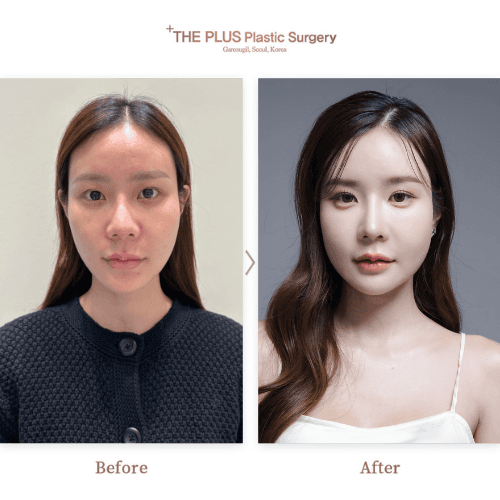
1. THEPLUS Plastic Surgery
You may consider THEPLUS Plastic Surgery for square jaw surgery if your goal is to reduce a broad or angular lower jaw and create a smoother, slimmer lower-face contour while assessing how the jaw and chin fit your overall facial proportions.
- URL: THEPLUS Plastic Surgery Website
- Location: Gangnam-gu, Seoul
- Procedure details:
- Square jaw surgery is offered to reshape a broad or angular lower jaw.
- Chin surgery is also available to adjust chin size or projection in relation to the nose, lips, and jawline.
- Full face contouring and cheekbone surgery are listed for people considering changes across more than one facial area.
- Surgical expertise:
- Dr. Kim is described as a board-certified plastic surgeon with expertise in facial contouring and research recognition related to 3D implants.
- Dr. Kim also runs annual educational sessions for other plastic surgeons.
- Related services:
- Rhinoplasty and revision rhinoplasty are available for facial-balance planning.
- Facelift, thread lift, and facial fat grafting are listed among facial rejuvenation options.
2. Made Young Plastic Surgery
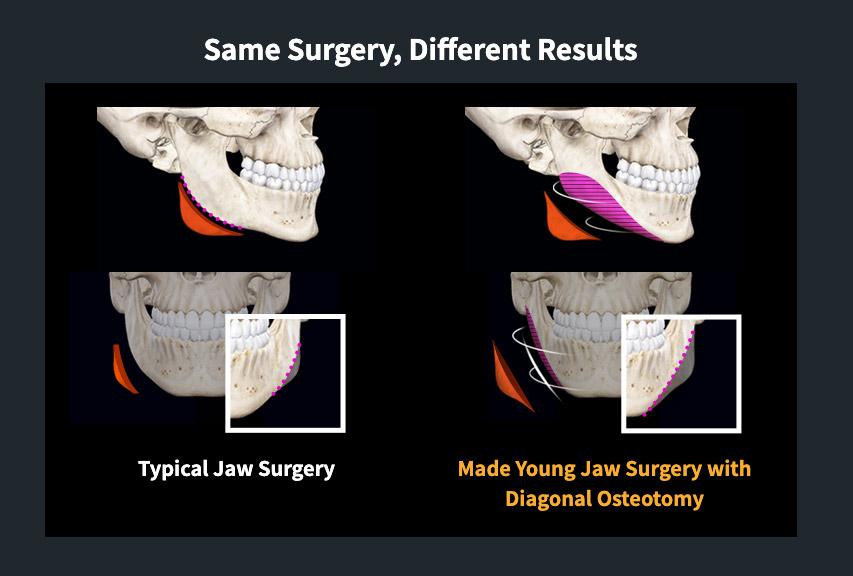
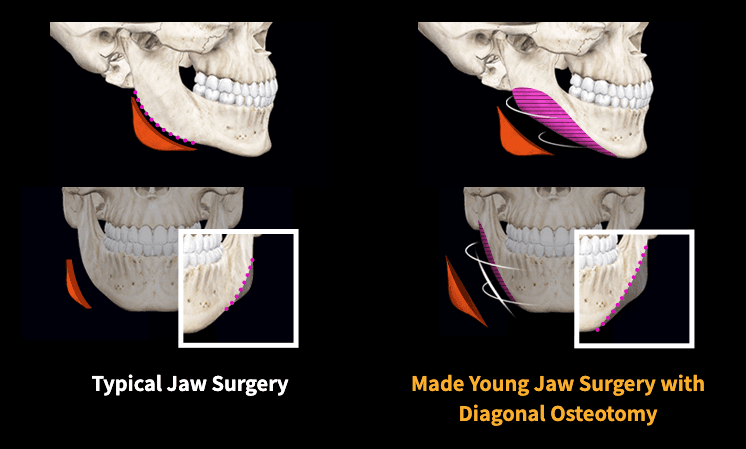
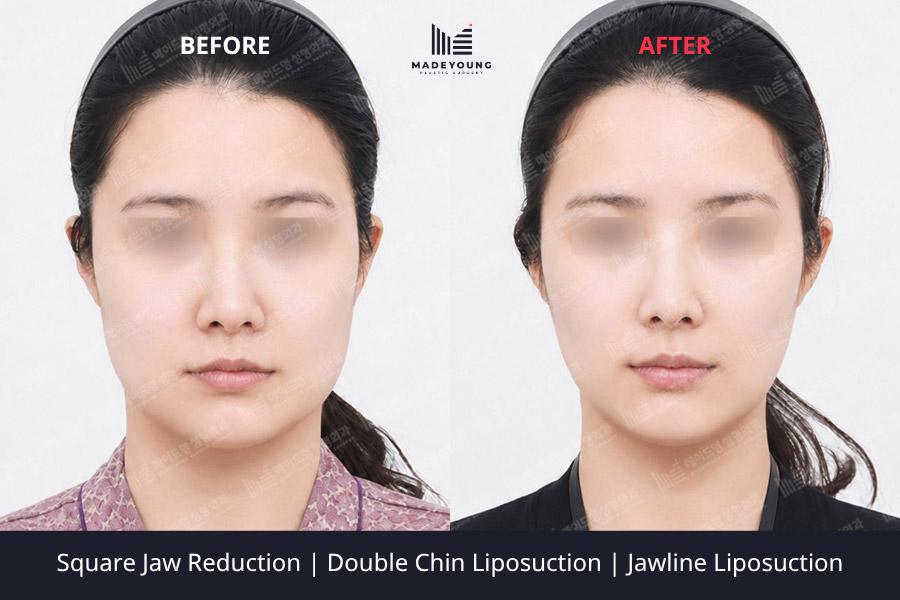
You may consider Made Young Plastic Surgery for jaw reduction surgery if you want a technique described as reducing the jaw angle and width from the ear toward the chin tip, with periosteum repositioning intended to help limit postoperative soft-tissue sagging.
- URL: Made Young Plastic Surgery Website
- Location: Seocho-gu, Seoul
- Procedure details:
- Dr. Suh Bum-sin’s described approach addresses both jaw angle and jaw width for a smooth, natural-looking reduction.
- Periosteum repositioning moves the bone membrane upward after surgery and is intended to help prevent soft-tissue drooping.
- Jaw reduction surgery, V-line surgery, metal-free V-line surgery, and genioplasty are listed facial-contouring options.
- Safety and monitoring:
- Full-time board-certified anesthesiologists are listed as being on site.
- The clinic describes one-to-one anesthesiologist monitoring during procedures and a cross-check system involving multiple anesthesiologists in an emergency.
- Full CCTV coverage of procedures is stated.
- Aftercare:
- A separate dedicated aftercare center is listed for systematic post-procedure care.
- The medical team is described as providing direct consultation and diagnosis before a procedure.
3. id Hospital Korea
You may consider id Hospital Korea for jaw surgery because orthognathic surgery and facial contouring are listed among its treatment areas, alongside a stated focus on customized planning, patient safety, and systematic post-care.
- URL: id Hospital Korea Website
- Location: Gangnam-gu, Seoul
- Procedure scope:
- Orthognathic surgery and facial contouring are listed treatment areas.
- Dentistry is also listed among the clinic’s services, which may be relevant when your jaw-surgery assessment involves dental considerations.
- Additional services:
- Eye and nose plastic surgery, breast surgery, lifting, skin-clinic care, and petit plastic surgery are also listed.
- The clinic describes its approach as customized and safety-oriented, with systematic post-care.
How Much Does Square Jaw Surgery Cost in Korea?
Square Jaw Surgery is supplied at ₩5,500,000–₩8,800,000 (approximately US$4,100–US$6,500). Individual quotes vary because the planned bone-contouring extent and any combined lower-face procedure determine the operative resources required.
| Procedure Price | Korean Won (₩) | USD ($) |
|---|---|---|
| Low Price | ₩5,500,000 | $4,100 |
| High Price | ₩8,800,000 | $6,500 |
Exchange rate as of 2026-09-06: 1 KRW = 0.000741 USD.
What Affects the Price?
- Extent of mandibular bone reduction — A standard mandibular-angle ostectomy treats the prominent gonial corner, while a long curved ostectomy extends forward along the lower border and lateral cortex reduction addresses outer-bone thickness. Broader or multi-part contouring requires more bone-cut planning, operating time, and surgical work to create a smooth continuous jawline.
- Combined chin contouring or genioplasty — Angle reduction combined with chin contouring or genioplasty, often marketed as V-line surgery, adds a separate chin procedure. Chin osteotomy requires additional operative steps, fixation requirements, nerve considerations, and recovery management beyond isolated angle reduction.
- Orthognathic treatment when bite or jaw position requires correction — When malocclusion, skeletal jaw-position problems, or marked asymmetry require orthognathic surgery, treatment becomes a functional jaw-surgery pathway rather than isolated cosmetic angle reduction. Jaw repositioning increases planning, operating time, anesthesia exposure, facility resources, and postoperative care needs.
- Imaging and in-person surgical planning — Mandibular-angle surgery requires examination of facial shape, bite, and TMJ status, with radiographic planning. CT or cone-beam CT may be needed when nerve location, asymmetry, three-dimensional anatomy, or simultaneous chin work requires more detailed assessment, adding diagnostic resources to the treatment plan.
Cost tip: Request an itemized quote that clearly states what is included, particularly the planned osteotomy type, imaging and pre-anesthesia assessment, anesthesia, operating-facility use, any chin procedure or fixation, medicines, postoperative reviews, and records for overseas follow-up.
The US$4,100–US$6,500 conversion is approximate, based on an exchange rate of 0.000741 on 2026-09-06. Check the exchange rate again when budgeting.
Square Jaw Surgery From Start to Finish
- Remote enquiry and consultation — Send neutral frontal, oblique, and profile photographs, plus dental or orthodontic records when available. Confirm English or interpreter support, but understand that a photo review cannot replace an in-person examination or final surgical plan.
- Pre-travel surgical review — Discuss prior facial or jaw surgery, bite changes, TMJ symptoms, sleep or airway concerns, allergies, medical conditions, medicines, supplements, nicotine, alcohol, recreational substances, and previous anesthesia problems. Clarify whether the proposed plan is isolated angle reduction, lateral cortex reduction, or combined chin surgery.
- In-person assessment in Korea — The surgeon examines facial proportions from several views, reviews dental occlusion and TMJ function, and obtains standardized photographs. Planning can include panoramic imaging, cephalometry, CT, or cone-beam CT when nerve location, asymmetry, chin work, or three-dimensional anatomy requires it.
- Pre-anesthesia clearance and consent — Meet the anesthesia team, complete required tests, review fasting instructions, and consent to specific risks: bleeding, fracture, lower-lip or chin sensory change, facial-nerve injury, infection, bite change, asymmetry, contour irregularity, and revision. Confirm the named surgeon, operating setting, and emergency-transfer plan.
- General anesthesia and intraoral contouring — The operation is commonly performed under general anesthesia through incisions inside the mouth. The surgeon exposes each mandibular angle, makes planned bone cuts with a saw or piezoelectric instrument, removes or reshapes bone, smooths edges, controls bleeding, and closes the oral incisions. A drain is sometimes used for more extensive surgery.
- Recovery room and discharge — Some patients go home the same day; others stay overnight because of surgical extent, swelling, nausea, bleeding risk, hydration, or combined procedures. Discharge follows airway assessment, adequate drinking, safe mobility, urination, and controllable pain and nausea.
- Early in-Korea recovery — Attend scheduled reviews for wound assessment, drain removal when used, and diet progression. Expect swelling, tightness, limited mouth opening, and temporary altered sensation in the lower lip or chin; swelling is often most apparent during days 3–7.
- Return-home and remote follow-up — Receive explicit fitness-to-fly clearance before departure. Send requested photographs, attend video reviews, and seek urgent local assessment for breathing or swallowing difficulty, rapidly enlarging swelling, heavy bleeding, fever with worsening pain, dehydration, or a new bite change.
Alternatives to Square Jaw Surgery
The right alternative depends on what creates the broad lower face. Non-surgical choices cannot remove mandibular bone but avoid an osteotomy and general anesthesia; surgical alternatives can address a different anatomical cause but add their own recovery and risk profile.
Masseter Botox
- Best for — Muscle-dominant masseter enlargement, especially when clenching or bruxism contributes to a broad lower face.
- Trade-off — Masseter Botox is temporary and needs repeat treatment; it cannot narrow a jaw widened by bone.
Surgical Masseter Reduction
- Best for — Carefully selected muscle-related width where non-surgical reduction is insufficient or unsuitable.
- Trade-off — Masseter reduction is not automatically necessary simply because the face appears broad and has separate functional and contour trade-offs.
V-Line Surgery or Genioplasty
- Best for — A chin that is too wide, long, short, recessed, or poorly proportioned relative to the jaw angle.
- Trade-off — Chin surgery or V-line surgery can create a more integrated lower-face change, but chin osteotomy introduces fixation, nerve, and recovery issues.
Double-Jaw Surgery
- Best for — Clinically important malocclusion, jaw-position discrepancy, pronounced asymmetry, or functional concerns requiring oral-and-maxillofacial and orthodontic care.
- Trade-off — Double-jaw surgery treats function and skeletal position but is not a lower-risk substitute for cosmetic angle reduction.
Facial Liposuction or Facelift
- Best for — Lower-face width driven by fat or skin laxity rather than mandibular bone.
- Trade-off — Face liposuction and a face lift can address soft tissue but do not reduce the jawbone.
How Can I Prepare for Square Jaw Surgery?
- Medical disclosure — Give the surgeon and anesthesiologist a complete list of medical conditions, allergies, prior anesthesia problems, jaw surgery, dental treatment, crowns, implants, orthodontics, bruxism, TMJ symptoms, and sleep or airway concerns.
- Medicines and supplements — Report aspirin, NSAIDs, anticoagulants, antiplatelet drugs, diabetes medicines including GLP-1 drugs, corticosteroids, psychiatric medicines, opioids, isotretinoin, hormones, fish oil, vitamin E, ginkgo, ginseng, garlic, turmeric/curcumin, St John’s wort, and all herbal products. Do not stop anticoagulants, psychiatric medicines, or diabetes drugs without a written plan from the prescribing clinician and surgical/anesthesia teams.
- Dental and oral health — Complete necessary dental treatment and resolve oral infection or periodontal disease before an elective intraoral operation. Bring relevant dental records.
- Nicotine, alcohol, and substances — Meet the surgeon’s nicotine-cessation requirement and disclose vaping, cannabis, stimulants, cocaine, opioids, and alcohol honestly. Avoid alcohol with sedating pain medicines unless the care team explicitly approves it.
- Fasting — Follow the facility’s exact pre-anesthesia instructions. Fasting requirements depend on the anesthetic plan; the treating team’s instructions override general online guidance.
- Accommodation and transport — Stay close enough to the surgical facility for prompt review. Arrange door-to-door transport, do not manage luggage alone, and stock approved liquids or soft foods, fluids, oral-care supplies, prescribed medicines, and extra pillows.
- Companion and flexible travel — Arrange a responsible adult for the first night and keep flights changeable. Do not pre-book a long-haul return flight before the surgeon can assess early recovery.
Travel note: Bring printed and digital copies of your medical history, medication list, emergency contacts, and travel insurance details. Check whether the policy covers complications of elective surgery.
Confirm the clinic’s individualized medicine-stop schedule, fasting rules, imaging requirements, and travel plan; the treating doctor’s instructions take precedence over this general guidance.
Aftercare Advice
Protect the surgical site, follow the prescribed diet, and treat new airway, bleeding, or infection symptoms as urgent—not as normal postoperative swelling.
- Diet and hydration — Maintain the prescribed liquid or non-chewing soft diet and advance chewing only when the surgeon clears it. Drink regularly; dehydration and inability to take fluids require prompt review.
- Oral care — Brush gently and use prescribed rinses exactly as directed. Avoid vigorous spitting, aggressive rinsing, and forceful mouth opening while intraoral wounds heal.
- Swelling and contact — Keep the head elevated when directed. Do not massage, press, or use an unapproved compression device on the jawline; use a prescribed garment only as instructed.
- Activity and heat — Walk lightly, but avoid strenuous exercise, heavy lifting, contact sports, saunas, hot yoga, and heat exposure that worsens swelling until the operating surgeon clears them. Do not resume unrestricted chewing or strenuous activity simply because pain has improved.
- Medicines and nicotine — Take only prescribed or surgeon-approved medicines. Do not add antibiotics, steroids, NSAIDs, or supplements without approval; avoid smoking, vaping, and all nicotine according to the surgeon’s cessation plan.
- Urgent warning signs — Seek urgent local care for trouble breathing, swallowing, or handling saliva; rapidly expanding facial or neck swelling; persistent or heavy oral bleeding; fever with worsening pain or swelling; pus or foul drainage; repeated vomiting; a new bite change; chest pain; shortness of breath; fainting; or leg swelling during travel.
- Results and reviews — Swelling, tightness, limited opening, and lower-lip or chin sensory changes are common early on. Plan 10–14 days before routine public-facing activity, roughly 2–4 weeks before most non-contact work, and 6–12 months for soft-tissue settling and bone remodeling to show a more stable contour. Persistent numbness, marked asymmetry, contour step-off, or restricted opening needs surgeon review.
Follow the operating surgeon’s instructions over general guidance and contact the clinic promptly whenever healing appears to worsen or something feels wrong.
Frequently Asked Questions
Related Blogs
Discover South Korea's Competitive Edge: Double Chin Tightening Cost Comparison Across Leading Countries
Discover the latest on double chin tightening procedures in Korea, exploring various techniques and their costs. Learn how these advanced treatments can help you achieve a more contoured facial profile while considering your budget.
Updated: Sep 25, 2026
Discover the Global Cost Breakdown for Chin Implants: Is Korea Your Best Bet?
Discover the affordability and quality of chin implants in Korea, a popular destination for cosmetic surgery. This article explores the average costs, factors influencing prices, and why Korea is a top choice for enhancing facial aesthetics.
Updated: Sep 25, 2026
Cheekbone Reduction in Korea: Methods, Recovery, Risks, and Travel Planning
Cheekbone reduction uses bone shaving, partial cuts, or L-shaped osteotomy with repositioning to narrow prominent zygomatic body or arch contours. In Korea, costs range from ₩5,500,000–₩18,000,000; international patients should plan 10–14 days locally for recovery and postoperative review.
Updated: Sep 20, 2026
Masseter Reduction in Korea: Candidacy, Surgery, Recovery, Risks, and Travel Planning
Masseter reduction removes a planned portion of deep chewing muscle through an intraoral incision after confirming muscle-driven lower-face width and assessing dental, bite, jaw, and anesthesia factors. International patients can review Korea provider registration, plan at least 10–14 days after isolated surgery, attend follow-ups, arrange flexible flights, and obtain operative records and emergen
Updated: Sep 19, 2026
Clinics offering Square Jaw Surgery

THEPLUS Plastic Surgery Korea | Eye, Nose, Face & Body Surgery
Sinsa

Made Young Plastic Surgery: Rejuvenating Aesthetic Excellence in Korea for Face Lifts, Contouring and More
Gangnam Station
ID Hospital - Main Branch in Korea: Specializing in Safe & Customized Facial Plastic Surgery and Post-Care Services
Sinsa

D.A Plastic Surgery Clinic in Korea: Advanced Cosmetic Procedures for Natural Beauty Enhancement
Gangnam Station