
Medical Tourism Blog
Revision Rhinoplasty in Korea: Methods, Recovery, Travel Planning, and Alternatives

Table of contents
- Revision Rhinoplasty at a Glance
- What Is Revision Rhinoplasty?
- Who Is a Good Candidate for Revision Rhinoplasty?
- How Is Revision Rhinoplasty Performed?
- Why Visit Korea for Revision Rhinoplasty?
- Key Information for International Patients
- Which Are the Best Clinics in Korea for Revision Rhinoplasty In?
- How Much Does Revision Rhinoplasty Cost in Korea?
- Revision Rhinoplasty From Start to Finish
- Alternatives to Revision Rhinoplasty
- How Can I Prepare for Revision Rhinoplasty?
- Aftercare Advice
Considering treatment in Korea? Everything you need to know e.g. — how to avoid scams, visas, interpreters, recovery tips — in our Medical Tourism Master Guide. Plan with confidence in minutes, not weeks!
Last updated: September 2026
Revision Rhinoplasty at a Glance
- What it treats — Revision rhinoplasty is repeat nose surgery that corrects persistent cosmetic, structural, or breathing problems after a prior rhinoplasty, such as deformity, scar contracture, implant issues, valve collapse, or septal deviation.
- Typical cost in Korea — Revision rhinoplasty is quoted at ₩8,200,000–₩20,000,000, approximately US$6,100–$14,800; open reconstruction, airway repair, implant removal, and ear or rib cartilage grafting can increase the quote.
- Often needs cartilage rebuilding — Prior surgery can leave scar tissue, weak support, or too little septal cartilage, so complex revisions commonly use grafts from the septum, ear, or rib to rebuild the bridge, tip, or nasal valves.
- Long result timeline — Bruising usually improves in 1–2 weeks, but visible swelling and stuffiness last longer; a scarred revision nose, particularly the tip, may take 12–18 months to settle into its final contour.
- Wait before elective revision — Elective revision is commonly deferred until about 12 months after the prior rhinoplasty so swelling and scar maturation can be distinguished from a stable problem; infection, implant extrusion, severe obstruction, or trauma may require earlier care.
- Korea travel planning — International patients should plan to remain in Korea for at least 10–14 days after surgery for splint and wound checks, bleeding or infection assessment, and the operating surgeon’s individualized fit-to-fly clearance.
- Korea-specific consideration — Korea offers international-patient services and surgeons familiar with augmentation implants and cartilage reconstruction, but no high-quality evidence shows revision rhinoplasty there has lower complication or reoperation rates than surgery in other countries.
What Is Revision Rhinoplasty?
Revision rhinoplasty is repeat nose surgery performed to correct persistent cosmetic, structural, or breathing concerns after an earlier rhinoplasty. It aims to restore a balanced nasal shape, improve support or airflow, and address problems that remain after healing. Revision rhinoplasty is a surgical procedure.
Who Is a Good Candidate for Revision Rhinoplasty?
- Stable post-rhinoplasty concern — Good candidates have a persistent contour, support, implant, scar-contracture, or breathing problem after a previous rhinoplasty or septorhinoplasty, rather than normal early swelling.
- Combined form and airway goals — Revision can address a saddle or over-resected bridge, crookedness, pinching, pollybeak deformity, tip droop, nostril asymmetry, weak nasal valves, septal deviation, retained implant problems, or graft distortion.
- Prepared for reconstruction — Suitable patients understand that scar release and cartilage grafting are frequently needed because prior surgery can weaken support or leave too little septal cartilage.
- Realistic decision-maker — A good candidate accepts that perfect symmetry is not achievable, the tip can remain swollen for many months, and another procedure can sometimes be necessary.
Elective revision is commonly deferred until roughly 12 months after the last rhinoplasty, when swelling and scar maturation are easier to distinguish from a stable deformity. Earlier treatment needs individualized assessment for infection, implant extrusion, severe obstruction, or trauma. Active nasal, skin, dental, or systemic infection; uncontrolled medical disease; a bleeding disorder; inability to undergo anesthesia safely; and medications that cannot be adjusted safely can rule out or delay surgery. Nicotine exposure, untreated body dysmorphic disorder, and blockage caused primarily by allergy, inflammation, or medication rather than a structural defect also require treatment or assessment before surgery.
How Is Revision Rhinoplasty Performed?
Revision planning is driven by what prior surgery changed: scar tissue, skin thickness, remaining cartilage, implant history, valve support, and the number of previous operations. The surgeon should assess breathing and appearance together rather than treating the visible deformity alone.
- Open revision approach — An incision across the columella, the skin strip between the nostrils, provides broad exposure for extensive scar release, implant removal, cartilage rebuilding, and complex tip or valve work. It is commonly used for structural revisions.
- Closed revision approach — Incisions remain inside the nostrils. This can suit selected, limited corrections where broad framework reconstruction is not required.
- Structural cartilage reconstruction — Spreader grafts widen and support the internal nasal valve; alar batten grafts reinforce weak sidewalls; septal-extension or columellar-strut grafts support the tip. Dorsal onlay and diced-cartilage techniques can rebuild or camouflage the bridge.
- Graft-source planning — Remaining septal cartilage is preferred when sufficient. Ear cartilage suits smaller, naturally curved grafts; autologous rib cartilage provides greater volume and strength when septal cartilage is depleted, but adds a chest scar and donor-site pain. Uncommon rib-harvest risks include chest-wall deformity and pneumothorax.
- Donor versus processed rib cartilage — A 2026 meta-analysis of 27 observational studies found lower pooled warping and revision rates with fresh-frozen than autologous costal cartilage, while infection and resorption differences were not statistically significant. The studies mixed primary and revision operations and varied widely in technique, so these data do not establish the best graft for an individual complex revision.
- Functional revision septorhinoplasty — Septoplasty and nasal-valve repair can be combined when documented structural obstruction is present. Allergy- or inflammation-driven congestion needs medical management as well as, or instead of, surgery.
Why Visit Korea for Revision Rhinoplasty?
South Korea has a substantial international-patient care sector and practical access to clinicians familiar with augmentation rhinoplasty, implants, and cartilage grafting. That access does not prove better revision-rhinoplasty safety or outcomes than care elsewhere. Choose on the operating surgeon’s qualifications, reconstructive experience, licensed facility, anesthesia plan, graft documentation, and continuity of care after departure.
- International-care infrastructure — Korea’s Ministry of Health and Welfare reports continuing policy support for attracting and serving international patients through registered medical institutions and related services. Review the government framework for international patients alongside the clinic’s own written arrangements.
- Relevant reconstructive exposure — Revision candidates can seek surgeons who routinely evaluate silicone implant complications, depleted septal cartilage, scarred soft tissue, and the need for ear or costal-cartilage reconstruction. Ask for case-specific experience rather than relying on destination reputation.
- Graft-material discussion — Published cartilage comparisons provide a basis for discussing autologous, fresh-frozen, and irradiated homologous costal cartilage, but a broader review of processing methods emphasizes limited comparative evidence. Obtain the exact proposed material, source, and rationale in writing.
- Important evidence limit — No high-quality comparative research establishes lower complication, revision, or reoperation rates for revision rhinoplasty in South Korea than in the United States or other countries. Even deformity-specific evidence, such as a review of postoperative contracted-nose correction, cannot provide a universal outcome estimate for every secondary rhinoplasty.
Key Information for International Patients
- Minimum stay — Plan to remain in Korea for at least 10–14 days after surgery. External splint and, when used, external suture removal often occurs around day 6–7, but this is not an automatic departure date.
- Fit-to-fly clearance — No universal revision-specific study defines a safe postoperative flight day. Stay for wound and splint review, bleeding and infection assessment, and explicit clearance from the operating surgeon before a long-haul flight.
- Longer-stay factors — A complex reconstruction, septoplasty or nasal-valve repair, rib-cartilage harvest, infection history, packing issues, or delayed healing can require a longer stay.
- Activity and itinerary — Light daily activity is often possible after several days. Bruising generally improves over 1–2 weeks, but nasal stuffiness and visible swelling persist longer; do not schedule strenuous sightseeing, hiking, nightlife, or business commitments during the early recovery period.
- Remote follow-up — Arrange scheduled photo or video reviews before surgery, plus a direct after-hours contact. Obtain an operative summary identifying grafts and removed or retained implants, medication instructions, and postoperative photographs before leaving.
- Care at home — Identify an ENT, facial plastic surgeon, or plastic surgeon near home for urgent in-person assessment. Remote review does not replace examination for infection, tissue compromise, major bleeding, or significant obstruction.
Travel note: Travel with a responsible adult who can take you from the facility and stay overnight after general anesthesia. Keep flights flexible until the surgeon has examined the nose and cleared travel.
Which Are the Best Clinics in Korea for Revision Rhinoplasty In?
Listed below are some of the best clinics in Korea for revision rhinoplasty in.
1. THEPLUS Plastic Surgery
For revision rhinoplasty, you can consider THE PLUS Plastic Surgery for a structural and aesthetic approach led by surgeons whose work includes revision-focused education, academic publishing, and international rhinoplasty teaching. The clinic describes revision surgery as addressing concerns from an earlier operation while working toward a more stable nasal structure and refined facial balance.
- URL: THEPLUS Plastic Surgery Website
- Location: Gangnam-gu, Seoul
- Rhinoplasty expertise:
- Dr. Jeong Jae-yong authored “Rebuilding Nose: Rhinoplasty for Asians,” which has Japanese and English editions used as educational resources.
- Dr. Kim Taek-kyun wrote rhinoplasty and revision-rhinoplasty chapters for “The 18 Masters of Korean Aesthetic Surgery.”
- Dr. Jeong and Dr. Kim have presented research and techniques through forums including the Seoul Rhinoplasty Forum, KSPRS, and IFAAS.
- Surgical approach:
- The rhinoplasty philosophy described by the clinic emphasizes facial harmony rather than treating the nose in isolation.
- Dr. Jeong’s stated approach combines functional and aesthetic considerations.
- Revision rhinoplasty is presented as a procedure to correct prior surgical concerns and restore a more stable nasal framework.
- Credentials and academic roles:
- Dr. Kim is a board-certified plastic surgeon and has received research awards related to 3D implants.
- Dr. Jeong is identified as President of the Korean Society of Plastic Surgeons.
- Both surgeons have participated in surgical education and advisory activities in Korea, Japan, and China.

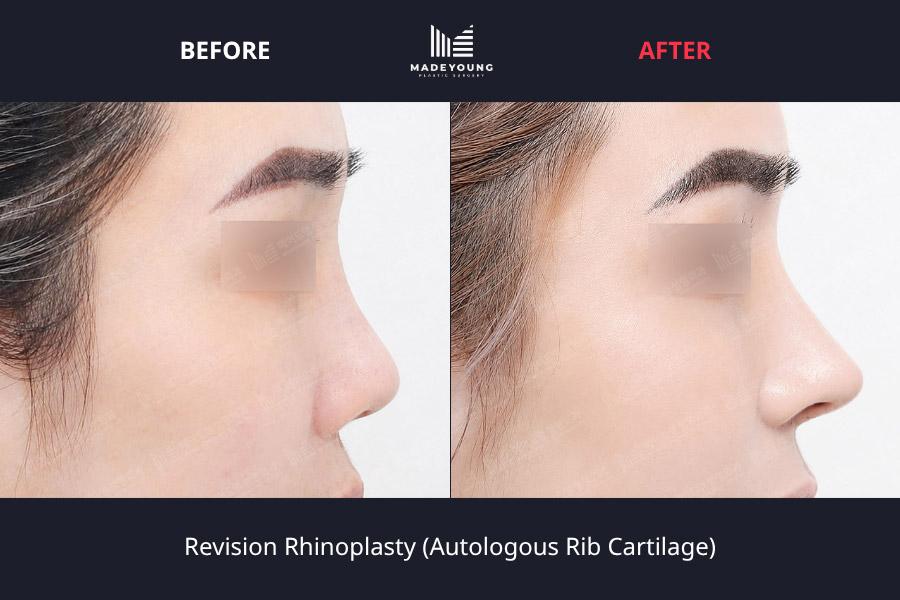
2. Made Young Plastic Surgery
You may consider Made Young Plastic Surgery for revision rhinoplasty if your previous surgery left scarring, tissue damage, or an implant-related concern requiring delicate corrective work. The clinic describes micro-dissection, capsule removal, and implant removal as part of its meticulous approach to complex revision cases, with direct medical-team consultation and diagnosis before treatment.
- URL: Made Young Plastic Surgery Website
- Location: Seocho-gu, Seoul
- Revision approach:
- The clinic focuses on precise dissection intended to minimize additional tissue damage.
- It identifies management of scarring and tissue damage from previous surgery as a revision specialty.
- Techniques listed include micro-dissection, capsule removal, and removal of prior nasal implants when indicated.
- Anesthesia and monitoring:
- Full-time board-certified anesthesiologists are on site.
- The clinic describes a 1:1 monitoring model in which one anesthesiologist continuously monitors one person.
- A cross-check system involving multiple anesthesiologists is described for emergency assessment and response.
- Procedure areas are described as having full CCTV coverage.
- Related nasal services: Available nasal procedures include primary rhinoplasty, revision rhinoplasty, reconstruction rhinoplasty, and rhinoplasty implant removal.
- Aftercare: The clinic operates a separate aftercare center and describes a systematic post-procedure care program.
3. LABOM Plastic Surgery
At LABOM Plastic Surgery, you can expect a diagnosis-first revision rhinoplasty evaluation that investigates why the prior result caused aesthetic or functional concerns before a correction is proposed. The clinic uses 3D CT analysis of nasal bone shape, cartilage condition, and implant position, and describes individualized planning for issues such as displacement, inflammation, thinning tip skin, septal deviation, or nasal-valve problems.
- URL: LABOM Plastic Surgery Website
- Location: Gangnam-gu, Seoul
- Evaluation and planning:
- Your assessment is intended to identify the cause of both appearance and breathing-related concerns, rather than relying on visual evaluation alone.
- 3D CT imaging is used to assess nasal bones, cartilage, and the current implant position.
- The clinic distinguishes implant malposition from contamination or infection because these concerns may require different treatment.
- Surgical design is tailored 1:1 to your nasal proportions and facial contours.
- Revision techniques:
- Implants may be removed or replaced after the cause of the original issue has been confirmed.
- Autologous cartilage grafts and dermal tissue grafts may be used to reinforce thinned nasal-tip areas.
- The clinic evaluates possible underlying structural concerns, including a deviated septum and nasal-valve problem, alongside aesthetic correction.
- Timing and recovery:
- The clinic generally recommends waiting until tissues have stabilized, typically 6 to 12 months after the first surgery; the appropriate timing depends on your condition.
- When inflammation or infection is present, it is described as needing treatment and full resolution before revision surgery.
- The stated procedure time is approximately 1–2 hours under sleep sedation, with same-day discharge.
- Stitches are typically removed at about seven days, and the stated recovery period is about 7–14 days.
- Aftercare and safety:
- The clinic describes individualized anesthesia planning and continuous monitoring.
- Postoperative care includes regular progress checks and structured support for recovery, swelling, bruising, and scar management.
- A dedicated systematic aftercare program is described for international visitors.
How Much Does Revision Rhinoplasty Cost in Korea?
Revision rhinoplasty is quoted at ₩8,200,000–₩20,000,000 (approximately US$6,100–$14,800). Individual quotes vary because a limited contour correction and a scarred structural reconstruction require substantially different operative work and resources.
| Procedure Price | Korean Won (₩) | USD ($) |
|---|---|---|
| Low Price | ₩8,200,000 | $6,100 |
| High Price | ₩20,000,000 | $14,800 |
Exchange rate as of 2026-09-06: 1 KRW = 0.000741 USD.
What Affects the Price?
- Extent of revision and surgical approach — A selected closed revision for a limited irregularity generally requires less dissection than an open revision with extensive scar release, removal of prior graft or implant material, and rebuilding of weakened support. Open structural reconstruction increases operating time and procedural complexity.
- Cartilage graft source and reconstruction — Using remaining septal cartilage for a small graft differs from rebuilding the bridge, tip, or nasal valves with ear cartilage or autologous rib cartilage. Rib harvest adds a donor-site procedure, operative time, consumables, postoperative care, and potential need for overnight observation.
- Functional airway repair — Revision surgery combined with septoplasty and nasal-valve reconstruction requires correction of both appearance and airflow. Spreader grafts, alar batten grafts, and septal reconstruction add structural planning, graft work, and operating time.
- Length and monitoring requirements — A long reconstruction, rib-cartilage harvest, or relevant medical factors can require more anesthesia time, recovery-room resources, and, when selected, overnight facility observation rather than routine same-day discharge.
Cost tip: Request an itemized quote that states what is included, particularly the planned approach, graft material and any rib-harvest component, anesthesia, facility or overnight-observation charges, postoperative visits, and any required splints or packing.
The US$6,100–$14,800 conversion is approximate, based on the exchange rate dated 2026-09-06. Check the exchange rate again when budgeting.
Revision Rhinoplasty From Start to Finish
- Remote inquiry and records review — Send clear standardized photographs, a timeline of every nasal operation, prior operative reports when available, implant and graft details, complication history, and current concerns. Confirm whether English consultation or interpreter support is available.
- Virtual surgical consultation — Discuss cosmetic and breathing goals, the realistic limits of revision, likely incision approach, potential graft source, recovery period, and the need to remain in Korea after surgery. A definitive plan still requires an in-person examination.
- In-person assessment and planning — The surgeon examines the outer nose and internal airway, reviews skin thickness, scarring, septal cartilage reserve, valve collapse, and any implant issue. Standardized photographs and selected nasal endoscopy or imaging can be used when clinically indicated.
- Medical and anesthesia review — Disclose allergies, prior anesthetic problems, medications, supplements, nicotine and recreational-drug use, steroid or filler history, trauma, and medical conditions. Testing and anesthesia assessment are ordered according to the operation and health history.
- Consent and travel coordination — Confirm the surgical plan, possible intraoperative changes, graft and implant strategy, hospital or outpatient facility, aftercare appointments, accommodation, responsible companion, and fit-to-fly review. Revision findings sometimes require a different reconstruction than anticipated.
- Anesthesia and surgery — Extensive revision rhinoplasty is usually performed under general anesthesia. The surgeon releases scar tissue, removes problematic material when indicated, corrects the framework and airway, and places grafts or valve support as planned. Duration depends on scar burden, graft harvest, and the extent of reconstruction.
- Recovery-room observation and discharge — Staff monitor breathing, pain, nausea, and bleeding. Many stable patients leave the same day; overnight observation can be appropriate after a long reconstruction, rib harvest, medical concern, or logistical need. Internal packing or splints can remain for 1–7 days, while an external splint commonly remains about one week.
- Early local reviews — Attend scheduled checks for the incision, splint, packing, swelling, airway, and signs of bleeding or infection. Do not remove or reposition splints, packing, tapes, or graft supports yourself.
- Departure assessment and overseas follow-up — Obtain written fit-to-fly advice, the operative record, medication plan, and emergency contact method. Continue photo/video follow-up as arranged, while seeking urgent local examination for concerning symptoms.
Alternatives to Revision Rhinoplasty
The right alternative depends on whether the main problem is still-maturing postoperative tissue, a structural airway defect, or a small cosmetic contour issue. Non-surgical choices avoid another operation but cannot rebuild weak cartilage support or reliably correct major deformity.
Observation
- Best use — Wait while postoperative swelling and scar maturation continue when there is no infection, extrusion, severe obstruction, or trauma. Elective revision is often considered around 12 months after prior surgery.
- Tradeoff — Avoids operating on an unstable nose, but does not correct a stable structural deformity or implant complication.
Septoplasty or Nasal-Valve Repair
- Best use — Consider focused airway surgery when documented septal deviation or internal/external valve collapse is the main issue and cosmetic revision is not required.
- Tradeoff — Can target breathing with less cosmetic reshaping than revision rhinoplasty, but may not correct bridge, tip, or nostril concerns. See septoplasty.
Medical Treatment for Rhinitis
- Best use — Allergy-, inflammation-, or medication-related blockage without a structural target needs a focused airway assessment and medical treatment.
- Tradeoff — This can improve congestion but cannot straighten a deviated septum or reinforce collapsed valves. See rhinitis surgery when a specialist identifies an appropriate surgical condition.
Hyaluronic-Acid Filler Camouflage
- Best use — Selected small depressions or contour irregularities can sometimes be camouflaged with temporary filler.
- Tradeoff — Filler cannot make a nose smaller or restore a deficient framework. It carries vascular risks, including skin necrosis and rare vision-threatening complications, and is not a low-risk substitute for structural revision. See non-surgical rhinoplasty.
How Can I Prepare for Revision Rhinoplasty?
- Send complete records early — Provide operative reports, implant cards, prior photographs, imaging, complication and infection history, and a list of all previous nasal procedures. Ask the clinic what records require certified translation.
- Disclose every medicine and supplement — Report prescription drugs, anticoagulants, antiplatelet drugs, aspirin, NSAIDs, vitamin E, fish oil, garlic, ginkgo, ginseng, St John’s wort, turmeric/curcumin, steroids, and recreational substances. Do not stop prescribed blood thinners independently; obtain a written plan from both the prescriber and surgeon.
- Follow the assigned stop schedule — Avoid aspirin, NSAIDs, and supplements that can affect bleeding only for the period specified by the surgical team. The correct interval depends on the drug, dose, medical indication, and anesthesia plan.
- Stop nicotine as instructed — Tell the surgeon about cigarettes, vaping, nicotine replacement, and other nicotine exposure. Nicotine impairs healing and increases postoperative risk; meet the clinic’s required cessation period before and after surgery.
- Use the written fasting instructions — Follow the anesthesiologist’s exact schedule for food, clear liquids, and regular medicines. Do not assume that an online fasting rule applies to the planned anesthesia.
- Protect the treatment area — Report active acne, skin lesions, dental infection, sinus symptoms, fever, or new nasal drainage before surgery. Avoid sunburn and do not treat a suspected infection with leftover antibiotics.
- Plan safe discharge — Reserve nearby accommodation, arrange a responsible adult for the first night, and pack loose front-opening clothing, an eyeglasses case, identification, medication list, and supplied postoperative medicines. Do not plan to drive or use public transport alone after anesthesia.
- Build flexibility into travel — Book changeable flights and avoid a fixed departure immediately after splint removal. A complex revision or an unexpected wound concern can extend the stay.
Travel note: Bring enough routine prescription medicine for the whole trip, in original labelled containers, plus copies of prescriptions and a medication summary.
Confirm all clinic-specific medication, fasting, nicotine, testing, companion, and travel requirements with the treating doctor; their individualized instructions take precedence over general guidance.
Aftercare Advice
Protect the reconstructed nose from pressure, heat, exertion, and trauma while early healing establishes the new support.
- Splints and wound care — Keep the external splint dry and leave packing, internal splints, tapes, and sutures untouched unless the clinic instructs otherwise. Use saline, ointment, antibiotics, pain medicine, or steroids only as prescribed.
- Position and swelling control — Sleep on the back with the head elevated. Apply cool, not frozen, compresses to the cheeks and under-eye area; never press directly on the nose.
- Nasal pressure — Do not blow the nose until cleared. Sneeze with the mouth open, avoid bending and straining, and keep glasses off the bridge until the surgeon permits them.
- Activity restrictions — Light walking is appropriate once cleared. Avoid heavy lifting, vigorous exercise, swimming, facial massage, contact sports, and any risk of facial impact for about 4–6 weeks or longer when the surgeon directs; restriction length depends on reconstruction extent and healing.
- Sun protection — Avoid sunburn and use broad-spectrum SPF 50 on healed exposed skin when outdoors. Protect scars and bruised skin from direct sun to reduce prolonged discoloration.
- Warning signs — Seek urgent assessment for trouble breathing, persistent or heavy bleeding, rapidly increasing pain or swelling, fever or chills, pus or foul drainage, spreading redness, wound opening, vision symptoms, severe headache, confusion, neck stiffness, or signs of medication allergy.
- Healing timeline — Bruising usually improves over 1–2 weeks, while stuffiness and visible swelling last for weeks. Do not judge the final contour early: a scarred revision nose, especially the tip, commonly settles over 12–18 months.
- Follow-up continuity — Attend local splint and wound checks before departure and complete remote reviews after returning home. Keep the operative summary available for any clinician who later evaluates the nose.
Follow the treating doctor’s instructions over general advice, and contact the clinic promptly whenever something appears wrong.
Frequently Asked Questions
Related Blogs
Comparing Septoplasty Costs: Why Korea's World-Class Care is a Top Choice for Medical Tourists
Discover the cost of septoplasty in Korea and explore why many consider it an affordable option for nasal surgery. This article breaks down the expenses, factors influencing pricing, and the benefits of undergoing the procedure in Korea.
Updated: Sep 26, 2026
Discover the Real Cost of Nasolabial Angle Adjustments: Why Korea Is a Top Destination for Facial Harmony
Discover the costs and benefits of nasolabial angle adjustment in Korea, a popular cosmetic procedure to enhance facial harmony. Explore what to expect, from pricing to the expertise of Korean surgeons, as you consider this transformative journey.
Updated: Sep 25, 2026
High-End Revision Rhinoplasty: Why Korea is a Premier Destination for Cosmetic Excellence and Savings
Explore the intricacies of revision rhinoplasty in Korea, where cutting-edge techniques meet affordability. Discover how costs compare to other countries and what factors influence the overall price of correcting previous nasal surgeries.
Updated: Sep 24, 2026
Discover the Cost of Nose Osteotomy: A Detailed Comparison of Korea vs. International Destinations
Discover why Korea is a top destination for nose osteotomy procedures, offering competitive costs without compromising on quality. Learn about the factors influencing prices and what to expect when considering this cosmetic surgery in Korea.
Updated: Sep 24, 2026
Clinics offering Revision Rhinoplasty

THEPLUS Plastic Surgery Korea | Eye, Nose, Face & Body Surgery
Sinsa

Made Young Plastic Surgery: Rejuvenating Aesthetic Excellence in Korea for Face Lifts, Contouring and More
Gangnam Station

LABOM Plastic Surgery: Expertise in Non-Surgical Nose, Facial Lifting & Anti-Aging Surgeries in Korea
Apgujeong

Okay Plastic Surgery Clinic in Korea: Comprehensive Aesthetic Procedures with Sincerity and Care
Cheongdam