
Medical Tourism Blog
Temporal Lift in Korea: Methods, Recovery, Risks and Travel Planning
Table of contents
- Temporal Lift Overview
- Which Are the Best Clinics in Korea for Temporal Lift?
- Benefits of Temporal Lift in Korea
- Cost of Temporal Lift in Korea
- Alternatives to Temporal Lift
- Conclusion
Considering treatment in Korea? Everything you need to know e.g. — how to avoid scams, visas, interpreters, recovery tips — in our Medical Tourism Master Guide. Plan with confidence in minutes, not weeks!
Have your eyes started to look “tired” even when you feel well-rested—simply because the outer brow has dropped a few millimeters? A temporal lift in Korea focuses on that exact area, subtly elevating the lateral brow and smoothing the temple region for a brighter, open-eyed look without a dramatic change in expression. This guide breaks down how the procedure works, who it’s best for, and what recovery really looks like (from swelling to follow-ups). You’ll also learn what shapes the cost in Korea and how surgical and non-surgical alternatives compare.
A Temporal Lift in Korea is a specialized facial rejuvenation procedure designed to subtly elevate the outer brow and temple area, helping create a more refreshed, open-eyed appearance while smoothing early signs of aging around the upper face. In this article, we’ll start with a clear Temporal Lift Overview, then explore the key Benefits of Temporal Lift in Korea, including how it may enhance facial balance and deliver natural-looking results. You’ll also find a practical breakdown of the Temporal Lift Procedure, guidance on who is Temporal Lift for, and what to expect regarding aftercare and recovery, from swelling and downtime to follow-up care. We’ll then discuss the cost of Temporal Lift in Korea and the factors that can influence pricing, and finally compare alternatives to temporal lift—such as non-surgical lifting options or other surgical approaches—so you can better understand which treatment may best match your goals.
Temporal Lift Overview
A temporal lift (also called a temple lift or lateral brow lift) is a facial rejuvenation procedure designed to elevate and smooth the outer (lateral) eyebrow area and the upper outer cheek/temple region. The technique targets early signs of aging that commonly appear at the temples and around the outer eye—such as lateral brow drooping, crow’s-feet accentuation, and a tired or heavy-eyed appearance—by repositioning soft tissues and improving skin tension in a controlled, natural-looking way.
In Korea, temporal lift procedures are frequently sought by patients who want subtle, “refreshed” changes rather than dramatic alteration, and are often discussed in the context of overall upper-face balance (brow shape, eyelid show, and outer canthal area).
What Areas a Temporal Lift Treats
A temporal lift is focused on the upper outer third of the face, especially:
- Lateral brow and tail of the eyebrow: Lifts a brow tail that has descended with age or genetics, which can make the eyes look smaller or heavier.
- Temple and lateral orbital area: Reduces laxity and improves smoothness around the outer eye region.
- Upper outer cheek transition: In some techniques, gentle upward repositioning can improve the transition between the temple and upper cheek, indirectly softening the appearance of early sagging.
- Crow’s-feet region (indirectly): By improving tissue positioning and tension, some patients notice reduced wrinkling at rest; dynamic crow’s-feet caused by muscle movement may still require neuromodulators (e.g., botulinum toxin) for best control.
It is not intended to correct lower-face sagging, deep nasolabial folds, or prominent jowls—those are typically addressed with different procedures (midface lift, lower facelift, or lifting energy devices depending on severity).
How It Works (Anatomy and Mechanism)
Aging and repeated facial expression gradually weaken the support of the brow fat pad, skin, and fibrous connections that help maintain brow position. The lateral brow often drops earlier and more noticeably than the medial brow, especially in people with:
- naturally low or straight brow shape
- thicker skin or heavier soft tissue
- strong brow-depressing muscles (e.g., orbicularis oculi activity)
- a history of sun exposure or weight fluctuations
A temporal lift aims to restore a more youthful lateral brow position by:
- releasing selected tethering attachments in the temple/lateral brow region
- elevating and securing soft tissue to a higher, more youthful vector
- redistributing tension to reduce heaviness over the lateral upper eyelid
This can create a brighter, more open eye area without necessarily changing the overall “identity” of the face when properly planned.
Which Are the Best Clinics in Korea for Temporal Lift?
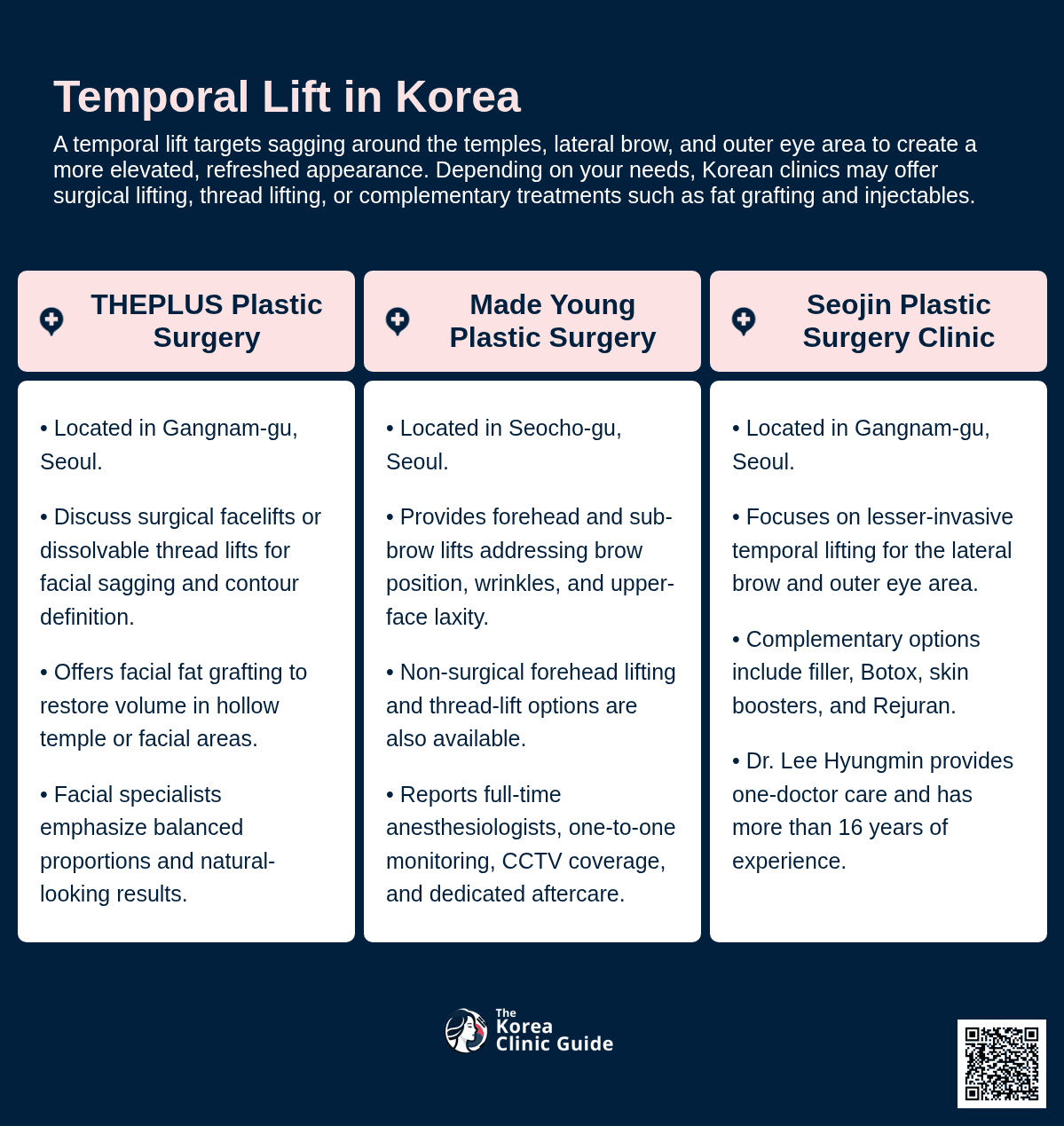
Listed below are some of the best clinics in Korea for temporal lift.
1. THEPLUS Plastic Surgery
For a temporal-lift consultation, you can explore facial lifting approaches within a practice that also offers facelifts, thread lifts, and facial fat grafting. The clinic’s stated emphasis on balanced facial features may be relevant if your goal is to refresh the upper-face or temple area while maintaining natural expression.
- URL: THEPLUS Plastic Surgery Website
- Location: Gangnam-gu, Seoul
- Lifting options:
- You can discuss a surgical facelift for repositioning sagging facial tissue, or a thread lift using dissolvable threads for mild facial sagging and contour definition.
- Face fat grafting is also offered to restore volume in hollow or flattened facial areas.
- Relevant surgical expertise:
- Dr. Kim is a board-certified plastic surgeon with a stated focus on facial contouring and an approach centered on balanced facial proportions.
- Dr. Jeong is President of the Korean Society of Plastic Surgeons and emphasizes combining function and appearance in his practice.
2. Made Young Plastic Surgery
You may consider Made Young Plastic Surgery for a temporal-lift discussion if you want to compare brow- and forehead-focused surgical lifting with non-surgical forehead or thread-lift options. The clinic states that its medical team provides direct consultation and diagnosis before treatment and that its doctors average more than 15 years of experience.
- URL: Made Young Plastic Surgery Website
- Location: Seocho-gu, Seoul
- Upper-face lifting options:
- You can discuss a forehead lift, which raises the brows and addresses forehead wrinkles and sagging skin, as well as a sub-brow lift focused on elevating the area above the eyebrow.
- Non-surgical forehead lifting and thread lifting are also listed among the clinic’s non-invasive lifting services.
- Safety and monitoring:
- Full-time board-certified anesthesiologists are on site.
- The clinic describes one-to-one anesthesiologist monitoring during procedures, with a cross-check system involving multiple anesthesiologists in an emergency.
- It reports full CCTV coverage of procedures and a separate aftercare center.
3. Seojin Plastic Surgery Clinic
At Seojin Plastic Surgery Clinic, you can consider a temporal lift as a lesser-invasive option focused on elevating the lateral brow and eye area. Your care is provided end to end by Dr. Lee Hyungmin, allowing your consultation and treatment planning to remain with one doctor.
- URL: Seojin Plastic Surgery Clinic Website
- Location: Gangnam-gu, Seoul
- Procedure focus:
- Temporal lift is listed as a lesser-invasive facial-lifting option targeting the lateral brow and eye area.
- You can also discuss complementary non-surgical options, including filler, Botox, skin boosters, and Rejuran.
- Personalized care:
- As a one-doctor clinic, Dr. Lee Hyungmin provides end-to-end care.
- Dr. Lee has more than 16 years of experience and was recognized as one of the 100 Good Doctors in Korea.
Common Techniques Used in Korea
The term “temporal lift” can describe a range of methods, and technique selection depends on anatomy, desired change, scarring tolerance, and whether it is being combined with other procedures.
1) Incision-based temporal lift (hairline/temple incision)
- A small incision is made within the hair-bearing temple or near the temporal hairline.
- The surgeon elevates tissue planes and fixes the lateral brow/temple tissues higher.
- This can be done as a limited open lift or with endoscopic assistance.
- Often chosen when more structural lift is needed compared with non-surgical options.
2) Endoscopic temporal/brow lift
- Uses small incisions hidden in the hair-bearing scalp.
- An endoscope (camera) helps visualize and release tissues precisely.
- Fixation is applied to maintain the new brow position.
- May be preferred for patients who want minimized visible scarring and a controlled lift of the outer brow, sometimes extending to a broader brow lift depending on the plan.
3) Suture-based or minimal-incision lifting
- Some clinics describe “thread” or “suture” approaches as a type of temporal lifting.
- These methods can provide modest elevation, but durability varies widely based on materials, fixation method, tissue quality, and degree of laxity.
- They are sometimes positioned as intermediate options between devices/threads and formal surgical lifting.
Because naming conventions can differ by clinic, it is important for patients to clarify exactly what plane is lifted, where incisions are located, and how fixation is performed.
Expected Aesthetic Changes
A well-executed temporal lift typically aims for a natural lateral brow elevation rather than an over-arched or “pulled” look. Commonly described outcomes include:
- a more defined brow tail and improved lateral brow symmetry
- reduced appearance of lateral upper eyelid hooding (skin bunching over the outer eyelid)
- a more rested eye expression, especially in photos
- improved contour in the temple-to-brow transition, which may subtly brighten the upper face
The change is often described as refinement rather than a large transformation, particularly for younger patients or those with mild-to-moderate laxity.
Who May Be a Good Candidate
Patients often considered good candidates include those with:
- lateral brow descent or asymmetry that makes the eyes look uneven or tired
- mild-to-moderate temple and outer eye laxity
- outer eyelid hooding primarily caused by brow descent (rather than eyelid skin excess alone)
- desire to improve upper-face freshness without a full facelift
Patients may be less suitable if they have:
- severe brow ptosis requiring a broader brow lift plan
- predominant eyelid skin excess better treated with [upper blepharoplasty](/blog/upper-blepharoplasty-korea) (sometimes combined)
- unrealistic expectations for wrinkle removal (dynamic wrinkles may persist)
- medical conditions that increase surgical risk or impair wound healing
Individual assessment is important because a small change in brow height and shape can significantly alter facial expression.
Relationship to Upper Blepharoplasty and Other Eye-Area Procedures
A temporal lift is frequently discussed alongside eyelid surgery because the brow and upper lid are mechanically linked.
- If the brow has descended, removing too much upper eyelid skin without addressing the brow can create an unnatural result or worsen heaviness over time.
- Combining a temporal lift with upper blepharoplasty may help achieve a more balanced improvement—addressing both brow position and lid skin.
- Some patients pursuing a more open eye appearance may also consider ptosis correction if eyelid muscle weakness is present, which is a different diagnosis and treatment pathway than brow descent.
In Korea, many facial plastic surgery plans are designed around overall harmony of the eye-brow-temple frame, not just eyelid skin.
Anesthesia and Procedure Setting
Temporal lifts may be performed under:
- local anesthesia with sedation (common for limited temporal lifts)
- general anesthesia (more common when combined with additional procedures)
Procedure time varies based on technique and whether it is combined with other surgeries. The setting may be an outpatient surgical center or clinic operating theater, depending on local regulations and the complexity of the plan.
Scarring and Hairline Considerations
Incisions are usually placed in areas intended to be discreet:
- within the temporal hair-bearing scalp
- along the temple hairline where scars can be concealed by hair styling
Key considerations include:
- risk of visible scarring in patients who wear hair pulled back
- potential for temporary hair shedding (telogen effluvium) around incision sites
- avoiding unwanted changes in the temporal hairline shape
Surgeon planning is especially important for patients with thin hair, a high hairline, or a tendency for hypertrophic scarring.
Recovery and Downtime (Typical Course)
Recovery experiences vary by technique, but commonly include:
- swelling and tightness in the temples and lateral forehead
- bruising that may track around the outer eye region
- mild discomfort or headache-like pressure in the early days
- temporary changes in sensation (numbness or tingling) around the incision and temple area
Patients are often advised to:
- avoid strenuous exercise for a period recommended by the surgeon
- sleep with head elevated initially to reduce swelling
- follow incision-care protocols to optimize scar healing
The visible “settling” period can take weeks, and subtle refinement may continue as swelling resolves and tissues stabilize.
Longevity of Results
Durability depends on:
- degree of initial laxity and skin quality
- technique used (extent of release and fixation method)
- individual healing and ongoing aging
- lifestyle factors (sun exposure, smoking, weight changes)
In general, incision-based and endoscopic approaches tend to provide more durable structural repositioning than purely suture-based or device-only methods, though individual outcomes vary.
Risks and Possible Complications
As with any surgical procedure, temporal lifts have potential risks that should be discussed in a formal medical consultation. These may include:
- asymmetry or an over/under-correction of brow height
- an overly tight or “pulled” appearance if vectors are not well planned
- scarring or scar visibility at the temple/hairline
- temporary or persistent numbness due to sensory nerve irritation
- hematoma or bleeding, swelling, infection
- hair thinning around incision sites
- rare injury to branches of the facial nerve that affect brow movement (risk depends on technique and anatomy)
- need for revision if the lift settles unpredictably or if aesthetic goals are not met
Risk profiles vary by patient health, tissue characteristics, surgical method, and the surgeon’s experience with temple-region anatomy.
Non-Surgical Alternatives and Adjuncts Commonly Considered
For mild concerns or as maintenance, some patients explore:
- neuromodulators (for dynamic lines and to reduce brow depression in select cases)
- energy-based skin tightening devices (variable lift, best for mild laxity)
- threads (modest lift, variable longevity)
- fillers (can restore temple volume and support, but do not truly lift tissues)
These options can complement a temporal lift or be used when surgical lifting is not desired, but they generally cannot replicate the structural repositioning achieved by surgery for more advanced laxity.
Key Planning Factors in Korean Aesthetic Context
Temporal lift planning in Korea often emphasizes:
- maintaining a natural brow shape (avoiding overly elevated arches)
- improving lateral eye openness without changing the patient’s recognizable features
- combining procedures strategically (e.g., upper blepharoplasty, ptosis correction, or skin treatments) based on the true cause of heaviness or tired appearance
- careful consideration of scar concealment, hairstyle preferences, and hairline stability
Benefits of Temporal Lift in Korea
A temporal lift (often called a temple lift or lateral brow lift) is a cosmetic procedure designed to elevate the outer brow and tighten the upper cheek/temple area for a more refreshed, youthful look. Korea is a popular destination for this treatment thanks to its high-volume aesthetic clinics, refined techniques, and patient-centered medical tourism systems.
Natural-looking brow and eye rejuvenation
One of the most noticeable benefits of a temporal lift is a subtle elevation of the outer eyebrow tail, which can make the eyes appear more open and rested. Many patients seek this procedure to address a “tired” or “heavy” look around the eyes without changing their overall facial identity. In Korea, surgeons commonly emphasize balanced, natural results—enhancing the eye area while keeping expressions and facial harmony intact.
Improved facial balance and a softer upper-face contour
By lifting and smoothing the temple region, the procedure can help restore a gentle curve to the outer brow and upper cheek transition. This can be especially beneficial if aging, weight changes, or natural anatomy has led to hollowness or sagging near the temples. When performed with careful planning, a temporal lift can create a more balanced upper-face profile and improve the overall frame of the face.
Targeted correction with smaller incisions
Temporal lifts are often performed using relatively short incisions hidden within the hairline, depending on technique and individual anatomy. Many Korean clinics offer minimally invasive or endoscopic approaches that focus on precise tissue repositioning. For appropriate candidates, this can mean a more targeted lift with less disruption compared with larger, more extensive facelift procedures.
Potential for refined, scar-conscious planning
A common concern with any lifting procedure is scarring. Korean aesthetic surgery is known for scar placement strategies—such as positioning incisions within the hairline—and detailed postoperative scar care guidance. While scars are an inevitable part of surgery, thoughtful incision design and meticulous closure techniques can help make them less noticeable over time.
High procedural experience in aesthetic-focused centers
Korea’s aesthetic medical field is well-known for high patient volume and specialization in facial procedures. Clinics that frequently perform brow and lifting surgeries may have more streamlined surgical workflows and detailed preoperative assessment routines. This environment can support consistency in technique and postoperative protocols, particularly for common concerns like asymmetry, brow height preferences, and eyelid–brow relationship.
Options to combine with complementary treatments
Many patients choose to pair a temporal lift with other procedures or non-surgical treatments for more comprehensive rejuvenation. Depending on needs, it may be combined with upper blepharoplasty, under-eye treatments, fat grafting, or skin tightening devices. Korea is well-equipped for this “combination approach,” offering a wide range of both surgical and non-surgical options in the same clinical setting, which can improve overall aesthetic coordination.
Efficient care pathways for international patients
For medical travelers, Korea is known for relatively organized systems supporting international care, including multilingual staff, consultation support, and coordinated follow-up plans. Many clinics provide structured preoperative evaluations and postoperative instructions tailored for visitors who may have limited time in the country. This can be particularly helpful for planning recovery milestones (swelling, bruising, stitch removal timing) around travel schedules.
Competitive value and transparent package-style pricing (in many clinics)
While costs vary widely by surgeon, technique, facility, and whether the procedure is combined with others, Korea is often considered cost-competitive relative to some other major medical tourism destinations. Many clinics provide itemized estimates or package-style pricing that includes consultations, imaging, anesthesia fees, and follow-up care, helping patients plan financially with fewer surprises.
Emphasis on personalized aesthetics and brow design preferences
Brow shape and the degree of lift are highly individualized, influenced by facial proportions, gender presentation, age, and cultural preferences. Korean aesthetic practice often places strong emphasis on detailed design discussions—how high the outer brow should sit, how to avoid an overly “pulled” look, and how the lift will interact with eyelid skin and eye shape. This personalization can help align surgical outcomes with the patient’s goals and comfort level.
Temporal Lift Procedure
1) Initial consultation and eligibility assessment
The process typically begins with a consultation where the surgeon evaluates your facial anatomy, degree of temporal and lateral brow descent, skin laxity, and overall facial balance. You’ll discuss your goals (for example, a subtle lift of the outer brow or smoothing of temple laxity) and the clinician will recommend the most appropriate approach (endoscopic temporal lift, limited-incision/“mini” temporal lift, or combination with other procedures such as upper blepharoplasty). Medical history review is essential, including prior facial procedures, tendency to scar, and any conditions that can affect healing.
2) Pre-procedure planning and preparation
Before scheduling, clinics commonly provide preoperative instructions such as temporarily stopping blood-thinning medications and supplements (only with approval from the prescribing physician), avoiding smoking/vaping, and limiting alcohol intake. Standard pre-op steps may include photographs for planning and comparison, plus basic tests if needed. The surgeon will outline incision placement (usually within the hairline at the temples), expected scar visibility, and realistic outcomes.
3) Anesthesia and day-of procedure steps
Temporal lift procedures are commonly performed under local anesthesia with sedation or under general anesthesia, depending on the technique and whether additional procedures are being done. On the day of surgery, the surgical team will mark the planned lift vectors and incision points with you upright to account for natural brow position and facial symmetry.
4) Incision placement and tissue elevation
Incisions are generally made within the temporal hair-bearing scalp to help conceal scars. Through these incisions, the surgeon gently elevates the soft tissue layers in the temple region and repositions them to create a lifted contour.
- Endoscopic technique: Uses a small camera (endoscope) and specialized instruments through short incisions to release and elevate tissues with improved visualization.
- Limited-incision technique: Focuses on the outer brow/temple area with a more localized dissection, often suited to mild-to-moderate drooping.
5) Fixation and contour refinement
Once the tissues are repositioned, the surgeon secures them using sutures and/or fixation devices as appropriate for the chosen technique. The goal is a natural-looking elevation rather than an overly tight appearance. The surgeon will check symmetry and adjust tension to balance both sides, accounting for normal minor asymmetries.
6) Closure and dressing
Incisions are closed with fine sutures or staples (commonly hidden in the hair). A light dressing or compression band may be applied to reduce swelling and help support the new position. Some patients may have small drains, though many temporal lift techniques do not require them.
7) Immediate recovery and early aftercare
After monitoring in the clinic or surgical center, you’ll receive instructions on wound care, head elevation, cold compress use (if advised), and activity restrictions. Swelling and bruising around the temples and outer eye area are common in the first days. Pain is usually manageable with prescribed or recommended medications, and you’ll be advised to avoid strenuous exercise, heavy lifting, and excessive bending for a period set by your surgeon.
8) Follow-up visits and suture/staple removal
Follow-up is used to assess healing, manage swelling, and monitor for complications such as hematoma, infection, or delayed wound healing. Sutures or staples (if used) are typically removed within about 7–14 days, depending on the closure method and individual healing.
9) Ongoing healing and timeline of results
Most swelling improves over the first few weeks, with refinement continuing for several months as tissues settle. Patients are commonly advised to limit sun exposure to incision areas and follow scar-care guidance. The final aesthetic result becomes clearer as residual swelling resolves and hair regrowth around the incision sites (if any shedding occurs) stabilizes.
10) Potential risks discussed during the process
Clinics typically review risks and safety considerations during consent, including bruising/swelling, numbness or altered sensation in the temple/scalp, temporary asymmetry, visible scarring, infection, hematoma, hairline changes, and the possibility of under- or over-correction requiring revision. Your provider will also explain warning signs that warrant urgent contact (rapid swelling, severe pain, fever, or sudden asymmetry).
Who is Temporal Lift for?
- People with early sagging at the temples or outer brows who want a subtle lift without changing their overall facial character.
- Those noticing “tired” or “heavy” eyes from mild brow descent, especially at the outer third of the eyebrow.
- Patients with crow’s-feet and lateral eye-area laxity where lifting the outer brow/temple region can soften the look.
- Individuals with mild to moderate upper-face skin laxity who are not ready for a full brow lift or facelift.
- People seeking facial balance and symmetry, including those with naturally uneven brows or slight asymmetry that has worsened with age.
- Patients who want a more open, refreshed eye appearance while keeping results natural-looking rather than dramatically arched.
- Those looking for a targeted procedure with a smaller treatment area, focusing specifically on the temporal region rather than the midface or lower face.
- Candidates who prefer combining procedures for comprehensive rejuvenation, such as pairing a temporal lift with upper blepharoplasty, skin treatments, or volume restoration (as advised by a clinician).
- Individuals in good general health with realistic expectations, who understand outcomes depend on anatomy, skin quality, and technique.
Temporal Lift Aftercare and Recovery
Recovery after a temporal lift (also called a lateral brow lift or temple lift) is typically faster and less intensive than full facelift recovery, but results and comfort depend heavily on proper aftercare. Your surgeon’s instructions should always take priority, especially regarding incision care and activity limits.
Immediately after surgery (first 24–72 hours)
- Swelling and tightness are expected. Most patients notice swelling around the temples, outer brows, forehead, and upper eyelids. Mild bruising can extend toward the eyelids.
- Cold compresses may be recommended to reduce swelling (use only as directed; avoid placing pressure directly on incisions).
- Head elevation is important. Sleep on your back with your head elevated to help limit swelling.
- Drainage and numbness can occur. A small amount of blood-tinged fluid from the incision line may be normal early on. Temporary numbness or tingling around the scalp/temple area is common.
- Pain is usually mild to moderate and managed with prescribed medications. Avoid medications or supplements that increase bleeding risk unless your surgeon approves (e.g., aspirin, certain anti-inflammatories, vitamin E, omega-3s).
Incision and wound care (first 1–2 weeks)
- Keep incision sites clean and dry as instructed. Temporal lift incisions are often hidden within the hairline; careful hygiene helps prevent irritation or infection.
- Do not scratch the scalp even if it itches during healing—itching is common as the skin repairs.
- Shampooing and hair care: Many clinics allow gentle hair washing after a set period (often a few days), using lukewarm water and mild shampoo. Avoid strong rubbing, hot showers, hair dyes, perms, and scalp treatments until cleared.
- Dressings/compression: If a light dressing or compression band is used, wear it exactly as directed to support tissues and reduce swelling.
- Sutures or staples removal (if not dissolvable) typically occurs around 7–14 days, depending on technique and healing.
Activity restrictions and daily life
- Walking is encouraged early to support circulation, but avoid activities that raise blood pressure significantly in the first week.
- Avoid heavy lifting, intense exercise, saunas, and hot yoga for at least 2–4 weeks (or longer if advised). Straining can worsen swelling or increase bleeding risk.
- Avoid bending forward repeatedly in the first week, as it can increase facial pressure.
- Return to work: Many patients return to desk work within 7–10 days, depending on bruising and comfort. Jobs requiring physical exertion may require more time.
Managing swelling and bruising
- Peak swelling often occurs around days 2–4, then gradually improves.
- Bruising typically fades within 1–2 weeks, though subtle discoloration can persist longer in some individuals.
- Warm compresses may be introduced later (only if your surgeon approves) to help bruising resolve.
- Limit alcohol and smoking. Alcohol can increase swelling; smoking and nicotine significantly impair healing and increase complication risk.
Sleeping position and facial movement
- Sleep on your back with elevation for at least 1–2 weeks to reduce swelling and avoid pressure on the temples.
- Avoid excessive facial expressions and chewing very hard foods early if you feel tension along the temple area. A soft diet for a few days may be more comfortable for some patients.
Makeup, skincare, and sun protection
- Avoid applying makeup on or near incision lines until they are fully sealed and your surgeon approves (often about 1–2 weeks).
- Skincare: Use gentle cleanser and avoid exfoliants, retinoids, acids, or strong actives near the surgical area until cleared.
- Sun protection is essential. Incisions and bruised areas can darken with UV exposure. Use hats and high-SPF sunscreen once your surgeon allows sunscreen near the area.
Common sensations during healing
- Numbness, tightness, or “pulling” sensations in the scalp/temple are typical and usually improve over weeks to months as nerves recover.
- Temporary asymmetry can occur due to uneven swelling and usually settles as swelling resolves.
- Mild lumpiness or firmness near the incision or along the lift area may be part of normal scar maturation.
When results start to look “normal”
- Many patients look socially presentable within 10–14 days, though mild swelling can persist.
- The outer brow and temple contour often continues to refine over 4–8 weeks, with scar maturation continuing for several months.
Warning signs that require medical attention
Contact your clinic promptly if you experience:
- Rapidly increasing swelling on one side, severe pain, or a tense expanding area (possible hematoma)
- Fever, worsening redness, warmth, foul-smelling drainage, or persistent pus-like discharge (possible infection)
- Vision changes, severe headache, or unusual eye pain
- Wound separation, significant bleeding, or sudden asymmetry that is worsening rather than improving
Follow-up appointments in Korea
For patients traveling to Korea for surgery, aftercare planning is important: schedule follow-ups before leaving, confirm who to contact after hours, and allow enough time in-country for early checks and suture/staple removal if needed. Many clinics also provide written aftercare guidelines and may offer remote follow-up once you return home.
Cost of Temporal Lift in Korea
The cost of a Temporal Lift (also called a temporal brow lift or lateral brow lift) in Korea varies widely by clinic, surgeon experience, technique, anesthesia type, and whether it’s performed alone or combined with other facial procedures.
Korean price range (low–high): N/A–N/A
Because clinics may quote differently (e.g., “surgery-only” vs. “all-inclusive” packages) and pricing can change based on individual anatomy and surgical plan, a single universal range isn’t reliably applicable here.
What typically determines the price in Korea
Even without a fixed “one-size-fits-all” price range, most Korean quotes are built from the same components:
- Surgeon’s fee and team fee: Experience level, reputation, and case complexity influence cost.
- Technique and incision approach: Temporal Lift methods can differ (incision length/location, fixation method, extent of dissection), affecting time and resources.
- Anesthesia and monitoring: Local anesthesia with sedation vs. general anesthesia can change facility and staffing needs.
- Facility and operating room fees: Clinic grade, safety systems, and post-op monitoring protocols can impact price.
- Pre-op evaluation and testing: Bloodwork, imaging (if needed), and medical clearance vary by patient.
- Post-op care and follow-up: Included follow-ups, wound care, medications, scar care, and compression garments (if used) may be bundled or billed separately.
- Revision policy and guarantees: Some clinics price higher but include structured follow-up or revision discounts/coverage terms.
- VAT/tax and language support: Some quotes include tax and interpreter coordination; others list them separately.
Cost comparison: Korea vs. the USA
In general, Temporal Lift pricing in the USA tends to be higher than in Korea for comparable elective cosmetic procedures. The difference is often driven by:
- Higher overhead in the US: Operating room costs, staffing, malpractice insurance, and administrative overhead are typically higher.
- Billing structure: US pricing often separates surgeon, anesthesia, and facility fees more explicitly, which can increase the final total.
- Regional variation: Major US metro areas (e.g., coastal cities) may price significantly higher than smaller markets.
- Insurance: Temporal Lift for cosmetic purposes is usually not covered, so patients pay out-of-pocket and are more exposed to regional cost differences.
By contrast, many Korean clinics position cosmetic procedures within a highly competitive market, which can translate into more standardized package-style quotes and a stronger emphasis on price transparency (though inclusions still vary by clinic).
Why it can be beneficial to travel to Korea for a Temporal Lift
Patients considering Korea often cite a combination of cost value and care infrastructure—especially when comparing total value rather than just the surgical line item.
Common benefits include:
- Value for money: While exact prices vary (Korean low–high range: N/A–N/A), many patients find Korea offers a favorable balance of surgeon experience, facility quality, and bundled care compared with typical US pricing.
- High procedural volume: Korea is a major hub for aesthetic surgery, and many surgeons have extensive experience with brow/temple lifting and facial contour balancing.
- Technique familiarity and refinement: Clinics may offer multiple Temporal Lift approaches and tailor the plan to desired lateral brow positioning and facial proportions.
- Streamlined medical tourism support: Many clinics provide English support, virtual consultations, pre-arranged schedules, and post-op care instructions for international patients.
- Bundled aftercare options: Some clinics package follow-ups, swelling/scar management guidance, and medications more routinely than many US practices.
- Opportunity to combine procedures efficiently: Patients sometimes combine a Temporal Lift with related treatments (e.g., upper blepharoplasty or skin-tightening modalities), which may be more logistically efficient in a single trip—though combining procedures should be medically appropriate and discussed with the surgeon.
Important cost-related considerations when traveling
- Travel expenses add up: Airfare, lodging, meals, and potential extended stays for follow-up should be included in your budget.
- Time off work and recovery window: Plan for swelling/bruising variability and avoid tight travel schedules immediately after surgery.
- Follow-up at home: If you return to the USA soon after surgery, you may need a local provider for any interim concerns—this can add cost.
- Revision planning: Understand the clinic’s revision policy and what is (and isn’t) covered if you’re no longer in Korea.
Alternatives to Temporal Lift
1) Endoscopic Brow Lift (Minimal-Scar Forehead Lift)
An endoscopic brow lift is a surgical option that elevates the outer brow and smooths upper-forehead lines using several small incisions hidden within the hairline. A tiny camera (endoscope) helps the surgeon reposition and secure tissue more precisely than older, longer-incision techniques.
- Why it may be recommended: If brow descent is more global (not only at the temple) or if forehead lines and heaviness of the upper eyelid are part of the concern, an endoscopic brow lift can provide a more comprehensive and longer-lasting lift than a temple-only approach.
- What it addresses: Outer brow droop, forehead wrinkles related to tissue descent, a “heavy” upper lid look caused by brow position.
- Downtime & recovery (typical): Swelling/bruising for 1–2 weeks is common; many patients return to non-strenuous work within about a week, depending on bruising.
- Considerations: As a surgical procedure, it involves anesthesia and has risks such as temporary numbness, asymmetry, or hairline/nerve-related concerns—so surgeon experience and careful pre-op assessment are important.
2) Temporal/“Fox-Eye” Thread Lift (PDO/PLLA Threads)
A thread lift uses dissolvable sutures placed under the skin to create a subtle lifting vector at the lateral brow/temple area. In Korea, this is commonly offered as a minimally invasive alternative for patients who want some lift but prefer to avoid surgery.
- Why it may be recommended: It can provide a modest lateral brow and upper-face tightening effect with less downtime than a surgical lift, making it appealing for patients who want quicker recovery.
- What it addresses: Mild lateral brow droop, early skin laxity at the temple, slight “tired” look in the outer eye region.
- Downtime & recovery (typical): Mild swelling, tenderness, and dimpling can occur for several days; bruising is variable.
- Considerations: Results are generally more subtle and shorter-lasting than surgery, and outcomes depend heavily on technique, thread selection, and the degree of skin laxity. Patients with significant sagging may be disappointed with a thread-only approach.
3) Non-Surgical Combination: Botulinum Toxin (Brow Lift) ± Temple Filler/Biostimulator
For patients whose main concern is a slight droop or “closing” of the outer eye, targeted neuromodulator injections can relax depressor muscles and allow a gentle, temporary lateral brow elevation. When temple hollowing contributes to a tired appearance, volume restoration with hyaluronic acid filler or collagen-stimulating injectables may complement the effect by supporting the upper face.
- Why it may be recommended: This approach is non-surgical, customizable, and can be a good first step for mild concerns or for patients who want to “test drive” a lifted look before considering surgery.
- What it addresses: Mild brow descent (especially muscle-driven), temple hollowing, and imbalance between brow position and upper-lid appearance.
- Downtime & recovery (typical): Usually minimal; small bumps or bruises can occur. Botulinum toxin effects develop over days, while filler results are immediate (with potential swelling initially).
- Considerations: Effects are temporary (botulinum toxin typically lasts a few months; fillers/biostimulators vary). Precise injection planning is critical in the temple region due to important blood vessels—so this should be performed by an experienced medical professional familiar with safe anatomical planes.
Conclusion
A temporal lift in Korea offers a refined, natural-looking way to elevate the outer brow and smooth the upper face, making it a popular option for patients seeking a brighter, more rested appearance with subtle contour improvement. As outlined in the overview and benefits, Korean clinics are often recognized for detail-oriented facial aesthetics and individualized planning, and the procedure itself typically focuses on precise lifting through discreet incisions to enhance eye-area shape while preserving expression. Ideal candidates are generally those experiencing early to moderate lateral brow droop or temple-area laxity who want targeted rejuvenation rather than a full facelift, with aftercare and recovery centered on swelling control, incision care, and careful follow-up to optimize symmetry and scar quality. Cost in Korea can be comparatively competitive, but it varies widely based on technique, anesthesia, surgeon experience, and facility standards—so transparent consultations and itemized quotes matter. Finally, for those not ready for surgery, alternatives such as neuromodulators, fillers, energy-based tightening, or thread lifts may provide temporary improvement, but a temporal lift remains the most definitive choice when longer-lasting structural elevation is the primary goal.
Frequently Asked Questions
Related Blogs
Sagging Nasolabial Area Solutions: Quick Lift & Face Thread Lift Procedures in Korea
Discover effective solutions for facial aging in Korea, focusing on nasolabial folds (smile lines). Explore Korea's top procedures like the Quick Lift (Mini Facelift) and Face Thread Lift, designed to reduce deepening smile lines and sagging skin. Korea's advanced clinics offer minimally invasive treatments with excellent results, affordable prices, and expert care, making it the prime destination
Updated: Oct 3, 2026
Heavy Brow Ridge Solutions: Forehead Lift Procedures in Korea for a Refined Look
Discover the benefits of undergoing a forehead lift in Korea to address issues like brow ptosis ("droopy eyelids") and frontal bossing ("heavy brow ridge"). This guide explains the procedures—endoscopic, coronal, and temporal brow lifts—and their effectiveness in revitalizing your appearance. Korea's advanced medical technology offers safe, affordable, and expert-led treatments for correcting brow
Updated: Oct 3, 2026
Restore Lost Facial Volume with Deep Plane Face Lift in Korea: Expert Solutions for Youthful Appearance
Discover how Korea offers advanced solutions for lost facial volume, including the innovative Deep Plane Facelift. This procedure lifts deep tissues beneath the skin to restore youthful fullness, tighten sagging skin, and achieve natural-looking, long-lasting results. Ideal for those experiencing facial volume loss and skin laxity, the Deep Plane Facelift in Korea combines expertise, affordability
Updated: Oct 3, 2026
Receding Hairline Solutions in Korea: Forehead Reduction and Hairline Correction Procedures Explained
Discover top-tier hairline procedures in Korea, renowned for advanced techniques like forehead reduction and hair transplantation. Whether addressing a high forehead or receding hairline, Korea offers expert surgeons, innovative methods, and affordable, high-quality care. Learn about surgical options, recovery, costs, and patient success stories. Ideal for medical tourists seeking natural, permane
Updated: Oct 3, 2026
Clinics offering Temporal Lift

THEPLUS Plastic Surgery Korea | Eye, Nose, Face & Body Surgery
Sinsa

Made Young Plastic Surgery: Rejuvenating Aesthetic Excellence in Korea for Face Lifts, Contouring and More
Gangnam Station

Seojin Plastic Surgery Clinic Korea: Pioneering Advanced Cosmetic Procedures for Personalized Aesthetic Transformation
Apgujeong