
Medical Tourism Blog
Eye Thread Lift in Korea: Methods, Recovery, Risks, and Travel Planning

Table of contents
- Eye Thread Lift at a Glance
- What Is an Eye Thread Lift?
- Who Is a Good Candidate for an Eye Thread Lift?
- How Is an Eye Thread Lift Performed?
- Why Visit Korea for an Eye Thread Lift?
- Key Information for International Patients
- Which Are the Best Clinics in Korea for Eye Thread Lift?
- Eye Thread Lift From Start to Finish
- Alternatives to an Eye Thread Lift
- How Can I Prepare for an Eye Thread Lift?
- Aftercare Advice
Considering treatment in Korea? Everything you need to know e.g. — how to avoid scams, visas, interpreters, recovery tips — in our Medical Tourism Master Guide. Plan with confidence in minutes, not weeks!
Last updated: September 2026
Eye Thread Lift at a Glance
- What it does — An eye thread lift uses absorbable PDO/PPDO threads placed around the temple, lateral brow, upper cheek, or under-eye area to create modest support for mild brow-tail descent, fine wrinkles, crepiness, or a shallow tear trough.
- Best candidates — It is most suitable for healthy adults with mild laxity or hollowing, good skin quality, and realistic expectations for a subtle, temporary change rather than a dramatic eye-shape transformation.
- Not a fix for eye bags — Threads do not reliably correct prominent under-eye fat bags, major skin excess, severe brow descent, true eyelid ptosis, or functional eye symptoms; blepharoplasty, brow lift, ptosis repair, or canthoplasty may be more appropriate.
- Recovery and results — Treatment is usually an outpatient procedure under local anesthesia, but bruising, swelling, tenderness, puckering, and asymmetry may take 1–4 weeks to settle; small eye-area studies assessed outcomes from about 12 weeks onward, not in the first days.
- Evidence and longevity — Eye-thread techniques are not standardized, and robust evidence does not establish a predictable duration, ideal thread count, or permanent lift; a thread-based fox-eye effect is not equivalent to surgical canthus repositioning.
- Korea travel planning — Plan 5–7 days in Korea when feasible to allow treatment and an early review, and arrange remote follow-up at roughly 1–2 weeks and 1–3 months; no universal evidence-based safe-to-fly interval exists.
- Korea-specific check — Korea’s practical advantage is its foreign-patient registration pathway, not proven superior eye-thread outcomes; verify the facility in the official Medical Korea directory and confirm the named clinician, exact thread/device, and complication plan before booking.
What Is an Eye Thread Lift?
An eye thread lift is a minimally invasive cosmetic treatment that places absorbable threads around the brow, temple, or under-eye area to support soft tissue. It aims for a subtle, temporary improvement in mild brow-tail descent, fine wrinkles, skin crepiness, or shallow under-eye hollowing. It is a minimally invasive procedure, not surgery.
Who Is a Good Candidate for an Eye Thread Lift?
- Mild periorbital laxity — Good candidates want subtle improvement in lateral brow-tail descent, fine outer-eye wrinkles, or mild skin looseness rather than a dramatic eye-shape change.
- Mild tear-trough or infraorbital creasing — Fine PDO/PPDO threads can be considered when the concern is a mild groove or crepey lower-eyelid skin without prominent fat protrusion.
- Temporary, minimally invasive treatment — Suitable patients understand that absorbable threads do not create a permanent surgical lift and accept the possibility of later treatment or an alternative procedure.
- Healthy adult with realistic expectations — Candidates need adequate skin quality, no active infection, and the ability to attend an early review before leaving Korea.
An eye thread lift is unsuitable for major eye bags, marked skin excess, severe brow descent, true eyelid ptosis, or a request for a permanent fox-eye or canthus repositioning result. Threads do not correct vision, levator-related lid droop, or functional eye symptoms. Delay treatment for active facial or periorbital infection, herpes simplex outbreak, open skin, uncontrolled diabetes, important bleeding risk, immunosuppression, pregnancy, or breastfeeding. A clinician must assess brow position, eyelid closure, lower-lid support, fat prolapse, baseline asymmetry, dry-eye history, previous eyelid surgery, and prior filler; new visual symptoms, double vision, eye pain, or inability to close the eye require ophthalmic or oculoplastic assessment rather than cosmetic threads.
How Is an Eye Thread Lift Performed?
“Eye thread lift” is a marketing umbrella term, not a standardized eye operation. Ask which anatomical concern is being treated, because thread design, insertion plane, and realistic outcome differ substantially.
- Lateral brow or temple suspension — Barbed, cogged, multidirectional, or double-needle absorbable threads are placed through temporal or hairline routes to support the lateral brow. This produces, at most, a subtle upward and outward brow-tail effect; it is not canthoplasty or a durable surgical brow lift. In a small 15-patient eyebrow-thread study, elevation was significant at 12 weeks but not at one week, showing why early appearance is unreliable.
- Infraorbital groove support — Fine smooth, twisted, or braided PDO/PPDO threads are placed in the upper cheek or infraorbital tissues for mild tear-trough definition, crepiness, or support. A 40-patient uncontrolled study reported improved grading through 12 weeks, but this does not establish that threads correct substantial lower-lid bags.
- Periorbital dermal threads — Short smooth threads are placed superficially for lateral eye wrinkles and skin-texture improvement. The intended effect is tissue support and collagen stimulation, not a powerful mechanical eyelid lift.
- Thread-supported midface work with surgery — Threads are sometimes added to lower-eyelid surgery for selected patients with midface descent. This is a combined strategy, not evidence that standalone threads resolve fat prolapse or lower-lid laxity.
Why Visit Korea for an Eye Thread Lift?
Korea offers international patients access to facilities participating in a formal foreign-patient registration system. That is a practical advantage, not proof that Korean eye-thread results are superior. The periorbital evidence base remains small, non-randomized, and technique-specific.
- Foreign-patient pathway — Use the official Medical Korea registered-provider directory to verify the facility rather than relying on an agency, influencer, or social-media account.
- Published local experience — Korean publications include a 30-patient retrospective study of braided PDO threads added to midface lifting for mild lower-eyelid and tear-trough concerns, and a separate 29-patient eyebrow-thread series with 3-month findings. These studies demonstrate local experience but not comparative superiority or a standardized eye-area technique.
- Device transparency — Ask for the exact thread material, design, thread count, planned plane, vectors, entry points, and anchoring approach. A PDO barbed-suture device clearance concerns absorbable soft-tissue approximation, not blanket approval of every cosmetic eye-lift technique or promised eye-shape result.
- Complication planning — Confirm the named treating clinician, after-hours contact method, early-review appointment, and pathway for thread removal, antibiotics, drainage, injection treatment, or surgical referral. This matters because facial-thread complications can include infection, extrusion, contour irregularity, migration, and nerve injury.
Key Information for International Patients
- Minimum stay — Plan 5–7 days in Korea when feasible: allow time for an in-person consultation and treatment, then an early review if bruising, swelling, asymmetry, visible thread, or an entry-point problem develops. This is conservative travel planning, not an evidence-based mandatory stay.
- Treatment and discharge — Local anesthesia alone usually permits same-day outpatient discharge. Oral anxiolysis or IV sedation changes the plan: arrange an adult escort, do not drive, and do not fly on the treatment day.
- Flight timing — No reliable eye-thread-specific evidence establishes a universal safe-to-fly interval. Obtain written clearance before a long-haul flight, particularly after sedation or when swelling, bruising, pain, or an unresolved asymmetry is present.
- Itinerary impact — Entry points can become difficult to see after several days, but swelling, bruising, tenderness, puckering, and asymmetry can take 1–4 weeks to settle. Avoid scheduling important photographs or events immediately after treatment.
- Remote follow-up — Agree on English-language photo or video review at about 1–2 weeks and again at 1–3 months. Carry the procedure note, consent copy, thread brand and material, lot information if available, and a list of medicines given or prescribed.
Travel note: Do not leave Korea without a 24-hour clinic contact, a clear plan for urgent assessment at home, and instructions on who will manage a protruding thread, suspected infection, or eye symptom.
Which Are the Best Clinics in Korea for Eye Thread Lift?
Listed below are some of the best clinics in Korea for eye thread lift.
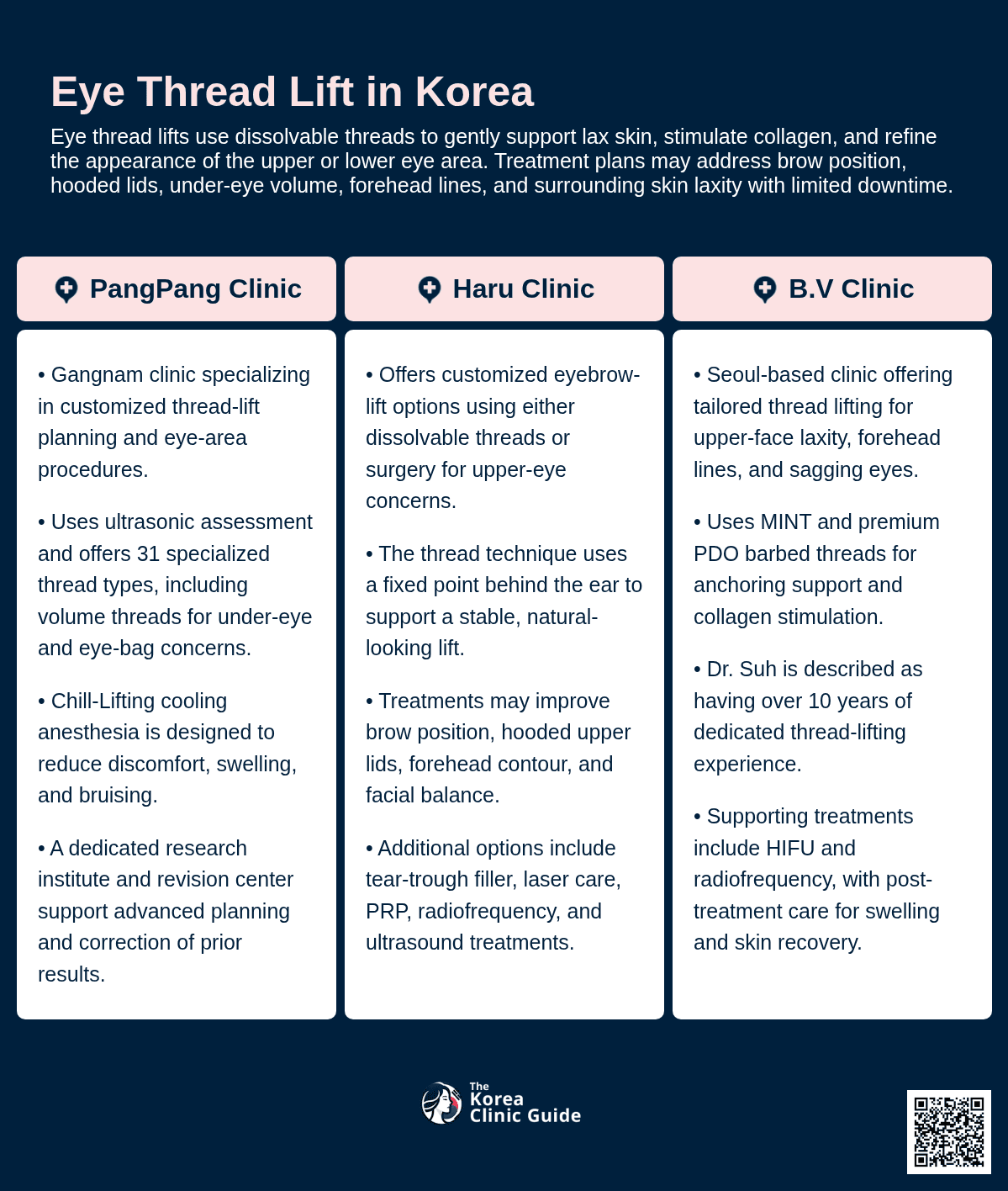
1. PangPang Clinic
For an eye-area thread lift, you can discuss a customized plan using PangPang Clinic’s thread-focused approach, including volume threads intended for under-eye and eye-bag areas and pre-procedure ultrasonic assessment. Its Pink Lift thread was developed by the clinic from data accumulated across thousands of lifting procedures, while its research collaboration with Seoul National University Bundang Hospital focuses on lifting techniques, collagen stimulation, and skin quality.
- URL: PangPang Clinic Website
- Location: Gangnam-gu, Seoul
- Thread-lift planning:
- Uses ultrasonic visual checks and pre-operative design alongside a personalized doctor consultation.
- Offers 31 specialized functional threads, with thread selection and placement customized to your concerns.
- Thread categories include barbed lifting threads, assist threads, elastic tightening threads, and volume threads for areas including the under-eye, cheeks, and eye bags.
- Comfort and recovery:
- Chill-Lifting uses contact-free cooling anesthesia, which the clinic states is designed to minimize pain, swelling, and bruising.
- Thread-lifting appointments are described as taking about 30 minutes to one hour, with partial, Airnox, or sleep-anesthesia options.
- An aftercare package is available to support and extend treatment effects.
- Research and revision care:
- The clinic reports operating a dedicated Thread Lifting Research Institute and participating in international beauty conferences through lectures and presentations.
- A Thread Lifting Revision Center provides assessment of unsatisfactory prior thread-lift results and may combine further threads with fillers, Botox, or lasers when appropriate.
2. Haru Clinic
For an eye-opening effect associated with brow position or hooded upper lids, you can discuss Haru Clinic’s surgical or thread-based eyebrow-lift options. Its thread-lifting method uses a fixed point behind the ear, an area the clinic describes as less mobile and firmly anchored, with the aim of creating a stable lift while minimizing discomfort by avoiding major nerves and blood vessels.
- URL: Haru Clinic Website
- Location: Gangnam-gu, Seoul
- Thread-lift approach:
- The technique is designed to pull and press the skin simultaneously, with the stated goal of lifting without making the face appear enlarged.
- When there is volume loss below the cheekbones, the lift can be adjusted to help create smoother contours.
- Haru describes its facial thread lift as using dissolvable barbed threads under local anesthesia; these threads are also intended to stimulate collagen and involve short downtime.
- Eye and upper-face options:
- Eyebrow lift options include thread-based or surgical treatment to raise brow position, smooth hooded upper lids, and improve forehead contour.
- A non-surgical forehead-focused thread treatment is not listed in the provided Haru materials; however, the clinic offers collagen-tightening treatments using radiofrequency or ultrasound for skin firmness.
- Customized dark-circle care may include tear-trough filler, laser treatment, or PRP for concerns involving hollowness, pigmentation, and fine lines.
- Clinical perspective:
- Dr. Jeong is identified as an official research physician for Merz, the company behind Belotero Filler, and teaches other doctors on filler techniques.
- Treatment planning is described as focused on facial harmony and balance through non-invasive techniques.

3. B.V Clinic
For upper-face laxity that can make your eye area look heavier, you can discuss B.V Clinic’s tailored thread-lifting approach, including its non-surgical forehead wrinkle restoration for forehead lines and sagging eyes. The clinic uses PDO barbed threads designed for anchoring and collagen stimulation, and Dr. Suh is described as having more than 10 years devoted exclusively to thread lifting with thousands of clinical cases.
- URL: B.V Clinic Website
- Location: Seoul
- Thread-lifting details:
- Uses MINT Threads, described as FDA- and KFDA-approved minimally invasive non-surgical threads.
- Premium PDO barbed threads are intended to provide anchoring support, lift tissue, and stimulate collagen for longer-term skin firmness.
- The 3D thread-lifting treatment uses strategically placed threads to lift and firm sagging skin while supporting natural facial contours.
- Upper-face and facial options:
- Non-surgical forehead wrinkle restoration is intended to address forehead wrinkles and sagging eyes with tailored threads, without visible scars or anesthesia.
- Full-face lifting is offered to address concerns such as forehead wrinkles, nasolabial folds, volume balance, and facial asymmetry.
- Volume-lifting treatments are available for areas affected by reduced facial volume and elasticity.
- Supporting treatments and aftercare:
- Shurink HIFU, Potenza radiofrequency, and Thor radiofrequency are offered for skin tightening, collagen support, and contour refinement.
- Post-treatment care includes skin-regeneration management intended to reduce swelling and support elasticity, with skincare and ultrasound-based care.
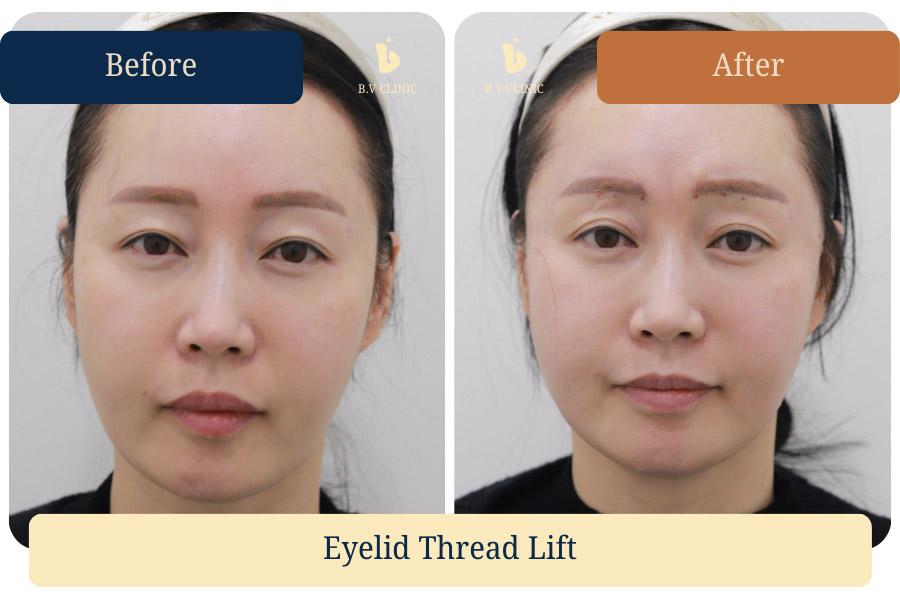
Eye Thread Lift From Start to Finish
- Remote screening — Send unfiltered front, oblique, side, and upward-gaze photographs in even light, plus a complete medication, supplement, allergy, eye-history, and prior-procedure list. Confirm whether the proposal targets the brow tail, tear trough, wrinkles, or a combination.
- Virtual consultation and travel coordination — Request an English consultation where available. Ask for the thread material and design, insertion plane, vectors, entry sites, anesthesia plan, expected recovery, early in-person review, and overseas complication pathway before booking flights.
- In-person assessment — The treating clinician examines facial animation, brow height, upper-lid skin excess, lid closure, lower-lid support, tear trough, fat prolapse, and baseline asymmetry. Standardized photographs, markings, informed consent, and discussion of alternatives occur before treatment.
- Preparation and anesthesia — Makeup and skincare are removed, then the planned entry sites are marked and disinfected. Local anesthetic is typical; oral anti-anxiety medicine or IV sedation requires an escort and changes fasting and discharge arrangements.
- Thread placement — The clinician creates small needle or cannula access points, advances smooth, twisted, braided, or barbed absorbable threads in the intended tissue plane, adjusts tension along the selected vector, trims thread ends, and checks contour and symmetry.
- Same-day recovery — Expect short observation followed by discharge when local anesthesia alone is used. Obtain written aftercare, prescribed-medicine instructions, a 24-hour contact route, and details of the threads used.
- Early clinic review — Attend the planned review before departure, especially when under-eye swelling, bruising, puckering, asymmetry, tenderness, or thread visibility is present. Do not judge the outcome during early swelling.
- Overseas follow-up — Send the agreed photographs or join video review at roughly 1–2 weeks and 1–3 months. Small eye-area studies assessed outcomes from 12 weeks to several months, not in the first days after placement.
Alternatives to an Eye Thread Lift
Non-surgical choices can suit small, temporary improvements but do not provide the correction available from surgery for skin excess, true ptosis, significant fat prolapse, or lower-lid laxity. Surgical procedures involve scars and longer recovery, but they are usually more appropriate when anatomy—not simply mild laxity—is driving the concern.
Botulinum toxin
- Best use — Selected patients seeking a small, temporary chemical elevation of the lateral brow tail.
- Tradeoff — It does not remove excess eyelid skin, repair ptosis, or correct under-eye bags.
Tear-trough filler or fat grafting
- Best use — True volume loss causing a hollow infraorbital groove can be treated with under-eye filler or under-eye fat grafting.
- Tradeoff — Filler can cause persistent edema and contour problems and carries rare vascular risk; visible bags or malar edema should not be treated as simple hollows.
Brow or upper-eyelid surgery
- Best use — Eyebrow lift, temporal lift, or upper blepharoplasty is more suitable for substantial brow descent or upper-lid skin excess.
- Tradeoff — Surgery has incisions, scars, and longer downtime but delivers stronger and generally more durable correction than threads.
Ptosis correction
- Best use — Ptosis correction addresses true levator dysfunction causing a drooping upper eyelid.
- Tradeoff — Cosmetic threads are not a substitute for functional eyelid assessment or ptosis repair.
Lower blepharoplasty with fat repositioning
- Best use — Under-eye fat removal or repositioning is often more appropriate for fat prolapse, meaningful bags, lower-lid laxity, and some combined tear-trough concerns.
- Tradeoff — It is surgery and requires more recovery, but standalone threads have not been shown to correct prominent bags reliably.
Canthoplasty or canthopexy
- Best use — Lower canthoplasty or related surgical lid-corner procedures can be considered for selected canthal position or laxity concerns.
- Tradeoff — A thread-based fox-eye effect does not reposition the eyelid corner in the same way.
How Can I Prepare for an Eye Thread Lift?
- Medication disclosure — Provide the clinician with every prescription drug, over-the-counter medicine, vitamin, herbal product, and supplement. Specifically report warfarin, apixaban, rivaroxaban, clopidogrel, aspirin, NSAIDs, corticosteroids, isotretinoin, and diabetes medicines.
- Blood-thinning medicines — Do not independently stop anticoagulants, antiplatelet medicines, or any medically necessary prescription. The prescribing clinician and treating doctor must decide whether any change is safe and necessary.
- Infection and skin check — Postpone treatment until facial, scalp, or periorbital infection, inflamed acne, herpes outbreak, open wound, sunburn, or irritation in the planned path has completely resolved.
- Eye-area preparation — Ask whether to arrive without eye makeup, contact lenses, lash extensions, skincare products, or jewelry. Report dry eye, thyroid eye disease, facial palsy, visual symptoms, prior eyelid or brow surgery, filler, biostimulator, and thread procedures.
- Fasting and sedation — Local anesthesia alone does not always require prolonged fasting. Follow the clinic’s specific fasting instructions if oral anti-anxiety medicine or IV sedation is planned.
- Nicotine and alcohol — Avoid nicotine and alcohol on the treating clinician’s schedule, especially where sedation, analgesics, healing concerns, or bruising risk are relevant.
- Travel arrangements — Keep flights flexible, reserve accommodation near the clinic for the early review, and arrange an adult escort when sedation is used.
Travel note: Book the procedure early enough in the trip to allow reassessment before departure, not on the day before a long-haul flight.
Confirm the treating doctor’s individualized requirements, which take precedence over general preparation guidance.
Aftercare Advice
Protect the thread paths and treat new eye symptoms as urgent until the treating clinician has assessed them.
- Pressure and facial movement — Do not rub, massage, pick, or press the temples, brows, or under-eye area unless the clinician specifically directs corrective massage. Avoid prolonged wide mouth opening for dental work and activities that substantially stretch the face for the clinic-specified period.
- Skin and entry points — Keep access points clean. Avoid makeup and non-prescribed eye-area products until cleared, and do not use cool compresses in a way that presses on thread paths.
- Activity and heat — Avoid strenuous exercise, heavy lifting, swimming, saunas, hot baths, contact sports, and vigorous facial treatments for the operator-specified interval. Sleep with the head elevated when instructed.
- Sun protection — Once the skin has healed enough for product application, use broad-spectrum SPF 50 around treated areas and avoid excessive sun exposure while bruising or inflammation remains.
- Expected recovery — Bruising, swelling, tenderness, puckering, and temporary asymmetry can take 1–4 weeks to settle. Do not assess the final effect in the first days; published eye-area studies evaluated outcomes from 12 weeks to several months.
- Warning signs — Contact the clinic urgently for worsening pain, rapidly increasing swelling, spreading redness or warmth, drainage, fever, skin color change or blistering, a visible or protruding thread, inflammatory lump, new numbness or weakness, or persistent marked asymmetry. Seek emergency and ophthalmic care immediately for visual change or loss, severe eye pain, double vision, inability to close the eye, or signs of severe allergy.
Follow the treating doctor’s instructions over general advice and contact the clinic promptly when anything appears wrong.
Frequently Asked Questions
Related Blogs

Lifestyle Lift in Korea vs. USA, Turkey, and More: A 2023 Cost Guide to Your Perfect Look
Explore the cost of Lifestyle Lift procedures in Korea and discover how this cosmetic option offers affordable and high-quality results. Learn about factors influencing pricing and why Korea is becoming a popular destination for those seeking rejuvenating facial treatments.
Updated: Oct 23, 2026
Abdominal Thread Lift in Korea: Candidacy, Evidence, Recovery, and Travel Planning
Abdominal thread lifts place absorbable threads in superficial abdominal tissue for subtle tightening, but methods, durability, and outcomes are not standardized. The article covers candidate screening, procedure planning, Korea travel and follow-up, preparation, aftercare warning signs, and alternatives for fat, excess skin, diastasis, or hernia.
Updated: Oct 13, 2026
Breast Thread Lift in Korea: Candidacy, Safety, Recovery, and Travel Planning
Breast thread lift uses absorbable threads placed through small entry points for modest contour improvement, but techniques, durability, and complication rates are not standardized. The article covers candidacy, preparation, travel planning for Korea, aftercare, warning signs, follow-up, and surgical alternatives for significant sagging.
Updated: Oct 13, 2026
Lip Thread Lift in Korea: Methods, Recovery, Risks and Travel Planning
Lip thread lifts use absorbable smooth or barbed threads to soften upper-lip lines or provide subtle traction, with suitability based on tissue quality, goals, and medical assessment. The article covers treatment planning, recovery, aftercare, risks, alternatives, and travel guidance for international patients in South Korea.
Updated: Oct 13, 2026
Clinics offering Eye Thread Lift

Haru Clinic Korea | Fully-Customized Full-Face Non-Surgical Rejuvenation With Threads, Botox & Fillers
Sinsa

PangPang Clinic: Korea's Premier Thread Lifting and Skin Rejuvenation Specialist in Gangnam, Seoul
Sinsa

B.V Clinic Korea: Advanced Aesthetic Treatments for Natural Beauty Enhancement & Rejuvenation
Sinnonhyeon Station
ID Hospital - Main Branch in Korea: Specializing in Safe & Customized Facial Plastic Surgery and Post-Care Services
Sinsa