
Medical Tourism Blog
Potenza in Korea: Treatment Methods, Recovery, Risks, and Travel Planning
Table of contents
- Potenza at a Glance
- What Is Potenza?
- Who Is a Good Candidate for Potenza?
- How Is Potenza Performed?
- Why Visit Korea for Potenza?
- Key Information for International Patients
- Which Are the Best Clinics in Korea for Potenza?
- Potenza From Start to Finish
- Alternatives to Potenza
- How Can I Prepare for Potenza?
- Aftercare Advice
Considering treatment in Korea? Everything you need to know e.g. — how to avoid scams, visas, interpreters, recovery tips — in our Medical Tourism Master Guide. Plan with confidence in minutes, not weeks!
Last updated: September 2026
Potenza at a Glance
- What it is — Potenza is fractional RF microneedling: sterile needles create controlled microchannels while radiofrequency heat targets dermal remodeling for texture, pores, fine lines, early laxity, and selected atrophic acne scars.
- Best candidates — It suits adults seeking gradual improvement in mild texture concerns or mild-to-moderate atrophic scars, with intact skin and realistic expectations; it is not a facelift, volume-restoring treatment, or permanent scar eraser.
- Downtime — Redness, warmth, swelling, pinpoint bleeding, and sunburn-like sensitivity usually last 1–3 days, while dryness, roughness, or tiny crusts can last 3–7 days; allow 5–7 days before an important event after intensive scar treatment.
- Results and sessions — Early texture changes may appear within weeks, but collagen remodeling is more meaningfully assessed 8–12 weeks after treatment; scars commonly require an individualized series rather than a single session.
- Scar-treatment limit — RF microneedling alone cannot reliably release deeply tethered rolling scars or fully correct deep boxcar and ice-pick scars, which may need subcision, TCA CROSS, punch procedures, or staged laser treatment.
- Korea travel plan — For an uncomplicated facial session with topical anesthetic, plan 3–5 days in Korea so you can remain near the clinic for the first 48–72 hours; allow 5–7 days for intensive scar protocols, large areas, or combined procedures.
- Protocol matters — Potenza is made by Seoul-based Jeisys Medical, but outcomes depend on the selected tip, needle depth, RF mode, energy settings, passes, and clinician technique—not Korea or the device brand alone; Potenza-specific evidence does not prove superiority over other RF microneedling platforms.
What Is Potenza?
Potenza is a fractional radiofrequency microneedling treatment that uses fine needles and controlled heat to stimulate skin repair and collagen remodeling. It aims to gradually improve texture, enlarged-looking pores, fine lines, early laxity, and selected acne scars rather than replace lost volume or lift significant sagging. Potenza is a minimally invasive, device-based dermatology treatment.
Who Is a Good Candidate for Potenza?
- Texture and pore concerns — Good candidates want gradual improvement in mild textural irregularity, enlarged-appearing pores, fine lines, crepey skin, or early laxity.
- Selected acne scars — Adults with mild-to-moderate atrophic scars can be suitable, especially when scars are not deeply tethered. Acne scar treatment often requires a combined plan rather than one device alone.
- Pigment-conscious treatment — People prone to post-inflammatory hyperpigmentation (PIH), including many patients with darker skin tones, need conservative settings, a clear sun-avoidance plan, and close review of prior pigment reactions.
- Realistic goals — Suitable patients understand that Potenza is a gradual dermal-remodeling treatment, not a facelift, filler, fat transfer, or permanent scar eraser.
Avoid treatment over bacterial, viral, or fungal infection, active cold sores, open wounds, substantial dermatitis, uncontrolled pustular acne, sunburn, or recent tanning. Elective RF microneedling is generally postponed during pregnancy because safety data are inadequate; breastfeeding requires individual review of anesthetics and any added topical products. Pacemakers, defibrillators, prior radiotherapy in the area, immunosuppression, cancer treatment, poor wound healing, keloid history, and current or recent isotretinoin require dermatologist assessment before booking. Rolling scars often need subcision to release fibrous tethering, while deep boxcar and ice-pick scars can require focal scar procedures rather than RF microneedling alone.
How Is Potenza Performed?
Potenza is a platform, not one fixed treatment. The clinician should specify the tip, RF mode, needle depth, pulse pattern, power, number of passes, and any product used through treatment-created channels.
- Bipolar needle RF — Current travels between needles for localized dermal heating. It can be selected for specific facial zones and scar patterns.
- Monopolar needle RF — Current travels through a circuit using a return pad, creating a different and potentially broader heating pattern. The rationale should be explained before treatment.
- Insulated needles — Insulation concentrates heat at selected depths and can be chosen when protecting the superficial skin is a priority.
- Non-insulated needles — Energy is delivered along more of the needle shaft, which changes the distribution of thermal effect and requires careful setting selection for skin type and indication.
- Needle and noninvasive tips — Invasive microneedle tips and superficial tips do not produce interchangeable results for acne scars, pores, tightening, or pigment concerns.
- Pumping or fusion protocols — These protocols place a product over microchannels created by the treatment. Confirm the exact product, sterility status, lot details, allergy risks, and evidence for that specific use; durable benefit over RF microneedling alone remains unproven.
Why Visit Korea for Potenza?
Potenza is made by Seoul-based Jeisys Medical, which supports local device availability. Korea also has a large international medical-care market, including dermatology visits, but this does not prove superior Potenza outcomes or lower complication rates than treatment elsewhere. Choose the clinician and protocol, not the destination alone.
- Korean-manufactured platform — Jeisys identifies Potenza as part of its energy-device portfolio, allowing patients to verify the platform directly with the manufacturer’s product information.
- International-care infrastructure — Official reporting describes substantial international medical-patient activity in Korea, including dermatology utilization, through Korea’s medical-tourism reporting. This supports practical access, not a comparative claim about results.
- Protocol transparency — Ask whether a licensed clinician performs or directly supervises the invasive needling, whether tips are sterile and single-use, and whether consent and aftercare are available in English.
- Evidence limit — In a small, single-center Potenza split-face trial of 20 people with atrophic acne scars, four sessions improved scars, but adding picosecond alexandrite laser did not show a significant advantage at assessed time points. The Potenza-specific study does not establish superiority over other RF microneedling platforms or scar treatments.
Key Information for International Patients
- Minimum stay — Plan 3–5 days in Korea for an uncomplicated facial session with topical anesthetic: consultation and treatment on day 1 or 2, then 48–72 hours nearby for early healing and access to the clinic.
- Longer itinerary — Allow 5–7 days for high-intensity acne-scar treatment, large body areas, prior herpes reactivation, pigment complications, or combined procedures.
- Flying — RF microneedling alone does not generally prohibit a same- or next-day flight, but early redness and swelling commonly peak during this period and remote assessment is harder. Do not fly or travel alone after oral anxiolytics, opioid pain medicine, or other sedation.
- Social downtime — Redness, warmth, swelling, pinpoint bleeding, and sunburn-like sensitivity usually last 1–3 days. Dryness, roughness, and tiny crusts can last 3–7 days; allow 5–7 days before an important event after intensive scar treatment or with PIH risk.
- Repeat sessions — Collagen remodeling is gradual. A treatment series is often considered for scars, but session number and interval must follow scar depth, response, downtime tolerance, and the full treatment plan rather than a standard package.
- Remote follow-up — Leave with English written aftercare, standardized photographs, a treatment record listing tip and settings when available, all applied products and lot information, an emergency contact route, and a telehealth date. A 1–2-week healing review and 8–12-week outcome review are practical.
Travel note: The recommended 3–5-day stay is practical follow-up planning, not an evidence-defined mandatory post-Potenza flight restriction.
Which Are the Best Clinics in Korea for Potenza?
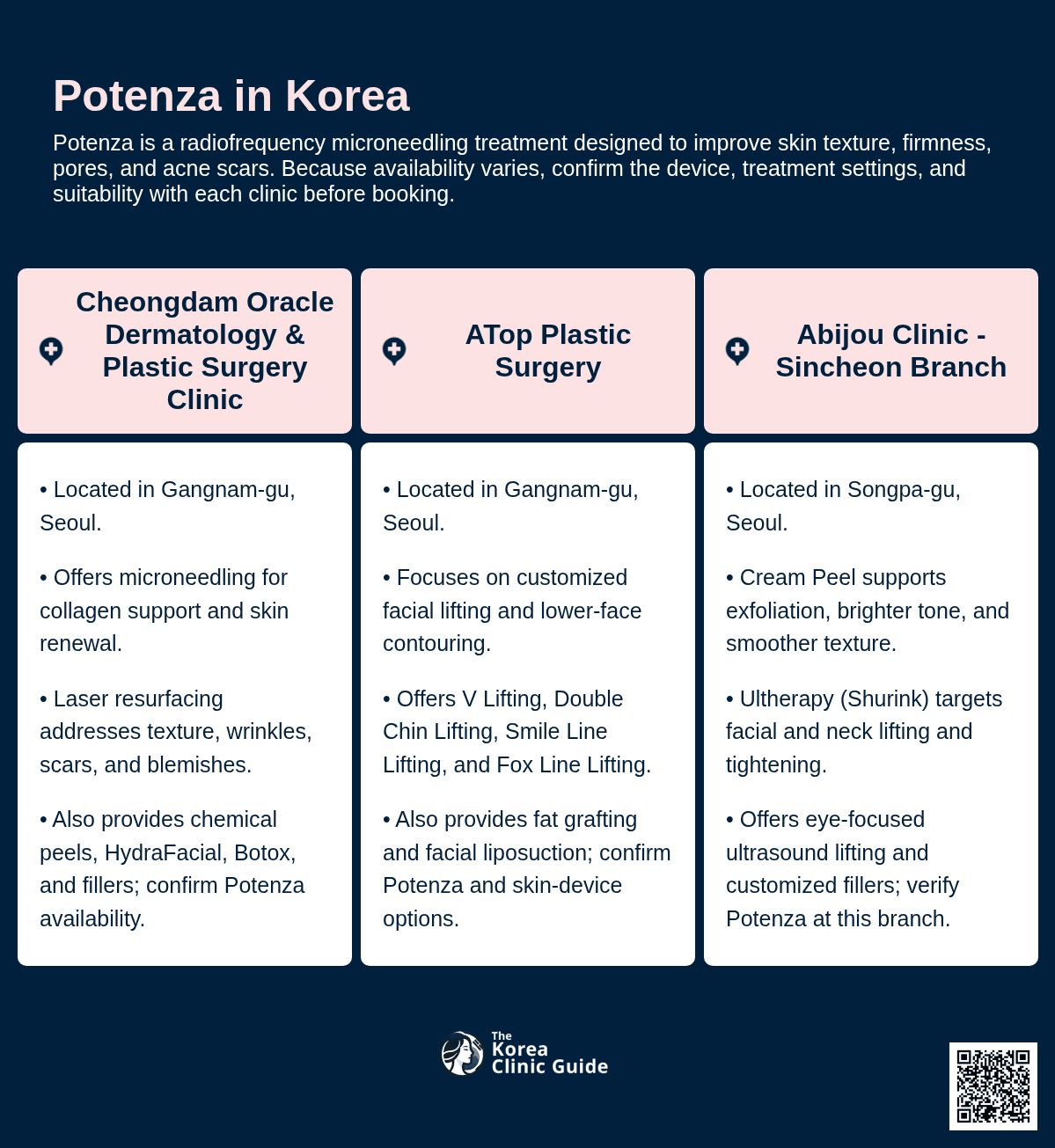
Listed below are some of the best clinics in Korea for potenza.
1. Cheongdam Oracle Dermatology & Plastic Surgery Clinic
If you are considering Potenza for texture, firmness, or acne-scar concerns, Cheongdam Oracle Dermatology & Plastic Surgery Clinic may be worth considering because its listed skin-treatment menu includes microneedling and laser resurfacing—collagen-focused approaches that address related skin-quality goals. The supplied information does not confirm that Potenza itself is offered, so you should verify device availability and your treatment plan directly with the clinic.
- URL: Cheongdam Oracle Dermatology & Plastic Surgery Clinic Website
- Location: Gangnam-gu, Seoul
- Skin-focused options:
- Microneedling is listed to create controlled micro-injuries that support the skin’s natural healing response and collagen production.
- Laser resurfacing is listed for improving texture and reducing the appearance of wrinkles, scars, and blemishes.
- Chemical peels are available for exfoliation, pigmentation, sun damage, and mild scarring.
- HydraFacial is listed as a cleansing, exfoliating, and hydrating treatment.
- Other aesthetic services:
- The clinic lists Botox, dermal fillers, and thread lifting among its non-surgical anti-aging options.
- Its broader menu also includes body contouring, hair treatments, and facial plastic surgery.
2. ATop Plastic Surgery
ATop Plastic Surgery may be relevant if you are exploring Potenza alongside facial-contouring or lifting goals, as its listed services focus heavily on customized lifting, lower-face definition, facial fat grafting, and facial liposuction. However, the supplied information does not list Potenza or other skin-device treatments, so you should confirm whether Potenza is available and appropriate for your skin concerns.
- URL: ATop Plastic Surgery Website
- Location: Gangnam-gu, Seoul
- Facial lifting and contouring:
- Custom Lifting is described as a personalized approach that can combine lifting techniques for specific areas of concern.
- V Lifting targets lower-face laxity for a more defined facial contour.
- Double Chin Lifting is listed to address fat and skin laxity beneath the chin.
- Smile Line Lifting addresses deep nasolabial folds, while Fox Line Lifting focuses on jawline definition.
- Related procedures:
- Fat grafting is listed to restore volume and enhance contours using your own fat.
- LSSA Facial Liposuction and Point Liposuction are listed for targeted fat removal and contouring.
- The clinic also lists eyelid, rhinoplasty, forehead, lip, and breast procedures.
3. Abijou Clinic - Sincheon Branch
You may consider Abijou Clinic - Sincheon Branch if you want to discuss Potenza in the context of non-surgical skin rejuvenation and tightening: its listed services include exfoliating skin care, ultrasound-based lifting for the face and neck, and tailored filler treatments. Potenza is not specifically confirmed in the supplied information, so you should check whether the device is offered at this branch.
- URL: Abijou Clinic - Sincheon Branch Website
- Location: Songpa-gu, Seoul
- Non-surgical skin and lifting options:
- Injectable option: A customized filler program is listed for adding volume, smoothing wrinkles, and enhancing contours in areas such as the lips, cheeks, and nasolabial folds.
Potenza From Start to Finish
- Remote inquiry and screening — Send unfiltered daylight photographs, treatment goals, medical history, allergies, medicines and supplements, prior isotretinoin use, pigment or keloid history, oral-herpes history, implanted devices, and pregnancy or breastfeeding status. Request English or virtual consultation options before committing to travel.
- Plan confirmation — Ask for the intended zones, Potenza tip, needle versus superficial approach, bipolar or monopolar RF mode, depth range, passes, anesthetic, expected downtime, and names of every topical or infused product.
- In-person assessment — The clinician examines acne activity, scar morphology, infection, dermatitis, tanning, pigment risk, prior healing, and whether alternatives such as subcision or laser better fit the anatomy. Routine laboratory testing is not usually required for a straightforward facial session.
- Skin preparation and anesthesia — Staff cleanse and disinfect the area. Topical anesthetic is commonly applied for about 30–60 minutes, then removed before needling. Follow clinic instructions if oral medication or sedation is planned.
- RF microneedling treatment — A sterile tip creates controlled microchannels while RF energy heats selected dermal tissue. The face commonly takes about 15–45 minutes; body areas take longer. Heat, pressure, discomfort, pinpoint bleeding, and temporary swelling are expected possibilities.
- Immediate recovery and discharge — The clinic applies approved post-procedure care and reviews restrictions. Obtain written aftercare, the device and tip used, product names, emergency contact details, and follow-up arrangements before leaving.
- Early healing in Korea — Stay reachable for the first 48–72 hours. Avoid makeup for at least 24 hours and until skin is no longer open or oozing; adjust sightseeing, heat exposure, exercise, and photographs around visible redness and swelling.
- Overseas review — Send requested healing photographs and complete the planned telehealth review. Assess a more representative collagen response at about 8–12 weeks, not in the first few days.
Alternatives to Potenza
The best alternative depends on whether the primary problem is tethering, deep scar shape, active acne, pigment, or laxity. Non-surgical approaches have less recovery than surgery but cannot reliably correct pronounced jowls, major volume loss, or deeply tethered scars.
Subcision and focal scar procedures
- Best for — Rolling scars with tethering, deep boxcar scars, and narrow ice-pick scars.
- Tradeoff — Subcision releases tethering; TCA CROSS, punch elevation, or excision addresses focal scar architecture. These are often combined with energy treatment rather than replaced by it.
- Related option — Review acne scar treatment for staged scar-focused approaches.
Fractional CO2 laser
- Best for — Selected atrophic acne scars and more intensive resurfacing goals.
- Tradeoff — CO2 laser can offer substantial remodeling but usually involves more pain, erythema, and PIH risk than RF microneedling. In a 30-patient split-face trial, both approaches improved scars similarly, while RF microneedling had shorter recovery markers and fewer PIH events in that study’s setting, as reported in the randomized comparison.
- Related option — See CO2 laser.
Nonablative fractional or pico-fractional laser
- Best for — Selected texture, scar, and pigment concerns where less ablative treatment is preferred.
- Tradeoff — Results, downtime, and pigment risk differ by laser wavelength, settings, skin type, and diagnosis; these treatments are not interchangeable with RF microneedling.
- Related options — Consider Fraxel laser or pico-fraxel.
Other RF microneedling platforms
- Best for — Patients seeking the RF microneedling treatment category rather than a specific brand.
- Tradeoff — Published evidence does not establish that Potenza is superior to all other platforms. Device selection should follow clinician experience, treatment plan, and transparent settings.
- Related option — See Secret RF microneedling.
Active-acne and pigment treatment
- Best for — Ongoing inflammatory acne, melasma, or superficial dyschromia.
- Tradeoff — Control active acne before scar-focused procedures. Potenza is not a stand-alone cure for melasma; pigment disorders need diagnosis, conservative treatment when appropriate, and strict photoprotection.
- Related options — See acne treatment and pigmentation treatment.
How Can I Prepare for Potenza?
- Medical disclosure — Tell the clinic about pacemakers or defibrillators, pregnancy or breastfeeding, cancer treatment, radiotherapy, immunosuppression, keloids, poor healing, herpes history, prior pigment reactions, allergies, and every recent aesthetic procedure.
- Medicines and supplements — Disclose anticoagulants, antiplatelet drugs, NSAIDs, isotretinoin, systemic steroids, immunosuppressants, and photosensitizing medicines, plus supplements that can affect bruising or healing. Do not stop prescribed anticoagulant or antiplatelet medicine without the prescriber’s direction.
- Active skincare — Report retinoids, benzoyl peroxide, hydroquinone, exfoliating acids, scrubs, strong vitamin C products, and home energy devices. Pause and restart them only on the treating clinician’s schedule.
- Sun exposure — Avoid intentional tanning and tanning beds. Postpone treatment for sunburn, visible tanning, infection, active dermatitis, open skin, or uncontrolled inflamed acne.
- Herpes prevention — With recurrent perioral herpes, ask before travel whether clinician-prescribed antiviral prophylaxis is appropriate for facial or perioral treatment.
- Food and transport — Fasting is not normally needed with topical anesthetic alone. Follow fasting instructions and arrange an escort and private transport if oral sedatives or other sedating medicine is planned.
- Treatment-day skin — Arrive with clean skin and no makeup, self-tanner, or heavy occlusive products.
- Travel planning — Book flexible flights, avoid scheduling an important event in the first week, and stay close enough for early review. Bring a hat and plan to limit direct sun exposure.
Travel note: Confirm in advance that the clinic will provide English aftercare, product details, and an emergency contact method that works after you leave Korea.
Confirm all clinic-specific medicine pauses, fasting requirements, skincare restrictions, and travel instructions with the treating doctor; individualized instructions take precedence over general guidance.
Aftercare Advice
Protect the healing skin barrier and treat worsening symptoms as a reason to contact the clinic promptly.
- First 24 hours — Use only clinician-approved gentle cleanser, bland moisturizer, and post-procedure products. Avoid makeup for at least 24 hours and until there is no oozing or open skin.
- Heat, sweat, and contact — Avoid strenuous exercise, hot yoga, saunas, steam rooms, hot tubs, pools, facial massage, rubbing, picking, and high-heat exposure for the period specified by the clinic, especially during the first 24 hours.
- Active products and hair removal — Do not restart retinoids, exfoliating acids, scrubs, benzoyl peroxide, strong vitamin C, waxing, or at-home energy devices until the clinician confirms barrier recovery.
- Sun protection — Once tolerated, apply broad-spectrum SPF 50 sunscreen and use a hat and shade. Rigorous photoprotection is particularly important after redness settles and for PIH-prone skin.
- Expected healing — Redness, warmth, tenderness, itching, swelling, pinpoint bleeding, dryness, roughness, and tiny crusts can occur. Do not pick crusts.
- Warning signs — Contact the clinic urgently for worsening pain, expanding redness or warmth, pus, fever, blistering, burn-like erosion, eye-area swelling, widespread rash, cold-sore lesions, or pigment change that persists or worsens.
- Results and review — Early texture changes can appear within weeks; judge the session more reliably at about 8–12 weeks. Complete the planned healing review and send requested photographs if already overseas.
Follow the treating doctor’s instructions over general advice and contact the clinic whenever healing appears abnormal.
Frequently Asked Questions
Related Blogs
Nuviju in Korea: Treatment Process, Recovery, Safety, and Travel Planning
Nuviju is a prescription cholic-acid injection for adults with moderate-to-severe pinchable fat beneath the chin, delivered in a mapped series of preplatysmal-fat injections at least one month apart. The article covers candidacy screening, Korea travel planning, recovery reactions and warning signs, aftercare, and alternatives such as liposuction, neck lift, and deoxycholic acid.
Updated: Oct 13, 2026
Juveacell in Korea: Types, Safety, Recovery, and Travel Planning
Juveacell is a donor-derived hADM skin booster for gradual improvement in hydration, texture, fine lines, pores, elasticity, and dermal density, with 3% and 8% formulations documented by the manufacturer. Learn about candidate screening, injection steps, recovery, aftercare, product verification, and travel planning for treatment in Korea.
Updated: Oct 13, 2026
PRF Injection in Korea: Uses, Evidence, Recovery, and Travel Planning
PRF injections use a patient’s processed blood for facial skin or scalp treatment, typically through a series of superficial injections with short-term redness, swelling, or bruising. International patients should plan 2–3 days in Korea, arrange next-day and remote follow-up, verify the clinic’s processing protocol, and obtain English treatment records and emergency contact details.
Updated: Oct 13, 2026
Milia Under Eyes Treatment: Milia Removal Procedures in Korea for Clearer, Smoother Skin
Discover how Korea leads in safe, effective Milia removal techniques such as manual extraction, electrosurgery, and laser ablation. This blog explores the benefits of choosing Korea for milia treatment, offering advanced technology, skilled dermatologists, and affordable pricing. Perfect for medical tourists seeking quick, professional solutions to benign keratin cysts beneath the eyes and on the
Updated: Oct 12, 2026
Clinics offering Potenza

B.V Clinic Korea: Advanced Aesthetic Treatments for Natural Beauty Enhancement & Rejuvenation
Sinnonhyeon Station

Cheongdam Oracle Dermatology & Plastic Surgery Clinic in Korea: Offering Advanced Skin, Anti-Aging, Body Contouring Treatments and More
Seolleung

VandS Dermatology Clinic - Dongtan, Korea: Comprehensive Skin Care and Cosmetic Procedures for Youthful, Radiant Skin
Hwaseong

Personal Beauty GU Clinic Ilsan, Korea - Unveiling Hidden Beauty with Tailored Treatments and Advanced Cosmetic Procedures
Ilsan