
Medical Tourism Blog
Under Eye Fat Grafting in Korea: Candidacy, Recovery, Risks, and Travel Planning

Table of contents
- Under Eye Fat Grafting at a Glance
- What Is Under-Eye Fat Grafting?
- Who Is a Good Candidate for Under-Eye Fat Grafting?
- How Is Under-Eye Fat Grafting Performed?
- Why Visit Korea for Under-Eye Fat Grafting?
- Key Information for International Patients
- Which Are the Best Clinics in Korea for Under Eye Fat Grafting?
- How Much Does Under-Eye Fat Grafting Cost in Korea?
- Under Eye Fat Grafting From Start to Finish
- Alternatives to Under-Eye Fat Grafting
- How Can I Prepare for Under-Eye Fat Grafting?
- Aftercare Advice
Considering treatment in Korea? Everything you need to know e.g. — how to avoid scams, visas, interpreters, recovery tips — in our Medical Tourism Master Guide. Plan with confidence in minutes, not weeks!
Last updated: September 2026
Under Eye Fat Grafting at a Glance
- What it does — This outpatient procedure harvests your own fat—usually from the abdomen, flanks, or thighs—and injects small parcels beneath the eyes and often the upper cheek to soften tear-trough hollows and lid-cheek shadowing.
- Korea cost — Stand-alone under-eye fat grafting in Korea is typically ₩1,000,000–₩2,000,000 (about US$700–$1,500); adding lower-eyelid surgery, sedation, or broader cheek grafting increases the quote.
- Best candidates — It is best suited to people with stable weight, sufficient donor fat, and under-eye darkness caused mainly by volume loss—not primarily pigment, visible vessels, edema, thin skin, or prominent eye bags.
- Recovery and travel — Expect visible under-eye swelling and bruising for 1–2 weeks, with desk work often possible after 3–7 days; international patients should plan 8–10 days in Korea, including early and pre-flight reviews.
- When results settle — Early fullness is not the final outcome because swelling resolves and some grafted fat is absorbed; judge retained volume around 3–6 months, when a refinement can be considered if needed.
- Important risk — Temporary asymmetry, prolonged swelling, contour irregularities, nodules, infection, and partial fat resorption can occur; any vision change, severe eye pain, double vision, or neurologic symptoms requires immediate emergency care.
- Korea-specific check — Korea itself has no proven outcome advantage; verify that the clinic is registered to treat foreign patients and obtain written confirmation of the surgeon, anesthesia plan, emergency arrangements, in-Korea reviews, and remote follow-up.
What Is Under-Eye Fat Grafting?
Under-eye fat grafting transfers a person’s own fat to the hollow area beneath the eyes and sometimes the upper cheek. It aims to restore lost volume, soften tear-trough shadows, and improve a sunken lid-cheek contour, though it does not reliably treat pigmentation or prominent eye bags. It is a surgical procedure because fat is harvested, processed, and injected through small access points.
Who Is a Good Candidate for Under-Eye Fat Grafting?
- Volume-loss pattern — Good candidates have a hollow tear trough, sunken lower eyelid, or abrupt lid-cheek junction caused primarily by lost or naturally limited volume.
- Adequate donor fat and stable weight — The abdomen, flanks, or thighs must provide enough harvestable fat. Stable weight matters because later weight change can alter facial volume.
- Realistic treatment goal — Fat grafting can soften shadowing and restore contour; it does not reliably erase brown pigmentation, visible veins, thin translucent skin, allergies, puffiness, or prominent eye bags.
- Able to complete follow-up — International patients need to remain in Korea for early review and organize remote follow-up after returning home.
Active skin, eyelid, sinus, or systemic infection requires treatment before surgery. Uncontrolled diabetes, significant anemia, bleeding disorders, unstable hypertension or organ disease, pregnancy or breastfeeding, and nicotine exposure can make elective surgery inappropriate or require postponement. Anticoagulants and antiplatelet drugs, including warfarin, apixaban, rivaroxaban, clopidogrel, and aspirin, require a plan from both the prescribing clinician and surgeon; never stop them independently. Unexplained eye symptoms, significant dry eye, unstable thyroid eye disease, or previous eyelid/orbital surgery warrant oculoplastic assessment, while prominent bags, skin laxity, and tear-trough tethering can make fat repositioning or lower-eyelid surgery more appropriate than grafting alone.
How Is Under-Eye Fat Grafting Performed?
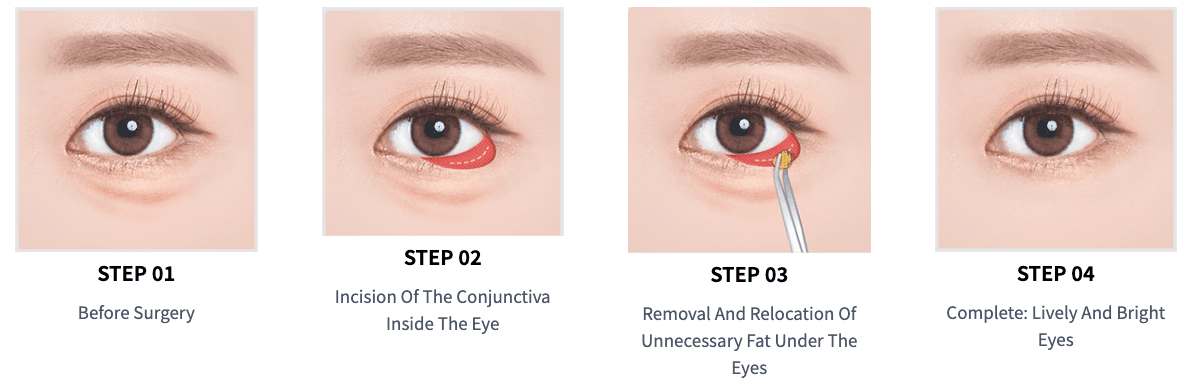
Under-eye fat grafting is defined less by consumer-facing “types” than by the fat preparation, placement plane, target area, and whether it is paired with lower-eyelid surgery.
- Structural fat or microfat grafting — Purified fat is placed in small parcels and layered around the tear trough, infraorbital rim, lid-cheek junction, and sometimes the upper cheek to restore volume.
- Microfat or MAFT-style delivery — Fine cannulas and very small aliquots allow controlled contouring in thin lower-eyelid tissues. A branded or proprietary technique name does not itself prove better retention or safety.
- Nanofat — Emulsified, filtered fat has little meaningful volume-producing capacity. It can be used for selected skin-quality or fine-texture goals but is not a replacement for microfat when actual volume restoration is needed.
- Combined lower-eyelid surgery — Lower blepharoplasty, orbital-fat repositioning, or septal reset may be added when fat bags, loose skin, or lower-lid laxity are dominant. This is more invasive than stand-alone grafting and changes recovery and risk.
- “Regenerative” additives — PRP, PRF, stromal vascular fraction, and cell-based additives are marketed for retention or skin quality, but a review of 27 facial fat-grafting supplementation studies found only one strong-quality study and concluded that improved retention remains unclear.
Why Visit Korea for Under-Eye Fat Grafting?
South Korea has a formal system for medical institutions that receive foreign patients, which offers a practical verification route before booking treatment. Use it to confirm eligibility, then judge the individual surgeon, anesthesia plan, emergency capability, and continuity of care. There is no credible comparative evidence that having under-eye fat grafting in Korea alone produces better safety, graft survival, or aesthetic outcomes than treatment elsewhere.
- Foreign-patient registration check — Confirm that the facility is listed through Korea’s registered medical institution system for international patients, rather than relying on marketing claims.
- Communication and documentation — Request written English confirmation of the surgeon’s credentials and scope, planned anesthesia, who will harvest and inject the fat, emergency escalation arrangements, postoperative appointments, and remote follow-up.
- Anatomy-led planning — Ask the surgeon to distinguish hollowing from bags, laxity, pigment, vascular discoloration, edema, and dry-eye disease. This distinction is central because added fat does not correct every cause of dark circles.
- Evidence limitation — The largest dedicated periorbital fat-grafting review pooled 4,046 cases, but most included studies were case series. Its reported 90.9% satisfaction and 7.9% overall complication rate are useful context, not personal outcome guarantees.
Key Information for International Patients
- Minimum stay — Plan 8–10 days in Korea for the in-person examination, outpatient procedure, early review, and surgeon clearance before a long-haul flight.
- Flight timing — Do not schedule an immediate return flight. A 7–10-day no-flight interval is a prudent facial-surgery planning benchmark; combined eyelid surgery, significant swelling, complications, anesthesia concerns, or elevated venous-thromboembolism risk can require a longer delay.
- Repeat visits — Attend a postoperative examination within several days and a pre-flight review. A later refinement, if needed, should not be considered until graft volume has stabilized at roughly 3–6 months.
- Itinerary impact — Desk-based work is often feasible after 3–7 days when recovery is uncomplicated, but bruising and visible swelling commonly last 1–2 weeks. Keep the first week free of intensive sightseeing, heat exposure, and appearance-sensitive events.
- Activity restrictions — Defer strenuous exercise for about 2 weeks or until the operating surgeon clears it. Donor-site bruising can persist for 2–3 weeks.
- Remote and local care — Leave Korea with an English operative summary, medication list, emergency contact, and photo/video follow-up schedule. Identify a local plastic surgeon or oculoplastic clinician before travel in case in-person assessment is needed at home.
Travel note: Arrange a responsible adult for discharge and the first night when sedation or general anesthesia is used. Build flexible flight and accommodation dates into the trip rather than treating surgeon clearance as automatic.
Which Are the Best Clinics in Korea for Under Eye Fat Grafting?
Listed below are some of the best clinics in Korea for under eye fat grafting.
1. THEPLUS Plastic Surgery
For under-eye fat grafting, you can consider THE PLUS Plastic Surgery if you want treatment planned in the context of overall facial volume and balance. The clinic offers facial fat grafting to restore fullness in hollow or flattened areas and emphasizes personalized aesthetic care, facial harmony, and specialized plastic-surgery expertise.
- URL: THEPLUS Plastic Surgery Website
- Location: Gangnam-gu, Seoul
- Relevant treatment approach:
- Facial fat grafting transfers your own fat to areas of facial volume loss, with the aim of restoring fullness and softening hollow or flattened contours.
- Blepharoplasty is also offered for adjustment of excess skin and tissue around the eyelids when concerns extend beyond volume loss alone.
- Surgical expertise:
- Dr. Kim is a board-certified plastic surgeon with expertise in facial contouring and a research background involving 3D implants.
- Dr. Jeong is President of the Korean Society of Plastic Surgeons and regularly provides professional education and conference presentations.
- Related facial options:
- Available facial procedures include facelift, thread lift, facial contouring, cheekbone surgery, jaw surgery, chin surgery, and facial implants.
- The clinic also lists stem-cell treatment as part of its broader aesthetic and post-procedure care approach.
2. Made Young Plastic Surgery
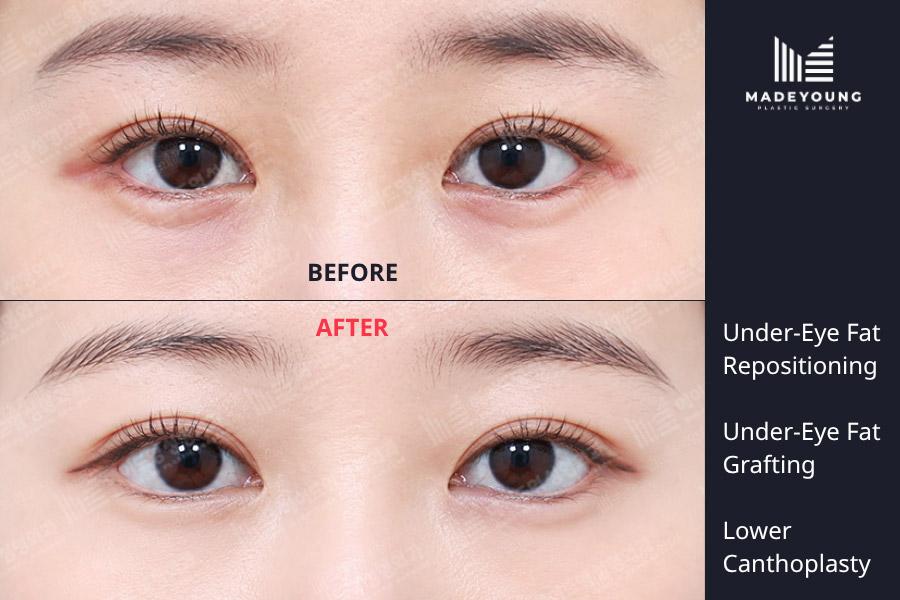
You may consider Made Young Plastic Surgery for an under-eye concern because it specifically lists lower blepharoplasty for under-eye bags, including fat removal or repositioning with possible skin tightening, and dark-circle treatment options that can include fat repositioning. Its medical team provides direct consultation and diagnosis before procedures, with on-site anesthesia monitoring and a dedicated aftercare center.
- URL: Made Young Plastic Surgery Website
- Location: Seocho-gu, Seoul
- Under-eye options:
- Lower blepharoplasty targets under-eye bags through fat removal or repositioning and may include skin tightening.
- Dark-circle treatment options listed by the clinic include fillers, fat repositioning, or laser treatments; the appropriate approach depends on the cause of your concern.
- Eye-surgery experience:
- Dr. Park Byung-Chan is described as having 15 years of experience dedicated exclusively to eye surgery.
- The clinic states that eye-procedure planning can be customized around incision lines, eyelid height, eyelid thickness, and your desired overall eye image.
- Safety and aftercare:
- Full-time board-certified anesthesiologists are on site, with one-to-one anesthetic monitoring and a cross-check system for emergencies.
- The clinic reports CCTV coverage of procedures and operates a separate aftercare center for systematic post-procedure care.
3. LABOM Plastic Surgery
For under-eye fat grafting, LABOM Plastic Surgery offers an autologous facial fat-grafting approach that harvests and centrifuge-purifies your own fat before placing it in volume-deficient facial areas. You can expect one-to-one planning based on your facial anatomy and degree of aging, with an emphasis on avoiding excessive correction and preserving natural expression.
- URL: LABOM Plastic Surgery Website
- Location: Gangnam-gu, Seoul
- Fat-grafting details:
- Fat may be harvested from donor areas such as the abdomen, thighs, or buttocks, then purified by centrifugation before injection.
- The clinic describes facial fat grafting as a way to address facial volume loss using your own tissue rather than implants.
- Its general facial fat-grafting description lists a procedure time of 1–2 hours under sleep sedation and approximately one week of recovery.
- Planning and surgical philosophy:
- Plastic-surgery specialists directly perform procedures, and the clinic reports more than 30 years of clinical experience across facial and hand anti-aging procedures.
- Planning is individualized rather than one-size-fits-all, considering facial structure, tissue position, and overall facial balance.
- The clinic’s approach focuses on correcting underlying structural and positional contributors to aging while avoiding overcorrection.
- Monitoring and recovery support:
- Available systems include pre-operative diagnosis, safe anesthesia and continuous monitoring, autologous fat-purification equipment, and autologous blood centrifugation.
- Aftercare includes regular progress checks and structured programs for recovery, swelling, bruising, and scar management.
- The clinic states that it has a dedicated aftercare system for international patients.
How Much Does Under-Eye Fat Grafting Cost in Korea?
Under-Eye Fat Grafting is supplied at ₩1,000,000–₩2,000,000 (approximately US$700–$1,500). Individual quotes vary because the treatment plan can range from focused tear-trough volume replacement to grafting across the under-eye and adjacent upper-cheek area, with different anesthesia and surgical requirements.
| Procedure Price | Korean Won (₩) | USD ($) |
|---|---|---|
| Low Price | ₩1,000,000 | $700 |
| High Price | ₩2,000,000 | $1,500 |
Exchange rate as of 2026-09-06: 1 KRW = 0.000741 USD.
What Affects the Price?
- Treatment extent and graft placement — Treating only a focal tear trough requires less harvesting, processing, and injection work than restoring volume across the infraorbital rim, lid-cheek junction, and adjacent mid-cheek. Wider or more anatomically complex placement requires more operating time and precise small-volume cannula delivery.
- Stand-alone grafting versus combined lower-eyelid surgery — Adding lower blepharoplasty, orbital-fat repositioning, or septal reset for eye bags, skin excess, or lid laxity makes the procedure more invasive than stand-alone fat grafting. It increases operative steps, operating time, anesthesia requirements, facility resources, and postoperative monitoring.
- Anesthesia plan — Local anesthetic alone uses fewer anesthesia resources than local anesthetic with sedation or general anesthesia. Sedation or general anesthesia requires anesthetic assessment, personnel, monitoring, recovery observation, and discharge arrangements.
- Fat-processing and delivery method — Structural fat or microfat grafting for volume restoration requires harvesting, purification, and layered placement of small fat parcels. If nanofat is added for skin-quality or fine-texture goals, it introduces separate processing and delivery work; nanofat does not replace microfat when meaningful volume restoration is required.
Cost tip: Request an itemized quote stating what is included, particularly the consultation and in-person assessment, donor-fat harvest and processing, injection areas, anesthesia, facility and recovery use, postoperative reviews, and any planned remote follow-up or later refinement policy.
The US$700–$1,500 conversion is approximate, based on the supplied exchange rate of 0.000741 on 2026-09-06. Check the exchange rate again when budgeting.
Under Eye Fat Grafting From Start to Finish
- Remote consultation and records — Send standardized front, oblique, and profile photographs in neutral lighting. Disclose medications, supplements, allergies, medical conditions, nicotine use, prior filler, prior eyelid surgery, dry-eye symptoms, and visual symptoms. Confirm that the in-person examination can change or cancel the initial plan.
- Travel and appointment coordination — Schedule the procedure early enough to allow an early postoperative review and a pre-flight assessment. Arrange accommodation close enough for follow-up, transport after surgery, and an adult escort if sedation or general anesthesia is planned.
- In-person facial and eye assessment — The surgeon evaluates tear-trough depth, lower-lid support, skin quality, pigment, asymmetry, fat-bag prominence, lid-cheek junction, donor sites, and whether grafting alone fits the anatomy. Testing and anesthetic clearance depend on medical history and planned anesthesia.
- Consent and final planning — Review donor sites, target areas, anesthesia, expected swelling, partial fat absorption, under- or over-correction, contour irregularity, donor-site risks, and the possibility of later refinement. Ask who performs the assessment, harvest, processing, injections, anesthesia, and emergency care.
- Anesthesia, harvest, and graft placement — The operation is generally outpatient. Local anesthetic alone, local anesthetic with sedation, or general anesthesia can be used depending on treatment extent and combination surgery. The surgeon harvests fat with low-trauma liposuction, processes it, and places small parcels through fine cannulas in selected tissue planes.
- Observation and discharge — After clinical recovery from anesthesia, leave with approved medication instructions and emergency contacts. An escort is required after sedation or general anesthesia; do not drive or plan strenuous activity.
- Early recovery in Korea — Expect swelling, bruising, tenderness, temporary asymmetry, and donor-site discomfort. Attend the planned review within days so the team can assess healing before travel.
- Pre-flight clearance and overseas follow-up — Obtain surgeon clearance before a long-haul flight and request written records. Send scheduled photographs and attend video reviews after return; seek urgent local care for eye or neurologic symptoms rather than waiting for a remote reply.
Alternatives to Under-Eye Fat Grafting
The right alternative depends on whether the main issue is missing volume, protruding orbital fat, loose lower-eyelid skin, pigment, vessels, or edema. Non-surgical options avoid fat harvest and surgery but usually provide temporary or more limited correction; eyelid surgery can address bags and laxity but carries a more invasive recovery profile.
Hyaluronic-Acid Filler
- Best fit — Carefully selected mild hollows with good skin quality and minimal laxity or fat herniation.
- Tradeoff — Filler is temporary and can be dissolved with hyaluronidase when clinically appropriate, unlike retained fat. It can also cause edema, Tyndall blue-gray discoloration, contour irregularity, and rare vascular complications.
- Learn more — Under-eye filler.
Fat Repositioning or Lower Blepharoplasty
- Best fit — Prominent fat pads, loose skin, lower-lid laxity, or higher-grade tear-trough deformity.
- Tradeoff — This treats existing orbital fat and lid structure rather than adding harvested fat. In a retrospective 101-patient comparison, both approaches improved mild deformities, while repositioning performed better for grade II–III cases; this was not a randomized trial.
- Learn more — Under-eye fat removal or repositioning and blepharoplasty.
Pigment or Vessel-Focused Treatment
- Best fit — Brown or blue discoloration where volume loss is not the dominant cause.
- Tradeoff — Dermatologic assessment and pigment- or vascular-focused treatment address color, not hollowing. Added volume alone will not reliably correct pigment or visible vessels.
- Learn more — Pigmentation treatment.
PRP or PRF Injection
- Best fit — Selected skin-quality goals rather than substantial tear-trough replacement.
- Tradeoff — PRP and PRF are not dependable substitutes for structural volume restoration, and evidence that additives improve long-term fat retention remains weak.
- Learn more — PRP facial treatment.
How Can I Prepare for Under-Eye Fat Grafting?
- Medication and supplement review — Send the surgeon and anesthetist a complete list well before travel. Aspirin, NSAIDs, and some supplements can increase bleeding risk; follow the surgeon’s stop dates. Never stop prescribed anticoagulants or antiplatelet drugs without an individualized plan from the prescriber and surgeon.
- Nicotine and alcohol — Follow the required cessation interval for smoking, vaping, nicotine replacement, and other nicotine exposure. Follow clinic-specific alcohol restrictions and avoid alcohol while taking prescription pain medication.
- Fasting — When sedation or general anesthesia is planned, follow the written fasting cutoff exactly. Do not assume the same instructions apply to local anesthesia alone.
- Eye-area preparation — Avoid sunburn, retinoids, exfoliating acids, scrubs, peels, and energy-based treatments near the eyes unless approved. Attend with clean skin; remove eye makeup, contact lenses, and lash extensions when instructed.
- Medical disclosure — Report prior filler, blepharoplasty, orbital surgery, dry-eye symptoms, thyroid disease, allergies, bleeding history, anesthetic reactions, and all visual symptoms. Bring accessible copies of relevant records.
- Recovery logistics — Arrange hotel transport, loose comfortable clothing, a first-night companion when sedated, and flexible flights. Do not schedule demanding tours, spa heat treatments, or major social commitments immediately after surgery.
Travel note: Book enough accommodation to remain until the surgeon completes the early review and clears long-haul travel; changing a flight is safer than flying against postoperative advice.
Confirm every medication stop date, fasting instruction, nicotine interval, and arrival requirement with the treating surgeon and anesthetist. Their individualized instructions take precedence over general guidance.
Aftercare Advice
Protect the grafted under-eye area and donor site during early healing; swelling is expected, but eye and neurologic symptoms are never routine.
- First 72 hours — Rest with the head elevated, take only approved medicines, use cool—not freezing—compresses as directed, and walk gently. Do not rub, massage, press, or sleep face-down on grafted areas unless the surgeon specifically instructs otherwise.
- Activity and heat — Avoid strenuous exercise, heavy lifting, straining, swimming, saunas, hot baths, and alcohol for the interval set by the surgeon; exercise is commonly deferred for about 2 weeks. Wear donor-site compression for the prescribed duration.
- Skin and sun protection — Use only gentle, approved products until access points heal. Avoid retinoids, acids, exfoliants, scrubs, and devices over the area until cleared; use SPF 50 sun protection once permitted.
- Expected recovery and results — Under-eye bruising and swelling commonly remain visible for 1–2 weeks, while donor-site bruising can last 2–3 weeks. Do not judge retained volume early: a facial fat-grafting meta-analysis estimated pooled retention at 47%, with a wide 26%–83% study range. This is not an under-eye-specific prediction; assess stable volume around 3–6 months.
- Urgent warning signs — Contact the clinic urgently for increasing redness, heat, fever of 38°C/100.4°F or above, foul drainage, uncontrolled bleeding, severe or worsening pain, medication reaction, open sores, or abscess-like lumps. Seek emergency care immediately for any vision change, severe eye pain, double vision, impaired eye movement, a bulging eye, severe headache, facial weakness, speech difficulty, chest pain, shortness of breath, or one-sided leg swelling; rare severe vascular events after facial fat grafting are documented.
Follow the treating doctor’s instructions over general advice, attend all planned reviews, and contact the clinic promptly when something appears wrong.
Frequently Asked Questions
Related Blogs

Upper Blepharoplasty in Korea: Methods, Recovery, Risks, and Travel Planning
Upper blepharoplasty conservatively removes excess upper-lid skin and, when indicated, limited muscle or fat after assessment of ptosis, brow position, eyelid closure, and eye health. International patients should plan a 7–10-day stay in Korea, attend early follow-up, arrange flexible travel and aftercare, and seek urgent assessment for vision changes or severe swelling.
Updated: Oct 13, 2026
Lower Canthoplasty in Korea: Methods, Recovery, Risks, and Travel Planning
Lower canthoplasty includes lower-eyelid-lowering and lateral canthal techniques, with candidacy based on lid support, ocular-surface health, and realistic anatomical goals. International patients can find guidance on technique clarification, 8–10 day travel planning, follow-up, aftercare, and urgent eye symptoms.
Updated: Oct 13, 2026
Upper Canthoplasty in Korea: Methods, Recovery, Risks and Travel Planning
Upper canthoplasty releases or redrapes the upper-medial epicanthal fold to improve visibility of an upper-eyelid crease, often alongside double-eyelid surgery. The article covers candidacy, surgical approaches, recovery, aftercare, travel planning for Korea, and warning signs requiring urgent eye care.
Updated: Oct 13, 2026
Epicanthoplasty in Korea: Methods, Recovery, Risks and Travel Planning
Epicanthoplasty is an outpatient procedure that releases and redrapes inner-eye-corner tissue to permanently reduce an epicanthal fold, with technique selected for anatomy, scar risk, and treatment goals. International patients should plan a 7–10-day stay for assessment and early wound review, follow aftercare restrictions, and arrange local eye-care follow-up after travel.
Updated: Oct 13, 2026
Clinics offering Under Eye Fat Grafting

THEPLUS Plastic Surgery Korea | Eye, Nose, Face & Body Surgery
Sinsa

Made Young Plastic Surgery: Rejuvenating Aesthetic Excellence in Korea for Face Lifts, Contouring and More
Gangnam Station

LABOM Plastic Surgery: Expertise in Non-Surgical Nose, Facial Lifting & Anti-Aging Surgeries in Korea
Apgujeong

Okay Plastic Surgery Clinic in Korea: Comprehensive Aesthetic Procedures with Sincerity and Care
Cheongdam