
Medical Tourism Blog
Eyebrow Thread Lift in Korea: Candidates, Recovery, Risks, and Travel Planning
Table of contents
- Eyebrow Thread Lift at a Glance
- What Is an Eyebrow Thread Lift?
- Who Is a Good Candidate for an Eyebrow Thread Lift?
- How Is an Eyebrow Thread Lift Performed?
- Why Visit Korea for an Eyebrow Thread Lift?
- Key Information for International Patients
- Which Are the Best Clinics in Korea for Eyebrow Thread Lift?
- Eyebrow Thread Lift From Start to Finish
- Alternatives to an Eyebrow Thread Lift
- How Can I Prepare for an Eyebrow Thread Lift?
- Aftercare Advice
Considering treatment in Korea? Everything you need to know e.g. — how to avoid scams, visas, interpreters, recovery tips — in our Medical Tourism Master Guide. Plan with confidence in minutes, not weeks!
Last updated: September 2026
Eyebrow Thread Lift at a Glance
- What it does — An eyebrow thread lift is an outpatient, minimally invasive procedure that uses absorbable barbed, cogged, coned, or multidirectional threads to create a subtle brow elevation or reshape the arch, often at the lateral brow tail, without conventional brow-lift incisions or skin removal.
- Best candidates — It is most suitable for mild-to-moderate, mobile brow descent, a downward lateral brow, or minor brow asymmetry in someone seeking a modest non-surgical change; marked ptosis, heavy excess eyelid skin, or a large permanent lift usually needs surgery or eyelid treatment instead.
- Recovery and downtime — Swelling, bruising, tenderness, dimpling, and temporary asymmetry are often most noticeable on days 3–7; allow 1–2 weeks before an important event, and avoid brow pressure, massage, strenuous exercise, heat, and compressive headwear until cleared.
- When results settle — A change may be visible immediately, but early swelling can distort brow height and symmetry. In a small 15-patient Korean PDO-thread study, measured elevation was significant at 12 weeks rather than week 1; assess the settled outcome around 2–3 months.
- Temporary result with limited evidence — Because the threads are absorbable, durability is uncertain and repeat treatment may be requested as lift fades. No high-quality trials establish the best thread material, number, vector, placement plane, or long-term outcome specifically for eyebrow lifting.
- Korea travel planning — Plan to stay in Korea for 5–7 days for in-person assessment, treatment, and an early review 1–3 days later. There is no universal evidence-based flying interval, so obtain clearance before a long-haul flight and delay travel for worsening swelling, infection, exposed thread, marked asymmetry, or any eye symptom.
- Korea-specific check — Korea offers clinics experienced with thread procedures and published local PDO techniques, but it has not been proven to produce better outcomes. Ask for the exact thread product, Korean regulatory details, device lot record, and confirmation that the facility is registered to treat international patients.
What Is an Eyebrow Thread Lift?
An eyebrow thread lift uses absorbable threads placed beneath the skin to subtly raise or reshape the brow without removing skin. It aims to improve mild brow drooping, a downward brow tail, or brow-related upper-eye heaviness while preserving a natural-looking result. It is a minimally invasive aesthetic procedure, usually performed with local anesthetic in an outpatient setting.
Who Is a Good Candidate for an Eyebrow Thread Lift?
- Mild lateral brow descent — Good candidates want a subtle lift of a downward brow tail or a modest temporal-brow shape change, not a dramatic forehead lift.
- Minor brow asymmetry — Threads can be planned along different vectors on each side when baseline brow height or arch differs, although exact symmetry is not realistic.
- Good tissue mobility — Relatively elastic, mobile skin and mild-to-moderate brow ptosis give threads a more plausible chance of creating visible repositioning.
- Non-surgical preference — This suits people who accept an absorbable, uncertain-duration result in exchange for no conventional brow-lift incision and outpatient treatment.
- Brow-driven upper-eye heaviness — Assessment should confirm that the tired appearance comes mainly from brow position rather than excess lid skin, hollowing, or true eyelid ptosis.
Avoid treatment with an active facial, scalp, or periocular infection; folliculitis, dermatitis, open wounds, or acne along planned entry sites must resolve first. Unexplained eyelid droop, visual-field symptoms, or suspected levator dysfunction require ophthalmology or oculoplastic assessment because a thread lift does not repair true blepharoptosis. Marked brow ptosis, heavy skin, substantial upper-eyelid excess, or a wish for a large permanent lift generally calls for a surgical alternative. Pregnancy, breastfeeding, uncontrolled diabetes, immunosuppression, impaired healing, bleeding disorders, uncontrolled hypertension, and severe scarring history require individualized assessment; do not stop prescribed anticoagulants or antiplatelet drugs without a plan from the prescriber and treating clinician.
How Is an Eyebrow Thread Lift Performed?
Eyebrow thread lifting is not a standardized operation. The visible effect and complication profile depend on thread design, insertion depth, vector, tissue plane, fixation, and the anatomy of the brow, forehead, and upper eyelid.
- Lateral or temporal vector — Pulls the brow tail toward the temple or scalp. This is commonly marketed as a temporal-brow or “fox-eye” thread lift and is intended for subtle lateral elevation.
- Medial-brow contour correction — Targets the inner-brow angle or arch rather than lifting the entire brow; it is a shape-focused plan rather than a treatment for significant descent.
- Multidirectional PDO method — Uses several barbed polydioxanone (PDO) threads to distribute upward traction through the forehead. In a small Korean study of multidirectional absorbable threads, measured brow and eyelid elevation was significant at 12 weeks, not at week 1.
- Anchored or floating suspension — Some approaches direct traction toward more stable scalp or fascial tissue, while others rely chiefly on barbs engaging subcutaneous tissue. No eyebrow-specific evidence identifies a superior approach.
- Thread material and design — PDO cog or barbed threads are common; some systems use absorbable PLLA/PLGA cone-bearing threads. More threads do not automatically mean a better result: a 2025 randomized PDO study in the midface and lower face found no 60-day advantage from higher thread counts, but it did not study eyebrows.
Ask for the device name, material, thread count, entry points, intended vector, tissue plane, and the clinic's plan for a painful, exposed, asymmetric, or displaced thread.
Why Visit Korea for an Eyebrow Thread Lift?
Korea offers access to clinics that routinely provide thread-based aesthetic procedures and to locally published eyebrow-thread techniques. This is a process and access advantage, not evidence that Korea produces superior eyebrow-thread outcomes. Evidence for eyebrow threads remains small-scale, short-term, and device-specific.
- Published local technique — A Korean multidirectional PDO study reported improved objective brow and eyelid measurements at 12 weeks, but involved only 15 patients; it is encouraging preliminary evidence rather than proof of durable results or treatment for eyelid ptosis.
- International-patient framework — Medical Korea's registration system states that institutions registered to attract foreign patients must carry medical-malpractice liability insurance. This is a facility-level safeguard, not an endorsement of a clinic, clinician, or outcome.
- Product-level verification — Korean device status, labeling, sterility controls, and clinician credentials remain specific to the proposed product and facility. Request the exact thread name, its Korean regulatory information, and the device lot record before leaving Korea.
- Evidence limits — No high-quality randomized trials establish the ideal eyebrow-thread material, number, vector, plane, fixation method, or durability. Do not treat marketing terms such as “fox-eye” or “MINT lift” as a standardized treatment plan.
Key Information for International Patients
- Minimum stay — Plan 5–7 days in Korea for the consultation and treatment, an early in-person review, and a buffer for bruising, asymmetry, infection, or thread-end problems.
- Procedure and discharge — Treatment is usually outpatient under local anesthetic. Arrange an adult escort and avoid navigating public transport alone if oral or IV sedation is used.
- Flight timing — No eyebrow-thread-specific evidence sets a universal safe interval before a long-haul flight. Obtain clearance after the early review; postpone travel for increasing swelling, bleeding, marked asymmetry, infection, exposed thread, sensory changes, or any eye or vision symptom.
- Itinerary impact — Bruising, tenderness, swelling, dimpling, and temporary asymmetry are often most noticeable during days 3–7. Allow 1–2 weeks before an important social event and avoid scheduling strenuous sightseeing, spa treatments, or sports immediately after treatment.
- Remote follow-up — Arrange photo or video follow-up at about 1–2 weeks and 6–12 weeks. Before departure, obtain English aftercare instructions, procedure notes, product and lot details, photographs, and an after-hours contact.
Travel note: A visible change can appear immediately, but swelling distorts the early result. Plan travel around the early review rather than procedure-day photographs.
Which Are the Best Clinics in Korea for Eyebrow Thread Lift?
Listed below are some of the best clinics in Korea for eyebrow thread lift.
1. PangPang Clinic
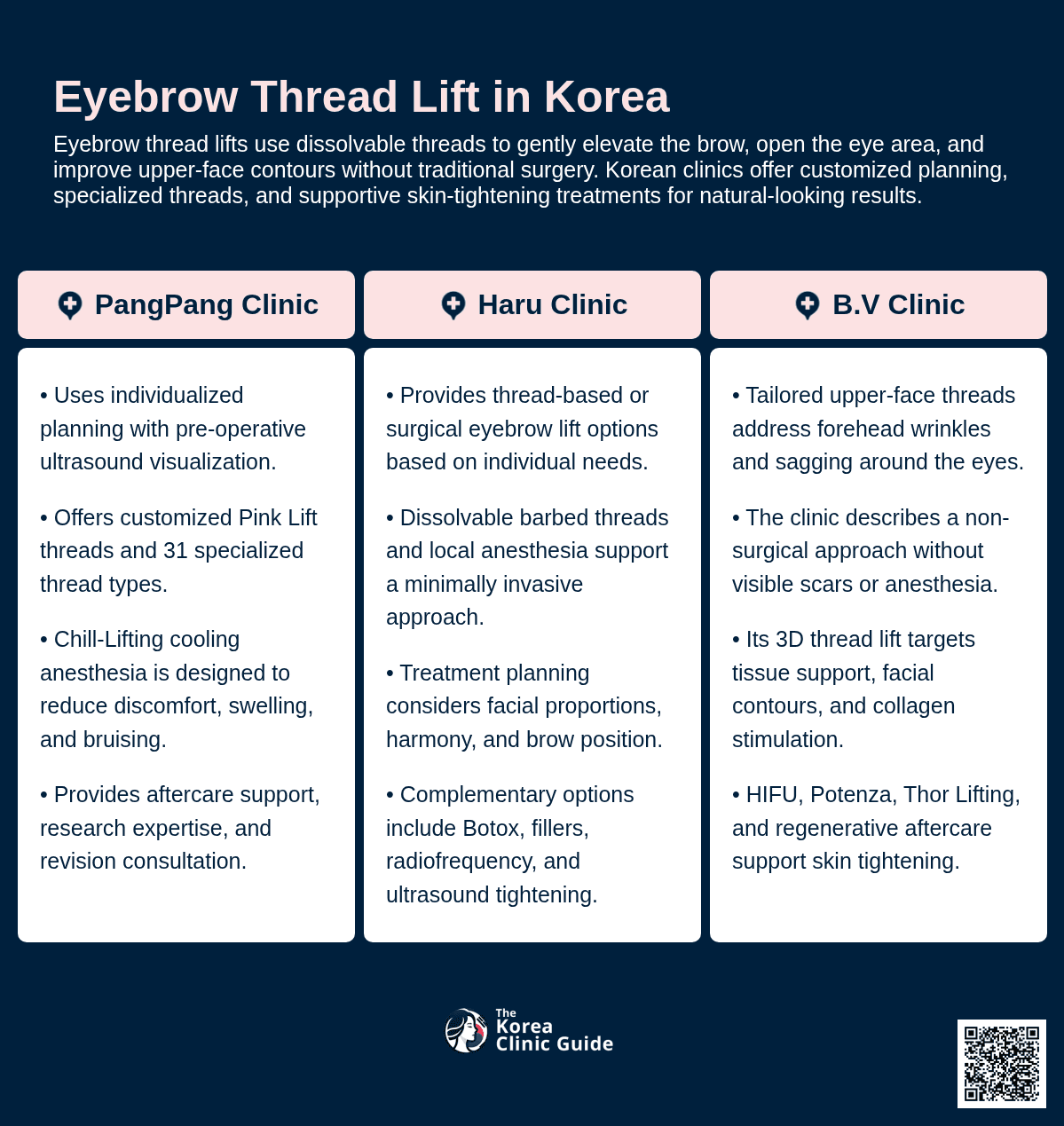
For an eyebrow thread lift, PangPang Clinic offers a thread-lifting-focused approach built around individualized planning, pre-operative ultrasound visualization, and customized thread selection. Its Pink Lift threads were developed from the clinic’s lifting-procedure data and are intended to provide a firm yet natural-looking lift, while the clinic’s research collaboration with Seoul National University Bundang Hospital emphasizes collagen stimulation and skin-quality improvement alongside lifting.
- URL: PangPang Clinic Website
- Location: Gangnam-gu, Seoul
- Thread-lift planning:
- Your treatment plan can be designed after a doctor consultation and pre-operative design with ultrasonic visual checking.
- The clinic describes using 31 specialized functional threads, with customization according to the area and lifting goal.
- Thread categories include barbed lifting threads for anchoring, assist threads to support the lift, and elastic tightening threads intended to support skin elasticity.
- Comfort and recovery:
- Chill-Lifting uses contact-free cooling anesthesia, which the clinic states is designed to reduce discomfort, swelling, and bruising.
- Listed anesthesia options for thread lifting include partial anesthesia, Airnox, or sleep anesthesia.
- The clinic lists thread-lift treatment time as approximately 30 minutes to one hour, with minimal recovery; individual recovery and suitability can vary.
- Research and aftercare:
- The clinic states that it operates a Thread Lifting Research Institute and participates in international beauty conferences through lectures and presentations.
- Its thread-lifting approach includes an aftercare package intended to support and prolong treatment effects.
- A revision center is available for concerns following a previous thread-lifting procedure, with possible complementary care such as fillers, Botox, or lasers.
2. Haru Clinic
You may consider Haru Clinic for an eyebrow thread lift if you want a brow-elevating option that can be thread-based or surgical, with planning centered on facial harmony and balance. The clinic describes thread lifting with dissolvable barbed threads under local anesthesia as a minimally invasive way to lift lax tissue, stimulate collagen, and keep downtime relatively short; for brow position and hooded upper lids, it also offers eyebrow lift treatment intended to create a more open, refreshed eye area.
- URL: Haru Clinic Website
- Location: Gangnam-gu, Seoul
- Brow and upper-face options:
- Eyebrow lift treatment may be performed with threads or surgery, depending on your needs and treatment plan.
- The stated goals include raising brow position, smoothing hooded upper lids, opening the eye area, and improving forehead contour.
- Thread lifting is described as using dissolvable barbed threads and local anesthesia.
- Facial-balance planning:
- Dr. Jeong is described as an official research physician at Merz and as teaching other doctors current filler techniques.
- Treatment design is described as individualized, with attention to your facial proportions, harmony, and a natural refreshed appearance.
- Complementary non-surgical options include Botox, fillers, and radiofrequency or ultrasound-based collagen tightening.
3. B.V Clinic
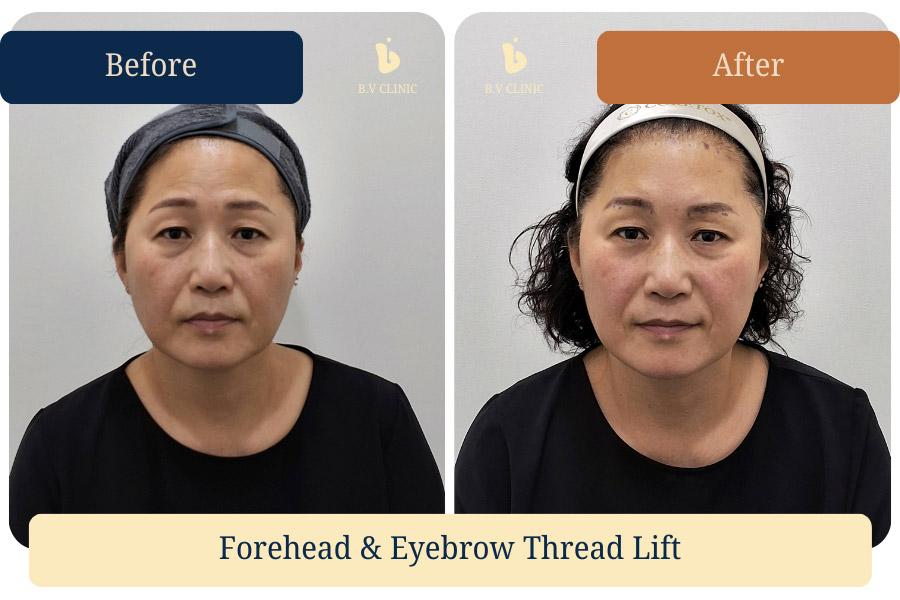
For an eyebrow thread lift, B.V Clinic offers tailored upper-face thread treatment aimed at concerns such as sagging around the eyes and forehead wrinkles. Its non-surgical forehead wrinkle restoration uses customized threads to support a natural-looking lift without visible scars or anesthesia, while the clinic’s broader 3D thread-lifting approach is designed to lift tissue, refine facial contours, and stimulate collagen.
- URL: B.V Clinic Website
- Location: Seoul
- Upper-face thread treatment:
- Non-surgical forehead wrinkle restoration is described as addressing forehead wrinkles and sagging eyes with tailored threads.
- The clinic states that this approach does not require visible scars or anesthesia.
- Its 3D thread lifting uses strategically placed threads and is described as targeting the SMAS layer for lift and collagen stimulation.
- Supportive skin-tightening and aftercare:
- HIFU, radiofrequency-based Potenza, and Thor Lifting are available as skin-tightening options.
- Post-treatment care includes skin-regeneration management intended to minimize swelling and support elasticity.
- The aftercare program may include nutritional skincare products and ultrasound-based treatment to support collagen.
Eyebrow Thread Lift From Start to Finish
- Remote enquiry and screening — Send unfiltered front, oblique, and side photographs with brows relaxed and raised. Ask whether English or virtual consultation is available, and disclose prior brow or eyelid surgery, fillers, botulinum toxin, threads, allergies, nicotine use, medical conditions, and all medicines and supplements.
- In-person anatomical assessment — The clinician assesses brow height and contour, eyelid opening, frontalis muscle compensation, skin thickness and mobility, asymmetry, scars, and infection risk. This visit must distinguish brow ptosis from upper-lid skin excess and true eyelid ptosis.
- Plan and consent — Confirm the target brow segment, vector, expected degree of elevation, exact thread product, thread number, anesthesia plan, downtime, risks, and the management plan for extrusion, infection, or asymmetry. Remote assessment cannot replace this examination.
- Marking and local anesthetic — Standard photographs are taken, the brow and temple/forehead are marked, skin is cleansed, and local anesthetic is injected. Oral or IV sedation, when used, requires transport arrangements and clinic-specific fasting instructions.
- Thread placement and tensioning — The clinician places absorbable barbed, cogged, coned, or multidirectional threads through small needle or cannula entry points in the brow, forehead, or temple. The threads engage soft tissue and are tensioned along the planned vector; there is ordinarily no skin excision or conventional brow-lift incision.
- Same-day discharge — Entry sites are cleaned and dressed as needed. Leave with written instructions, prescribed medicines where applicable, and a direct contact route for urgent concerns.
- Early Korean review — Attend review around 1–3 days after treatment and, where possible, again before departure. The clinician checks for hematoma, infection, exposed thread, dimpling, sensory change, and brow or eyelid asymmetry.
- Overseas follow-up and result assessment — Send agreed photographs at 1–2 weeks and 6–12 weeks. Reassess the settled result around 2–3 months; do not book repeat treatment based on immediate post-procedure height or early asymmetry.
Alternatives to an Eyebrow Thread Lift
Threads trade greater procedural convenience and no conventional incision for a subtler, absorbable lift with uncertain durability. Surgical procedures better address significant descent, excess skin, or functional eyelid problems, but involve incisions, longer recovery, and surgical risks.
Surgical Brow or Forehead Lift
- Best for — Marked brow ptosis or a request for greater and more durable repositioning.
- Tradeoff — More invasive than threads, with a longer recovery and incision-related considerations.
- Related procedures — Eyebrow lift, forehead lift, and temporal lift.
Endotine Lift
- Best for — Surgical brow or forehead repositioning using an implant-assisted suspension approach.
- Tradeoff — A surgical option rather than an absorbable thread treatment.
- Related procedure — Endotine lift.
Subbrow Lift or Upper Blepharoplasty
- Best for — Upper-eyelid skin excess that is the main cause of hooding or heaviness.
- Tradeoff — Removes or repositions tissue; it does not simply pull the brow upward.
- Related procedures — Subbrow lift and upper blepharoplasty.
Ptosis Correction
- Best for — True eyelid ptosis caused by levator dysfunction and reduced eyelid opening.
- Tradeoff — Treats eyelid mechanics, which a brow thread lift cannot correct.
- Related procedure — Ptosis correction.
Forehead Botulinum Toxin
- Best for — A small, temporary brow-shape adjustment in selected anatomy.
- Tradeoff — It does not correct significant brow ptosis; excessive or poorly placed forehead toxin can worsen eyelid ptosis.
- Related procedure — Forehead Botox.
Eyebrow Microblading
- Best for — Creating an optical impression of improved brow height, arch, or symmetry.
- Tradeoff — Changes pigment appearance only and does not lift tissue.
- Related procedure — Eyebrow microblading.
How Can I Prepare for an Eyebrow Thread Lift?
- Medication disclosure — Provide a complete list of prescription drugs, over-the-counter medicines, and supplements. Include warfarin, apixaban, rivaroxaban, clopidogrel, aspirin, NSAIDs, corticosteroids, isotretinoin, diabetes medicines, vitamin E, fish oil, ginkgo, garlic, ginseng, St John's wort, and turmeric/curcumin.
- Bleeding-risk medicines — Do not independently stop anticoagulants, antiplatelets, steroids, or diabetes medicines. The prescribing doctor and procedural clinician must set any pause or adjustment plan.
- Skin and infection check — Report acne, folliculitis, rash, dermatitis, cold sores, wounds, eye irritation, or scalp infection before travel. Defer treatment when infection or inflammation affects a planned entry point or thread track.
- Nicotine and alcohol — Disclose cigarettes, vaping, nicotine pouches, patches, and gum. Follow the clinic's nicotine and alcohol restrictions because both can affect healing, bleeding, and medication planning.
- Fasting and transport — Local-anesthetic-only treatment often does not require fasting, but oral or IV sedation does. Follow the clinic's written fasting instructions and arrange an adult escort if sedation is planned.
- Treatment-area preparation — Follow instructions on makeup, active skincare, hair washing, brow waxing or threading, and sun exposure. Do not schedule facial massage, gua sha, energy-based treatments, or injectables around the brow without clearance.
- Travel flexibility — Book accommodation near the clinic through the early review and keep return flights flexible enough to delay travel if a thread adjustment, removal, or complication assessment is needed.
Travel note: Bring medical records and a translated medication list. Keep copies of allergies, prior eye procedures, and the contact details of clinicians at home.
Confirm the treating clinic's individualized medication, fasting, skincare, and travel requirements; these instructions take precedence over general guidance.
Aftercare Advice
Protect the thread tracks and avoid pressure on the brow while swelling and tissue anchoring settle.
- First 3–7 days — Expect bruising, tenderness, swelling, tightness, dimpling, and temporary asymmetry. Use cold compresses only as directed, protect entry sites, and sleep with the head elevated when instructed.
- Pressure and facial movement — Do not rub, massage, manipulate, wax, thread, or forcefully stretch the forehead and brow. Avoid gua sha, facials, energy devices, and injectable treatments near the thread paths until cleared.
- Activity and heat — Avoid strenuous exercise, heavy lifting, straining, helmets, compressive headwear, saunas, hot baths, and face-down sleeping until the clinician permits them. Many people return to low-demand work and gentle activity in 1–2 weeks if recovery is uncomplicated.
- Skin and sun care — Cleanse and use ointment or medicines exactly as prescribed. Avoid makeup over entry points until permitted, and use SPF 50 on healed exposed skin to reduce the risk of post-inflammatory pigment change.
- Urgent warning signs — Seek prompt assessment for fever; worsening redness, warmth, pus, foul drainage, rapidly increasing one-sided swelling, severe escalating pain, expanding bruising, thread protrusion, weakness, numbness, abnormal brow movement, or persistent marked deformity. Seek urgent eye assessment for blurred or double vision, eye pain, inability to close an eye, or any vision change.
- Result timing — Do not judge the outcome during the first week. A small Korean study found significant measured elevation at 12 weeks, and durability beyond short follow-up remains uncertain; assess a settled result around 2–3 months.
Follow the treating doctor's instructions over general advice and contact the clinic promptly when anything appears wrong.
Frequently Asked Questions
Related Blogs
Abdominal Thread Lift in Korea: Candidacy, Evidence, Recovery, and Travel Planning
Abdominal thread lifts place absorbable threads in superficial abdominal tissue for subtle tightening, but methods, durability, and outcomes are not standardized. The article covers candidate screening, procedure planning, Korea travel and follow-up, preparation, aftercare warning signs, and alternatives for fat, excess skin, diastasis, or hernia.
Updated: Oct 13, 2026
Breast Thread Lift in Korea: Candidacy, Safety, Recovery, and Travel Planning
Breast thread lift uses absorbable threads placed through small entry points for modest contour improvement, but techniques, durability, and complication rates are not standardized. The article covers candidacy, preparation, travel planning for Korea, aftercare, warning signs, follow-up, and surgical alternatives for significant sagging.
Updated: Oct 13, 2026
Lip Thread Lift in Korea: Methods, Recovery, Risks and Travel Planning
Lip thread lifts use absorbable smooth or barbed threads to soften upper-lip lines or provide subtle traction, with suitability based on tissue quality, goals, and medical assessment. The article covers treatment planning, recovery, aftercare, risks, alternatives, and travel guidance for international patients in South Korea.
Updated: Oct 13, 2026
Filling Threads in Korea: Types, Recovery, Risks and Travel Planning
Filling threads are absorbable volumizing thread configurations placed under local anesthesia to soften minor static lines and localized hollows in appropriately assessed patients. The article covers candidate screening, device documentation, Korea travel planning, recovery, aftercare, complications, and alternatives such as filler, fat grafting, thread lifts, and facelift surgery.
Updated: Oct 12, 2026
Clinics offering Eyebrow Thread Lift

Haru Clinic Korea | Fully-Customized Full-Face Non-Surgical Rejuvenation With Threads, Botox & Fillers
Sinsa

PangPang Clinic: Korea's Premier Thread Lifting and Skin Rejuvenation Specialist in Gangnam, Seoul
Sinsa

B.V Clinic Korea: Advanced Aesthetic Treatments for Natural Beauty Enhancement & Rejuvenation
Sinnonhyeon Station