
Medical Tourism Blog
Endotine Lift in Korea: Candidacy, Procedure, Recovery, and Travel Planning
Table of contents
- Endotine Lift at a Glance
- What Is an Endotine Lift?
- Who Is a Good Candidate for an Endotine Lift?
- How Is an Endotine Lift Performed?
- Why Visit Korea for an Endotine Lift?
- Key Information for International Patients
- Which Are the Best Clinics in Korea for Endotine Lift?
- Endotine Lift From Start to Finish
- Alternatives to an Endotine Lift
- How Can I Prepare for an Endotine Lift?
- Aftercare Advice
Considering treatment in Korea? Everything you need to know e.g. — how to avoid scams, visas, interpreters, recovery tips — in our Medical Tourism Master Guide. Plan with confidence in minutes, not weeks!
Last updated: September 2026
Endotine Lift at a Glance
- What it is — An Endotine lift is a surgical brow or forehead lift that uses a bioabsorbable implant to temporarily anchor elevated brow tissue to the skull while it heals; it is a fixation method, usually used during an endoscopic lift, not a nonsurgical treatment.
- Best candidates — It is most suitable for low, asymmetric, or descended brows causing upper-eye heaviness, provided scalp and cranial-bone thickness are adequate; it does not correct true eyelid ptosis or upper-lid skin excess on its own.
- Expected change — Results are generally measured rather than dramatic: a 35-patient series combining Endotine fixation with [upper blepharoplasty](/blog/upper-blepharoplasty-korea) reported mean brow elevation of 1.6 mm, stable through up to 55 months of follow-up.
- Recovery timeline — Dressings are commonly removed in 1–3 days and sutures or staples, when used, around days 7–10; many people resume quiet work or social activity in 10–14 days, while brow position settles over weeks and complete healing may take up to 6 months.
- Implant-specific limitation — The implant is bioabsorbable, but there is no universal absorption timeline; tenderness, palpable bumps, or visible fullness can last several months, especially with thin or atrophic scalp tissue.
- Korea travel planning — International patients should plan to remain in Korea for at least 10–14 days after an isolated procedure for wound checks and possible suture or staple removal, with longer stays needed for combined surgery or delayed healing.
- Korea-specific distinction — Endotine-assisted forehead lifting has been documented in Seoul since 2007, but no contemporary Korea-wide registry proves superior outcomes; verify the surgeon’s Endotine experience, exact device model, anesthesia plan, local reviews, and remote follow-up in writing.
What Is an Endotine Lift?
An Endotine lift is a brow and forehead lift that uses a dissolvable implant to hold repositioned tissue while it heals. It addresses low or uneven brows and upper-eye heaviness caused by brow descent, creating a more open, rested appearance. It is a surgical procedure, usually performed through small scalp incisions.
Who Is a Good Candidate for an Endotine Lift?
- Brow descent — Good candidates have low or asymmetric brows, forehead laxity, or upper-eye heaviness caused primarily by brow ptosis rather than the eyelid itself.
- Realistic surgical goals — The procedure is designed for a measured elevation and stabilization of brow tissue. In one combined-procedure series, mean brow elevation was 1.6 mm with stability reported through 55 months, not a guaranteed dramatic change.
- Suitable operative anatomy — Candidates have adequate scalp and cranial-bone thickness for fixation, with hair-bearing scalp available to conceal the short incision sites and implant placement.
- Medical and logistical readiness — Candidates are fit for anesthesia or IV sedation, can stop nicotine according to the surgical plan, have a responsible adult for the first night, and can remain in Korea for postoperative review.
An Endotine lift is not appropriate with an active scalp or forehead infection, an open wound, inadequate cranial-bone thickness, or known sensitivity to the implant biomaterial, including PLA/PGA. Thin or atrophic scalp increases the risk of palpable or visible implant fullness, discomfort, contour irregularity, and wound problems. Pregnancy, breastfeeding, uncontrolled illness, unmanaged bleeding risk, and uncoordinated anticoagulant or antiplatelet use generally require deferral or medical optimization. Assessment must also distinguish brow ptosis from excess upper-eyelid skin, true eyelid ptosis, dry-eye disease, facial-nerve weakness, a high hairline, or prior forehead surgery; these factors can call for a different or combined operation.
How Is an Endotine Lift Performed?
An Endotine lift is a brow-lift fixation method, not a single standardized operation. The bioabsorbable implant temporarily secures elevated tissue while healing occurs, and the surgeon chooses the access route and fixation plan according to brow shape, scalp quality, hairline, and associated eyelid concerns.
- Endoscopic forehead lift — The usual approach uses short incisions in the hair-bearing scalp. The surgeon releases the forehead and brow tissue, elevates it, creates a controlled cranial fixation point, and engages the raised tissue on the implant tines. The manufacturer indicates Endotine Forehead for subperiosteal browplasty with either endoscopic or open surgery.
- Open brow-lift fixation — The same device can be used with an open approach when anatomy, prior surgery, or the need for wider exposure makes endoscopic access unsuitable. Scar placement and recovery differ from the endoscopic approach.
- Device selection — Manufacturer instructions list Endotine Forehead 3.0-mm and 3.5-mm tine models, plus the smaller Endotine Forehead-mini. Ask which model is proposed and why; implant dimensions do not by themselves predict the aesthetic result.
- Combined eyelid surgery — An Endotine brow lift is sometimes combined with upper blepharoplasty when excess upper-lid skin remains after brow position is assessed. It does not repair true eyelid ptosis, which requires ptosis correction when indicated.
- Transblepharoplasty suspension — Endotine TransBleph is a distinct upper-eyelid approach for selected patients having eyelid surgery, not a substitute for full endoscopic forehead release. In a small 20-patient series, the device was palpable in all patients and initially visible in about half, illustrating why tissue thickness and counseling matter.
Why Visit Korea for an Endotine Lift?
Endotine-assisted forehead lifting has been documented in Seoul since 2007. That confirms local use of the technique, but it does not prove that outcomes are superior in Korea or establish a nationwide complication rate. Choose a surgeon and facility based on documented planning and follow-up rather than implant availability alone.
- Documented local use — A Korean surgical publication described endoscopic forehead lifting with Endotine in Seoul, providing historical evidence that the device has been used in the Korean surgical setting.
- Device-specific planning — Endotine Forehead is a purpose-designed, bioabsorbable fixation device indicated for subperiosteal browplasty. Its manufacturer instructions describe both endoscopic and open use, controlled drilling, and placement under hair-bearing scalp where possible.
- International-care infrastructure — Korea maintains the official Medical Korea information portal for overseas patients. Before booking, obtain written confirmation of English consultation, surgeon credentials, anesthesia arrangements, the exact device model, in-country reviews, emergency contact arrangements, and remote follow-up.
- Evidence limitation — No contemporary Korea-wide registry comparing Endotine with bone tunnels, sutures, or screws was identified. A broader scoping review of 27 studies and 2,519 patients found highly inconsistent outcome and complication reporting across fixation methods.
Key Information for International Patients
- Minimum stay — Plan to stay in South Korea for at least 10–14 days after an isolated Endotine-assisted brow or forehead lift. This allows an early wound check and removal of non-dissolving sutures or staples, often around postoperative days 7–10.
- Combined surgery — Stay longer after upper blepharoplasty, ptosis repair, facelift, midface surgery, or fat grafting. Delayed healing, dry-eye symptoms, bleeding, or significant swelling also change the travel timeline.
- Flights — Do not set the return-flight date until the operating surgeon clears travel after examination. Avoid flying while there is active bleeding, concerning swelling, uncontrolled pain, visual symptoms, or a wound problem.
- First-night support — Arrange a responsible adult to stay overnight after general anesthesia or IV sedation. Do not plan to navigate airports, public transport, or hotel check-in alone on the day of surgery.
- Itinerary impact — Expect dressings for roughly 1–3 days and visible bruising, swelling, scalp tightness, numbness, itching, or implant-site fullness. Many people return to non-strenuous work or quiet social activity in about 10–14 days, while brow position continues settling for weeks.
- Remote follow-up — Obtain the clinic’s written plan for video reviews, wound photographs, medication questions, and urgent contact after returning home. Give the team contact details for a doctor at home who can assess complications if necessary.
Travel note: Keep accommodation close enough for scheduled reviews, avoid a rigid sightseeing schedule, and book changeable flights. Complete healing can take up to 6 months, so final assessment should not depend on the appearance at the end of a short medical trip.
Which Are the Best Clinics in Korea for Endotine Lift?
Listed below are some of the best clinics in Korea for endotine lift.
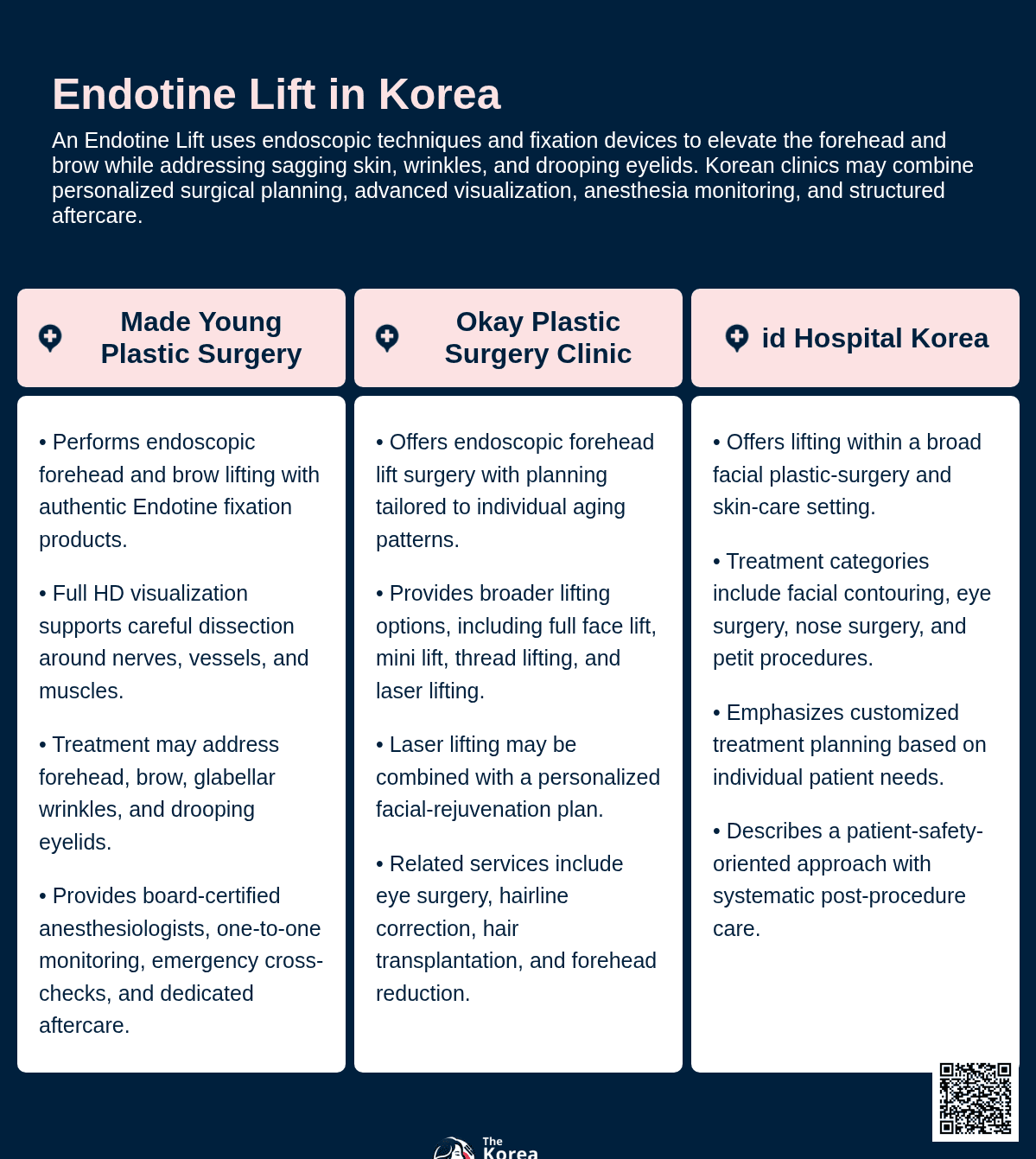
1. Made Young Plastic Surgery
For an Endotine Lift, you can expect an endoscopic forehead and brow-lifting approach using authentic Endotine fixation products at Made Young Plastic Surgery. The clinic describes Full HD endoscopic visualization for delicate dissection around nerves, vessels, and muscles, with lifting designed to address forehead, brow, and glabellar wrinkles as well as drooping eyelids.
- URL: Made Young Plastic Surgery Website
- Location: Seocho-gu, Seoul
- Procedure details:
- The described approach lifts the skin, periosteum, and muscle in the forehead and brow area.
- Procerus muscle resection may be included to address glabellar lines.
- A Full HD endoscopic system is used during dissection.
- The clinic states that it uses authentic Endotine products for fixation.
- Care and monitoring:
- Medical-team consultation and diagnosis are provided before the procedure.
- Full-time board-certified anesthesiologists are on site.
- The clinic describes one-to-one anesthesiology monitoring and a cross-check response system for emergencies.
- A dedicated aftercare center provides post-procedure care.
2. Okay Plastic Surgery Clinic
You may consider Okay Plastic Surgery Clinic for an Endotine Lift if you are looking for a personalized forehead-lifting plan within a broader facial-rejuvenation approach. The clinic offers endoscopic forehead lift surgery alongside full and mini face lifts, thread lifting, and laser lifting, with design tailored to your aging pattern.
- URL: Okay Plastic Surgery Clinic Website
- Location: Gangnam-gu, Seoul
- Lifting options:
- Endoscopic forehead lift surgery is available.
- Other listed options include full face lift, mini lift, thread lifting, and laser lifting.
- Laser lifting may be combined with a personalized lifting plan.
- Related services:
- Eye procedures include double-eyelid surgery, eye correction, under-eye surgery, and revision procedures.
- Hairline correction, hair transplantation, and forehead reduction are also available for forehead and hairline aesthetic concerns.
3. id Hospital Korea
For an Endotine Lift, you can expect a facial-treatment-focused setting at id Hospital Korea, where lifting is offered within a wider range of customized plastic surgery and skin-care services. The clinic emphasizes individualized planning, a patient-safety-oriented approach, and systematic post-care.
- URL: id Hospital Korea Website
- Location: Gangnam-gu, Seoul
- Related facial services: Available treatment categories include lifting, facial contouring, eye and nose plastic surgery, skin-clinic treatments, and petit plastic surgery.
- Care approach:
- The clinic describes customized plastic surgery planning and systematic post-care.
- Its stated focus includes patient safety-oriented treatment.
Endotine Lift From Start to Finish
- Remote consultation — Send clear frontal and side-view photographs, medical history, medicine and supplement lists, nicotine exposure, prior facial surgery or injections, and details of dry-eye or visual symptoms. Confirm whether the concern is brow descent, eyelid skin excess, true ptosis, or a combination.
- Surgical plan and travel coordination — The surgeon discusses brow shape, asymmetry, hairline, scar strategy, whether Endotine is appropriate, the proposed model and fixation sites, anesthesia, combination procedures, expected Korean stay, and the postoperative review schedule.
- In-person assessment — Before surgery, the team examines brow height, eyelid margin position, forehead movement, scalp thickness, hairline, facial asymmetry, eye closure, and relevant prior scars. Testing and medical clearance depend on age, health history, anesthesia plan, and clinic protocol.
- Anesthesia and preparation — The operation is commonly performed as an outpatient procedure under the anesthesia or IV-sedation plan selected by the anesthetic and surgical teams. The scalp is prepared, incision positions are marked, and the brow elevation plan is reconfirmed.
- Tissue release and elevation — Through short scalp incisions in the endoscopic approach, the surgeon releases retaining attachments beneath the forehead and brow, then elevates the tissue to the planned position. An open approach uses a different incision pattern when indicated.
- Endotine fixation — The surgeon creates a controlled cranial fixation point with the device-specific system, seats the bioabsorbable implant against the skull, and engages the elevated soft tissue on its tines. Placement under hair-bearing scalp helps reduce conspicuousness during the early healing period.
- Closure and discharge — Incisions are closed and dressings applied. After recovery from anesthesia or sedation, leave with the designated adult, written wound-care instructions, emergency contact details, and a scheduled early review.
- In-country review — Attend dressing removal, often within 1–3 days, and the later incision check. When non-dissolving sutures or staples are used, removal is often planned around days 7–10.
- Overseas follow-up — Send requested photographs and attend video reviews after returning home. Report escalating pain, swelling, wound drainage, eye-closure problems, facial weakness, or visual changes promptly rather than waiting for a routine appointment.
Alternatives to an Endotine Lift
The right alternative depends on the source of upper-eye heaviness and the desired degree and durability of change. Surgical options reposition tissue or remove excess skin more predictably but involve scars and longer recovery; non-surgical options are temporary and cannot reliably correct meaningful tissue descent.
Endoscopic or Open Brow Lift
- Best suited to — Patients with brow ptosis who need forehead release and elevation but do not require Endotine fixation specifically.
- Tradeoff — Fixation can use bone tunnels, sutures, screws, or other methods. A 2025 scoping review did not establish one universally best method because reporting was heterogeneous.
- Related procedure — Read about an eyebrow lift.
Temporal Lift
- Best suited to — People with mainly lateral or outer-brow descent and a goal focused on the brow tail rather than central forehead elevation.
- Tradeoff — It is more limited in scope than a full forehead lift and does not address substantial medial-brow or forehead laxity.
- Related procedure — Read about a temporal lift.
Upper Blepharoplasty
- Best suited to — Patients whose heaviness is mainly from excess upper-eyelid skin rather than a low brow.
- Tradeoff — Removing eyelid skin does not elevate a descended brow and can worsen the appearance of brow descent if the assessment is incomplete.
- Related procedure — Read about upper blepharoplasty.
Ptosis Correction
- Best suited to — Patients with a low eyelid margin that partly covers the pupil, rather than skin hooding caused by brow descent.
- Tradeoff — This corrects eyelid-opening mechanics, not forehead or brow position; some patients need both procedures.
- Related procedure — Read about ptosis correction.
Botulinum Toxin
- Best suited to — Patients seeking treatment for dynamic forehead or glabellar lines without meaningful brow tissue descent.
- Tradeoff — Results are temporary and injection placement can alter brow position. It cannot replace surgical elevation for established brow ptosis.
- Related procedure — Read about forehead Botox.
Thread Lift
- Best suited to — Patients seeking a temporary, non-surgical lifting option and accepting more limited correction.
- Tradeoff — Threads do not reproduce the release and cranial fixation of a surgical brow lift, and they are not a substitute for ptosis repair or removal of significant eyelid skin.
- Related procedure — Read about a thread lift.
How Can I Prepare for an Endotine Lift?
- Medical disclosure — Provide complete details of medical conditions, allergies, dry-eye symptoms, visual problems, bleeding history, poor scarring, facial-nerve symptoms, prior forehead or scalp surgery, and all previous facial injections or operations.
- Prescription medicines — Tell both the surgeon and prescribing clinician about anticoagulants, antiplatelet drugs, diabetes medicines, steroids, and all other prescriptions well before travel. Never stop or alter a prescription independently; the clinicians must coordinate any hold or bridging plan.
- Supplements and pain medicines — Disclose aspirin, NSAIDs, fish oil, vitamin E, herbal products, and other supplements. Follow the surgeon’s specific stop dates because bleeding risk and medical need differ by product and patient.
- Nicotine and alcohol — Stop smoking, vaping, nicotine replacement, and other nicotine exposure for the surgeon-directed period before and after surgery. Avoid alcohol for the period specified by the operating team.
- Fasting and testing — Follow written fasting instructions exactly for anesthesia or IV sedation. Complete any requested blood tests, electrocardiogram, or medical clearance before the procedure date.
- Scalp and hair preparation — Follow the clinic’s hair-washing and scalp-product instructions. Do not shave the operative area unless the surgical team specifically directs it.
- Travel arrangements — Reserve accommodation for at least 10–14 postoperative days, arrange a responsible adult for the first night, and choose flexible flights. Bring a hat only if it will not put pressure on incision or fixation areas.
- Sun and skin protection — Avoid sunburn, scalp irritation, and any skin treatment that could compromise the planned operative field before surgery.
Travel note: Bring copies of operative records and medication lists, and confirm how to contact the clinic outside business hours before discharge.
Confirm all medication holds, nicotine cessation timing, fasting rules, testing, and travel clearance directly with the treating surgeon and anesthesia team; their individualized instructions take precedence over general guidance.
Aftercare Advice
Protect the healing forehead and fixation areas, attend every scheduled review, and treat new eye or wound symptoms as urgent rather than cosmetic concerns.
- Head position and swelling — Keep the head elevated as directed and use surgeon-approved cool compresses. Swelling, bruising, tightness, tenderness, itching, and temporary scalp numbness are common early effects.
- Incision care — Keep dressings and incisions dry or wash hair only as instructed. Do not pick crusts, apply unapproved products, or massage the forehead and scalp.
- Pressure and activity — Avoid pressure-producing hats, helmets, forehead massage, strenuous exercise, contact sports, head trauma, and other restricted activity until the surgeon clears them. Fixation stability and wound healing determine the restriction period.
- Implant-site changes — Early palpability, visible fullness, and tenderness over the Endotine sites can last for several months, especially with thin scalp tissue. The device instructions do not provide one universal timetable for complete resorption.
- Sun protection — Once incisions are fully closed and the surgeon permits it, protect scars and exposed skin from sun with SPF 50 and physical shade.
- Warning signs — Seek urgent assessment for rapidly enlarging swelling, persistent bleeding, escalating pain, fever, spreading redness, pus-like drainage, wound separation, new facial weakness, inability to close the eyes, significant visual change, chest pain, or shortness of breath.
- Result timing — Non-strenuous work or social activity is often possible in roughly 10–14 days, but bruising and brow position continue to settle for weeks. Complete healing can take up to 6 months.
Follow the treating doctor’s instructions over general advice, and contact the clinic promptly when anything appears wrong.
Frequently Asked Questions
Related Blogs
Renuvion in Korea: Methods, Recovery, Risks, and Travel Planning
Renuvion uses helium-plasma radiofrequency energy beneath the skin, alone or after liposuction, to address mild-to-moderate localized laxity; Dermal resurfacing treats surface wrinkles with an external ablative handpiece. The article covers candidacy, alternatives, preparation, recovery, risks, Korea travel planning, and the need for surgeon clearance before flying.
Updated: Oct 13, 2026
Temporal Lift in Korea: Methods, Recovery, Risks and Travel Planning
A temporal lift elevates the outer brow through temporal scalp incisions, using open, subcutaneous, endoscopic, or combined techniques chosen for brow position, hairline, and eyelid anatomy. The article covers candidate screening, Korea facility and surgeon verification, a 10–14-day stay, recovery restrictions, aftercare, warning signs, and alternatives such as forehead lift, blepharoplasty, and p
Updated: Oct 13, 2026
Premature aging face treatment in Korea: Face Lift options for younger-looking skin
Early onset facial laxity and wrinkles are rising among 30s–40s. Our Korea medical tourism guide explains rhytids and how a rhytidectomy (face lift) can refresh the lower face and neck. Explore options: Deep Plane Facelift, SMAS Facelift, Mini Facelift, Lower Facelift and Neck Lift, plus non-surgical adjuncts. Learn candidacy, recovery timelines, costs, certifications, and tips for planning surger
Updated: Oct 12, 2026
Brow Ptosis in Korea: Forehead Lift and Subbrow Lift Treatment Options
Thinking about Brow Ptosis surgery in Korea? This expert guide explains diagnosis, functional vs cosmetic concerns, and compares a Forehead Lift with a Subbrow Lift—indications, scars, recovery, and costs. It maps the South Korea medical tourism journey (planning, visas, surgery day, follow-ups), highlights surgeon credentials and safety, and shares real outcomes, risks, and patient stories so you
Updated: Oct 12, 2026
Clinics offering Endotine Lift

Made Young Plastic Surgery: Rejuvenating Aesthetic Excellence in Korea for Face Lifts, Contouring and More
Gangnam Station

Okay Plastic Surgery Clinic in Korea: Comprehensive Aesthetic Procedures with Sincerity and Care
Cheongdam
ID Hospital - Main Branch in Korea: Specializing in Safe & Customized Facial Plastic Surgery and Post-Care Services
Sinsa
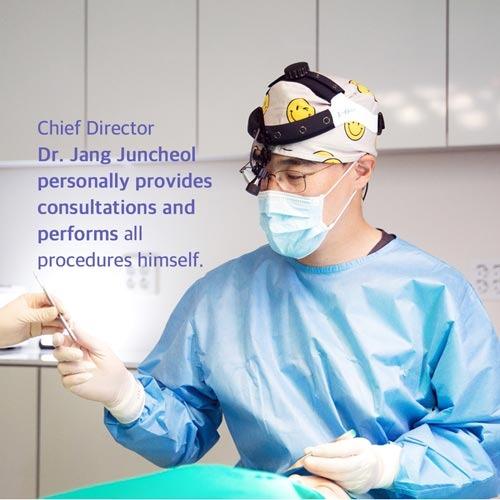
GGN Plastic Surgery Korea: Expert Cosmetic Procedures for Eye, Face, and Non-Surgical Enhancements in Gangnam Station
Gangnam Station