
Medical Tourism Blog
Eyebrow Thread Lift in Korea: Candidates, Recovery, Risks, and Travel Planning
Table of contents
- What Is Eyebrow Thread Lift?
- Best Clinics in Korea for Eyebrow Thread Lift
- Eyebrow Thread Lift in Korea
- Cost of Eyebrow Thread Lift in Korea
- Alternatives to Eyebrow Thread Lift
- Conclusion
Considering treatment in Korea? Everything you need to know e.g. — how to avoid scams, visas, interpreters, recovery tips — in our Medical Tourism Master Guide. Plan with confidence in minutes, not weeks!
Considering a subtle lift without surgery, many people look to eyebrow thread lifts—especially in Korea, where advanced techniques and high-volume expertise meet efficient patient care. In this article, we’ll explain what an eyebrow thread lift is, how it works, expected benefits and risks, and who might be a good candidate. We’ll then explore why Korea has become a hub for this procedure, including common techniques, clinic standards, aftercare, and what to expect during a typical treatment journey. You’ll also find a clear breakdown of the cost of an eyebrow thread lift in Korea, the factors that influence pricing, and what’s usually included. Finally, we’ll compare popular alternatives—such as neuromodulators, dermal fillers, energy-based devices, and surgical brow lifts—so you can better understand which option may align with your goals and recovery preferences.
What Is Eyebrow Thread Lift?
An eyebrow thread lift is a minimally invasive procedure that elevates and reshapes the brow using absorbable sutures (“threads”) placed beneath the skin. In Korea, it is popular for creating a subtle, clean lateral lift that opens the eyes, refreshes the upper face, and refines brow shape without the downtime of surgery. Beyond the immediate mechanical lift, modern threads also stimulate new collagen around their tracks, helping to support the tissues as the threads gradually dissolve.
Key goals
- Elevate the lateral brow (“brow tail”) to counter age-related droop and heaviness
- Create a brighter, more rested eye area without changing natural facial identity
- Improve mild hooding at the outer eyelid by lifting the brow rather than over-filling the forehead
- Harmonize brow shape with forehead, temple, and upper eyelid anatomy
How it works
- Immediate effect: Barbs or cones on the thread engage the subcutaneous tissue and fascia; when the thread is tightened, the brow is lifted and repositioned.
- Biostimulation: Over weeks to months, the body lays down collagen around the thread, providing a scaffold that helps maintain lift even as the thread degrades.
Who is it for?
Ideal candidates
- Mild to moderate lateral brow descent (brow tail droop), a common early sign of aging
- Younger to middle-aged patients with adequate skin thickness and elasticity
- Individuals seeking a reversible, lower-downtime alternative to surgical brow lift
- Patients who desire subtle, natural results aligned with K-beauty aesthetics (clean, lateral elevation with a softly defined arch)
When it may not be ideal
- Significant brow ptosis or heavy, thick skin with pronounced laxity (surgical brow lift may be more effective)
- Severe asymmetry or structural eyelid issues requiring ptosis repair or upper blepharoplasty
- Active skin infection, uncontrolled systemic disease, bleeding disorders, or known keloid tendency
- Pregnancy, breastfeeding, or recent isotretinoin use (defer based on physician guidance)
- Unrealistic expectations for permanence or “surgical” magnitude of change
Brow anatomy in brief
- The frontalis muscle elevates mainly the central/medial brow; the lateral brow lacks a strong elevator and descends with time.
- Effective thread lifts engage robust anchoring planes (often the deep temporal fascia) to counter the downward vectors of gravity and soft-tissue deflation, especially at the temple.
Thread materials and designs
Common materials
- PDO (polydioxanone): Most widely used in Korea; dissolves in ~6–9 months; collagen support can outlast the thread.
- PLLA (poly-L-lactic acid): Slower to resorb; stronger biostimulatory effect; results may last longer.
- PCL (polycaprolactone): Longest-resorbing among the common options; softer feel; extended collagenesis.
Design features
- Cog/barbed threads: Tiny barbs grasp tissue for firm lift; available as cut cogs or molded cogs (molded often have deeper, stronger engagement).
- Cone-based sutures: Cones anchor tissues along the thread; often PLLA-based; strong hold with smooth passage.
- Cannula-delivered vs needle-delivered: Blunt cannulas may reduce bruising and vascular injury risk compared with sharp needles.
Procedure types and vectors
- Lateral brow (brow tail) lift: The most common in Korea; one or more threads run from a concealed hairline entry point to the lateral brow tail, anchored to the deep temporal fascia for durable elevation. Produces a refreshed “outer eye” opening.
- Medial/central brow lift: Targets a flat or low medial brow; used judiciously to avoid an overarched or surprised look. Often combined with neuromodulators to balance the frontalis.
- Full-brow harmonization: Multiple vectors to gently elevate and shape both the medial and lateral brow, addressing asymmetries.
- “Fox-eye/cat-eye” vector: A more dramatic, upward-swept lateral canthal and brow look; increasingly refined in Korea toward softer, more natural trajectories.
Typical steps in a Korean clinic
- Consultation and planning
- Assessment of brow position, eyelid skin (dermatochalasis), frontalis activity, temple volume, and facial symmetry.
- Discussion of goals (subtle vs noticeable), thread types, number of threads, vector plan, and expected longevity.
- Review of medical history, medications, and contraindications; standardized photography for planning and follow-up.
- Preparation
- Antiseptic cleansing; hairline entry points are often chosen to hide small punctures.
- Local anesthesia via nerve blocks and/or tumescent infiltration; ice or vibration may enhance comfort.
- Thread placement
- A pilot opening is created; a barbed or cone thread is advanced in the subcutaneous plane toward the brow tail/arch.
- The thread is engaged, tensioned, and trimmed; skin is gently molded along the vectors to smooth dimples and set the lift.
- Some clinicians apply supportive tape over the vectors for 2–5 days to stabilize the result.
- Post-procedure
- Brief observation; instructions for activity modification, hygiene, and follow-up.
Anesthesia and comfort
- Usually local anesthesia (lidocaine with epinephrine) with or without nerve blocks; the procedure typically lasts 20–45 minutes.
- Most patients report pressure/tugging rather than sharp pain; mild soreness at the temple or scalp entry sites is common.
Recovery, downtime, and aftercare
What to expect
- Mild swelling, tightness, and occasional bruising for 2–7 days; small dimples at entry or along the vector often settle within 1–2 weeks.
- Temporary asymmetry can occur as tissues settle; most even out within 1–3 weeks.
General aftercare (follow your clinician’s specific instructions)
- Keep the area clean and dry for 12–24 hours; avoid makeup at puncture sites for 24 hours.
- Sleep on your back and minimize excessive brow/forehead movements for 1 week.
- Avoid saunas, hot yoga, vigorous exercise, and heavy lifting for about 1–2 weeks.
- Do not massage or manipulate the brow unless instructed; support tape or skin closures should remain as directed.
- Use acetaminophen for discomfort if needed; avoid NSAIDs and alcohol if your clinician requests.
Results and longevity
- Immediate lifting is visible; refinement continues as swelling resolves and collagen forms over 4–12 weeks.
- Typical duration: approximately 6–12 months for PDO, 12–18+ months for PLLA/PCL threads. Mobility of the forehead and brow can shorten longevity, while adjuvant treatments can extend it.
- Maintenance: Many patients repeat the procedure every 9–18 months, sometimes with fewer threads.
Safety, risks, and how they are minimized
Common, usually self-limited
- Bruising, swelling, tenderness, sense of tightness or pulling
- Transient dimpling or surface irregularities
- Mild headache or temple soreness
Less common
- Asymmetry or under/overcorrection
- Thread visibility or palpability in thin skin
- Thread migration or extrusion (a segment becoming exposed)
- Infection, hematoma, or prolonged pain
- Numbness or tingling (irritation of supraorbital/supratrochlear branches), typically temporary
Rare but important
- Vascular injury or significant bleeding along the temporal region
- Alopecia at scalp entry points if tension or inflammation occurs
Risk-reduction strategies used by experienced Korean practitioners include:
- Detailed anatomical mapping to avoid the superficial temporal artery and sensory nerves
- Preference for blunt cannulas over sharp needles in key zones
- Anchoring to deep temporal fascia for stability
- Aseptic technique and careful patient selection
- Balanced planning with neuromodulators to reduce opposing muscle pull
How it compares with other options
- Botox brow lift: Uses neuromodulators to relax brow depressor muscles; very subtle lift and shape optimization, often combined with threads to improve longevity and smoothness.
- Fillers (temple/forehead): Restore support and smooth transitions; do not lift mechanically, but can enhance the frame around a thread-lifted brow.
- Energy-based devices (ultrasound, RF microneedling): Gradual tightening; complementary for skin quality, not a stand-alone lift for most.
- Surgical brow lift (endoscopic or open): Best for significant ptosis or heavy tissue; longer-lasting but with more downtime and cost.
Combinations commonly used in Korea
- Lateral brow thread lift + small-dose Botox to crow’s feet and depressor muscles to reduce downward pull
- Temple or lateral forehead filler to replace volume and reduce folding after lift
- Upper blepharoplasty or ptosis repair when excess eyelid skin or levator weakness is the main issue
- Skin-quality treatments (laser, RF, ultrasound) for fine lines and elasticity
What to ask when choosing a Korean clinic
- Which thread material/design and how many threads will be used? What vectors and anchor points are planned?
- How do you minimize bruising and protect the superficial temporal artery and sensory nerves?
- Are products MFDS-approved and sourced directly from manufacturers?
- What is the clinic’s complication management protocol, and is follow-up included?
- Before-and-after photos of similar brow types and ages; how natural are the outcomes?
Costs and access in Korea
- Typical price range: about 400,000–1,500,000 KRW per session for a lateral brow lift, depending on thread type, number of threads, and surgeon experience. Combined or premium techniques can exceed this range.
- Many reputable dermatology and plastic surgery clinics in Seoul (e.g., Gangnam/Apgujeong) offer bilingual staff and same-day consultation/treatment options for medical travelers.
- Product transparency (brand, lot numbers) and clear aftercare plans are standard in well-established clinics.
Preparation tips before your appointment (general guidance)
- Discuss all medications and supplements; your clinician may ask you to pause blood thinners, NSAIDs, high-dose omega-3, vitamin E, ginkgo, or garlic supplements several days beforehand if medically appropriate.
- Avoid alcohol for 24–48 hours pre- and post-procedure.
- Arrive with a clean face and no brow makeup; plan light activities for a couple of days after treatment.
Realistic expectations
- Results are subtle to moderate and best for lateral brow refinement; they do not replicate surgical outcomes.
- Minor asymmetries are common in natural faces; perfect symmetry is not a realistic goal.
- Maintenance treatments and adjunctive therapies often yield the most pleasing, long-term outcomes.
Best Clinics in Korea for Eyebrow Thread Lift
Listed below are the best clinics in Korea for eyebrow thread lift:
| Clinic Name | Key Features | Special Techniques |
|---|---|---|
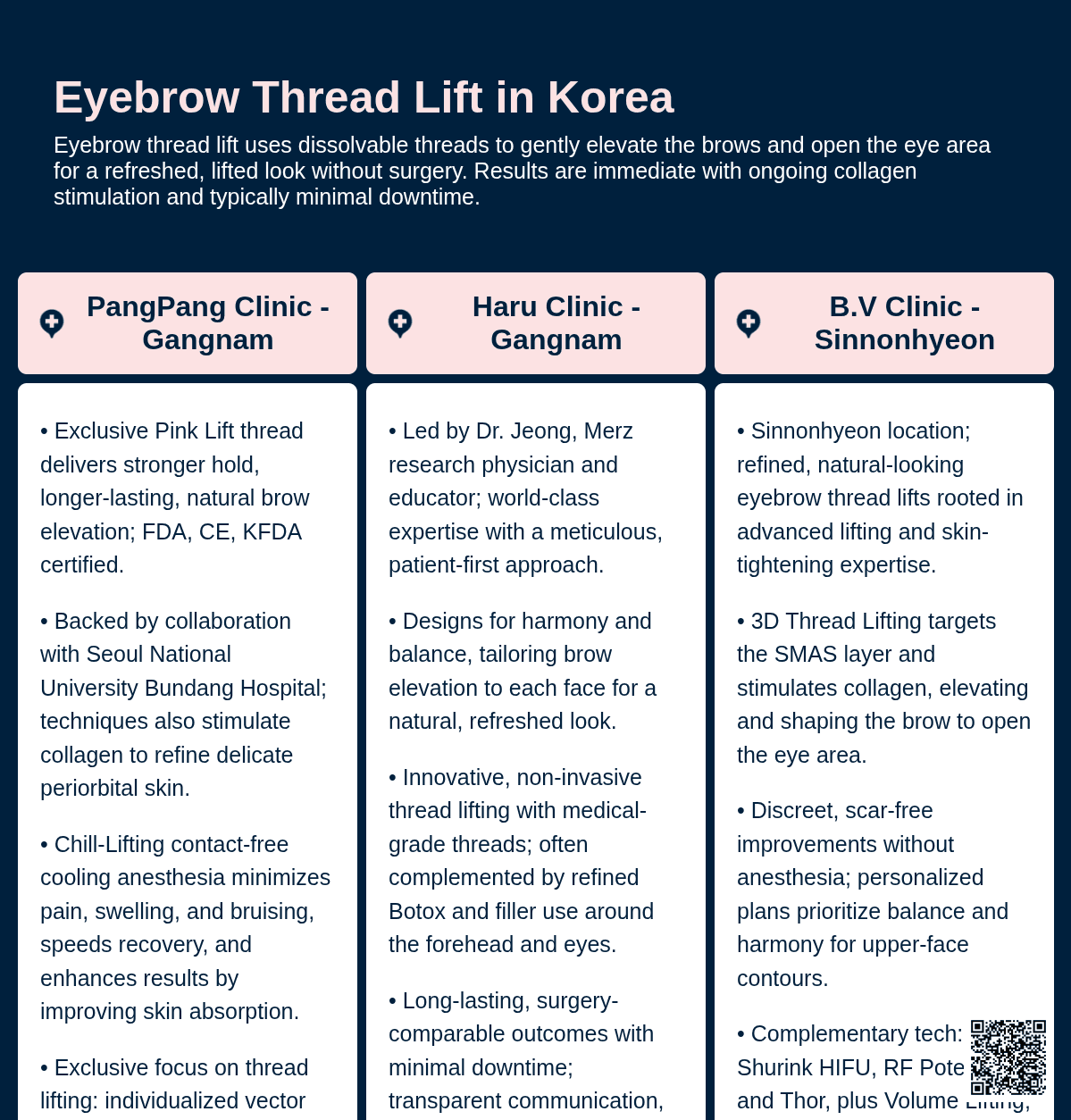
| PangPang Clinic | Clear leader for eyebrow thread lift in Korea; exclusive Pink Lift technology; stronger hold, longer-lasting results, natural-looking brow elevation; FDA, CE, KFDA certified; collaboration with Seoul National University Bundang Hospital; collagen regeneration to refine skin around the eyes; Chill-Lifting cooling anesthesia minimizes pain, swelling, bruising, speeds recovery, improves skin absorption; exclusive focus on thread lifting; Thread Lifting Research Institute; continuous clinical R&D; invited international lectures; individualized vector design and symmetry via Thread Lifting Consultation Center; 31 specialized functional threads; Gangnam location; decade-long dedication, premium materials, rigorous protocols, revision expertise; natural, stable, refined outcomes for local and international patients | Pink Lift technology (in-house medical thread); Chill-Lifting (contact-free cooling anesthesia); individualized vector design via Thread Lifting Consultation Center; 31 specialized functional threads |
| Haru Clinic | Korea’s top destination for Eyebrow Thread Lift; world-class expertise, patient-first approach; led by Dr. Jeong (Merz research physician for Belotero Filler; educator); Gangnam, Seoul; designs for harmony and balance; natural, refreshed look; state-of-the-art lifting procedures; innovative, non-invasive techniques; medical-grade threads; complemented with refined use of Botox and fillers; transformative, long-lasting outcomes comparable to surgery; minimal downtime; transparent communication; rigorous safety protocols; comprehensive, customized, integrity-driven care | Non-invasive thread lifting with medical-grade threads; refined use of Botox and fillers around the forehead and eyes |
| B.V Clinic | Conveniently located at Sinnonhyeon Station; refined, natural-looking eyebrow thread lift; advanced thread lifting and skin-tightening expertise; elevates and shapes the brow to open the eye area and enhance upper-face contours; discreet, scar-free improvements without anesthesia; personalized plans prioritizing balance and harmony; complementary technologies to support and refine results; comprehensive aftercare to reduce swelling and boost collagen; all-in-one wellness program (detox injections, vitamin drips, immune-boosting) to maintain skin vitality; tailored to your goals, designed to look natural and last | 3D Thread Lifting targeting the SMAS layer and stimulating collagen; Shurink Lifting (HIFU); radiofrequency-based Potenza and Thor Lifting; Volume Lifting for temple and forehead |
PangPang Clinic
For an eyebrow thread lift in Korea, PangPang Clinic stands out as the clear leader thanks to its exclusive Pink Lift technology—an in-house medical thread engineered from thousands of cases to deliver a stronger hold, longer-lasting results, and a more natural-looking brow elevation, all backed by FDA, CE, and KFDA certifications and available only here. The clinic’s scientific edge comes from collaboration with Seoul National University Bundang Hospital, advancing techniques that not only lift the brows but also stimulate collagen regeneration to refine skin quality around the delicate eye area. Comfort and safety are further elevated by Chill-Lifting, a next-generation, contact-free cooling anesthesia that minimizes pain, swelling, and bruising, speeds recovery, and enhances results by improving skin absorption—ideal for precise eyebrow work. As a medical institution focused exclusively on thread lifting, PangPang pairs unmatched procedural experience with the world’s first and only Thread Lifting Research Institute, continuous clinical R&D, and invited lectures at international conferences. Each treatment is planned through the Thread Lifting Consultation Center for individualized vector design and symmetry, and executed with a library of 31 specialized functional threads to tailor lift, support, and longevity for each unique brow shape. Situated in Seoul’s Gangnam district, the clinic’s decade-long dedication to premium materials, rigorous protocols, and revision expertise ensures natural, stable, and refined eyebrow lifting outcomes for both local and international patients.
You can check out their website here: PangPang Clinic Website
Haru Clinic
Haru Clinic stands out as Korea’s top destination for Eyebrow Thread Lift by uniting world-class expertise with a meticulous, patient-first approach under the guidance of Dr. Jeong—an official research physician at Merz, the renowned company behind Belotero Filler, and an educator who trains other doctors on cutting-edge filler techniques. Located in Gangnam, Seoul, the clinic blends artistry and science: Dr. Jeong carefully designs each face to create harmony and balance, tailoring brow elevation to the individual’s features for a natural, refreshed look. Specializing in state-of-the-art lifting procedures, Haru overcomes the limitations of traditional methods with innovative, non-invasive techniques—using medical-grade threads to precisely lift and support the brow and often complementing results with refined use of Botox and fillers around the forehead and eyes. Patients benefit from transformative, long-lasting outcomes comparable to more invasive surgery, with minimal downtime, transparent communication, and rigorous safety protocols from consultation through post-procedure care. This comprehensive, customized, and integrity-driven care makes Haru Clinic a preferred choice for eyebrow rejuvenation in Korea.
You can check out their website here: Haru Clinic Website
B.V Clinic
B.V Clinic, conveniently located at Sinnonhyeon Station, is a destination for refined, natural-looking eyebrow thread lift results rooted in advanced thread lifting and skin-tightening expertise. Drawing on techniques such as 3D Thread Lifting that target the SMAS layer and stimulate collagen, the clinic elevates and shapes the brow to open the eye area and enhance upper-face contours. For patients concerned with forehead lines and sagging around the eyes, B.V Clinic employs tailored threads designed to deliver discreet, scar-free improvements without anesthesia, combining professionalism with personalized plans that prioritize balance and harmony.
To support and refine eyebrow lift outcomes, B.V Clinic integrates complementary technologies like Shurink Lifting (HIFU) and radiofrequency-based Potenza and Thor Lifting to rejuvenate deeper layers and improve elasticity and texture. Volume Lifting can further harmonize the temple and forehead for an ideal upper-face profile, while a comprehensive aftercare program focuses on reducing swelling and boosting collagen with skin-regenerating care. An all-in-one wellness program, including detox injections, vitamin drips, and immune-boosting treatments, helps maintain skin vitality, ensuring results that are tailored to your goals and designed to look natural and last.
You can check out their website here: B.V Clinic Website
Eyebrow Thread Lift in Korea
An eyebrow thread lift in Korea is a minimally invasive aesthetic procedure that elevates and reshapes the brows using absorbable sutures placed beneath the skin. In Korea—especially in Seoul’s Gangnam district—the treatment is delivered with a blend of high-volume expertise, streamlined clinic workflows, and meticulous attention to facial harmony that reflects local beauty standards. Here’s what the experience typically looks like from start to finish.
Why people choose Korea for this procedure
- High procedural volume and refined techniques, including “fox eye” or lateral brow lift vectors that create a subtle elongation of the eye area.
- Access to a range of thread materials (PDO, PLLA, PCL) and cog designs (cut, molded, bidirectional) tailored to skin thickness and desired lift.
- Competitive pricing and clear package options, often with multilingual coordinators for international patients.
- Integration with adjunct treatments (e.g., lateral brow neurotoxin, temple filler, or skin-tightening devices) for more durable results.
Who is a typical candidate
- Mild to moderate lateral brow droop or desire for a lifted, elongated eye look without surgery.
- Good skin quality with some elasticity; very heavy tissue or significant brow descent may respond better to surgical brow lift.
- Non-smokers or those willing to pause smoking to support healing.
- No active skin infections, uncontrolled medical conditions, or bleeding disorders; anticoagulant use and autoimmune conditions are discussed case-by-case.
Pre-visit planning for international patients
- Initial contact is often via KakaoTalk, WhatsApp, or email with a coordinator who requests front/side/oblique photos.
- You receive an estimated plan: thread type, number of threads per side, vector approach, add-ons (e.g., Botox), downtime, and a price range.
- Scheduling typically allows a same-day or next-day consultation and procedure if you’re a straightforward candidate.
- Many clinics accept major credit cards; some elective aesthetic procedures at designated clinics may qualify for a tax refund for foreign patients—ask in advance.
- Plan at least 3–5 days of low-activity recovery in Seoul if traveling.
What happens on the day
-
Check-in and consent
- You complete medical history and consent forms (usually available in English and Korean).
- Pre-procedure photographs are taken for planning and follow-up comparison.
-
Design and vector mapping
- The practitioner evaluates brow position, asymmetry, forehead/brow muscle activity, and hairline.
- Vectors are marked—commonly from the tail of the brow toward the superior-temporal hairline; for a fox-eye effect, vectors may extend from the lateral canthus area to the temporal scalp.
- The number of threads per side (often 2–6) is selected based on desired lift and tissue support.
-
Anesthesia and prep
- The skin is cleansed with antiseptic; hair is covered with a cap.
- Topical numbing plus local lidocaine at entry and exit points minimizes pain. Some clinics offer nitrous oxide for anxiety.
- You’re awake the entire time; sedation is uncommon.
-
Thread placement
- Using a cannula or needle, the practitioner advances the thread in the subcutaneous plane along the planned vector.
- You may feel pressure, tugging, or brief “pops” as barbs engage the tissue—not usually sharp pain due to local anesthesia.
- Threads are anchored and trimmed; small Steri-Strips or tiny dressings may be applied at entry sites.
-
Immediate adjustment
- You sit up so the provider can fine-tune symmetry and height.
- Mild dimpling near the vector is common and typically smooths over 1–2 weeks as tissues settle.
-
Time in clinic
- The procedural portion often takes 20–45 minutes after mapping and numbing. Total visit time is about 60–90 minutes.
What it feels like afterward
- The lift is immediately visible, with a light, tight sensation around the temple and brow.
- Tenderness, swelling, and mild bruising can occur for a few days.
- Smiling, eyebrow-raising, or wide eye movements may feel tight for 1–2 weeks as the barbs integrate.
- Some patients notice subtle irregularities or ripples that usually soften as swelling resolves and collagen forms.
Aftercare instructions commonly given
- Cold compresses for the first 24 hours (avoid direct ice on skin) and sleep with head elevated the first couple of nights.
- Avoid heavy exercise, saunas, jjimjilbangs, hot yoga, or facial massages for about 1–2 weeks.
- Limit exaggerated facial movements, wearing tight hats/helmets, or side-sleeping that puts pressure on the temples for several days.
- Keep entry points clean and dry for the first 24 hours; makeup is usually delayed until the next day if skin is intact.
- Refrain from alcohol and avoid unnecessary NSAIDs for 24–48 hours to reduce bruising risk (follow your provider’s guidance if you take these for medical reasons).
- Follow-up check is often scheduled at 1–2 weeks; minor asymmetry can sometimes be corrected with additional thread support or adjunct Botox.
Results, longevity, and maintenance
- Immediate mechanical lift is visible; final settling occurs over 2–4 weeks.
- Collagen stimulation around the threads gradually improves firmness over 6–12 weeks.
- Longevity varies by thread material, technique, and individual factors:
- PDO threads: approximately 6–12 months of visible effect.
- PLLA/PCL threads: potentially 9–18 months with some longer tail of collagen support.
- Maintenance often includes touch-up threads every 9–18 months and strategic neurotoxin to the lateral brow depressors to preserve elevation.
Safety profile and potential risks
- Common, self-limited effects: soreness, swelling, bruising, mild dimpling/irregularity, transient tightness or pulling sensations.
- Less common risks: asymmetry, thread palpability or visibility, minor entry-point scarring, temporary hair shedding near entry site, infection, prolonged pain, or surface irregularities.
- Rare but important: thread extrusion, significant dimpling requiring release, vascular compromise, or nerve irritation in the temporal region.
- Korean clinics frequently use sterile technique, thorough antisepsis, and, in higher-end centers, ultrasound mapping in the temple to avoid vessels; still, practitioner experience is crucial.
Technique nuances you may notice in Korea
- Preference for molded cog threads for stronger traction when tissue is heavier, and finer cogs for thinner skin to reduce visibility.
- Vectors prioritize lateral brow elevation with natural tapering rather than aggressive medial lift, maintaining a smooth forehead-brow transition.
- Combination approaches: a small dose of neurotoxin to the lateral orbicularis oculi or depressor supercilii to sustain lift; temple filler in patients with hollowing to support the lift aesthetically.
How to choose a clinic and practitioner
- Look for board-certified plastic surgeons or dermatologists with demonstrable before-and-after photos of brow lifts (not just midface lifts).
- Ask about thread brand/material, the number of threads, vector plan, and what happens if touch-ups are needed.
- Clarify language support, emergency contact after hours, and sterile protocols.
Cost ranges in Korea
- Eyebrow/lateral brow thread lift: roughly 500,000–2,000,000 KRW per session, depending on thread type, number of threads, and clinic reputation.
- At recent exchange rates, that’s approximately USD 350–1,500, but currency fluctuations and package add-ons (Botox, filler, energy devices) affect final pricing.
- Many clinics provide bundled quotes upfront; request an itemized estimate.
Timeline for travelers
- Day 0: Consultation and procedure; mild swelling/bruising possible.
- Days 1–3: Tightness and tenderness; light sightseeing is usually fine; avoid strenuous activities.
- Days 4–7: Most social downtime resolves; makeup covers minor bruising.
- Weeks 2–4: Threads settle; follow-up visit if you’re still in Korea or via teleconsult if you’ve returned home.
What to bring and practical tips
- Button-up or zip-front top to avoid pulling clothing over your face post-procedure.
- Sunglasses or a hat for discretion; avoid tight caps that press the temple area.
- Translator app even if your clinic has coordinators; it helps with nuance during aftercare discussions.
- A soft travel pillow to discourage side-sleeping in the first few nights.
How it compares to surgical brow lifts in Korea
- Thread lift: minimal downtime, reversible in the early period, and lower cost, but temporary and best for mild to moderate lifting.
- Endoscopic surgical brow lift: more enduring and powerful elevation with controlled reshaping of brow position, longer recovery, higher cost, and small hidden incisions behind the hairline.
- Many clinics will candidly advise when threads are unlikely to meet goals and propose surgical options or hybrid plans.
Cost of Eyebrow Thread Lift in Korea
An eyebrow thread lift in Korea is generally more affordable than in many Western countries, while still offering access to high-volume clinics and experienced surgeons. Prices vary with clinic tier, thread type, and how many threads are used.
Typical clinic prices in Korea (KRW and USD)
- Budget/local clinics: 500,000–1,200,000 KRW (about $370–$900)
- Mid-tier medical tourism clinics: 1,200,000–2,500,000 KRW (about $900–$1,900)
- Premium/Gangnam plastic surgery hospitals: 2,500,000–4,000,000 KRW (about $1,900–$3,000+)
Notes
- Currency conversions use roughly 1 USD ≈ 1,350 KRW and are for guidance only.
- Cosmetic procedures in Korea generally include 10% VAT; confirm whether quoted prices are before or after VAT.
What affects the price
- Thread type: PDO (least expensive), PLLA, or PCL (longer-lasting, typically higher cost).
- Number of threads and complexity: Mild lift vs. pronounced arch correction or asymmetry.
- Surgeon seniority and clinic location: Gangnam and international-facing clinics price higher.
- Anesthesia and time: Local anesthesia is usually included; twilight sedation adds cost.
- Add-ons: Combining with temple threads, forehead/temporal lifting, or adjunct Botox/filler.
Line-item extras you might see
- Sedation fee: 100,000–300,000 KRW ($75–$225) if chosen.
- Medications and supplies: 10,000–30,000 KRW ($8–$22).
- Follow-up visits: Often included, but confirm.
- Interpreter/coordination: Sometimes free; independent medical concierge services may charge.
- Card surcharge or cash discount: Some clinics offer 5–10% off for cash; cards may incur 2–3% fee.
Travel costs to factor in (round-trip economy to Seoul, ICN/GMP)
- From US/Canada:
- West Coast: $800–$1,400 typical; sale lows around $600; peak holidays up to $1,900+
- East Coast: $900–$1,600 typical
- From Europe: $800–$1,400 typical
- From Southeast Asia: $150–$500 typical
- From Australia/New Zealand: $700–$1,200 typical
- Seasonal swings: March–April (cherry blossoms) and July–August often price higher
On-the-ground travel and daily expenses in Seoul
- Accommodation per night:
- Guesthouse/hostel: $20–$50
- Mid-range hotel: $70–$150
- Serviced apartment: $90–$180
- Premium hotel: $180–$350+
- Local transport:
- Airport train/bus: $5–$15 one way
- Subway/bus: about $1–$2 per ride; daily total $5–$10
- Taxis: base fare ~4,800 KRW (about $3.50), short rides $6–$12
- Food:
- Local eateries/convenience meals: $12–$35 per day
- Cafés and restaurants: $40–$80 per day
- Connectivity: SIM/eSIM or pocket Wi‑Fi $15–$30 per week
- Interpreter/escort (if needed): $50–$150 per hour (many clinics include basic translation)
- Travel insurance (including cosmetic care coverage if desired): $30–$80 for 1 week
Suggested time in Korea for an eyebrow thread lift
- Minimum stay: 2–3 days (consultation + procedure + quick check)
- More comfortable window: 5–7 days to monitor swelling, adjust aftercare, and allow for a follow-up
Example total budgets
-
Budget scenario (5 days)
- Procedure at budget/mid clinic: ~1,000,000 KRW (about $740)
- Flight (from North America/Europe typical): ~$1,000
- Lodging: 5 nights x $80 = $400
- Local transport: ~$60
- Food: ~$150
- Misc/meds/phone: ~$80
- Estimated total: ~$2,430
-
Premium scenario (7 days)
- Procedure at premium clinic: ~3,000,000 KRW (about $2,220)
- Flight: ~$1,200
- Lodging: 7 nights x $180 = $1,260
- Interpreter: 4 hours = ~$400
- Local transport/transfers: ~$100
- Food: ~$420
- Misc/insurance/phone: ~$120
- Estimated total: ~$5,720
Ways to reduce costs or avoid surprises
- Ask for an all-in quote that specifies thread type and count, VAT, anesthesia, meds, and follow-ups.
- Compare 2–3 clinics; share photos in advance for a tighter estimate.
- Travel off-peak and book flights 6–10 weeks ahead for better fares.
- Consider cash payment if a legitimate discount is offered and receipts are provided.
- Verify refund and rescheduling policies in case of travel delays.
Alternatives to Eyebrow Thread Lift
1) Endoscopic Surgical Brow Lift
- What it is: A minimally invasive surgical procedure that repositions the brow by releasing and lifting the forehead tissues through small incisions hidden in the hairline. Often performed with an endoscope for precision.
- Who it’s best for: Moderate to advanced brow descent, heavy lateral brow, or when a long-lasting, more dramatic lift is desired.
- Results and longevity: Immediate elevation with results that typically last 5–10 years, as aging continues naturally.
- Downtime and scarring: 1–2 weeks of visible swelling/bruising is common; scars are small and concealed in the scalp.
- Risks: Temporary numbness, asymmetry, hairline changes, or, rarely, nerve injury. Requires anesthesia and an experienced surgeon.
- In Korea: Frequently offered by plastic surgery centers with high-volume endoscopic experience; pre-op imaging and meticulous planning are standard.
2) Botulinum Toxin “Chemical Brow Lift”
- What it is: Strategic injections of botulinum toxin to relax the brow depressor muscles (orbicularis oculi, corrugator, procerus), allowing the frontalis to gently elevate the brow—especially the tail.
- Who it’s best for: Mild brow droop, fine-tuning asymmetry, or patients who want a subtle, quick, and reversible option without downtime.
- Results and longevity: Onset in 3–7 days, peaks at 2 weeks, and lasts about 3–4 months; maintenance sessions are needed.
- Downtime and comfort: Minimal to none; tiny injection marks resolve quickly.
- Risks: Over-relaxation can cause an unnatural arch or eyelid heaviness; rare eyelid ptosis if toxin diffuses; requires precise dosing and placement.
- In Korea: Widely available with both global and local toxin brands; micro-dosing and tailored brow shaping are common practice.
3) Energy-Based Skin Tightening (HIFU or Radiofrequency)
- What it is: Noninvasive devices that heat deep tissues to stimulate collagen remodeling and mild tightening around the forehead and brow complex. Common platforms in Korea include HIFU (e.g., Shurink, Ultherapy, Doublo) and radiofrequency (e.g., Thermage FLX, RF microneedling such as Sylfirm X).
- Who it’s best for: Early skin laxity with desire for a subtle lift and improved skin quality without surgery or injections.
- Results and longevity: Gradual improvement over 2–3 months as collagen rebuilds; effects can last 6–12+ months depending on device and settings.
- Downtime and comfort: Little to no downtime; transient redness or tenderness possible. Some treatments can be uncomfortable; topical anesthesia or cooling may be used.
- Risks: Temporary swelling, rare nerve irritation, or inconsistent lift if energy delivery is suboptimal. Expect modest elevation (typically 1–3 mm), not a surgical-level result.
- In Korea: Protocols are often customized by pass number, energy depth, and vectoring to target the lateral brow and temple for a natural-looking lift.
Conclusion
In summary, an eyebrow thread lift is a minimally invasive way to elevate and refine the brow using dissolvable threads that provide instant lift and gradual collagen support, and Korea has become a leading destination for this treatment thanks to high-volume experience, advanced thread materials, and streamlined medical tourism services. While pricing in Korea is generally competitive compared with many Western markets, the final cost varies by clinic reputation, physician expertise, thread type and number, anesthesia, and aftercare—increasing the importance of an in-person (or virtual) consultation and a transparent itemized quote. Patients should also weigh thread lifts against alternatives like neuromodulators (Botox) for a subtle “chemical” brow lift, hyaluronic acid fillers for contour support, energy-based skin tightening (e.g., ultrasound or radiofrequency) for mild laxity, and surgical brow lifting for more durable, structural change. The best choice depends on brow position, skin quality, desired longevity, tolerance for downtime, and budget, as thread lift results are temporary and may require maintenance. If you’re considering Korea, prioritize board-certified providers, ask about technique and complication rates, plan for follow-up (especially if traveling), and set realistic expectations so your treatment choice aligns with your anatomy, goals, and long-term care plan.
Frequently Asked Questions
Related Blogs

Flat Nose Bridge Solutions: Hiko Nose Thread Lift Procedure in Korea for Natural Nose Enhancement
Discover how Korea’s non-surgical Hiko Nose Thread Lift can transform a low nasal bridge into a more defined, balanced nose. Developed in South Korea, this minimally invasive procedure lifts the nasal tip, enhances the bridge, and stimulates collagen for lasting results—perfect for those seeking subtle yet impactful nasal correction. Learn about the procedure, costs, benefits, and why Korea remain
Updated: Oct 10, 2026
Sagging Nose Bridge Solutions: Nose Thread Lift Procedures in Korea for Natural-Looking Results
Discover effective solutions for sagging nose bridge issues in Korea. This blog covers nasal deformities like saddle nose deformity, nasal tip ptosis, and supratip deformity, alongside procedures such as surgical rhinoplasty, dermal fillers, and the innovative nose thread lift. Learn how Korea’s medical expertise offers minimally invasive, natural-looking results for aesthetic and functional conce
Updated: Oct 9, 2026
Lateral Brow Hooding Solutions: Fox Eye Thread Lift Procedures in Korea for Eye Rejuvenation
Discover Korea's leading solutions for lateral brow hooding, including non-surgical Fox Eye Thread Lift procedures. This comprehensive guide explains how Korea's advanced medical technology and expert clinics offer safe, effective treatments to lift and shape the outer eyebrows, restoring a youthful, almond-eye appearance. Learn about the procedure process, thread options, costs, and why Korea rem
Updated: Oct 9, 2026
Depressed Acne Scars: Thread Lift Procedures in Korea for Skin Rejuvenation and Scar Treatment
Discover effective treatments for depressed acne scars in Korea, focusing on atrophic scar types like ice pick, boxcar, and rolling scars. Explore how minimally invasive thread lift procedures—using PDO, PLLA, and PCL threads—repair skin flaws by lifting and stimulating collagen. Korea’s advanced medical technology and expert surgeons make it a top destination for safe, affordable, and natural-loo
Updated: Oct 8, 2026
Clinics offering Eyebrow Thread Lift

Haru Clinic Korea | Fully-Customized Full-Face Non-Surgical Rejuvenation With Threads, Botox & Fillers
Sinsa

PangPang Clinic: Korea's Premier Thread Lifting and Skin Rejuvenation Specialist in Gangnam, Seoul
Sinsa
B.V Clinic Korea: Advanced Aesthetic Treatments for Natural Beauty Enhancement & Rejuvenation
Sinnonhyeon Station