
Medical Tourism Blog
Pico Fraxel in Korea: Treatment Methods, Recovery, Costs of Travel Time, and Alternatives
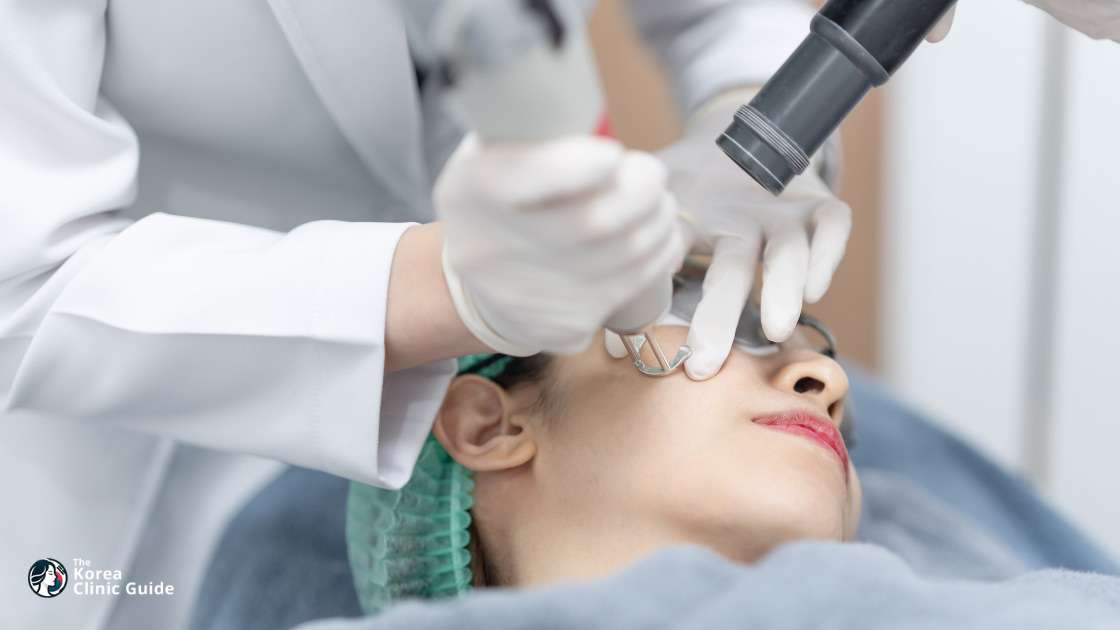
Table of contents
- Pico Fraxel at a Glance
- What Is Pico Fraxel?
- Who Is a Good Candidate for Pico Fraxel?
- How Is Pico Fraxel Performed?
- Why Visit Korea for Pico Fraxel?
- Key Information for International Patients
- Which Are the Best Clinics in Korea for Pico Fraxel?
- Pico Fraxel From Start to Finish
- Alternatives to Pico Fraxel
- How Can I Prepare for Pico Fraxel?
- Aftercare Advice
Considering treatment in Korea? Everything you need to know e.g. — how to avoid scams, visas, interpreters, recovery tips — in our Medical Tourism Master Guide. Plan with confidence in minutes, not weeks!
Last updated: September 2026
Pico Fraxel at a Glance
- What it is — Pico Fraxel is non-ablative fractional picosecond laser resurfacing: a fractional lens creates microscopic treatment zones to stimulate collagen remodeling for atrophic acne scars, texture, pores, and fine lines.
- Best candidates — It is best suited to stable rolling or shallow boxcar acne scars and mild textural concerns in people who accept gradual improvement rather than complete scar removal; active acne should be controlled first.
- Not a standard procedure — “Pico Fraxel” is a marketing term, not one uniform device treatment or necessarily the Fraxel brand. Confirm the laser model, wavelength, fractional MLA or DOE lens, density, passes, and treatment zones before consenting.
- Downtime and results — Redness, dryness, rough texture, fine flaking, and occasional pinpoint bleeding can be visible for about 1–7 days, while collagen-driven scar and texture improvement develops over weeks to months and is best assessed 8–12 weeks after the final session.
- Sessions and travel — Published courses commonly use 3 sessions about 4 weeks apart or 4 sessions about 3 weeks apart. International patients should plan 2–3 nights for a first visit and arrange return sessions or local follow-up.
- Key limitation and risk — Fractional pico laser cannot reliably release deeply tethered rolling scars or fully correct deep ice-pick scars, which may need subcision or focal procedures; pigment-reactive skin and melasma require conservative planning because PIH, hypopigmentation, and melasma worsening can occur.
- Korea distinction — Korea’s main advantage is access to an in-person, device-specific assessment within an established international-patient system—not a uniquely Korean Pico Fraxel technique. Confirm that the plan is fractional resurfacing rather than broad-beam pico toning.
What Is Pico Fraxel?
Pico Fraxel is a non-ablative fractional picosecond laser treatment that creates tiny treatment zones in the skin to stimulate collagen remodeling. It aims to gradually soften atrophic acne scars and improve uneven texture, visible pores, and fine lines rather than completely erase scars. It is a non-surgical, minimally invasive skin-resurfacing procedure.
Who Is a Good Candidate for Pico Fraxel?
- Atrophic acne scars — Good candidates have stable rolling or shallow boxcar scars and accept gradual softening rather than complete scar removal. Fractional picosecond treatment does not reliably release deep tethering beneath rolling scars or fully correct narrow, deep ice-pick scars.
- Texture, pores, and fine lines — Adults seeking improvement in uneven texture, enlarged pores, or mild fine wrinkles can be suitable when they accept a treatment series and ongoing sun protection.
- Controlled acne and realistic goals — Treat active inflammatory acne first when new breakouts are still creating scars. Published evidence supports fractional remodeling most clearly for atrophic scars, not permanent pore elimination, major tightening, or “glass skin.”
- Pigment-conscious patients — Darker and pigment-reactive skin can be treated, but needs a careful diagnosis, conservative settings, and explicit discussion of post-inflammatory hyperpigmentation (PIH) and hypopigmentation.
Do not treat tanned or sunburned skin, open wounds, active bacterial, viral, or fungal infection, or a changing or suspicious lesion. Elective cosmetic laser treatment is generally deferred during pregnancy and breastfeeding because safety data are limited. A history of keloids, poor wound healing, uncontrolled diabetes, immunosuppression, significant systemic illness, or recurrent cold sores requires individualized medical assessment; perioral treatment can require preventive oral antiviral medication. Melasma also requires particular caution: recent reviews find uncertain durability and recurrence control, and evidence does not establish picosecond laser as superior to standard topical treatment for this chronic, relapse-prone condition.
How Is Pico Fraxel Performed?
“Pico Fraxel” is a marketing term, not one standardized device procedure and not necessarily treatment with the Fraxel brand. Confirm the exact laser, wavelength, fractional lens, density, number of passes, and treatment zones before consenting.
- 1,064-nm fractional picosecond Nd:YAG — A 1,064-nm picosecond Nd:YAG laser used with a microlens array (MLA), diffractive optical element (DOE), or comparable fractional optic is commonly selected for atrophic scars, pores, texture, and fine lines. Concentrated microbeams create microscopic treatment zones while leaving intervening skin untreated.
- 755-nm fractional picosecond alexandrite — This approach uses a fractional or diffractive lens for remodeling and selected photoaging or pigment goals. Pigment diagnosis remains essential, especially in melasma-prone skin.
- More epidermal pigment-directed delivery — Approaches such as 532-nm delivery act more superficially and require especially cautious selection of skin type, diagnosis, recent sun exposure, and settings because pigment complications can occur.
- Fractional resurfacing versus pico toning — Fractional pico treatment creates discrete microscopic injury zones intended to trigger collagen remodeling. Pico toning generally refers to lower-fluence, broad-beam treatment for diffuse pigmentation; it is not interchangeable with scar-focused fractional resurfacing.
- Scar-focused combination planning — Laser can improve surface texture and scar edges, but scar shape determines whether it is enough. Rolling scars can need subcision, while deep ice-pick scars often need focal chemical reconstruction or punch techniques.
Why Visit Korea for Pico Fraxel?
Korea has an established medical-tourism framework for international patients and a large dermatology and aesthetic-treatment market. Pico Fraxel itself is not a uniquely Korean technique, so the important advantage is access to an in-person, device-specific plan rather than a claim that every clinic delivers the same treatment. Verify the clinician, device, and proposed settings individually.
- International-care infrastructure — Medical Korea’s official platform provides a government-backed pathway for overseas patients seeking Korean healthcare information and services.
- High international-patient volume — Korea reported more than two million foreign patients in 2025, reflecting substantial experience coordinating care for overseas visitors across medical services, as reported by Korea.net.
- Device-specific consultation opportunity — A Korea visit can support direct examination, standardized photography, and confirmation of whether the proposed service is truly fractional picosecond resurfacing rather than broad-beam pico toning. Ask for the model, wavelength, MLA/DOE or other handpiece, spot size, fluence, density, overlap, passes, and clinical endpoint.
- Evidence-informed scar planning — The current acne-scar evidence is encouraging but limited: a 2023 meta-analysis of seven studies found scar improvement comparable with other fractional lasers, lower reported pain and PIH incidence, and more temporary pinpoint bleeding. Results from one device or lens cannot be assumed to apply to every treatment marketed as Pico Fraxel.
Key Information for International Patients
- Recommended stay — Plan 2–3 nights for a first treatment: remote screening, an in-person assessment, treatment, and an optional next-day skin check. This is particularly sensible for pigment-prone skin, extensive facial treatment, or any combination procedure.
- Treatment course — One session is not a complete scar-remodeling course. Published protocols commonly use three sessions about 4 weeks apart or four sessions about 3 weeks apart; arrange return visits or local dermatology follow-up.
- Flying home — There is no research-based mandatory post-laser flight interval. A medically well person can fly when comfortable and able to maintain strict sun and barrier protection; flying the next day is a conservative practical choice, not a universal rule.
- Itinerary impact — Most people return to routine indoor activities the same day, but redness, dryness, fine flaking, pinpoint petechiae, and a sandpaper-like texture can remain visible for about 1–7 days. Avoid scheduling beach visits, outdoor tours, sauna visits, swimming, or heat-heavy exercise during early healing.
- Remote follow-up — Arrange a healing check at about 1–2 weeks, especially if leaving Korea quickly. Take dated photographs in consistent lighting and keep the Korean provider’s written aftercare plan, consent, invoice, laser details, and treatment photographs for a local dermatologist.
- Combination procedures — Subcision, filler, RF microneedling, or ablative resurfacing each have separate risks, downtime, and flight considerations. Do not treat a combined plan as a minor laser appointment.
Travel note: Book flexible flights and avoid a sun-exposed itinerary before and after treatment. Strict photoprotection is central to reducing inflammation-related pigment change.
Which Are the Best Clinics in Korea for Pico Fraxel?
Listed below are some of the best clinics in Korea for pico fraxel.
1. Abijou Clinic - Myeongdong Branch
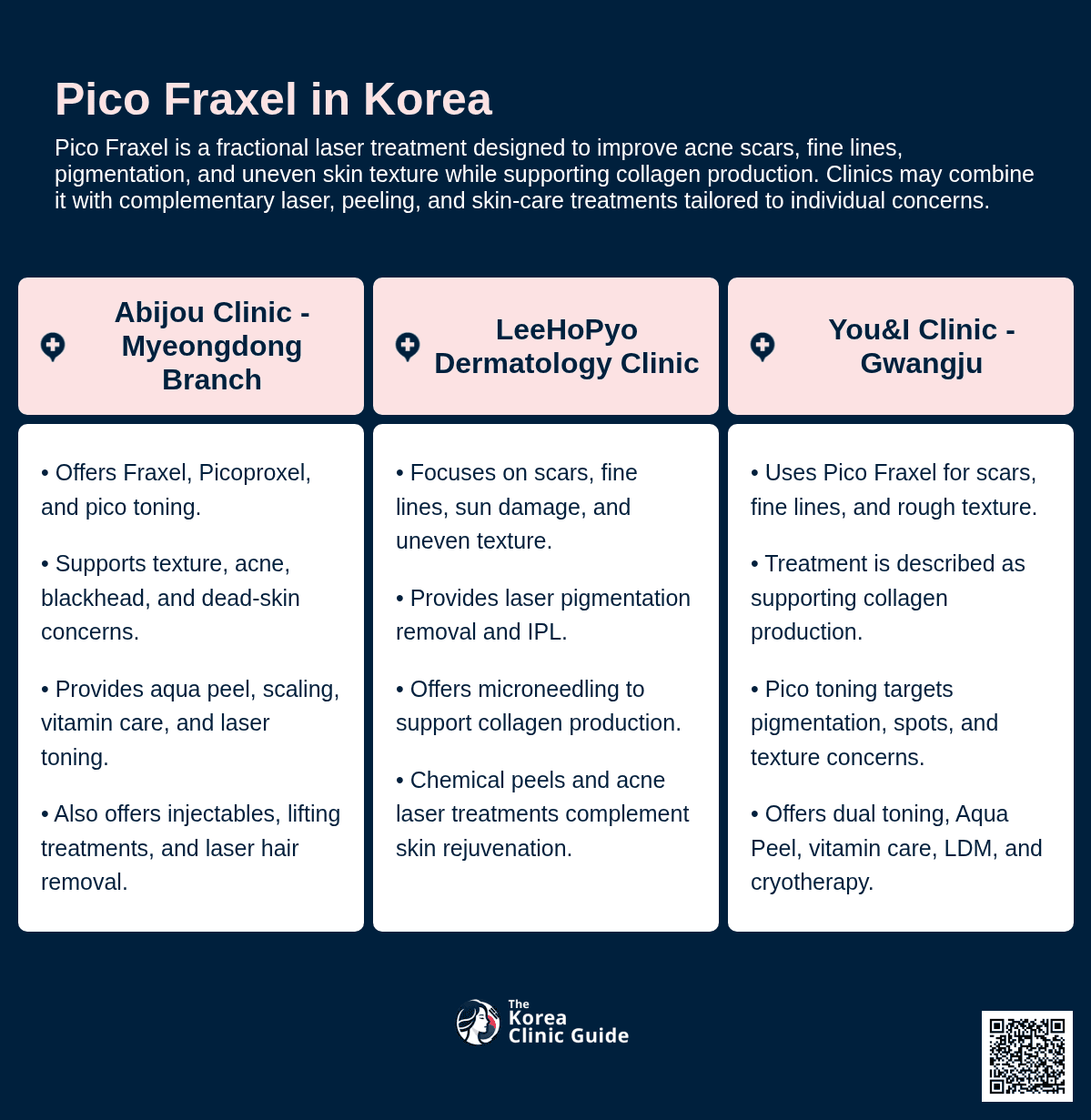
You can consider Pico Fraxel here as part of a broad skin-care offering that specifically includes Fraxel, Picoproxel, pico toning, and premium all-in-one pico toning. Your treatment options can be considered alongside concerns such as uneven texture, acne-focused care, dead skin cells, and blackheads.
- URL: Abijou Clinic - Myeongdong Branch Website
- Location: Jung-gu, Seoul
- Skin treatments:
- Offers Fraxel and Picoproxel alongside pico toning and premium all-in-one pico toning.
- Provides acne-focused treatments and customizable skin-care packages.
- Also lists aqua peel, scaling, vitamin management, and laser toning.
- Additional aesthetic services:
2. LeeHoPyo Dermatology Clinic
You may consider Pico Fraxel here if your goals include improving scars, fine lines, sun damage, pigmentation, or overall texture through laser-based skin rejuvenation. The clinic also offers complementary approaches such as laser pigmentation removal, IPL, chemical peels, microneedling, and acne laser treatment, which may be relevant when your concerns extend beyond texture alone.
- URL: LeeHoPyo Dermatology Clinic Website
- Location: Gangnam-gu, Seoul
- Skin and scar care:
- Laser treatments are described for improving texture, wrinkles, scars, and sun damage.
- Microneedling is offered to support collagen production and reduce acne-scar appearance.
- Acne laser treatment targets acne-causing bacteria and inflammation.
- Pigmentation options:
- Laser pigmentation removal targets melanin in dark spots.
- IPL is offered for pigmentation, age spots, and vascular lesions.
- Chemical peels are available to exfoliate damaged outer layers and address fine lines and pigmentation.
3. You&I Clinic - Gwangju
You may consider Pico Fraxel here for a fractional laser approach to scars, fine lines, and uneven skin texture, with the treatment described as promoting collagen production for smoother-looking skin. Pico toning, laser toning, and dual toning are also available when pigmentation or broader tone and texture concerns are part of your plan.
- URL: You&I Clinic - Gwangju Website
- Location: Seo-gu, Gwangju
- Procedure details:
- Pico Fraxel is listed as a fractional laser treatment for scars, fine lines, and skin texture.
- The treatment is described as promoting collagen production for smoother skin.
- Complementary skin care:
- Pico toning uses picosecond laser technology for pigmentation, texture, stubborn spots, and fine lines.
- Dual toning combines two laser technologies to address pigmentation and rough texture.
- Aqua Peel, vitamin care, Sono Care, cryo therapy, and LDM are available as additional skin-care options.
Pico Fraxel From Start to Finish
- Remote screening — Send standardized, makeup-free photographs and a complete history through the clinic’s English-language or virtual-consultation channel. Disclose acne activity, melasma, prior laser reactions, cold sores, keloids, medicines, isotretinoin exposure, allergies, and prior scar treatments.
- Written plan before travel — Confirm the exact device/model, wavelength, fractional lens or handpiece, target areas, estimated number of passes, topical anesthetic, expected downtime, proposed add-ons, and remote follow-up process. Ask whether the plan is fractional picosecond resurfacing or pico toning.
- In-person assessment — The clinician examines the skin, distinguishes rolling, boxcar, and ice-pick scars, checks for active acne or pigment disorders, reviews contraindications, and takes standardized photographs. A test area can be appropriate where pigment risk or treatment response is uncertain.
- Skin preparation and anesthesia — Makeup and sunscreen are removed. Topical anesthetic is commonly applied for about 30–40 minutes; straightforward treatment generally does not require fasting, IV therapy, sedation, blood tests, hospitalization, or a companion.
- Laser treatment — Protective eye shields are used. The clinician delivers fractional picosecond passes over the agreed zones; active laser time is typically minutes, although total appointment time is longer because of assessment and numbing.
- Immediate recovery and discharge — Cooling and a bland moisturizer are applied as appropriate. Expect warmth, redness, mild swelling, dryness, roughness, and sometimes pinpoint bleeding or petechiae. Leave with written instructions for cleansing, moisturizing, sunscreen, product restrictions, and warning signs.
- Early review and travel — Attend a next-day skin check when arranged, particularly after extensive treatment or a combined procedure. Travel once comfortable, with supplies for gentle skincare and reliable physical sun protection.
- Overseas follow-up and result assessment — Send healing photographs at around 1–2 weeks. Collagen remodeling is gradual; assess meaningful scar and texture change about 8–12 weeks after the final session rather than during the first week of healing.
Alternatives to Pico Fraxel
The best alternative depends on what is causing the visible concern. Non-ablative options generally involve less downtime but deliver more gradual change and often require a series; ablative or surgical scar procedures can address specific anatomy more directly but bring greater recovery and pigment risk.
Subcision and filler
- Best fit — Tethered rolling scars that pull downward when the skin moves.
- Tradeoff — Subcision releases fibrous bands that laser cannot reliably break. Temporary bruising and swelling are common, and filler adds product-specific risks and follow-up needs.
- Related option — See acne scar treatment for scar-morphology-based planning.
Ablative fractional CO2 or Er:YAG laser
- Best fit — Boxcar scars or more substantial textural damage when a person accepts more visible recovery.
- Tradeoff — Ablative resurfacing removes microscopic columns of skin and can produce more pronounced improvement per session, but generally entails more downtime, oozing or crusting, and pigment risk than Pico Fraxel.
- Related option — Review CO2 laser resurfacing before choosing an ablative approach.
RF microneedling
- Best fit — Mild-to-moderate acne scarring and texture concerns when a series-based, non-ablative approach is preferred.
- Tradeoff — Insulated needles deliver radiofrequency energy below the surface; results and recovery depend on needle depth, energy, passes, and any combined treatment. It does not substitute for subcision in strongly tethered scars.
- Related option — Potenza RF microneedling is one RF microneedling option.
Conventional microneedling
- Best fit — Mild textural irregularity or patients seeking a lower-intensity collagen-induction approach.
- Tradeoff — It is generally less intensive than fractional laser and often requires more sessions. It does not reliably correct deep scars.
- Related option — Learn about MTS facial treatment.
Pigment-directed treatment
- Best fit — Freckles, lentigines, PIH, or melasma only after a precise diagnosis.
- Tradeoff — Pigment treatment is not scar remodeling. Melasma often needs topical therapy and long-term sun control; laser inflammation can worsen it. Pigmentation treatment and laser toning address different goals from fractional resurfacing.
How Can I Prepare for Pico Fraxel?
- Sun and tanning — Avoid deliberate sun exposure, tanning beds, tanning products, and treatment over sunburned skin. Reschedule if the planned treatment area is tanned or inflamed.
- Medical disclosure — Tell the clinician about cold sores, melasma, PIH, keloids, poor healing, diabetes, immune suppression, active acne, allergies, and all previous procedures in the treatment area.
- Medicines and supplements — Provide a full list of prescribed medicines, anticoagulants, antiplatelets, isotretinoin, aspirin, vitamin E, herbal products, and other supplements. Do not independently stop prescribed anticoagulants, antiplatelets, isotretinoin, or any medicine; changes require agreement from the prescriber and treating clinician.
- Active skincare — Discuss retinoids, exfoliating acids, scrubs, benzoyl peroxide, recent peels, injectables, and other energy-based treatments. Pause only on the clinic’s specified schedule because the required interval depends on the product, skin condition, and planned settings.
- Cold-sore prevention — Report any history of herpes labialis before perioral treatment. Ask whether preventive oral antiviral medication is indicated.
- Day of treatment — Arrive with clean skin and no makeup or sunscreen unless the clinic gives different instructions. Fasting is generally unnecessary for a topical-anesthetic-only session.
- Travel logistics — Bring a wide-brimmed hat, SPF 50+ sunscreen, bland fragrance-free moisturizer, and a way to avoid direct sun. Book accommodation with easy indoor access and keep flights flexible if extensive treatment or an add-on is planned.
Travel note: Do not schedule treatment immediately before a beach holiday, hiking itinerary, or long outdoor sightseeing days. Heat and ultraviolet exposure complicate early healing.
Confirm the treating clinic’s product-stop periods, medication instructions, and travel requirements; its individualized directions take precedence over general guidance.
Aftercare Advice
Protect the recovering skin barrier and prevent sun exposure; early irritation or picking increases the risk of prolonged redness and pigment change.
- Cleanse and moisturize gently — Use lukewarm water and a mild cleanser, then apply a bland fragrance-free moisturizer. Use cool compresses only as directed. Do not scrub, rub, peel, or pick flaking skin, crusts, or pinpoint scabs.
- Strict sun protection — Apply broad-spectrum SPF 50+ sunscreen as instructed and use a hat, shade, and physical barriers. Avoid deliberate sun exposure throughout healing and between sessions.
- Pause irritating products and procedures — Avoid retinoids, exfoliating acids, scrubs, and other irritating products until the skin has recovered or the clinician clears reintroduction. Do not add new active products during the healing period.
- Avoid heat and friction — Skip swimming, sauna and steam rooms, hot yoga, and strenuous heat-heavy exercise while meaningful redness, swelling, crusting, or barrier disruption remains. Avoid facial massage and rubbing the treated area.
- Know warning signs — Seek prompt review for worsening pain, expanding redness or warmth, pus, fever, blisters, marked swelling, extensive crusting, a cold-sore eruption, or persistent/new dark or light patches. Take dated photographs, contact the Korean provider, and arrange local dermatology assessment if already home.
- Allow time for results — Redness and fine flaking commonly settle within about 1–7 days, while scar and texture improvement develops over weeks to months. Evaluate the course about 8–12 weeks after the final session, not during early healing.
Follow the treating doctor’s individualized instructions and contact the clinic promptly when healing appears abnormal.
Frequently Asked Questions
Related Blogs
Effective Juvelook Volume Filler for Lip Wrinkles Treatment in Korea
Discover how Korea leads in treating lip wrinkles—or perioral rhytides—with advanced procedures like Juvelook Volume Filler. Combining hyaluronic acid and PDLLA, this innovative Korean treatment offers immediate hydration and long-term collagen stimulation, effectively reducing smoker's lines and lipstick lines. Experience enhanced skin firmness, natural lip rejuvenation, and lasting results over
Updated: Oct 4, 2026
Dehydrated Lips Treatment with Hydro Injection in Korea: Effective Solutions for Moisturizing and Rejuvenation
Discover the benefits of Hydro Injection in Korea, a leading solution for dehydrated lips caused by cheilitis and related conditions. This minimally invasive procedure uses hyaluronic acid-based treatments to deeply hydrate, smooth, and rejuvenate lips, addressing issues such as chapped lips and fine lines. Korea’s advanced clinics offer expert care, streamlined processes, and cost-effective optio
Updated: Oct 3, 2026

Allergic Pigmentation Treatment with Pico Toning in Korea: Effective Solutions for Clear Skin
Discover how Pico Toning laser treatment in Korea effectively addresses Post-Inflammatory Hyperpigmentation (PIH), also known as allergic pigmentation or post-inflammatory brown spots. This advanced skin pigmentation procedure uses ultra-short pulses to break down melanin, making Korea a top destination for safe, affordable, and expert care. Learn about the treatment process, benefits, costs, and
Updated: Oct 3, 2026
Sallow Complexion Solutions: Skin Whitening Injection Treatment in Korea for Radiant Skin
Discover how Korea leads in medical tourism for skin whitening and treatment of sallow complexion. This blog explores causes like anemia and vitamin deficiencies, details Korea’s innovative skin whitening injections—featuring glutathione, vitamin C, and tranexamic acid—outlining procedures, costs, and patient experiences. Learn how Korea’s advanced clinics offer safe, effective treatments to brigh
Updated: Oct 2, 2026
Clinics offering Pico Fraxel

Personal Beauty GU Clinic Ilsan, Korea - Unveiling Hidden Beauty with Tailored Treatments and Advanced Cosmetic Procedures
Ilsan
Fullface Clinic in Korea: Your Go-To Destination for Advanced Aesthetic Procedures and Dermatology Services
Hongdae

Better Me Clinic Hongdae Korea | Aesthetic & Dermatology Clinic Near Hongdae Entrance Station
Hongdae

You&I Clinic - Gwangju, Korea: Your Destination for Comprehensive Skin Rejuvenation, Laser Treatments, and Weight Management Services
Sangmu District