
Medical Tourism Blog
Pigmentation Treatment in Korea: Methods, Recovery, Travel Planning, and Risks
Table of contents
- Pigmentation Treatment at a Glance
- What Is Pigmentation Treatment?
- Who Is a Good Candidate for Pigmentation Treatment?
- How Is Pigmentation Treatment Performed?
- Why Visit Korea for Pigmentation Treatment?
- Key Information for International Patients
- Which Are the Best Clinics in Korea for Pigmentation Treatment?
- Pigmentation Treatment From Start to Finish
- Alternatives to Pigmentation Treatment
- How Can I Prepare for Pigmentation Treatment?
- Aftercare Advice
Considering treatment in Korea? Everything you need to know e.g. — how to avoid scams, visas, interpreters, recovery tips — in our Medical Tourism Master Guide. Plan with confidence in minutes, not weeks!
Last updated: September 2026
Pigmentation Treatment at a Glance
- Diagnosis-led care — Pigmentation treatment is a tailored plan—not one procedure—for diagnosed melasma, PIH, freckles, or solar lentigines; suspicious, changing, irregular, or bleeding spots need dermatologic assessment and possible biopsy before cosmetic treatment.
- First-line foundation — Daily broad-spectrum sunscreen plus shade and hats are essential; for melasma or PIH, tinted iron-oxide sunscreen adds visible-light protection, while clinician-directed topical treatments are often the first step.
- Treatment options — Low-fluence 1,064-nm Nd:YAG laser toning may be used cautiously for selected melasma or PIH, while targeted Q-switched or picosecond lasers are better suited to confirmed discrete freckles or sun spots.
- Recovery and results — Laser toning usually causes only brief redness, but targeted pigment spots may darken and crust for 1–2 weeks; final pigment response is more reliably assessed after inflammation settles, around 4–8 weeks.
- Repeat-treatment reality — Melasma and PIH improve gradually and often require maintenance: laser-toning protocols commonly involve 5–15 sessions every 1–2 weeks, spanning roughly 5–30 weeks rather than a single visit.
- Key risk — Treatment-induced inflammation can cause rebound darkening, post-inflammatory hyperpigmentation, or mottled light spots, particularly after excessive cumulative laser treatment or in people with prior PIH; conservative settings and a test spot can reduce risk.
- Korea travel planning — Allow 2–3 full days for consultation and a low-downtime or test-spot session, or 5–7 days for a targeted laser or peel; Korea is particularly experienced with repeated conservative Nd:YAG laser-toning protocols, but device availability does not guarantee suitability or superior results.
What Is Pigmentation Treatment?
Pigmentation treatment is a diagnosis-led range of skincare, light-based, and peeling treatments that reduce excess skin color from concerns such as melasma, post-inflammatory marks, freckles, and sun spots. It aims to fade discoloration gradually, prevent new darkening, and support clearer, more even-looking skin while controlling triggers such as sun exposure and inflammation. Pigmentation treatment is non-surgical.
Who Is a Good Candidate for Pigmentation Treatment?
- Benign diagnosed pigmentation — Good candidates have a dermatologist-confirmed concern such as melasma, post-inflammatory hyperpigmentation (PIH), freckles, or discrete solar lentigines.
- Persistent, realistic treatment goals — Suitable patients understand that melasma and PIH improve gradually and often require long-term maintenance, rather than permanent clearance from one laser session.
- Controlled underlying inflammation — Acne-, eczema-, injury-, or procedure-related PIH is best treated after the triggering inflammation is under control.
- Commitment to light protection — Daily broad-spectrum sunscreen, shade, hats, and—for melasma or PIH—a tinted iron-oxide sunscreen for visible-light protection are central to treatment success.
- Ability to attend follow-up — Candidates for laser toning can complete a repeated plan locally or arrange coordinated care at home; published schedules commonly involve 5–15 sessions at weekly or every-two-week intervals.
Do not cosmetically laser, peel, or freeze an undiagnosed, changing, asymmetric, irregularly colored, bleeding, or suspicious lesion. Dermatologic examination, dermoscopy, and biopsy when indicated come first, since destructive treatment can obscure a lesion needing histology. Defer treatment during active infection, cold sores, open wounds, active dermatitis, acne flares, sunburn, or recent tanning because inflammation raises PIH risk. Pregnancy, breastfeeding, previous PIH or vitiligo, keloid tendency, immunosuppression, recent isotretinoin, anticoagulants, photosensitizing medicines, and prior treatment in the same area all require individualized assessment; do not stop prescribed medicines independently. Oral tranexamic acid (TXA) is not appropriate without physician screening for clotting, cardiovascular, menstrual, ocular, and medication risks.
How Is Pigmentation Treatment Performed?
Pigmentation treatment starts with diagnosis, not a device choice. The method depends on whether pigment is diffuse or discrete, superficial or dermal, and associated with melasma, PIH, acne scarring, photodamage, or active inflammation.
- Photoprotection and medical skincare — This is the foundation for every diagnosis. A clinician may prescribe hydroquinone, azelaic acid, tretinoin, cysteamine, topical TXA, kojic acid, niacinamide, or vitamin C. A short prescription course of triple-combination cream often contains hydroquinone 4%, tretinoin 0.05%, and fluocinolone acetonide 0.01%; prolonged unsupervised use can cause irritation and steroid-related harm.
- Low-fluence Q-switched 1,064-nm Nd:YAG laser toning — A repeated low-energy approach used cautiously for selected melasma and PIH. It usually causes brief redness with little social downtime, but cumulative excessive treatment can cause rebound hyperpigmentation or mottled hypopigmentation. A systematic review of laser toning found highly variable protocols, limited long-term follow-up, and hypopigmentation risk associated with more sessions.
- Targeted Q-switched or picosecond laser — Used for confirmed benign freckles, lentigines, and other sharply defined superficial lesions. The spot commonly darkens, then forms a small crust before clearing over about 1–2 weeks; a test spot is particularly useful in darker skin and in people with previous PIH.
- IPL photorejuvenation — IPL can address selected superficial photodamage, multiple lentigines, and redness. It is not automatically suitable for melasma, where heat and inflammation can aggravate pigment.
- Superficial chemical peel — Chemical peels using glycolic, salicylic, lactic, mandelic, or low-strength trichloroacetic acid can help selected epidermal PIH, acne-related marks, and photodamage. Deeper peels create more inflammation, healing time, and dyschromia risk.
- Fractional resurfacing — Fraxel laser or ablative CO2 laser can be considered when pigmentation coexists with texture change or acne scarring. These treatments are not default melasma care because controlled skin injury increases downtime and PIH risk.
Why Visit Korea for Pigmentation Treatment?
Korea has extensive clinical familiarity with conservative, repeated pigment-laser protocols, including low-fluence Q-switched Nd:YAG laser toning. This is useful for international patients seeking diagnosis-led planning, but it does not make a Korean treatment plan automatically superior. Device brand and local availability are not evidence that a modality is right for melasma or PIH.
- Established regional laser-toning practice — Low-fluence Q-switched 1,064-nm Nd:YAG treatment is widely described in Asian practice and Korean clinical literature, supporting local experience with repeated conservative protocols.
- Regulated medical-device framework — Korea’s Ministry of Food and Drug Safety maintains a medical-device regulatory system, relevant when a clinic identifies the actual device and approved intended use.
- Access to multimodal planning — Pigment care can combine medical skincare, light protection, selected laser or IPL treatment, and follow-up rather than treating every brown mark with the same device.
- Evidence limits matter — A 2026 systematic review and meta-analysis found very low-certainty overall evidence for laser-based melasma treatment because studies used inconsistent protocols and had important design limitations. Ask for the diagnosis, rationale, settings strategy, expected number of sessions, and PIH plan rather than choosing by laser name.
Key Information for International Patients
- Minimum stay — Plan 2–3 full days for consultation, diagnostic review, and one low-downtime topical, laser-toning, or test-spot session. This allows time to review an early reaction.
- Targeted laser or peel stay — Allow 5–7 days when treatment can cause darkening, blistering, or crusting. A discrete treated spot often needs 1–2 weeks to shed its crust and heal fully.
- Repeated-course limitation — A short trip cannot normally complete melasma laser toning. Common protocols use 5–15 sessions every 1–2 weeks, spanning about 5–30 weeks.
- Flying home — No high-quality evidence defines one exact safe post-laser or post-peel flight interval. Base departure on epithelial injury, swelling, pain, visible crusting, and the treating clinician’s examination before travel.
- Itinerary impact — Routine non-ablative treatment usually permits sightseeing with strict sun avoidance. Avoid beach activities, outdoor tours, saunas, hot baths, swimming pools, and strenuous exercise while the skin is inflamed or healing.
- Remote continuity — Leave with a written diagnosis, device manufacturer and model, wavelength, treatment map, medication instructions, photographs, and an emergency contact. Arrange remote review around 1–2 weeks after a targeted laser or peel.
Travel note: A companion is generally unnecessary for topical care, superficial peels, and routine non-ablative lasers. Arrange private transport and an adult companion if oral sedatives, extensive resurfacing, periorbital treatment, or temporary visual impairment from eye protection is expected.
Which Are the Best Clinics in Korea for Pigmentation Treatment?
Listed below are some of the best clinics in Korea for pigmentation treatment.
1. ID Hospital - Sinsa
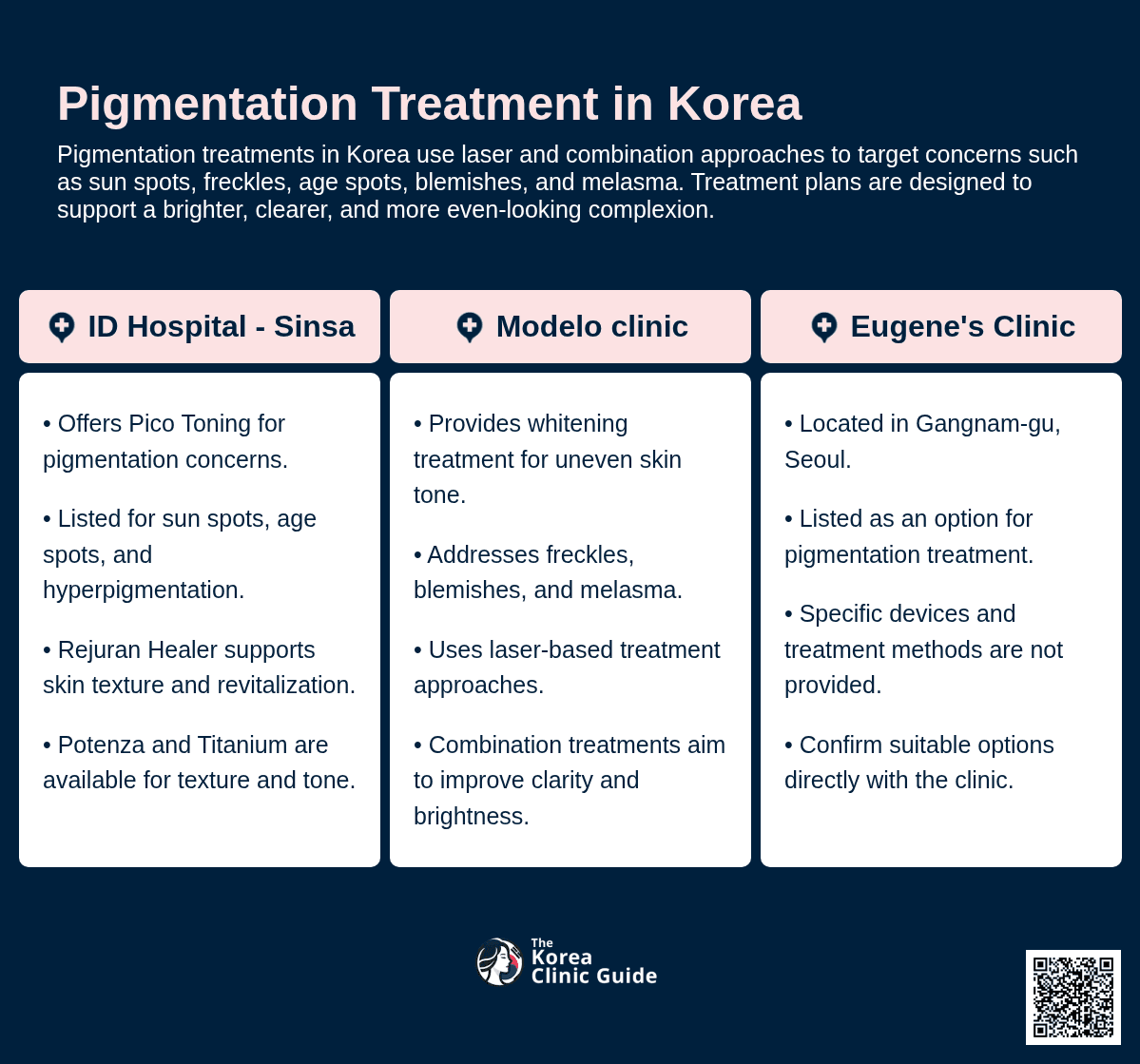
For pigmentation treatment, you can expect Pico Toning at ID Hospital - Sinsa, a laser-based option intended to target pigmentation and support a brighter, more even-looking skin tone. The clinic specifically lists it for concerns such as sun spots, age spots, and other forms of hyperpigmentation.
- URL: ID Hospital - Sinsa Website
- Location: Gangnam-gu, Seoul
- Procedure details:
- Pico Toning uses laser technology to target pigmentation.
- The treatment is listed for sun spots, age spots, and other hyperpigmentation concerns.
- Related skin treatments:
- Rejuran Healer is available for overall skin texture, fine lines, and revitalization.
- Potenza RF microneedling is offered for texture, pores, acne scars, and elasticity.
- Titanium is listed as an energy-based treatment for skin-tone improvement alongside lifting and tightening.
2. Modelo clinic
You may consider Modelo Clinic for pigmentation treatment if you are seeking care for freckles, blemishes, or melasma: its whitening service uses laser and combination treatments to improve skin tone and clarity and aim for a brighter, more even complexion.
- URL: Modelo clinic Website
- Location: Gangnam-gu, Seoul
- Pigmentation concerns treated:
- Whitening treatment is listed for freckles, blemishes, and melasma.
- Laser and combination treatment approaches are used to address tone and clarity.
3. Eugene's Clinic
Eugene's Clinic is identified in the available information, but no details are provided about its pigmentation-treatment methods, devices, or specific concerns treated. You would need to confirm the available options and whether they match your skin concerns directly with the clinic.
- URL: Eugene's Clinic Website
- Location: Gangnam-gu, Seoul
Pigmentation Treatment From Start to Finish
- Remote screening — Send unfiltered daylight photographs, onset and trigger history, prior treatment records, current medicines and supplements, allergies, cold-sore history, PIH or keloid history, reproductive status, and relevant medical conditions. Confirm that a physician—not only a coordinator—will assess the diagnosis.
- Virtual or English-language consultation — Discuss whether the concern is likely melasma, PIH, lentigo, freckling, photodamage, or a non-pigment cause such as vascularity or tear-trough shadow. The clinic should explain whether treatment is realistic within the travel window.
- In-person evaluation — The clinician examines the skin, documents standardized photographs, reviews Fitzpatrick phototype, pigment depth, inflammation, sun exposure, hormones, and medication use. Suspicious lesions require dermoscopy or biopsy assessment rather than cosmetic removal.
- Treatment planning or test spot — The clinician selects topical treatment, laser toning, targeted Q-switched or picosecond laser, IPL, peel, or a combination plan. Conservative settings and a test spot are especially relevant after prior PIH, hypopigmentation, or in higher phototypes.
- Treatment day — Skin is cleansed and photographed; protective eyewear is used. Topical anesthetic is used for selected procedures. The clinician individualizes wavelength, pulse type, spot size, fluence, passes, cooling, and endpoint; low-fluence toning should aim for mild transient erythema rather than blistering.
- Discharge and early review — Receive written aftercare and medication instructions. Laser toning commonly produces temporary redness or mild swelling; targeted lesions can darken before crusting. Return for a review during the trip when the clinic requests it.
- Overseas follow-up — Send clear photographs as directed, particularly at 1–2 weeks after a peel or targeted laser. Continue with a dermatologist at home for prescriptions, recurring melasma care, and additional sessions.
Alternatives to Pigmentation Treatment
The best alternative depends on the diagnosis. Non-procedural treatment avoids laser-induced inflammation but usually works more slowly; targeted procedures can clear selected discrete lesions faster but bring crusting and PIH risk.
Medical skincare and photoprotection
- Best role — First-line management for melasma and many cases of PIH, particularly when inflammation, tanning, hormones, or visible light continue to trigger pigment.
- Tradeoff — Requires consistent daily use and reassessment after roughly 8–12 weeks, but avoids procedure-related skin injury.
Acne or dermatitis treatment
- Best role — Addresses the source of PIH when active acne or eczema continues to create new marks. See acne treatment when acne is the primary driver.
- Tradeoff — Pigment fades more slowly, but controlling inflammation is essential before considering pigment procedures.
IPL or targeted pigment laser
- Best role — IPL can suit diffuse superficial photodamage; targeted lasers can suit a dermatologist-confirmed benign lentigo or freckle.
- Tradeoff — More direct treatment for discrete lesions, but not a universal solution for melasma and can provoke PIH in susceptible skin.
Chemical peel
- Best role — Conservative superficial peeling can help selected epidermal PIH and acne-related discoloration.
- Tradeoff — Produces dryness or flaking for several days and needs careful selection in melasma or PIH-prone skin.
Fractional resurfacing
- Best role — Consider this when texture, photoaging, or acne scars are as important as pigment.
- Tradeoff — Greater improvement in texture can come with substantially longer healing—about 1–4 weeks for ablative fractional resurfacing—and higher inflammation and PIH risk.
How Can I Prepare for Pigmentation Treatment?
- Protect from light — Use broad-spectrum, water-resistant SPF 30 or higher daily, seek shade, and avoid tanning or sunburn before treatment. For melasma and PIH, choose tinted sunscreen with iron oxides and reapply at least every two hours outdoors.
- Provide a complete medicine list — Report all prescription and non-prescription medicines, vitamins, herbal products, hormones or oral contraceptives, isotretinoin, anticoagulants, antiplatelets, and photosensitizing drugs. Do not independently stop essential prescribed medication.
- Review active skincare — Ask the clinic when to pause retinoids, benzoyl peroxide, AHA/BHA/PHA acids, scrubs, depilatories, bleaching agents, topical steroids, and fragranced products. Do not apply a new active product shortly before treatment.
- Avoid extra skin trauma — Do not wax, tweeze, pick, exfoliate aggressively, or book another laser or peel in the area without clearance. Report cold-sore history before facial laser treatment.
- Disclose reproductive and clotting risks — Report pregnancy, breastfeeding, plans to conceive, thrombosis history, thrombophilia, unexplained visual symptoms, and menstrual or cardiovascular history. Do not start oral TXA without individualized prescribing oversight.
- Fasting and transport — Routine non-ablative laser or superficial peel treatment generally does not require fasting. Follow fasting instructions exactly if sedation or extensive resurfacing is planned, and arrange an escort and private transport after sedatives.
- Keep travel flexible — Schedule outdoor activities before—not immediately after—treatment, reserve sun-protected indoor plans, and avoid booking an inflexible long-haul flight immediately after an ablative procedure.
Travel note: Bring a wide-brimmed hat, tinted SPF, gentle fragrance-free cleanser, and bland moisturizer. Pack these in carry-on luggage so aftercare does not depend on shopping after treatment.
Confirm the treating clinic’s individualized preparation instructions, as they take precedence over general guidance.
Aftercare Advice
Protect the treated skin from inflammation, friction, and light exposure; these steps materially reduce the chance of post-laser PIH and poor healing.
- Cleanse and moisturize gently — Use a gentle cleanser and bland fragrance-free moisturizer. Use cool compresses only when the clinician approves them; do not scrub, exfoliate, or use irritating active products until cleared.
- Use strict sun and visible-light protection — Apply broad-spectrum SPF 50 and, for melasma or PIH, a tinted iron-oxide sunscreen. Reapply during outdoor exposure and use shade and a hat.
- Leave darkened spots and crusts alone — After targeted laser treatment, pigment often darkens before it lifts. Do not pick or peel crusts, as premature removal increases scarring and PIH risk.
- Avoid heat and friction — Avoid strenuous exercise, saunas, hot baths, hot tubs, pools, contact sports, and facial rubbing until redness, crusting, and skin sensitivity have resolved.
- Know warning signs — Contact the clinic urgently for increasing pain, spreading redness or warmth, pus, fever, painful blister clusters, persistent bleeding, extensive blistering, eye pain or vision changes, or rapidly worsening darkening or lightening.
- Judge results at the right time — Low-downtime treatment redness often settles quickly, while treated lentigines clear over roughly 1–2 weeks and pigment outcome is better assessed after inflammation settles at about 4–8 weeks. Melasma and PIH require gradual reassessment and maintenance; a small laser-toning monotherapy study reported 81% recurrence within six months, illustrating why ongoing trigger control matters.
Follow the treating doctor’s instructions over general advice and contact the clinic promptly when healing appears abnormal.
Frequently Asked Questions
Related Blogs
Discover the Real Costs of Torr Lifting: Korea vs Global Competitors in USA, Mexico, Turkey & Vietnam
Discover the cost dynamics of Torr Lifting services in Korea, exploring factors influencing pricing, from equipment quality to operational expenses. Gain insights that can help businesses make informed decisions about lifting solutions in the Korean market.
Updated: Oct 24, 2026
Korean vs. International Acne Treatment Costs: Is Korean Skincare the Superior Choice?
Discover the latest insights into acne treatment costs in Korea, exploring affordable solutions and cutting-edge dermatological advancements. Learn how you can achieve clear skin with budget-friendly options in one of the world’s top skincare destinations.
Updated: Oct 24, 2026
Discover the Global Price of Filler Dissolver: Korea’s Competitive Edge vs. Top Destinations
Discover the latest insights on the cost of Filler Dissolver treatments in Korea, including factors that influence pricing and tips for finding the best clinics. Stay informed on how to achieve safe and effective results while managing your aesthetic goals and budget.
Updated: Oct 24, 2026
Korea vs The World: Investment in Toenail Treatments Across Global Destinations
Discover the ins and outs of toenail treatment costs in Korea, from basic care to advanced procedures. This article breaks down pricing, factors influencing costs, and offers tips for finding affordable and professional care.
Updated: Oct 24, 2026
Clinics offering Pigmentation Treatment

Seojin Plastic Surgery Clinic Korea: Pioneering Advanced Cosmetic Procedures for Personalized Aesthetic Transformation
Apgujeong

ID Hospital - Sinsa, Korea: Experience Advanced Cosmetic Procedures for Facial and Body Contouring, Skin Rejuvenation and More
Sinsa

Modelo Clinic Korea: Achieving Timeless Beauty with Personalized Botox, Filler, Skincare Treatments & More
Apgujeong

Eugene's Clinic: Premier Medical Services and Treatments in Korea
Apgujeong