
Medical Tourism Blog
Acne Treatment in Korea: Medical Options, Travel Planning, and Aftercare
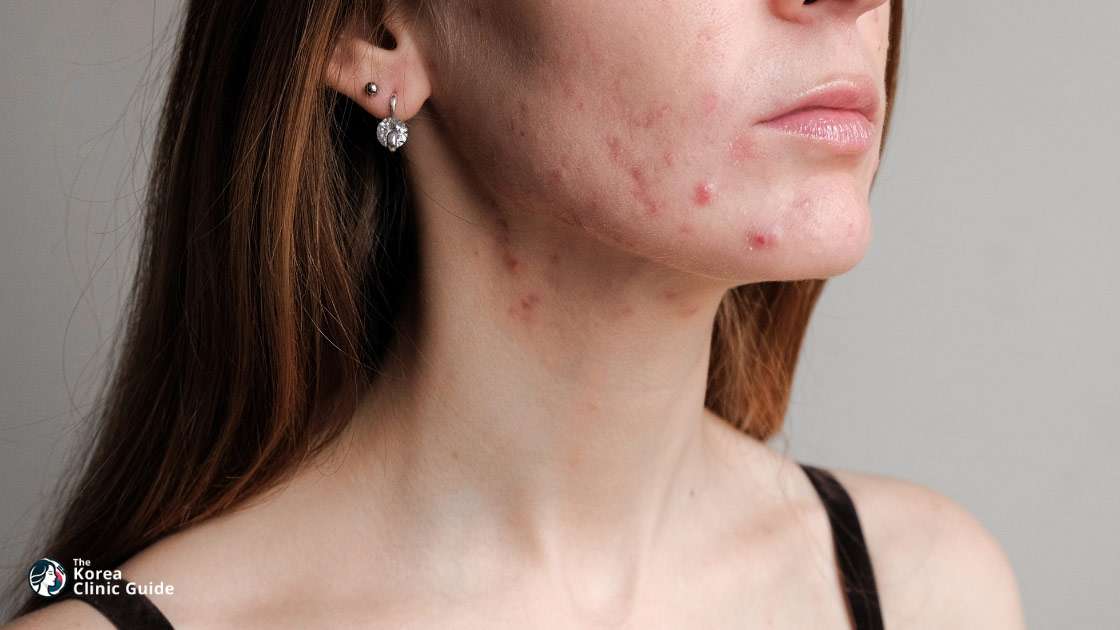
Table of contents
- Acne Treatment at a Glance
- What Is Acne Treatment?
- Who Is a Good Candidate for Acne Treatment?
- How Is Acne Treatment Performed?
- Why Visit Korea for Acne Treatment?
- Key Information for International Patients
- Which Are the Best Clinics in Korea for Acne Treatment?
- Acne Treatment From Start to Finish
- Alternatives to Acne Treatment
- How Can I Prepare for Acne Treatment?
- Aftercare Advice
Considering treatment in Korea? Everything you need to know e.g. — how to avoid scams, visas, interpreters, recovery tips — in our Medical Tourism Master Guide. Plan with confidence in minutes, not weeks!
Last updated: September 2026
Acne Treatment at a Glance
- What it is — Acne treatment is a personalized medical plan—not one procedure—using topical medicines, limited oral treatment, hormonal options, isotretinoin for severe disease, and selected in-office adjuncts.
- Best candidates — Dermatologist-led care is appropriate for persistent blackheads or whiteheads, recurrent inflammatory or truncal acne, painful nodules or cysts, early scarring, or acne causing substantial distress.
- When results appear — Topical regimens are usually reassessed after 6–8 weeks, with more meaningful improvement commonly taking 2–3 months; ongoing maintenance is often needed to prevent relapse.
- Travel time needed — Allow 1–3 days in Korea for consultation-based care, prescriptions, extraction, or a simple steroid injection; superficial peels may require 3–7 days for visible redness and flaking to settle.
- Procedures are adjuncts — Extractions, peels, IPL, laser/light treatments, RF microneedling, and PDT may help selected patients, but current guidelines find insufficient evidence to treat them as replacements for preventive medication.
- Systemic-treatment limitation — Oral antibiotics typically last about 3–4 months, while isotretinoin usually requires a 4–5 month monitored course; neither should be started abroad without confirmed home-country prescribing and follow-up.
- Korea-specific consideration — Korea offers accessible outpatient dermatology and foreign-patient infrastructure, but no evidence shows superior acne outcomes; verify a Medical Korea-registered institution and leave with English records listing diagnosis, generic medicines, doses, and procedure details.
What Is Acne Treatment?
Acne treatment is a personalized medical plan that uses skin medicines, oral treatments when needed, and selected office-based care to manage acne. It aims to clear existing breakouts, reduce painful inflammation, limit new lesions, and help prevent marks and scarring. It is primarily non-surgical, with some minimally invasive in-office options such as extractions or injections.
Who Is a Good Candidate for Acne Treatment?
- Persistent comedonal acne — Suitable for people with blackheads and whiteheads that have not settled with a consistent, appropriately used over-the-counter routine.
- Inflammatory or truncal acne — Dermatologist-led assessment is appropriate for recurrent papules, pustules, chest or back acne, and lesions that leave dark marks.
- Painful or scarring acne — Prompt medical care is important for nodules, cysts, early scars, rapidly worsening disease, or acne causing substantial distress.
- Travel-based review or adjunctive care — A Korean consultation, written topical plan, extraction, or a single injection is practical during a short stay when home follow-up is already available.
Acne treatment is a longitudinal medical plan, not one standard procedure. The dermatologist needs to distinguish active acne from rosacea, folliculitis, medication-related eruptions, and acne scars; examine facial and truncal distribution; and consider skin tone, pigment-change tendency, pregnancy potential, medications, and prior treatment response. Do not start isotretinoin abroad during pregnancy or without a reliable plan for pregnancy prevention, required testing, prescription access, and long-term monitoring. Postpone peels, photodynamic therapy (PDT), and laser or light treatments over infected, open, severely irritated, or photosensitive skin, and obtain method-specific review during pregnancy or breastfeeding. Avoid combining isotretinoin with vitamin A supplements or tetracycline antibiotics such as doxycycline unless the prescriber explicitly directs it.
How Is Acne Treatment Performed?
Treatment is selected by lesion type, severity, scarring risk, affected areas, medical history, and the ability to continue care after returning home. The 2024 American Academy of Dermatology guideline strongly supports several medication-based approaches; in-office procedures are adjuncts rather than replacements for a preventive regimen.
- Topical combination therapy — Adapalene, tretinoin, tazarotene, or trifarotene reduces blocked pores and inflammation. Benzoyl peroxide is often combined with a topical retinoid; azelaic acid, salicylic acid, or clindamycin plus benzoyl peroxide can be added for selected acne patterns. Avoid topical antibiotic treatment alone because of antimicrobial-resistance concerns.
- Time-limited oral antibiotics — Doxycycline or another tetracycline-class antibiotic can help moderate-to-severe inflammatory acne when paired with benzoyl peroxide and/or a topical retinoid. Treatment is generally limited to the shortest effective duration, often about 3–4 months, then replaced by topical maintenance.
- Hormonal-directed treatment — Combined oral contraceptives, spironolactone, or topical clascoterone can suit selected patients with hormonally influenced acne. Reproductive history, medical contraindications, and medication availability in the home country determine whether this is realistic.
- Oral isotretinoin — This is a major option for severe, scarring, resistant, or highly burdensome acne. A typical course lasts around 4–5 months and requires structured follow-up for adverse effects and reproductive risk; it is not a one-visit treatment.
- Lesion-directed office care — Careful extraction can treat individual blackheads and whiteheads. An intralesional corticosteroid injection can reduce pain and swelling in a large inflammatory lesion, but neither prevents future acne.
- Peels, devices, and PDT — Superficial salicylic, glycolic, mandelic, Jessner, or selected trichloroacetic-acid peels, IPL, laser/light treatments, RF microneedling, and PDT are sometimes offered as adjuncts. Evidence remains insufficient for the AAD to recommend for or against these physical modalities for active acne, so ask what medication plan and outcome measure support any device package.
Why Visit Korea for Acne Treatment?
Korea can be useful for an outpatient dermatology assessment, a documented topical plan, and selected low-downtime office care. It is not proven that having acne treated in Korea produces better clearance, scar prevention, or relapse outcomes than guideline-concordant care elsewhere. For international visitors, the main practical issue is arranging continuity of prescriptions and monitoring at home.
- Registered-institution verification — Medical Korea states that institutions registered to serve foreign patients are required to carry medical-malpractice liability insurance. Use its registered medical institution system to verify a facility before booking.
- Clear distinction between treatment goals — Ask the clinician to separate active acne, post-inflammatory hyperpigmentation, persistent redness, and established scars. Scar procedures generally require active acne control and a separate scar-type and pigment-risk assessment.
- Protocol-specific device evidence — Korean studies have evaluated particular RF and IPL protocols, but this does not establish a Korean location advantage. A 2024 Korean split-face study of combined needle RF/IPL and a retrospective RF microneedling study require cautious interpretation because results are device-specific and long-term comparative evidence is limited.
- Records for home continuity — Request English clinical records with the diagnosis, generic drug names, concentrations, dose, intended duration, procedure formulation or device settings when available, and urgent-contact details. These records matter more than a device brand name after departure.
Key Information for International Patients
- Minimum stay — Allow 1–3 days for a consultation, written topical plan, extraction, or uncomplicated intralesional corticosteroid injection. Allow about 3–7 days after a superficial peel if visible redness or flaking would affect plans.
- Systemic medicines — Do not treat oral antibiotics, hormonal treatment, or isotretinoin as a one-visit medical-tourism service. Arrange a named home clinician for prescribing, monitoring, laboratory review when indicated, and urgent care before starting.
- Isotretinoin access — U.S. iPLEDGE requirements do not automatically transfer to overseas care or prescriptions. The FDA states that pretreatment pregnancy testing must occur in a medical setting under the program, so confirm U.S. continuation before beginning isotretinoin abroad.
- Flights and PDT — Do not fly on the day of PDT. Remain in Korea through the clinic’s immediate photosensitivity window, commonly about 48 hours, and until pain and swelling are manageable; the exact restriction depends on the photosensitizer and protocol.
- Itinerary impact — Consultations, prescriptions, extraction, and simple injections usually have no physical recovery period. Peels can cause 1–7 days of redness and flaking, while PDT and stronger energy-based treatments can cause discomfort, crusting, and strict light avoidance.
- Remote follow-up — Book a video review or identify a home dermatologist before travel. Send baseline photographs in natural light and obtain written escalation instructions for infection, allergy, pigment changes, or medicine adverse effects.
Travel note: Keep plans flexible after a peel, PDT, laser, IPL, or RF treatment. Visible inflammation and strict sun avoidance can interfere with sightseeing, outdoor activities, and photographs.
Which Are the Best Clinics in Korea for Acne Treatment?
Listed below are some of the best clinics in Korea for acne treatment.
1. Three Wishes Clinic - Myeongdong
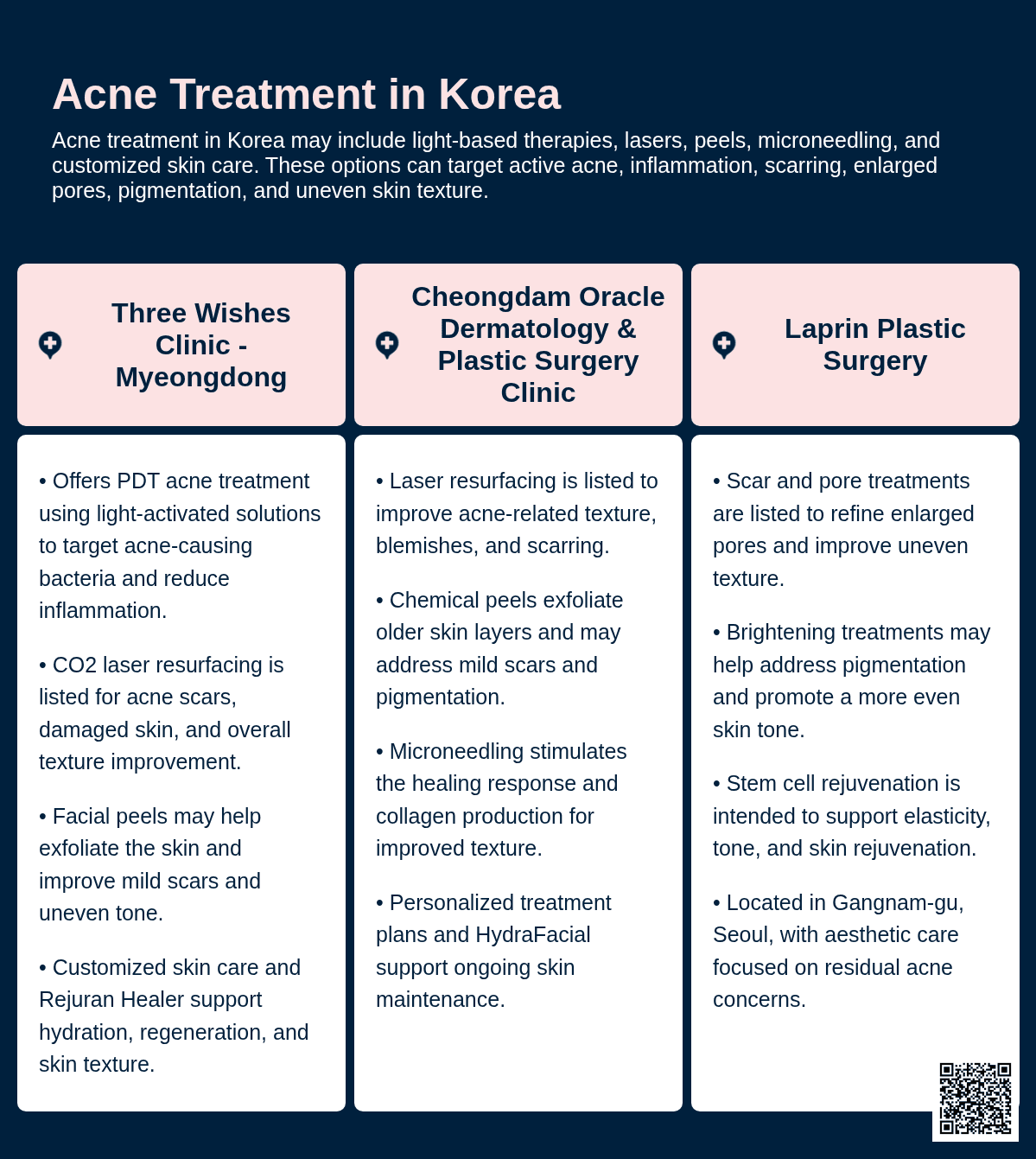
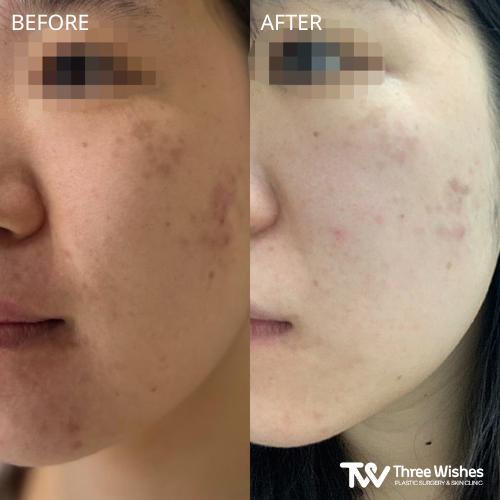
For acne treatment, you can consider Three Wishes Clinic - Myeongdong for PDT acne treatment, which uses light-activated solutions to target acne-causing bacteria and help reduce inflammation in chronic or severe acne. The clinic also lists CO2 laser resurfacing and facial peels for concerns such as acne scarring, texture, and mild scars.
- URL: Three Wishes Clinic - Myeongdong Website
- Location: Jung-gu, Seoul
- Acne-focused options:
- PDT acne treatment is described as using light-activated solutions to target acne-causing bacteria and help clear chronic or severe acne.
- CO2 laser resurfacing removes damaged skin layers and stimulates collagen production; it is listed for acne scars and overall skin-texture improvement.
- Facial peels exfoliate outer skin layers and may be used for mild scars and uneven tone.
- Related skin care:
- Customized skin care treatments can include cleansing, hydration, and maintenance facials tailored to individual skin concerns.
- Rejuran Healer is a polynucleotide injection treatment listed for supporting skin regeneration, texture, and elasticity.
2. Cheongdam Oracle Dermatology & Plastic Surgery Clinic
For acne-related texture, blemishes, and scarring, you may consider Cheongdam Oracle Dermatology & Plastic Surgery Clinic because it lists laser resurfacing, chemical peels, and microneedling—three approaches intended to improve skin texture, scars, blemishes, and mild scarring. Personalized treatment plans are also stated as part of its dermatologic and cosmetic care.
- URL: Cheongdam Oracle Dermatology & Plastic Surgery Clinic Website
- Location: Gangnam-gu, Seoul
- Acne and scar-related treatments:
- Laser resurfacing uses focused light to improve skin texture and reduce scars and blemishes while promoting collagen formation and new skin growth.
- Chemical peels exfoliate older skin layers and are listed for mild scarring, pigmentation, and sun damage.
- Microneedling creates controlled micro-injuries to stimulate the natural healing process, collagen production, skin texture, and firmness.
- Skin maintenance:
- HydraFacial is a multi-step cleansing, exfoliating, and hydrating treatment listed for overall skin health.
- The clinic states that it provides personalized treatment plans.
3. Laprin Plastic Surgery
For acne-treatment concerns centered on residual scarring, enlarged pores, or uneven-looking skin, you may consider Laprin Plastic Surgery because it lists scar and pore treatment to improve skin texture and appearance, along with brightening treatments for pigmentation and overall skin clarity.
- URL: Laprin Plastic Surgery Website
- Location: Gangnam-gu, Seoul
- Relevant aesthetic care:
- Scar and pore treatment is listed for smoothing and refining the appearance of scarring, enlarged pores, and skin texture.
- Brightening treatments are listed to address pigmentation, even skin tone, and improve overall skin clarity.
- Stem cell rejuvenation is listed as a treatment intended to support skin elasticity, tone, and rejuvenation.
Acne Treatment From Start to Finish
- Send records before booking — Provide clear, unfiltered photographs in natural light; list current and previous acne medicines and product concentrations, allergies, supplements, medical conditions, and pregnancy or breastfeeding status. Ask whether English or virtual consultation is available.
- Confirm the treatment scope — Establish whether the appointment concerns active acne, scars, redness, or pigmentation. Ask for the exact proposed medication, peel, photosensitizer, or device; expected downtime; number of sessions; and the plan after returning home.
- Attend dermatologist assessment — The clinician examines comedones, papules, pustules, nodules, scars, pigment marks, and facial or truncal distribution. Standardized photographs can document baseline severity; hormone or other testing is reserved for atypical acne, signs of androgen excess, or systemic-treatment planning.
- Review systemic-treatment safety — When isotretinoin or hormonal therapy is under consideration, the consultation covers reproductive risk, interactions, adverse effects, monitoring, and legal access to continued treatment in the home country. Do not begin treatment until that handover is workable.
- Receive the selected treatment — A medication plan generally starts immediately. Extractions and steroid injections are brief office treatments; a superficial peel follows cleansing and controlled chemical application. PDT involves applying a photosensitizer, an incubation period, then controlled light exposure.
- Leave with written instructions — Obtain the diagnosis, severity assessment, full medication list, dosing and duration, procedure details, prohibited products, sun restrictions, warning signs, and direct contact method. Request product formulation and device settings when available.
- Reassess remotely or at home — Review a topical regimen after about 6–8 weeks; more substantial improvement often takes 2–3 months. A home clinician should oversee any oral medicine course, isotretinoin monitoring, and treatment changes after departure.
Alternatives to Acne Treatment
The right alternative depends on whether the priority is controlling active lesions, avoiding antibiotic exposure, addressing hormonal patterns, or treating marks and scars left after acne is controlled. Repeated cosmetic procedures are not an equivalent substitute for medication when acne is severe, nodular, scarring, or treatment-resistant.
Guideline-Based Medication Plan
- Best for — Mild-to-moderate comedonal or inflammatory acne, especially when a consistent preventive routine has not been used long enough.
- Tradeoff — Topical retinoids and benzoyl peroxide have strong guideline support but often cause temporary dryness or irritation during the adjustment period.
Oral Antibiotic Course
- Best for — Moderate-to-severe inflammatory acne requiring faster inflammation control alongside topical treatment.
- Tradeoff — The course should be limited, commonly 3–4 months, rather than used as indefinite maintenance.
Hormonal Treatment
- Best for — Selected patients with acne that follows a hormonal pattern.
- Tradeoff — Suitability depends on reproductive and medical history, and ongoing prescribing must be available at home.
Isotretinoin
- Best for — Severe, scarring, refractory, or substantially distressing acne.
- Tradeoff — It can be more appropriate than repeated adjunctive procedures, but its teratogenic risk and monitoring needs make continuity essential.
Scar, Redness, and Pigment Treatment
- Best for — Residual concerns after active acne is adequately controlled.
- Tradeoff — Scar procedures require lesion and skin-type assessment and are distinct from active-acne care. Consider acne scar treatment, peeling, IPL, redness treatment, or pigmentation treatment according to the remaining problem.
How Can I Prepare for Acne Treatment?
- Send an accurate medicine list — Disclose prescription drugs, doxycycline or other tetracyclines, vitamin A supplements, hormonal medicines, herbal products, retinoids, benzoyl peroxide, exfoliating acids, and all allergies. Do not independently stop prescribed acne medicine.
- Avoid last-minute routine changes — Do not begin several new active products immediately before assessment; irritation can obscure the underlying acne pattern and make treatment selection less reliable.
- Discuss pregnancy and breastfeeding early — Tell the clinic before booking any systemic medicine, peel, laser/light treatment, or PDT. Isotretinoin must not be started during pregnancy.
- Prepare procedure skin properly — Avoid intentional tanning and sunburn. Before a peel, PDT, IPL, laser, or RF treatment, ask whether and when to pause topical retinoids, benzoyl peroxide, acids, scrubs, retinol products, and waxing.
- Plan the stay around downtime — Book 1–3 days for consultation-based care, 3–7 days for a superficial peel, and a longer flexible stay for PDT. Arrange accommodation with easy indoor light control if PDT is planned.
- Set up home follow-up first — Confirm who will manage refills, laboratory tests when clinically indicated, pregnancy testing where applicable, and urgent complications after return. Carry a digital and printed copy of the plan.
Travel note: Avoid scheduling PDT or a stronger peel immediately before a long-haul flight, outdoor itinerary, or event where visible redness and flaking would be difficult to manage.
Confirm the treating doctor’s clinic-specific preparation requirements, which take precedence over general guidance.
Aftercare Advice
Protect the skin barrier and follow the written medication and light-avoidance plan exactly; picking, overtreating, and unprotected sun exposure can prolong inflammation and pigment changes.
- Topical regimen — Use medicines at the prescribed frequency rather than adding extra exfoliants for faster results. Ask the clinic how to restart retinoids, benzoyl peroxide, and acids after a peel, PDT, or energy-based treatment.
- Gentle skin care — Cleanse gently, use a bland non-comedogenic moisturizer, and do not squeeze lesions or pull peeling skin. Avoid scrubs, waxing, and irritating treatments until the skin has recovered.
- Sun and heat protection — Apply broad-spectrum SPF 50 as directed and avoid tanning. Follow PDT light-avoidance instructions strictly, commonly for about 48 hours but dependent on the photosensitizer and protocol.
- Activity and contact — Avoid strenuous exercise, sauna heat, swimming, facial massage, and friction over treated skin for the period specified by the clinic, especially after a peel, PDT, laser, IPL, or RF procedure.
- Expected timing — Judge topical treatment after roughly 6–8 weeks, not days; meaningful improvement commonly takes 2–3 months. Temporary redness and flaking after a superficial peel generally last about 1–7 days.
- Urgent warning signs — Contact the clinic or seek urgent medical care for escalating pain, spreading redness or warmth, fever, pus, major swelling, blistering, facial or eye involvement, allergy symptoms, or severe persistent pigment change. During isotretinoin treatment, urgently report possible pregnancy, severe headache or visual symptoms, severe abdominal symptoms, or significant mood changes.
Follow the treating doctor’s individualized instructions and contact the clinic promptly when anything appears wrong.
Frequently Asked Questions
Related Blogs
Filler Dissolver in Korea: Hyaluronidase Methods, Recovery, Risks, and Travel Planning
Filler dissolver uses targeted hyaluronidase injections to reduce confirmed or suspected hyaluronic-acid filler causing lumps, migration, asymmetry, discoloration, or excess volume, with ultrasound available for uncertain or deep deposits. International patients can plan consultation, treatment, early review, aftercare, travel timing, documentation, and emergency follow-up, while urgent pain, skin
Updated: Sep 19, 2026
Inmode Lifting in Korea: Forma, MiniFX, Results, Recovery and Travel Planning
InMode lifting uses contact or suction-coupled radiofrequency handpieces, such as Forma and MiniFX, for mild laxity, early jawline softness, texture concerns, or selected contour areas. The article covers candidacy, Korea travel planning, treatment steps, recovery, aftercare, warning signs, and alternatives.
Updated: Sep 19, 2026
Knee Whitening in Korea: Methods, Safety, Recovery, and Travel Planning
Knee whitening begins with dermatology assessment, trigger control, and topical care, with selected patients receiving superficial peels or conservative laser after a test spot. Korea listings start at ₩30,000; plan 3–5 days, obtain English treatment records, and follow friction, sun, and aftercare restrictions.
Updated: Sep 19, 2026
Armpit Whitening in Korea: Diagnosis, Treatment Methods, Recovery, and Travel Planning
Armpit whitening begins with diagnosing the cause of darkening, then uses trigger control, clinician-directed topicals, superficial peels, or selected low-fluence laser/IPL. In Korea, listed cost is KRW 30,000; allow 2–3 days, plan follow-up, and avoid treatment on irritated or infected skin.
Updated: Sep 18, 2026
Clinics offering Acne Treatment

Three Wishes Clinic - Myeongdong, Korea: Advanced Botox, Fillers, Laser, and Skin Treatments for Confidence and Care
Myeongdong

Cellinique Clinic Korea: Advanced Stem Cell and Laser Treatments for Health, Beauty, and Rejuvenation in Gangnam
Apgujeong

Cheongdam Oracle Dermatology & Plastic Surgery Clinic in Korea: Offering Advanced Skin, Anti-Aging, Body Contouring Treatments and More
Seolleung

Dr. Ssem Magic Beauty Clinic - Leading Aesthetic Treatments in Korea for Skin, Body, and Hair
Seomyeon