
Medical Tourism Blog
V-OLET Injection in Korea: Double-Chin Treatment, Recovery, Safety, and Travel Planning
Table of contents
- V-OLET Injection at a Glance
- What Is a V-OLET Injection?
- Who Is a Good Candidate for a V-OLET Injection?
- How Is a V-OLET Injection Performed?
- Why Visit Korea for a V-OLET Injection?
- Key Information for International Patients
- Which Are the Best Clinics in Korea for V Olet Injection?
- V-OLET Injection From Start to Finish
- Alternatives to a V-OLET Injection
- How Can I Prepare for a V-OLET Injection?
- Aftercare Advice
Considering treatment in Korea? Everything you need to know e.g. — how to avoid scams, visas, interpreters, recovery tips — in our Medical Tourism Master Guide. Plan with confidence in minutes, not weeks!
Last updated: September 2026
V-OLET Injection at a Glance
- What it treats — V-OLET is a prescription deoxycholic-acid injection that breaks down localized moderate-to-severe fat beneath the chin; it is not a weight-loss treatment or a solution for loose neck skin, platysmal bands, or deeper neck anatomy.
- Best candidates — Appropriate candidates are adults at a stable weight with pinchable submental fat, reasonably firm skin, realistic expectations, and willingness to undergo repeat treatments if needed.
- Treatment schedule — The Korean labeled protocol uses 0.2 mL injections on an approximately 1-cm grid, up to 50 injections or 10 mL per session, with sessions at least 1 month apart and up to 6 sessions total.
- Recovery and results — Swelling, firmness, bruising, tenderness, numbness, and redness are common; allow 5–7 days before an important appearance event, while final contour is best assessed 8–12 weeks after the last session.
- Korea travel needs — Plan at least 2 calendar days for an in-person assessment and treatment followed by a next-day review; a complete course usually requires return visits because sessions cannot be closer than 1 month apart.
- Key safety concern — Correct injection depth is essential: too-shallow placement can cause ulceration or skin necrosis, while poorly placed injections can affect structures such as the marginal mandibular nerve and may cause lower-lip weakness or swallowing problems.
- Korea-specific distinction — V-OLET is a locally authorized Korean 1% deoxycholic-acid product for adult submental fat with a defined dosing and injection protocol, but its availability in Korea does not itself mean superior results versus comparable care elsewhere.
What Is a V-OLET Injection?
V-OLET injection is a deoxycholic-acid treatment that breaks down localized fat beneath the chin. It aims to reduce a double-chin contour and improve jawline definition in adults whose fullness is caused mainly by superficial fat. It is a minimally invasive injectable procedure, performed without surgical incisions or general anesthesia.
Who Is a Good Candidate for a V-OLET Injection?
- Localized submental fat — Good candidates are adults with moderate-to-severe, pinchable fat below the chin that creates a double-chin contour.
- Stable weight and realistic goals — V-OLET is for localized submental-fat reduction, not general weight loss or treatment of obesity.
- Adequate skin recoil — Candidates with reasonably firm neck skin generally have more predictable contour improvement after fat reduction.
- Commitment to a treatment course — The labeled protocol permits up to six sessions, at least one month apart, so a single short trip does not normally complete treatment.
V-OLET is approved in Korea for adults; pediatric use is contraindicated. Do not proceed with an active infection at the injection site, known hypersensitivity to deoxycholic acid or product components, or pregnancy. Current or previous swallowing difficulty requires careful medical assessment because post-treatment swelling, pain, and firmness can worsen dysphagia. Marked skin laxity, platysmal bands, salivary-gland prominence, thyroid enlargement, enlarged lymph nodes, or scarring from previous submental procedures can mean that superficial fat is not the main cause of fullness and that injection treatment will give an unsatisfactory or less predictable contour. Review anticoagulants, antiplatelet medicines, bleeding disorders, breastfeeding, allergies, and prior chin or neck treatment with the clinician; do not stop prescribed blood thinners independently. The Korean product monograph sets out these contraindications and anatomy-related precautions.
How Is a V-OLET Injection Performed?
There are no patient-facing “types” of V-OLET. Meaningful differences are the treatment plan, injection depth, and comfort measures used within the approved submental protocol.
- Labeled grid injection — The Korean label specifies 2 mg/cm² in subcutaneous submental fat: 0.2 mL per point on an approximately 1-cm grid, with no more than 50 injections or 10 mL in one session. Sessions must be at least one month apart, with up to six treatments. Review the labeled dose and schedule.
- Anatomy-led placement — The injector marks the safe submental field and places medicine vertically into mid-depth preplatysmal fat, the layer between skin and the platysma muscle. Injection into the dermis can cause ulceration and necrosis; excessively deep or poorly sited injection risks non-target structures.
- Comfort measures — Cooling, topical anesthetic, and/or local lidocaine can be used for pain control. These measures do not alter the approved dose or the inflammatory recovery process.
- Non-submental proposals — Injection into arms, abdomen, flanks, thighs, jowls, axillae, or other body areas is not a standard V-OLET technique. Safety and effectiveness outside submental fat have not been established in the Korean label, so such treatment is off-label rather than routine care.
Why Visit Korea for a V-OLET Injection?
V-OLET is a Korean prescription deoxycholic-acid product authorized for adult submental-fat improvement. It contains deoxycholic acid 20 mg/2 mL, equivalent to 10 mg/mL or 1%, and is intended for moderate-to-severe protruding or excessive fat below the chin. Korea’s key distinction is access to this named locally authorized product and its defined local treatment instructions—not evidence that treatment in Korea produces inherently superior results.
- Locally authorized medicine — V-OLET is authorized in Korea for adult submental fat, commonly called a double chin. The Korean authorization review describes the approved product and indication.
- Defined dosing and anatomical protocol — The local monograph specifies concentration, injection grid, maximum session volume, monthly minimum interval, and the structures that must be avoided, including the marginal mandibular nerve, salivary glands, thyroid, vessels, lymph nodes, and muscle. See the Korean product instructions.
- Evidence limitation — Two V-OLET clinical studies are described in the product information, but a complete independently published Phase III report with detailed efficacy endpoints and long-term durability data was not located. Broader randomized evidence supports deoxycholic acid for selected submental fat, but studies of ATX-101/Kybella cannot establish identical outcomes for V-OLET. A large randomized ATX-101 trial supports the drug class rather than this exact Korean formulation.
Key Information for International Patients
- Minimum stay — Plan at least 2 calendar days: an in-person consultation and treatment day, followed by a next-day review arranged with the treating clinician. Allow 5–7 days after a first or larger session when visible swelling, comfort, and access to the injector matter.
- Repeat visits — A full course cannot usually fit into one short trip. Further treatment is no sooner than one month, and the Korean label permits up to six sessions.
- Flying — No V-OLET-specific evidence establishes a mandatory no-fly interval. Complete the early review before a long-haul departure when possible, and postpone travel for severe or escalating symptoms.
- Visible recovery — Swelling, redness, bruising, tenderness, numbness, firmness, and palpable nodules can be socially conspicuous. Plan 5–7 days before an appearance-critical event, but recognize that swelling and induration can persist longer.
- Itinerary impact — This is an outpatient local injection without incisions or stitches, so sightseeing is generally easier than after surgery. Avoid scheduling it immediately before photographs, business events, or a remote destination where prompt medical review would be difficult.
- Remote follow-up — Leave with the product name, concentration, lot number, total volume, injection map, treatment date, clinician contact details, and written urgent-care instructions. Arrange photo-based follow-up if further sessions will occur outside Korea.
Travel note: Do not board a long flight with rapidly worsening neck swelling, swallowing difficulty, breathing symptoms, severe pain, lower-lip weakness, or pale, purple, blistered, or ulcerated skin. Contact the clinic urgently or seek emergency care.
Which Are the Best Clinics in Korea for V Olet Injection?
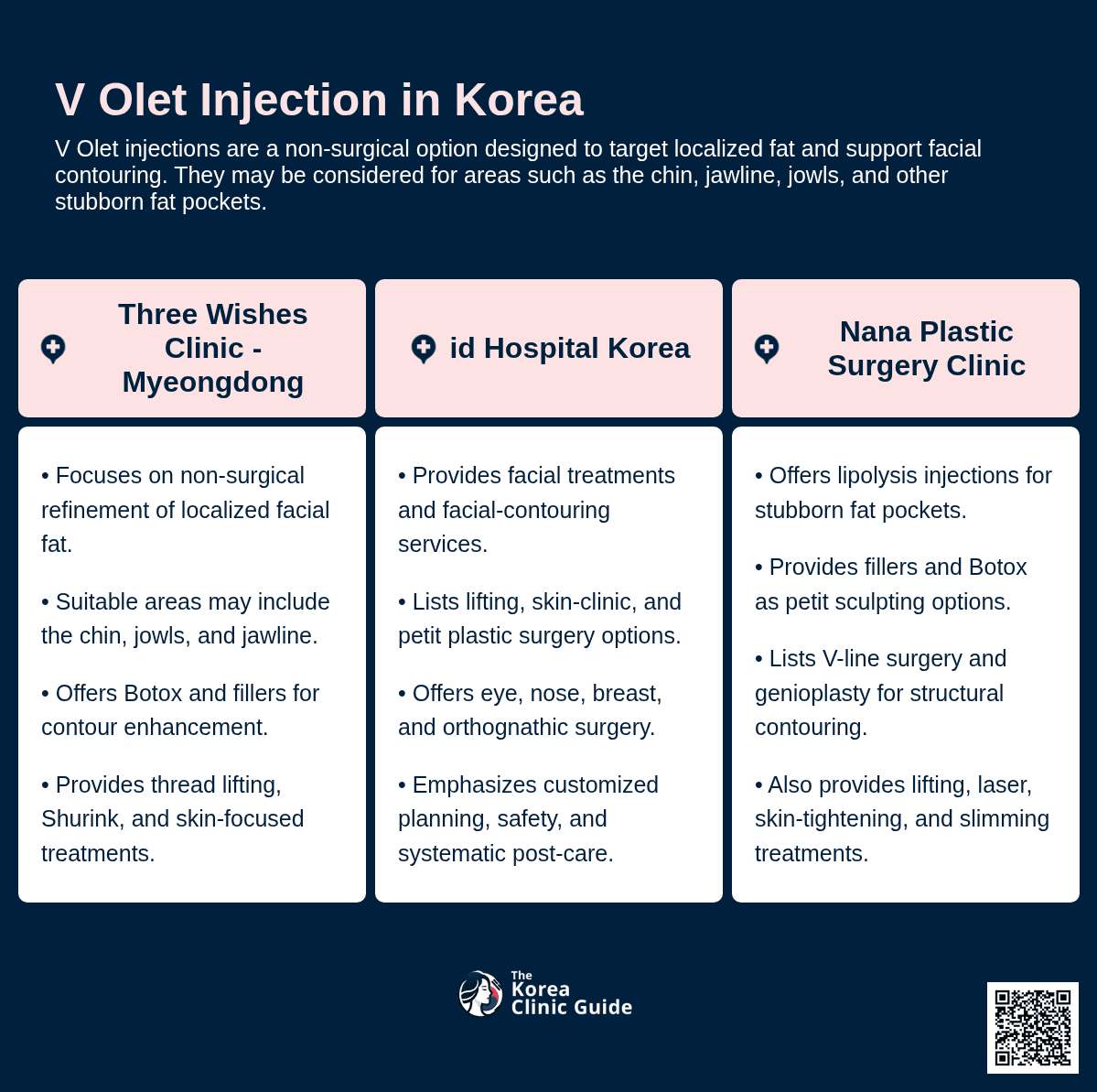
Listed below are some of the best clinics in Korea for v olet injection.
1. Three Wishes Clinic - Myeongdong
For V Olet Injection, you can consider Three Wishes Clinic - Myeongdong if your goal is non-surgical refinement of localized facial fat, such as beneath the chin, along the jowls, or at the jawline. Its listed fat-dissolving injections are intended to break down targeted fat deposits and help contour these areas without surgery.
- URL: Three Wishes Clinic - Myeongdong Website
- Location: Jung-gu, Seoul
- Related non-surgical options:
- Botox and dermal fillers are available for wrinkle reduction, volume restoration, and facial contour enhancement.
- Thread lifting uses dissolvable threads to lift sagging tissue and stimulate collagen production.
- Shurink is an ultrasound-based lifting and tightening treatment for the face or body.
- Skin-focused treatments:
- Rejuran Healer uses polynucleotide technology intended to support skin regeneration, texture, elasticity, and fine lines.
- CO2 laser, chemical peels, PDT acne treatment, laser hair removal, and customized skin-care treatments are listed.
2. id Hospital Korea
For V Olet Injection, you may consider id Hospital Korea if you want a clinic whose listed care spans facial treatments, petit plastic surgery, lifting, skin-clinic services, and facial contouring. The clinic describes a customized treatment approach with attention to patient safety and systematic post-care.
- URL: id Hospital Korea Website
- Location: Gangnam-gu, Seoul
- Related services:
- Listed services include facial contouring, lifting, skin-clinic treatments, and petit plastic surgery.
- The clinic also lists orthognathic surgery, eye and nose plastic surgery, breast surgery, and dentistry.
- Care approach: The clinic describes customized plastic surgery planning, patient safety-oriented treatment, and systematic post-care.
3. Nana Plastic Surgery Clinic
For V Olet Injection, you may consider Nana Plastic Surgery Clinic when you are seeking a non-surgical option for stubborn fat pockets as part of a broader facial-contouring plan. The clinic lists slimming treatments that include lipolysis injections, alongside petit sculpting options such as fillers and Botox, and it also provides surgical V-line and chin-contouring procedures when a more structural change is being considered.
- URL: Nana Plastic Surgery Clinic Website
- Location: Gangnam-gu, Seoul
- Facial contouring options:
- V-line surgery reshapes the jawline and chin for a more defined V-shaped facial contour.
- Genioplasty, cheekbone reduction, and facial implant surgery are listed for structural facial contouring.
- Petit sculpting options include fillers and Botox.
- Related lifting and skin treatments:
- Thread lifting, mini facelift, full facelift, neck lifting, and forehead lifting are listed for sagging skin and facial or neck rejuvenation.
- Dermatology services include skin tightening, laser treatments, and slimming treatments.
- Slimming services are described as targeting stubborn fat pockets with non-invasive approaches including cryolipolysis and lipolysis injections.
V-OLET Injection From Start to Finish
- Remote inquiry and screening — Ask whether English-language or virtual consultation is available. Send medical history, allergies, pregnancy or breastfeeding status, swallowing symptoms, previous chin or neck procedures, and a complete medicine and supplement list. Photographs can support planning but cannot confirm candidacy.
- Travel coordination — Schedule enough time for an in-person assessment and early review. Keep flights flexible where possible, particularly after a first or higher-volume session.
- In-person examination and consent — The clinician confirms that fullness is preplatysmal submental fat rather than lax skin, platysmal banding, salivary-gland prominence, thyroid enlargement, lymph nodes, or deeper neck anatomy. They assess skin recoil, prior scarring, bleeding risk, and the possibility of repeat sessions.
- Marking and anesthesia — The skin is cleansed and the submental treatment field is marked in an approximately 1-cm grid. Cooling, topical anesthetic, or local lidocaine can be used; general anesthesia is not routine for this injectable procedure.
- Injection treatment — Multiple small injections are delivered into preplatysmal subcutaneous fat. Under the labeled protocol, each point receives 0.2 mL, with a maximum of 50 injections and 10 mL in one session. The product monograph emphasizes correct depth and avoidance of critical neck structures.
- Discharge and early recovery — Leave after outpatient observation with written aftercare and emergency contact information. Expect burning, tenderness, swelling, redness, bruising, numbness, and firmness; the treated area can initially appear fuller.
- Next-day review — Attend the arranged review before international departure where practical. The clinician checks swelling, skin condition, pain, and any swallowing or nerve-related symptoms.
- Remote follow-up and further sessions — Send requested photographs and report concerning symptoms promptly. Reassess for another session no sooner than one month; assess the final contour more realistically 8–12 weeks after the last session, once inflammation has substantially settled.
Alternatives to a V-OLET Injection
The right alternative depends on whether the contour concern is superficial fat, loose skin, platysmal bands, gland prominence, or deeper neck anatomy. Non-surgical options avoid surgical incisions but often require repeat treatment and produce more gradual change; surgery can remove more fat or correct tissue laxity more directly but carries incision, anesthesia, compression, and longer-recovery considerations.
Submental Liposuction
- Best fit — More direct removal of a larger submental fat volume.
- Tradeoff — It involves small incisions, compression, surgical risks, and a more demanding recovery than an injectable treatment.
- Learn more — Double-chin liposuction and face liposuction.
Neck Lift
- Best fit — Lax neck skin, prominent platysmal bands, or structural neck features that fat reduction alone will not correct.
- Tradeoff — A surgical option with more extensive recovery, but it can address tissue laxity rather than only superficial fat.
- Learn more — Neck lift.
Energy-Based Tightening
- Best fit — Mild skin laxity when tightening, rather than substantial fat removal, is the primary goal.
- Tradeoff — Degree of fat reduction and supporting evidence vary substantially by device and protocol.
- Learn more — HIFU laser treatment, InMode lifting, Ultherapy lifting, and double-chin tightening.
Other Fat-Dissolving Injections
- Best fit — Patients considering a different injectable formulation after a clinician confirms the target is localized fat.
- Tradeoff — Products differ in active ingredient, authorization, injection depth, treatment area, and evidence. Do not assume all contour injections have V-OLET’s mechanism or risk profile.
- Learn more — Fat-dissolving injections.
How Can I Prepare for a V-OLET Injection?
- Disclose all medicines — Provide every prescription drug, over-the-counter medicine, vitamin, herb, and supplement before booking. Highlight warfarin, direct oral anticoagulants, aspirin, clopidogrel, NSAIDs, and any history of unusual bruising or bleeding.
- Do not stop prescribed blood thinners yourself — Anticoagulant or antiplatelet treatment needs individualized clearance because bruising and bleeding risk can increase. The prescriber managing that medicine must direct any change.
- Report relevant health history — Declare allergy to deoxycholic acid or any product component, active skin infection, pregnancy, breastfeeding, dysphagia, previous chin or neck surgery, fillers, threads, energy-based procedures, and neurological symptoms.
- Fasting and sedation — Fasting is generally unnecessary for a local injectable treatment. Fast only if the clinic plans sedation or specifically instructs it; arrange an escort and do not drive after sedating medication.
- Prepare the treatment field — Arrive with clean skin. Avoid irritating topical products on the chin and neck unless the treating clinician tells you otherwise.
- Plan accommodation and transport — Stay somewhere that permits a next-day review and rapid return to the clinic if swelling becomes concerning. A companion is not routinely necessary without sedation, but can be useful for anxiety, language support, or a larger treatment session.
- Keep the schedule flexible — Do not book the procedure immediately before an important event or long-haul flight. Early swelling can be visible and does not predict the final contour.
Travel note: Bring travel insurance details and save the clinic’s urgent contact number locally. Ask in advance how after-hours symptoms and remote follow-up are handled.
Confirm the treating doctor’s individualized medication, fasting, transport, and travel requirements; those instructions take precedence over general guidance.
Aftercare Advice
Treat early swelling and firmness as an expected inflammatory reaction, but never ignore symptoms that suggest nerve injury, skin injury, infection, or airway involvement.
- Protect the injection area — Use gentle cool compresses only if the clinician advises them. Do not massage, use gua sha, apply heat packs, or press firmly on the treated chin and neck unless specifically instructed.
- Avoid additional local procedures — Do not have further injections, threads, energy-based treatments, or aggressive facial and neck procedures in the area until the treating clinician clears them.
- Manage the visible recovery period — Swelling, tenderness, bruising, redness, numbness, induration, and nodules are common. In V-OLET studies, induration, swelling, numbness, and pain persisted beyond 30 days in at least 10% of treated patients, though most resolved before 60 days. See the reported safety data.
- Seek urgent help for red flags — Contact the clinic urgently or seek emergency care for new asymmetric smile or lower-lip weakness; difficulty swallowing, choking, trouble handling saliva, breathing difficulty, or rapidly expanding swelling; severe worsening pain; or pale, dusky, purple, blistered, ulcerated, or blackened skin. Fever, drainage, spreading redness, or a hot expanding tender area also need prompt assessment.
- Follow up and judge results at the right time — Attend the early review, keep records for overseas care, and do not assess final contour during swelling. A further session is no sooner than one month; judge the result around 8–12 weeks after the final session.
Follow the treating doctor’s written instructions, as they take precedence over general advice, and contact the clinic promptly whenever recovery appears abnormal.
Frequently Asked Questions
Related Blogs
Unlock Radiant Skin: Global Cost Comparison of Skin Whitening Injections from Korea to the World
Discover the latest insights on the cost of skin whitening injections in Korea, exploring pricing trends and factors influencing affordability. Uncover key information about this popular cosmetic procedure and its accessibility for those seeking radiant, lighter skin tones.
Updated: Sep 26, 2026
From Mole to Marvel: Korea vs. Global Costs for Premium Mole Removal Services
Discover the factors influencing mole removal costs in Korea, including procedure types and clinic reputation. Learn how to navigate pricing options for effective and affordable skincare treatments.
Updated: Sep 26, 2026
Comprehensive Cost Analysis: Why Lipoma Removal in Korea May Be Your Best Option
Discover the affordable options for lipoma removal in Korea, where advanced medical facilities offer top-notch care at a fraction of the cost compared to the West. Explore the factors that influence pricing and learn how to plan your medical trip for the best outcomes.
Updated: Sep 26, 2026
Discover the Global Price of Filler Dissolver: Korea’s Competitive Edge vs. Top Destinations
Discover the latest insights on the cost of Filler Dissolver treatments in Korea, including factors that influence pricing and tips for finding the best clinics. Stay informed on how to achieve safe and effective results while managing your aesthetic goals and budget.
Updated: Sep 26, 2026
Clinics offering V-OLET Injection

Three Wishes Clinic - Myeongdong, Korea: Advanced Botox, Fillers, Laser, and Skin Treatments for Confidence and Care
Myeongdong
ID Hospital - Main Branch in Korea: Specializing in Safe & Customized Facial Plastic Surgery and Post-Care Services
Sinsa

Cheongdam Oracle Dermatology & Plastic Surgery Clinic in Korea: Offering Advanced Skin, Anti-Aging, Body Contouring Treatments and More
Seolleung

Nana Plastic Surgery Clinic in Korea: Advanced Aesthetic Procedures for Face, Body, and Breast Enhancement
Sinnonhyeon Station