
Medical Tourism Blog
Neck Lift in Korea: Methods, Recovery, Travel Planning, and Alternatives

Table of contents
- Neck Lift at a Glance
- What Is a Neck Lift?
- Who Is a Good Candidate for a Neck Lift?
- How Is a Neck Lift Performed?
- Why Visit Korea for a Neck Lift?
- Key Information for International Patients
- Which Are the Best Clinics in Korea for Neck Lift?
- How Much Does a Neck Lift Cost in Korea?
- Neck Lift From Start to Finish
- Alternatives to a Neck Lift
- How Can I Prepare for a Neck Lift?
- Aftercare Advice
Considering treatment in Korea? Everything you need to know e.g. — how to avoid scams, visas, interpreters, recovery tips — in our Medical Tourism Master Guide. Plan with confidence in minutes, not weeks!
Last updated: September 2026
Neck Lift at a Glance
- What it treats — A neck lift reshapes the jawline and neck by addressing loose skin, submental fat, and separated or lax platysma muscle bands through incisions around the ears and often beneath the chin.
- Typical cost — In Korea, a neck lift costs about ₩6,600,000–₩9,900,000 (approximately US$4,900–$7,300); open surgery, platysmaplasty, liposuction, deeper neck work, or a combined facelift can increase the quote.
- Best candidates — It is most suitable for medically well adults with persistent loose neck skin, a turkey-wattle appearance, platysmal bands, or poor jaw-to-neck definition despite stable weight and realistic expectations.
- Recovery and results — Initial social recovery is usually 1–2 weeks, bruising often starts improving after 4–5 days, and swelling can take weeks to months to settle; results are durable but aging continues and scars may mature for up to 6 months.
- Korea travel plan — International patients should usually plan 10–14 days in Korea for assessment, surgery, next-day review, and wound or suture checks; flying is commonly delayed at least 7–10 days after facial surgery, subject to surgeon clearance.
- Important limitation — A neck lift is not a weight-loss procedure and cannot fully correct weak chin projection, severely crepey sun-damaged skin, or every horizontal neck line; prominent jowls may require a combined face-and-neck lift.
- Korea-specific consideration — Korea offers substantial international-patient infrastructure and interpreter support, but there is no robust evidence that Korean neck lifts are safer or longer-lasting than elsewhere; verify foreign-patient registration, surgeon credentials, anesthesia staffing, and emergency-transfer plans.
What Is a Neck Lift?
A neck lift is cosmetic surgery that reshapes the neck and jawline by tightening loose tissues and removing excess skin or fat. It aims to improve a loose or “turkey” neck, vertical neck bands, submental fullness, and reduced jaw-to-neck definition for a smoother, firmer contour. It is a surgical procedure.
Who Is a Good Candidate for a Neck Lift?
- Persistent neck laxity — Good candidates have loose neck skin, a “turkey-wattle” appearance, vertical platysmal bands, or a poorly defined jaw-to-neck angle that remains despite stable weight.
- Localized contour concerns — An isolated neck lift can suit medically well adults whose main concern is submental fullness, upper-neck laxity, or neck bands while the upper face remains satisfactory.
- Combined lower-face aging — Jowls and lower-face descent often require a face-and-neck approach rather than neck surgery alone; consider a facelift, SMAS facelift, or deep-plane facelift when these are major concerns.
- Realistic surgical goals — Suitable candidates understand that surgery improves skin, fat, and platysma-related contour but is not weight-loss treatment and cannot fully correct poor chin projection, severely crepey sun-damaged skin, or every horizontal neck line.
Adults need an in-person assessment of skin elasticity, superficial versus deep fat, platysma separation, jowls, submandibular-gland prominence, and chin projection. Active skin, dental, salivary-gland, or systemic infection requires postponement. Uncontrolled hypertension, diabetes, heart or lung disease, bleeding disorders, pregnancy or the immediate postpartum period, and conditions that make anesthesia or healing unsafe require optimization or make elective surgery inappropriate. Current nicotine exposure—including vaping, pouches, gum, and patches—can compromise skin survival and wound healing; the surgeon sets the cessation interval and testing policy. Anticoagulants, antiplatelet drugs, and bleeding-risk supplements require a plan agreed by the surgeon and prescribing clinician, never self-directed discontinuation. Unrealistic expectations, body-dysmorphic disorder concerns, or inability to arrange supervision and follow-up warrant delay and further assessment.
How Is a Neck Lift Performed?
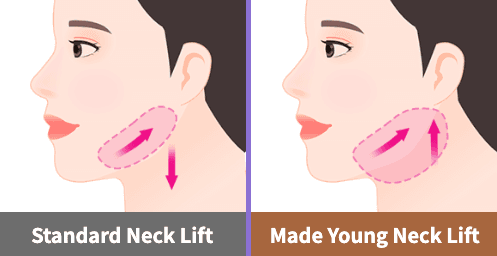
A neck lift is tailored to the structure causing the contour problem. Incisions are generally placed around the ears and hairline, often with a small submental incision beneath the chin; IV sedation or general anesthesia can be used.
- Limited-incision neck lift — Incisions concentrate around the ears. This approach can suit modest laxity, but shorter access generally permits less extensive correction.
- Open neck lift with submental access — Ear-area and under-chin incisions give direct access to submental fat, separated platysma muscle, loose skin, and skin excision. It is commonly considered for more substantial laxity or banding.
- Platysmaplasty or submentoplasty — Midline platysma tightening, sometimes called corset platysmaplasty, treats visible vertical bands and muscular laxity.
- Submental liposuction with neck lift — Removing superficial fat can sharpen the cervicomental angle when fat is a major contributor and skin recoil is adequate. Excessive fat removal can create contour irregularities.
- Face-and-neck lift with deeper correction — When jowls and lower-face descent contribute, the surgeon can combine neck work with SMAS or deep-plane-related facelift techniques. Selected deeper work can address subplatysmal fat, digastric muscles, or submandibular glands, but it is more technically complex. Published deep-plane literature uses heterogeneous techniques and reports variable complication rates, so ask which structures will be treated and why.
Why Visit Korea for a Neck Lift?
Korea’s strongest procedure-specific advantage is its established international-patient infrastructure within a large aesthetic-care market, not proven superiority in neck-lift outcomes. Choose the surgeon and facility based on credentials, the proposed anatomy-specific plan, anesthesia staffing, and emergency arrangements. There is no robust head-to-head evidence showing Korean neck lifts are safer, longer-lasting, or more effective than those performed elsewhere.
- Established overseas-patient volume — Seoul recorded 999,642 international medical tourists and 131,541 plastic-surgery department visits in 2024. This supports access to international medical centers and interpreter-coordinator services, but it does not predict an individual surgical result.
- Foreign-patient registration check — Verify that the institution is registered to treat foreign patients. Registration requirements include relevant specialist staffing and medical-malpractice liability coverage; this is a safety baseline rather than proof of neck-lift expertise.
- Documentation and continuity — Request the named surgeon’s specialty credentials, written operative plan, anesthesia plan, emergency-transfer arrangements, English discharge instructions, medication list, and operative report before committing to travel.
- Anatomy-led planning — An in-person examination can identify whether a limited neck lift will undercorrect the concern, or whether chin augmentation, liposuction, or a combined facelift is more appropriate.
Key Information for International Patients
- Minimum stay — Plan 10–14 days in Korea for an in-person consultation and testing where indicated, surgery, next-day assessment or drain removal when used, and wound or suture review before departure.
- Remote consultation — Start planning at least 4–6 weeks before travel. Send unfiltered frontal, oblique, profile, and neck-extension photographs through a secure channel, and disclose prior procedures, scars, clotting events, allergies, medicines, supplements, and nicotine use.
- Flying home — A 7–10-day delay after facial cosmetic surgery is commonly advised in medical-tourism guidance, but only the operating surgeon can clear an individual patient. Surgery and long-distance travel both raise venous-thromboembolism risk; the risk is higher with limited mobility, prior VTE, obesity, estrogen exposure, cancer, complications, or drains. CDC medical-tourism guidance supports individualized travel planning.
- First-night support — Arrange door-to-door transport and a responsible adult to stay available for the first night after IV sedation or general anesthesia. Do not drive yourself.
- Itinerary impact — Expect initial social recovery of 1–2 weeks. Bruising often begins improving after about 4–5 days, but swelling can persist for weeks to months and tightness or altered sensation can last for months.
- Remote follow-up — Confirm video-review arrangements before surgery and identify a clinician at home in case in-person care is needed. Complications after departure can require prolonged treatment and may not be covered by travel or domestic insurance.
Travel note: Book flexible accommodation close to the facility and avoid a fixed long-haul departure until the surgeon has reviewed healing in person.
Which Are the Best Clinics in Korea for Neck Lift?
Listed below are some of the best clinics in Korea for neck lift.
1. THEPLUS Plastic Surgery
If you are considering a neck lift alongside broader facial rejuvenation, THE PLUS Plastic Surgery offers surgical facelift, thread-lift, and facial fat-grafting options intended to address sagging, contour definition, and volume changes while preserving natural expression. Its approach emphasizes facial harmony, which may be relevant when you want your neck and lower-face result to fit your overall features.
- URL: THEPLUS Plastic Surgery Website
- Location: Gangnam-gu, Seoul
- Facial lifting options:
- Facelift surgery lifts and repositions sagging facial tissue to refine facial contours.
- Thread lifting uses dissolvable threads for mild sagging when you are exploring a less invasive lifting approach.
- Facial fat grafting transfers your own fat to restore volume in hollow or flattened facial areas.
- Surgical expertise:
- Dr. Kim is a board-certified plastic surgeon with expertise in facial contouring and rhinoplasty, and has received research awards related to 3D implants.
- Dr. Jeong serves as President of the Korean Society of Plastic Surgeons and regularly participates in professional education and conference programs.
- Related procedures: The clinic also offers cheekbone, square-jaw, chin, and facial-implant procedures that may be relevant if you are discussing overall facial proportions with your surgeon.
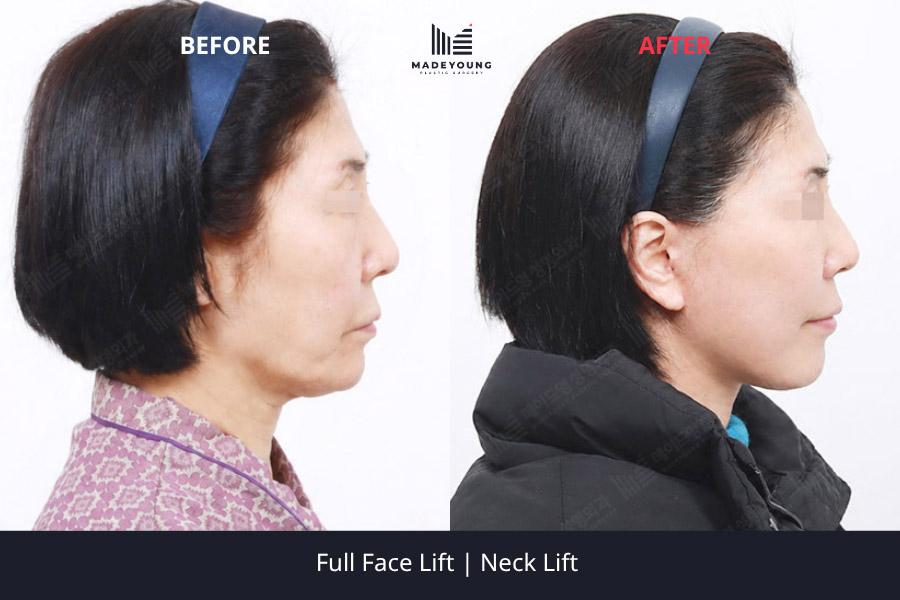
2. Made Young Plastic Surgery
You may consider Made Young Plastic Surgery for a neck lift if you want your neck and jawline addressed within a practice focused on facial anti-aging surgery. The clinic describes neck lift surgery as a way to treat loose neck skin and excess fat for a smoother neckline, while its lifting approach emphasizes analysis of sagging and vertical repositioning of deeper facial tissues rather than skin tightening alone.
- URL: Made Young Plastic Surgery Website
- Location: Seocho-gu, Seoul
- Lifting approach:
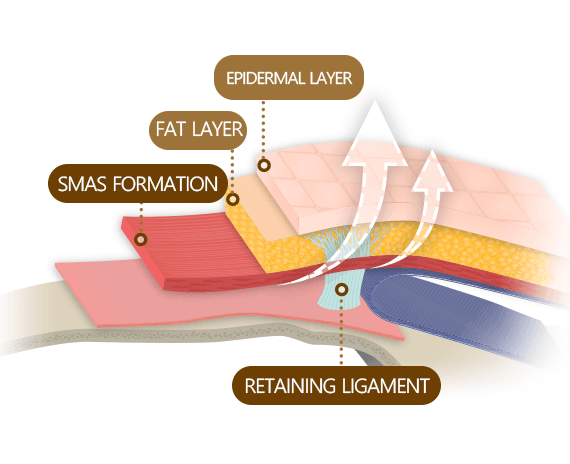
- For facial sagging, the clinic describes dissection beneath the SMAS layer to release stretched supporting tissues, then lifting the skin, fat, and SMAS together.
- Lifted tissues are secured vertically, opposite the direction of sagging, with the stated goal of avoiding excessive cheekbone prominence and supporting natural-looking, lasting results.
- Related face and neck services:
- Double-chin lift is available to target submental fullness and help define the jawline.
- Facelift, forehead lift, and sub-brow lift are offered for broader facial rejuvenation planning.
- Non-surgical options include thread lift, focused-ultrasound treatments such as Shurink and Ultherapy, and skin boosters.
- Safety and aftercare:
- The clinic states that board-certified anesthesiologists are on site full time and that one anesthesiologist continuously monitors each person during procedures.
- It describes a cross-check emergency response system, procedure-area CCTV coverage, and a dedicated aftercare center.
3. LABOM Plastic Surgery
You may consider LABOM Plastic Surgery for a neck lift if you want a deep-plane-based approach that addresses the neck together with sagging facial tissues and jawline definition. Its Triple Face Lift is designed to reposition the skin, SMAS, and deep malar fat layer together, with optional platysma-muscle sling surgery for selected neck concerns and an emphasis on avoiding excessive skin pull.
- URL: LABOM Plastic Surgery Website
- Location: Gangnam-gu, Seoul
- Face and neck lift technique:
- The Triple Face Lift simultaneously lifts the skin, SMAS, and deep fat layer, aiming to reposition sagging tissue rather than treat the skin alone.
- The clinic lists concerns addressed by this approach as jawline laxity, double chin, neck wrinkles, nasolabial folds, marionette lines, and deep-fat-pad descent.
- Planning is described as anatomy-based and individualized according to your facial structure and degree of aging.
- The stated procedure time is 3–4 hours under sedation with local anesthesia, with an indicated recovery period of 7–14 days.
- Neck-focused customization:
- A platysma-muscle sling, described as “pelican” surgery, may be combined with lifting procedures when appropriate.
- Other listed combination options include SMAS grafting and deep fat-pad removal.
- Care and follow-up:
- Plastic-surgery specialists directly perform procedures, and the clinic reports more than 30 years of clinical experience across facial and hand anti-aging surgery.
- Pre-operative diagnosis, anesthesia and continuous monitoring systems, and individualized surgical planning are described as part of care.
- Aftercare includes regular progress checks and programs for recovery, swelling, bruising, and scar management, with a dedicated system for international patients.
How Much Does a Neck Lift Cost in Korea?
A Neck Lift costs approximately ₩6,600,000–₩9,900,000 (about US$4,900–$7,300). Individual quotes vary because the operation is tailored to the specific anatomical problems being treated and the extent of surgery required.
| Procedure Price | Korean Won (₩) | USD ($) |
|---|---|---|
| Low Price | ₩6,600,000 | $4,900 |
| High Price | ₩9,900,000 | $7,300 |
Exchange rate as of 2026-09-06: 1 KRW = 0.000741 USD.
What Affects the Price?
- Limited-incision versus traditional open neck lift — A limited-incision lift concentrated around the ears generally involves less access and correction than a traditional lift with ear-area and submental incisions. Open submental access permits direct fat treatment, platysma repair, skin redraping, and skin excision, requiring more dissection and operating time.
- Platysmaplasty for bands or muscle laxity — Corset platysmaplasty or other platysma tightening is required when visible bands or separated, lax neck muscle contribute to the contour. Midline muscle repair adds operative steps and time beyond skin redraping alone.
- Fat treatment and deep-neck correction — Submental liposuction adds fat-removal work and consumables when superficial fat is a major concern. Selected treatment of subplatysmal fat, digastric muscles, or submandibular glands is more technically complex and requires more extensive dissection.
- Combined face-and-neck lift — When jowls and lower-face descent also need correction, a facelift with SMAS or deep-plane-related work expands the treated area beyond an isolated neck lift. This lengthens surgery and can require more facility and anesthesia resources.
- Anesthesia and postoperative observation — IV sedation and general anesthesia require different anesthesia resources. A drain, next-day review, and—when a combined facelift and neck lift warrants it—overnight observation also add clinical monitoring and facility use.
Cost tip: Request an itemized written quote stating what is included, particularly the proposed neck-lift method, anesthesia, facility use, any combined procedures, drains, and scheduled postoperative reviews.
The US$4,900–$7,300 conversion is approximate, based on the ₩0.000741 exchange rate dated 2026-09-06. Check the exchange rate again when budgeting.
Neck Lift From Start to Finish
- Remote enquiry and consultation — Share secure, unfiltered photographs and a complete health history. The clinic can discuss English-language or interpreter-supported consultation, likely incision pattern, whether a facelift or chin procedure is relevant, estimated stay, and postoperative contact arrangements.
- Arrival and in-person assessment — The surgeon examines skin quality, fat depth, platysma bands, jowls, gland prominence, chin projection, symmetry, and prior scars. This examination can change the remote plan.
- Testing, consent, and anesthesia review — Complete laboratory testing, medical clearance, or anesthesia assessment when indicated by health history, age, planned anesthesia, and facility policy. Review medication changes, fasting, risks, consent, and an emergency contact.
- Surgery day — The surgeon performs a limited or open neck lift through ear-area incisions and often a submental incision. Fat can be removed or redistributed, the platysma tightened or suspended, skin redraped, and excess skin excised. An isolated operation is commonly outpatient; combined face-and-neck surgery can involve overnight observation.
- Discharge and first night — Leave with dressings and sometimes a drain, prescribed medication, and written instructions. A companion takes the patient to accommodation and remains available overnight.
- Early postoperative review — Attend the next-day visit for assessment of swelling, bleeding, dressings, pain control, skin perfusion, and drain management. Drain removal timing depends on the technique and output.
- Wound checks before departure — Attend every scheduled review and any suture-removal appointment. Obtain English copies of the operative note, consent, medication list, discharge instructions, emergency contact details, pathology report if tissue was sent, and fitness-to-fly clearance.
- Overseas follow-up — Join scheduled video reviews after returning home. Send photographs through the clinic’s secure channel and seek urgent local care for warning signs while notifying the operating team.
Alternatives to a Neck Lift
Surgery is the most direct option for significant loose skin and platysma laxity because it can remove skin and repair deeper structures. Non-surgical choices can suit localized fat, dynamic bands, or mild laxity, but they do not provide the same correction or established longevity for major skin excess.
Facelift
- Best suited to — Jowls and lower-face descent in addition to neck laxity.
- Tradeoff — A facelift, SMAS facelift, or deep-plane facelift addresses connected lower-face and neck aging but involves a broader operation and recovery.
Submental Liposuction
- Best suited to — Localized superficial double-chin fat with good skin elasticity and limited platysma laxity.
- Limit — Double-chin liposuction does not remove substantial loose skin or reliably correct prominent platysmal bands.
Botulinum Toxin for Platysmal Bands
- Best suited to — Selected dynamic vertical bands without substantial loose skin or deep fat.
- Tradeoff — Facial Botox is temporary and technique-dependent. A randomized-trial meta-analysis supports improvement in platysma prominence, not surgical-equivalent correction.
Deoxycholic-Acid Injection
- Best suited to — Adults with moderate submental fullness and limited excess skin or muscle laxity.
- Tradeoff — Fat-dissolving injections do not repair platysma or remove loose skin. Korea has regulated deoxycholate products for this indication, including V-Olet and Belkyra; confirm the exact product, approved indication, and injector qualifications. Published Korean-market evidence does not establish equivalence to surgery.
Energy Tightening or Threads
- Best suited to — Mild laxity where modest, temporary improvement is acceptable.
- Tradeoff — Double-chin tightening and a neck thread lift do not remove major skin excess or perform open platysma repair. An evidence review found moderate skin-laxity improvement with energy devices but did not establish surgical-equivalent longevity.
Chin Implant
- Best suited to — An indistinct jawline driven substantially by weak chin projection.
- Tradeoff — A chin implant changes skeletal support but does not tighten loose neck skin or correct platysmal bands.
How Can I Prepare for a Neck Lift?
- Disclose medicines and supplements early — Provide every prescription, over-the-counter medicine, and supplement: warfarin, apixaban, rivaroxaban, clopidogrel, aspirin, NSAIDs, diabetes medicines and GLP-1 drugs, hormones, isotretinoin, fish oil, vitamin E, ginkgo, garlic, ginseng, turmeric or curcumin, and St John’s wort. The surgeon, anesthesiologist, and prescribing clinician must decide whether any treatment is paused; never stop prescribed blood thinners independently.
- Stop nicotine as directed — Stop cigarettes, vaping, nicotine pouches, gum, and patches for the surgeon’s required pre- and postoperative interval. Nicotine constricts blood vessels and can impair healing and skin survival.
- Follow fasting rules exactly — Follow the facility’s instructions rather than a generic schedule. For healthy elective patients, anesthesia guidance commonly allows clear liquids until two hours before anesthesia and requires at least six hours after a light meal, but the anesthesiologist’s plan controls.
- Prepare the skin and neck — Avoid sunburn, active dermatitis, waxing, abrasive neck treatments, and new irritating skincare products before surgery.
- Plan recovery logistics — Reserve nearby, flexible accommodation; arrange transport from the facility; bring loose front-opening clothing; and arrange a responsible adult for the first night.
- Disclose substances honestly — Tell anesthesia staff about alcohol, cannabis, stimulants, opioids, and other recreational drugs. Concealment can make sedation or general anesthesia less safe.
- Keep flights flexible — Do not book a non-changeable return for the earliest possible date. Healing, drains, wound checks, complications, and individual clot risk determine clearance to fly.
Travel note: Bring a written list of medicines, allergies, emergency contacts, and the clinic’s after-hours number in both digital and printed form.
Confirm the treating doctor’s individualized instructions, testing requirements, medication plan, fasting time, and nicotine policy; they take precedence over general guidance.
Aftercare Advice
Protect the neck from bleeding, pressure, and avoidable swelling while attending every scheduled surgical review.
- Position and movement — Keep the head elevated and neck relatively straight during the early period. Walk lightly when cleared, but avoid bending at the waist, straining, heavy lifting, sudden neck movement, and activities that sharply raise blood pressure.
- Dressings, drains, and incisions — Follow the surgeon’s exact instructions for compression, dressing changes, drain care, cleansing, antibiotics if prescribed, and scar treatment. Do not apply direct ice to the neck or rub incisions.
- Exercise and heat — Resume exercise progressively only after clearance. Strenuous cardio, resistance training, swimming, contact sports, heavy lifting, saunas, and hot baths are commonly restricted longer than walking because they can worsen swelling or bleeding.
- Sun and scar protection — Once the surgeon permits skincare and sun exposure, protect healing scars with SPF 50 and physical coverage. Avoid nicotine and friction on incision lines.
- Recovery timeline — Bruising often improves after 4–5 days; many people return to desk work and light daily activity at about 1–2 weeks when cleared. Swelling can take weeks to months to settle, and incision maturation can take up to 6 months.
- Emergency warning signs — Seek urgent surgical assessment or emergency care for rapidly expanding neck swelling, breathing or swallowing difficulty, uncontrolled bleeding, severe escalating pain, chest pain, shortness of breath, fainting, fever, spreading redness or warmth, pus-like drainage, wound opening, calf pain or swelling, sudden asymmetry, or new lower-lip weakness. A neck hematoma can threaten the airway and is an emergency.
Follow the treating doctor’s instructions over general advice, contact the clinic promptly when anything appears wrong, and do not wait for a planned remote review if warning signs develop.
Frequently Asked Questions
Related Blogs
Subbrow Lift in Korea: Candidates, Surgery, Recovery, and Travel Planning
A subbrow lift removes a tailored strip of skin below the eyebrow to treat lateral upper-lid hooding while preserving the native lid crease; some cases need fixation or combined eyelid procedures. In Korea, it costs ₩3,000,000–₩4,000,000, with an 8–10-day stay typically needed for review and suture removal around days 5–7.
Updated: Sep 13, 2026
Forehead Lift in Korea: Methods, Recovery, Risks and Travel Planning
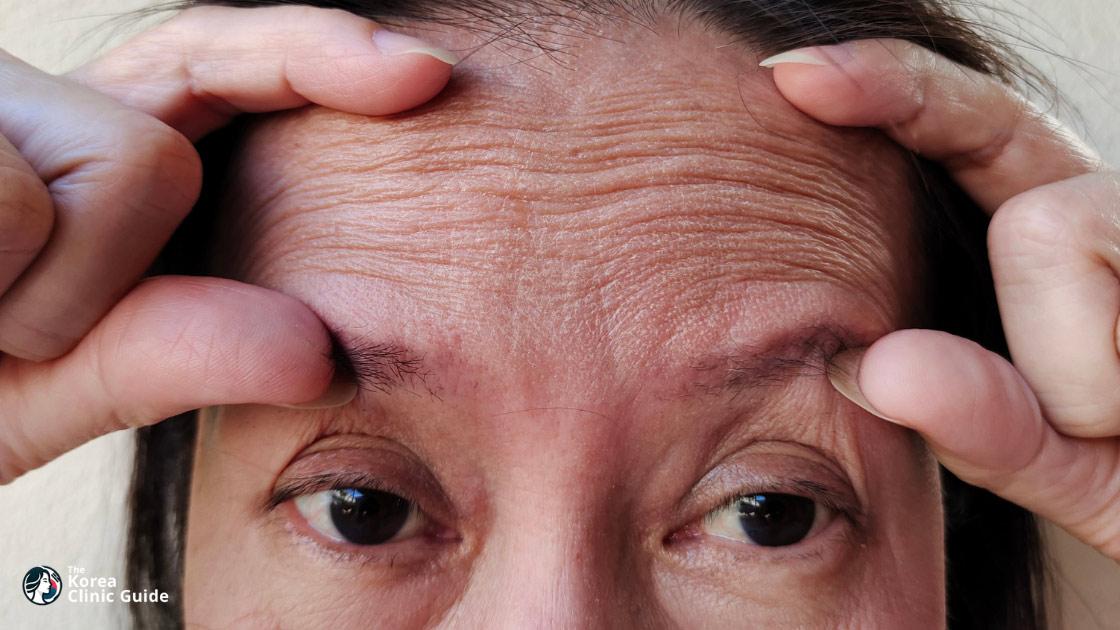
Forehead lift surgery repositions low or asymmetric brows through endoscopic, hairline, temporal, direct, or coronal techniques, with planning based on hairline, eyelids, scalp, and brow descent. In Korea, costs are ₩6,600,000–₩12,000,000, with guidance on provider verification, 10–14 nights of stay, recovery, flying, and follow-up.
Updated: Sep 10, 2026

Forehead Reduction in Korea: Candidacy, Recovery, Risks and Travel Planning
Forehead reduction removes a strip of forehead skin and advances the hair-bearing scalp through a pretrichial or trichophytic hairline incision, with suitability based on stable hair loss, scalp laxity, and scar expectations. International patients should plan 7–10 days in Korea for wound review and possible suture removal, arrange first-night support, flexible flights, and remote follow-up.
Updated: Sep 9, 2026
Face Lift in Korea: Methods, Recovery, Travel Planning, and Safety
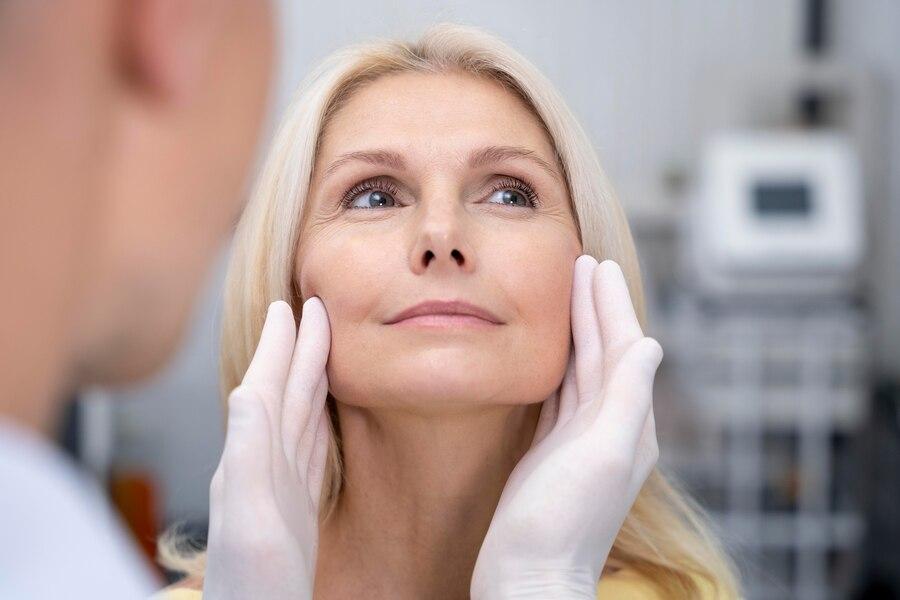
Face lift surgery repositions deeper facial tissues and redrapes skin to address jowls, lower-face and neck laxity, with Korea prices of KRW 7,000,000–15,000,000 (about USD 4,900–10,500). International patients should plan at least 14 days in Korea for early reviews, obtain surgeon flight clearance, and arrange records and remote follow-up before departure.
Updated: Sep 9, 2026
Clinics offering Neck Lift
RINE Plastic Surgery Clinic | Facelift and Eye Rejuvenation Surgery
Nonhyeon

THEPLUS Plastic Surgery Korea | Eye, Nose, Face & Body Surgery
Sinsa

Made Young Plastic Surgery: Rejuvenating Aesthetic Excellence in Korea for Face Lifts, Contouring and More
Gangnam Station

LABOM Plastic Surgery: Expertise in Non-Surgical Nose, Facial Lifting & Anti-Aging Surgeries in Korea
Apgujeong