
Medical Tourism Blog
Skin Booster Exosome in Korea: Evidence, Safety, Recovery, and Travel Planning

Table of contents
- Skin Booster Exosome at a Glance
- What Is an Exosome Skin Booster?
- Who Is a Good Candidate for an Exosome Skin Booster?
- How Is an Exosome Skin Booster Performed?
- Why Visit Korea for an Exosome Skin Booster?
- Key Information for International Patients
- Which Are the Best Clinics in Korea for Skin Booster Exosome?
- Skin Booster Exosome From Start to Finish
- Alternatives to an Exosome Skin Booster
- How Can I Prepare for an Exosome Skin Booster?
- Aftercare Advice
Considering treatment in Korea? Everything you need to know e.g. — how to avoid scams, visas, interpreters, recovery tips — in our Medical Tourism Master Guide. Plan with confidence in minutes, not weeks!
Last updated: September 2026
Skin Booster Exosome at a Glance
- What it is — An exosome skin booster is an investigational extracellular-vesicle (EV) adjunct, usually applied topically after microneedling or RF microneedling rather than injected; it is not an established injectable skin-booster treatment.
- Evidence limit — A small Korean split-face trial of 28 adults found better 12-week hydration, elasticity, wrinkle, and pigmentation outcomes with a specific topical exosome solution after three microneedling sessions, but this does not validate all commercial products or prove durable benefit.
- Recovery and results — Microneedling-based treatment can cause redness, swelling, tightness, dryness, pinpoint bleeding, or petechiae that generally settle within several days and resolved within one week in the Korean trial; assess collagen-related change at 8–12 weeks.
- Travel planning — International patients should plan 3–7 days in Korea and ideally remain for a 48–72-hour review before long-haul travel, particularly while visible redness or swelling is settling.
- Who it suits — Best suited to healthy adults seeking modest improvement in mild texture change, fine lines, pores, dryness, dullness, or uneven tone who have intact, stable skin and realistic expectations about the uncertain added value of EVs.
- Key safety boundary — Decline cosmetic exosome injections: a clinic should provide written proof that the exact product is authorized in Korea for its proposed injection route and indication, since cosmetic status, GMP claims, or particle counts are not authorization.
- Korea-specific distinction — Korean investigators contributed to a controlled topical-EV-after-microneedling study, and the MFDS issued EV therapy-product development guidance in 2024; neither confirms that aesthetic exosome vials are standardized, effective, or approved for facial injection.
What Is an Exosome Skin Booster?
An exosome skin booster is an investigational extracellular-vesicle preparation typically applied to the skin after microneedling or radiofrequency microneedling. It aims to support modest improvement in fine lines, texture, pores, dryness, dullness, and uneven tone, although the device treatment likely provides much of the effect. It is usually minimally invasive when paired with needling, while application to intact skin is non-surgical.
Who Is a Good Candidate for an Exosome Skin Booster?
- Mild photoaging concerns — Suitable candidates are healthy adults seeking modest improvement in fine lines, rough texture, visible pores, dryness, dullness, elasticity, or uneven tone.
- Realistic treatment goals — Good candidates understand that microneedling or RF microneedling is likely to provide much of the benefit; topical extracellular-vesicle (EV) preparations remain an investigational adjunct.
- Stable, intact skin — The treatment field should be free of active acne, dermatitis, sunburn, wounds, and infection.
- Able to complete follow-up — International patients need to share standardized photographs and remain reachable for a 48–72-hour and 2–4-week review.
Do not accept intradermal, subcutaneous, intravenous, or scalp injection of a cosmetic EV/exosome product. Defer needle-based treatment for active bacterial, viral, or fungal infection; cold sores; open wounds; recent tanning; painful pustular acne; or a flare of eczema, rosacea, psoriasis, or contact dermatitis. Pregnancy and breastfeeding are reasons to postpone because reproductive safety data are inadequate when a biologic preparation is used after barrier-disrupting treatment. A dermatologist must assess substantial keloid or hypertrophic-scar history, poor wound healing, immunosuppression, skin-cancer treatment in the area, prior radiation, bleeding disorders, and anticoagulant or antiplatelet use; never stop prescribed medication independently. Allergy to a listed ingredient, preservative, antiseptic, adhesive, topical anesthetic, or biological source material rules out that product.
How Is an Exosome Skin Booster Performed?
Patient-facing differences are mainly determined by whether the preparation is placed on intact skin or applied after a device creates temporary microchannels. Ask for the exact product, source material, route, device, needle depth, and RF settings in writing.
- Topical application on intact skin — A serum, ampoule, or mask is applied without needling. Downtime is minimal, but the skin barrier limits dermal delivery; this is best understood as cosmetic topical care.
- Microneedling followed by topical EV application — Controlled microchannels are made with a needling device, then the named preparation is applied. This is the most studied approach: a small Korean randomized split-face trial used three sessions at three-week intervals.
- RF microneedling followed by topical EV application — Needles deliver radiofrequency heat into the dermis as well as creating channels. It generally causes more temporary warmth, redness, and swelling than superficial mechanical needling. A 60-person unblinded split-face study reported a 12-week incremental wrinkle-improvement signal, not proof of durable superiority.
- Proposed “exosome injections” — Decline this approach unless the clinic provides written proof that the exact product is authorized in Korea for that injection route and indication. Cosmetic status, a particle count, “medical grade,” GMP manufacturing, or a manufacturer registration does not establish injectable authorization.
Why Visit Korea for an Exosome Skin Booster?
Korean investigators contributed to a controlled study of topical adipose-derived EV preparation after microneedling. Korea also has active regulatory work on EV therapeutic-product development. These facts do not validate every product marketed in Korean aesthetic clinics or establish that any cosmetic exosome product is approved for facial injection.
- Relevant clinical research — In the 2023 Korean randomized split-face study, 28 adults received three microneedling sessions; the exosome-solution side had better 12-week instrument and aesthetic outcomes than the saline-control side. The study was small, short, and product-specific.
- Access to device-based protocols — Clinics commonly combine topical adjuncts with microneedling or RF microneedling, which is the route used in available clinical studies rather than injection.
- Regulatory distinction to verify — The MFDS published guidance for quality, non-clinical, and clinical assessment of EV therapy products in 2024. This development guidance is not proof that a commercial aesthetic vial is standardized, authorized for injection, or clinically effective.
- Product scrutiny remains essential — International EV standards stress transparent reporting of source, separation, characterization, dose normalization, storage, controls, and functional testing; marketing terminology and particle counts alone do not establish equivalence or potency.
Key Information for International Patients
- Minimum stay — Plan 3–7 days for a first treatment. Consultation and treatment can occur on one day, but reserve 48–72 hours for early review and for visible redness or swelling to settle.
- Flight timing — No exosome-specific evidence-based flight restriction exists. Next-day travel can be physically possible after uncomplicated superficial microneedling, but leaving after 48–72 hours is the more cautious long-haul plan.
- Repeat sessions — Published regimens range from three sessions every three weeks to three sessions every four weeks and four sessions every two weeks. These are study protocols, not a validated universal schedule; do not book a package on the assumption that maintenance timing is established.
- Itinerary impact — Expect temporary redness, tightness, dryness, edema, pinpoint bleeding, or petechiae from microneedling or RF microneedling. In the Korean trial, transient erythema, edema, and petechiae resolved within one week.
- Companion and transport — No companion is normally needed with topical anesthetic alone. Arrange an escort and do not drive, navigate airports alone, or make important decisions after oral anxiolytics or sedation.
- Remote follow-up — Obtain an English emergency contact and a written plan for photographs at about 48–72 hours and 2–4 weeks. Remote review cannot replace an in-person examination for a suspected complication.
Travel note: Delay departure and seek review for increasing pain, spreading redness, pus, fever, blisters, ulceration, marked swelling, visual symptoms, or a reaction that is worsening rather than settling.
Which Are the Best Clinics in Korea for Skin Booster Exosome?
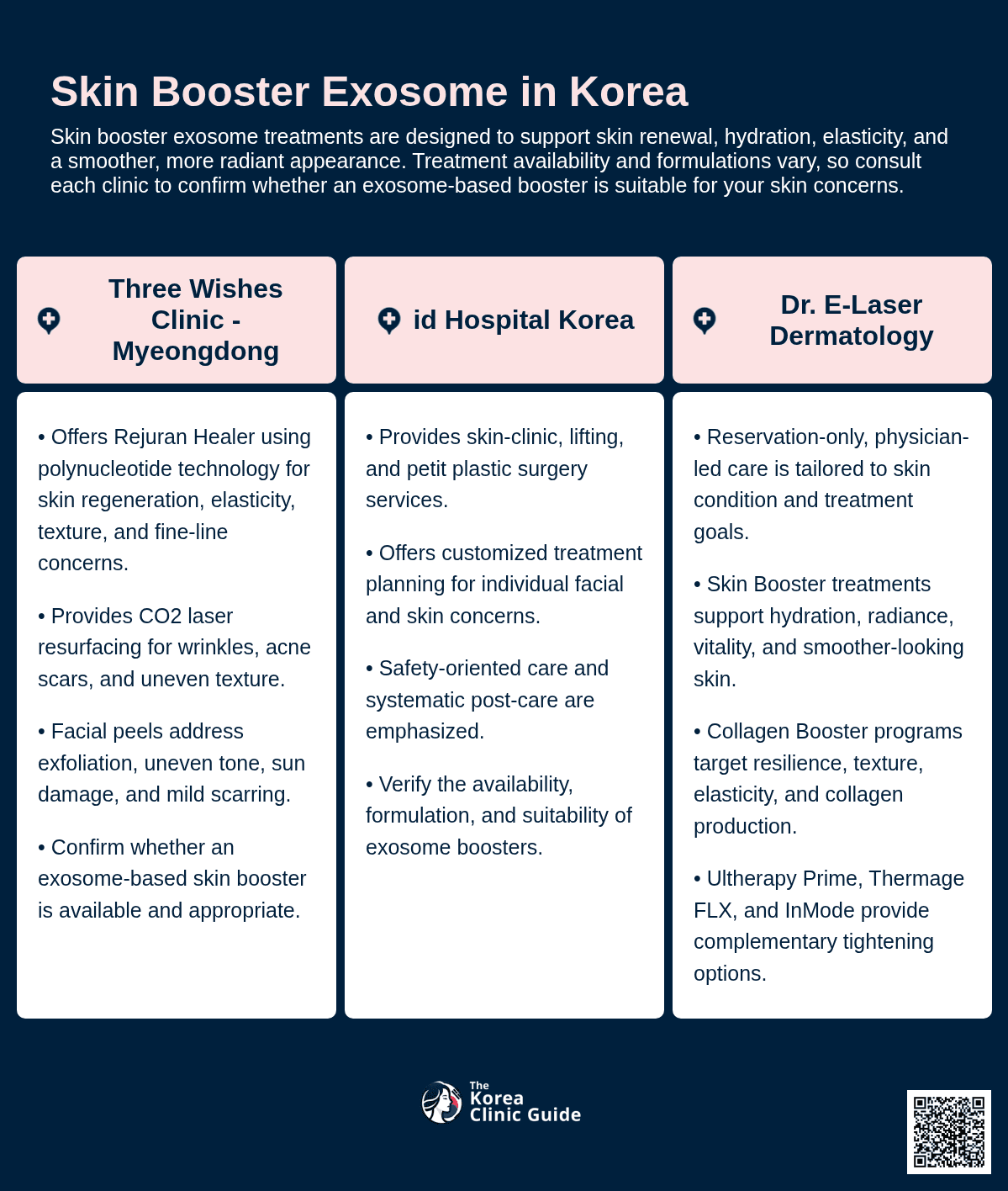
Listed below are some of the best clinics in Korea for skin booster exosome.
1. Three Wishes Clinic - Myeongdong
You may consider Three Wishes Clinic - Myeongdong if you want a clinic with injectable skin-regeneration options alongside texture-focused treatments; its listed Rejuran Healer uses polynucleotide technology to support skin regeneration, elasticity, and fine-line improvement. The provided information does not specifically confirm a Skin Booster Exosome treatment, so you should verify the product and treatment plan available for you.
- URL: Three Wishes Clinic - Myeongdong Website
- Location: Jung-gu, Seoul
- Skin-focused options:
- Rejuran Healer is listed as an injectable PN treatment intended to support skin regeneration, texture, elasticity, and fine lines.
- CO2 laser resurfacing is offered for wrinkles, acne scars, and texture concerns.
- Facial peels are available for exfoliation, uneven tone, sun damage, fine lines, and mild scars.
- Customized skin-care treatments include cleansing, hydration, and maintenance facials.
- Related aesthetic treatments:
- Shurink ultrasound treatment is offered for non-surgical skin lifting and tightening.
- PDT acne treatment is listed for targeting acne-causing bacteria and inflammation.
2. id Hospital Korea
You can expect a clinic focused on facial treatments, customized planning, safety-oriented care, and systematic post-care at id Hospital Korea. Its listed skin-clinic and lifting services may be relevant when discussing your Skin Booster Exosome goals, but the supplied information does not confirm that exosome boosters are offered, so you should verify availability and suitability for your skin concerns.
- URL: id Hospital Korea Website
- Location: Gangnam-gu, Seoul
- Available services:
- Listed services include a skin clinic, lifting, and petit plastic surgery.
- The clinic also lists facial contouring, orthognathic surgery, eye and nose surgery, breast surgery, and dentistry.
- Care approach: The clinic describes customized treatment planning, patient safety-oriented care, and systematic post-care.
3. Dr. E-Laser Dermatology
You may consider Dr. E-Laser Dermatology if you want a reservation-only, physician-led clinic that tailors skin treatment to your condition and goals. Its listed Skin Booster focuses on hydration, glow, vitality, and smoother-looking skin, while its Collagen Booster targets resilience, texture, and elasticity; however, the provided information does not specifically confirm an exosome-based booster, so you should verify the formulation offered for you.
- URL: Dr. E-Laser Dermatology Website
- Location: 2F, 830 Seolleung-ro, Gangnam-gu, Seoul, Korea
- Skin booster care:
- The listed Skin Booster is intended to support hydration, radiance, skin vitality, and a smoother, fresher appearance.
- The Collagen Booster is designed to support collagen production, skin resilience, texture, and elasticity.
- Texture and pigmentation support:
- Acne scar and pore-and-scar treatments are available for uneven texture, marks, and enlarged pores.
- Toning, brightening, and melasma programs are listed for dullness, uneven tone, and pigmentation concerns.
- Complementary tightening options:
Skin Booster Exosome From Start to Finish
- Send records before booking — Request an English-language or virtual consultation. Share clear, unfiltered photographs, medical conditions, allergies, medicines, supplements, herpes history, scarring or pigment history, and recent procedures.
- Verify the proposed protocol — Obtain the product name, cell or non-cell source, full ingredient list, route of administration, manufacturer, Korean regulatory classification, batch/lot number, expiry date, storage instructions, device name, intended needle depth, RF use, session plan, and written aftercare. Confirm that the product will be applied topically, not injected.
- Attend the clinical assessment — The clinician examines active acne, dermatitis, wounds, tanning, infection, pigment risk, and scar tendency. Healthy patients having a topical adjunct with microneedling do not generally need blood tests; testing is based on a bleeding, immune, healing, or infectious concern, or on another proposed procedure.
- Prepare the treatment field — Skin is cleansed and disinfected. Topical anesthetic is often applied before microneedling or RF microneedling; routine sedation is not needed.
- Receive the device treatment — The clinician performs mechanical microneedling or RF microneedling over the agreed facial areas. Treatment duration depends on the areas, device, anesthesia time, and whether RF is used.
- Apply the topical preparation — The named EV/exosome preparation is applied after needling. Inspect intact packaging and confirm the label, lot number, and expiry before use.
- Leave with documentation — Obtain a written record of the date, treatment areas, device and settings when relevant, product name, lot number, listed ingredients or source, and medicines used. Receive instructions on cleansing, skincare, makeup, sun avoidance, and urgent-contact procedures.
- Complete early recovery and remote review — Expect device-related redness and swelling to settle over several days; assess early cosmetic change over 4–12 weeks. Send standardized photographs at the agreed intervals and seek local medical care promptly for infection, severe allergy, or eye symptoms.
Alternatives to an Exosome Skin Booster
Established options are usually preferable when the goal is treatment of a defined diagnosis rather than general skin-rejuvenation marketing. Non-surgical procedures offer gradual texture or hydration improvement with limited downtime; they do not correct major laxity, deep folds, or substantial volume loss.
Microneedling or RF Microneedling Alone
- Main tradeoff — Removes uncertainty about the added EV product while retaining the device treatment that may account for much of the observed benefit.
- Best suited to — Mild texture change, pores, fine lines, and some acne-scar protocols. See Secret RF microneedling or Potenza.
PRP Facial Treatment
- Main tradeoff — Uses a preparation made from the patient’s own blood rather than a commercial EV product.
- Evidence comparison — In an investigator-blinded split-face trial, topical adipose-derived exosomes and PRP produced no significant between-side difference when both were paired with RF microneedling. See PRP facial treatment.
Identified Injectable Skin Boosters
- Main tradeoff — These treatments involve injections and their own risks, but product identity and intended use can be clearer than an unstandardized EV claim.
- Best suited to — Patients specifically seeking hydration-focused injectable treatment after a clinician confirms the product, anatomy, and contraindications. See skin booster, Rejuran Healer, or PDRN injection.
Fractional Laser Resurfacing
- Main tradeoff — Offers a more established resurfacing pathway for selected texture, photoaging, and scar concerns, usually with more downtime and stricter pigment-risk planning.
- Best suited to — Patients whose examination supports laser treatment rather than a general rejuvenation adjunct. See Fraxel laser or acne scar treatment.
How Can I Prepare for an Exosome Skin Booster?
- Disclose medicines and supplements early — List anticoagulants, antiplatelets, systemic corticosteroids, immunosuppressants, isotretinoin, retinoids, exfoliating acids, benzoyl peroxide, fish oil, vitamin E, and herbal supplements. The treating clinician and prescribing clinician must decide whether any change is appropriate; do not stop prescribed medicines yourself.
- Avoid UV injury for 1–2 weeks — Do not arrive with a tan, sunburn, or recent high-UV exposure. Reschedule treatment over sunburned or inflamed skin.
- Report skin and health changes — Tell the clinic about cold sores, acne flares, rash, infection, wounds, pregnancy or breastfeeding, impaired healing, immune conditions, recent radiation, allergy history, and prior keloid or hypertrophic scars.
- Request product documentation — Ask for the exact name, source, ingredients, route, manufacturer, lot/batch number, expiry date, storage information, and Korean product classification. Decline a product when the clinic will not identify it clearly.
- Keep skincare simple — Follow the clinic’s instructions on pausing retinoids, acids, scrubs, and benzoyl peroxide. Arrive with clean skin and avoid introducing unfamiliar active products before treatment.
- Plan transport and accommodation — Stay close enough for a 48–72-hour check if possible. Arrange an escort when oral anxiolytics or sedation are proposed, and use flexible flights until early recovery is uncomplicated.
Travel note: Do not schedule this procedure immediately before a beach holiday, ski trip, outdoor tour, sauna visit, or other high-UV and high-heat activity.
Confirm the treating doctor’s clinic-specific fasting, medication, skincare, and travel requirements; those individualized instructions take precedence over general guidance.
Aftercare Advice
Protect the healing skin barrier and treat worsening symptoms as a clinical issue, not ordinary post-procedure redness.
- Use only approved skincare — Apply only the prescribed products or a bland, fragrance-free moisturizer until the barrier settles. Avoid retinoids, exfoliating acids, benzoyl peroxide, scrubs, alcohol-based toners, and unfamiliar products.
- Avoid heat, friction, and contamination — Do not touch the face with unwashed hands. Avoid strenuous exercise, saunas, steam rooms, hot yoga, swimming, hot tubs, and direct sun for at least 24–48 hours, or longer while redness persists.
- Delay cosmetics as instructed — Follow the clinic’s written interval before makeup. Do not use makeup to conceal a worsening rash, drainage, or painful swelling.
- Use sun protection at the instructed time — Once the clinician confirms it is appropriate, use broad-spectrum SPF 50 sunscreen and limit direct sun exposure, particularly when prone to post-inflammatory pigment change.
- Know the warning signs — Seek urgent assessment for increasing pain, spreading redness or heat, pus, fever, grouped blisters, widespread rash, persistent nodules, progressive discoloration, ulceration, blanching or dusky skin, swelling affecting the eyes or breathing, or any visual symptom.
- Judge results at the right time — A hydrated appearance can appear within days to weeks, while collagen-remodeling-related change is more fairly assessed at 8–12 weeks after treatment begins. Do not interpret early swelling as the final result.
Follow the treating doctor’s instructions over general advice and contact the clinic promptly when anything appears wrong.
Frequently Asked Questions
Related Blogs
Effective Tear Trough Depression Treatment in Korea with Juvelook Volume Filler
Discover how Korea leads in treating tear trough depression—the "sunken groove below the eye." This condition causes dark circles, hollows, and a tired look. The innovative Juvelook Volume Filler, approved in Korea, combines hyaluronic acid and polylactic acid to deliver immediate hydration and long-term collagen boost, providing natural rejuvenation. Learn how Korea's advanced clinics perform thi
Updated: Oct 28, 2026
Knee Hyperpigmentation Solutions: Knee Whitening Procedures in Korea for Brighter, Even Skin
Discover effective knee whitening solutions in Korea for hyperpigmentation and darkened skin. This comprehensive blog covers causes like friction and sun damage and details treatments such as topical hydroquinone, chemical peels, microdermabrasion, laser therapy, microneedling, and cryotherapy. Highlighting Korea’s advanced technology and expert care, it guides you through procedures, costs, and p
Updated: Oct 28, 2026
Ultracol in Korea: Candidates, Safety, Recovery, and Travel Planning
Ultracol is a PDO microsphere injectable intended in Korea for temporary improvement of bilateral nasolabial folds, delivered after eligibility review and product-label verification. The article covers candidate screening, outpatient treatment and recovery, travel planning, aftercare, warning signs, follow-up, and alternatives.
Updated: Oct 27, 2026
Discover the Price Spectrum: Lilied Skin Booster Costs—Korea vs. Global Destinations
Discover the latest trends in skincare with the Lilied Skin Booster in Korea. Learn about its pricing, benefits, and why it’s becoming a must-have addition to beauty routines across the country.
Updated: Oct 27, 2026
Clinics offering Skin Booster Exosome

Three Wishes Clinic - Myeongdong, Korea: Advanced Botox, Fillers, Laser, and Skin Treatments for Confidence and Care
Myeongdong

B.V Clinic Korea: Advanced Aesthetic Treatments for Natural Beauty Enhancement & Rejuvenation
Sinnonhyeon Station
ID Hospital - Main Branch in Korea: Specializing in Safe & Customized Facial Plastic Surgery and Post-Care Services
Sinsa

VandS Dermatology Clinic - Dongtan, Korea: Comprehensive Skin Care and Cosmetic Procedures for Youthful, Radiant Skin
Hwaseong