
Medical Tourism Blog
Collagen Booster in Korea: Types, Safety, Recovery, and Travel Planning

Table of contents
- Collagen Booster at a Glance
- What Is a Collagen Booster?
- Who Is a Good Candidate for a Collagen Booster?
- What Are the Different Types of Collagen Booster?
- Why Visit Korea for a Collagen Booster?
- Key Information for International Patients
- Which Are the Best Clinics in Korea for Collagen Booster?
- Collagen Booster From Start to Finish
- Alternatives to a Collagen Booster
- How Can I Prepare for a Collagen Booster?
- Aftercare Advice
Considering treatment in Korea? Everything you need to know e.g. — how to avoid scams, visas, interpreters, recovery tips — in our Medical Tourism Master Guide. Plan with confidence in minutes, not weeks!
Last updated: September 2026
Collagen Booster at a Glance
- What it is — A collagen booster is a particulate injectable biostimulator—such as PLLA, PDLLA, CaHA, or PCL—used for gradual facial volume restoration and collagen-associated remodeling; it is not the same as a conventional HA filler or every Korean “skin booster.”
- Gradual, staged results — Treatment-day fullness may be swelling or carrier gel rather than the final effect. Improvement develops gradually, and PLLA-type treatment should not be reassessed for another session sooner than 4 weeks.
- Recovery — Redness, tenderness, swelling, and bruising commonly improve within hours to about 7 days, although bruising can remain visible for roughly 2 weeks.
- Best candidates — It can suit healthy adults with diffuse facial volume loss, wrinkles, or mild laxity who prefer progressive improvement over immediate sharp contouring and can provide a complete history of prior fillers, threads, implants, or facial surgery.
- Key limitation and risk — Particulate biostimulators are not simply dissolved with hyaluronidase, and delayed papules or nodules can occur weeks to months later. Rare vascular injection complications can cause skin necrosis, visual impairment, or cerebral ischemia and need immediate care.
- Korea travel planning — Plan 2–3 days for an uncomplicated facial injection and remain locally for at least 24–48 hours so the clinic is accessible for early complications. Staged sessions usually require a later trip or follow-up at home.
- Korea-specific verification — Confirm the exact active material, brand, labeling status for the planned area, vial count, dilution, and injector—not just the clinic’s “booster” label. Request English consent, aftercare, emergency contact details, and a lot-numbered treatment record.
What Is a Collagen Booster?
A collagen booster is an injectable treatment that uses biostimulating material to encourage gradual collagen-related tissue remodeling. It aims to restore subtle facial volume, soften lines, and improve skin quality over time rather than create immediate sharp contour. It is a minimally invasive treatment.
Who Is a Good Candidate for a Collagen Booster?
- Gradual volume restoration — Good candidates want progressive improvement in facial hollowing, wrinkles, or diffuse volume loss rather than immediate, sharply sculpted contour.
- Skin-quality and laxity concerns — An injectable collagen biostimulator can suit adults seeking gradual facial collagen remodeling where tissue thickness and treatment area are appropriate for the selected material.
- Staged-treatment acceptance — PLLA-type treatments are commonly conservative and staged; reassessment for another Sculptra-type session should occur no sooner than 4 weeks after the preceding session.
- Documented injectable history — Candidates can provide accurate records of earlier fillers, threads, implants, facial surgery, and the exact areas treated.
Treatment is unsuitable during active acne cysts, herpes lesions, dermatitis, dental infection, or any infection or inflammation near the injection field. Defer elective treatment during pregnancy or breastfeeding; PLLA safety is not established in these groups or in people under 18. Severe allergy, prior anaphylaxis or multiple severe allergies, keloid or hypertrophic-scar susceptibility, bleeding disorders, immunosuppression, uncontrolled diabetes, autoimmune or connective-tissue disease, abnormal healing, and major active illness require individualized medical assessment. Product choice also depends on facial anatomy: do not inject an area containing an undocumented permanent filler or implant, and do not assume that lips or the periorbital area are appropriate, as PLLA labeling does not establish safety and effectiveness in those areas.
What Are the Different Types of Collagen Booster?
“Collagen booster” is an umbrella term, not one standardized injection. Confirm the exact material, formulation, dose, dilution, intended plane, and labeled use before consenting; these products are not interchangeable.
- PLLA (poly-L-lactic acid) — Sculptra-type treatment is generally placed in deep dermal or subcutaneous tissue for staged, gradual volume restoration. Initial fullness can come from the carrier gel or swelling, not the eventual collagen-associated result.
- PDLLA (poly-D,L-lactic acid) — This group includes pure PDLLA products, such as AestheFill, and PDLLA products combined with non-cross-linked hyaluronic acid. A 260-participant randomized trial found AestheFill non-inferior to HA filler for moderate-to-severe nasolabial folds through 52 weeks, but that finding applies to that product and indication rather than every PDLLA injection.
- CaHA (calcium hydroxylapatite) — Radiesse-type material can be used with different dilutions when the goal is structural support versus diffuse biostimulation. Its particle properties, carrier, injection plan, and aftercare differ from PLLA protocols.
- PCL (polycaprolactone) — Ellansé-type products have distinct microsphere and carrier characteristics. The intended area, treatment plane, expected persistence, and local labeling must be assessed for the exact formulation.
- PDLLA-HA combinations — The hyaluronic-acid component does not make the PDLLA particles reversible. Unlike conventional HA filler, a particulate biostimulator is not simply dissolved with hyaluronidase.
Why Visit Korea for a Collagen Booster?
Korea offers broad access to injectable aesthetic care, but it does not inherently produce better collagen-booster outcomes. Results depend on the clinician, the exact material, injection plane, dose, and complication response plan. Verify the institution, product, and treating clinician rather than choosing on the basis of a broad “collagen booster” label.
- Foreign-patient registration checks — Use the Medical Korea registered-institution system to verify a Ministry of Health and Welfare-registered foreign-patient attraction institution where applicable.
- Product-specific consent — Korean clinics market several products under “booster” terminology, including treatments that are not particulate biostimulators. Ask for the active material, brand, Korean labeling status for the intended area, vial count, dilution, and whether the use is off-label before treatment.
- Written treatment traceability — Request English-language consent, aftercare, emergency contact details, and a procedure record listing the product, batch or lot number, amount, dilution, injection sites, needle or cannula use, treatment date, and clinician.
- Evidence with important limits — A small 2026 split-face trial of 33 participants found one PDLLA plus non-cross-linked HA product non-inferior to PLLA for nasolabial-fold correction through 24 weeks. This does not establish equivalent long-term outcomes, safety, or performance across all PDLLA, PLLA, CaHA, and PCL products.
Key Information for International Patients
- Minimum stay — Plan 2–3 days for an uncomplicated facial injection: consultation and treatment on day 1, with day 2 available for an early review or complication check. Allow longer after extensive body treatment, combination procedures, or marked bruising.
- Flight timing — No universal flight restriction specific to particulate biostimulators has been established. Remain in Korea for at least 24–48 hours as conservative access-to-care planning, not because cabin pressure is known to alter the injected material.
- Visible recovery — Redness, tenderness, swelling, and bruising commonly settle over hours to about 7 days; bruising can last about 2 weeks. Schedule photographs, events, and close-up business commitments accordingly.
- Repeat sessions — Do not try to complete a staged program during one short visit. PLLA reassessment should be no earlier than 4 weeks, so later sessions are ordinarily arranged at home or on a separate trip.
- Remote follow-up — Arrange a video or photo check-in, retain the lot-numbered treatment record, and identify a clinician at home before travel. Delayed papules or nodules can arise weeks to months later and need clinical review.
- Emergency planning — Ask who provides urgent assessment after hours and how English-language support works. Accidental intravascular injection can cause skin necrosis, visual impairment, or cerebral ischemic events and requires immediate action.
Travel note: Leave Korea only when acute swelling is stable, communication with the clinic is confirmed, and you know where to seek urgent care at home.
Which Are the Best Clinics in Korea for Collagen Booster?
Listed below are some of the best clinics in Korea for collagen booster.
1. PangPang Clinic
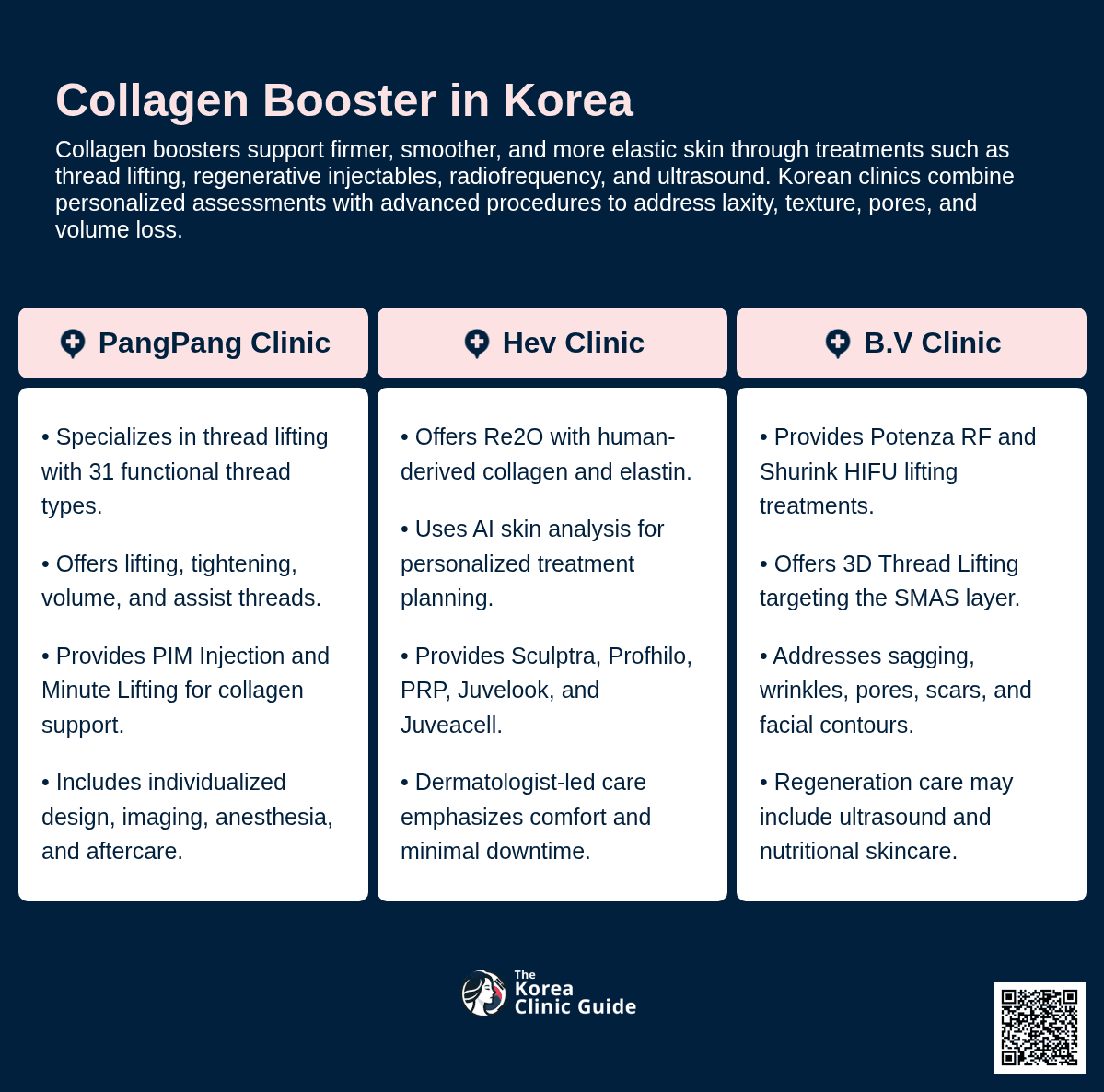
For a collagen-boosting approach centered on thread lifting, you can consider PangPang Clinic’s highly specialized use of lifting, tightening, volume, and assist threads. Its thread procedures are designed to provide a visible lift while supporting your own collagen production and skin elasticity over time, with treatment planning tailored to your concerns.
- URL: PangPang Clinic Website
- Location: Gangnam-gu, Seoul
- Thread-focused approach:
- The clinic focuses exclusively on thread lifting and reports using 31 specialized functional thread types to customize lifting solutions.
- Its Thread Lifting Research Institute supports ongoing development of thread-lifting techniques based on research and clinical data.
- Thread options include barbed lifting threads, elastic tightening threads, volume threads for areas such as the cheeks and under-eyes, and complementary assist threads.
- Procedure details:
- Thread lifting is listed for the face, neck, breasts, buttocks, and abdomen, with a typical treatment time of 30 minutes to 1 hour.
- The clinic lists partial, Airnox, or sleep anesthesia options; minimal pain and recovery; and results lasting about one year or longer.
- Planning may include ultrasonic visual checks and pre-procedure design, followed by an aftercare package intended to support and extend the effect.
- Other collagen-oriented options:
- PIM Injection combines Ultra Cell, thread lifting, and Botox; it uses absorbable thread components to support collagen production, facial volume, firmness, elasticity, and fine wrinkles.
- PIM Injection is listed as a roughly 30-minute treatment with local anesthesia and no recovery period; a monthly series of three to five treatments is recommended for optimal effect.
- Minute Lifting is a 30-minute non-invasive option with an immediate lifting effect and a stated maintenance period of six months to one year.
- Additional services:
- If you are seeking correction after a previous thread lift, the Thread Lifting Revision Center may combine revision work with fillers, Botox, or lasers.
- The medical team participates in international beauty conferences through invited lectures and presentations.
2. Hev Clinic
For a collagen booster that directly replenishes structural dermal components rather than only stimulating collagen production, you may consider Hev Clinic’s Re2O treatment. Re2O uses human-derived collagen and elastin (hADM) to address firmness, texture, and pores, and Hev pairs individualized skin analysis with dermatologist-led care from consultation through aftercare.
- URL: Hev Clinic Website
- Location: Gangnam-gu, Seoul
- Collagen booster details:
- Re2O is described as directly replenishing the skin’s structural scaffold with human-derived collagen and elastin rather than solely stimulating production.
- The clinic lists a protocol of three monthly Re2O sessions, with improvements in firmness, texture, and pores and results stated to last over a year.
- Hev may use Re2O after Thermage FLX or Ultherapy to replenish the dermis following deeper-layer contraction from lifting devices.
- Dermatologist-led planning:
- Board-certified dermatologist Dr. Shin Ji-yeon personally oversees consultation, procedures, and aftercare.
- AI diagnostic equipment is used to assess factors including skin thickness, degree of aging, and pigment depth for a one-to-one plan.
- Dr. Shin’s work includes well-aging, device-based lifting, dermal structure restoration using Juveacell and Re2O, and customized non-surgical facial contouring.
- Related regenerative treatments:
- Available collagen- or regeneration-focused options include Sculptra, Profhilo, PRP, Juvelook, and Juveacell.
- RF microneedling and microneedling are available for pores, scars, and collagen remodeling, while Ultherapy and Thermage are offered for gradual tightening through deep collagen stimulation.
- The clinic also offers Rejuran skin boosters and laser treatments including Fraxel and fractional CO2 laser.
- Comfort and aftercare:
- A non-sedation, pain-controlled anesthesia system allows real-time communication during injectable procedures.
- The clinic emphasizes low-irritation treatment selection and minimal downtime, with the aim of allowing an immediate return to daily activities when appropriate.
- Post-treatment care includes the clinic’s Repair Barrier Cream and a maintenance plan timed around an approximately three- to four-week skin-cell regeneration cycle.
3. B.V Clinic
At B.V Clinic, you can pursue collagen-supporting skin tightening through Potenza radiofrequency, Shurink HIFU, or thread-lifting treatments selected around your skin needs and facial contours. The clinic’s approach combines non-surgical lifting with post-treatment regeneration management intended to support elasticity and recovery.
- URL: B.V Clinic Website
- Location: Seoul
- Collagen-boosting options:
- Potenza Lifting uses radiofrequency technology to support collagen and elasticity while addressing scars and pore texture.
- Shurink Lifting uses high-intensity focused ultrasound to target deeper skin layers for tightening, elasticity, and contour refinement.
- 3D Thread Lifting places threads strategically to lift and firm sagging skin while stimulating collagen production for sustained improvement.
- Thread lifting details:
- 3D Thread Lifting targets the SMAS layer to enhance natural facial contours.
- Full Face Lifting is intended to restore volume and balance, address wrinkles and nasolabial folds, and provide an immediate non-surgical lifting effect.
- Non-Surgical Forehead Wrinkle Restoration uses tailored threads for forehead wrinkles and sagging around the eyes without visible scars or anesthesia.
- Aftercare:
- Post-treatment regeneration management may include nutritional skincare products and ultrasound treatments intended to reduce swelling and support elasticity and collagen.
- An all-in-one wellness program includes detox injections, vitamin drips, and immune-support treatments.
Collagen Booster From Start to Finish
- Remote screening and travel planning — Send clear photographs and a complete treatment history. Confirm whether an English or virtual consultation is available, but treat remote advice as preliminary until an in-person examination is completed.
- In-person consultation — The clinician reviews goals, facial proportions, skin thickness, asymmetry, prior fillers, threads, implants, surgery, allergies, cold sores, relevant medical conditions, and medicines. Discuss the exact product, injection plane, expected degree of immediate versus delayed change, risks, alternatives, and emergency plan.
- Consent and treatment mapping — Receive product-specific consent and confirm the material, amount or vial count, dilution or reconstitution, needle versus cannula plan, treatment areas, and whether any use is off-label. Photographs and injection markings are commonly completed before treatment.
- Skin preparation and anesthesia — The skin is cleansed with antiseptic. Topical anesthetic or local anesthetic can be used; uncomplicated facial injections are generally performed without sedation.
- Injection — The clinician places the particulate biostimulator with a needle and/or blunt cannula in the planned tissue plane. Technique is material- and area-specific; PLLA is generally injected deeply and conservatively undercorrected.
- Immediate assessment and discharge — The injector checks symmetry, skin color, capillary refill, pain, and other early signs of a complication. Most treatments are outpatient, with short observation and same-day discharge.
- Early recovery in Korea — Use a cloth-wrapped cool pack intermittently during the first 24 hours when instructed. Keep the clinic accessible for 24–48 hours and attend any requested review.
- Staged assessment and overseas follow-up — Do not judge final collagen-associated improvement from treatment-day fullness. Send follow-up photographs as requested, retain your treatment record, and seek prompt review for persistent or delayed lumps, inflammation, or asymmetry.
Alternatives to a Collagen Booster
The best alternative depends on whether the priority is immediate contour, gradual tissue remodeling, skin tightening, or correction of major volume loss and tissue descent. Non-surgical options cannot reproduce the lift achieved by surgery, while surgery involves more downtime and travel planning.
Hyaluronic Acid Filler
- Best for — Immediate, precisely placed contouring of selected facial hollows, folds, lips, or chin.
- Tradeoff — HA filler generally offers more immediate correction and can usually be treated with hyaluronidase when clinically indicated; particulate biostimulators are gradual and not simply dissolved by hyaluronidase.
- Related procedure — Consider facial filler for a filler-focused evaluation.
Sculptra
- Best for — Patients specifically considering a PLLA collagen biostimulator and willing to use a staged approach.
- Tradeoff — It remains a particulate injectable with delayed results and nodule risk, not an interchangeable version of PDLLA, CaHA, or PCL.
- Related procedure — Read about Sculptra.
Facial Fat Grafting
- Best for — More substantial volume loss when a surgical procedure and longer recovery are acceptable.
- Tradeoff — Fat grafting can address broader volume deficits but requires fat harvesting, procedural recovery, and less predictable fat survival than a simple office injection.
- Related procedure — Explore face fat grafting.
RF Microneedling or HIFU
- Best for — Mild texture, pore, or tightening concerns where added volume is not the primary goal.
- Tradeoff — These energy-based treatments target different mechanisms and are not equivalent replacements for volume restoration with a biostimulator.
- Related procedures — Consider Secret RF microneedling or HIFU laser.
How Can I Prepare for a Collagen Booster?
- Product records — Bring records for every prior filler, collagen stimulator, thread, implant, facial operation, and previous complication. Include product name, treatment area, and date whenever possible.
- Medical disclosure — Tell the clinician about allergies, cold sores, keloid or hypertrophic scars, autoimmune disease, diabetes, immunosuppression, cancer treatment, hepatitis, abnormal healing, recent stroke or heart attack, and active skin or dental infection.
- Blood-thinning medicines — Report aspirin, clopidogrel, warfarin, apixaban, rivaroxaban, dabigatran, and other anticoagulant or antiplatelet medicines. Do not stop prescribed medication independently; the prescribing clinician and injector must decide whether a change is safe.
- Bruising-risk supplements — With clinician approval, review aspirin, ibuprofen, naproxen, high-dose vitamin E, fish oil or omega-3, ginkgo, garlic, ginseng, and St John’s wort before treatment. Follow the clinic’s specific stop period rather than using a universal schedule.
- Food and hydration — Eat and drink normally for a local-anesthetic injection; fasting is not ordinarily needed. Follow written fasting instructions if oral or IV sedation or another procedure is planned.
- Skin and alcohol — Arrive with clean skin and no makeup. Avoid alcohol for at least 24 hours before treatment when instructed, as it can worsen flushing and bruising; defer treatment for an active rash, acne cyst, cold sore, or infection.
- Travel logistics — Book flexible flights, remain locally for 24–48 hours after injection, and avoid scheduling important events for up to 2 weeks if bruising would be disruptive. A companion is usually unnecessary for local anesthesia but can be required with sedation.
Travel note: Obtain the clinic’s emergency contact and confirm how remote follow-up will work before the procedure, not after departure.
Confirm all clinic-specific medicine, fasting, and arrival requirements with the treating doctor; individualized instructions take precedence over general guidance.
Aftercare Advice
Protect the treated area, monitor for vascular warning signs, and follow the aftercare protocol for the exact product rather than applying a generic “collagen booster” routine.
- Cold compresses — Use a cloth-wrapped cool pack intermittently for the first 24 hours when directed. Do not place ice directly on the skin.
- Heat, exercise, and contact — Avoid strenuous exercise, sauna, steam rooms, hot yoga, intense heat, facials, and rubbing or vigorous massage until redness and swelling settle. Do not massage unless the injector prescribed it for the exact product.
- Product-specific massage — For Sculptra, FDA instructions describe circular massage for 5 minutes, 5 times daily, for 5 days when directed by the clinician. Do not apply this “5-5-5” routine automatically to PDLLA, CaHA, PCL, or combination products.
- Sun and skincare — Keep skincare gentle while the skin is reactive, avoid intense UV exposure and extreme temperatures, and use broad-spectrum SPF 50 sunscreen.
- Expected changes and results — Redness, soreness, swelling, and bruising generally improve within hours to 7 days, although bruising can remain visible for about 2 weeks. Treatment-day fullness can reflect edema or carrier gel; collagen-associated improvement develops gradually and depends on material, dose, plane, area, and staged sessions.
- Urgent warning signs — Seek emergency in-person assessment immediately for severe or escalating pain, blanching, mottled or dusky discoloration, cool skin, visual symptoms, severe headache, weakness, speech difficulty, or stroke-like symptoms. Contact the clinic promptly for increasing redness, warmth, pus, fever, persistent swelling, a growing painful lump, or delayed papules or nodules.
Follow the treating doctor’s instructions and contact the clinic immediately when anything appears wrong.
Frequently Asked Questions
Related Blogs
Discovering the Cost of Anal Bleaching in Korea: How It Compares with the USA, Australia, Turkey, and More
Discover the cost and factors influencing anal bleaching treatments in Korea in our comprehensive guide. Explore the latest trends, pricing, and expert insights to make an informed decision for your skincare routine.
Updated: Oct 23, 2026
Discover the Global Price Spectrum: Keloid Injection Costs From Korea to the USA, UK, and Beyond
Discover the affordability and effectiveness of keloid injection treatments in Korea, a popular destination for medical tourism. Learn about average costs, available treatments, and why patients around the world are choosing Korea for their keloid care.
Updated: Oct 23, 2026
Korea vs. Global Rates: What You’ll Spend on Acne Scar Treatment from Seoul to San Francisco
Discover the affordable and effective acne scar treatments available in Korea, renowned for their cutting-edge dermatological advancements. Explore various options that cater to different skin types and budgets, helping you achieve smoother, clearer skin.
Updated: Oct 23, 2026
The Ultimate Cost Comparison: Shurink Lifting in Korea vs USA, Mexico, and More Global Destinations
Discover the cost and benefits of Shurink Lifting in Korea, a popular non-surgical procedure offering skin tightening and rejuvenation. Learn how this advanced treatment compares to other options and why it's gaining popularity among locals and international visitors alike.
Updated: Oct 23, 2026
Clinics offering Collagen Booster
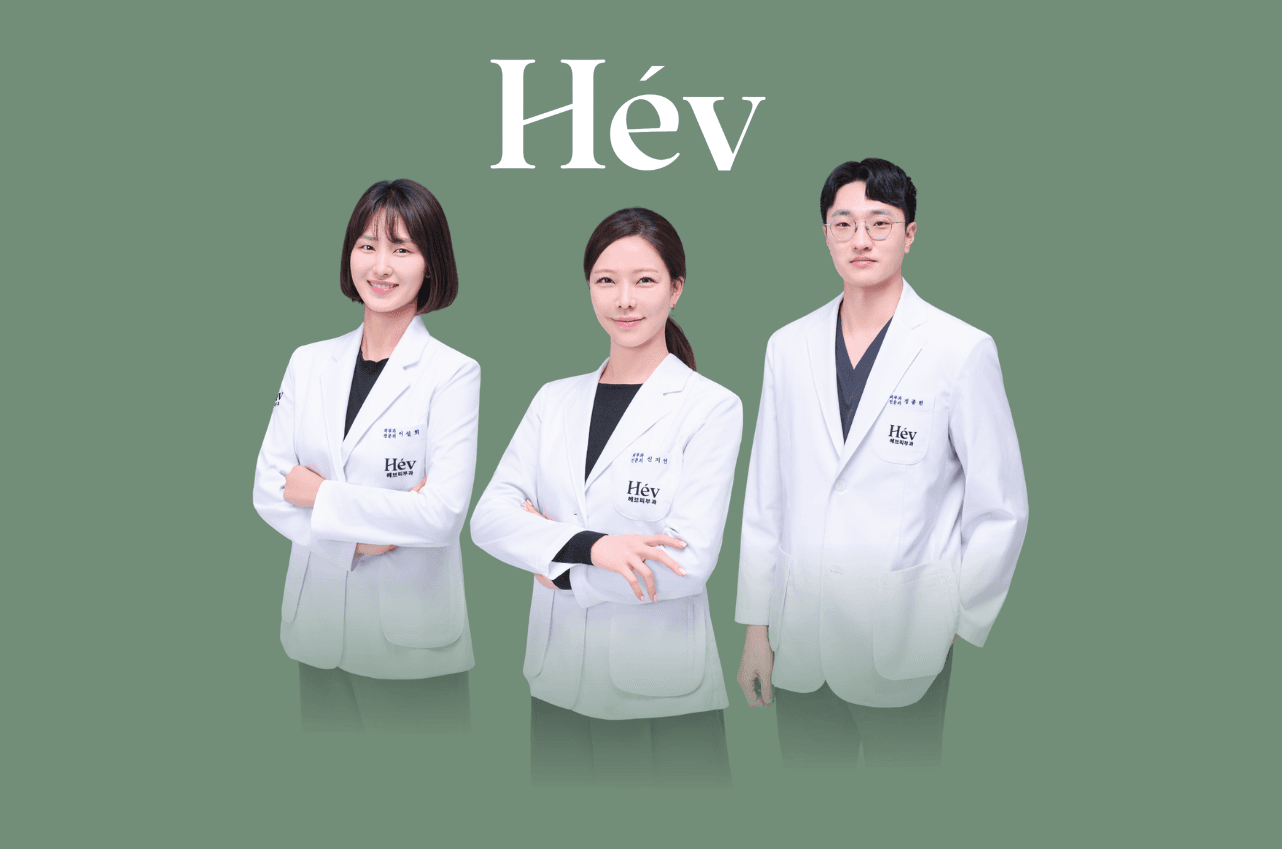
Hev Clinic Korea | Premium Sinsa Clinic for Skin, Laser & Injectables
Sinsa

Made Young Plastic Surgery: Rejuvenating Aesthetic Excellence in Korea for Face Lifts, Contouring and More
Gangnam Station

PangPang Clinic: Korea's Premier Thread Lifting and Skin Rejuvenation Specialist in Gangnam, Seoul
Sinsa

Seojin Plastic Surgery Clinic Korea: Pioneering Advanced Cosmetic Procedures for Personalized Aesthetic Transformation
Apgujeong