
Medical Tourism Blog
Ultracol in Korea: Candidates, Safety, Recovery, and Travel Planning

Table of contents
- Ultracol at a Glance
- What Is Ultracol?
- Who Is a Good Candidate for Ultracol?
- What Are the Different Types of Ultracol?
- Why Visit Korea for Ultracol?
- Key Information for International Patients
- Which Are the Best Clinics in Korea for Ultracol?
- Ultracol From Start to Finish
- Alternatives to Ultracol
- How Can I Prepare for Ultracol?
- Aftercare Advice
Considering treatment in Korea? Everything you need to know e.g. — how to avoid scams, visas, interpreters, recovery tips — in our Medical Tourism Master Guide. Plan with confidence in minutes, not weeks!
Last updated: September 2026
Ultracol at a Glance
- What it is — Ultracol is an injectable PDO microsphere collagen biostimulator in a CMC carrier, not a PDO thread lift or hyaluronic-acid gel filler; its goal is gradual tissue improvement rather than an immediate lift.
- Korean labeled use — The publicly stated Korean MFDS intended use is temporary improvement of bilateral facial nasolabial folds, so tear trough, nose, forehead, neck, body, hip, and lip proposals require extra scrutiny; lip augmentation is specifically excluded in the accessible IFU.
- Best candidate — It best suits adults with mild-to-moderate nasolabial folds who accept modest, gradual and variable change, have healthy skin at the injection site, and do not need immediate contour, major lifting, or reliably reversible treatment.
- Recovery and timing — Normal non-strenuous activity is generally possible the same day, while redness, swelling, pain, and bruising commonly settle within 5–14 days; allow 1–2 weeks before an important event and do not judge collagen-related results in the first days.
- Repeat-treatment uncertainty — No validated universal session schedule or proven longevity is available: the small Ultracol 100 study used two sessions four weeks apart and assessed outcomes four weeks later, while a previously cited Ultracol 200 study was retracted in 2025.
- Travel planning — Treatment is usually outpatient, but international patients should stay in Korea at least overnight for early review; plan 2–3 days for extensive treatment or limited access to care at home, and arrange remote follow-up plus a complete treatment record.
- Key safety limitation — Ultracol’s PDO component should not be assumed dissolvable with hyaluronidase, and serious filler complications can occur: increasing pain, pale or mottled skin, blistering, visual symptoms, or neurologic symptoms require immediate emergency assessment.
What Is Ultracol?
Ultracol is an injectable filler containing PDO microspheres designed to support gradual collagen-related tissue improvement. It is used to soften mild-to-moderate nasolabial folds for patients seeking subtle, progressive facial refinement rather than immediate volume or lifting. Ultracol is a minimally invasive injectable procedure, not surgery or a PDO thread lift.
Who Is a Good Candidate for Ultracol?
- Nasolabial-fold concern — Good candidates are adults seeking gradual, modest improvement of mild-to-moderate bilateral nasolabial folds within Ultracol’s publicly stated Korean MFDS intended use.
- Realistic treatment goal — Choose Ultracol only when gradual collagen-related change is acceptable; it is not an HA gel filler, an immediate surgical-style lift, or a reliably reversible contour treatment.
- Healthy treatment area — The proposed injection site should be free of active infection, significant inflammation, eczema, psoriasis, suspicious lesions, and unresolved skin reactions.
- Reliable follow-up access — International patients need to remain reachable by the treating clinic and have a plan for urgent assessment after returning home.
Ultracol is unsuitable for minors, pregnancy, breastfeeding, and known hypersensitivity to PDO, sodium carboxymethylcellulose (SCMC/CMC), or other formulation components listed in the accessible English IFU reproduction. Coagulation disorders, liver dysfunction, autoimmune disease, immunosuppressive treatment, chronic anticoagulant use, and a history of serious filler reactions require individualized medical assessment rather than routine booking. Previous permanent or unknown filler, implants, scarred tissue, or prior facial surgery can change the safe injection plane and can make treatment unsuitable. Do not use Ultracol for lip augmentation or the vermilion border: the accessible IFU specifically excludes this use, and thin periorbital skin has a higher reported papule or nodule risk.
What Are the Different Types of Ultracol?
The accessible English IFU reproduction identifies three vial models. Vial strength does not by itself determine which facial area or result is appropriate; confirm the current Korean-label indication and the injector’s rationale before consenting.
- Ultracol 50 — Contains a stated 50 mg of dry product. Ask the clinic to explain the planned amount, dilution, injection plane, and indication rather than selecting a vial by name alone.
- Ultracol 100 — Contains a stated 100 mg of dry product. A small 2024 nasolabial-fold study evaluated two treatments four weeks apart, but its short follow-up and design do not establish a universal regimen or superiority over comparator injectables.
- Ultracol 200 — Contains a stated 200 mg of dry product. Do not rely on the formerly cited Ultracol 200 eight-week study: it was retracted in October 2025.
Why Visit Korea for Ultracol?
Ultracol is a Korean-made PDO microsphere tissue-repair material. Its official English manufacturer site describes the Korean MFDS Class IV intended use as temporary improvement of bilateral facial nasolabial folds. Korea is therefore the place to verify Korean-label product documentation directly, not a reason to assume that broad facial or body uses are established.
- Korean-label verification — Ask to see the sealed vial, expiry date, lot number, current Korean IFU, and an accurate English translation. The official site does not publish a complete current IFU, while the available English version is third-party hosted and cannot be independently confirmed as equivalent to the Korean label.
- Defined product category — Ultracol contains PDO microspheres in an SCMC/CMC carrier; it is distinct from PDO threads and hyaluronic-acid filler. This distinction matters because hyaluronidase should not be presumed to dissolve its PDO component.
- Evidence-aware consent — The remaining product-specific comparative evidence is limited to a small, short-term Ultracol 100 study. It does not prove that Ultracol is safer, longer-lasting, or more effective than established HA, PLLA, PDLLA, PCL, or calcium-hydroxylapatite products.
- Caution beyond folds — Claims for tear troughs, forehead, nose, neck, body, or hip augmentation should be treated as clinic-specific proposals, not established Korean-label uses. The public Korean indication is limited to bilateral nasolabial folds.
Key Information for International Patients
- Minimum stay — The injection is normally outpatient and same-day. Plan at least one overnight stay so the injector can review early pain, bruising, swelling, or skin-color change; allow 2–3 days for extensive multi-area treatment, substantial bruising history, or limited follow-up access at home.
- Flying and onward travel — No high-quality Ultracol study defines a mandatory delay before flying. Do not leave Seoul or board a flight with increasing pain, marked swelling, pale, gray-blue, or mottled skin, blistering, visual symptoms, or neurologic symptoms.
- Recovery window — Normal non-strenuous activity can generally resume the same day when feeling well. Swelling, redness, pain, and bruising usually settle within 5–14 days according to the accessible IFU; allow 1–2 weeks before an important event.
- Repeat visits — No validated universal session schedule exists. The small Ultracol 100 study used two sessions four weeks apart and assessed outcomes four weeks later, so a brief medical-tourism trip cannot establish the final collagen-related result.
- Remote follow-up — Arrange a video or photo review before departure. Keep the product model, lot number, expiry date, reconstitution details, injection sites and planes, delivery device, clinician contact details, and emergency instructions.
Travel note: A companion is not known to be mandatory for this outpatient treatment, but do not plan an isolated trip when prompt emergency care or clinic communication would be difficult.
Which Are the Best Clinics in Korea for Ultracol?
Listed below are some of the best clinics in Korea for ultracol.
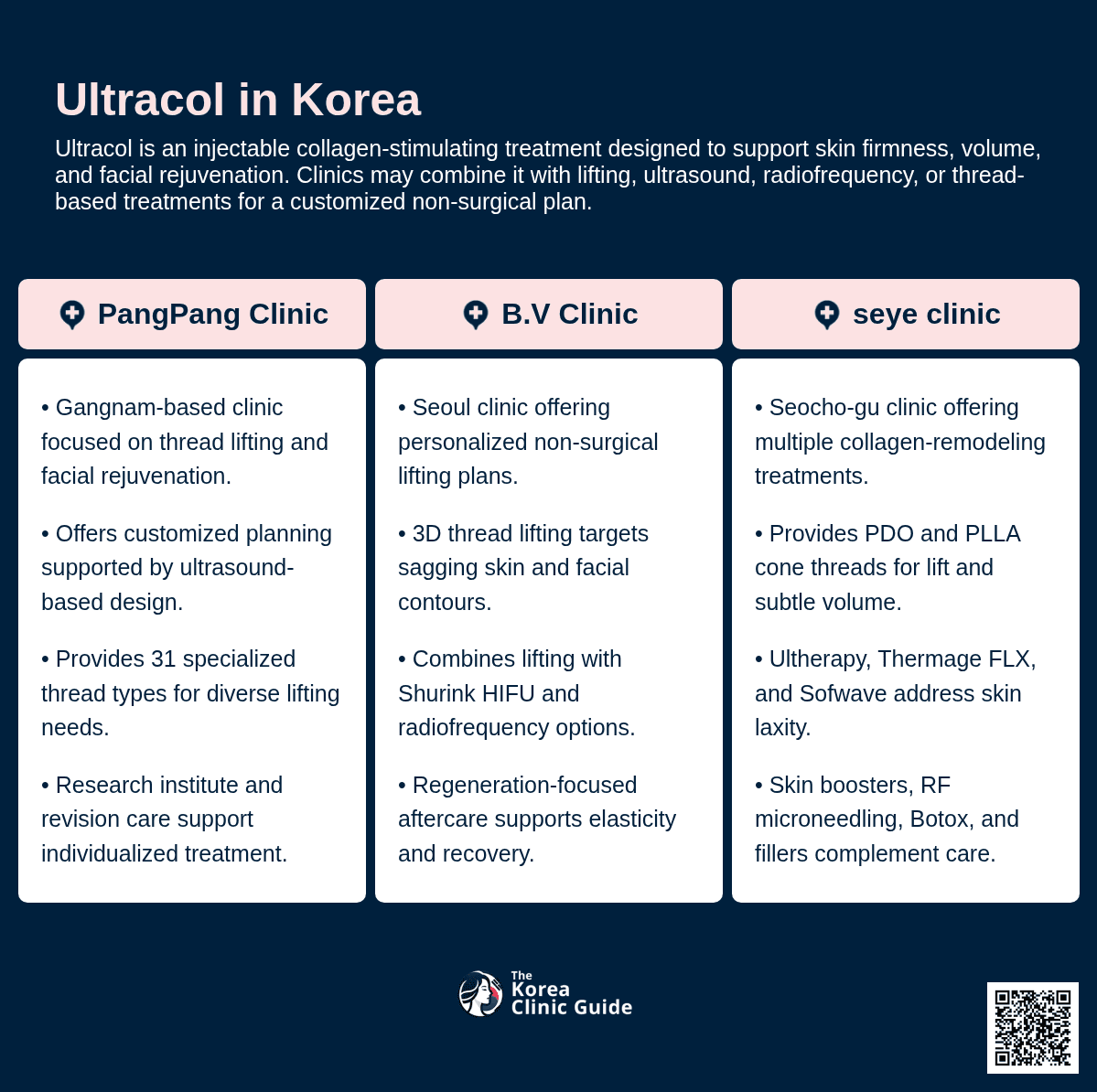
1. PangPang Clinic
If you are considering Ultracol alongside lifting-focused facial rejuvenation, you can expect a clinic whose practice and research are concentrated on thread lifting, with individualized planning that can draw on 31 specialized thread types and ultrasound-based pre-procedure design.
- URL: PangPang Clinic Website
- Location: Gangnam-gu, Seoul
- Lifting approach:
- Thread lifting may be used for the face, neck, breasts, buttocks, and abdomen.
- Available thread categories include barbed lifting threads, assist threads, elastic tightening threads, and volume threads for areas such as the under-eyes and cheeks.
- The clinic describes treatment times of about 30 minutes to one hour, with partial, Airnox, or sleep-anesthesia options.
- Planning and aftercare:
- Your plan is based on a doctor consultation, your concerns, and customized thread selection.
- Ultrasonic visual checks and pre-operative design are part of the stated thread-lifting system.
- A thread aftercare package is available to support and prolong treatment effects.
- Research and revision care:
- The clinic states that it established a Thread Lifting Research Institute and bases procedure development on research and clinical data.
- Its team participates in international beauty conferences through invited lectures and presentations.
- A dedicated revision service addresses unsatisfactory prior thread-lifting results and may incorporate fillers, Botox, or lasers.
2. B.V Clinic
If you are considering Ultracol in Korea, B.V Clinic may be relevant if you also want a personalized, non-surgical lifting plan: its services include 3D thread lifting aimed at lifting and firming sagging skin while supporting collagen stimulation, plus skin-tightening and post-treatment care options.
- URL: B.V Clinic Website
- Location: Seoul
- Lifting and tightening options:
- 3D thread lifting uses strategically placed threads to lift and firm sagging skin and refine facial contours.
- Full-face lifting is designed to address volume balance, forehead wrinkles, nasolabial folds, and facial asymmetry without surgery.
- Shurink HIFU, Potenza radiofrequency treatment, and Thor radiofrequency treatment are available for skin tightening and contour-focused care.
- Aftercare:
- Post-treatment care includes skin-regeneration management intended to minimize swelling and support elasticity.
- Aftercare may include nutritional skincare products and ultrasound treatments intended to support collagen production.
3. seye clinic
If you are exploring Ultracol alongside non-surgical facial rejuvenation, you can expect Seye Clinic to offer several lifting and collagen-remodeling modalities, including PDO thread lifting for an immediate tissue lift and longer-term collagen stimulation, as well as ultrasound and radiofrequency tightening options.
- URL: seye clinic Website
- Location: Seocho-gu, Seoul
- Lifting options:
- PDO barbed threads are used to reposition soft tissue for an immediate lift; results continue to improve over two to three months and often last around one year.
- Silhouette Soft PLLA cone threads provide lift and subtle volume for midface and jawline refinement through small entry points under local anesthesia.
- Ultherapy targets the SMAS layer with focused ultrasound for facial, jawline, and neck laxity, with collagen remodeling over two to three months.
- Thermage FLX and Sofwave are additional energy-based options for firming lax skin and refining facial contours.
- Complementary skin treatments:
- RF microneedling combines microneedles and radiofrequency to support skin tightening, pore refinement, and acne-scar improvement.
- Hyaluronic-acid skin boosters and Rejuran skin boosters are available for hydration, texture, and fine-line concerns.
- Micro-Botox and dermal fillers can be used for fine lines, contouring, and volume restoration.
Ultracol From Start to Finish
- Remote inquiry and consultation — Send clear, unfiltered facial photographs, medical history, prior filler and procedure records, allergy information, medication list, and treatment goals. Confirm whether an English-speaking consultation or video appointment is available.
- Eligibility and indication review — The injector assesses whether the concern is a nasolabial fold suitable for a gradual tissue-repair filler approach or whether facial descent, skeletal support loss, edema, or volume loss calls for a different treatment. Confirm the exact intended area is supported by the current product labeling.
- Consent and product verification — Review expected temporary effects, late nodules, infection, malposition, vascular compromise, and the limits of reversal. Request the current Korean IFU and English translation, then record the Ultracol 50, 100, or 200 model, lot number, and expiry date.
- Treatment-day assessment — The clinician takes photographs, examines the skin, checks for active inflammation or infection, finalizes the plan, and disinfects the treatment area. Anesthesia or sedation requirements are not established in the supplied product information; clarify the clinic’s pain-control plan in advance.
- Injection — The accessible English IFU reproduction describes reconstitution with sterile water and deep-dermal linear-threading injection. Its version and equivalence to the current Korean IFU are unverified, so the treating clinician must use the applicable authorized protocol rather than a patient-directed technique.
- Immediate review and discharge — The clinic checks the area for pain, asymmetry, color change, swelling, and bruising, then provides written aftercare and urgent-contact instructions. The manufacturer states treatment duration varies with the patient and treatment area.
- Early recovery in Korea — Stay locally overnight when feasible. Contact the clinic promptly for escalating pain, unusual color change, rapidly progressive swelling, or any concern instead of waiting until travel home.
- Overseas follow-up — Send scheduled photographs and attend video follow-up as directed. Seek urgent local medical assessment for vascular or neurologic warning signs, while also notifying the Korean clinic.
Alternatives to Ultracol
The best alternative depends on whether the priority is immediate contour, gradual skin-quality change, lifting of descended tissue, or a more pronounced surgical correction. Non-surgical injectables avoid surgical recovery but have different materials, durability, and complication-management limits; surgery addresses significant laxity more directly but requires substantially more downtime.
Hyaluronic-Acid Facial Filler
- Best fit — Consider facial filler for immediate, focal contour correction when potential enzymatic reversibility is an important priority.
- Tradeoff — HA filler still carries risks of vascular occlusion, infection, inflammatory reactions, asymmetry, and overcorrection.
Other Collagen Biostimulators
- Best fit — Sculptra, Juvelook collagen booster, and Radiesse filler are different particulate injectable categories for selected gradual collagen-stimulation goals.
- Tradeoff — Composition, dilution, injection planes, approved uses, duration, and management of nodules or malposition differ by product; current evidence does not show Ultracol is superior to these options.
PDO Thread Lift
- Best fit — A thread lift can be considered for selected tissue descent when a mechanical lifting approach is the actual goal.
- Tradeoff — Threads are not liquid PDO microspheres and have distinct placement, visibility, infection, irregularity, and recovery concerns.
Facelift Surgery
- Best fit — A face lift is more appropriate for substantial laxity, jowling, and facial descent when a patient wants a more pronounced correction.
- Tradeoff — Surgery involves anesthesia, incisions, a longer recovery period, and greater travel and follow-up demands.
How Can I Prepare for Ultracol?
- Medical disclosure — Provide a complete list of fillers, biostimulators, threads, implants, facial surgery, allergies, autoimmune conditions, bleeding history, liver disease, skin disease, herpes outbreaks, and current medicines before booking.
- Blood-thinning medicines and supplements — Report anticoagulants, antiplatelet medicines, aspirin, NSAIDs, and supplements associated with bruising risk. Do not stop prescribed medication independently; the prescribing clinician and injector must set an individualized plan because no Ultracol-specific stop period is established.
- Skin condition — Postpone treatment for acne flares, rash, open wounds, infection, significant inflammation, or recent aggressive procedures in the intended area.
- Sun and alcohol — Avoid arriving with sunburn or irritated skin. No product-specific evidence defines an exact alcohol restriction period; ask the clinic for its protocol and avoid heavy alcohol use around treatment if it conflicts with that plan.
- Travel logistics — Book flexible onward travel, stay within easy reach of the clinic overnight, and arrange a way to contact the clinic after hours. Bring a companion when language barriers, anxiety, extensive treatment, or difficult local transport could interfere with prompt care.
Travel note: Do not schedule Ultracol immediately before a wedding, professional appearance, or other event where visible swelling or bruising is unacceptable; allow at least 1–2 weeks.
Confirm fasting, makeup removal, transport, pain-control, massage, and all clinic-specific requirements with the treating doctor, whose instructions take precedence over general guidance.
Aftercare Advice
Protect the injection area and act quickly on unusual pain or color change; early recognition is critical after any facial filler procedure.
- Swelling and bruising — Use an indirect ice pack as directed. The accessible IFU lists swelling, pain, redness, and hematoma/bruising that usually resolve within 5–14 days.
- Massage — The third-party English IFU describes a “5-5-5” regimen: five minutes, five times daily, for five days. Do this only when the injector confirms it applies to the exact Korean-label product, treatment area, and technique used.
- Skin protection and activity — Keep skin care gentle, avoid makeup until needle-entry points have closed, and avoid strong pressure on the area unless instructed. Postpone strenuous exercise, sauna or steam exposure, heavy alcohol use, facial devices, microneedling, laser treatment, peels, and additional injectables until the injector clears them; avoid sun and UV lamps until redness and swelling settle, then use SPF 50 on exposed facial skin.
- Urgent warning signs — Seek emergency assessment immediately for severe or increasing pain, blanching, gray-blue or mottled skin, cold skin, blistering, rapidly progressive swelling, visual symptoms, severe headache, facial weakness, confusion, speech difficulty, or limb weakness. These can indicate vascular compromise, tissue injury, or a neurologic emergency.
- Results and follow-up — Do not judge collagen-related results in the first days. The small Ultracol 100 study assessed outcomes four weeks after a second treatment given four weeks after the first; this is an assessment timeline, not a guaranteed regimen or outcome.
Follow the treating doctor’s written instructions and contact the clinic promptly when anything appears wrong, including persistent swelling, a developing lump, increasing redness, drainage, fever, or delayed nodules.
Frequently Asked Questions
Related Blogs
Effective Juvelook Volume Filler for Lip Wrinkles Treatment in Korea
Discover how Korea leads in treating lip wrinkles—or perioral rhytides—with advanced procedures like Juvelook Volume Filler. Combining hyaluronic acid and PDLLA, this innovative Korean treatment offers immediate hydration and long-term collagen stimulation, effectively reducing smoker's lines and lipstick lines. Experience enhanced skin firmness, natural lip rejuvenation, and lasting results over
Updated: Nov 5, 2026
Effective Age Spots Removal with PicoSure Laser Treatment in Korea for Clearer Skin
Discover the benefits of PicoSure laser treatment for age spots (lentigines) in Korea. This advanced procedure effectively targets pigmentation and promotes skin rejuvenation, making Korea a top destination for affordable, high-quality medical tourism. Learn how PicoSure works, treatment benefits, costs, and what to expect—perfect for those seeking clear, even-toned skin in Korea.
Updated: Nov 5, 2026
Uneven Skin Texture Treatment with Potenza in Korea: Advanced Solutions for Smooth Skin
Discover how Korea leads the world in skincare with advanced treatments like Potenza RF Microneedling. Perfect for addressing uneven skin texture caused by aging, acne scars, or Keratosis Pilaris, this innovative procedure stimulates collagen for smoother, firmer skin. Korea’s top clinics offer personalized care with cutting-edge technology and expert practitioners, making it a premier destination
Updated: Nov 4, 2026
Dehydrated Lips Treatment with Hydro Injection in Korea: Effective Solutions for Moisturizing and Rejuvenation
Discover the benefits of Hydro Injection in Korea, a leading solution for dehydrated lips caused by cheilitis and related conditions. This minimally invasive procedure uses hyaluronic acid-based treatments to deeply hydrate, smooth, and rejuvenate lips, addressing issues such as chapped lips and fine lines. Korea’s advanced clinics offer expert care, streamlined processes, and cost-effective optio
Updated: Nov 4, 2026
Clinics offering Ultracol

SH Clinic: Comprehensive Women's, Men's & Couples' Health Services in Korea
Sinsa

PangPang Clinic: Korea's Premier Thread Lifting and Skin Rejuvenation Specialist in Gangnam, Seoul
Sinsa

Seojin Plastic Surgery Clinic Korea: Pioneering Advanced Cosmetic Procedures for Personalized Aesthetic Transformation
Apgujeong
B.V Clinic Korea: Advanced Aesthetic Treatments for Natural Beauty Enhancement & Rejuvenation
Sinnonhyeon Station