
Medical Tourism Blog
Midface Sagging Solutions: Endotine Lift Procedure in Korea for Facial Rejuvenation

Table of contents
- The Endotine Lift: A Detailed Clinical and Procedural Review
- Navigating the Medical Tourism Journey in South Korea
- Which Are the Best Clinics in Korea for Midface Sagging?
- A Comparative Financial Analysis for the Medical Tourist
- Patient Experiences and Expected Outcomes
- Conclusion
- References
Considering treatment in Korea? Everything you need to know e.g. — how to avoid scams, visas, interpreters, recovery tips — in our Medical Tourism Master Guide. Plan with confidence in minutes, not weeks!
The midface, stretching from the lower eyelids to the upper lip (and including the cheeks and nose), is an area that undergoes significant changes with age. Over time, the tissues here tend to shift downward and lose fullness, leading to what clinicians refer to as midface sagging or "droop of mid-face tissues." Unlike "sunken cheeks," which is mostly about fat loss, midface sagging is a more complex process involving skin, fat, and bone.
Aging is the primary cause, as production of collagen and elastin (the proteins that keep skin firm and elastic) slows as early as your late 20s. Skin loses support, and both deep and superficial facial fat pads shrink and start to descend, pulled by gravity, which deepens folds around the mouth and causes cheeks to droop. Concurrently, facial bones subtly erode, reducing the skeletal structure that props up the overlying tissues.
Apart from aging and gravity, other factors like smoking, sun exposure, rapid weight loss, poor nutrition, stress, and dehydration can all make midface sagging worse.
The Lexicon of Midface Droop: Pseudonyms and Related Terms
Navigating the terminology for midface concerns can be confusing. The term "broad midface droop affecting cheek prominence," as sometimes used, can be ambiguous; "droop" refers to the sag, while "prominence" implies a structural aspect. "Midface ptosis," "saggy cheeks," "jowls," and "droop of mid-face tissues" all refer to similar sagging conditions. However, it's essential to distinguish midface sagging (soft tissue issue) from conditions like "Hyperplasia of midface" or "Malar prominence," which are about having prominent cheekbones or an overgrown midface—these are best addressed by bony reduction procedures, not lifts.
The Endotine Lift is a lifting treatment for midface sagging and not suitable for reducing cheekbone prominence. Accurate diagnosis is necessary for proper treatment planning.
| Medical Term | Common Pseudonyms/Related Terms |
|---|---|
| Hyperplasia of midface | Big midface, Hypertrophy of midface, Large midface, Midface hyperplasia, Midfacial excess, Midfacial prominence, Overgrowth of the midface |
| Malar prominence | Cheekbone, Zygomatic prominence |
| Cheek sagging | Saggy cheeks, Droop of mid-face tissues, Jowls |
| Blepharoptosis | Ptosis, Drooping eyelid |
Non-Surgical and Surgical Alternatives to the Endotine Lift
Treating midface sagging isn't one-size-fits-all. For mild to moderate cases, non-surgical options like dermal fillers (hyaluronic acid products such as Juvederm Voluma) can quickly boost volume and stimulate collagen production. Technologies like radiofrequency (RF) or ultrasound therapy (including Ultherapy or Oligio) use controlled energy to tighten the skin by encouraging new collagen. Thread lifts can give a modest lift with minimal downtime.
Surgical options become essential for more pronounced sagging. The Endotine Lift uses a small bioabsorbable device for a minimally invasive surgical solution. More comprehensive surgeries include traditional facelifts (targeting the lower face and neck) and the deep plane facelift (lifting deeper tissues for dramatic change). A midface lift, however, targets cheek elevation specifically.
The Endotine Lift: A Detailed Clinical and Procedural Review
The Endotine Device: A Bioabsorbable Innovation
The Endotine Lift uses a unique, bioabsorbable implant crafted from poly-lactic acid (a dissolvable material also used in some sutures). This implant features several angled tines for multipoint fixation, which evenly spreads lifting tension across a broader area of the facial tissues. In a midface lift, the device gets attached to the cheekbone, holding repositioned tissues securely atop these tines.
Importantly, the Endotine device serves only as a temporary fixture—it dissolves within about a year. During this period, as the device supports the tissues, your body naturally builds scar tissue in the area, which becomes the long-term scaffold to hold the lifted contours. No second surgery for device removal is needed.
A Step-by-Step Surgical Breakdown
The Endotine Midface Lift is a deep-plane, minimally invasive surgery carried out in the subperiosteal layer (the deepest soft tissue directly atop the facial bones).
After giving anesthesia (either local with sedation or general), the surgeon makes small, hidden incisions—usually behind the hairline at the temples or inside the mouth above the upper lip. Using delicate, endoscopic tools, the tissues are gently released from the underlying bone. The Endotine device is then introduced, positioned, and anchored—lifting the cheek tissues upward and suturing the leash for stability. The incisions are then closed.
The Recovery Timeline
Recovery from the Endotine Lift is generally faster and more manageable than a traditional facelift.
- Immediate Post-Op (Days 1–7): Expect mild swelling, bruising, and tightness. Elevate your head, use cold packs, and possibly wear a face band around the clock.
- Early Recovery (Weeks 1–2): Swelling and bruising lessen. Most return to light activity and work in 10–14 days. Avoid strenuous exertion for at least two weeks.
- Full Recovery (Months 3–6): Final results develop as swelling resolves and tissue settles. Some numbness may linger but typically fades.
Risks and Potential Complications
Every surgery comes with some risks. Possible complications from the Endotine Lift include infection, hematoma, nerve injury, and scarring.
Risks specific to the Endotine device include:
- Palpability or tenderness, especially in patients with thin skin (often temporary).
- Asymmetry, like uneven cheeks.
- Nerve injury (usually temporary numbness).
- Device dislocation (rare).
Navigating the Medical Tourism Journey in South Korea
Why South Korea?
South Korea has become a hotspot for cosmetic surgery, recognized for its exceptionally skilled surgeons and modern clinics. The nation boasts strong regulations and certifications (like those from the Korean Society of Plastic and Reconstructive Surgeons or KHIDI), and often, clinics offer all-inclusive packages—rolling consultation, procedure, accommodation, translation assistance, and aftercare into a single price.
A Patient's Guide to South Korea: A Step-by-Step Process
If you’re considering an Endotine Lift in South Korea, here’s how the medical tourism process usually unfolds:
- Initial Research & Consultation (2-4 weeks prior): Investigate clinics and procedures. Using a licensed medical tourism agency can streamline doctor selection, logistics, and language help. Online consultations occur at this stage.
- Securing a Visa & Booking Travel (4-6 weeks prior): Visa requirements depend on your country. Book flights and accommodation near your clinic, and check if airport transfers are included.
- Onsite Evaluation & Procedure Day: Meet your surgeon in person for final planning and pre-op checks. Surgery is conducted under appropriate anesthesia.
- Recovery Period in Korea (10-14 days): Stay for recovery, bandage removal, swelling checks, and follow-ups.
- Discharge & Return Home: After clearance, get your medical records and aftercare guidelines. Confirm remote follow-up options and revision policies.
| Stage | Activities & Timeline |
|---|---|
| Initial Research & Consultation | Research clinics and procedures; conduct online video consultations; receive initial quotes. (2-4 weeks prior to travel) |
| Securing Visa & Travel | Apply for a visa (C-3 or G-1); book flights and accommodation near the clinic. (4-6 weeks prior to travel) |
| Onsite Evaluation & Procedure | In-person consultation to finalize plans; undergo pre-op health checks; have surgery. (Upon arrival in Korea) |
| Recovery in Korea | Initial recovery period for swelling reduction, bandage removal, and follow-up visits. (10-14 days post-op) |
| Discharge & Return Home | Receive discharge documents and aftercare instructions; confirm follow-up care and revision policy. (After surgeon clearance) |
Which Are the Best Clinics in Korea for Midface Sagging?
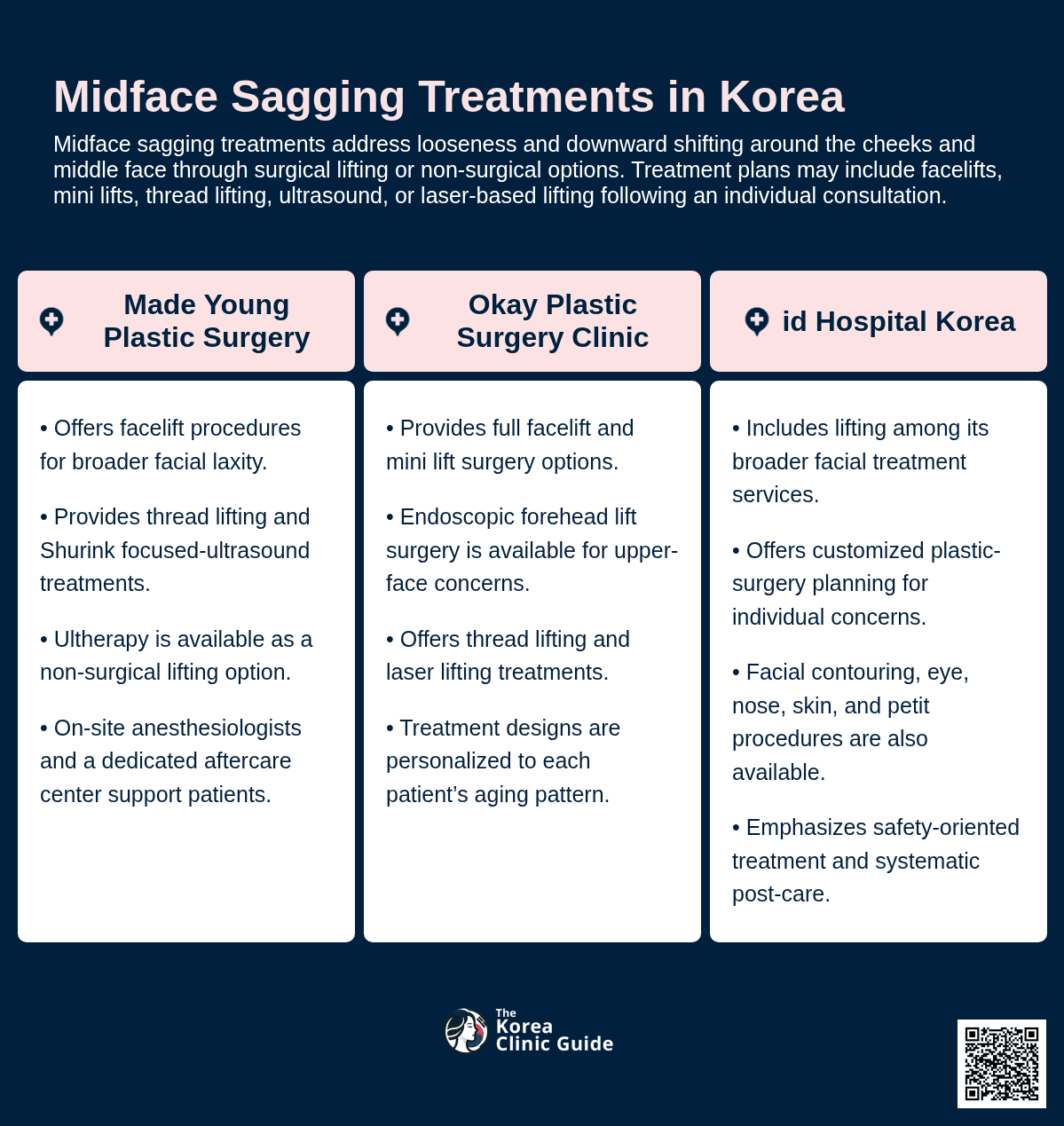
Listed below are some of the best clinics in Korea for midface sagging.
1. Made Young Plastic Surgery
For midface sagging that occurs with broader facial laxity, you can discuss a surgical facelift or non-surgical lifting approach at Made Young Plastic Surgery, with your plan informed by direct consultation and diagnosis from the medical team. The clinic also offers thread lifting and ultrasound-based lifting options when a non-surgical approach is being considered.
- URL: Made Young Plastic Surgery Website
- Location: Seocho-gu, Seoul
- Facial lifting options:
- Facelift procedures are available for facial aging concerns.
- Thread lifting, Shurink focused-ultrasound treatment, and Ultherapy are listed among non-surgical lifting options.
- Forehead and sub-brow lifting are available for upper-face sagging and wrinkle concerns.
- Procedure support:
- Full-time board-certified anesthesiologists are on site.
- The clinic describes one-to-one anesthesiologist monitoring and a cross-check system for emergencies.
- A dedicated aftercare center provides post-procedure care.
2. Okay Plastic Surgery Clinic
You may consider Okay Plastic Surgery Clinic if you want your midface-sagging concerns assessed as part of your overall aging pattern, with options ranging from a full facelift or mini lift to thread lifting and laser lifting. The clinic describes personalized lifting designs and may combine laser lifting with the selected approach.
- URL: Okay Plastic Surgery Clinic Website
- Location: Gangnam-gu, Seoul
- Lifting options:
- Available approaches include full facelift surgery, mini lift surgery, endoscopic forehead lift surgery, thread lifting, and laser lifting.
- Treatment design is described as personalized to your aging pattern.
3. id Hospital Korea
You may consider id Hospital Korea for midface sagging if you want to explore lifting within a broader facial-treatment plan, supported by customized plastic-surgery planning, safety-oriented care, and systematic post-care. Its listed services include lifting alongside facial contouring and eye and nose procedures, allowing discussion of related facial concerns in one setting.
- URL: id Hospital Korea Website
- Location: Gangnam-gu, Seoul
- Relevant services:
- Lifting is listed among the hospital's treatment areas.
- Facial contouring, eye and nose plastic surgery, skin-clinic care, and petit plastic surgery are also listed.
- Care approach: The hospital describes customized plastic surgery, safety-oriented treatment, and systematic post-care.
A Comparative Financial Analysis for the Medical Tourist
Endotine Lift Costs in South Korea
Facial surgeries in South Korea vary in price, but for the Endotine Midface Lift, you can expect about 7,500,000 KRW or $5,500 USD. General facelifts range from 7,000,000 to 15,000,000 KRW ($5,100–$10,900 USD). Typically, clinics bundle in consultation, anesthesia, operating room fees, post-op care, translations, and sometimes transport, making the process smoother for international patients.
International Price Comparison
Simply comparing cosmetic surgery sticker prices isn’t the full story. While Korea is seen as affordable, sometimes the surgery cost equals or even exceeds prices in the US (Korean facelift avg: $9,500 USD; US avg: $7,048 USD). The savings come in the bundled, all-inclusive nature of Korean medical tourism. For example, a Korean full surgery package can run $4,000–$10,500 USD—often covering everything from arrival to departure. In the US, the headline fee rarely includes post-op care, anesthesia, or facility fees.
| Procedure Type | South Korea (USD) | United States (USD) | Other Countries (USD) |
|---|---|---|---|
| Endotine Midface Lift | ~$5,500 | Not specified | Not specified |
| Facelift (general) | ~$5,100 - $10,900 | ~$7,000 - $15,000 | Not specified |
| Forehead Lift | ~$4,418 (average) | ~$3,000 - $8,000 | Turkey: $4,200+; Mexico: $250-$3,000 |
| Mini Facelift | ~$2,000 - $6,000 | Not specified | Not specified |
| Thread Lift | Not specified | Not specified | Mexico: $250 - $750; Turkey: $399-$900 |
| Oligio Lifting (RF) | ~$380 - $1,030 | Not specified | Thailand: ~$400 - $700 |
| Thermage (RF) | Not specified | ~$700 - $6,000 | Turkey: $4,200+ |
| Ultherapy (Ultrasound) | Not specified | ~$950 - $5,300 | Turkey: $3,000+ |
Beyond the Sticker Price: Hidden Costs
Remember to factor in airfare, extra accommodation, and day-to-day living costs that may not be included in your package. Some clinics may also have slightly higher prices for foreign patients, but reputable agencies offer transparency and help keep pricing fair.
Patient Experiences and Expected Outcomes
Real-World Results: A Synthesis of Patient Testimonials
Feedback post-Endotine Midface Lift is generally positive, with over 95% of patients in some studies reporting satisfaction. Many are pleased with the restored cheek position and lifted mouth corners. However, some people experience issues: a few say the results look "stretched" or "unnatural," while others report persistent swelling, asymmetry, or discomfort from the device. The take-home message is that, while the majority are happy, individual outcomes depend on expectations, anatomy, and healing.
Longevity and Realistic Expectations
Results from an Endotine Lift aren’t permanent, but they do last for several years. The device dissolves within about a year, with scar tissue taking over. For brow lifts with the Endotine device, results may endure for 5–10 years, but genetics, health, and lifestyle all impact how long the improvements persist. Using sunscreen and maintaining a healthy lifestyle helps prolong results. Some natural settling will always occur over time.
The Verdict: Efficacy and Patient Satisfaction
The Endotine device brings a safe, effective, minimally invasive avenue for lifting the midface and brows, offering the benefit of multipoint fixation, quick recovery, and no visible external scars for most. But due diligence is vital—understanding possible complications, setting realistic expectations, and choosing the right surgeon make all the difference in outcome and satisfaction.
Conclusion
The Endotine Lift offers a minimally invasive surgical solution for midface sagging, utilizing a temporary, bioabsorbable device. South Korea provides comprehensive, bundled packages, making it an attractive destination for international patients considering this procedure. While overall satisfaction rates are high, some individuals do experience complications or disappointment, highlighting the importance of realistic expectations and thorough research. Ultimately, successful outcomes depend on accurate diagnosis, experienced surgeons, and patient commitment to proper preparation and aftercare.
References
1, 2, 3, 4, 5, 6, 7, 8, 9, 10, 11, 12, 13, 14, 15, 16, 17, 18, 19, 20, 21, 22, 23, 24, 25, 26, 27, 28, 29, 30, 31, 32, 33, 34, 35, 36, 37, 38, 39, 40, 41, 42, 43, 44, 45, 46, 47, 48, 49
Frequently Asked Questions
Related Blogs
Renuvion in Korea: Methods, Recovery, Risks, and Travel Planning
Renuvion uses helium-plasma radiofrequency energy beneath the skin, alone or after liposuction, to address mild-to-moderate localized laxity; Dermal resurfacing treats surface wrinkles with an external ablative handpiece. The article covers candidacy, alternatives, preparation, recovery, risks, Korea travel planning, and the need for surgeon clearance before flying.
Updated: Oct 13, 2026
Temporal Lift in Korea: Methods, Recovery, Risks and Travel Planning
A temporal lift elevates the outer brow through temporal scalp incisions, using open, subcutaneous, endoscopic, or combined techniques chosen for brow position, hairline, and eyelid anatomy. The article covers candidate screening, Korea facility and surgeon verification, a 10–14-day stay, recovery restrictions, aftercare, warning signs, and alternatives such as forehead lift, blepharoplasty, and p
Updated: Oct 13, 2026
Premature aging face treatment in Korea: Face Lift options for younger-looking skin
Early onset facial laxity and wrinkles are rising among 30s–40s. Our Korea medical tourism guide explains rhytids and how a rhytidectomy (face lift) can refresh the lower face and neck. Explore options: Deep Plane Facelift, SMAS Facelift, Mini Facelift, Lower Facelift and Neck Lift, plus non-surgical adjuncts. Learn candidacy, recovery timelines, costs, certifications, and tips for planning surger
Updated: Oct 12, 2026
Brow Ptosis in Korea: Forehead Lift and Subbrow Lift Treatment Options
Thinking about Brow Ptosis surgery in Korea? This expert guide explains diagnosis, functional vs cosmetic concerns, and compares a Forehead Lift with a Subbrow Lift—indications, scars, recovery, and costs. It maps the South Korea medical tourism journey (planning, visas, surgery day, follow-ups), highlights surgeon credentials and safety, and shares real outcomes, risks, and patient stories so you
Updated: Oct 12, 2026
Clinics offering Endotine Lift

Made Young Plastic Surgery: Rejuvenating Aesthetic Excellence in Korea for Face Lifts, Contouring and More
Gangnam Station

Okay Plastic Surgery Clinic in Korea: Comprehensive Aesthetic Procedures with Sincerity and Care
Cheongdam
ID Hospital - Main Branch in Korea: Specializing in Safe & Customized Facial Plastic Surgery and Post-Care Services
Sinsa
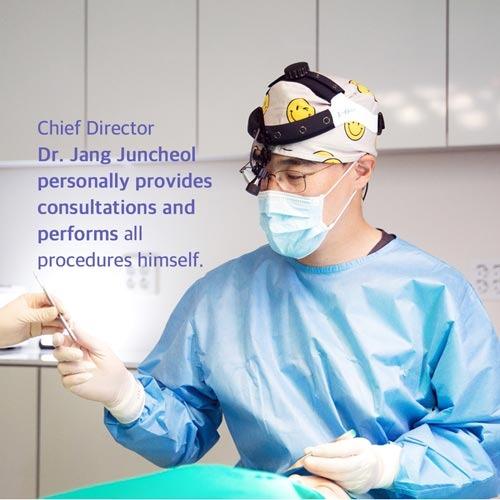
GGN Plastic Surgery Korea: Expert Cosmetic Procedures for Eye, Face, and Non-Surgical Enhancements in Gangnam Station
Gangnam Station