Medical Tourism Blog
Renuvion in Korea: Methods, Recovery, Risks, and Travel Planning
Table of contents
- What Is Renuvion?
- Best Clinics in Korea for Renuvion
- Getting Renuvion in Korea
- Cost of Renuvion in Korea
- Alternatives to Renuvion
- Conclusion
Considering treatment in Korea? Everything you need to know e.g. — how to avoid scams, visas, interpreters, recovery tips — in our Medical Tourism Master Guide. Plan with confidence in minutes, not weeks!
Have you ever wished you could tighten loose skin without committing to a full surgical lift? That is exactly why Renuvion is drawing growing interest in Korea, where patients often look for treatments that offer noticeable contour improvement with smaller incisions and shorter recovery. Using a combination of radiofrequency energy and helium plasma, Renuvion is positioned as a middle-ground option between noninvasive tightening and traditional excisional surgery. This article explains how it works, who it may suit, what it can cost in Korea, and how it compares with other available treatments.
Renuvion is gaining attention in Korea as a minimally invasive skin-tightening treatment, and this article will provide a clear overview of what it is, how it works, and why some patients consider it for improving skin laxity. It will also explain what to expect when getting Renuvion in Korea, including who may be a suitable candidate for the procedure, before looking at the typical cost of Renuvion in Korea and the factors that can affect pricing. Finally, the article will compare Renuvion with other treatment options so readers can better understand the available alternatives and decide which approach may best match their goals.
What Is Renuvion?
Renuvion is a minimally invasive cosmetic procedure designed to tighten skin and improve soft-tissue laxity beneath the surface. It uses a combination of radiofrequency (RF) energy and helium plasma to deliver controlled heat to the undersurface of the skin and the fibroseptal network, which is the supportive connective tissue structure beneath the skin. By heating these tissues in a precise way, the procedure aims to cause immediate tissue contraction and stimulate the body’s natural healing response, including new collagen production over time.
Renuvion has also been marketed under the name J-Plasma in some settings. In aesthetic medicine, it is commonly used to address mild to moderate skin laxity, especially in areas where patients want more tightening than liposuction alone can provide but may not yet want, or need, a more extensive surgical excision procedure such as a tummy tuck or arm lift.
How Renuvion works
The technology behind Renuvion is based on the interaction between RF energy and helium gas.
- Radiofrequency energy generates heat in tissue.
- Helium gas is energized into a plasma state.
- This helium plasma helps deliver focused heat while also allowing very rapid cooling of surrounding tissue.
This combination is important because the treatment is intended to create a controlled thermal effect under the skin while limiting the spread of heat to nearby structures. In practical terms, the device is inserted through very small incisions, and the surgeon passes it beneath the skin to treat specific areas.
The thermal effect has two major goals:
-
Immediate contraction of collagen-rich tissue
- Collagen fibers shrink when exposed to the right amount of heat.
- This can produce an early tightening effect.
-
Longer-term remodeling
- The healing response triggered by the treatment can stimulate the formation of new collagen and elastin.
- Over the following weeks to months, this remodeling may further improve firmness and contour.
What the procedure is used for
Renuvion is most often used for skin tightening and contour refinement. It is not primarily a fat-removal procedure, although it is frequently combined with liposuction.
Common treatment areas include:
- Abdomen
- Flanks
- Arms
- Inner or outer thighs
- Back
- Bra-line area
- Neck and jawline
- Lower face in selected cases
In many practices, Renuvion is used when a patient has:
- Loose or crepey skin after weight loss
- Mild to moderate skin laxity related to aging
- Residual looseness after liposuction
- Soft tissue drooping that is not severe enough to clearly require excisional surgery
Renuvion and liposuction: how they differ
Renuvion and liposuction are often discussed together, but they are not the same procedure.
Liposuction
- Removes unwanted fat
- Improves body contour by reducing volume
- Does not directly tighten skin in a reliable way
Renuvion
- Targets tissue tightening beneath the skin
- Aims to improve skin contraction and firmness
- Does not replace fat removal when excess fat is the main issue
Because of this difference, many patients undergo liposuction first, followed by Renuvion in the same session to address skin laxity after fat has been reduced. This combination can be especially useful in areas where skin quality is borderline and where liposuction alone might leave looseness more noticeable.
Who may be a good candidate
Renuvion is generally considered for patients who want improvement in skin laxity but are not ideal candidates for, or do not want, a larger excisional surgery. A suitable candidate often has:
- Mild to moderate loose skin
- Reasonably good overall skin quality
- Stable body weight
- Good general health
- Realistic expectations about results
People who often benefit the most are those whose concern is early or moderate looseness, not severe excess hanging skin. If there is a large amount of redundant skin, Renuvion may not provide enough improvement on its own, and surgical skin removal may still be the more effective option.
Who may not be an ideal candidate
A patient may not be the best fit for Renuvion if they have:
- Severe skin laxity or substantial hanging skin
- Unrealistic expectations of “surgical-level” lifting without scars
- Certain medical conditions that increase surgical risk
- Poor wound healing capacity
- Active infection in the treatment area
- Significant smoking history or inability to stop smoking around the time of surgery
- Uncontrolled chronic illness
Because Renuvion uses thermal energy under the skin, proper patient selection is especially important. The degree of laxity, skin thickness, fat distribution, and the presence of prior scarring or previous procedures can all affect whether it is appropriate.
What happens during the procedure
The exact technique varies depending on the area being treated, whether liposuction is also being performed, and the surgeon’s approach. In general, the procedure includes several steps:
1. Consultation and planning
Before treatment, the surgeon evaluates:
- The amount and location of skin laxity
- Skin thickness and elasticity
- Fat deposits
- Body contour goals
- Past surgeries and medical history
Treatment zones are marked while the patient is standing so the physician can map where tightening is needed.
2. Anesthesia
Renuvion may be performed under:
- Local anesthesia with sedation
- Tumescent anesthesia
- General anesthesia
The choice depends on the treatment area, the extent of the procedure, and whether it is combined with liposuction or another surgery.
3. Small access incisions
Tiny incisions are made to allow insertion of the device beneath the skin. These incisions are usually much smaller than those required for excisional surgery.
4. Subdermal treatment
The Renuvion handpiece is passed under the skin. As it moves through the treatment plane, it delivers helium plasma energized by RF energy to the tissue. The goal is to heat the fibrous structures beneath the skin enough to create contraction without over-treating the area.
If liposuction is being performed, it often comes before the Renuvion portion so that the tissue plane is already accessed and contouring can be paired with tightening.
5. Completion and dressing
After treatment, the incisions may be closed with sutures or left to drain depending on the surgeon’s technique and whether liposuction was performed. Compression garments are frequently used to help reduce swelling and support the healing tissues.
What patients typically feel and see after treatment
Immediately after Renuvion, it is common to experience:
- Swelling
- Bruising
- Tightness
- Mild to moderate discomfort
- Temporary numbness or altered sensation
The area often feels firm early in recovery because of swelling and tissue contraction. Some improvement may be visible relatively soon, but the final result usually evolves over time as swelling subsides and collagen remodeling occurs.
Recovery and downtime
Recovery depends on:
- The size of the treatment area
- Whether liposuction was performed
- The depth and extent of treatment
- The patient’s healing response
In general:
- Light activities may resume within a few days in some cases
- More strenuous exercise is usually postponed for several weeks
- Compression garments may be recommended for a period of time
- Swelling can persist for weeks
- Tissue remodeling may continue for several months
Neck or smaller body areas may involve shorter downtime than larger multi-area body contouring sessions.
When results appear
Renuvion results usually develop in stages:
Immediate phase
Some tissue contraction can occur during the procedure itself, so there may be an early tightening effect.
Early recovery phase
In the first few weeks, swelling begins to improve and contour changes may become easier to appreciate.
Remodeling phase
Over several months, collagen production and tissue remodeling may continue, which can gradually improve tightness and skin texture.
Patients should understand that results are not always instant or dramatic in the same way as surgical skin excision. The best outcomes tend to be seen in properly selected patients with moderate laxity rather than severe excess skin.
How long results may last
The longevity of results depends on several factors:
- Age
- Skin quality
- Degree of laxity before treatment
- Weight stability
- Lifestyle factors such as smoking and sun damage
- Genetics
Renuvion does not stop the natural aging process. However, if the patient maintains a stable weight and healthy skin habits, the improvement can be long-lasting. Significant weight fluctuations or ongoing skin aging may gradually reduce the visible benefit over time.
Potential benefits of Renuvion
In the right patient, potential advantages may include:
- Improved skin tightening without large excisional scars
- Small access incisions rather than long surgical incisions
- Enhanced results when combined with liposuction
- Better contour definition in areas with mild to moderate looseness
- Shorter recovery than more extensive skin removal surgery in selected cases
It is often discussed as a middle-ground option between noninvasive skin tightening treatments and full surgical lifting procedures.
Limitations of the procedure
Renuvion can be helpful, but it has limitations that patients should understand clearly.
- It is not a substitute for surgical excision when skin excess is severe.
- It does not remove large amounts of fat on its own.
- Results can vary depending on skin quality and treatment area.
- Some patients may need additional procedures to achieve their goals.
- The improvement may be meaningful but still more subtle than a formal lift or tuck.
This is one of the most important points in patient education: Renuvion may improve laxity, but it does not create the same degree of lifting as procedures that physically remove extra skin.
Risks and possible complications
As with any medical or cosmetic procedure, Renuvion carries risks. These can include:
- Swelling
- Bruising
- Pain or discomfort
- Seroma, which is a collection of fluid
- Infection
- Changes in skin sensation
- Temporary numbness
- Contour irregularities
- Burns or thermal injury
- Prolonged healing
- Scarring at incision sites
- Asymmetry
- Need for revision treatment
Because the technology uses heat under the skin, one of the most serious concerns is thermal injury if the device is not used carefully. Proper technique, appropriate energy settings, and experienced surgical judgment are essential.
Why physician experience matters
Renuvion is operator-dependent. Outcomes are influenced not only by the device itself but also by:
- Depth of treatment
- Number of passes
- Energy settings
- Understanding of anatomy
- Patient selection
- Combination with other procedures
An experienced physician evaluates whether the expected tightening is likely to be enough for the patient’s anatomy and goals. This is especially important in areas such as the neck or arms, where contour changes can be visible and over- or under-treatment may affect the aesthetic result.
Renuvion compared with noninvasive skin tightening
Renuvion is more invasive than treatments performed entirely on top of the skin, such as certain RF, ultrasound, or laser tightening procedures. However, it is generally less invasive than open surgical lifting procedures.
Compared with noninvasive treatments, Renuvion may offer:
- Stronger tightening potential
- More direct treatment of the subdermal tissue
- Better contour refinement when paired with liposuction
Compared with surgical excision procedures, it may offer:
- Smaller incisions
- Less scarring
- Reduced downtime in selected cases
- Less dramatic but sometimes sufficient improvement
This positioning is why it appeals to patients seeking more than a surface-level treatment but less than a traditional excisional operation.
Common treatment areas in more detail
Abdomen
The abdomen is one of the most common areas treated with Renuvion, especially after liposuction. It may be useful for patients with loose skin after pregnancy or weight loss when the laxity is noticeable but not extreme. If there is muscle separation or significant hanging skin, however, a tummy tuck may still be more appropriate.
Arms
The upper arms are a common area of concern because loose skin can become visible even with small movements. Renuvion may help tighten mild to moderate laxity. In more advanced cases, a brachioplasty, or arm lift, may provide a more reliable result.
Neck and jawline
In selected patients, Renuvion can be used under the chin and along the neck to improve jawline definition and reduce mild neck laxity. It is sometimes paired with liposuction under the chin. Patients with heavy platysmal banding or more advanced sagging may require other neck-lifting procedures for a stronger result.
Thighs
The inner thighs are prone to skin looseness, especially after weight changes. Renuvion may improve mild laxity, but the thigh area can be challenging because of gravity, tissue characteristics, and healing patterns.
What to discuss during a consultation
Anyone considering Renuvion should ask detailed questions during consultation, such as:
- Am I a good candidate for Renuvion specifically?
- Would liposuction, Renuvion, or a surgical lift best match my goals?
- How much tightening is realistically expected in my case?
- Where will the incisions be placed?
- What type of anesthesia will be used?
- What is the expected downtime?
- What are the risks in the area I want treated?
- How many similar procedures has the physician performed?
- If my skin laxity is too severe, what alternatives should I consider?
These questions help clarify whether the procedure aligns with the patient’s anatomy and expectations rather than simply focusing on the appeal of a newer technology.
Regulatory and practice considerations
The way Renuvion is marketed and offered can differ by country, clinic, and physician specialty. In Korea, as in other regions, patients should verify:
- Whether the treatment is being used for an appropriate indication
- The physician’s training and experience
- The clinic’s safety standards
- The details of postoperative follow-up
Patients should also be careful about claims that suggest Renuvion can replace all traditional lifting procedures. While it can be a valuable tool in body contouring and skin tightening, its effectiveness depends heavily on the specific clinical situation.
Key terms patients may hear
When researching Renuvion, patients may come across related terms. Understanding them can make consultations easier:
- Helium plasma: Helium gas that has been energized to carry RF energy in a controlled way
- Subdermal: Beneath the skin
- Fibroseptal network: Connective tissue framework under the skin that helps support skin and fat
- Collagen remodeling: The process of healing and rebuilding collagen over time after controlled tissue injury
- Skin laxity: Looseness or sagging of the skin
- Body contouring: Procedures designed to improve shape and definition of the body
What makes Renuvion distinct
What makes Renuvion different from many other tightening methods is that it treats the tissue from underneath the skin, rather than only from the surface. This allows energy to be applied directly to the structural layers involved in laxity. That is why it is frequently positioned as an adjunct to liposuction and a bridge between noninvasive treatments and more extensive surgery.
For patients with the right anatomy and expectations, the procedure can offer meaningful improvement in firmness and contour with relatively small incisions. For patients with more advanced looseness, however, it is best understood as one tool among several, rather than a universal replacement for traditional lifting surgery.
Best Clinics in Korea for Renuvion
Listed below are the best clinics in Korea for renuvion:
| Clinic Name | Key Features | Special Techniques |
|---|---|---|
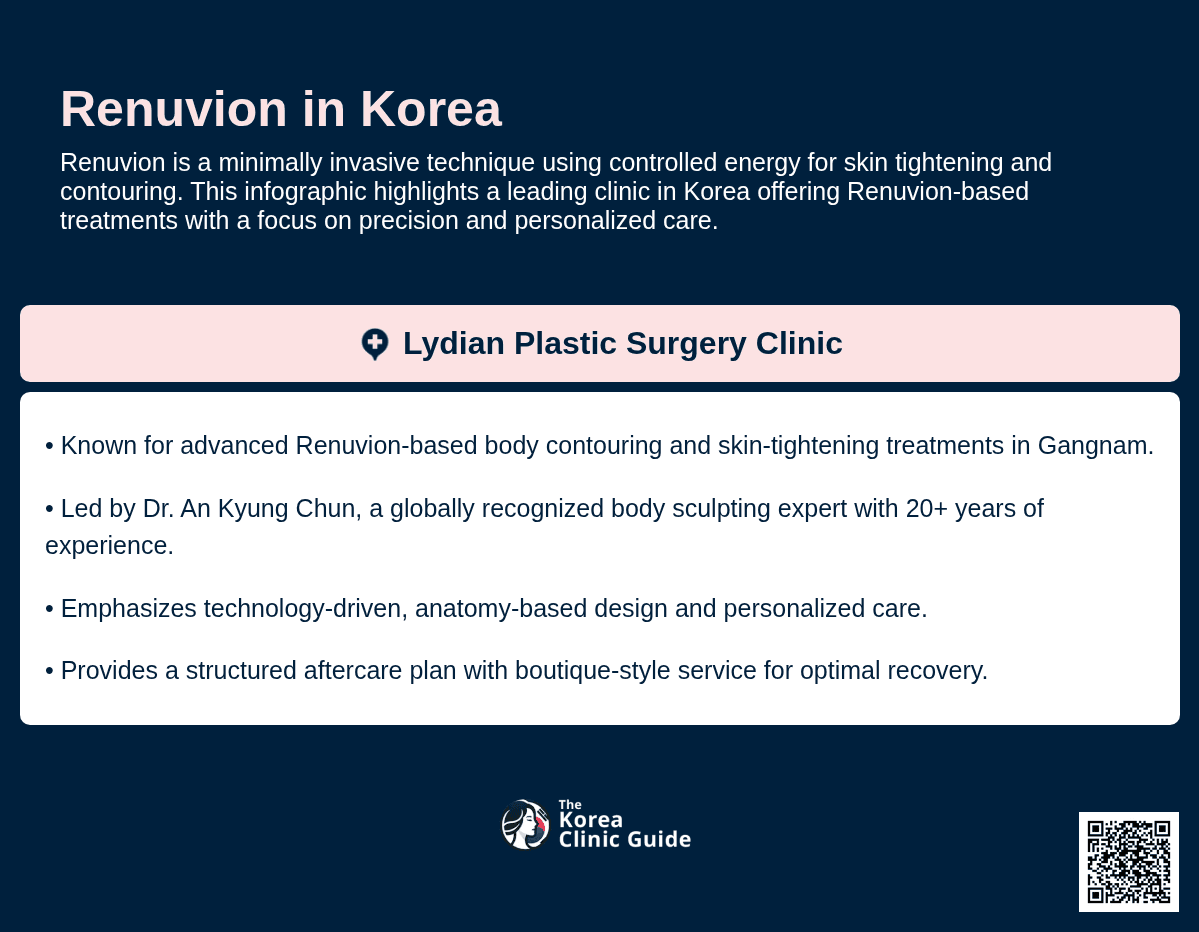
| Lydian Plastic Surgery Clinic Website | Lydian Plastic Surgery Clinic, located in Cheongdam, Gangnam, Seoul, is a standout choice in Korea for patients considering Renuvion as part of advanced body contouring and skin-tightening treatment. The clinic is led by Dr. An Kyung Chun, a globally recognized body sculpting specialist with more than 20 years of experience. Dr. An has been selected as one of Korea’s Top 18 Aesthetic Plastic Surgery Experts, serves as Director of the 5D Liposculpture Academy, has been listed among the World’s Top 100 Doctors in Stem Cell Aesthetic Medicine, and is also responsible for domestic physician training in high-definition body sculpting and liposuction devices. This level of expertise gives patients confidence that their treatment plan is being guided by a surgeon deeply experienced in both precision contouring and aesthetic balance. What further distinguishes Lydian is its commitment to modern technology, individualized design, and structured recovery. The clinic continuously invests in the latest medical devices from Korea and abroad rather than relying on outdated equipment, and every procedure is planned using an anatomy-based design approach that takes each patient’s body shape, proportions, and natural curves into account. For patients undergoing Renuvion-related contouring care, Lydian also offers a 4-step systematic aftercare program focused on swelling reduction, irregularity correction, skin elasticity recovery, and residual fat contouring. Combined with the clinic’s boutique-style personalized care, this comprehensive approach has helped establish Lydian as a respected destination for sophisticated body sculpting in Korea. | Renuvion-related contouring care; 4-step systematic aftercare program focused on swelling reduction, irregularity correction, skin elasticity recovery, and residual fat contouring |
Lydian Plastic Surgery Clinic
Lydian Plastic Surgery Clinic, located in Cheongdam, Gangnam, Seoul, is a standout choice in Korea for patients considering Renuvion as part of advanced body contouring and skin-tightening treatment. The clinic is led by Dr. An Kyung Chun, a globally recognized body sculpting specialist with more than 20 years of experience. Dr. An has been selected as one of Korea’s Top 18 Aesthetic Plastic Surgery Experts, serves as Director of the 5D Liposculpture Academy, has been listed among the World’s Top 100 Doctors in Stem Cell Aesthetic Medicine, and is also responsible for domestic physician training in high-definition body sculpting and liposuction devices. This level of expertise gives patients confidence that their treatment plan is being guided by a surgeon deeply experienced in both precision contouring and aesthetic balance.
What further distinguishes Lydian is its commitment to modern technology, individualized design, and structured recovery. The clinic continuously invests in the latest medical devices from Korea and abroad rather than relying on outdated equipment, and every procedure is planned using an anatomy-based design approach that takes each patient’s body shape, proportions, and natural curves into account. For patients undergoing Renuvion-related contouring care, Lydian also offers a 4-step systematic aftercare program focused on swelling reduction, irregularity correction, skin elasticity recovery, and residual fat contouring. Combined with the clinic’s boutique-style personalized care, this comprehensive approach has helped establish Lydian as a respected destination for sophisticated body sculpting in Korea.
You can check out their website here: Lydian Plastic Surgery Clinic Website
Getting Renuvion in Korea
Renuvion is a minimally invasive cosmetic procedure used for skin tightening and soft-tissue contraction. It combines radiofrequency (RF) energy with helium plasma to deliver controlled heat beneath the skin, helping tighten tissue and improve contour in selected areas of the body and, in some cases, the face or neck. In Korea, where aesthetic medicine is highly developed and widely sought after, Renuvion may be offered as a standalone treatment or alongside procedures such as liposuction for patients who want improved skin retraction after fat removal.
What Renuvion is
Renuvion is often described as a technology that uses a specialized handpiece to deliver energy under the skin through very small access points. The device energizes helium gas with radiofrequency energy, creating a focused plasma stream. This allows surgeons to heat tissue in a controlled way while the helium helps cool surrounding areas quickly. The goal is to produce subdermal coagulation and soft-tissue contraction, which can lead to a firmer appearance as healing progresses.
It is not the same as topical laser resurfacing or noninvasive radiofrequency skin treatments performed on the surface of the skin. Renuvion works under the skin, which is why it is generally considered more invasive than surface-based tightening treatments but less extensive than large excisional surgeries.
Why patients in Korea seek Renuvion
Patients considering Renuvion in Korea often do so for one or more of the following reasons:
- Mild to moderate skin laxity
- Desire for more contour after liposuction
- Preference for smaller incisions and shorter downtime than traditional excisional surgery
- Interest in combining body contouring with skin tightening
- Concern about early looseness in areas such as the neck, arms, abdomen, thighs, or back
Korea’s cosmetic medicine sector is known for detailed consultations, modern clinics, and a broad range of body and facial contouring procedures. For international patients, Korea may also be attractive because many clinics have coordinators for foreign visitors and may offer bundled care pathways, although the quality and scope of support vary widely by facility.
Common treatment areas
Renuvion may be used in several parts of the body, depending on the patient’s anatomy and the surgeon’s judgment. Commonly treated areas include:
- Neck and under-chin area: to address mild skin looseness and improve jawline definition
- Upper arms: for crepey or mildly sagging skin
- Abdomen: especially after weight changes or pregnancy-related laxity, though candidacy depends on severity
- Flanks and back: to improve contour and tissue contraction
- Inner or outer thighs: for selected patients with laxity
- Chest or bra-line area: in some body contouring plans
The best results are generally seen in patients with mild to moderate laxity rather than severe excess skin. People with substantial skin redundancy may be better candidates for surgical excision procedures such as a tummy tuck, arm lift, or thigh lift.
Who may be a good candidate
A consultation is essential because Renuvion is not ideal for everyone. In general, suitable candidates may include those who:
- Are in good general health
- Have realistic expectations
- Have mild to moderate skin laxity
- Want tightening in a specific area without a large excisional scar
- Are close to a stable weight
- Do not smoke, or are willing to stop before and after the procedure
- Understand that final results take time to develop
Candidates are often evaluated based on:
- Skin quality and elasticity
- Thickness of the fat layer
- Degree of sagging
- History of weight fluctuations
- Prior surgeries or scarring
- Medical conditions that may affect healing
- Medications or supplements that increase bleeding risk
Who may not be an ideal candidate
Renuvion may be less suitable or inappropriate for patients with:
- Significant excess skin requiring surgical removal
- Active infections or skin disease in the treatment area
- Uncontrolled diabetes or major medical instability
- Bleeding disorders or use of certain anticoagulants without medical clearance
- Poor wound healing history
- Unrealistic cosmetic expectations
- Pregnancy, depending on the situation and physician guidance
A thorough preoperative assessment is especially important for international patients traveling to Korea, since follow-up may be more complicated once they return home.
How Renuvion fits into aesthetic treatment planning in Korea
In Korean cosmetic practice, treatment planning often emphasizes balance, contour, and proportional improvement rather than treating one issue in isolation. For this reason, Renuvion may be recommended in several ways:
As a standalone skin-tightening procedure
This may be considered when the patient has some looseness but does not need major fat removal.
Combined with liposuction
This is one of the most common pairings. Liposuction removes fat, while Renuvion is used to encourage tissue contraction under the skin after suctioning. This combination may be considered in the abdomen, arms, flanks, thighs, or under-chin area.
As part of revision contouring
In selected cases, it may be used to improve contour irregularity or residual laxity after prior body contouring, though revision cases require careful evaluation.
The consultation process in Korea
A typical consultation for Renuvion in Korea may include:
- Review of medical history
- Physical examination of skin quality and fat distribution
- Discussion of goals and concerns
- Photographs for planning and comparison
- Explanation of realistic outcomes
- Discussion of anesthesia options
- Review of recovery timeline
- Discussion of risks, alternatives, and possible need for additional treatments
Patients should expect the surgeon to determine whether Renuvion alone is enough or whether another procedure would likely give a better result. Ethical clinics will explain when a patient is not a strong candidate.
For international patients, many Korean clinics provide:
- English-language consultation support
- Messaging before arrival
- Help with scheduling tests and surgery
- Instructions for hotel recovery and transport
However, translation quality and medical communication can vary. It is important to confirm that informed consent and postoperative instructions are fully understood.
Pre-procedure preparation
Preparation instructions depend on the treatment area and whether Renuvion is being combined with liposuction or another procedure. Typical preparation may include:
- Blood tests or basic preoperative screening
- Review of current medications
- Temporary discontinuation of blood-thinning supplements or medications if approved by the prescribing physician
- Smoking cessation before and after treatment
- Avoiding alcohol before surgery if instructed
- Fasting for a certain period if sedation or general anesthesia will be used
- Arranging a companion or transport after discharge
Patients traveling to Korea should consider arriving early enough to complete consultation, possible testing, and preoperative planning without rushing.
How the procedure is performed
The exact technique varies by surgeon and treatment area, but the general steps often include the following:
-
Marking the treatment area
The surgeon marks the zones of planned tightening while the patient is standing or in a natural position. -
Anesthesia
Depending on the extent of treatment, the procedure may be performed under:- Local anesthesia with sedation
- Tumescent local anesthesia
- General anesthesia
Larger areas or combined procedures may require deeper anesthesia.
-
Small access incisions
Very small incisions are made to allow insertion of the device beneath the skin. -
Subdermal energy delivery
The handpiece is advanced under the skin, and controlled RF-helium plasma energy is applied in passes through the treatment area. The aim is to achieve tissue contraction while minimizing unintended thermal injury. -
Possible liposuction combination
If performed with liposuction, fat is suctioned first or as part of the same contouring plan, and then Renuvion may be used to improve retraction. -
Closure and dressing
Small incisions may be closed with sutures or left to drain depending on technique. Dressings and compression garments are commonly applied.
Procedure time depends on the number and size of treatment areas. Small areas such as the neck may take less time than larger areas like the abdomen and flanks.
How Renuvion works biologically
The tightening effect is generally explained by two main mechanisms:
Immediate tissue contraction
Heat causes collagen fibers and connective tissue structures to contract. This may create some early tightening effect.
Gradual remodeling
Over the following weeks and months, the healing process may stimulate collagen remodeling and tissue reorganization, contributing to progressive improvement in firmness and contour.
This means results are often not fully visible right away. Swelling can temporarily obscure the outcome, and meaningful improvement may continue to evolve over several months.
Anesthesia and setting
In Korea, Renuvion may be performed in:
- Specialized cosmetic surgery clinics
- Day surgery centers
- Hospitals, especially when combined with larger procedures
The choice of setting depends on:
- Size of the treatment area
- Need for liposuction or multiple procedures
- Patient health status
- Type of anesthesia
Patients should ask who will administer anesthesia, what monitoring will be used, and whether the facility is equipped to manage emergencies.
Potential benefits
Potential benefits of Renuvion, when appropriately selected and skillfully performed, may include:
- Improved tissue tightness
- Better contour definition
- Smaller incisions than excisional surgery
- Possible enhancement of liposuction outcomes
- Treatment of areas that may not need large skin-removal surgery
- Shorter downtime than major excisional procedures in some cases
That said, benefits depend heavily on patient selection. The procedure does not replace surgery in patients with major skin excess.
Limitations of the procedure
Renuvion has important limitations that patients should understand:
- It cannot remove large amounts of excess skin
- Results may be subtle in some patients
- Outcomes vary by area of the body
- It may not fix severe cellulite or major contour deformities
- It may not be enough after major weight loss if significant sagging is present
- Some patients may still later choose surgical lifting procedures
Clinics should avoid overselling it as a universal skin-tightening solution.
Risks and possible complications
Like any invasive procedure, Renuvion carries risks. These can vary based on the device settings, surgeon experience, treatment area, extent of treatment, and whether it is combined with liposuction.
Possible risks and complications may include:
- Swelling
- Bruising
- Pain or tenderness
- Temporary numbness or altered sensation
- Seroma or fluid collection
- Infection
- Burns or thermal injury
- Skin irregularity or contour asymmetry
- Prolonged drainage from incision sites
- Scarring at access points
- Hyperpigmentation or skin changes
- Delayed healing
- Need for revision or additional procedures
When combined with liposuction or performed under sedation/general anesthesia, there are also risks associated with those aspects of treatment, including bleeding, anesthesia complications, and thromboembolic risks in appropriate contexts.
Patients should discuss how the clinic prevents complications, what warning signs to watch for, and how emergencies are handled after hours.
Recovery after Renuvion
Recovery varies depending on:
- Treatment area
- Amount of energy delivered
- Whether liposuction was also performed
- Individual healing response
- Compression use
- Activity level during recovery
Common postoperative experiences may include:
- Swelling for several days to weeks
- Bruising
- Tightness or soreness
- Temporary firmness or unevenness
- Mild drainage from small incision sites if liposuction is also done
Compression garments
Compression is often recommended, especially for body areas and combined liposuction cases. The garment helps support tissues and control swelling. The length of wear varies by surgeon.
Activity restrictions
Patients are often advised to:
- Walk early and regularly, if medically appropriate
- Avoid heavy lifting or strenuous exercise for a period
- Keep incisions clean and dry as instructed
- Attend follow-up appointments
- Avoid smoking during healing
Return to work
Some patients return to desk work within a few days, while others need longer, especially after larger combined body contouring procedures.
When results appear
There may be some early tightening, but visible improvement often develops gradually over weeks to months. Swelling can make early assessment misleading.
Recovery considerations for international patients in Korea
Medical travelers should plan more carefully than local patients because complications or early concerns may arise after leaving the country. Important considerations include:
- Staying in Korea long enough for early follow-up
- Confirming who to contact outside office hours
- Understanding how drains, dressings, or compression will be managed
- Asking how long flying should be delayed after the procedure
- Getting written records in English if needed
- Planning for follow-up at home if necessary
Patients should avoid booking return flights too soon after surgery, especially if they are having larger combined procedures.
Results and longevity
How long results last depends on:
- Baseline skin quality
- Age and collagen characteristics
- Weight stability
- Sun exposure and lifestyle
- Whether the procedure was combined with fat removal
- Future pregnancies or weight changes
Renuvion does not stop natural aging. Skin and connective tissue continue to change over time. Maintaining a stable weight and healthy lifestyle may help preserve contour improvements.
Comparison with other treatments available in Korea
Korea offers many skin-tightening and contouring procedures, so patients may compare Renuvion with several alternatives.
Renuvion vs noninvasive RF or ultrasound
Noninvasive treatments generally involve no incisions and less downtime, but they may produce more modest tightening than subdermal procedures. Renuvion is more invasive but may provide stronger contraction in selected patients.
Renuvion vs thread lifting
Thread lifting is more commonly discussed for facial tissue repositioning rather than broad body contouring. Renuvion is more often considered for subdermal tightening in the neck and body.
Renuvion vs surgical lift procedures
Excisional surgery removes skin directly and is usually more effective for severe laxity. Renuvion may appeal to patients who are not ready for the scars and recovery of a formal lift, but it cannot match surgical skin removal when excess is substantial.
Renuvion vs liposuction alone
Liposuction removes fat but does not reliably tighten loose skin. In some patients, Renuvion is added to improve skin contraction after fat removal.
What to ask a clinic in Korea
Patients considering Renuvion in Korea should ask detailed questions such as:
- Am I a good candidate for Renuvion, or would another procedure work better?
- Will it be performed alone or with liposuction?
- Which areas do you recommend treating?
- What degree of improvement is realistic in my case?
- What are the risks in this specific area?
- What type of anesthesia will be used?
- Who performs the procedure and who administers anesthesia?
- How many similar cases have you treated?
- What complications have you seen and how were they managed?
- What is the expected recovery timeline?
- What follow-up care is included?
- What support is available if I am an overseas patient?
Asking for before-and-after photos of patients with similar anatomy can also help set realistic expectations.
Choosing a provider in Korea
When evaluating clinics, patients should focus on medical quality rather than marketing alone. Important factors include:
- The operating surgeon’s credentials and specialty background
- Experience with body contouring and energy-based subdermal tightening
- Facility standards and emergency readiness
- Transparent explanation of risks and alternatives
- Clear informed consent process
- Availability of postoperative care
- Honest communication about whether surgery might be a better option
Patients should be cautious about clinics that promise dramatic tightening with no downtime or present the procedure as risk-free.
Cost considerations in Korea
Pricing in Korea can vary depending on:
- Treatment area
- Number of areas
- Whether liposuction is included
- Type of anesthesia
- Clinic location and reputation
- Surgical complexity
- Postoperative garments, medications, and follow-up
Patients should ask whether the quoted price includes:
- Consultation fees
- Preoperative tests
- Surgeon fees
- Anesthesia fees
- Facility fees
- Compression garments
- Medications
- Follow-up visits
- Translation support for foreign patients
A lower price does not necessarily reflect better value if postoperative care is limited or provider experience is unclear.
Regulatory and safety context
Device availability, indications, and regulatory details can differ by country and may evolve over time. Patients seeking Renuvion in Korea should verify that:
- The clinic is using approved equipment in accordance with local regulations
- The surgeon explains the intended use clearly
- Consent documents accurately describe benefits, limitations, and risks
Because cosmetic technologies are sometimes marketed aggressively, a proper medical consultation is more important than promotional claims.
Practical tips before booking treatment in Korea
If planning Renuvion in Korea, patients may benefit from:
- Sending clear photos in advance for preliminary screening
- Asking whether an in-person exam could change the treatment plan
- Confirming recovery duration before booking flights
- Avoiding tightly scheduled tourism after the procedure
- Asking for a written aftercare plan in a language they understand
- Bringing comfortable loose clothing for recovery
- Verifying whether a companion is required after anesthesia
Signs that require prompt medical attention after the procedure
Patients should seek medical review promptly if they experience symptoms such as:
- Increasing redness, warmth, or discharge suggesting infection
- Fever
- Severe or worsening pain
- Significant asymmetrical swelling
- Breathing difficulty or chest pain
- Skin discoloration that appears concerning
- Persistent fluid accumulation
- Worsening numbness or other unusual symptoms
These warnings should be explained clearly before discharge, particularly for patients staying in hotels or recovering away from home.
Expected patient experience
A typical patient journey in Korea may look like this:
- Online inquiry and photo review
- In-person consultation after arrival
- Physical exam and treatment planning
- Preoperative testing if needed
- Procedure day with anesthesia and treatment
- Short observation or same-day discharge in many cases
- Compression and wound care
- Follow-up visits during the first days or week
- Ongoing recovery over several weeks
- Gradual refinement of results over several months
Realistic expectations
The best outcomes usually occur when patients understand that Renuvion is designed for targeted tightening and contour enhancement, not dramatic skin removal. In Korea, where aesthetic standards can be very specific and refined, patients may be tempted to pursue highly polished contour changes. Still, the procedure has biological limits, and results are shaped by tissue quality as much as by technology.
For many patients, the key question is not whether Renuvion works in general, but whether it is the right tool for their particular degree of skin laxity, fat distribution, and cosmetic goals. A careful evaluation by a qualified surgeon is what determines that most accurately.
Who is Renuvion for?
-
Adults with mild to moderate skin laxity
- Renuvion is often considered by people who have loose or crepey skin that is noticeable but not severe enough to require more extensive surgery.
-
People seeking skin tightening after weight loss
- Individuals who have lost weight and are left with mild skin looseness in areas such as the abdomen, arms, thighs, or neck may benefit.
-
Those who want more definition in the face or body
- Renuvion may be suitable for patients hoping to improve contour and firmness in areas like the jawline, neck, upper arms, abdomen, back, or thighs.
-
Patients combining treatment with liposuction
- It is commonly used alongside liposuction for people who want both fat reduction and added soft tissue tightening for a smoother result.
-
People who are not ready for a full surgical lift
-
Individuals with good overall skin quality
- Patients who still have some natural skin elasticity often respond better than those with very advanced sagging or heavily damaged skin.
-
Adults in generally good health
- Suitable candidates are typically healthy non-smokers or people who can stop smoking, have realistic expectations, and are able to follow recovery instructions.
-
People bothered by early signs of aging
- Renuvion may appeal to those noticing early drooping, softening of facial contours, or mild loose skin before these changes become more pronounced.
-
Patients looking for a minimally invasive treatment
- Those who want smaller incisions, less tissue disruption, and potentially shorter recovery than traditional excisional surgery may consider Renuvion.
-
People seeking treatment in commonly targeted areas
- Frequently treated areas include the neck, lower face, arms, abdomen, flanks, bra line, thighs, and knees.
-
Those who understand its limits
- Renuvion is generally better for mild to moderate laxity; patients with significant excess skin may be better candidates for surgical skin removal rather than energy-based tightening alone.
-
Patients eligible after professional assessment
- Final suitability depends on an in-person evaluation by a qualified surgeon, who can assess skin thickness, degree of laxity, treatment goals, and whether Renuvion is appropriate or safe.
Cost of Renuvion in Korea
Publicly listed pricing for Renuvion in Korea is often limited, because many clinics quote patients only after a consultation and may bundle the procedure with liposuction, body contouring, or facial tightening. Based on the Korean low and high price range provided here, the current Korea range is N/A to N/A.
Because of that, the most practical way to compare Korea with other countries is to note that Korean pricing is usually clinic-dependent rather than openly standardized, while countries such as the USA more commonly have published estimate ranges.
| Country | Typical published or clinic-reported range | Notes |
|---|---|---|
| Korea | N/A – N/A | Many clinics do not publish a standard price online. Final cost may depend on treatment area, whether liposuction is added, anesthesia, and surgeon experience. |
| USA | USD 3,000 – USD 15,000+ | Usually the most expensive market. Prices often rise significantly when Renuvion is combined with liposuction or performed in multiple body areas. |
| UK | GBP 2,500 – GBP 8,000+ | Private cosmetic procedure pricing is often high, especially in London or when hospital facility fees are included. |
| Australia | AUD 4,000 – AUD 12,000+ | Pricing tends to be closer to other high-cost private healthcare markets. |
| Thailand | USD 2,500 – USD 7,000+ | Often marketed as a medical tourism destination, with lower procedural costs than the USA or UK. |
| Singapore | SGD 4,000 – SGD 10,000+ | Generally higher than Thailand, reflecting a premium private medical market. |
How Korea compares with the USA and other countries
- Compared with the USA: Korea may be more affordable in some cases, but direct comparison is difficult when Korean clinics do not publish standardized Renuvion pricing.
- Compared with the UK and Australia: Korea may fall below or around the lower-middle end of those markets depending on the clinic, treatment area, and whether the procedure is standalone or combined.
- Compared with Thailand: Thailand often promotes more transparent medical tourism pricing, while Korean clinics may focus more on customized quotations after consultation.
- Compared with Singapore: Korea may be less expensive than Singapore in some cases, especially when broader cosmetic surgery competition affects pricing.
Why prices vary so much
Renuvion cost can differ widely from country to country because of:
- surgeon experience and reputation
- clinic location
- body area being treated
- whether it is combined with liposuction
- anesthesia type
- operating room or facility fees
- aftercare and follow-up services
Important note for readers comparing prices
When reviewing Renuvion prices internationally, patients should check whether the quote includes:
- consultation fees
- anesthesia
- facility or operating room charges
- compression garments
- medications
- follow-up visits
- combination procedures such as liposuction
A lower advertised number may not reflect the full final cost, especially when comparing Korea with the USA or other countries.
Alternatives to Renuvion
If a patient is considering alternatives to Renuvion for skin tightening or contour improvement, several established options may be appropriate depending on the treatment area, degree of skin laxity, and whether surgery is acceptable.
1. BodyTite or FaceTite
BodyTite and FaceTite are radiofrequency-assisted lipolysis treatments that combine fat reduction with soft-tissue tightening. These procedures use controlled radiofrequency energy delivered beneath the skin to heat tissue, stimulate collagen remodeling, and improve contour.
Why it may be recommended:
- Often suitable for patients who want both fat reduction and skin tightening
- Can be used on the face, neck, arms, abdomen, thighs, and other body areas
- Usually less invasive than traditional excisional surgery
- May be a good option when laxity is more noticeable and non-invasive devices may not be strong enough
How it differs from Renuvion:
- Renuvion uses helium plasma and radiofrequency energy
- BodyTite/FaceTite rely on radiofrequency energy alone
- In some cases, practitioners may prefer BodyTite or FaceTite when a patient’s main concern includes localized fat deposits in addition to loose skin
2. Ultherapy or HIFU-based lifting treatments
Ultherapy and other high-intensity focused ultrasound (HIFU) treatments are non-surgical options designed to lift and tighten mild to moderate skin laxity. They deliver focused ultrasound energy into deeper tissue layers to stimulate collagen production over time.
Why it may be recommended:
- Appropriate for patients who want a non-invasive treatment with no incisions
- Commonly used for the jawline, chin, neck, and brow area
- Can be attractive for people who are not ready for a surgical or minimally invasive procedure
- Downtime is typically limited compared with energy treatments performed under the skin
How it differs from Renuvion:
- HIFU treatments work from outside the skin, while Renuvion is typically used in a more invasive manner under the skin
- Results from HIFU are usually more subtle and may be better for early laxity
- It may be recommended for younger patients or those seeking a more conservative approach
3. Thermage FLX
Thermage FLX is a non-invasive monopolar radiofrequency treatment that targets skin laxity by heating the deeper dermal layers and encouraging collagen remodeling. It is commonly used for facial tightening and can also be applied to certain body areas.
Why it may be recommended:
- Suitable for patients looking for a non-surgical tightening treatment
- Often used for the face, eyes, jawline, and body
- Typically involves little to no recovery time
- Can be a reasonable option for mild skin loosening when the goal is gradual improvement rather than a dramatic change
How it differs from Renuvion:
- Thermage is entirely external and non-invasive
- It usually produces more gradual and modest tightening
- It may be recommended for patients who want maintenance treatments or who prefer to avoid procedures involving cannulas, incisions, or internal energy delivery
Conclusion
In conclusion, Renuvion in Korea can be an appealing option for people seeking skin tightening and contour refinement with a minimally invasive approach, but whether it is the right choice depends on your goals, skin quality, budget, and overall treatment plan. Understanding what Renuvion is, who it is best suited for, how to access reputable clinics in Korea, and how its cost compares with other cosmetic procedures is essential before making a decision. Since alternatives such as liposuction, lifting procedures, and other energy-based treatments may be more appropriate in some cases, the best next step is to consult a qualified surgeon in Korea who can recommend the safest and most effective option for your needs.
Frequently Asked Questions
Related Blogs
Effective Face Lift, Thread Lift & Belody Lifting for Skin Laxity After Weight Loss in Korea
Discover how Korea leads in innovative solutions for skin laxity after weight loss. From surgical facelifts and neck lifts to minimally invasive thread lifts and Belody Lifting, Korea offers advanced treatments to tighten loose skin. Benefit from affordable prices, expert surgeons, and cutting-edge technology for facial and neck rejuvenation. Whether you seek a long-lasting facelift or a quick non
Updated: Oct 2, 2026
Drooping Brow After Botox? Subbrow Lift Solutions in Korea for Natural Results
Discover how South Korea’s expert Subbrow Lift procedures can effectively correct drooping brows caused by Botox treatments. This comprehensive guide covers causes of drooping brow after botulinum toxin injections, shows how a Subbrow Lift offers lasting improvements, and explains the seamless medical tourism process in Korea. Learn about costs, recovery, and patient experiences to make an informe
Updated: Oct 2, 2026
Heavy Eyelids Solutions: Subbrow Lift Procedure in Korea for a Youthful Look
Discover how Korea leads in effective treatment for heavy eyelids caused by dermatochalasis and ptosis. Learn about the Subbrow Lift procedure in Korea, a minimally invasive surgery that removes excess skin and rejuvenates the eye area. Experience top-quality care, skilled surgeons, and affordable prices—making Korea the ideal destination for medical tourism. Enhance your vision and appearance wit
Updated: Oct 2, 2026
Revolutionizing Midface Descent Treatment in Korea with Deep Plane Facelift Procedures
Discover effective solutions for midface descent in Korea. This comprehensive blog covers how aging causes sagging cheeks, tear troughs, and jowls, and explores advanced procedures like the Deep Plane Facelift. Learn why Korea is a leading destination for natural, long-lasting results, with expert surgeons and all-inclusive packages. Find out about the procedure, recovery process, costs, and patie
Updated: Oct 2, 2026