
Medical Tourism Blog
Lip Plastic Surgery in Korea: Types, Recovery, Risks, and Travel Planning

Table of contents
- Lip Plastic Surgery at a Glance
- What Is Lip Plastic Surgery?
- Who Is a Good Candidate for Lip Plastic Surgery?
- What Are the Different Types of Lip Plastic Surgery?
- Why Visit Korea for Lip Plastic Surgery?
- Key Information for International Patients
- Which Are the Best Clinics in Korea for Lip Surgery?
- Lip Plastic Surgery From Start to Finish
- Alternatives to Lip Plastic Surgery
- How Can I Prepare for Lip Plastic Surgery?
- Aftercare Advice
Considering treatment in Korea? Everything you need to know e.g. — how to avoid scams, visas, interpreters, recovery tips — in our Medical Tourism Master Guide. Plan with confidence in minutes, not weeks!
Last updated: September 2026
Lip Plastic Surgery at a Glance
- Not one operation — Cheiloplasty can mean permanent lip reduction, a lip lift that shortens the philtrum, corner-mouth lifting, surgical augmentation, or reconstructive repair; incision location, scarring, anesthesia, recovery, and travel suitability differ by technique.
- Lasting structural change — Lip reduction and skin-excision lip lifts are intended to be permanent, while fat grafting has variable volume retention and may require repeat treatment.
- Recovery timeline — Swelling, bruising, tightness, and visible social downtime are usually greatest for 7–14 days; external sutures are commonly checked or removed around day 4–7, lip-lift appearance may settle by about 4 months, and reduction results can take up to 6 months.
- Korea stay needed — Plan at least 7–10 days in Korea for a straightforward lip lift or reduction, and 10–14 days for combined procedures, fat grafting, revision surgery, general anesthesia, or elevated healing risk; fly only after surgeon clearance.
- Key trade-off — A lip lift creates a permanent external scar below the nose or along the vermilion border, and all lip operations can cause asymmetry, altered sensation, tightness, wound separation, contour concerns, or a need for revision.
- Who should defer — Elective surgery should wait for active cold sores or oral, dental, or facial infection, pregnancy, uncontrolled medical conditions, or nicotine exposure when the surgeon requires abstinence; smoking and nicotine raise poor-healing and tissue-risk concerns.
- Korea-specific checks — Verify the named operating surgeon through the Korean Society of Plastic and Reconstructive Surgeons member search, confirm who will perform the procedure, and arrange English records, after-hours contact, and remote follow-up before traveling.
What Is Lip Plastic Surgery?
Lip plastic surgery, or cheiloplasty, is a group of operations that reshape, reduce, lift, augment, or reconstruct the lips. It addresses cosmetic concerns such as lip size, symmetry, visible lip height, or mouth-corner position, and can restore function after injury, scarring, or congenital conditions. It is surgical, with the specific incision, scar, recovery, and permanence depending on the operation performed.
Who Is a Good Candidate for Lip Plastic Surgery?
- Aesthetic reshaping candidate — Medically stable adults seeking a permanent change in lip size, visible vermilion, upper-lip length, symmetry, or downturned mouth corners.
- Lip-reduction candidate — People with excess lip bulk, eversion, or meaningful upper-to-lower-lip imbalance who accept that reduction cheiloplasty removes tissue permanently.
- Lip-lift candidate — Adults with a long philtrum (the space between the nose and upper lip), limited upper-tooth show, or an upper lip that turns inward, who accept a permanent external scar.
- Reconstructive candidate — Patients with functional or structural concerns after clefting, trauma, burns, cancer treatment, or prior surgery; the assessment must address lip closure, movement, oral lining, eating, and speech as well as appearance.
Active cold sores, oral or dental infection, facial infection, and pregnancy are reasons to defer elective cosmetic surgery. Uncontrolled diabetes, bleeding disorders, major cardiopulmonary disease, immunosuppression, poorly controlled hypertension, and medicines that affect bleeding or healing require optimization and medical clearance. Nicotine exposure—including smoking, vaping, pouches, and nicotine replacement when the surgeon requires abstinence—raises poor-healing and tissue-risk concerns; evidence reviews associate smoking with wound complications in plastic surgery. A surgeon must also assess scars, lip closure, tooth show, bite and dental factors, previous filler, implants or silicone, and the ability to remain in Korea for early review. Defer surgery when expectations are unrealistic, the decision is pressured by another person, permanent scarring is unacceptable, or body dysmorphic disorder is suspected.
What Are the Different Types of Lip Plastic Surgery?
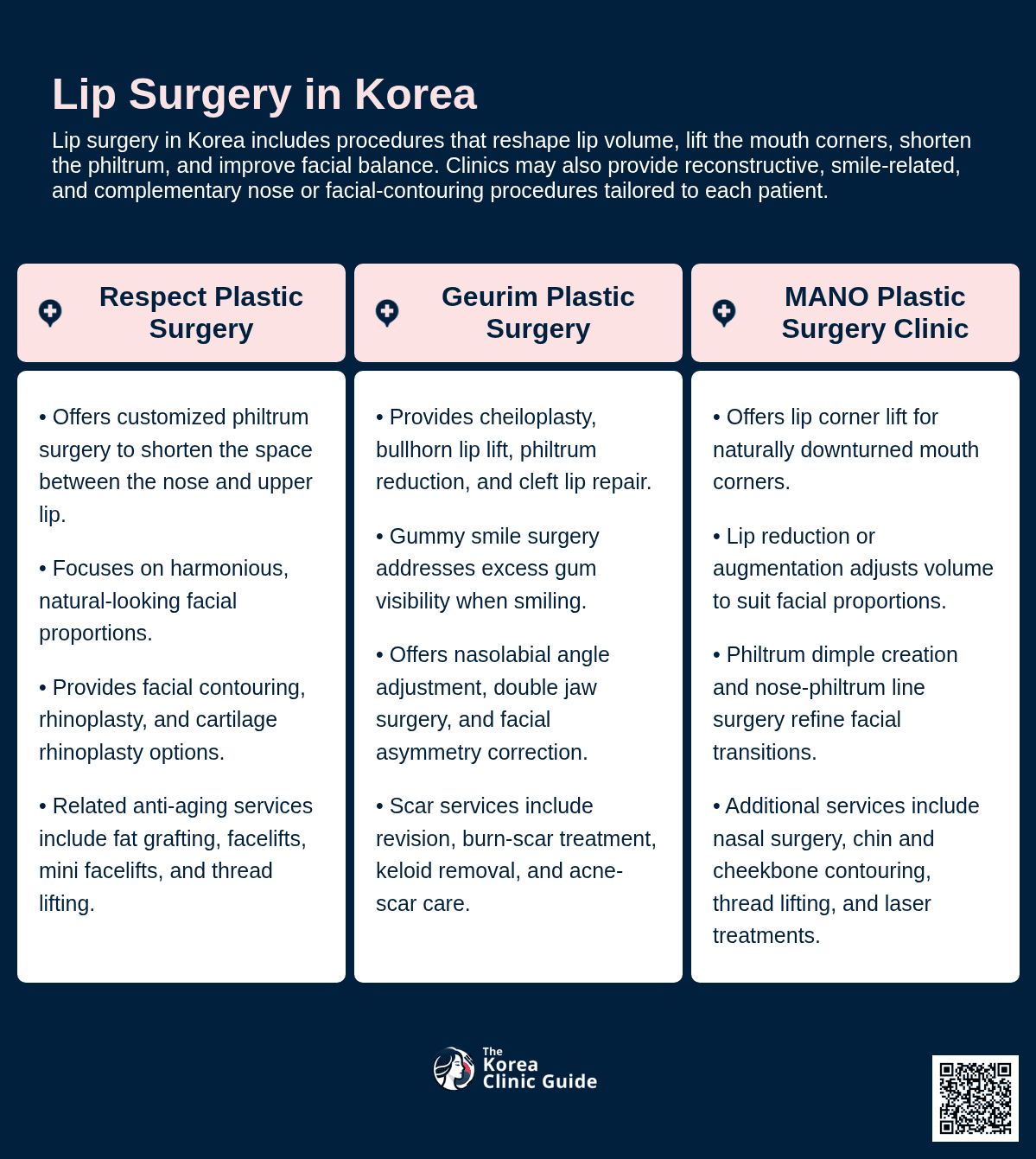
“Lip plastic surgery” or cheiloplasty is not one standardized operation. The incision, anesthesia plan, scar location, permanence, recovery, and suitability for short-term travel depend on the specific procedure.
- Lip reduction — Reduction cheiloplasty removes a measured strip of tissue, commonly through an incision inside the mouth, to reduce bulk, eversion, or asymmetry. It creates a permanent structural reduction.
- Subnasal lip lift — Also called a bullhorn lip lift, this technique removes skin beneath the nostrils to shorten the philtrum and increase upper-vermilion show. The scar sits below the nose.
- Direct lip lift — Skin is removed at the vermilion border to increase visible lip height. It offers direct control of the border but has a more visible-scar trade-off than a subnasal lift.
- Corner mouth lift — Small incisions at the oral commissures elevate persistently downturned mouth corners. Asymmetry and visible scarring require particularly careful counseling.
- Surgical augmentation — V-Y mucosal advancement or vermilion advancement repositions existing lip tissue for more visible show. Fat grafting can add volume, but some transferred fat does not persist, and repeat grafting can be necessary.
- Revision or reconstructive cheiloplasty — Scar release, muscle repair, local flaps, commissuroplasty, cleft-lip revision, or tissue transfer address prior surgery, clefting, trauma, burns, or tumor treatment. These operations prioritize function alongside appearance and often require staged local follow-up.
Why Visit Korea for Lip Plastic Surgery?
Korea has a large international medical-care sector and established systems for serving overseas patients. This does not establish superior lip-surgery outcomes: published evidence does not show that Korea is better than other countries for cheiloplasty, so surgeon-specific assessment and continuity planning remain decisive.
- International-care infrastructure — Seoul reported receiving 1 million international medical tourists in 2024, an indicator of the city’s established overseas-patient care market rather than proof of outcomes for lip surgery specifically.
- Credential verification — Check the named operating doctor, not only the clinic brand, through the Korean Society of Plastic and Reconstructive Surgeons member search. Confirm that the doctor performing the operation is the doctor discussed during consultation.
- Facility due diligence — Ask whether the facility has current KAHF evaluation or accreditation status where applicable, and ask about after-hours contact, emergency transfer arrangements, and anesthesia staffing for the planned operation.
- Realistic evidence standard — Reviews of lip augmentation and lip-lift literature identify heterogeneous techniques and outcome measures, limiting direct comparison between operations. A systematic review of upper-lip lifting found inconsistent quantitative outcomes, while a newer review reported that heterogeneity prevented meta-analysis. Before-and-after galleries and satisfaction claims cannot predict an individual result.
Key Information for International Patients
- Minimum stay — Plan at least 7–10 days in Korea for a straightforward lip lift or lip reduction, allowing for early wound review and removal of external sutures when used. Plan 10–14 days for combined facial surgery, fat grafting, revision surgery, healing risks, or general anesthesia.
- Flight timing — Do not book a fixed early departure. The CDC cites American Society of Plastic Surgeons advice to wait 7–10 days after facial cosmetic procedures before flying; this is general facial-procedure guidance, not lip-surgery-specific evidence. Fly only after the operating surgeon clears travel, eating and drinking are normal, pain is controlled, and there is no bleeding, expanding swelling, infection concern, or imminent wound care.
- Repeat visits — External sutures are commonly reviewed or removed around day 4–7. Internal oral sutures often dissolve. Revision and reconstructive cheiloplasty need longer, sometimes staged, local follow-up and are poor fits for a brief medical-tourism itinerary.
- Itinerary impact — Expect the most obvious swelling, bruising, tightness, and social downtime during the first 7–14 days. Schedule a quiet recovery period rather than business meetings, photography-heavy events, strenuous sightseeing, or long travel days.
- Remote follow-up — Arrange a video review before departure, an after-hours contact route, and a clinician at home who can evaluate complications. Obtain operative notes, medication details, and wound-care instructions in English; the CDC emphasizes that infection and revision needs can complicate care after cosmetic tourism.
Travel note: Major reconstructive cheiloplasty, cleft-lip revision, complex scar correction, and removal of prior permanent filler or silicone should not be scheduled as a short trip. These cases need diagnosis-specific planning and reliable in-person follow-up.
Which Are the Best Clinics in Korea for Lip Surgery?
Listed below are some of the best clinics in Korea for lip surgery.
1. Respect Plastic Surgery
For lip-area aesthetic surgery, you can explore philtrum surgery at Respect Plastic Surgery, which is intended to shorten the space between your nose and upper lip as part of a more balanced facial profile. The clinic describes customized surgical and non-surgical planning focused on harmonious, natural-looking facial results.
- URL: Respect Plastic Surgery Website
- Location: Gangnam-gu, Seoul
- Lip-area procedure: Philtrum surgery is offered to reduce philtrum length and adjust the visual balance between your nose and upper lip.
- Related facial services:
- Facial contouring options include front chin surgery and cheekbone reduction.
- Rhinoplasty options include 3D molding and cartilage rhinoplasty.
- Anti-aging services include fat grafting, facelift, mini facelift, and thread lifting.
2. Geurim Plastic Surgery
At Geurim Plastic Surgery, you can discuss several lip-focused procedures ranging from aesthetic reshaping to reconstructive correction, including cheiloplasty, bullhorn lip lift, philtrum reduction, and cleft lip repair. The clinic also offers smile and facial-proportion procedures that may be relevant when your goals involve the relationship between your lips, gums, nose, and jaw.
- URL: Geurim Plastic Surgery Website
- Location: Seoul
- Lip and smile procedures:
- Cheiloplasty is offered for lip reshaping with aesthetic and functional considerations.
- Bullhorn lip lift elevates the upper lip and reduces philtrum length.
- Philtrum reduction surgery is available for shortening the space between the nose and upper lip.
- Gummy smile surgery adjusts gum visibility when you smile.
- Reconstructive care: Cleft lip surgery and cleft palate surgery are offered for congenital lip and palate anomalies.
- Related facial planning:
- Nasolabial angle adjustment can modify the relationship between your nose and upper lip.
- Double jaw surgery and facial asymmetry correction are available for functional and aesthetic jaw-facial concerns.
- Scar revision, burn-scar treatment, keloid removal, and acne-scar treatment are listed among scar-care options.
3. MANO Plastic Surgery Clinic
For lip surgery at MANO Plastic Surgery Clinic, you can consider lip corner lift or lip reduction/augmentation to alter mouth-corner position or lip volume according to your facial proportions. The clinic also offers philtrum-focused procedures that can be considered when you want to refine the transition from your nose to your upper lip.
- URL: MANO Plastic Surgery Clinic Website
- Location: Seocho-gu, Seoul
- Lip procedures:
- Lip corner lift is intended to raise naturally downturned mouth corners.
- Lip reduction or augmentation adjusts lip volume by removing or adding volume to create a more balanced lip size.
- Philtrum and nose relationship:
- Philtrum dimple creation adds definition to the vertical groove between your nose and upper lip.
- Nose and philtrum line surgery is offered to refine the transition between these areas for facial-profile balance.
- Related facial services:
- Nasal bridge and tip surgery, alar base reduction, long-nose correction, and other nasal procedures are available.
- Chin surgery, zygoma reduction, and mandible angle reduction are listed facial-contouring options.
- Thread lifting and laser treatments are available through the clinic's skin services.
Lip Plastic Surgery From Start to Finish
- First contact and virtual screening — Send clear, makeup-free photos at rest and smiling, a concise goal statement, prior-procedure photographs, and an English medical summary. Ask whether English consultation and written English consent, medication, and aftercare instructions are available.
- Procedure definition before booking — Obtain the exact operation name, incision location, expected scar, anesthesia or sedation plan, anticipated Korea stay, early-review dates, total quoted scope, and remote follow-up plan. Distinguish lip reduction, lip lift, surgical augmentation, scar revision, and reconstruction; they are not interchangeable operations.
- Medical and surgical disclosure — Report all medicines and doses, allergies, bleeding history, diabetes, hypertension, cardiopulmonary conditions, nicotine use, cold sores, dental history, and every prior lip filler, implant, silicone injection, or operation. Prior permanent filler or silicone can make revision materially more complex.
- In-person examination and consent — The surgeon evaluates facial proportions, philtrum length, tooth show, lip closure and movement, scars, tissue quality, symmetry, and dental or bite factors where relevant. This examination can change the initial plan or show that surgery is not appropriate.
- Preoperative planning — Follow any testing, medication plan, antiviral plan for recurrent cold sores, and fasting instructions required by the facility. Straightforward aesthetic lip lifts and reductions are often outpatient procedures under local anesthesia; combined procedures can involve sedation or general anesthesia.
- Operation — For reduction, the surgeon removes and closes a measured strip of tissue, often from inside the mouth. For a subnasal lift, skin below the nose is excised and the upper lip is advanced before closure. More complex cheiloplasty can involve scar release, muscle repair, flaps, or grafting.
- Discharge and first night — Leave with written wound care, prescribed medicines, dietary guidance, emergency contacts, and a scheduled early review. Arrange a responsible adult for the first night after sedation or general anesthesia; do not drive or travel alone immediately after sedation.
- Early postoperative review — Attend the clinic’s scheduled review, typically including external-suture assessment or removal around day 4–7 when applicable. Report bleeding, worsening swelling, fever, drainage, wound separation, or trouble swallowing immediately.
- Remote follow-up after return home — Send requested photographs and attend video reviews. Keep the operative record and medication list available for any clinician treating a later concern; delay elective revision until scars and swelling have matured unless a functional issue or complication requires earlier care.
Alternatives to Lip Plastic Surgery
The right alternative depends on the goal. Nonsurgical options are temporary or limited in what they can change but avoid a surgical incision; surgery can create structural change but brings permanent scarring, healing time, and revision risk.
Hyaluronic-Acid Lip Filler
- Best for — Temporary volume, contour definition, or minor asymmetry rather than philtrum shortening or true lip-size reduction.
- Trade-off — Lip fillers are adjustable and do not require surgical incisions, but they cannot permanently reduce lips or shorten a long philtrum. They carry a distinct risk profile, including rare vascular compromise.
Botulinum-Toxin Lip Flip
- Best for — A subtle outward roll of the upper lip when extra volume is not the aim.
- Trade-off — A lip flip is temporary and does not add tissue, shorten the philtrum, or correct structural lip asymmetry.
Philtrum Reduction Surgery
- Best for — Patients whose primary concern is a long upper lip rather than lip bulk.
- Trade-off — Philtrum reduction surgery is essentially a lip-lift pathway and still involves a permanent external scar; it is not a substitute for volume reduction.
Dental or Orthodontic Treatment
- Best for — Concerns driven by tooth position, bite, gum display, or jaw relationship.
- Trade-off — Clear aligners, braces, periodontal treatment, or jaw assessment address underlying dental causes but do not directly reshape lip tissue. Obtain dental input before choosing a lip operation when tooth show or bite is central to the concern.
Cleft-Lip or Scar Revision Pathway
- Best for — Functional restriction, cleft-related deformity, traumatic scarring, or problematic prior surgery.
- Trade-off — Cleft lip surgery or scar revision focuses on function and tissue quality rather than routine cosmetic enhancement, often requiring multidisciplinary assessment and longer follow-up.
How Can I Prepare for Lip Plastic Surgery?
- Confirm the exact operation — Obtain the procedure name, incision and scar location, anesthesia plan, recovery reviews, and post-return contact plan before paying a nonrefundable deposit. A “lip surgery” quote is not specific enough.
- Disclose medicines and supplements early — Provide all prescription drugs, over-the-counter medicines, vitamins, herbal products, anticoagulants, antiplatelet medicines, diabetes medicines, allergies, and prior anesthesia reactions. Do not independently stop warfarin, apixaban, rivaroxaban, clopidogrel, prescribed aspirin, or other prescribed medicines; the prescriber and surgeon must agree on a safe plan.
- Report cold sores and infection — Tell the surgeon about recurrent herpes labialis, dental pain, mouth ulcers, gum infection, or skin infection. Postpone elective surgery for an active cold sore, oral or dental infection, or facial infection until treated and healed; the surgeon can decide whether antiviral prophylaxis is appropriate.
- Stop nicotine as directed — Avoid cigarettes, vaping, nicotine pouches, and nicotine-replacement products for the surgeon’s required period. The necessary interval depends on the operation and health history, but nicotine-related healing risk is not optional counseling.
- Follow fasting instructions exactly — When sedation or general anesthesia is planned, follow the facility’s food and drink cut-off times precisely. Do not use a generic online fasting schedule in place of the anesthesia team’s instructions.
- Protect external-incision skin — Avoid tanning and sunburn before a lip lift, corner lift, or other external incision. Arrive without lipstick, lip balm, or makeup unless the clinic directs otherwise.
- Plan a recovery-ready stay — Book nearby accommodation for at least 7–10 days for straightforward aesthetic surgery, keep flights flexible, and arrange a responsible adult for the first night after sedation or general anesthesia. Pack soft foods and a written list of emergency contacts.
Travel note: Bring an English medical summary, medication list with doses, allergy record, prior-procedure details, and photographs of previous lip surgery. Keep copies of all Korean operative and medication records for care at home.
Confirm all medication changes, fasting, nicotine abstinence, transport, and accommodation requirements with the treating doctor; individualized instructions take precedence over general guidance.
Aftercare Advice
Protect the incision and avoid stretching the lips during the early healing phase; most preventable problems follow trauma, nicotine exposure, or delayed reporting of a wound concern.
- Swelling and position — Use cold compresses only as directed and sleep with the head elevated during the early recovery period. Swelling, bruising, tightness, and altered sensation are most noticeable for about 7–14 days.
- Food and lip movement — After reduction cheiloplasty, follow the prescribed soft-food plan and limit forceful chewing, puckering, excessive talking, wide smiling, and other movements that stretch the repair during the first week.
- Incision care — Keep external and intraoral incisions clean exactly as instructed. Do not apply lipstick, makeup, sunscreen, scar gel, or other products to an unhealed external incision unless the surgeon approves it.
- Activity and heat — Resume light activity only as cleared. Avoid strenuous exercise, heavy lifting, swimming, contact sports, and activities that could stretch or strike the lips for roughly two weeks or until surgeon clearance. Avoid nicotine and alcohol while healing.
- Sun and scar protection — Once the wound is closed and the surgeon approves topical care, protect an external scar from sun exposure and use broad-spectrum SPF 50 on surrounding healed skin. The scar from a lip lift typically continues healing for 6–8 weeks, while swelling and tightness can continue settling for months.
- Urgent warning signs — Contact the clinic urgently for rapidly worsening swelling, excessive bleeding, fever, pus or foul drainage, wound separation, severe or escalating pain, new marked asymmetry, breathing or swallowing difficulty, or an allergic-reaction symptom.
- Result timing — Attend scheduled reviews and send requested photographs after travel. A lip-lift appearance can take about four months to settle; reduction-cheiloplasty settling can take up to six months. Fat-graft retention is less predictable, and revision is usually delayed until scar maturation unless there is a functional problem or complication.
Follow the treating doctor’s instructions over general guidance, and contact the clinic promptly when healing appears different from the plan.
Frequently Asked Questions
Related Blogs
Korean Gummy Smile Surgery vs. World: What Patients Pay Globally and Why Korea Excels
Discover the latest trends and costs of gummy smile surgery in Korea, a sought-after cosmetic dental procedure. Uncover why this destination is becoming a hub for affordable and high-quality treatment options.
Updated: Oct 27, 2026
Discover the Global Cost of Blood Purification: Why Korea is a Leading Choice
Discover the latest insights into the cost of blood purification treatments in Korea, a leading destination for advanced medical procedures. Explore how competitive pricing and high-quality healthcare standards are attracting international patients seeking cutting-edge solutions for their medical needs.
Updated: Oct 27, 2026
Explore Global Costs for Sweat Gland Removal: Is Korea the Best Choice for You?
Discover the costs and benefits of sweat gland removal surgery in Korea, a popular destination for medical tourists seeking affordable and effective hyperhidrosis treatment. Explore detailed breakdowns of expenses, including consultation fees, surgical costs, and post-operative care options.
Updated: Oct 27, 2026

Global Lip Plastic Surgery Costs Compared: Why Korea's Advanced Techniques Shine
Discover the allure of lip plastic surgery in Korea, where cutting-edge techniques meet affordability. Explore the varying costs, factors influencing pricing, and why Korea has become a global hub for cosmetic enhancements.
Updated: Oct 25, 2026
Clinics offering Lip Plastic Surgery
Respect Plastic Surgery: Premier Facial Rejuvenation and Aesthetic Procedures in Korea
Gangnam Station
Dr Tak Plastic Surgery Korea: Advanced Facial, Eye, Nose, Anti-Aging & Body Procedures in Seoul
Seocho

MANO Plastic Surgery Clinic in Korea: Enhancing Natural Beauty with Tailored Facial Procedures
Hakdong

Geurim Plastic Surgery: Comprehensive Aesthetic and Reconstructive Procedures in Korea
Sinsa