
Medical Tourism Blog
Foreign Body Removal in Korea: Assessment, Removal Methods, Recovery, and Travel Planning

Table of contents
- Foreign Body Removal at a Glance
- What Is Foreign Body Removal?
- Who Is a Good Candidate for Foreign Body Removal?
- How Is Foreign Body Removal Performed?
- Why Visit Korea for Foreign Body Removal?
- Key Information for International Patients
- Which Are the Best Clinics in Korea for Foreign Body Removal?
- Foreign Body Removal From Start to Finish
- Alternatives to Foreign Body Removal
- How Can I Prepare for Foreign Body Removal?
- Aftercare Advice
Considering treatment in Korea? Everything you need to know e.g. — how to avoid scams, visas, interpreters, recovery tips — in our Medical Tourism Master Guide. Plan with confidence in minutes, not weeks!
Last updated: September 2026
Foreign Body Removal at a Glance
- What it treats — Foreign body removal evaluates and treats problematic cosmetic soft-tissue material, including filler, liquid silicone, permanent filler, threads, or implant-related material; it is not one standardized operation.
- Treatment depends on material — Confirmed hyaluronic-acid filler may be dissolved with clinician-administered hyaluronidase, while silicone, PMMA, CaHA, PLLA, threads, and implants generally require observation, image-guided treatment, or surgery rather than dissolver injections.
- Imaging guides safe removal — Examination and targeted imaging identify the material’s location and relation to important structures; ultrasound can guide focal removal, CT may help in complex areas, and MRI should be avoided until metal has been excluded.
- Incomplete removal is possible — Diffuse, migrated, scar-encapsulated, or permanent material may not be safely removable in full, so debulking, symptom control, scar revision, or staged reconstruction can be more realistic than one definitive procedure.
- Recovery varies by technique — HA dissolution or focal image-guided removal commonly causes bruising, swelling, tenderness, and temporary contour changes for several days, while open excision can require suture review at roughly 5–14 days and months for scars and contours to settle.
- Korea travel planning — Allow about 3–7 days for assessment, imaging, a minor procedure, and early review; open excision usually needs about 10–14 days or longer, and return flights should remain flexible until the surgeon confirms fitness to fly.
- Korea-specific consideration — Korea offers registered-institution checks and international-patient coordination, but no high-quality evidence shows superior foreign-body-removal outcomes there; verify the individual clinician’s credentials, emergency arrangements, and cross-border follow-up plan.
What Is Foreign Body Removal?
Foreign body removal is the assessment and treatment of problematic material left in soft tissue after cosmetic injections, threads, implants, or material migration. It addresses pain, swelling, nodules, infection, distortion, or functional problems while aiming to remove material safely or reduce symptoms when complete removal is unsuitable. Treatment ranges from non-surgical medication or filler dissolution to minimally invasive image-guided removal or open surgery, depending on the material and location.
Who Is a Good Candidate for Foreign Body Removal?
- Symptomatic cosmetic material — Suitable candidates have pain, persistent swelling or inflammation, palpable nodules, migration, visible distortion, recurrent wound problems, or functional impairment after filler, liquid silicone, threads, an implant, or another injected material.
- Focal and localizable material — A defined deposit, retained thread, fluid collection, or superficial object that can be located on examination or imaging is more amenable to targeted treatment.
- Patients prepared for a staged plan — Permanent, diffuse, migrated, or scar-encapsulated material often requires more than one treatment and can leave contour change even after technically appropriate removal.
- People with complete records where possible — The original product name, injection date and plane, volume, device card, prior imaging, and photographs help the treating team distinguish reversible HA filler from silicone, PMMA, calcium hydroxylapatite (CaHA), poly-L-lactic acid (PLLA), or another material.
Do not pursue elective blind exploration when the material cannot be located or its relationship to nerves, blood vessels, joints, or other important structures is unclear; removal itself can cause tissue injury and still be incomplete, as outlined in guidance on soft-tissue foreign bodies. Untreated infection, spreading redness, pus, fever, skin breakdown, tissue color change, escalating pain, or new neurologic, visual, breathing, or swallowing symptoms require urgent in-person assessment rather than medical travel. Surgery is delayed until bleeding risk, diabetes, cardiopulmonary disease, and other significant medical issues are appropriately managed. Pregnancy, breastfeeding, active inflammatory skin disease, and local dental, sinus, or skin infection also require a site- and material-specific decision.
How Is Foreign Body Removal Performed?
Treatment follows the actual substance, its depth and distribution, and whether the problem is inflammation, infection, migration, granuloma, or mechanical damage. Complete removal is not always the safest objective.
- Observation or medical treatment — Deep, small, inert material without symptoms can be left in place when dissection would create greater harm. Inflammatory reactions can require observation or clinician-directed corticosteroid treatment rather than immediate extraction.
- Hyaluronidase for HA filler — Clinician-administered hyaluronidase breaks down confirmed or strongly suspected hyaluronic-acid filler; it does not remove silicone, PMMA, CaHA, PLLA, threads, implants, or an unknown injectable. For delayed HA reactions, the 2024 CARE consensus distinguishes noninflammatory reactions, which can be treated with hyaluronidase, from infection, which requires drainage, culture, and antibiotics rather than hyaluronidase as first-line care.
- Image-guided focal removal — Ultrasound-guided needle or forceps extraction, aspiration, drainage, or a limited incision can address accessible, localized material while limiting unnecessary dissection. Ultrasound provides real-time localization; radiography identifies many radiopaque materials, while CT is useful in selected complex locations. MRI must be avoided until metallic material has been excluded because metal movement can cause neurovascular injury.
- Open excision, debulking, or capsulectomy — Encapsulated deposits, infected collections, migrated threads, implant-related pathology, and accessible permanent filler can require open surgery under local anesthesia, sedation, or general anesthesia. The surgeon removes material only to the extent compatible with protecting skin, blood supply, nerves, and contour.
- Staged reconstruction — Diffuse silicone, PMMA, and other permanent fillers often cannot be fully extracted safely. Debulking followed by scar revision, contour reconstruction, or later revision can be more realistic than a single definitive operation. Published evidence for silicone and permanent-filler complications is largely heterogeneous case-based literature, so recurrence and cosmetic outcomes cannot be forecast precisely for an individual patient.
Why Visit Korea for Foreign Body Removal?
Korea has established systems for receiving international medical patients and for checking participating providers. That infrastructure can help with records, language-accessible coordination, and travel logistics, but it does not prove better foreign-body-removal outcomes than other countries. This is a highly individualized diagnostic and surgical problem, so clinician expertise and continuity planning matter more than destination marketing.
- Registered-provider checks — Use the Medical Korea registered-institution system to verify whether a facility is listed for international patient services; confirm the individual clinician’s specialty, operating privileges, and emergency-transfer arrangements directly.
- International-patient framework — Korea’s national medical-tourism platform provides medical visa information, which can be relevant when the planned assessment, operation, and early reviews require an extended stay.
- Appropriate diagnostic pathway — A credible Korean plan starts with records, physical examination, and targeted imaging rather than a promise to dissolve or remove every material. This is especially important for unknown injectables and suspected silicone, PMMA, threads, or implant-related material.
- Evidence limitation — No high-quality Korea-specific comparative studies establish superior removal rates, lower complication rates, or faster recovery for this broad group of procedures. Verify the facility, consent language, after-hours contact process, and cross-border complication plan before paying a deposit.
Key Information for International Patients
- Minimum stay — Allow roughly 3–7 days for in-person assessment, imaging, a minor local-anesthetic procedure, and an early review. Do not treat this as a fixed timeline; the finding on imaging and the actual technique determine the stay.
- Open-surgery stay — Plan about 10–14 days or longer after open excision when the surgeon needs to inspect healing or remove nonabsorbable sutures, commonly removed about 5–14 days after surgery. Complex facial, breast, buttock, limb, infected, reconstructive, or staged cases can require a substantially longer stay.
- Flying home — Do not book a non-changeable return flight before the surgeon confirms wound stability, mobility, pain control, clot-risk planning, and fitness to fly. Early long-haul travel is particularly impractical after open surgery, infection treatment, significant swelling, or a procedure requiring drains or repeated wound reviews.
- Itinerary impact — Minor image-guided treatment or HA dissolution often causes several days of bruising, tenderness, swelling, and temporary contour change. Open surgery requires a low-activity itinerary; avoid carrying heavy luggage, strenuous sightseeing, heat exposure, swimming, and contact trauma until cleared.
- Remote follow-up — Arrange a telehealth and photo-review schedule before treatment, and identify a clinician at home who can provide wound care or suture removal if needed. Leave with an English discharge summary, operative and anesthesia record, imaging files, medication list, and pathology or culture results when applicable.
Travel note: Do not travel to Korea for elective treatment when there is fever, rapidly spreading redness, pus, worsening pain, dusky or pale skin, visual symptoms, facial weakness, breathing difficulty, or swallowing difficulty. Seek urgent local care first.
Which Are the Best Clinics in Korea for Foreign Body Removal?
Listed below are some of the best clinics in Korea for foreign body removal.
1. IVY Plastic Surgery Clinic
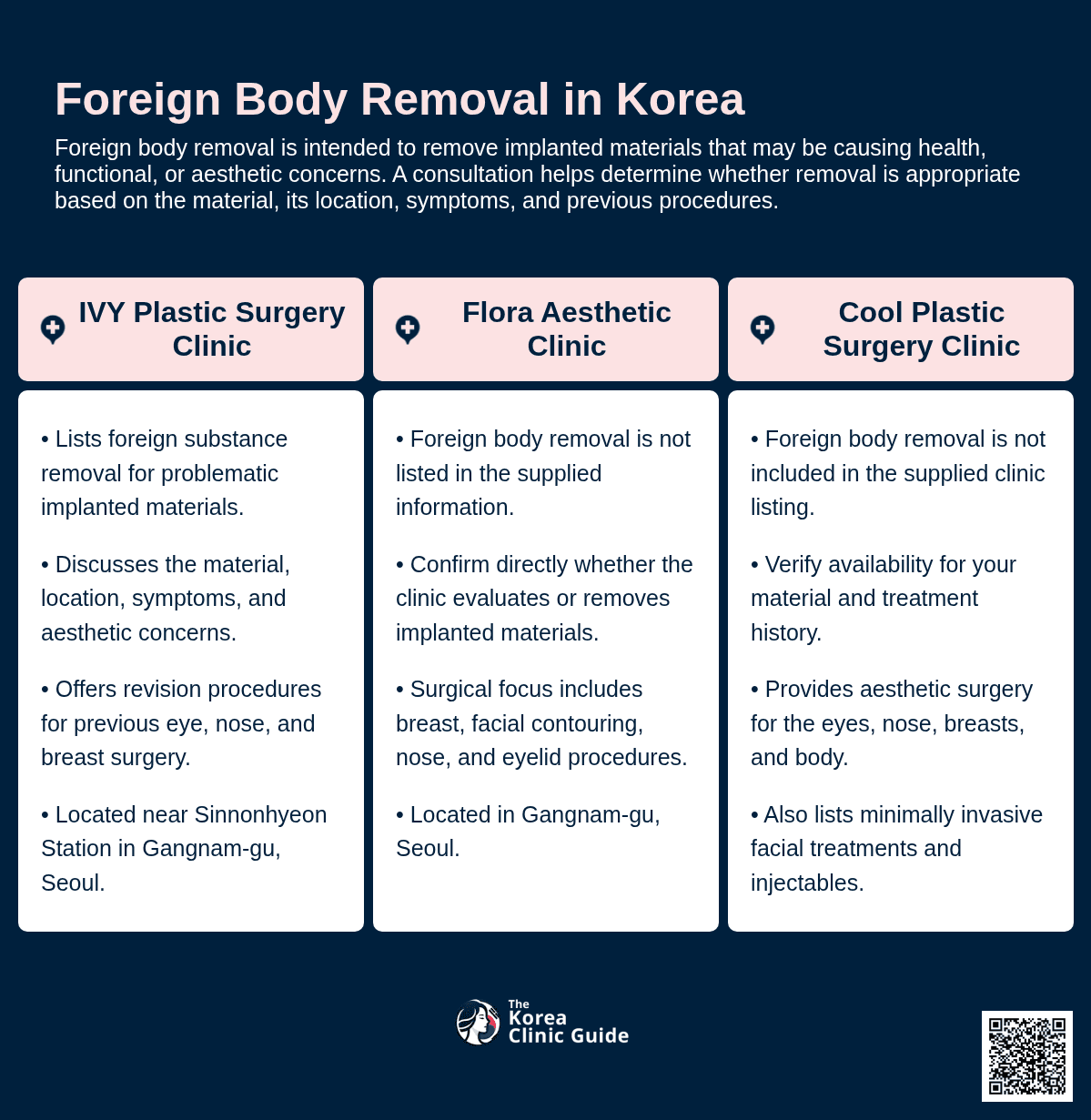
IVY Plastic Surgery Clinic lists foreign substance removal for implanted materials that may be causing health or aesthetic concerns. If you are considering removal, you can discuss the substance involved, its location, your symptoms or cosmetic concerns, and whether removal is appropriate for your situation during a personalized consultation.
- URL: IVY Plastic Surgery Clinic Website
- Location: Gangnam-gu, Seoul
- Procedure focus:
- Foreign substance removal is listed as a procedure intended to remove implanted materials that may cause health or aesthetic issues.
- The clinic describes the goal as eliminating problematic material while addressing appearance-related concerns.
- Related surgical options:
- Rhinoplasty without implants is listed for nose reshaping using your own tissue rather than synthetic implants.
- Revision options are listed for prior eye, nose, and breast surgery, which may be relevant if you have concerns after an earlier procedure.
- Consultation options:
- Online consultation, KakaoTalk consultation, and online reservation are listed.
- The clinic is located near Sinnonhyeon Station.
2. Flora Aesthetic Clinic
The supplied information for Flora Aesthetic Clinic does not list foreign body removal, so you should confirm directly whether it evaluates or performs removal of implanted or other foreign materials before making plans. Its listed surgical practice instead centers on breast surgery, facial contouring, rhinoplasty, eyelid procedures, and fat grafting.
- URL: Flora Aesthetic Clinic Website
- Location: Gangnam-gu, Seoul
- Listed surgical services:
- Breast services include augmentation, lift, reduction, and gynecomastia surgery.
- Facial and nasal procedures include square-jaw and cheekbone reduction, chin procedures, rhinoplasty, and corrections for short, hump, or crooked noses.
- Eye procedures include incisional and non-incisional double-eyelid surgery, canthoplasty, blepharoplasty, and lower-eyelid fat repositioning.
3. Cool Plastic Surgery Clinic
Cool Plastic Surgery Clinic’s supplied listing does not include foreign body removal, so you should verify whether this procedure is available and whether your specific material and treatment history can be assessed. The available information describes aesthetic surgery and minimally invasive treatments for the eyes, nose, breasts, body contour, and facial aging.
- URL: Cool Plastic Surgery Clinic Website
- Location: Gangnam-gu, Seoul
- Listed services:
- Eye procedures include non-incisional, partial-incision, and full-incision double-eyelid surgery, ptosis correction, canthoplasty, and lower-eyelid fat repositioning.
- Nasal surgery includes augmentation, short-nose, hump-nose, crooked-nose, and bulbous-nose correction.
- Other listed options include breast augmentation, nipple and areola correction, liposuction, thread lifting, minimally invasive facelift, Botox, and fillers.
Foreign Body Removal From Start to Finish
- Remote record review and triage — Send the original procedure date, product or implant information, injection volume and plane if known, photographs, prior imaging, prior treatment attempts, medication list, allergies, and current symptoms. Request an English or interpreter-supported virtual consultation when available. Urgent symptoms should be directed to local emergency care, not managed remotely.
- In-person examination and consent — The treating clinician examines the area, documents contour and skin findings with photographs, reviews scars and prior procedures, and discusses the realistic endpoints: observation, symptom control, partial removal, complete removal where safe, or staged reconstruction.
- Targeted localization — The team selects imaging based on the suspected substance and site. Ultrasound can localize radiolucent and superficial material in real time; radiography detects many radiopaque objects; CT can clarify deep or anatomically complex findings. Avoid MRI until metallic foreign material has been excluded.
- Treatment planning — The clinician identifies whether the finding is HA filler, another injectable, a retained thread, implant-related material, granuloma, scar tissue, infection, or another cause of the visible change. Suspected infection is assessed for drainage, culture, and antibiotics; it is not automatically treated with hyaluronidase.
- Anesthesia and procedure — Focal removal can use local anesthesia, with sedation or general anesthesia reserved for a deeper, broader, or reconstructive operation. The clinician performs hyaluronidase injection, ultrasound-guided extraction or aspiration, limited incision and drainage, thread removal, open excision, debulking, capsulectomy, or reconstruction according to the plan. Duration ranges from a brief office-based treatment to a substantially longer operation for diffuse or implant-related disease.
- Discharge and early review — After a minor procedure, discharge is often the same day once pain and bleeding are controlled. After sedation or general anesthesia, arrange a responsible adult and follow the clinic’s observation and transport rules. An early review checks bleeding, skin circulation, swelling, infection, drains, and wound edges.
- Overseas follow-up — Before departure, obtain all records and confirm photo-review timing, wound-care responsibilities, suture-removal arrangements, and an emergency contact route. Report new symptoms promptly rather than waiting for a scheduled virtual review.
Alternatives to Foreign Body Removal
The alternative depends on the material and the harm caused by removal. Non-surgical options avoid an incision but cannot remove every substance; surgery can address accessible material and damaged tissue but adds scar, bleeding, nerve-injury, and healing risks.
Observation or Medical Management
- Best fit — Deep, inert, asymptomatic material or diffuse deposits where removal threatens nerves, blood vessels, skin viability, or contour.
- Tradeoff — Material remains in place and requires monitoring; new pain, enlargement, drainage, skin change, or functional symptoms need reassessment.
HA Filler Dissolution
- Best fit — Confirmed or strongly suspected hyaluronic-acid filler causing an aesthetic or noninfectious complication.
- Tradeoff — Filler dissolver treatment is not effective for silicone, PMMA, CaHA, PLLA, threads, or implants. It can also produce a temporary volume deficit that later requires reassessment.
Implant Removal or Revision
- Best fit — Symptoms tied to an implant, capsule, rupture concern, displacement, or implant-related inflammation rather than free injected material.
- Tradeoff — Breast implant surgery or capsular contracture treatment addresses a different anatomical problem and can require capsulectomy, implant exchange or removal, and a longer recovery than focal foreign-body extraction.
Scar or Contour Revision
- Best fit — Residual scar tethering, contour depression, or asymmetry after material has been removed or is no longer active.
- Tradeoff — Scar removal surgery treats the consequence rather than removing diffuse retained material, and revision is usually deferred until inflammation and wound healing are stable.
How Can I Prepare for Foreign Body Removal?
- Records and images — Bring the original procedure or operative report, product brand and lot details, implant/device card, previous scans, culture or pathology reports, and dated photographs. Unknown material changes both imaging and the removal plan.
- Medication disclosure — List all prescriptions, over-the-counter medicines, supplements, herbs, injectable treatments, allergies, diabetes medicines, GLP-1 medicines, nicotine use, alcohol, recreational drugs, and previous anesthesia problems. Do not independently stop anticoagulants, antiplatelets, diabetes medicines, or prescribed medicines.
- Written medication plan — Obtain instructions directly from the surgeon and anesthetist on anticoagulants, antiplatelets, NSAIDs, supplements, GLP-1 medicines, fasting, and perioperative diabetes management. Their individualized directions take precedence over general guidance.
- Infection check — Report dental work, sinus symptoms, acne or dermatitis flare, open wounds, fever, recent antibiotics, and any drainage from the treatment area. Elective removal is commonly postponed until active infection is assessed and controlled.
- Skin and substance precautions — Avoid new cosmetic injections, threads, tattoos, aggressive skin procedures, and unapproved topical products near the planned site before assessment. Stop smoking and nicotine exposure according to the surgeon’s instructions because they can impair wound healing; avoid alcohol as instructed before anesthesia or surgery.
- Travel logistics — Reserve flexible flights, choose accommodation close to the clinic, and arrange an adult escort when sedation or general anesthesia is planned. Keep the first days after treatment free of tours, strenuous activity, and luggage handling.
Travel note: Build enough time into the trip for unexpected imaging, drainage, culture results, repeat treatment, or delayed suture removal. A fixed departure date is unsuitable for a potentially staged operation.
Confirm the clinic’s fasting, medication, skin-preparation, transport, and accommodation requirements in writing; the treating doctor’s instructions take precedence.
Aftercare Advice
Protect the treated area and attend early review; prompt assessment of infection, bleeding, or skin-circulation changes is more important than trying to manage them from abroad.
- Wound and dressing care — Keep incisions, dressings, and drains clean and dry exactly as instructed. Do not apply antibiotic ointment, silicone gel, makeup, massage, or other topical products unless the treating team has approved them.
- Activity and heat — Avoid strenuous exercise, heavy lifting, contact trauma, swimming, hot tubs, and saunas until cleared. These restrictions are especially important after open excision, drainage, or reconstruction because they can worsen swelling, bleeding, wound separation, and infection risk.
- Swelling and contour changes — Bruising, tenderness, swelling, and temporary unevenness are common for several days after HA dissolution or focal removal. After open surgery, scars and contours continue settling for months; staged treatment can be necessary when permanent or diffuse material cannot be safely removed in one operation.
- Sun protection — Once the wound is closed and the surgeon permits skincare, protect exposed treated skin from pigment change with broad-spectrum SPF 50 and physical shade. Do not apply sunscreen directly to an open wound.
- Warning signs — Seek urgent assessment for rapidly worsening pain or swelling, spreading redness or warmth, pus or foul drainage, fever, persistent bleeding, wound separation, white, dusky, or black skin change, new numbness or weakness, visual change, facial or neurologic symptoms, chest pain, shortness of breath, or one-sided calf swelling.
- Follow-up — Send scheduled wound photographs, attend suture or drain reviews, and keep a local clinician ready for in-person wound care after returning home. Request copies of pathology and culture results and confirm any antibiotic changes with the operating team.
Follow the treating doctor’s instructions over general guidance, and contact the clinic immediately when healing, pain, drainage, swelling, or skin color appears abnormal.
Frequently Asked Questions
Related Blogs
Discover the Global Spectrum of Scar Removal Surgery Costs and Why Korea Leads the Way
Discover how much scar removal surgery costs in Korea, a popular destination for affordable cosmetic procedures. Explore factors influencing the pricing and what to expect during your medical journey in this comprehensive guide.
Updated: Sep 25, 2026
Otoplasty in Korea: Methods, Recovery, Risks and Travel Planning
Otoplasty reshapes or repositions outer-ear cartilage for prominent ears, asymmetry, and selected congenital or revision concerns, usually as a 1–3 hour outpatient procedure using sutures, cartilage modification, or both. International patients planning treatment in Korea should allow 10–14 days for assessment, early wound review and possible suture removal, follow activity and dressing restrictio
Updated: Sep 21, 2026
Varicose Vein Treatment in Korea: Methods, Recovery, Travel Planning, and Safety
Varicose vein treatment begins with standing duplex ultrasound mapping and may use laser or radiofrequency ablation, vein glue, mechanochemical ablation, foam sclerotherapy, phlebectomy, or surgery based on anatomy and risk factors. The article covers candidacy, recovery, compression and walking guidance, follow-up, warning symptoms, and travel planning including flight restrictions after treatmen
Updated: Sep 19, 2026
Hyperhidrosis Laser in Korea: Methods, Recovery, Results, and Travel Planning
Laser treatment for primary axillary hyperhidrosis uses subdermal fiber ablation through tiny incisions or surface laser sessions to reduce underarm sweating, with repeat treatment sometimes needed. The article covers candidacy, Korea travel planning, preparation, recovery, warning signs, follow-up, and alternatives such as antiperspirants, Botox, microwave thermolysis, and gland removal.
Updated: Sep 18, 2026
Clinics offering Foreign Body Removal

IVY Plastic Surgery Clinic in Korea: Comprehensive Aesthetic Procedures for Facial, Body and Breast Enhancements
Sinnonhyeon Station

Flora Aesthetic Clinic in Apgujeong, Korea – Premier Destination for Advanced Cosmetic and Aesthetic Procedures
Apgujeong

Joa Plastic Surgery: Premier Aesthetic Procedures & Personalized Care in Korea
Sinnonhyeon Station
Cha Min Plastic Surgery Clinic in Korea: Specializing in Rhinoplasty, Implant Removal, and Advanced Cosmetic Procedures
Sinnonhyeon Station