Medical Tourism Blog
Cheiloplasty in Korea: Types, Recovery, Travel Planning, and Safety

Table of contents
- Cheiloplasty at a Glance
- What Is Cheiloplasty?
- Who Is a Good Candidate for Cheiloplasty?
- What Are the Different Types of Cheiloplasty?
- Why Visit Korea for Cheiloplasty?
- Key Information for International Patients
- Which Are the Best Clinics in Korea for Cheiloplasty?
- Cheiloplasty From Start to Finish
- Alternatives to Cheiloplasty
- How Can I Prepare for Cheiloplasty?
- Aftercare Advice
Considering treatment in Korea? Everything you need to know e.g. — how to avoid scams, visas, interpreters, recovery tips — in our Medical Tourism Master Guide. Plan with confidence in minutes, not weeks!
Last updated: September 2026
Cheiloplasty at a Glance
- What it is — Cheiloplasty is an umbrella term for lip surgery; cosmetic reduction removes tissue from the upper lip, lower lip, or both through an incision usually placed inside the lip.
- Permanent change — Reduction cheiloplasty permanently decreases lip volume because tissue is excised, although asymmetry, tightness, contour concerns, altered sensation, or dissatisfaction can sometimes require revision.
- Procedure time — Isolated cosmetic lip reduction is commonly an outpatient procedure under local anesthesia and typically takes about 1 hour; cleft and reconstructive operations have different anesthesia and care needs.
- Recovery timeline — Expect soreness, swelling, and limited smiling or extensive talking for several days, soft foods for up to 1 week, and suture management at about 1 week; final cosmetic assessment may take up to 6 months.
- Korea stay — For isolated cosmetic reduction in Korea, plan 10–14 days to allow an in-person examination, surgery, early wound review, and roughly 7–10 days before long-haul flying if cleared by the surgeon.
- Best candidates — Suitable cosmetic candidates are medically well adults with stable lip fullness or asymmetry, realistic expectations, and acceptance of permanent tissue removal after dental, filler-related, inflammatory, and other causes are assessed.
- Korea verification — Korea registers institutions serving foreign patients and requires registered facilities to carry malpractice liability insurance, but this does not verify an individual surgeon’s cheiloplasty experience or predict procedure-specific outcomes.
What Is Cheiloplasty?
Cheiloplasty is lip surgery used to reduce, repair, or reshape lip tissue, depending on the underlying concern. It can improve lip proportion, symmetry, closure, comfort, or reconstruction after injury, congenital differences, or prior treatment. Cheiloplasty is a surgical procedure.
Who Is a Good Candidate for Cheiloplasty?
- Cosmetic reduction candidate — A medically suitable adult with stable lip prominence or asymmetry who wants permanent reduction of the upper lip, lower lip, or both.
- Function-focused candidate — Someone whose lip bulk affects lip closure, eating, or comfort, after dental, oral, inflammatory, and other medical causes have been assessed.
- Reconstructive candidate — A person needing repair after trauma, tumor treatment, congenital difference, or problematic permanent filler, where oral competence and symmetry can be more important than volume reduction.
- Cleft-care candidate — An infant, child, or adult with a cleft-related concern who is assessed within a coordinated cleft/craniofacial care plan; cleft-lip surgery is not equivalent to cosmetic reduction.
Elective cosmetic reduction is unsuitable with an active oral, dental, lip, or systemic infection; an active cold sore; or persistent unexplained enlargement until the cause is treated. Uncontrolled diabetes, significant bleeding disorders, immunosuppression, poorly controlled inflammatory disease, and ongoing nicotine exposure can materially raise anesthesia and wound-healing risks. Candidates must accept that removed tissue is permanent and that asymmetry, tightness, altered sensation, visible contour issues, and revision are possible. For primary cleft repair, medically healthy infants often begin treatment within the first 6 months, but growth, nutrition, airway, cardiac status, cleft anatomy, and associated conditions determine timing within longitudinal interdisciplinary cleft care).
What Are the Different Types of Cheiloplasty?
Cheiloplasty is an umbrella term. Confirm the diagnosis and intended operation before booking: a cosmetic lip reduction has different goals, anesthesia needs, recovery, and follow-up requirements from cleft or reconstructive lip surgery.
- Cosmetic reduction cheiloplasty — The surgeon removes selected excess tissue from the upper lip, lower lip, or both to achieve less volume and better balance. Reduction is permanent because tissue is excised; an inner-lip incision and suture closure are common.
- Primary cleft-lip cheiloplasty — Initial unilateral or bilateral cleft-lip repair restores lip landmarks and reconstructs the orbicularis oris muscle, often considering nasal-base correction at the same stage. It forms one part of broader cleft care through growth.
- Secondary cleft revision — This addresses residual scar tightness, vermilion or mucosal irregularity, muscle imbalance, lip asymmetry, or related nasal concerns after an earlier repair. The extent ranges from scar-focused revision to more extensive re-repair.
- Reconstructive cheiloplasty — Trauma, tumor treatment, congenital differences, permanent filler complications, or diagnosed chronic enlargement can require tissue removal, local rearrangement, staged reconstruction, or other functional repair rather than routine cosmetic reduction.
- Contoured “bikini” reduction — A bikini-shaped excision is one published reduction design. Its supporting report was a noncomparative level-IV case series, so it is not evidence that this pattern is superior for sensation, scarring, function, or satisfaction.
Why Visit Korea for Cheiloplasty?
Korea has a formal registration framework for institutions serving foreign patients. This can help international visitors check an institution before travel, but it does not prove an individual surgeon’s cheiloplasty experience or predict results. Because cheiloplasty covers very different operations, verify expertise in the exact indication—cosmetic reduction, cleft revision, or reconstruction.
- Foreign-patient registration — Medical Korea describes a registration system for institutions serving international patients, with registered institutions required to carry medical-malpractice liability insurance since 2016.
- Verification, not a quality guarantee — Registration and liability-insurance requirements are useful starting points. Ask separately about the operating surgeon’s relevant training and case experience, facility, anesthesia provider, emergency-transfer arrangements, interpreter-supported consent, complication coverage, and revision policy.
- Evidence limit — No Korea-wide public registry data identified procedure-specific cheiloplasty volume, complications, revision rates, or international-patient outcomes. Broad plastic-surgery statistics cannot establish that Korean cheiloplasty is safer or better than treatment elsewhere.
- Reconstructive care distinction — For cleft lip, choose a team able to provide or coordinate the continuing speech, hearing, dental, orthodontic, nasal, psychosocial, and surgical surveillance described in ACPA care parameters).
Key Information for International Patients
- Minimum stay — For isolated cosmetic reduction, plan conservatively for 10–14 days in Korea. This allows an in-person examination, surgery, early wound review, and roughly 7–10 days before a long-haul flight when the operating surgeon clears travel.
- Flight timing — Do not book a non-changeable early return. Combined operations, substantial swelling, complications, sedation or general anesthesia, and wound concerns can extend the stay; obtain clearance from the operating surgeon before flying.
- Repeat visits — Arrange an early postoperative review and clarify whether sutures dissolve or need removal at about 1 week. Residual swelling can remain for months, so final cosmetic assessment is more reliable at up to 6 months.
- Itinerary impact — Expect soreness, swelling, limited smiling or extensive talking for several days, and soft foods for up to 1 week after uncomplicated reduction surgery. Avoid scheduling demanding sightseeing, business presentations, or social events immediately afterward.
- Remote follow-up — Leave with an English operative report, anesthesia record, medication list, written wound-care instructions, emergency contact route, and remote-review plan. Video or photo review does not replace local urgent assessment for bleeding, infection, wound separation, or breathing symptoms.
- Cleft and major reconstruction — Primary cleft-lip repair and complex reconstructive cheiloplasty are generally poor fits for a short medical-tourism visit because early follow-up and long-term multidisciplinary care are essential.
Travel note: Stay in accessible accommodation near the treating facility and travel with a companion for the first night after sedation or general anesthesia.
Which Are the Best Clinics in Korea for Cheiloplasty?
Listed below are some of the best clinics in Korea for cheiloplasty.
1. Geurim Plastic Surgery
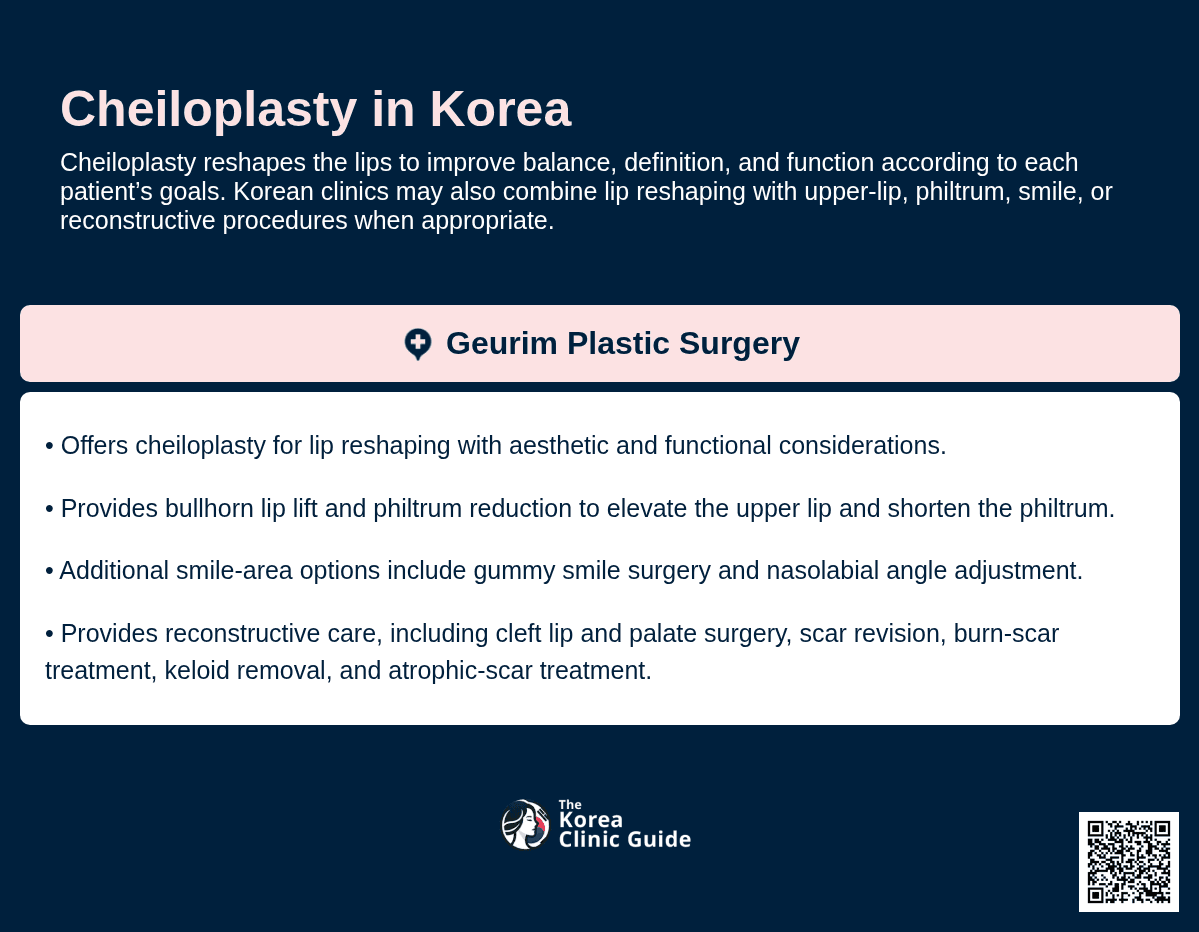
At Geurim Plastic Surgery, you can explore cheiloplasty to reshape your lips with attention to both appearance and function. The clinic also offers related upper-lip and smile procedures, which may be relevant when considering overall lip proportions.
- URL: Geurim Plastic Surgery Website
- Location: Seoul
- Procedure options:
- Cheiloplasty is offered for lip reshaping with aesthetic and functional considerations.
- Bullhorn lip lift and philtrum reduction are available for upper-lip elevation and shortening of the philtrum.
- Gummy smile surgery and nasolabial angle adjustment are additional smile-area options.
- Reconstructive care:
- Cleft lip and cleft palate surgery are listed among the clinic’s specialized reconstructive procedures.
- Scar revision, burn-scar treatment, keloid removal, and atrophic-scar treatment are also available.
Cheiloplasty From Start to Finish
- Remote inquiry and screening — Send standardized lip photographs, a concise description of the goal, prior operative records, complete filler history, medication and supplement list, allergies, nicotine use, cold-sore history, dental concerns, and medical conditions. Ask whether English consultation and written consent are available. Remote review can screen suitability, but it cannot replace examination.
- In-person consultation — The surgeon confirms what “cheiloplasty” means in this case and examines lip thickness, symmetry, vermilion show, cupid’s bow, philtrum, tooth display, lip seal, speech and eating function, oral lining, scars, bite, facial proportions, and prior filler. Persistent swelling requires diagnostic evaluation rather than automatic reduction.
- Medical and anesthesia assessment — A healthy adult having local anesthesia alone often needs history, examination, and targeted testing only. Sedation, general anesthesia, significant medical conditions, or reconstructive surgery require assessment and tests based on individual anesthesia risk; there is no universal cheiloplasty test panel.
- Planning and consent — Confirm the upper lip, lower lip, or both; the planned reduction design; expected scar location; anesthesia; suture plan; medications; follow-up date; flight clearance process; and the policy for complications or revision. For cleft care, the team also considers prior repair, speech, hearing, dental and orthodontic needs, nasal anatomy, and growth.
- Surgery — Cosmetic reduction is commonly an outpatient procedure under local anesthesia and typically takes about 1 hour. The surgeon makes an incision inside the lip, removes selected tissue, and closes it with stitches; sedation or general anesthesia changes monitoring and discharge requirements.
- Discharge and early recovery — After local anesthesia, discharge follows once the team is satisfied with immediate recovery. After sedation or general anesthesia, leave with a responsible adult and do not drive. Use prescribed medicines only, follow the written food and oral-care plan, and attend the early wound assessment.
- Overseas follow-up — Complete the local review before departure, then share agreed photographs with the Korean team after returning home. Seek urgent in-person care locally rather than relying on remote messages for concerning symptoms.
Alternatives to Cheiloplasty
The right alternative depends on whether the problem is true excess lip tissue, temporary hyaluronic-acid filler, disease-related swelling, lip position, a downturned mouth corner, or a cleft-related structural concern. Surgical reduction is permanent; non-surgical or limited procedures can be more appropriate when tissue removal would not address the cause.
Hyaluronic-Acid Filler Dissolution
For unwanted hyaluronic-acid lip filler, observation while the filler resorbs or clinician-administered dissolution can avoid tissue excision. This does not treat permanent silicone or other permanent filler complications, which can require imaging, staged removal, and reconstruction. See filler dissolver.
- Best for — Confirmed hyaluronic-acid overfilling rather than naturally large lips.
- Tradeoff — Dissolution is not a substitute for surgery when excess native tissue is the issue.
Bullhorn Lip Lift or Philtrum Reduction
A subnasal lift or philtrum reduction changes upper-lip position and visible vermilion rather than reducing lip bulk. It can be a better match for an elongated philtrum or low upper-lip position.
- Best for — A long philtrum or limited upper-tooth show with normal lip volume.
- Tradeoff — These operations leave a different scar pattern and do not remove substantial lip tissue. See bullhorn lip lift and philtrum reduction surgery.
Corner Mouth Lift
This procedure targets downturned oral commissures, not generalized upper- or lower-lip fullness.
- Best for — Mouth corners that turn downward at rest.
- Tradeoff — It does not correct prominent lip volume; incision placement and scar acceptance need careful discussion. See corner mouth lift.
Cleft-Specific Revision or Related Care
Residual cleft concerns can be driven by scar, muscle continuity, speech, dental alignment, nasal form, or growth rather than excess volume alone.
- Best for — A prior cleft repair with a clearly defined functional or structural concern.
- Tradeoff — Scar revision, orthodontics, speech therapy, rhinoplasty, limited lip revision, or broader re-repair may be selected within a long-term cleft plan. See cleft lip surgery.
How Can I Prepare for Cheiloplasty?
- Clarify the operation — Confirm whether the planned surgery is cosmetic reduction, cleft revision, scar repair, permanent-filler treatment, or reconstruction. The diagnosis determines the safe timeline and required follow-up.
- Disclose medicines and supplements — Provide every prescription medicine, over-the-counter pain reliever, vitamin, herbal product, and supplement well before surgery. Do not independently stop anticoagulants, antiplatelet drugs, diabetes medicines, corticosteroids, antidepressants, or anti-seizure medicines; coordinate changes with the surgeon, anesthetist, and prescribing clinician.
- Report cold sores and oral problems — Tell the team about herpes simplex/cold sores, dental infection, oral ulcers, gum disease, and unexplained lip swelling. Treat active infection or an outbreak before elective surgery; the clinician decides whether antiviral prophylaxis is appropriate.
- Stop nicotine as directed — Follow the surgical team’s nicotine-cessation plan. Include cigarettes, vaping, nicotine pouches, and nicotine replacement products unless the team specifically permits them; nicotine impairs wound healing.
- Follow fasting instructions exactly — Fast only when the facility instructs it, particularly for sedation or general anesthesia. Do not assume local-anesthetic-only surgery requires the same fasting plan.
- Arrange practical support — Reserve nearby accommodation with easy transport, keep flight dates flexible, and arrange a responsible adult for the first night after sedation or general anesthesia. Avoid alcohol unless the team confirms it is safe around surgery and prescribed medicines.
- Bring records — Carry identification, prior lip or filler procedure records, relevant medical clearances, allergy details, and contact information for a clinician at home.
Travel note: Do not schedule surgery immediately after arrival. An in-person examination can change or cancel a remote plan when lip fullness reflects active disease, filler, scar anatomy, or a functional concern.
Confirm the treating clinic’s medication, fasting, nicotine, accommodation, and travel requirements in writing; individualized surgical and anesthesia instructions take precedence over general guidance.
Aftercare Advice
Protect the incision, limit lip strain, and prioritize the operating surgeon’s written plan over generic postoperative advice.
- Food and mouth movement — Use soft foods for up to about 1 week when instructed. Limit extensive talking, broad smiling, lip stretching, and manipulation during the first several days; avoid hard, sharp, spicy, or very hot foods when restricted.
- Swelling and discomfort — Keep the head elevated while resting and use external cold packs only as directed. Take pain medicine, antibiotics, oral rinses, or other medicines exactly as prescribed.
- Incision protection — Do not pick sutures or force the lip open. Sutures commonly dissolve or are managed at about 1 week, but follow the clinic’s specific suture plan.
- Activity and exposure — Avoid nicotine, alcohol, swimming, strenuous exercise, heat exposure, and direct sun until cleared. Once the incision is closed and the surgeon permits it, protect exposed skin with SPF 50 sunscreen.
- Urgent warning signs — Seek urgent in-person assessment for excessive or persistent bleeding, rapidly increasing swelling, breathing or swallowing difficulty, fever, pus or foul drainage, spreading redness, severe or worsening pain, wound separation, black or gray tissue, or inability to drink. After long-haul travel, seek emergency care for calf pain or swelling, chest pain, shortness of breath, coughing blood, or fainting.
- Result timing — Bruising and soreness commonly improve over days, while residual swelling can persist for months. Do not judge final symmetry or pursue revision early; a cosmetic result is more reliably assessed at up to 6 months after lip reduction surgery.
Follow the treating doctor’s instructions and contact the clinic promptly when anything appears wrong.
Frequently Asked Questions
Related Blogs
Otoplasty in Korea: Methods, Recovery, Risks and Travel Planning
Otoplasty reshapes or repositions outer-ear cartilage for prominent ears, asymmetry, and selected congenital or revision concerns, usually as a 1–3 hour outpatient procedure using sutures, cartilage modification, or both. International patients planning treatment in Korea should allow 10–14 days for assessment, early wound review and possible suture removal, follow activity and dressing restrictio
Updated: Sep 21, 2026
Varicose Vein Treatment in Korea: Methods, Recovery, Travel Planning, and Safety
Varicose vein treatment begins with standing duplex ultrasound mapping and may use laser or radiofrequency ablation, vein glue, mechanochemical ablation, foam sclerotherapy, phlebectomy, or surgery based on anatomy and risk factors. The article covers candidacy, recovery, compression and walking guidance, follow-up, warning symptoms, and travel planning including flight restrictions after treatmen
Updated: Sep 19, 2026
Hyperhidrosis Laser in Korea: Methods, Recovery, Results, and Travel Planning
Laser treatment for primary axillary hyperhidrosis uses subdermal fiber ablation through tiny incisions or surface laser sessions to reduce underarm sweating, with repeat treatment sometimes needed. The article covers candidacy, Korea travel planning, preparation, recovery, warning signs, follow-up, and alternatives such as antiperspirants, Botox, microwave thermolysis, and gland removal.
Updated: Sep 18, 2026
Hyperhidrosis Surgery in Korea: ETS Methods, Risks, Recovery, and Travel Planning
Endoscopic thoracic sympathectomy (ETS) uses small chest ports under general anesthesia to permanently interrupt the sympathetic chain for severe primary palmar sweating after non-surgical treatments have failed or are not tolerated. International patients should plan 7–10 postoperative days in Korea, attend follow-up before flying, obtain flight clearance if pleural air is a concern, and arrange
Updated: Sep 18, 2026