
Medical Tourism Blog
Lip Reduction in Korea: Candidacy, Surgery, Recovery, Risks and Travel Planning

Table of contents
- Lip Reduction at a Glance
- What Is Lip Reduction?
- Who Is a Good Candidate for Lip Reduction?
- How Is Lip Reduction Performed?
- Why Visit Korea for Lip Reduction?
- Key Information for International Patients
- Lip Reduction From Start to Finish
- Which Are the Best Clinics in Korea for Lip Reduction?
- Alternatives to Lip Reduction
- How Can I Prepare for Lip Reduction?
- Aftercare Advice
Considering treatment in Korea? Everything you need to know e.g. — how to avoid scams, visas, interpreters, recovery tips — in our Medical Tourism Master Guide. Plan with confidence in minutes, not weeks!
Last updated: September 2026
Lip Reduction at a Glance
- What it does — Lip reduction, or reduction cheiloplasty, is an outpatient surgery that removes a measured amount of inner-lip mucosa and soft tissue from the upper lip, lower lip, or both to permanently reduce bulk while preserving function.
- Best candidates — Suitable candidates have stable naturally prominent lips or confirmed soft-tissue asymmetry, are healthy enough for elective surgery, and want a lasting change; dental or jaw protrusion, swelling, or prior filler can mimic excess lip volume.
- Recovery timeline — Swelling, soreness, bruising, and limited movement are common for days 1–3; cool liquid-to-soft foods and careful oral hygiene are usually needed through the first week, social swelling often improves around 2 weeks, and contour settles over 3–6 months or longer.
- Long-lasting but hard to reverse — Because tissue is excised, the reduction is structurally long-lasting, but over-reduction, contour irregularity, asymmetry, altered sensation, or oral-competence changes can be difficult to correct; early swelling is not the final result.
- Korea travel plan — International patients should plan 10–14 days in Korea for an in-person examination, outpatient operation, and approximately 1-week wound or suture review; long-haul flight timing requires individualized surgeon clearance.
- Korea-specific evidence — Korea has established international-patient resources, but no comparative evidence shows superior Korean cosmetic lip-reduction outcomes; the identified Korean publication is a three-case cleft-related reconstructive report, not a primary aesthetic outcomes study.
What Is Lip Reduction?
Lip reduction, or reduction cheiloplasty, is an operation that removes a controlled amount of lip tissue to decrease upper-lip, lower-lip, or overall lip bulk. It addresses naturally prominent lips, disproportion, or stable asymmetry to create a more balanced contour while preserving normal lip function. Lip reduction is a surgical procedure, typically performed through an incision inside the mouth.
Who Is a Good Candidate for Lip Reduction?
- Stable, naturally prominent lips — Good candidates want a lasting reduction in upper-lip, lower-lip, or overall lip bulk and understand that reduction cheiloplasty removes tissue rather than temporarily changing shape.
- Specific proportion concerns — Suitable goals include reducing lower-lip dominance, balancing upper-to-lower lip proportions, or correcting stable asymmetry when examination confirms excess soft tissue.
- Medically prepared adults — Candidates need to be fit for elective surgery and able to follow a restricted diet, oral-care routine, activity limits, and postoperative review schedule.
- Realistic about permanence — Tissue excision is structurally long-lasting and difficult to reverse; early swelling does not predict the settled contour.
Active lip, oral, dental, or systemic infection requires treatment before elective surgery. Unexplained, recurrent, or inflammatory lip enlargement needs diagnostic assessment because trauma, infection, inflammation, tumors, congenital conditions, and syndromes can enlarge the lips and are not automatically cosmetic problems (technical review of lip enlargement causes and reduction designs). Defer surgery during pregnancy or when diabetes, hypertension, cardiopulmonary disease, immune compromise, or bleeding risk is not adequately controlled. Unknown permanent filler, silicone, biopolymer, implants, extensive scarring, prior reduction, cleft history, dental protrusion, or jaw imbalance require tailored assessment; apparent prominence is not always excess lip tissue.
How Is Lip Reduction Performed?
Lip reduction is tailored to the lip involved and the contour required. The surgeon generally works through an inner wet-mucosal incision, removing a measured strip of mucosa and submucosal tissue while protecting lip closure, movement, sensation, and natural proportions.
- Upper lip reduction — Removes selected upper-lip bulk when the upper lip is disproportionately full. Planning must account for tooth show, philtrum length, smile movement, and upper-lip position.
- Lower lip reduction — Addresses a heavy or everted lower lip. The surgeon assesses lower-lip support, dental occlusion, and whether chin or jaw position is creating apparent prominence.
- Combined upper and lower reduction — Reduces both lips when genuine excess affects overall facial balance. Conservative planning is important because excessive reduction can affect oral competence and food control.
- Transverse or elliptical mucosal excision — The conventional approach removes a horizontal or elliptical segment from the inner lip and closes it with sutures, keeping the incision out of the external lip skin.
- Contour-specific excision patterns — Bikini, Brazilian hang-glider, and crab-claw designs are named concepts intended to shape central contour or preserve particular areas. They are not standardized brands or proven superior techniques: the bikini article is technical, while the crab-claw report included nine patients with 6-month follow-up and no comparison group (evidence limitations for named designs).
Why Visit Korea for Lip Reduction?
Korea has an established infrastructure for international medical visitors, including official Medical Korea resources for overseas patients. For lip reduction specifically, however, evidence does not show that Korea produces better outcomes than other countries. Choose the operating surgeon and facility on credentials, communication, anesthesia arrangements, and follow-up planning—not on a technique name or destination alone.
- International-patient infrastructure — The official Medical Korea international portal provides a national entry point for overseas patients seeking Korean healthcare information.
- Relevant academic reconstructive activity — A Seoul National University Dental Hospital publication described three cleft-related lower-lip deformity cases managed with transverse myomucosal reduction alongside individualized treatment of associated problems (Korean three-case report). This supports relevant reconstructive expertise but is not evidence of routine cosmetic outcomes.
- Evidence limitation — The Korean publication is a small reconstructive case report, not a comparative study or national registry. No identified comparative evidence establishes superior Korean results, complication rates, or revision rates for primary aesthetic lip reduction.
- Verification remains essential — Confirm the named surgeon’s specialty credentials, who administers anesthesia, the operating facility, emergency-transfer arrangements, and the clinic’s written overseas follow-up plan before booking.
Key Information for International Patients
- Minimum stay — Plan 10–14 days in Korea. This allows an in-person assessment, outpatient operation, early access to the surgical team, and the usual review or non-absorbable suture removal at about 1 week.
- Repeat visits — Expect at least an early postoperative contact and an approximately 1-week wound check. Absorbable sutures do not eliminate the need for review when healing is uncertain.
- Flying home — Do not book an inflexible long-haul departure. No robust lip-reduction-specific evidence defines a universal safe flight interval; the surgeon must clear travel based on anesthesia, bleeding, swelling, wound condition, medical history, and flight duration.
- Itinerary impact — Days 1–7 require cool liquid-to-soft foods, careful oral hygiene, limited lip stretching, and easy access to the clinic. Avoid scheduling food tours, strenuous sightseeing, swimming, nightlife, or activities that make follow-up difficult.
- Remote follow-up — Arrange a secure way to send photographs after returning home and obtain a direct after-hours contact method, English discharge instructions, medication information, and an operative or anesthesia record where available.
Travel note: Delay departure and seek surgeon review for bleeding, wound opening, infection, rapidly increasing swelling, or an anesthesia-related problem. Travel clearance is a clinical decision, not a fixed calendar milestone.
Lip Reduction From Start to Finish
- Remote screening — Send clear rest and smile photographs, medical history, medication and supplement lists, allergy details, nicotine use, and records of prior fillers, implants, trauma, or lip surgery. English-language or virtual consultation availability depends on the provider.
- In-person consultation and examination — The surgeon evaluates lip volume at rest and in motion, asymmetry, sensation, oral function, tooth show, dental occlusion, jaw relationship, scars, and intraoral health. This step distinguishes genuine tissue excess from swelling, injected material, or skeletal/dental protrusion.
- Safety assessment and planning — Health history and planned anesthesia determine whether blood tests, pregnancy testing, ECG, dental assessment, or anesthetic review are needed. The surgeon confirms whether upper, lower, or bilateral reduction is appropriate and explains irreversible tradeoffs and revision limits.
- Consent and markings — Discuss the target contour, incision design, expected limitation of movement during healing, complications, and the plan for sutures. Markings and the final excision amount are individualized rather than selected from a standard template.
- Anesthesia and surgery — Reduction cheiloplasty is generally an outpatient operation under local anesthesia; sedation or general anesthesia is used when clinically appropriate. Through an inner mucosal incision, the surgeon removes a controlled amount of mucosa and soft tissue, shapes the contour, controls bleeding, and closes the incision. Operating time depends on whether one or both lips are treated and whether scar or prior-procedure issues are present.
- Recovery room and discharge — After observation, leave with prescribed pain control, oral-care and diet instructions, emergency contacts, and a review appointment. A responsible adult should accompany patients discharged after sedation or general anesthesia.
- Early local recovery — Expect swelling, soreness, bruising, and restricted movement during days 1–3. Continue liquid-to-soft, cool foods through the first week as directed, and attend the wound or suture review around day 7.
- Overseas follow-up and settling — Send requested photographs after returning home. Social recovery commonly improves around 2 weeks, but contour and scars continue to settle for 3–6 months or longer; defer decisions about asymmetry or revision until adequate healing (published reports commonly assess outcomes at 6 months).
Which Are the Best Clinics in Korea for Lip Reduction?
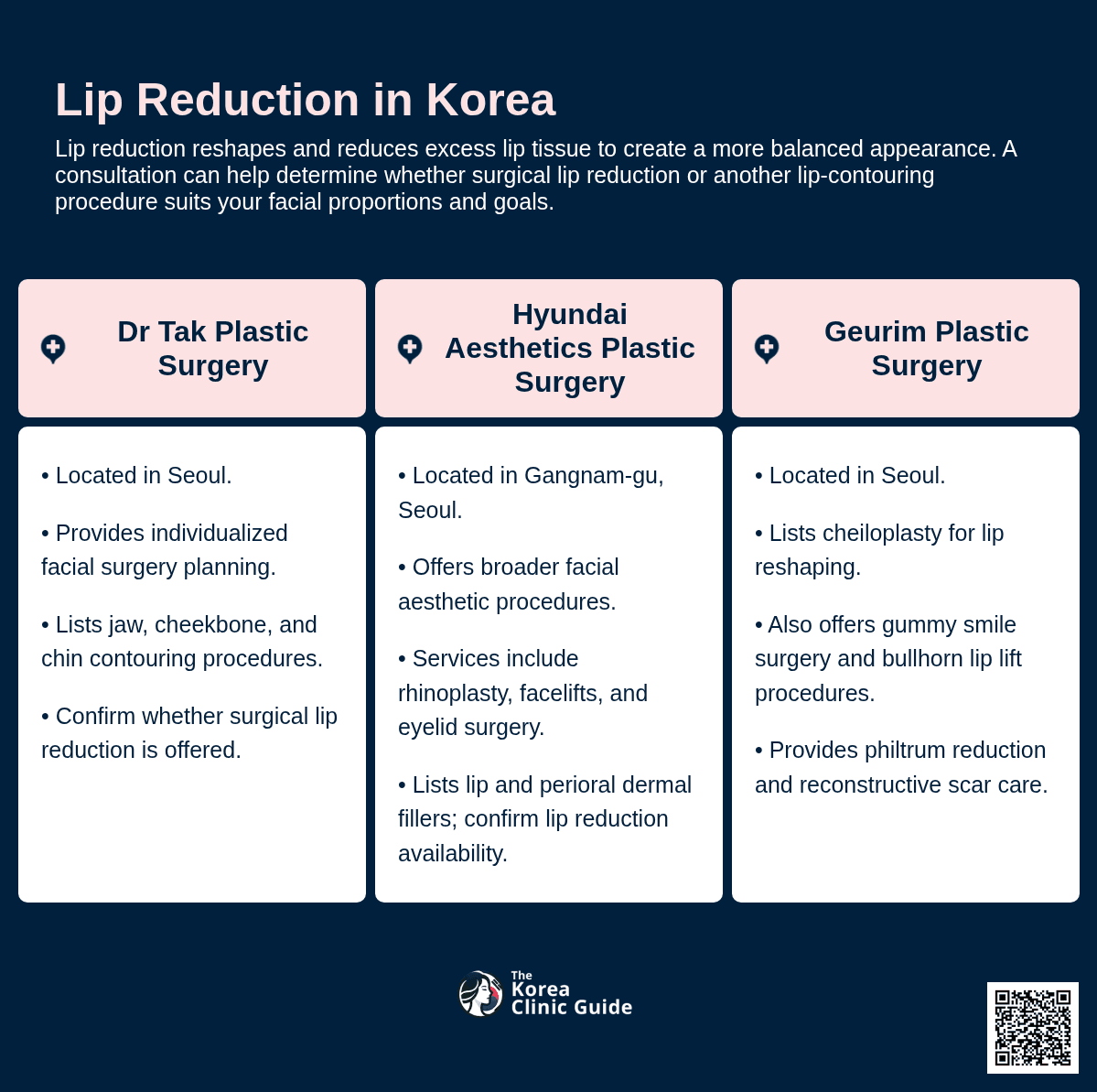
Listed below are some of the best clinics in Korea for lip reduction.
1. Dr Tak Plastic Surgery
For lip reduction, Dr Tak Plastic Surgery may be worth considering if you want a consultation that places lip proportions within your overall facial balance: the clinic describes tailored surgical plans and offers facial contouring procedures such as jaw, cheekbone, and chin surgery. Lip reduction itself is not listed in the available service information, so you should confirm whether it is offered and appropriate for your goals.
- URL: Dr Tak Plastic Surgery Website
- Location: Seoul
- Facial surgical scope:
- Facial contouring services listed include jaw reduction, cheekbone reduction, and genioplasty.
- The clinic also lists rhinoplasty, eyelid surgery, facelifts, and neck lifts.
- Planning approach: The clinic describes thorough consultations and individualized surgical plans based on your aesthetic goals.
2. Hyundai Aesthetics Plastic Surgery
Hyundai Aesthetics Plastic Surgery may suit you if you are exploring how changes to the lips would fit with broader facial balance, as its listed facial services include rhinoplasty, facelift surgery, eyelid surgery, and dermal fillers for the lips and surrounding mouth area. Surgical lip reduction is not specified in the available information, so you should confirm whether the clinic provides it and whether it matches your concerns.
- URL: Hyundai Aesthetics Plastic Surgery Website
- Location: Gangnam-gu, Seoul
3. Geurim Plastic Surgery
For lip reduction or other lip reshaping concerns, Geurim Plastic Surgery offers cheiloplasty, a procedure used to reshape the lips for appearance and function. You can also discuss related features of your smile and upper-lip proportions, since the clinic lists gummy smile surgery, bullhorn lip lift, philtrum reduction, and nasolabial-angle adjustment.
- URL: Geurim Plastic Surgery Website
- Location: Seoul
- Lip and smile procedures:
- Cheiloplasty is listed for reshaping the lips with aesthetic and functional considerations.
- Gummy smile surgery adjusts gum visibility when you smile.
- Bullhorn lip lift elevates the upper lip, while philtrum reduction shortens the space between the nose and upper lip.
- Nasolabial-angle adjustment is listed to refine the relationship between the nose and upper lip.
- Related reconstructive care:
- The clinic lists cleft lip and cleft palate surgery among its specialized procedures.
- Scar revision, burn-scar treatment, keloid removal, and acne-scar treatment are also listed.
Alternatives to Lip Reduction
The right alternative depends on why the lips appear large or unbalanced. Surgery removes true soft-tissue bulk and is difficult to reverse; non-surgical or reconstructive pathways address a different cause and do not substitute for volume reduction.
Diagnosis and medical treatment
- Inflammatory or infectious swelling — Treat allergy, infection, inflammatory disease, or a suspected syndrome before considering cosmetic excision. Persistent unexplained enlargement requires diagnostic assessment.
- Foreign-material assessment — Previous permanent filler, silicone, biopolymer, or suspected migration can require records, imaging, and specialist planning rather than routine reduction. Consider foreign body removal when clinically appropriate.
Orthodontic or jaw treatment
- Dental or skeletal protrusion — Forward teeth or jaw position can push the lips outward despite normal tissue volume. An orthodontic evaluation or protruding teeth correction is more relevant than lip excision when protrusion is the cause; substantial skeletal imbalance can warrant a double-jaw surgery assessment.
Reconstructive cheiloplasty or scar revision
- Cleft, trauma, or scar-related distortion — Reconstructive lip surgery targets function, scar contracture, and asymmetry rather than simple volume reduction. Consider cleft lip surgery or scar removal surgery when history and examination support that pathway.
Lip lift or philtrum reduction
- Long upper lip rather than excess bulk — A lip lift changes upper-lip position and visible vermilion; it does not remove substantial lip volume. Discuss bullhorn lip lift or philtrum reduction surgery when upper-lip length is the primary concern.
Fillers and augmentation
- Not a reduction substitute — Lip fillers and lip augmentation add volume or projection. They are unsuitable alternatives for true lip bulk, although dissolution or assessment can be relevant when prior injectable material is driving the appearance.
How Can I Prepare for Lip Reduction?
- Medical disclosure — Provide the surgeon with every prescription medicine, over-the-counter drug, supplement, allergy, medical condition, prior anesthesia problem, nicotine exposure, alcohol or recreational-drug use, and all prior lip injections, implants, or operations.
- Bleeding-risk medicines — Discuss anticoagulants, antiplatelet medicines, NSAIDs, aspirin, vitamin E, fish oil, and herbal supplements well before surgery. Do not stop prescribed anticoagulants or antiplatelet medicines independently; the surgeon and prescribing clinician must set the plan.
- Nicotine and alcohol — Stop smoking, vaping, nicotine pouches, patches, and gum for the period specified by the surgeon. Avoid alcohol according to the facility’s instructions, particularly around anesthesia and prescribed pain medicines.
- Oral and lip health — Report cold sores, ulcers, dental infection, gum disease, lip cracking, or recent dental work before travel. Attend surgery with a clean mouth and do not apply unapproved lip products.
- Fasting and anesthesia — Follow the facility’s exact fasting instructions when sedation or general anesthesia is planned. Local anesthesia alone does not justify assuming that normal eating and drinking rules apply.
- Accommodation and transport — Stay close enough for an urgent clinic review during the first week. Arrange a responsible adult and private transport after sedation or general anesthesia; do not drive yourself.
- Travel flexibility — Book changeable flights and avoid commitments that prevent the 1-week review. Pack cool, soft-food options and any clinic-approved oral-care items.
Travel note: Bring translated medical records where possible and ask for English discharge instructions before the operation, not only at checkout.
Confirm all medication changes, fasting rules, nicotine cessation timing, testing, companion requirements, and travel clearance criteria with the treating doctor; individualized instructions take precedence over general guidance.
Aftercare Advice
Protect the incision and avoid lip trauma during early healing; the first week has a major effect on wound closure and comfort.
- Cold compresses and elevation — Use only surgeon-approved cold compresses and keep the head elevated during the first days. Do not place ice directly on the lip or apply pressure that distorts the incision.
- Diet and oral hygiene — Follow the prescribed liquid-to-soft, cool-food diet, commonly through days 4–7. Avoid hot, spicy, acidic, hard, or sharp foods, and use the surgeon’s oral-rinse and gentle hygiene instructions after eating.
- Movement and contact — Do not bite, pull, purse, or repeatedly stretch the lips. Limit excessive smiling and wide mouth opening early on; avoid kissing, contact sports, swimming, hot tubs, and unapproved topical products until cleared.
- Activity and substances — Avoid strenuous exercise, heat exposure, alcohol when prohibited, and all nicotine until the surgeon clears them. These restrictions protect healing and reduce avoidable bleeding or wound stress.
- Review and result timing — Attend the approximately 1-week wound or suture check. Swelling often improves substantially by about 2 weeks, while scar maturation and contour settling continue for 3–6 months or longer.
- Urgent warning signs — Contact the clinic urgently for persistent or heavy bleeding, rapidly expanding or one-sided swelling, worsening pain, fever or chills, foul odor, pus-like drainage, spreading redness or warmth, wound opening, breathing or swallowing difficulty, severe new numbness, or lip discoloration.
Follow the treating doctor’s instructions over this general guidance and contact the clinic promptly when anything appears wrong.
Frequently Asked Questions
Related Blogs
Korean Gummy Smile Surgery vs. World: What Patients Pay Globally and Why Korea Excels
Discover the latest trends and costs of gummy smile surgery in Korea, a sought-after cosmetic dental procedure. Uncover why this destination is becoming a hub for affordable and high-quality treatment options.
Updated: Oct 27, 2026
Discover the Global Cost of Blood Purification: Why Korea is a Leading Choice
Discover the latest insights into the cost of blood purification treatments in Korea, a leading destination for advanced medical procedures. Explore how competitive pricing and high-quality healthcare standards are attracting international patients seeking cutting-edge solutions for their medical needs.
Updated: Oct 27, 2026
Explore Global Costs for Sweat Gland Removal: Is Korea the Best Choice for You?
Discover the costs and benefits of sweat gland removal surgery in Korea, a popular destination for medical tourists seeking affordable and effective hyperhidrosis treatment. Explore detailed breakdowns of expenses, including consultation fees, surgical costs, and post-operative care options.
Updated: Oct 27, 2026

Global Lip Plastic Surgery Costs Compared: Why Korea's Advanced Techniques Shine
Discover the allure of lip plastic surgery in Korea, where cutting-edge techniques meet affordability. Explore the varying costs, factors influencing pricing, and why Korea has become a global hub for cosmetic enhancements.
Updated: Oct 25, 2026
Clinics offering Lip Reduction
Respect Plastic Surgery: Premier Facial Rejuvenation and Aesthetic Procedures in Korea
Gangnam Station

Dr Tak Plastic Surgery Korea: Advanced Facial, Eye, Nose, Anti-Aging & Body Procedures in Seoul
Seocho

Lush Plastic Surgery: Premier Aesthetic Clinic in Korea for Tailored, Safe, and Cost-Effective Treatments
Apgujeong

Hyundai Aesthetics Plastic Surgery: Leading Plastic Surgery Clinic in Korea for Face, Body, Breast Procedures and Non-Surgical Treatments
Sinsa