
Medical Tourism Blog
Clear Aligners in Korea: Treatment Process, Travel Planning, Costs of Time, and Aftercare
Table of contents
- Clear Aligners at a Glance
- What Are Clear Aligners?
- Who Is a Good Candidate for Clear Aligners?
- How Are Clear Aligners Performed?
- Why Visit Korea for Clear Aligners?
- Key Information for International Patients
- Which Are the Best Clinics in Korea for Clear Aligners?
- Clear Aligners From Start to Finish
- Alternatives to Clear Aligners
- How Can I Prepare for Clear Aligners?
- Aftercare Advice
Considering treatment in Korea? Everything you need to know e.g. — how to avoid scams, visas, interpreters, recovery tips — in our Medical Tourism Master Guide. Plan with confidence in minutes, not weeks!
Last updated: September 2026
Clear Aligners at a Glance
- What it does — Clear aligners are custom, removable transparent trays that gradually move teeth to address mild to moderate crowding, gaps, crooked teeth, and selected bite problems.
- Daily commitment — Each tray typically must be worn at least 22 hours per day, removed for food and all drinks except water, and changed only on the orthodontist’s schedule.
- Best candidates — Suitable candidates have healthy teeth and gums, reliable hygiene habits, and the ability to wear trays consistently; cavities, infection, and active gum disease should be treated first.
- Treatment duration — Results develop over months rather than immediately; simple alignment may take months, while bite correction, extraction mechanics, and refinement stages can take substantially longer.
- No routine downtime — There is no surgical recovery or usual work restriction; pressure, tenderness, and temporary speech changes are often most noticeable for 1–3 days after a new tray or attachment placement.
- Complex-case limitation — Fixed braces or hybrid treatment may be more predictable for extraction cases, severe rotations, major vertical movements, difficult root control, strong anchorage needs, or skeletal jaw discrepancies.
- Korea travel planning — Plan at least 2–4 business days initially, but this is not usually a one-trip treatment: reviews are commonly needed every 6–10 weeks, fabrication can take up to about 6 weeks, and a written home-country handover plan is essential.
What Are Clear Aligners?
Clear aligners are custom-made, removable transparent trays that gradually reposition teeth through a planned series of orthodontic movements. They address crowding, gaps, crooked teeth, and selected bite concerns while offering a less noticeable alternative to traditional braces. Clear-aligner treatment is non-surgical, though some plans include small attachments, enamel reshaping, or elastics to guide movement.
Who Is a Good Candidate for Clear Aligners?
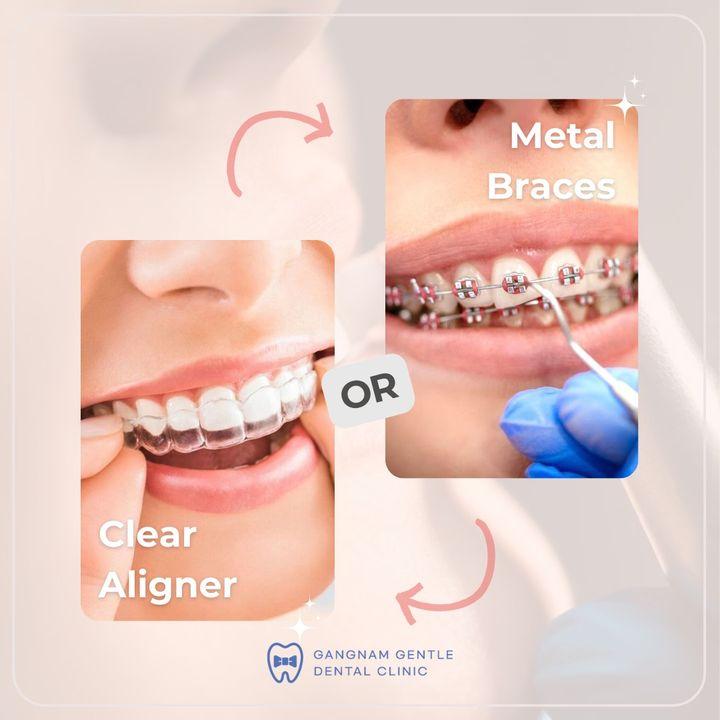
- Mild to moderate alignment concerns — Good candidates want to correct crowding, gaps, crooked front teeth, or selected overbite, underbite, open-bite, and crossbite problems with removable transparent trays.
- Reliable full-time wearers — Clear aligner therapy requires wearing each tray for at least 22 hours daily, removing it for meals, cleaning teeth before reinsertion, and changing trays only on the orthodontist’s schedule.
- Healthy teeth and gums — Candidates have stable gum health, no untreated cavities or infection, and can maintain twice-daily fluoride brushing plus daily cleaning between teeth.
- Patients open to auxiliaries — Attachments, buttons, interarch elastics, or interproximal reduction (IPR, small planned enamel reduction) are often needed for predictable movements and bite correction.
Active periodontitis, gingival inflammation, cavities, dental infection, poor plaque control, unexplained loose teeth, active root resorption, and major dental trauma require assessment and treatment before orthodontic movement starts. Severe skeletal jaw discrepancies, impacted teeth, difficult rotations, large vertical movements, and extraction or anchorage-heavy cases often respond more predictably to fixed braces, hybrid mechanics, or double-jaw surgery. Children and adolescents need an assessment of growth and tooth eruption; aligners suit some growing patients but are not automatically the best appliance. Pregnancy is not usually a contraindication, but discuss radiographs, nausea-related hygiene problems, periodontal inflammation, and any elective dental work with the orthodontist and prenatal team.
How Are Clear Aligners Performed?
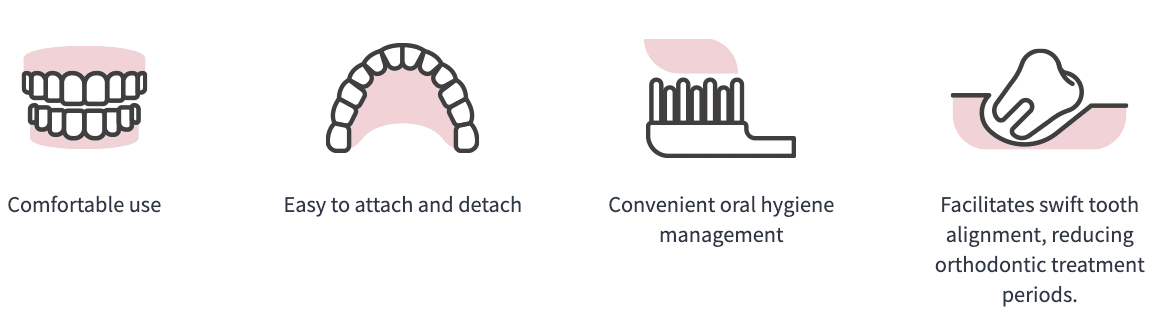
Clear aligners are custom-made sequential trays, but the treatment approach changes substantially with the bite problem, planned tooth movement, and need for additional mechanics.
- Limited anterior alignment — Focuses on a small number of visible teeth with minor crowding or spacing. It does not automatically correct the back-teeth bite and can be inappropriate when cosmetic straightening would create a poor functional bite.
- Comprehensive upper-and-lower treatment — Moves teeth across both arches and addresses selected bite relationships. This is the usual approach when crowding, spacing, arch coordination, and bite correction are interconnected.
- Attachment-assisted aligners — Tooth-colored composite attachments give trays grip for rotations, root control, extrusion, and other difficult movements. They are functional orthodontic components, not optional cosmetic additions.
- Hybrid mechanics — Buttons and elastics can guide upper-to-lower bite correction; IPR creates controlled space; temporary anchorage devices or a period of fixed braces can be added where aligners alone are not sufficiently predictable.
- Refinement stage — A new scan and additional trays are used when teeth do not fully track the planned movement or when the finish needs adjustment. Refinement is common and does not by itself indicate an error.
Why Visit Korea for Clear Aligners?
Korea is worth considering for its established international-patient administrative framework, not because evidence shows clear aligners work better there than elsewhere. Clear-aligner success depends on diagnosis, case selection, wear adherence, hygiene, and sustained orthodontic supervision. For an overseas patient, the decisive issue is whether the clinic has a credible cross-border monitoring and handover plan.
- Registered foreign-patient providers — Use the Medical Korea registered-provider system to verify the clinic itself rather than relying on a broker or marketing statement. Registered institutions serving foreign patients operate within Korea’s foreign-patient framework.
- Required patient information and safeguards — Korea’s framework requires disclosure to foreign patients of the diagnosis, planned treatment, potential adverse effects, estimated charges or contract terms, and dispute-resolution process; Medical Korea also describes malpractice liability-insurance requirements for registered providers.
- Digital orthodontic records — Digital scans, photographs, bite records, and treatment simulations can support planning and remote communication. They do not replace clinical examinations of gum health, bite contacts, tracking, and tooth movement.
- Important evidence limit — No high-quality procedure-specific evidence establishes superior clear-aligner outcomes in Korea. Comparative evidence instead supports matching the appliance to complexity and adherence: a 2025 systematic review and meta-analysis found no significant overall difference in treatment quality or duration for non-extraction cases, while fixed appliances had better treatment quality in extraction cases.
Key Information for International Patients
- Minimum initial stay — Plan 2–4 business days for examination, X-rays or indicated radiographs, photographs or digital scans, records review, consent, and, when trays are ready, attachment placement and delivery.
- Manufacturing and return visits — Fabrication after scanning can take up to about 6 weeks in some practices. A second Korea visit can be needed for fitting, IPR, attachments, or a refinement scan; orthodontic reviews are commonly scheduled every 6–10 weeks.
- Not a one-trip treatment — Simple alignment still takes months, while bite correction, extraction mechanics, and refinements take longer. Arrange regular return care or written acceptance of handover by a licensed orthodontist at home before paying for treatment.
- Flight timing — Standard scans, IPR, attachment bonding, and tray delivery do not involve incisions, general anesthesia, or routine sedation. Air travel is generally possible the same day when feeling well; carry the current and previous trays in hand luggage.
- Work and itinerary impact — There is no routine downtime. Mild pressure, tenderness, and temporary speech changes are often strongest for 1–3 days after a new tray or attachment placement, but normal work, walking, and non-contact exercise can usually continue immediately.
- Remote follow-up — Remote scans or photographs can support communication, hygiene reminders, and adherence, but do not universally replace in-person assessment. A systematic review of tele-orthodontics found communication benefits while also noting suboptimal real-world removable-appliance wear.
Travel note: Obtain English copies of the scan, radiographs, periodontal charting, treatment simulation, aligner prescription, attachment and IPR chart, tray-change schedule, consent, and emergency contact details before leaving Korea. Confirm in writing whether international tray shipping is lawful and clinically supported where you live.
Which Are the Best Clinics in Korea for Clear Aligners?
Listed below are some of the best clinics in Korea for clear aligners.
1. Gangnam Gentle Dental Clinic
For clear aligners, you can expect a personalized orthodontic plan shaped by a thorough consultation and digital examination at Gangnam Gentle Dental Clinic. The clinic emphasizes providing only necessary treatment, with an approach intended to reduce treatment time and the number of visits where appropriate; Dr. Travis Kim also speaks fluent English, which may make discussions about your plan more straightforward.
- URL: Gangnam Gentle Dental Clinic Website
- Location: Seocho-gu, Seoul
- Clear-aligner care:
- Clear aligners are offered as transparent orthodontic devices used to adjust tooth position.
- Treatment is described as customized to your individual needs, following a thorough consultation.
- The clinic’s research and development focus includes reducing treatment duration and unnecessary visits.
- Practical considerations:
- Weekday and weekend availability is described, which may help with scheduling around your stay or routine.
- An established infection-prevention and sterilization system is described.
- Digital equipment is used for systematic, precise examinations, with an emphasis on comfort and minimal pain.
- Related dental care:
- You can also access cavity treatment, gum treatment, root-canal care, wisdom-tooth extraction, TMJ care, and emergency dental treatment if these needs arise during your orthodontic planning.
- Cosmetic options include minimal-shaving veneers, gum contouring, and teeth whitening.
2. Minish Dental Hospital
You may consider Minish Dental Hospital if you want clear-aligner planning within a large Gangnam dental setting that provides orthodontic treatment alongside restorative, periodontal, and jaw-related care. Its in-house laboratory and technology company, 19 advanced dental devices, and team that includes orthodontic specialists may be useful when your tooth alignment needs to be considered as part of a broader smile or oral-health plan.
- URL: Minish Dental Hospital Website
- Location: Gangnam-gu, Seoul
- Orthodontic setting:
- Orthodontic treatment is available for improperly positioned teeth and jaws, with goals that include improved oral function and appearance.
- The clinic reports a team of 102 dentists and technicians, including orthodontic, veneer, and general dental specialists.
- An in-house laboratory and affiliated technology company support the clinic’s dental work and research and development.
- Coordinated dental services:
- Related services include cavities and prosthodontics, periodontal therapy, teeth whitening, and care for bruxism and TMJ concerns.
- Minish veneers and other restorative options are available if your treatment plan also addresses damaged, discolored, or missing teeth.
- International access:
- The facility states that it serves expats and international visitors without language barriers.
- The clinic operates in a 14-floor facility and describes individualized treatment plans.
3. Blanche Dental Clinic
At Blanche Dental Clinic, you can explore customized teeth-straightening treatment for misaligned teeth and jaw discrepancies, with attention to both appearance and dental health. If you are considering clear aligners, the available information supports asking how the clinic’s individualized orthodontic solutions apply to your specific alignment goals.
- URL: Blanche Dental Clinic Website
- Location: Seocho-gu, Seoul
- Orthodontic care:
- Customized teeth-straightening solutions are available for different age groups.
- Treatment is intended to address misaligned teeth and jaw discrepancies while supporting both function and appearance.
- Related aesthetic options:
- Professional teeth whitening is designed to provide noticeable brightening in a single visit.
- Gum contouring and gummy-smile treatment are available for gum-line and smile-balance concerns.
- Laminates are described as a non-invasive, same-day option that does not require anesthesia or temporary teeth.
- Comfort options: Sedation treatment is available for dental procedures, including aesthetic treatments, for a more relaxed experience.
Clear Aligners From Start to Finish
- Remote pre-screening — Send requested photographs, dental history, previous orthodontic records, and goals through an English-speaking coordinator or virtual consultation where available. This is preliminary only; photographs cannot diagnose gum disease, root conditions, or bite mechanics.
- In-person orthodontic examination — The orthodontist assesses tooth position, bite, gums, cavities, restorations, jaw joints, oral hygiene, and indicated radiographs. Active disease is stabilized before tooth movement begins.
- Records and treatment planning — The clinic takes photographs, bite records, and a digital scan or impressions. The orthodontist determines whether treatment needs IPR, attachments, buttons, elastics, fixed braces, or other auxiliaries.
- Plan review and consent — Review the digital setup, expected limits, likely duration, tray-change interval, monitoring schedule, refinement policy, retention plan, fees, and cross-border urgent-care responsibility. Do not treat a digital smile preview as a guarantee of the final bite or appearance.
- Fabrication and travel coordination — The clinic submits the approved prescription for tray production. Confirm collection timing, shipping policies, and whether a home orthodontist has agreed to take over if Korea follow-up becomes impractical.
- Fitting appointment — The clinician checks tray fit, bonds composite attachments where planned, performs IPR if indicated, fits buttons or elastics when required, and teaches insertion, removal, cleaning, and tray seating. These appointments normally require no fasting or sedation.
- Active treatment and reviews — Wear each tray as prescribed, commonly at least 22 hours daily, and attend scheduled reviews or submit remote records when directed. The orthodontist checks tracking, bite changes, gum health, and whether to advance, hold, rescan, or modify treatment.
- Refinement and completion — When planned movements are complete, the orthodontist assesses bite contacts, tooth position, gum health, and appearance. A refinement scan and extra trays are used when needed before attachment removal.
- Retention and overseas follow-up — Final records support removable and/or fixed retainer fabrication. Continue long-term retainer wear and arrange local dental and orthodontic review, because teeth can shift throughout life.
Alternatives to Clear Aligners
The main tradeoff is removability and appearance versus control of difficult tooth movements and independence from daily wear adherence. Fixed appliances are often more predictable for complex extraction, rotation, torque, and anchorage mechanics; aligners can be appropriate when the case and wear habits support them.
Fixed Braces
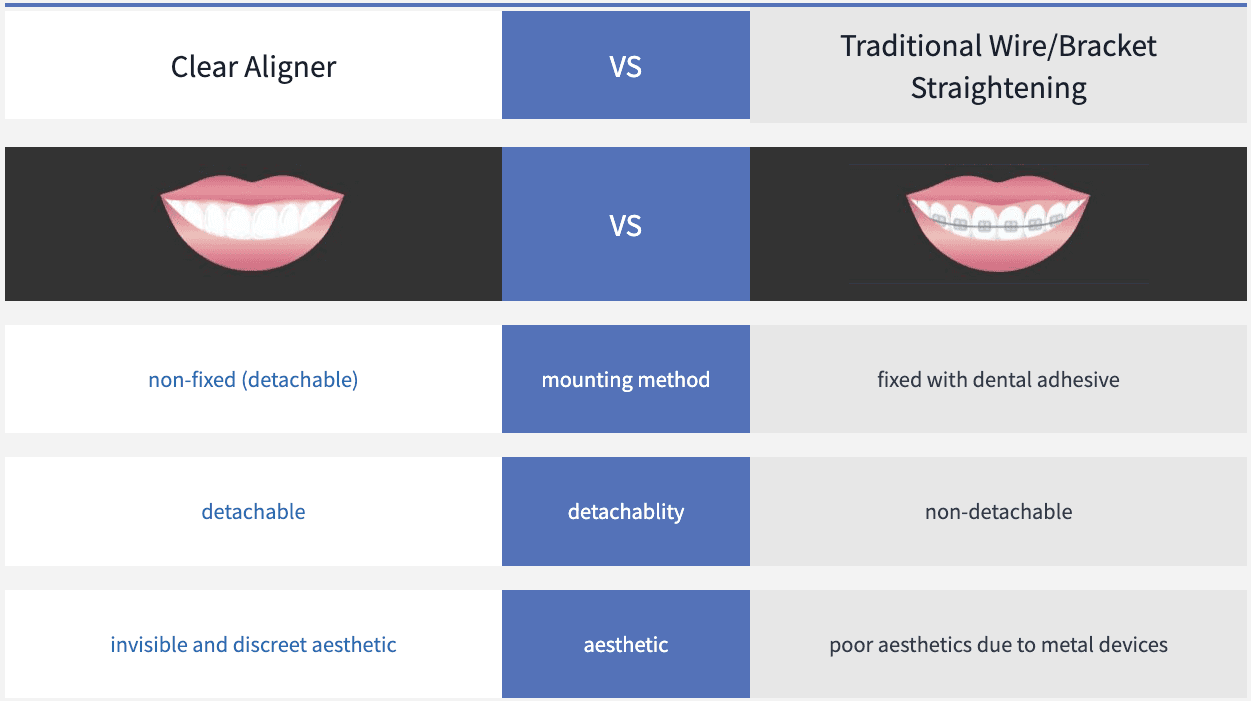
- Best fit — Suitable for complex crowding, major rotations, extraction treatment, difficult root torque, significant vertical movement, or cases needing strong anchorage.
- Evidence tradeoff — In premolar-extraction cases, a systematic review found both systems effective, but fixed appliances had better buccolingual inclination, occlusal contacts, and shorter treatment duration in the included studies.
- Related option — Read about braces.
Self-Ligating Braces
- Best fit — A fixed-brace option using a built-in clip rather than elastic ties to hold the archwire. It remains dependent on regular in-person adjustments and oral-hygiene care.
- Tradeoff — It avoids removable-tray wear requirements but does not make all complex cases faster or eliminate normal orthodontic risks.
- Related option — Read about Clippy-C braces.
Orthognathic Surgery
- Best fit — Considered for a substantial skeletal jaw discrepancy that tooth movement alone cannot correct predictably.
- Tradeoff — Surgery can change jaw position and facial skeletal relationships but requires extensive planning, surgical recovery, and orthodontics before and after surgery.
- Related option — Read about double-jaw surgery.
Veneers
- Best fit — Veneers can alter the visible shape, color, or apparent alignment of selected front teeth when orthodontic movement is not the goal.
- Tradeoff — Veneers do not correct tooth roots, crowding, or bite relationships and generally require irreversible enamel preparation. They are not a substitute for orthodontics when functional correction is needed.
- Related option — Read about veneers.
How Can I Prepare for Clear Aligners?
- Provide complete records — Share prior orthodontic records and recent dental X-rays when available, plus medical conditions, allergies, pregnancy status, gum bleeding, bruxism, smoking or vaping, dental trauma, root-resorption history, and all medicines and supplements.
- Stabilize oral health first — Complete recommended periodontal, cavity, and infection treatment before scanning or fitting. Begin active aligner treatment only when daily brushing and interdental cleaning are reliable.
- Review medicines; do not self-stop — There is no routine medication-stop rule for aligners and no routine antibiotic requirement. Antiresorptive drugs, especially bisphosphonates, are associated with reduced orthodontic tooth movement, and evidence suggests NSAIDs can reduce movement rate in a dose-dependent manner; review these and medicines affecting bone remodeling, infection, bleeding, or healing with the orthodontist and prescriber, as summarized in a systematic review.
- Fasting and sedation — Do not fast for ordinary scans, IPR, attachment bonding, or aligner delivery unless another planned procedure requires it. Routine sedation is not used.
- Pack for the journey — Keep a hard case, spare case, soft travel toothbrush, fluoride toothpaste, floss or interdental cleaners, elastics, chewies, current tray, and previous tray in carry-on luggage.
- Plan flexible logistics — Book accommodation close enough for a possible additional fitting or record appointment and keep flights flexible if tray delivery or treatment planning is delayed. A companion and special transport are not normally needed for non-sedating appointments.
- Protect trays from loss and heat — Never wrap aligners in a napkin, leave them in a hot car, clean them with hot water, or put them in a dishwasher; heat can warp clear plastic.
Travel note: Before travel, secure written answers on tray-delivery timing, monitoring frequency, refinement fees, international shipping, urgent-care responsibility, records release, termination terms, and local handover.
Confirm the treating orthodontist’s clinic-specific requirements, which take precedence over general guidance.
Aftercare Advice
Consistent wear, meticulous hygiene, and prompt reporting of fit problems protect both the planned result and the health of teeth and gums.
- Wear and seat trays correctly — Wear aligners for the prescribed daily duration, commonly at least 22 hours, and use chewies or seating instructions when provided. Do not advance, skip, or stop trays independently.
- Remove for food and drinks — Remove trays for all food and every beverage except plain water. Brush and floss, or at minimum rinse thoroughly when brushing is not possible, before reinserting; sugary and acidic drinks trapped under trays increase decay and gum-disease risk.
- Clean without damaging plastic — Rinse trays with cool or lukewarm water and use a non-abrasive cleanser. Avoid hot water, alcohol, dishwashers, and abrasive toothpaste, which can warp or scratch the trays.
- Use elastics and hygiene tools — Wear elastics exactly as directed, brush twice daily with fluoride toothpaste, clean between teeth daily, and continue routine professional hygiene appointments.
- Act on problems promptly — Contact the orthodontist for a fallen attachment, cracked or lost tray, tray that no longer seats, unusual tooth mobility, severe pain, or worsening gum inflammation. For facial swelling, fever, pus, uncontrolled bleeding, trauma, suspected allergy, or difficulty swallowing or breathing, seek urgent dental or medical assessment.
- Protect the final result — Final appearance and bite are assessed only after planned movements and any refinement are complete. Wear removable and/or fixed retainers as prescribed; a retainer that cracks, warps, loosens, or stops fitting needs prompt review because teeth can move throughout life, as explained by the American Association of Orthodontists.
Follow the treating doctor’s individualized instructions and contact the clinic promptly when something appears wrong.
Frequently Asked Questions
Related Blogs
Teeth Crown in Korea: Types, Treatment Steps, Travel Timing, and Aftercare
Dental crowns restore weakened or damaged teeth with full coverage; treatment includes assessment, tooth preparation, scanning or impressions, temporary or CAD/CAM fabrication, fitting, and bite checks. In Korea, crowns cost ₩600,000–₩1,100,000 (about US$400–$800), and international patients should remain for final fitting and adjustment.
Updated: Sep 18, 2026
Dental Bridge in Korea: Types, Treatment Timeline, Travel Planning, and Aftercare
Dental bridges replace one or more missing teeth using crowns, bonded wings, implants, or a combination, with the final design determined by tooth, gum, bone, and bite health. The article explains candidate criteria, bridge types, treatment steps, Korea travel planning, aftercare, alternatives, and the need for local follow-up.
Updated: Sep 18, 2026

All-ceramic Veneers in Korea: Types, Treatment Steps, Travel Planning, and Aftercare
All-ceramic veneers are bonded after assessment of enamel, gums, bite, and cosmetic goals, with preparation, laboratory fabrication or CAD/CAM milling, try-in, bonding, and bite adjustment. International patients can review candidate criteria, Korea travel planning, minimum stays, records to obtain, alternatives, preparation, and aftercare requirements.
Updated: Sep 18, 2026
Inlay Filling in Korea: Materials, Treatment Steps, Recovery and Travel Planning
Inlay fillings restore moderate decay or failed fillings in molars and premolars with intact cusps through laboratory or CAD/CAM fabrication, followed by fit checks and bonding. In Korea, listed costs are ₩400,000–₩600,000 (about US$300–$400); international patients may need 3–5 business days, while some chairside CAD/CAM cases can be completed in one visit.
Updated: Sep 16, 2026
Clinics offering Clear Aligners

Minish Dental Hospital: Korea's Premier Dental Clinic Offering Advanced Treatments and Personalized Care
Sinsa

Gangnam Gentle Dental Clinic: Your Trusted Dental Care Provider in Korea Offering Comprehensive Services with Optimal Comfort and Safety
Sinnonhyeon Station

Blanche Dental Clinic in Korea: Advanced & Tailored Dental Care for a Healthy, Beautiful Smile
Nonhyeon

Yonsei Baro Dental Clinic - Premier Orthodontic and Dental Care in Korea
Apgujeong