
Medical Tourism Blog
Hyperhidrosis Botox in Korea: Treatment Areas, Results, Recovery, and Travel Planning
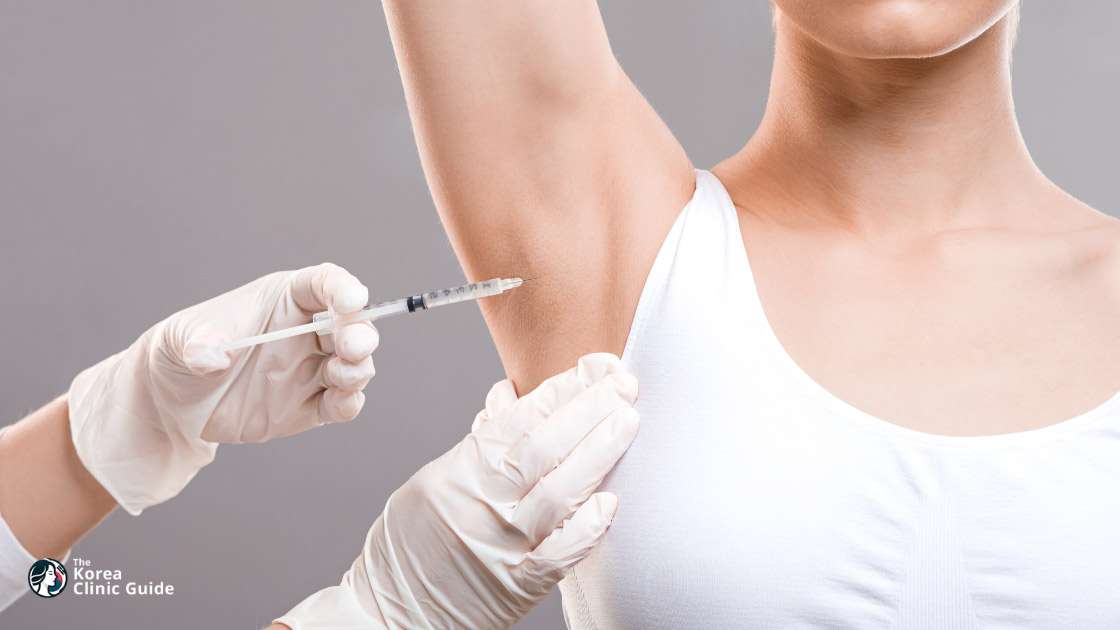
Table of contents
- Hyperhidrosis Botox at a Glance
- What Is Hyperhidrosis Botox?
- Who Is a Good Candidate for Hyperhidrosis Botox?
- How Is Hyperhidrosis Botox Performed?
- Why Visit Korea for Hyperhidrosis Botox?
- Key Information for International Patients
- Which Are the Best Clinics in Korea for Hyperhidrosis Botox?
- How Much Does Hyperhidrosis Botox Cost in Korea?
- Hyperhidrosis Botox From Start to Finish
- Alternatives to Hyperhidrosis Botox
- How Can I Prepare for Hyperhidrosis Botox?
- Aftercare Advice
Considering treatment in Korea? Everything you need to know e.g. — how to avoid scams, visas, interpreters, recovery tips — in our Medical Tourism Master Guide. Plan with confidence in minutes, not weeks!
Last updated: September 2026
Hyperhidrosis Botox at a Glance
- What it does — Superficial botulinum toxin injections temporarily block sweat-gland nerve signals in a defined area; they reduce sweating but do not remove glands or cure the underlying tendency.
- Best candidates — It is best established for severe focal underarm sweating that persists despite clinical-strength or prescription antiperspirants; palms and soles can be treated, but involve more painful injections and site-specific tradeoffs.
- Korea cost — Treatment in Korea typically costs ₩500,000–₩1,600,000 (about US$400–$1,200), with price driven by the body area, toxin product and dose, coverage, and whether anesthesia is needed.
- Results and longevity — Sweat reduction can begin within 2–4 days and is best judged at about 2 weeks; benefit is temporary, with palmar studies reporting roughly 3–12 months of effect and a weighted mean of about 6.2 months.
- Recovery — Underarm treatment usually takes 30–60 minutes, needs no admission or general anesthesia, and allows light daily activity the same day; pinprick marks, tenderness, bruising, or swelling usually settle within days.
- Travel planning — Allow 1–2 days in Korea for a straightforward underarm visit, but a 7–14-day stay is preferable for local response review; hand or foot treatment may require a nerve block and can temporarily limit gripping, driving, or long walks.
- Key Korea distinction — Korea offers imported and domestic toxin products, but their units and indications are not interchangeable; request the exact product name, lot number, total dose, dilution, and injection map, and confirm whether the planned site is labeled or off-label.
What Is Hyperhidrosis Botox?
Hyperhidrosis Botox uses small, superficial botulinum toxin injections to temporarily reduce excessive sweating in specific body areas. It helps people manage focal sweating that affects clothing, comfort, grip, walking, work, or social confidence. It is a minimally invasive treatment, performed without surgery or sweat-gland removal.
Who Is a Good Candidate for Hyperhidrosis Botox?
- Underarm symptoms — Good candidates have focal underarm sweating that soaks clothing, causes skin irritation, or interferes with work and social life despite clinical-strength or prescription antiperspirants.
- Hand or foot sweating — Palmar or plantar treatment suits people whose sweating affects grip, handwriting, device use, footwear, walking, or skin health and who accept the greater discomfort of these injection sites.
- Defined focal areas — Selected patients seek treatment for the scalp, forehead, face, groin, or inframammary folds, where treatment requires conservative, anatomically precise dosing.
- Temporary control preference — Botulinum toxin is appropriate for people who prefer a reversible treatment over sweat-gland destruction or surgery and understand that repeat sessions are needed when sweating returns.
Primary focal hyperhidrosis is typically bilateral and relatively symmetric, begins in childhood or adolescence, and does not occur during sleep. New adult-onset, generalized, one-sided, nocturnal, or systemic-symptom-associated sweating needs medical assessment for a secondary cause before injections. Do not treat active infection, cellulitis, dermatitis flare, or open skin at the injection site. Elective treatment is generally deferred during pregnancy or breastfeeding; people with myasthenia gravis, Lambert-Eaton syndrome, ALS, or significant peripheral motor neuropathy need specialist review, while palmar candidates whose work depends on maximum grip strength must weigh temporary hand weakness carefully.
How Is Hyperhidrosis Botox Performed?
Treatment is tailored to the sweating area rather than chosen from fixed consumer-facing types. The product, dose, dilution, injection depth, grid spacing, and anesthetic plan are individualized; botulinum-toxin units are product-specific and cannot be converted casually between brands.
- Axillary grid injections — The clinician maps the active underarm sweat field, often using the Minor starch-iodine protocol, then places shallow intradermal injections about 1–2 cm apart. The established onabotulinumtoxinA protocol uses 50 units per axilla across 10–15 sites.
- Palmar injections — Numerous small injections cover the sweating surface of each palm. Cooling, topical anesthetic, vibration, or median and ulnar nerve blocks can improve comfort, but a hand block can leave the hand temporarily numb or weak.
- Plantar injections — A multi-injection pattern covers the sole, sometimes with cooling or regional anesthesia. Injection pain and tenderness while walking are the main practical limitations.
- Craniofacial and other focal sites — Small, individualized intradermal doses are placed across the mapped area. Evidence is less standardized outside the underarms, and placement around facial muscles demands particular care because diffusion can cause unwanted weakness, including eyelid droop.
- Product documentation — “Botox” is commonly used as a generic term, but it is the brand name for onabotulinumtoxinA. Request the exact product name, lot number, total units, dilution, and injection map for future treatment planning.
Why Visit Korea for Hyperhidrosis Botox?
Korea offers both imported and domestically manufactured botulinum toxin products. For hyperhidrosis, the important issue is not a country-based claim of better results, but correct diagnosis, appropriate site-specific technique, and transparent product documentation. There is no high-quality evidence that treatment in Korea delivers longer-lasting sweat reduction or fewer complications than equivalent evidence-based treatment elsewhere.
- Korean-listed axillary indication — The Korean drug-information listing for Botox Injection includes primary axillary hyperhidrosis. This supports an axillary indication for that named product, not for every toxin available in Korea; ask whether the proposed product and treatment site are within current Korean labeling or an off-label clinical use.
- Product choice requires clarity — Korean practice includes several toxin products, but their units, evidence base, and approved indications are not interchangeable. A clinic should identify the exact formulation rather than quoting a dose simply as “Botox units.”
- Structured medical-tourism access — Korea’s official Medical Korea platform provides international-patient information. Arrange an English consultation before travel and confirm the clinic’s process for records, consent, and overseas follow-up.
- Evidence boundary — Axillary disease has the strongest evidence base. Studies of palms, soles, scalp, face, groin, and inframammary skin are smaller and more heterogeneous, so no clinic should promise the same outcome or duration across every body site.
Key Information for International Patients
- Minimum stay — Allow 1–2 days for a straightforward underarm consultation, mapping, injections, and brief observation. Underarm treatment usually does not require admission or general anesthesia.
- Best review window — Sweat reduction often begins within 2–4 days, but assess the practical response at about 2 weeks. A 7–14-day stay is preferable when feasible because it allows a local review of residual sweating or incomplete coverage.
- Hands and feet need extra planning — Palmar and plantar treatment involves more injections and is usually more painful. A nerve block can improve comfort but requires avoiding demanding hand use, long walking days, and driving while numbness or weakness persists.
- Flight timing — There is no evidence-based prohibition on flying after uncomplicated intradermal underarm injections. Flying home immediately, however, removes the option of an in-person 1–2-week assessment; confirm timing with the treating clinician.
- Itinerary impact — Light sightseeing is generally realistic after underarm treatment. Schedule sauna visits, hot yoga, vigorous exercise, long hikes, and activities that heavily use treated hands or feet after the first 24 hours.
- Remote follow-up — Leave Korea with an English-language summary stating the product, lot number, total dose, dilution, treated sites, injection map, and urgent-contact instructions. Keep this record for the next injector.
Travel note: Build flexibility into flights and work commitments. The effect is temporary and response depends on body site, formulation, dose, mapped coverage, disease severity, and prior treatment history.
Which Are the Best Clinics in Korea for Hyperhidrosis Botox?
Listed below are some of the best clinics in Korea for hyperhidrosis botox.
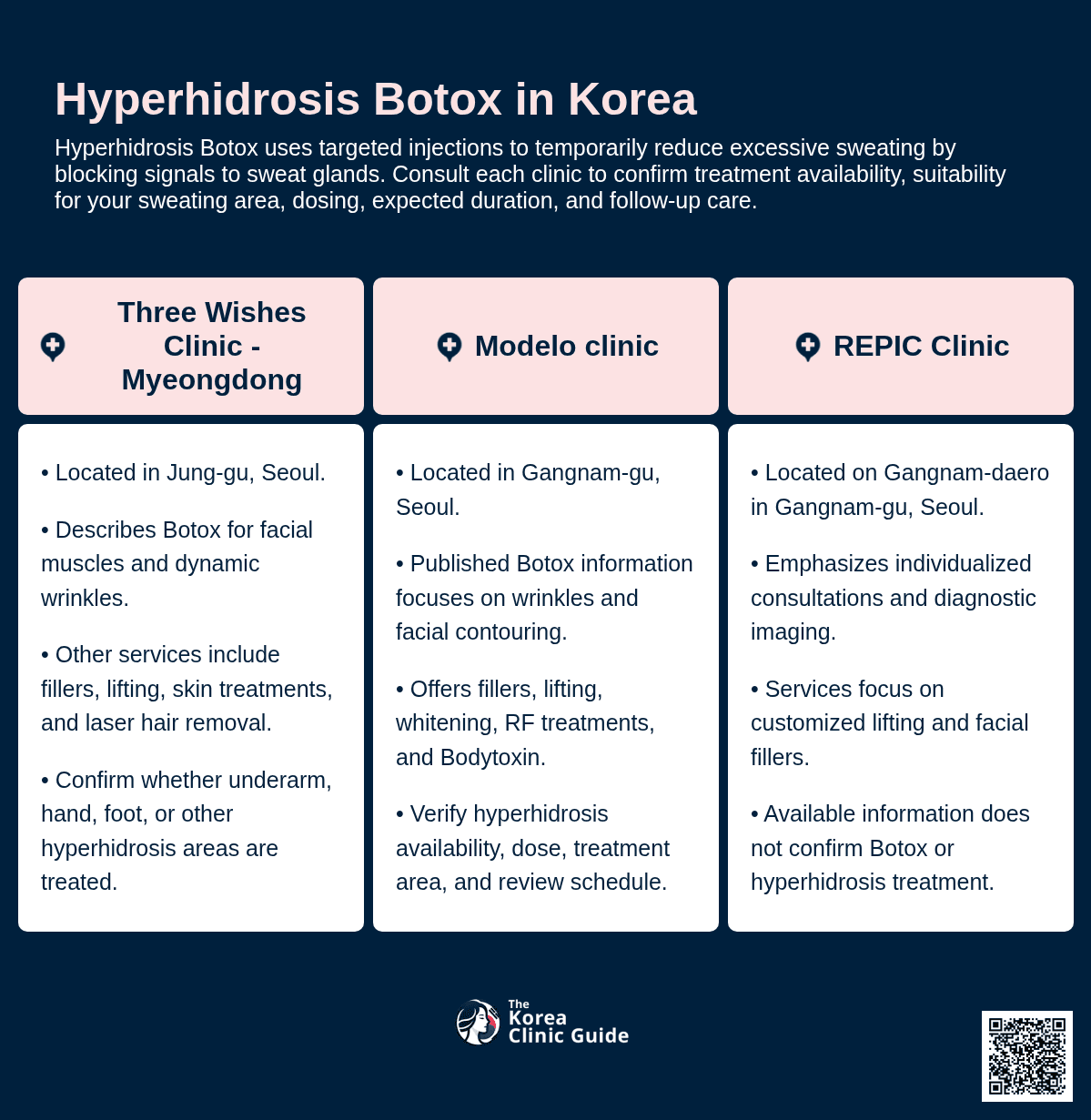
1. Three Wishes Clinic - Myeongdong
You may consider Three Wishes Clinic - Myeongdong if you want to ask whether its Botox service can be adapted for hyperhidrosis, but the available clinic information specifically describes Botox for relaxing facial muscles and treating dynamic facial wrinkles rather than excessive sweating. Confirm that hyperhidrosis treatment for your intended area is offered and discuss suitability, dosing, expected duration, and follow-up directly with the clinic.
- URL: Three Wishes Clinic - Myeongdong Website
- Location: Jung-gu, Seoul
- Botox context:
- The clinic describes Botox as an injectable treatment that relaxes facial muscles to soften dynamic wrinkles, including crow’s feet and forehead lines.
- The provided information does not confirm Botox treatment for underarm, hand, foot, or other sweating concerns.
- Other available services: Its listed aesthetic services include fillers, fat-dissolving injections, thread lifting, skin treatments, laser hair removal, and semi-permanent makeup.
2. Modelo clinic
You may consider Modelo Clinic for a hyperhidrosis Botox consultation if you value an approach centered on your individual goals, though its published Botox information focuses on wrinkle treatment and facial contouring rather than excessive sweating. Before booking, verify that it treats your specific sweating area and ask how the treatment plan, dose, anticipated effect, and review schedule would be tailored to you.
- URL: Modelo clinic Website
- Location: Gangnam-gu, Seoul
- Botox information provided:
- Wrinkle Botox is described as targeting wrinkles and fine lines, with an approach optimized for Asian skin and facial structures.
- Contour Botox is described as a facial reshaping and definition treatment designed for balanced facial aesthetics.
- The available information does not specifically list Botox for hyperhidrosis.
- Related clinic services: The clinic also lists facial fillers, lifting treatments, whitening treatments, radiofrequency-based Comfort Thermage, thread lifting, and Bodytoxin.
3. REPIC Clinic
You may consider REPIC Clinic if you want a clinic that emphasizes individualized consultation, diagnostic imaging, and customized aesthetic planning, but the available information does not confirm that it offers Botox or Botox treatment for hyperhidrosis. Ask the clinic directly whether it treats excessive sweating in your intended area and whether its assessment process applies to this concern.
- URL: REPIC Clinic Website
- Location: Gangnam-gu, Seoul, Republic of Korea 2F, 318, Gangnam-daero
- Consultation and planning:
- 3D Facial Analysis & Diagnosis using MetaView is described as evaluating facial balance and structural features and helping measure changes over time.
- Personalized treatment planning combines clinical observation and diagnostic tools to build step-by-step programs for selected concerns.
- Services described:
- The listed services focus on custom lifting and customized facial filler treatments.
- The provided information does not list Botox, hyperhidrosis treatment, or a lead clinician.
How Much Does Hyperhidrosis Botox Cost in Korea?
Hyperhidrosis Botox costs range from ₩500,000 to ₩1,600,000 (approximately US$400–$1,200). Individual quotes vary because the treatment plan can require different body areas, toxin quantities, injection coverage, and anesthesia arrangements.
| Procedure Price | Korean Won (₩) | USD ($) |
|---|---|---|
| Low Price | ₩500,000 | $400 |
| High Price | ₩1,600,000 | $1,200 |
Exchange rate as of 2026-09-06: 1 KRW = 0.000741 USD.
What Affects the Price?
- Treatment area and coverage — Underarm treatment uses a defined intradermal grid, while palms, soles, scalp, face, groin, or other focal sites require different mapping and coverage. Treating more than one area or a larger active sweat field requires more injections, toxin, and procedure time.
- Toxin product and total dose — The exact botulinum toxin product and total units are part of the treatment plan. Units are product-specific and cannot be converted casually across brands; the chosen product, required dose, dilution, and number of injection points determine the medication and consumable requirements.
- Palmar or plantar anesthesia planning — Hands and feet generally need many more painful injections than underarms. Cooling, topical anesthetic, or a median/ulnar or regional nerve block may be used, adding anesthetic supplies, clinical time, and—when a hand block is used—brief observation and recovery planning.
- Mapping and response review — A Minor starch-iodine test can be used to identify the active sweat field before creating the injection grid. A planned 1–2-week reassessment or clinician-directed touch-up assessment also requires follow-up resources, particularly when residual sweating reflects incomplete coverage of the mapped area.
Cost tip: Request an itemized quote stating what is included, including the exact toxin product, total dose, treatment areas, mapping, anesthesia or nerve block if planned, injections, observation, follow-up, and any touch-up assessment.
The US$400–$1,200 conversion is approximate, based on the 2026-09-06 exchange rate of 0.000741 KRW per USD. Check the exchange rate again when budgeting.
Hyperhidrosis Botox From Start to Finish
- Remote inquiry and consultation — Send the clinic a clear history of affected areas, onset, symmetry, night sweating, prior treatments, medicines, allergies, pregnancy status, neuromuscular conditions, and past toxin records. Confirm English communication and whether the intended site is axillary, palmar, plantar, or another focal area.
- Clinical assessment — At the appointment, the clinician reviews functional impact, triggers, medication changes, and signs of secondary hyperhidrosis. An HDSS severity score and examination can document severity; generalized, asymmetric, nocturnal, or systemic sweating warrants medical investigation rather than immediate symptom suppression.
- Mapping and treatment plan — The clinician identifies the active sweat field, often with a Minor starch-iodine test for underarms. Discuss the exact toxin product, total units, expected coverage, anesthetic options, site-specific risks, and whether the use is off-label.
- Skin preparation and anesthesia — The skin is cleaned and dried. Underarms usually need no sedation. Palms and soles may require topical anesthetic, cooling, vibration, or a regional nerve block; fasting is unnecessary unless the clinic plans sedation.
- Intradermal injections — Very small toxin aliquots are injected superficially in a grid across the mapped area. Underarm treatment generally takes 30–60 minutes including assessment, consent, mapping, and injections; hands and feet often take longer because of anesthetic planning and injection number.
- Discharge and early monitoring — Most people leave shortly after treatment and can resume light daily activity that day. Expect pinprick marks, small raised wheals, tenderness, minor bruising, or swelling for hours to a few days.
- Response review — Improvement can start in 2–4 days. Review the response at around 1–2 weeks, when residual sweating can be assessed for incomplete treatment-field coverage and clinician-directed adjustment.
- Overseas follow-up — Contact the clinic remotely if concerning symptoms occur and retain the procedure record. Repeat treatment is performed when meaningful sweating returns, rather than automatically on a fixed schedule.
Alternatives to Hyperhidrosis Botox
Non-surgical options preserve reversibility but often require ongoing maintenance. Underarm sweat-gland reduction procedures can be more durable, while surgery carries substantially greater and less reversible risks; palms and soles have different practical options from underarms.
Topical and Oral Medicines
- Antiperspirants — Aluminum- or zirconium-based products are common first-line choices for axillary disease. The current axillary treatment algorithm starts with topical antiperspirants and includes botulinum toxin A as a subsequent or alternative pathway.
- Topical anticholinergics — Glycopyrronium cloths and sofpironium gel are underarm-focused options. Dry mouth and blurred vision can occur, especially after transfer to the eyes or systemic absorption.
- Oral anticholinergics — Oxybutynin or glycopyrrolate can help multifocal sweating but need clinician oversight because dry mouth, constipation, blurred vision, urinary retention, overheating risk, and cognitive effects can limit use.
Iontophoresis
- Best role — This noninvasive electrical-water treatment is especially relevant for hands and feet. It requires repeated sessions and maintenance, but a recent palmar review found moderate efficacy with relatively few side effects.
miraDry
- Underarm-only tradeoff — miraDry uses microwave thermolysis to reduce underarm sweat glands and is not used for palms or soles. It aims for a more durable underarm effect than injections but can require a second session and has a different recovery and adverse-effect profile.
Local Sweat-Gland Reduction
- More durable procedural choices — Hyperhidrosis laser treatment, sweat-gland removal, and axillary liposuction are underarm-focused approaches. Curettage, laser, and liposuction-based methods have procedural and surgical risks, but the axillary guideline lists local sweat-gland ablation after unsatisfactory responses to less invasive treatments.
Endoscopic Thoracic Sympathectomy
- Surgical last-line option — Hyperhidrosis surgery is sometimes considered for carefully selected, refractory severe palmar disease. Compensatory sweating is a major risk, so it is not a simple permanent substitute for toxin injections.
How Can I Prepare for Hyperhidrosis Botox?
- Medical history — Provide a full medication and supplement list, allergies, prior toxin records, prior hyperhidrosis evaluation, neuromuscular history, pregnancy or breastfeeding status, and details of sweating during sleep or systemic symptoms.
- Medication review — Do not independently stop anticoagulants, antiplatelet drugs, or chronic medicines. Ask the injector and prescribing clinician whether adjustment is appropriate; disclose aminoglycoside antibiotics, muscle relaxants, sedatives, anticholinergics, and other drugs that affect neuromuscular transmission.
- Bruising-related supplements — Report NSAIDs, fish oil or omega-3 products, vitamin E, ginkgo, garlic supplements, and ginseng. Whether to pause any product depends on medical history and prescriber advice.
- Treatment-area care — Arrive with clean, dry underarms. Follow the clinic’s instructions on deodorant, antiperspirant, and shaving; avoid shaving immediately beforehand because irritated skin can make injections less comfortable.
- Food and alcohol — Fasting is normally unnecessary for ordinary underarm injections without sedation. Follow exact fasting instructions if oral anxiolysis, sedation, or a nerve block is planned, and avoid alcohol when the clinic advises because it can increase bruising risk.
- Transport and schedule — Routine underarm injections do not normally require an escort. Arrange an escort or taxi and do not drive after sedatives or while a hand block leaves the hands numb or weak; keep flights and intensive activities flexible.
Travel note: For palmar treatment, do not schedule luggage handling, manual work, or an immediate long-haul flight after a nerve block. Protect numb hands from heat and sharp objects.
Confirm the treating doctor’s clinic-specific preparation requirements, which take precedence over general guidance.
Aftercare Advice
Protect the treated skin and allow the toxin response to develop; do not judge the final sweat reduction on the day of injections.
- Activity — Resume light daily activity the same day. Avoid strenuous exercise, sauna, hot yoga, and heavy sweating for about 24 hours; these restrictions are largely clinic-protocol based and intended to limit irritation, bleeding, and bruising.
- Contact and grooming — Do not rub, massage, aggressively exfoliate, or shave the treated area for roughly 24 hours. Keep the skin clean and resume deodorant or antiperspirant on the clinic’s schedule.
- Discomfort — Use a cool compress for tenderness or swelling only if the clinician approves it. Ask about pain relief; acetaminophen/paracetamol is often preferred when bruising is a concern, but individual medical advice controls.
- Hands and feet — After palmar injections or a hand block, avoid heavy gripping and protect numb or weak hands from burns, cuts, and injury. After plantar treatment, wear comfortable footwear and reduce prolonged walking when tenderness affects gait.
- Results and review — Improvement often starts in 2–4 days and should be assessed at around 2 weeks. The duration is variable; a systematic review of palmar treatment reported 3–12 months of benefit, with a weighted mean of about 6.2 months for botulinum toxin A across heterogeneous studies.
- Warning signs — Seek urgent care for difficulty breathing, swallowing, or speaking, generalized weakness, or significant allergic symptoms. Contact the clinic promptly for fever, spreading redness, pus, severe swelling, fainting, facial weakness after facial treatment, or troublesome grip weakness.
Follow the treating doctor’s instructions over general advice and contact the clinic promptly when anything appears wrong.
Frequently Asked Questions
Related Blogs
Neck Muscle Pain Solutions: Trapezius Botox Procedures in Korea for Effective Relief
Discover how Korea leads in Trapezius Botox treatments for neck stiffness and cervicalgia relief. This blog explains the procedure, benefits, costs, and patient outcomes of using Botox in Korea to treat trapezius muscle pain—a common cause of neck discomfort. Ideal for medical tourists, learn why Korea’s advanced clinics and affordable prices make it a top destination for neck pain relief through
Updated: Oct 8, 2026
Trapezius Hypertrophy Solutions: Trapezius Botox Procedures in Korea for Muscle Slimming and Relief
Discover how Korea leads in trapezius hypertrophy treatment with innovative procedures like Trapezius Botox (Trap Tox) and shoulder slimming. Ideal for those seeking relief from muscle overgrowth, pain, or aesthetic enhancement, Korea offers expert care, advanced techniques, and affordable costs. Whether addressing bulky shoulders or neck elongation, Korea’s top clinics provide safe, effective sol
Updated: Oct 7, 2026
Tension Shoulder Pain Relief in Korea: Trapezius Botox Procedures for Effective Treatment
Discover how Korea leads in Trapezius Botox treatments for chronic tension shoulder pain. This comprehensive guide covers the causes of myofascial pain syndrome, the procedure specifics, and why Korea is a top destination for medical tourists seeking pain relief and aesthetic enhancements. Learn about the safety, costs, and outstanding expertise available in Korea’s clinics, making it an ideal cho
Updated: Oct 7, 2026
TMJ Pain Relief in Korea: Masseter Botox Procedures for Effective Jaw Pain Management
Discover effective treatment options for TMJ disorders in Korea, including Masseter Botox and minimally invasive Botox procedures. Learn how Korea's advanced clinics and expert practitioners provide relief from jaw pain, headaches, and muscle overactivity associated with temporomandibular joint disorders (TMD). This blog explores the causes, symptoms, and benefits of Botox treatments for TMJ pain,
Updated: Oct 7, 2026
Clinics offering Hyperhidrosis Botox

Haru Clinic Korea | Fully-Customized Full-Face Non-Surgical Rejuvenation With Threads, Botox & Fillers
Sinsa

Three Wishes Clinic - Myeongdong, Korea: Advanced Botox, Fillers, Laser, and Skin Treatments for Confidence and Care
Myeongdong

Seojin Plastic Surgery Clinic Korea: Pioneering Advanced Cosmetic Procedures for Personalized Aesthetic Transformation
Apgujeong

Modelo Clinic Korea: Achieving Timeless Beauty with Personalized Botox, Filler, Skincare Treatments & More
Apgujeong