
Medical Tourism Blog
Migraine Headaches Treatment in Korea: Forehead Botox Procedures for Lasting Relief
Table of contents
- The Medical Solution: OnabotulinumtoxinA (Botox®) for Chronic Migraine
- Which Are the Best Clinics in Korea for Migraine Headaches?
- The Medical Tourist's Journey to South Korea
- Financial Analysis: Comparing Global Costs
- Patient Outcomes: Balancing Success and Risk
- Conclusion
- References
Considering treatment in Korea? Everything you need to know e.g. — how to avoid scams, visas, interpreters, recovery tips — in our Medical Tourism Master Guide. Plan with confidence in minutes, not weeks!
This advisory is designed for individuals exploring OnabotulinumtoxinA (Botox®) for chronic migraine, particularly those considering medical tourism in South Korea. You'll find a clear explanation of how chronic migraine differs from tension-type headache, critical for any patient seeking treatment. We outline the FDA-approved PREEMPT protocol for chronic migraine, which uses a pattern of 31 injections across seven muscle groups—a much broader and different approach than cosmetic Botox. South Korea’s strengths as a leading medical tourism destination are highlighted, with up-to-date cost comparisons, showing the savings and patient-centered services available. The report also provides a balanced review of patient outcomes, noting the significant success seen in clinical trials and testimonials, as well as a frank discussion about potential adverse effects—emphasizing that practitioner skill is central to the procedure’s safety and success. This resource aims to help you make an informed and safe decision as you consider migraine treatment abroad.
The Neurological Nature of Migraine
Migraine is much more than just a strong headache—it’s a complex neurological disorder. Its hallmark is a severe, throbbing or pulsing pain, often on one side of the head, and it’s commonly paired with nausea, vomiting, and a heightened sensitivity to light (photophobia) and sound (phonophobia). The full migraine experience unfolds in stages, starting with subtle warning signs in the prodrome (like mood changes or neck stiffness), then aura (such as visual disturbances), followed by the main headache attack, and ending with the postdrome “migraine hangover.”
What triggers a migraine varies greatly—hormonal changes, stress, lack of sleep, environmental factors, some foods, and even weather fluctuations all play a role.
Clearing Up the Confusion: Migraine vs. Tension-Type Headache
You may have heard the phrase “chronic migraines triggered by forehead muscle tension,” but this actually combines features from two distinct disorders: chronic migraine and tension-type headache. This distinction is crucial because OnabotulinumtoxinA is FDA-approved only for chronic migraine—not for tension-type headache.
A tension-type headache (TTH) is usually related to muscle tension and stress, presenting as a mild to moderate, bilateral sensation of pressure—like a tight band around the head. Migraines, in contrast, are often unilateral, pounding in nature, and accompanied by nausea and severe sensitivity to sensory input.
Table 1: Differentiating Migraine and Tension-Type Headache
| Characteristic | Migraine | Tension-Type Headache (TTH) |
|---|---|---|
| Pain Quality | Throbbing or pulsating | Dull, band-like, or pressure |
| Pain Location | Usually unilateral (can be bilateral) | Typically bilateral |
| Associated Symptoms | Nausea, vomiting, severe sensitivity to light/sound | Mild sensitivity, neck/scalp tenderness |
| Primary Mechanism | Complex neurological disorder | Muscle tension and stress |
Lay Terms and Misconceptions
People often confuse migraines with terms like “sinus headache” or “tension headache.” “Classic migraine” typically refers to migraine with aura, while “common migraine” is without aura. Sometimes, because a migraine can cause sinus-like symptoms, it's mistaken as a sinus issue, but true sinus headaches have thick mucus—a feature generally absent in migraine. All of this highlights the need for accurate patient education so the correct therapy is pursued.
The Medical Solution: OnabotulinumtoxinA (Botox®) for Chronic Migraine
Beyond Muscle Paralysis: How OnabotulinumtoxinA Works
Many assume OnabotulinumtoxinA (Botox®) relieves migraines solely by relaxing tense forehead muscles. While muscle relaxation is a part of its action, Botox® is effective for migraines because it blocks the release of pain signals from sensory nerve endings—targeting the underlying neurological mechanisms rather than just muscle tension.
Instead of focusing on a single pain mediator, Botox® inhibits the release of multiple key neuropeptides and neurotransmitters, such as calcitonin gene-related peptide (CGRP), substance P, and glutamate. By preventing these pain signals from reaching the brain, Botox® disrupts the cycle of chronic migraine.
Expecting a few forehead injections is a common misconception—unlike cosmetic Botox, the therapeutic protocol is much more extensive.
The PREEMPT Protocol: FDA-Approved Treatment Steps
Botox® for chronic migraine follows the PREEMPT protocol, which is FDA-approved for adults with 15 or more headache days per month. This involves 155 units of Botox® spread over 31 injections targeting seven muscle groups.
Table 2: The PREEMPT Protocol: Injection Sites and Unit Distribution
| Injection Site | Description |
|---|---|
| Forehead | Lower forehead near the eyebrows and mid-forehead above each eye |
| Temples | In the temples, above and behind each ear |
| Bridge of the Nose | Lower forehead above the nose |
| Neck | Back base of the skull and along the neck |
| Shoulders | Upper back, above the shoulder blades |
Most patients undergo this treatment every 12 weeks, and while some experience improvement within a month, maximum benefit often requires two sessions (up to six months).
What to Expect: From Consultation to Recovery
You’ll begin with a detailed checkup by a qualified professional, such as a neurologist familiar with the PREEMPT protocol. You may be told to avoid blood thinners and alcohol prior, to reduce the chance of bruising. During the procedure, the provider will mark injection sites, and you may receive a numbing cream. The injections themselves are quick and minimally painful, typically taking 10–30 minutes.
Recovery is easy, with most patients returning to their normal day right away, though mild redness or swelling might occur. You’ll want to avoid rubbing the area or lying down for a few hours to prevent spread of the toxin, which can cause drooping eyelids or other side effects.
Efficacy and Safety Profile: What the Studies Show
Clinical trials, especially the pivotal PREEMPT studies, confirm that OnabotulinumtoxinA can reduce headache days by about 8–9 per month (compared to 6–7 days on placebo). Improvements in migraine severity and quality of life are also common.
A strong placebo effect is present in migraine therapy, but the reductions in headache hours are meaningful. The treatment is usually well-tolerated, but the FDA warns about possible spread of the toxin away from the injection site, which in rare cases can cause symptoms like difficulty breathing—especially in those with pre-existing neuromuscular conditions.
Which Are the Best Clinics in Korea for Migraine Headaches?
Listed below are some of the best clinics in Korea for migraine headaches.
1. Dr. E-Laser Dermatology
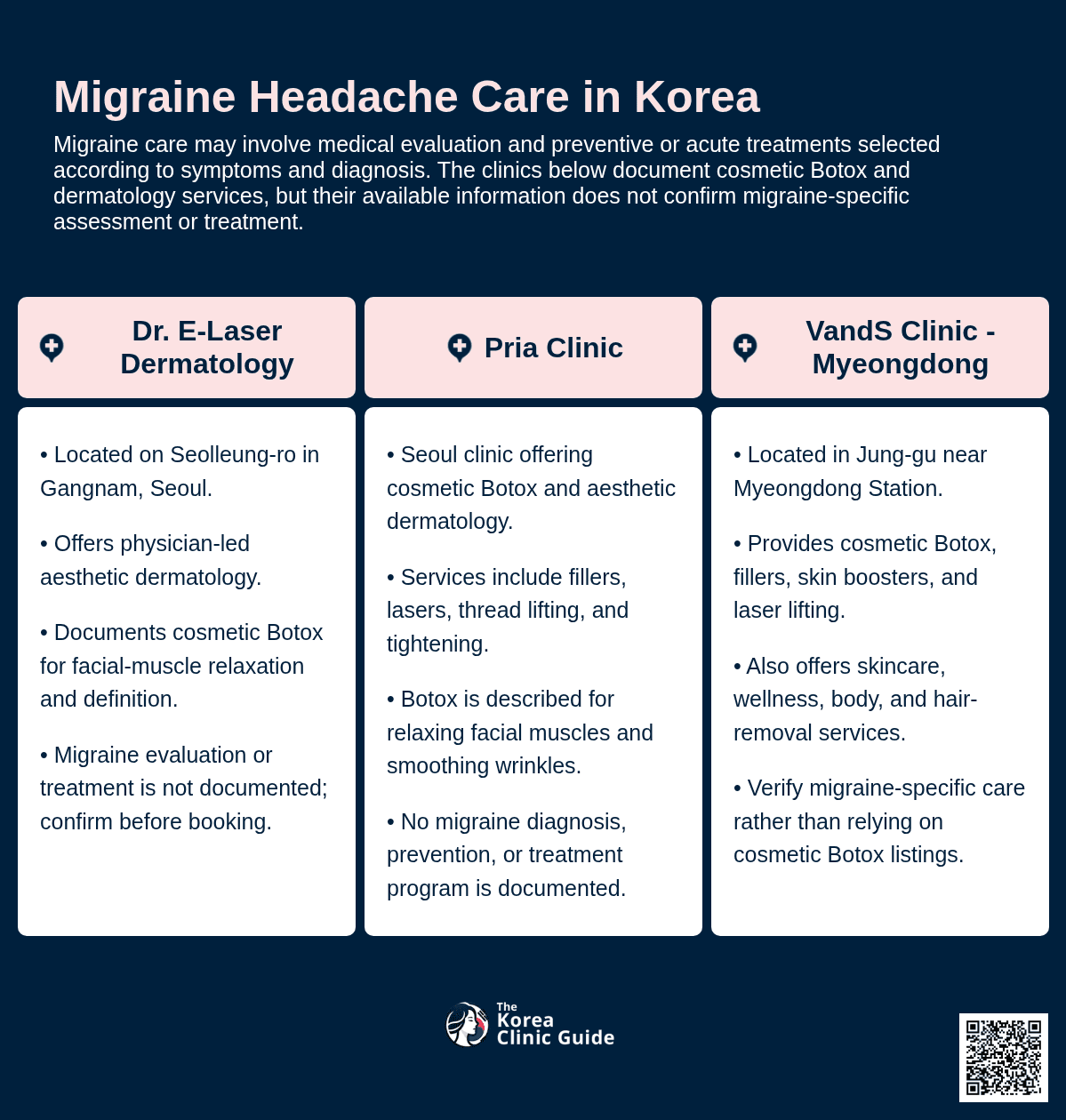
You may consider Dr. E-Laser Dermatology if you are also seeking physician-led aesthetic dermatology in Seoul, particularly cosmetic Botox and skin-focused treatments tailored to your skin condition and goals. However, the available information does not document a migraine-headache evaluation or treatment program, so you should not assume its cosmetic Botox services are provided for migraine care.
- URL: [Dr. E-Laser Dermatology Website](https://www.koreaclinicguide.com/clinic/Unknown Slug/?utm_source=koreaclinicguide&utm_medium=referral&utm_campaign=migraine-headaches-korea){data-slug="Unknown Slug" data-position="1"}
- Location: 2F, 830 Seolleung-ro, Gangnam-gu, Seoul, Korea
- Documented services:
- The clinic documents Botox for targeted facial-muscle relaxation, expression lines, and facial definition, along with fillers, laser treatments, lifting and tightening procedures, and acne and pigmentation care.
- Its Botox description is cosmetic and does not state that migraine assessment or migraine treatment is offered.
2. Pria Clinic
You may consider Pria Clinic if your needs also include cosmetic Botox or other aesthetic dermatology treatments in Seoul, as it offers injectables, laser-based skin treatments, thread lifting, and non-surgical tightening. The available clinic information does not document migraine-headache diagnosis, prevention, or treatment, so confirm whether it can address migraine concerns before arranging care.
- URL: Pria Clinic Website
- Location: Seoul
- Botox information:
- Botox is described as a minimally invasive cosmetic injectable used to relax specific facial muscles and smooth dynamic wrinkles.
- The clinic information does not indicate that Botox is used here for migraine prevention or that migraine consultation is available.
- Other documented services:
- Services listed include dermal fillers, laser toning, pico laser, IPL, thread lifting, lipolysis injections, Hydrafacial, and Ultherapy/HIFU.
- These offerings are presented as aesthetic and skin-rejuvenation treatments rather than headache care.
3. VandS Clinic - Myeongdong
You may consider VandS Clinic - Myeongdong for cosmetic and dermatologic services near Myeongdong Station, including Botox, fillers, skin boosters, laser lifting, and customized skincare. However, its available service information does not document migraine-headache evaluation or treatment, so you should verify whether it provides any migraine-specific care rather than relying on its cosmetic Botox listing.
- URL: VandS Clinic - Myeongdong Website
- Location: Jung-gu, Seoul
- Relevant documented injectable service:
- The clinic lists Botox and contour injections for cosmetic reduction of fine lines and wrinkles and facial-feature definition.
- This description does not state that Botox is offered for migraine headaches or that headache assessment is available.
- Other documented services:
- Listed services include fillers, thread lifting, laser lifting, skin boosters, IV therapy, acne and pigmentation care, skincare, body contouring, hair removal, and semi-permanent makeup.
- These are described as cosmetic, dermatologic, or wellness-oriented services rather than migraine care.
The Medical Tourist's Journey to South Korea
Why South Korea Stands Out
South Korea is a top choice for medical tourism due to its excellent healthcare quality, high-tech facilities, and efficient systems. Its focus on beauty and wellness drives both innovation and experience. Government-backed medical tourism programs make access and logistics straightforward, and South Korea ranks highly in global health care indices.
The Patient Experience: Step-by-Step
Traveling to South Korea for OnabotulinumtoxinA treatment is smooth—especially with a medical tourism agency:
- Planning & Documentation: Ensure your passport, insurance, and visa status are sorted. Visa requirements are often simple for short procedures.
- Choosing an Agency: Agencies coordinate appointments, travel, translation, and accommodations for a seamless process.
- Pre-Trip Consultation: Virtual seminars provide a chance to share medical records and set expectations.
- On-Site Care: Airport pickups, in-person consultations, efficient procedures, and quick recovery make the process efficient and patient-friendly.
- Post-Treatment Follow-up: Full effects settle in 1–2 weeks, lasting three to six months. Clinics help schedule ongoing care virtually or for future travel.
Some agencies even combine treatment packages with sightseeing tailored to your needs.
Selecting the Right Clinic and Practitioner
While costs are lower, quality remains top-tier. Focus on clinics with strong accreditation and a reputation for therapeutic (not only cosmetic) excellence. Always verify the credentials and experience of your provider—outcomes and risk of side effects depend heavily on practitioner expertise.
Well-known clinics like EGG Skin Clinic, VG Plastic Surgery, and university centers like Severance Hospital or Samsung Medical Center excel in this field.
Financial Analysis: Comparing Global Costs
South Korea’s Cost Advantage
OnabotulinumtoxinA treatment in South Korea generally costs ₩500,000–₩1,500,000 KRW ($400–$1,200 USD) per session, with a full course ranging from $800–$1,200 USD. This is largely thanks to a competitive market, lower overhead, and the availability of quality domestic brands like Nabota, Botulax, and Coretox.
Table 3: Comparative Cost Analysis of OnabotulinumtoxinA Treatment
| Country | Approximate Cost per Session | Cost Drivers |
|---|---|---|
| South Korea | $400 - $1,200 USD | High competition, domestic brands, lower overhead |
| USA | Up to $2,000 CAD | Varied, high per-unit costs |
| Canada | $900 - $2,000 CAD | City variation, possible insurance coverage |
| UK | $300 - $500 EUR | Higher European pricing |
| Turkey | $330 - $500 EUR | Low operating costs, package deals |
| Thailand | $75 - $550 EUR | Affordable, requires due diligence |
South Korea Versus Other Medical Tourism Hubs
South Korea beats many competitors by combining affordability, transparency, and clinical excellence. The U.S. and Canada have much higher list prices. Turkey and Thailand can offer very low prices, but South Korea’s quality and accreditation standards often give it an edge for complex therapeutic procedures.
Consider All Costs
Beyond the sticker price, factor in:
- Consultation fees, which may be bundled or separate.
- Value Added Tax (VAT), which sometimes isn’t included in listed rates.
- Travel expenses: airfare, accommodation, and daily costs.
- Deposits to secure appointments.
- Long-term costs: Repeat treatments every three to six months are needed for continued benefit.
Patient Outcomes: Balancing Success and Risk
What You Can Expect: Results from Studies
Most patients see a meaningful reduction in headache days and severity, often feeling the transformation in their daily life. Improvement is gradual, typically showing fully after six months of therapy.
Patient Experiences: Positive Stories
Many patients report dramatic results—such as migraines dropping from several per week to just one per month—allowing them to work, care for family, and enjoy daily life again. The injections themselves are generally well-tolerated, even providing cosmetic benefits for some.
Negative Reports: Possible Adverse Effects
However, not everyone fares as well. Some individuals experience intense neck and shoulder pain, difficulty swallowing, drooping eyelids, severe anxiety, and even symptoms that last many months. The practitioner’s skill is often cited as the factor distinguishing positive outcomes from severe side effects—the wrong technique or dosage can be problematic.
Table 4: Patient-Reported Experience Summary
| Positive Outcomes | Negative Outcomes |
|---|---|
| Reduced migraine frequency and severity | Severe neck and shoulder pain |
| Better quality of life | Difficulty swallowing or breathing |
| Less need for pain medication | Drooping eyelids, muscle weakness |
| Quick recovery, minimal discomfort | Anxiety, panic attacks, nausea |
| Cosmetic benefits (forehead smoothing) | Long-lasting side effects |
Conclusion
OnabotulinumtoxinA offers strong benefits for many chronic migraine sufferers, but clear diagnosis, proper protocol, and practitioner expertise are vital for safety and success. South Korea stands out as an affordable, high-quality treatment destination, but all hidden costs and potential risks should be weighed. Ultimately, the best outcomes rely on careful provider selection and realistic expectations.
References
1, 2, 3, 4, 5, 6, 7, 8, 9, 10, 11, 12, 13, 14, 15, 16, 17, 18, 19, 20, 21, 22, 23, 24, 25, 26, 27, 28, 29, 30, 31, 32, 33, 34, 35, 36, 37, 38, 39, 40
Frequently Asked Questions
Related Blogs
Effective Jaw Clenching Solutions: Masseter Botox & Bruxism Treatment in Korea
Discover effective treatments for jaw clenching (bruxism) in Korea, including Masseter Botox injections and custom night guards. Learn how Korea's advanced medical tourism system offers safe, affordable, and personalized solutions to relieve symptoms like jaw pain, headaches, and dental damage. Explore the step-by-step process and benefits of receiving bruxism treatment in Korea, a top destination
Updated: Oct 4, 2026
Effective Body Botox Treatment for Plantar Hyperhidrosis in Korea: Relief and Care Solutions
Discover effective treatment options for plantar hyperhidrosis (excessive foot sweating) in Korea. This comprehensive guide covers Botox (Botulinum Toxin) injections, their procedure, benefits, and how Korea’s advanced clinics offer affordable, quality care for hyperhidrosis. Learn why medical tourists choose Korea for this minimally invasive solution, with insights into costs, recovery, and expec
Updated: Oct 4, 2026

Chin Dimpling Solutions: Chin Botox and Chin Surgery in Korea for a Smooth Jawline
Discover how Korea leads in treating chin dimpling with advanced procedures like Chin Botox (Botulinum Toxin Injections) and surgical options such as chin implants and genioplasty. Learn about the causes of chin dimpling, treatment benefits, costs, and why Korea is the top destination for medical tourism. Whether you seek quick, non-surgical smoothing or permanent structural correction, Korea offe
Updated: Oct 3, 2026
Square Jawline Reduction with Masseter Botox in Korea: Effective Contouring Solutions
Discover how Korea leads in Masseter Botox procedures for treating "square jawline" caused by masseter hypertrophy. This non-surgical treatment contours the jawline, reduces muscle enlargement, and alleviates jaw pain from TMJ or bruxism. Learn about the step-by-step procedure, benefits, recovery tips, and why Korea is a top destination for medical tourism. With competitive costs and experienced s
Updated: Oct 3, 2026
Clinics offering Forehead Botox

365mc Hospital: Korea's Leading Liposuction and Body Contouring Clinic with Innovative AI Technologies and Comprehensive Patient Care
Gyodae

Haru Clinic Korea | Fully-Customized Full-Face Non-Surgical Rejuvenation With Threads, Botox & Fillers
Sinsa

PangPang Clinic: Korea's Premier Thread Lifting and Skin Rejuvenation Specialist in Gangnam, Seoul
Sinsa

B.V Clinic Korea: Advanced Aesthetic Treatments for Natural Beauty Enhancement & Rejuvenation
Sinnonhyeon Station