Medical Tourism Blog
MiraDry in Korea: Treatment Process, Recovery, Results, and Travel Planning
Table of contents
- MiraDry at a Glance
- What Is MiraDry?
- Who Is a Good Candidate for MiraDry?
- How Is MiraDry Performed?
- Why Visit Korea for MiraDry?
- Key Information for International Patients
- Which Are the Best Clinics in Korea for Miradry?
- MiraDry From Start to Finish
- Alternatives to MiraDry
- How Can I Prepare for MiraDry?
- Aftercare Advice
Considering treatment in Korea? Everything you need to know e.g. — how to avoid scams, visas, interpreters, recovery tips — in our Medical Tourism Master Guide. Plan with confidence in minutes, not weeks!
Last updated: September 2026
MiraDry at a Glance
- What it treats — MiraDry is a non-surgical microwave treatment for primary axillary hyperhidrosis: excessive sweating confined to the underarms. A cooled suction handpiece targets sweat and odor glands after local anesthetic injections; it is not an established treatment for palms, soles, face, groin, or generalized sweating.
- Treatment time — Both underarms are usually treated in one outpatient visit taking about one hour after numbing injections. Some people achieve an adequate response with one session, while others consider a separate second session after the result is reassessed.
- Expected reduction — The goal is substantial, durable sweat reduction rather than completely dry underarms. Manufacturer-linked clinical material reports an average 82% sweat reduction, and the treated glands are intended to be permanently damaged, but residual sweating or odor can remain.
- Recovery and results — Light activity and desk work are often possible the same day, but swelling, tightness, tenderness, bruising, numbness, and nodules may last days to weeks. Assess the settled result after swelling resolves, usually over about 1–3 months.
- Travel planning — For treatment in Korea, allow 2–3 calendar days for consultation, treatment, and 24–48 hours of early recovery and clinic access. There is no established flight ban, but a same-day long-haul departure can be difficult because icing, arm soreness, swelling, and luggage handling are common concerns.
- Important safety screen — MiraDry should follow evaluation for primary bilateral underarm sweating; new generalized, one-sided, nighttime, or medication-related sweating needs medical assessment first. It is contraindicated with a pacemaker or other implanted electronic device, supplemental-oxygen requirement, or intolerance to expected local anesthetics.
- Korea-specific check — No Korean outcome data show that MiraDry is superior in Korea, and a Korean case report describes serious nerve injury after treatment. Before booking, request proof of the genuine device and current local authorization, operator training details, English records, and a remote follow-up plan.
What Is MiraDry?
MiraDry is a treatment that uses controlled microwave energy to reduce sweat glands in the underarms. It addresses primary axillary hyperhidrosis, helping reduce excessive underarm sweating and related odor or daily disruption. It is a non-surgical outpatient procedure performed after local numbing injections.
Who Is a Good Candidate for MiraDry?
- Primary axillary hyperhidrosis — Good candidates have persistent, troublesome sweating limited mainly to both underarms, without an identifiable medical cause.
- Meaningful daily impact — Consider treatment when sweat marks, clothing changes, odor concerns, work disruption, or social distress continue despite antiperspirants or other conservative care.
- Realistic treatment goal — MiraDry aims for substantial, durable sweat reduction, not a guarantee of completely dry underarms. Manufacturer-linked material reports an average 82% sweat reduction in clinical studies, but individual results differ.
- Appropriate treatment area — MiraDry is designed for the axillae only. It is not an established treatment for sweating of the palms, soles, face, groin, trunk, or the whole body.
Do not book an elective underarm procedure until a clinician assesses new, generalized, one-sided, nighttime, or medication-associated sweating, which can indicate secondary hyperhidrosis rather than primary axillary disease. MiraDry is contraindicated for people with a heart pacemaker or other implanted electronic device, those requiring supplemental oxygen, and people with known intolerance or resistance to the expected local anesthetics, including lidocaine and epinephrine, as listed in the device instructions for use. Defer treatment for active infection, open skin, substantial dermatitis, or other underarm conditions that make injections or healing unsafe. The international manufacturer information describes use for primary axillary hyperhidrosis in adults; pregnancy and breastfeeding safety data are inadequate, so elective treatment is generally postponed. Underarm tissue thickness, arm circumference, prior scars, and low body mass can affect energy planning and nerve-risk counseling; a prospective study identified smaller upper-arm circumference and low BMI as factors associated with treatment danger zones.Study of anatomy-related treatment risk
How Is MiraDry Performed?
MiraDry has no separate patient-facing procedure types. The meaningful differences are the number of sessions, mapping coverage, and device settings chosen for underarm anatomy and response.
- Initial bilateral session — Both underarms are mapped and treated in one outpatient visit, usually taking about one hour after local anesthetic injections.
- Single-session plan — One treatment is sufficient for some patients; assess the settled response before deciding whether further treatment is needed.
- Staged treatment plan — A second session can be considered for persistent sweating after recovery. It is a separate procedure and, for overseas patients, usually a separate travel event.
- Individualized coverage and energy — The clinician adjusts template placement, coverage, and settings around tissue thickness, symptoms, scars, prior treatment, and nerve-related risk tolerance.
- Residual-sweat reassessment — A later touch-up targets remaining active areas when clinically appropriate; do not assume that a second session is necessary or included in the initial plan.
Why Visit Korea for MiraDry?
Korea has clinics and a local distributor that advertise MiraDry availability. However, no Korea-specific cohort data were identified showing superior MiraDry efficacy, complication rates, or outcomes for international patients. Choose a provider based on documented device authenticity, operator training, diagnostic assessment, and a workable follow-up plan—not on claims of country-specific superiority.
- Reported local availability — A Korean distributor states that it supplies MiraDry in Korea and describes the system as MFDS-authorized, but this focused review did not locate an authoritative public MFDS record confirming the current authorization number, exact MD4000 model, or locally authorized indications. Ask the institution for current authorization documentation before paying a deposit.
- Clear indication verification — The device labeling supports primary axillary hyperhidrosis and permanent unwanted-underarm-hair reduction for Fitzpatrick skin types I-IV; odor reduction is described in the context of hyperhidrosis treatment. Confirm that the proposed Korean treatment and claims match the locally authorized indication rather than assuming sweat, odor, and hair claims are identical across jurisdictions.Device labeling and indication details
- Safety requires careful provider selection — Korean literature includes a report of musculocutaneous and median neuropathy after MiraDry. This single case cannot quantify complication rates, but it makes operator training, anatomy-based planning, and rapid access to follow-up important.Korean neuropathy case report
- Documentation for cross-border care — Request an English treatment record stating the device model, session details, anesthetic used, written aftercare, emergency contact, and remote follow-up route before leaving Korea.
Key Information for International Patients
- Minimum stay — Allow 2-3 calendar days: consultation and treatment, followed by 24-48 hours for icing, early recovery, and access to the treating team. This is conservative travel planning, not a manufacturer-mandated stay.
- Flight timing — No evidence-based MiraDry-specific commercial-flight restriction was identified. A same-day long-haul flight is often impractical because swelling, soreness, numbness, and icing needs can make baggage handling difficult.
- Sedation and transport — Local anesthesia alone is typical, and a companion is not routinely required. Do not drive or fly against clinic advice if oral sedation, prescription pain medicine, or a complication requires a more restrictive plan.
- Itinerary impact — Light daily activity and desk work are often possible on the treatment day, but plan loose clothing and avoid luggage lifting, vigorous workouts, saunas, and other heat-heavy activities during early recovery.
- Remote follow-up — Arrange a 24-72-hour message, phone, or video check before departure. Keep the clinic's emergency contact, and identify an appropriate clinician at home in case an in-person assessment is needed.
- Repeat treatment — Assess the stable result after swelling resolves, generally over about 1-3 months. Do not schedule a second session into the same short trip unless the clinician has a specific reason.
Travel note: Bring an English medical summary covering sweating onset, affected sites, nighttime symptoms, prior treatments, medicines and supplements, allergies, implanted devices, and prior underarm surgery or scarring.
Which Are the Best Clinics in Korea for Miradry?
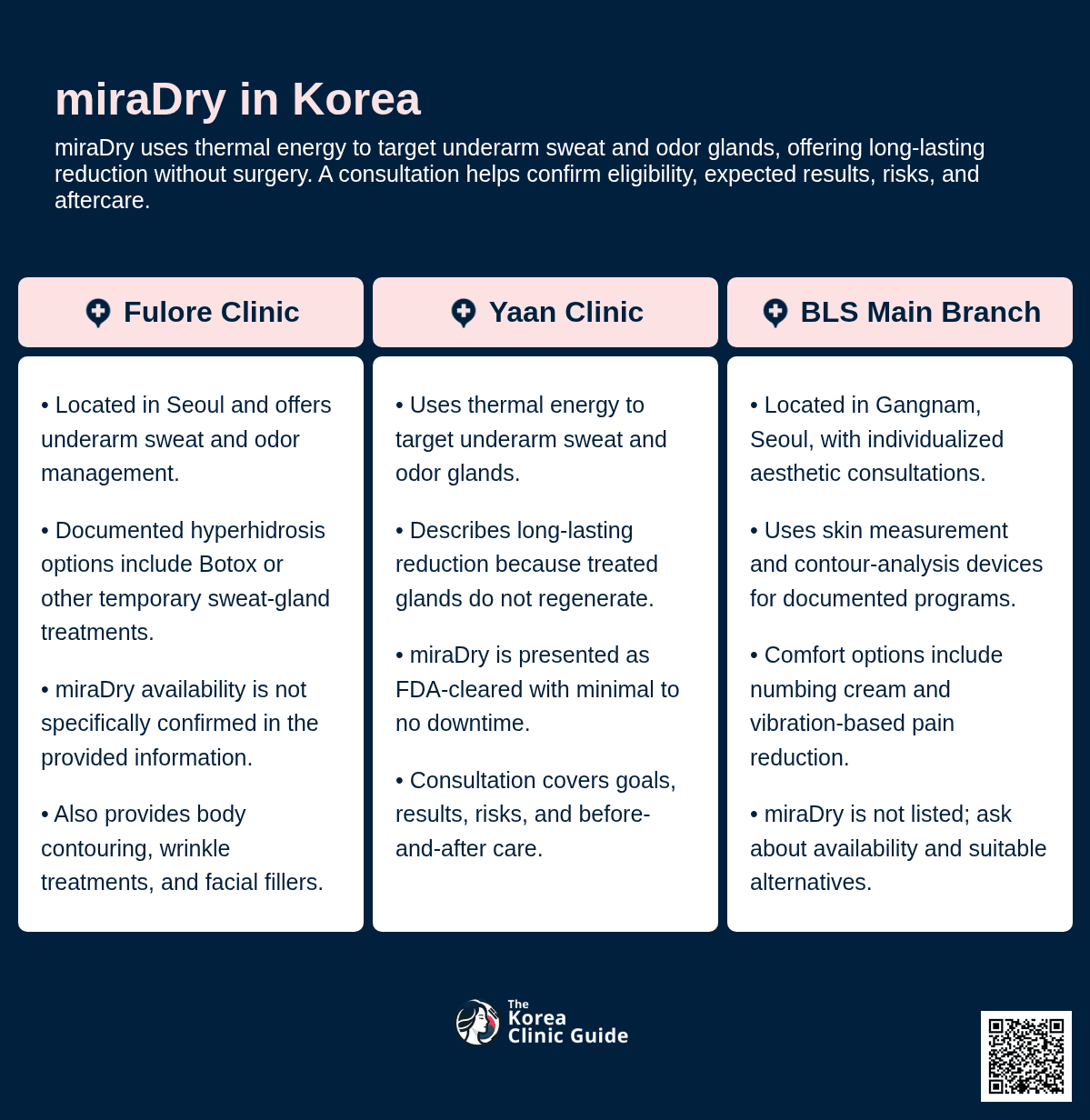
Listed below are some of the best clinics in Korea for miradry.
1. Fulore Clinic
You may consider Fulore Clinic if you are seeking underarm sweat and odor management in Seoul, but the available information does not specifically confirm miraDry. Its documented hyperhidrosis care uses Botox or other methods to temporarily reduce sweat-gland activity, so you should clarify whether miraDry is available and which approach fits your concerns.
- URL: Fulore Clinic Website
- Location: Seoul
- Sweat and odor management:
- Hyperhidrosis treatment is described as reducing excessive perspiration and associated odor.
- Documented options include Botox or other methods that temporarily block sweat-gland activity.
- Other available care: The clinic also provides body contouring, wrinkle treatments, and facial fillers.
2. Yaan Clinic
You may consider Yaan Clinic for miraDry if excessive underarm sweating and odor are your main concerns: the clinic describes using thermal energy to target underarm sweat and odor glands, with long-lasting reduction because treated glands do not regenerate. Your plan is intended to begin with a consultation covering your goals, expected results, risks, and before-and-after care.
- URL: Yaan Clinic Website
- Location: Seoul
- miraDry treatment:
- Thermal energy is used to target and eliminate sweat and odor glands in the underarm area.
- The clinic describes the treatment as providing long-lasting reduction in underarm sweat and odor because these glands do not regenerate.
- miraDry is described as FDA-cleared and as involving minimal to no downtime.
- Planning and care:
- A consultation is used to tailor treatment to your individual needs.
- You can discuss expected outcomes, potential risks, and care instructions before and after treatment.
- Other services: The clinic also offers fillers, laser-based skin rejuvenation, lifting and thread-lifting procedures, and weight-loss injections.
3. BLS Main Branch
You may want to ask BLS Main Branch whether it provides miraDry, as the available information does not document this procedure. The clinic does describe individualized assessment and several comfort options for its listed aesthetic treatments, which may be relevant when discussing whether an underarm sweat-treatment plan is available and appropriate for you.
- URL: BLS Main Branch Website
- Location: 13-5, Dosan-daero 67-gil, Gangnam-gu, Seoul, Republic of Korea
- Consultation and assessment:
- A one-to-one consultation reviews your concerns, facial structure, and skin condition to guide treatment planning.
- Skin measurement and contour-analysis devices are used for the clinic’s documented skin and lifting programs.
- Comfort options:
- Documented options include topical numbing cream and vibration-based pain reduction.
- Conscious sedation and general anesthesia are also listed for treatments requiring additional pain control and monitoring.
- Documented services:
- Listed treatments include radiofrequency and ultrasound lifting, skin revitalization programs, and hyaluronic-acid fillers.
- miraDry is not listed in the provided clinic information.
MiraDry From Start to Finish
- Remote inquiry and consultation — Send an English medical history, clear description of sweating distribution and severity, prior treatments, medication list, allergies, implanted-device status, oxygen requirement, and photos of any underarm scarring or rash. Confirm whether English consultation and remote follow-up are available.
- Pre-travel eligibility review — The clinic reviews whether the pattern fits primary axillary hyperhidrosis rather than generalized or secondary sweating. Ask for the device model, operator credentials, proposed session plan, total fees, and written cancellation or rescheduling policy.
- In-person assessment — The clinician examines both axillae for dermatitis, infection, lesions, scars, and anatomy that affects treatment coverage. They discuss realistic reduction goals, possible need for a later session, risks, consent, and aftercare.
- Mapping and local anesthesia — The underarms are marked with the treatment template. Local anesthetic injections, commonly involving lidocaine and epinephrine, numb the area; tell the clinician immediately about prior anesthetic reactions.
- Microwave thermolysis — A vacuum handpiece draws underarm tissue toward a cooled surface while controlled microwave energy targets the dermal-fat interface where sweat and odor glands sit. Cooling protects the superficial skin as energy damages targeted glands.How the MiraDry system works
- Completion and discharge — Both underarms generally take about one hour to treat. Uncomplicated local-anesthetic treatment is outpatient; the team reviews icing, washing, activity restrictions, pain control, and urgent warning signs before discharge.
- Early recovery in Korea — Use towel-wrapped ice packs as instructed and remain reachable for the clinic during the first 24-48 hours. Swelling, tightness, tenderness, redness, bruising, numbness, and palpable nodules are common.
- Remote reassessment — Contact the clinic at the agreed interval, especially for blistering, worsening pain, weakness, or altered sensation. Review the settled response after roughly 1-3 months and discuss retreatment only if residual symptoms justify it.
Alternatives to MiraDry
Non-surgical options generally require ongoing treatment but avoid intentional gland destruction. Gland-directed procedures and surgery can offer longer-lasting reduction, but they involve incisions or tissue removal and carry greater risks of scarring, wound problems, and recovery burden.
Botulinum toxin A
Hyperhidrosis Botox temporarily blocks nerve signaling to sweat glands.
- Best tradeoff — A non-surgical option for patients who prefer a reversible treatment.
- Duration — Benefit commonly lasts about 6-8 months, so repeat injections are expected.
- Limitation — It does not permanently reduce sweat glands.
Laser or gland-directed procedures
Hyperhidrosis laser treatment and sweat gland removal aim to reduce underarm gland activity or physically remove glands.
- Best tradeoff — Consider when seeking local gland-directed treatment but accepting a more invasive approach.
- Techniques — Options can include laser-based treatment, curettage, liposuction-curettage, or limited excision.
- Limitation — Scarring, infection, wound-healing problems, and downtime are more relevant than with MiraDry.
Hyperhidrosis surgery
Hyperhidrosis surgery, including endoscopic thoracic sympathectomy, changes sympathetic nerve signaling.
- Best tradeoff — Reserved for carefully selected, severe cases rather than routine isolated underarm sweating.
- Major limitation — Compensatory sweating elsewhere on the body can be substantial and difficult to reverse.
Bromhidrosis treatment
Bromhidrosis treatment focuses on underarm odor when odor is the central concern rather than sweat volume.
- Best tradeoff — Appropriate when odor evaluation and odor-gland management are the primary goal.
- Limitation — It does not automatically address clinically significant hyperhidrosis; clarify whether sweat, odor, hair, or all three are being treated.
How Can I Prepare for MiraDry?
- Medical disclosure — Send the clinic a complete list of prescription medicines, over-the-counter products, vitamins, herbal supplements, allergies, chronic conditions, implanted devices, oxygen use, and prior underarm procedures well before travel.
- Prescription medicines — Do not independently stop anticoagulants, antiplatelets, diabetes medicines, or other prescribed drugs. No standardized MiraDry labeling protocol was identified for medicine interruption; follow the treating clinician's individualized plan.
- Underarm hair — Shave both underarms 4-6 days before treatment so slight regrowth helps identify the treatment area. Do not wax, pluck, or create cuts, ingrown hairs, or irritation.Manufacturer preparation instructions
- Deodorant and antiperspirant — Do not apply deodorant or antiperspirant on the day before treatment.
- Skin condition — Report a rash, infection, open skin, recent irritation, or new lesion before attending. Reschedule rather than treating compromised skin.
- Fasting and substances — Local anesthesia does not routinely imply fasting, but follow the clinic's instructions if sedation is planned. No universal device-label instructions were identified for alcohol, smoking/vaping, supplements, or sun exposure; do not arrive intoxicated or dehydrated.
- Clothing and transport — Wear a loose sleeveless or wide-armhole top. Arrange transport or a companion if sedation is possible, and avoid plans requiring heavy luggage handling.
- Flexible travel — Keep at least 24-48 hours after treatment free from demanding sightseeing, strenuous activity, and a long-haul flight when possible.
Travel note: Pack easy-access ice packs if the clinic recommends them and book accommodation where you can rest comfortably with limited arm movement.
Confirm all clinic-specific preparation requirements, including medicine instructions and any sedation-related fasting rules, directly with the treating doctor.
Aftercare Advice
Early aftercare is centered on controlling swelling, protecting the underarm skin, and recognizing skin or nerve symptoms quickly.
- Ice and discomfort control — Use towel-wrapped ice packs as directed during the next few days. The manufacturer also advises a suitable non-prescription anti-inflammatory when appropriate for the patient; confirm suitability if there is kidney disease, ulcer history, anticoagulant use, or another relevant condition.Manufacturer aftercare guidance
- Skin hygiene — Wash gently with water and mild liquid soap, then pat dry. Use topical antibiotic ointment only when the treating clinician directs it, because these products can trigger contact dermatitis.
- Shaving and products — Avoid shaving and deodorant or antiperspirant for the next few days. Resume only when the skin is intact and the clinic approves.
- Exercise, heat, and alcohol — Return to light activity as comfort allows, but wait several days before rigorous exercise. Some Korean provider instructions advise avoiding sauna, strenuous exercise, and alcohol for about one week; use the treating clinic's protocol and extend restrictions while swelling or tenderness persists.
- Expected recovery — Swelling, tightness, tenderness, bruising, redness, numbness, nodules, and altered sensation can last days to weeks. In a long-term survey, two-thirds of reported side effects resolved within two weeks and all resolved by 12 weeks, but individual recovery can take longer.Long-term safety survey
- Urgent warning signs — Contact the clinic urgently and seek local in-person care for escalating pain, spreading redness or warmth, fever, pus, drainage, a blister or open wound, marked one-sided swelling, persistent or worsening numbness, new hand or finger weakness, reduced arm movement, chest symptoms, or signs of allergic reaction.
- Result review — Judge the stable result after swelling settles, usually around 1-3 months. Treated glands are intended to be destroyed, but residual glands, incomplete coverage, and anatomy can leave ongoing sweating or odor.
Follow the treating doctor's written instructions over general guidance, and contact the clinic promptly when recovery appears abnormal.
Frequently Asked Questions
Related Blogs
Skin Tags on Neck: Skin Tag Removal Procedures in Korea for Smooth, Clear Skin
Discover safe and effective skin tag removal in Korea, focusing on neck skin tags (acrochordons). Learn about procedures like ligation, excision, electrocautery, cryotherapy, and laser removal performed by Korea’s expert dermatologists. Explore affordable costs compared to other countries and benefit from Korea’s advanced technology and patient-centered care. Whether you're seeking cosmetic improv
Updated: Oct 8, 2026
Erase Perioral Wrinkles: Sculptra and Thread Lift Treatments in Korea for Youthful Skin
Discover effective treatments for perioral wrinkles in Korea, including Sculptra and Thread Lifts. This comprehensive guide highlights how Korea’s medical tourism offers top-quality, cost-effective non-surgical solutions to restore facial volume and tighten skin around the mouth. Learn how Sculptra stimulates collagen for long-lasting results, while Thread Lifts provide an immediate, natural-looki
Updated: Oct 8, 2026
Bruise Recovery Solutions in Korea: How Arginine Fluid Procedures Accelerate Healing
Discover how Korea leads in bruise recovery by using advanced procedures like Arginine Fluid therapy, promoting faster healing after post-injection ecchymosis or hematomas. This blog explores the benefits of Korean medical treatments for bruises, highlighting safe, effective options such as IV arginine infusion, collagen boosting, and circulation improvement. Learn about Korea’s reputation in medi
Updated: Oct 7, 2026
Keloid Scar Itching Solutions: Keloid Injection Procedures in Korea for Effective Relief
Discover effective keloid treatment options in Korea, featuring intralesional corticosteroid injections that reduce itching, scarring, and discomfort. Korea's advanced medical facilities and expert dermatologists make it a top destination for keloid injection therapy. This blog covers procedures like triamcinolone acetonide injections, treatment protocols, costs, and tips for medical tourists seek
Updated: Oct 7, 2026