Medical Tourism Blog
Hyperhidrosis Laser in Korea: Methods, Recovery, Results, and Travel Planning
Table of contents
- Hyperhidrosis Laser at a Glance
- What Is Laser Treatment for Hyperhidrosis?
- Who Is a Good Candidate for Laser Treatment for Hyperhidrosis?
- How Is Laser Treatment for Hyperhidrosis Performed?
- Why Visit Korea for Laser Treatment for Hyperhidrosis?
- Key Information for International Patients
- Which Are the Best Clinics in Korea for Hyperhidrosis Laser?
- Hyperhidrosis Laser From Start to Finish
- Alternatives to Laser Treatment for Hyperhidrosis
- How Can I Prepare for Laser Treatment for Hyperhidrosis?
- Aftercare Advice
Considering treatment in Korea? Everything you need to know e.g. — how to avoid scams, visas, interpreters, recovery tips — in our Medical Tourism Master Guide. Plan with confidence in minutes, not weeks!
Last updated: September 2026
Hyperhidrosis Laser at a Glance
- What it treats — Laser treatment targets primary focal axillary hyperhidrosis—chronic, bilateral excessive underarm sweating—not sweating of the palms, soles, face, scalp, or the whole body.
- Procedure variations — “Hyperhidrosis laser” can mean invasive subdermal fiber ablation through tiny incisions or external surface laser sessions; some clinics add suction or curettage, which makes it a more invasive gland-removal procedure.
- Sessions and results — Subdermal treatment may be planned as one session, but retreatment is possible: in a 15-person 1440-nm study, 3 participants required a second session at 6 months, and durability beyond 1 year is uncertain.
- Recovery time — Subdermal ablation commonly causes soreness, swelling, bruising, limited arm comfort, and temporary altered sensation for about 1–2 weeks; results are best assessed at 8–12 weeks.
- Key risks — Possible complications include burns or blisters, infection, fluid collection, scarring, temporary hair reduction, numbness, incomplete sweat reduction, and recurrence; small studies cannot provide reliable complication rates.
- Korea travel plan — International patients should plan 3–5 days in Korea for diagnosis, treatment, and an early wound check; delaying long-haul travel by roughly 48–72 hours is a cautious approach after an uncomplicated local-anesthetic procedure.
- Korea-specific check — Korea’s MFDS regulates medical devices, but this does not prove a clinic’s laser protocol is appropriate; request the exact device, wavelength, delivery route, authorized intended use, and whether curettage or suction is included.
What Is Laser Treatment for Hyperhidrosis?
Hyperhidrosis laser is a laser-based procedure that damages sweat-producing tissue to reduce excessive underarm sweating. It aims to lessen sweat-related clothing stains, discomfort, and disruption to daily activities in people with primary focal axillary hyperhidrosis. It is minimally invasive when performed beneath the skin through tiny incisions; surface laser approaches do not require incisions but usually involve several sessions.
Who Is a Good Candidate for Laser Treatment for Hyperhidrosis?
- Confirmed axillary condition — Good candidates have troublesome, longstanding, bilateral underarm sweating consistent with primary focal axillary hyperhidrosis.
- Meaningful daily impact — Treatment is most relevant when sweating regularly stains clothing or interferes with work, social activities, or comfort despite antiperspirants or other reversible options.
- Appropriate treatment goal — Candidates seek underarm sweat reduction and understand that laser treatment is not established for the palms, soles, face, scalp, or generalized sweating.
- Suitable treatment field — Underarm skin should be free of active infection, open wounds, dermatitis, shaving cuts, and a hidradenitis suppurativa flare.
A clinician should first rule out secondary sweating. New-onset, generalized, one-sided, or night-time sweating, medication changes, and systemic symptoms require medical evaluation rather than local sweat-gland ablation; primary hyperhidrosis is typically focal, symmetric, chronic, and absent during sleep. Assessment can include the Hyperhidrosis Disease Severity Scale and a Minor starch–iodine test to map active sweat areas. Pregnancy, breastfeeding, uncontrolled bleeding risk, uncoordinated anticoagulant or antiplatelet treatment, significant reactions to local anesthetics or sedatives, and prior underarm gland surgery require postponement or individualized assessment. Do not stop warfarin, apixaban, rivaroxaban, clopidogrel, or prescribed aspirin without direction from the prescribing clinician.
How Is Laser Treatment for Hyperhidrosis Performed?
“Hyperhidrosis laser” is not one standardized procedure. Ask for the device name, wavelength, delivery route, number of planned sessions, anesthesia plan, and whether mechanical gland removal is included.
- Subdermal laser ablation — After local or tumescent anesthesia, the clinician makes tiny underarm incision(s) and passes a laser fiber or cannula in the dermal–subdermal plane to thermally damage sweat-producing tissue. Published protocols include 1064-nm and 1440–1444-nm Nd:YAG systems. This is an invasive outpatient procedure despite the small incisions.
- Transcutaneous long-pulsed laser — Nd:YAG or diode energy is delivered through intact skin, often using settings also used for hair reduction. It generally requires a series of monthly sessions. In a small 12-person study, three to four 1064-nm sessions reduced the mapped sweat area by 45% at six months after treatment ended, but the study was too small to establish superiority over standard treatments.
- Laser with suction or curettage — Some protocols combine laser energy with liposuction or curettage to mechanically remove glands. This is not laser-only treatment and carries the recovery and complication considerations of a more invasive gland-removal procedure.
- Repeat treatment — One subdermal session can be planned, but repeat treatment is sometimes required. In a small prospective 1440-nm study, three of 15 participants received a second session at six months after an insufficient response; external laser protocols generally require several sessions.
Why Visit Korea for Laser Treatment for Hyperhidrosis?
South Korea has a formal medical-device regulatory system administered by the Ministry of Food and Drug Safety (MFDS). That framework is useful for due diligence, but it does not prove that a particular clinic’s device, indication, or protocol is appropriate. No high-quality comparative evidence shows better laser-hyperhidrosis outcomes in Korea than elsewhere.
- Device verification — Request the exact device, wavelength, intended delivery route, and Korean-authorized intended use. The MFDS medical-device regulatory framework regulates devices generally, but “hyperhidrosis laser” alone does not identify an authorized device indication.
- Clear protocol disclosure — A suitable Korean provider should state whether treatment is subdermal fiber ablation, surface laser treatment, or a combined laser-and-curettage/suction procedure, because these approaches have different downtime and risks.
- Evidence-aware planning — Published laser evidence remains small and device-specific. A 15-person prospective study reported one-year improvement after 1440-nm subdermal treatment, although three participants needed retreatment at six months; this is encouraging but does not establish permanent dryness or predict an individual result.
Key Information for International Patients
- Minimum stay — Plan 3–5 days in Korea for consultation, assessment of primary versus secondary sweating, treatment, and an early wound or symptom check.
- Appointment duration — Published subdermal protocols take about 30 minutes, but allow additional time for mapping, anesthesia, consent, recovery observation, and discharge instructions.
- Flight timing — No laser-specific evidence defines a universal long-haul-flight restriction. For an uncomplicated local-anesthetic procedure, remaining locally for an early review and delaying long-haul travel about 48–72 hours is a cautious planning approach, not a universal requirement.
- Sedation restriction — After oral or IV sedation, do not drive, travel alone, or take a long flight for at least 24 hours. Obtain individualized clearance before flying.
- Itinerary impact — Subdermal ablation commonly causes soreness, bruising, swelling, restricted arm comfort, and altered underarm sensation for roughly 1–2 weeks. Avoid scheduling strenuous sightseeing, lifting luggage, swimming, sauna visits, or upper-body exercise immediately afterward.
- Remote follow-up — Arrange a clinic contact usable outside office hours and confirm how to send wound photographs or report worsening pain, drainage, fever, burns, swelling, or persistent arm/hand sensory symptoms after returning home.
Travel note: Stay longer and obtain in-person review before flying if there is blistering or burn injury, significant swelling, drainage, fever, wound separation, or persistent numbness.
Which Are the Best Clinics in Korea for Hyperhidrosis Laser?
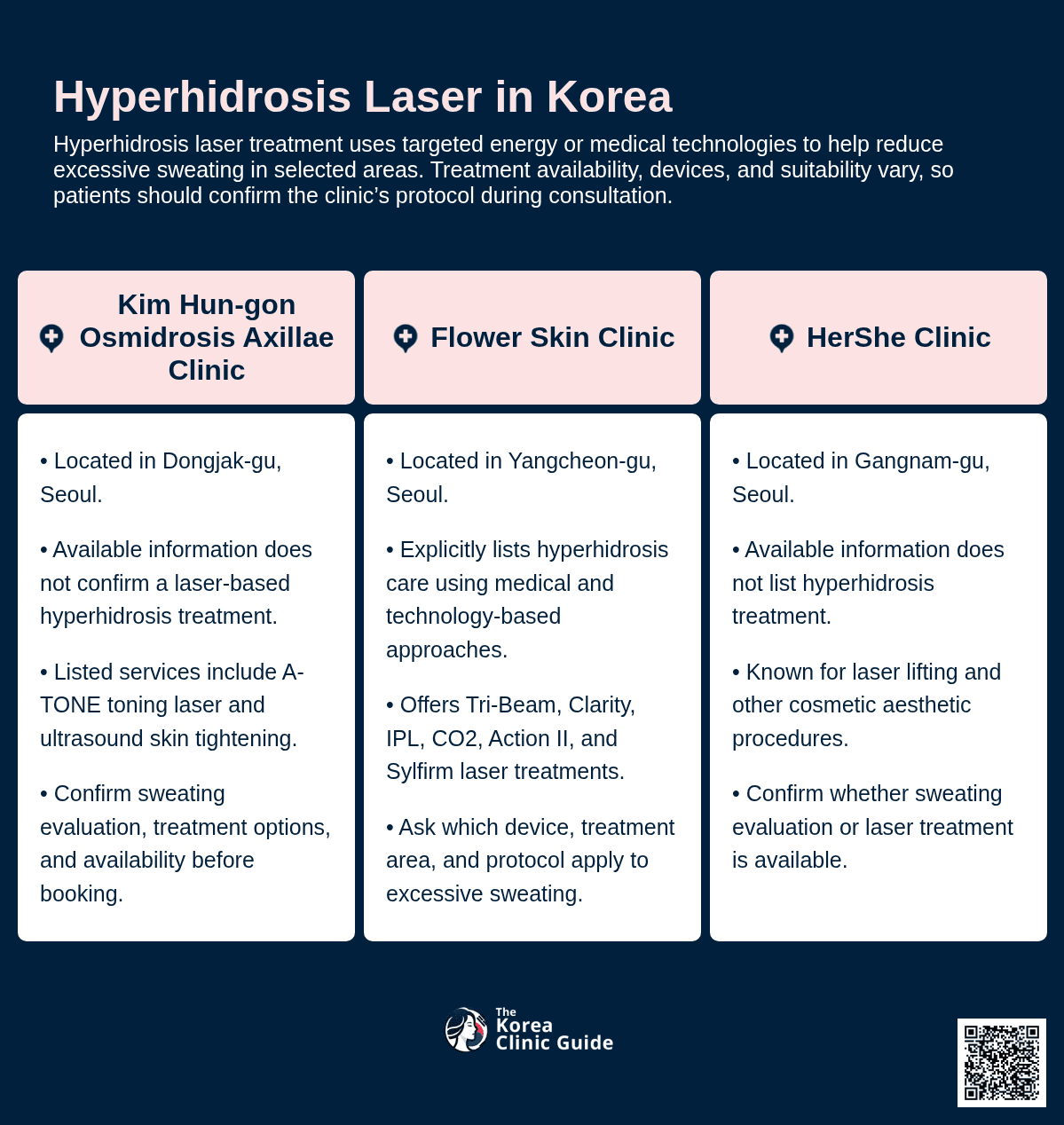
Listed below are some of the best clinics in Korea for hyperhidrosis laser.
1. Kim Hun-gon Osmidrosis Axillae Clinic
For Hyperhidrosis Laser, the available information does not describe a laser-based excessive-sweating treatment at Kim Hun-gon Osmidrosis Axillae Clinic. You can expect a practice whose listed services focus primarily on aesthetic surgery, facial procedures, and selected nonsurgical skin treatments, so you should verify whether hyperhidrosis assessment or laser treatment is available before making plans.
- URL: Kim Hun-gon Osmidrosis Axillae Clinic Website
- Location: Dongjak-gu, Seoul
- Listed nonsurgical services:
- A-TONE toning laser for pigmentation and skin-tone concerns.
- Ultrasound-based skin tightening, fillers, Botox, and V-Line injections are listed.
- Other surgical services: The clinic lists eyelid and nose surgery, facial contouring, breast surgery, fat grafting, and liposuction.
2. Flower Skin Clinic
You may consider Flower Skin Clinic for Hyperhidrosis Laser because its dermatology-focused services explicitly include hyperhidrosis treatment using medical and technological approaches, alongside care for skin diseases and a broad range of laser treatments. The information does not name a specific laser protocol for excessive sweating, so you should confirm the device, treatment area, expected course, and whether it fits your sweating concerns.
- URL: Flower Skin Clinic Website
- Location: Yangcheon-gu, Seoul
- Hyperhidrosis and skin care:
- Hyperhidrosis treatment is listed among the clinic’s medical and technology-based services.
- The clinic also lists care for atopic dermatitis, urticaria, psoriasis, vitiligo, contact dermatitis, seborrheic dermatitis, and fungal skin infections.
- Laser and device treatments:
- Listed technologies include Tri-Beam, Clarity, IPL, Action II, CO2 laser, and Sylfirm laser for pigmentation, vascular concerns, rejuvenation, and related skin issues.
- Laser options are also listed for acne, rosacea, lifting, scalp care, and hair removal.
- Relevant considerations:
- You can ask whether your sweating has a skin-related trigger or whether evaluation is recommended before treatment.
- The available information does not specify a hyperhidrosis laser device or treatment protocol.
3. HerShe Clinic
For Hyperhidrosis Laser, the available information does not list excessive-sweating treatment at HerShe Clinic. You can expect a Cheongdam cosmetic clinic with laser lifting and other aesthetic services, but you should confirm whether it provides hyperhidrosis evaluation or a laser-based sweating treatment before proceeding.
- URL: HerShe Clinic Website
- Location: Gangnam-gu, Seoul
- Listed laser and aesthetic care:
- Laser lifting is listed as a noninvasive treatment intended to tighten skin and support collagen production.
- Other listed services include non-surgical lifting, a minimally invasive SMAS-focused Max Lifting procedure, under-eye fat repositioning, upper eyelid surgery, and a skin-rejuvenation booster.
Hyperhidrosis Laser From Start to Finish
- Remote consultation and records review — Send the clinic a symptom history, previous treatments, medication and allergy list, history of underarm procedures, and clear photographs if requested. Confirm whether English consultation is available and obtain the exact proposed device and treatment plan in writing.
- In-person diagnosis and mapping — The clinician reviews whether symptoms fit primary focal axillary hyperhidrosis and screens for secondary-cause warning signs. Severity can be recorded with the Hyperhidrosis Disease Severity Scale, while a Minor starch–iodine test can map the active sweating area.
- Treatment planning and consent — Discuss expected reduction rather than guaranteed permanent dryness, possible hair reduction, repeat-session likelihood, recovery restrictions, and risks including burns, seroma, infection, scarring, sensory change, incomplete response, and recurrence. Confirm whether laser alone or suction/curettage is planned.
- Anesthesia and sedation — Subdermal procedures use local or tumescent anesthesia, commonly lidocaine with epinephrine; some clinics also use sedation. Fasting and companion requirements depend on the anesthesia plan.
- Laser treatment — For subdermal ablation, tiny underarm incision(s) allow controlled movement of a laser fiber or cannula beneath the skin. Surface laser treatment instead delivers energy across intact skin and is usually scheduled as a multi-session course.
- Dressing and discharge — The access sites are dressed, the clinician checks pain and immediate symptoms, and the clinic provides written instructions for dressings, pain control, activity, bathing, and urgent contact.
- Early local review — Attend an early wound and symptom check before departure. The clinic assesses incision healing, swelling, bruising, fluid collection, burn injury, and sensory symptoms.
- Outcome and overseas follow-up — A practical response assessment is at 8–12 weeks, using symptom change and, where appropriate, repeat HDSS scoring or sweat mapping. Continue remote follow-up after returning home and discuss retreatment only after the treated area has healed and the response is clear.
Alternatives to Laser Treatment for Hyperhidrosis
Reversible options are generally preferable when diagnosis is uncertain, future pregnancy is planned, or avoiding invasive risks is the priority. More durable local procedures can reduce treatment frequency but are harder to reverse and have greater recovery demands; laser has no robust direct evidence proving it safer, more effective, or more durable than the established options below.
Prescription Antiperspirants
- Approach — Aluminum chloride, commonly 20%, is a non-invasive first-line option for axillary sweating.
- Tradeoff — It is inexpensive and reversible but can irritate underarm skin and requires continuing use.
Botulinum Toxin
- Approach — Hyperhidrosis Botox temporarily blocks the nerve signal to sweat glands through multiple underarm injections.
- Tradeoff — No incision or gland destruction is involved, but results wear off and repeat injections are needed.
Microwave Thermolysis
- Approach — miraDry uses microwave energy, not a laser, to treat underarm sweat glands.
- Tradeoff — It is a non-laser energy procedure with its own recovery profile; direct high-quality comparisons against laser treatment are lacking.
Mechanical Gland Removal
- Approach — Sweat-gland removal, axillary liposuction, or curettage-based procedures mechanically disrupt or remove underarm gland tissue.
- Tradeoff — These are more invasive local procedures, with incision, contour, scarring, fluid-collection, and recovery considerations.
Endoscopic Thoracic Sympathectomy
- Approach — Hyperhidrosis surgery interrupts sympathetic nerve pathways and is reserved for carefully selected severe cases.
- Tradeoff — It is surgery rather than local underarm treatment and can cause compensatory sweating elsewhere on the body.
How Can I Prepare for Laser Treatment for Hyperhidrosis?
- Medical review — Provide complete medical records, previous hyperhidrosis treatments, prior underarm surgery, allergies, and a full medication list well before travel. Include diabetes medicines, isotretinoin, GLP-1 medicines when sedation is planned, and all over-the-counter products.
- Blood-thinning medicines and supplements — Report warfarin, apixaban, rivaroxaban, clopidogrel, aspirin, NSAIDs, fish oil, vitamin E, ginkgo, garlic, and St John’s wort. The laser clinician and the prescriber managing each medicine must decide whether a change is appropriate; never stop prescribed treatment independently.
- Pregnancy and breastfeeding — Tell the clinic about pregnancy, breastfeeding, or plans to conceive. Postponement is generally appropriate for elective gland-ablation treatment.
- Underarm skin — Prevent sunburn, tanning, waxing injury, shaving cuts, active dermatitis, and deodorant-related irritation in the treatment area. Follow the clinic’s exact instructions on shaving and deodorant use.
- Fasting and sedation — Follow fasting instructions exactly when sedation or anesthesia is planned. Requirements differ for local anesthesia alone versus oral or IV sedation.
- Smoking and alcohol — Ask for the clinic’s required cessation period. Smoking, nicotine exposure, and alcohol can complicate recovery planning, but no procedure-specific evidence establishes one universal timeframe for laser sweat-gland ablation.
- Practical arrangements — Book accommodation near the clinic for the first night, wear loose sleeveless or front-opening clothing, and arrange transport that does not require driving. Bring translated medicine records and an after-hours clinic number.
- Companion and flights — Arrange a responsible adult companion for sedation and keep departure plans flexible until after an early review.
Travel note: Do not schedule treatment immediately before a fixed long-haul departure. Sedation, combined suction/curettage, or wound concerns can require a longer stay.
Confirm the treating clinic’s individualized medication, fasting, skin-preparation, companion, and travel requirements, as these take precedence over general guidance.
Aftercare Advice
Protect the small access sites and give the treated underarms time to heal; worsening symptoms require prompt clinical review rather than self-treatment.
- Dressings and hygiene — Keep incision sites clean and dry exactly as directed. Use only the prescribed dressing, ointment, cooling method, and pain medicine.
- Activity and friction — Avoid vigorous upper-body exercise, heavy lifting, swimming, sauna, hot baths, and tight-sleeve friction until the clinician confirms healing, often around 1–2 weeks after uncomplicated invasive treatment.
- Do not manipulate lumps — Do not massage, puncture, or attempt to drain nodules, swelling, or a possible fluid collection. Contact the clinic for assessment.
- Deodorant and hair removal — Resume deodorant, shaving, waxing, or laser hair removal only after the skin has healed and the clinic approves. Temporary underarm hair reduction can occur after laser treatment.
- Warning signs — Seek urgent advice for increasing pain, spreading redness or warmth, pus or foul drainage, fever, blistering or burn injury, wound separation, substantial one-sided swelling, a rapidly enlarging fluid collection, weakness, or persistent or worsening numbness in the arm or hand.
- Results and follow-up — Swelling can last up to one week, while soreness, bruising, restricted arm comfort, and temporary sensory changes can last roughly 1–2 weeks. Review the result at about 8–12 weeks; long-term durability beyond one year is uncertain across laser methods.
Follow the treating doctor’s instructions over general advice and contact the clinic promptly when healing or sensation appears abnormal.
Frequently Asked Questions
Related Blogs
Varicose Vein Treatment in Korea: Methods, Recovery, Travel Planning, and Safety
Varicose vein treatment begins with standing duplex ultrasound mapping and may use laser or radiofrequency ablation, vein glue, mechanochemical ablation, foam sclerotherapy, phlebectomy, or surgery based on anatomy and risk factors. The article covers candidacy, recovery, compression and walking guidance, follow-up, warning symptoms, and travel planning including flight restrictions after treatmen
Updated: Sep 19, 2026
Hyperhidrosis Surgery in Korea: ETS Methods, Risks, Recovery, and Travel Planning
Endoscopic thoracic sympathectomy (ETS) uses small chest ports under general anesthesia to permanently interrupt the sympathetic chain for severe primary palmar sweating after non-surgical treatments have failed or are not tolerated. International patients should plan 7–10 postoperative days in Korea, attend follow-up before flying, obtain flight clearance if pleural air is a concern, and arrange
Updated: Sep 18, 2026
Ear Plastic Surgery in Korea: Types, Recovery, Travel Planning and Aftercare
Ear plastic surgery includes otoplasty for prominent ears, earlobe repair, and diagnosis-specific reconstruction for conditions such as microtia, cryptotia, trauma, or constricted ears. The article explains candidacy, techniques, recovery, aftercare, international travel planning, and the recommended 7–10-day Korea stay for uncomplicated routine otoplasty.
Updated: Sep 18, 2026
NK Cell Test in Korea: Methods, Results, Travel Planning, and Limitations
NK cell testing uses a blood draw for assay-specific measures such as NK-cell count, cytotoxicity, CD107a/perforin, or stimulated IFN-γ release, typically for specialist-directed immune evaluation. International patients should confirm the exact assay, specimen handling, turnaround, English reporting, reference interval, and follow-up plan; NK Vue in Korea requires 20–24 hours of incubation and at
Updated: Sep 18, 2026