Medical Tourism Blog
Hyperhidrosis Surgery in Korea: ETS Methods, Risks, Recovery, and Travel Planning
Table of contents
- Hyperhidrosis Surgery at a Glance
- What Is Hyperhidrosis Surgery?
- Who Is a Good Candidate for Hyperhidrosis Surgery?
- How Is Hyperhidrosis Surgery Performed?
- Why Visit Korea for Hyperhidrosis Surgery?
- Key Information for International Patients
- Which Are the Best Clinics in Korea for Hyperhidrosis Surgery?
- Hyperhidrosis Surgery From Start to Finish
- Alternatives to Hyperhidrosis Surgery
- How Can I Prepare for Hyperhidrosis Surgery?
- Aftercare Advice
Considering treatment in Korea? Everything you need to know e.g. — how to avoid scams, visas, interpreters, recovery tips — in our Medical Tourism Master Guide. Plan with confidence in minutes, not weeks!
Last updated: September 2026
Hyperhidrosis Surgery at a Glance
- What it treats — Endoscopic thoracic sympathectomy or sympathicotomy (ETS) is a keyhole chest operation that permanently interrupts part of the sympathetic nerve chain, mainly to control severe primary palmar (hand) hyperhidrosis.
- Best candidates — Candidates typically have severe, bilateral hand sweating that disrupts daily activities and has not responded to, or cannot tolerate, treatments such as prescription antiperspirants, iontophoresis, botulinum toxin, or clinician-guided medication.
- Immediate but permanent effect — Hand sweating often falls immediately or soon after surgery, and ETS is intended to be permanent rather than a repeat-session treatment; residual sweating, recurrence, or excessively dry hands can still occur.
- Main long-term trade-off — Compensatory sweating—new or increased sweating on the trunk, abdomen, back, groin, or legs—is the most important long-term risk and can be severe; clip removal or other “reversal” surgery is not a dependable restoration of normal function.
- Recovery and hospital stay — Uncomplicated patients commonly go home the same day or after one night, desk work may be feasible in about 4–7 days, and chest-wall or shoulder discomfort can last days to weeks.
- Korea travel planning — International patients should plan at least 7–10 postoperative days in Korea, preferably 10–14 days for an in-person review and individualized flight clearance; flying is unsafe with unresolved pneumothorax, and travel should wait 7 days after an X-ray confirms full resolution.
- Technique details matter — Ask the Korean surgical team for the exact rib-level target and interruption method: R4 may lower compensatory-sweating risk but can leave hands moister than R3, while clipping may have lower reported compensatory sweating but more failure or recurrence than cutting approaches.
What Is Hyperhidrosis Surgery?
Hyperhidrosis surgery, usually endoscopic thoracic sympathectomy or sympathicotomy, is a chest operation that permanently interrupts nerve signals involved in sweating. It is mainly used to reduce severe, persistent hand sweating from primary focal hyperhidrosis when non-surgical treatments have not provided enough relief. It is a surgical procedure performed under general anesthesia through small chest incisions.
Who Is a Good Candidate for Hyperhidrosis Surgery?
- Severe palmar hyperhidrosis — Good candidates have persistent, bilateral primary hand sweating that interferes with work, handshakes, writing, device use, or daily activities despite appropriate non-surgical treatment.
- Documented treatment history — Candidates have already tried or cannot tolerate suitable options such as prescription antiperspirants, iontophoresis, botulinum toxin, or clinician-directed anticholinergic treatment.
- Clear focal pattern — ETS is principally considered for primary focal palmar sweating. It is not a dependable treatment for plantar sweating, because effects on the feet are variable.
- Informed acceptance of permanence — Candidates understand that sympathetic-chain interruption is intended to be permanent and accept the possibility of excessive hand dryness, residual sweating, recurrence, and compensatory sweating elsewhere on the body.
ETS is unsuitable for secondary or generalized sweating until medication effects and systemic causes, including endocrine disease, infection, malignancy, neurologic disease, and hypoglycemia, have been assessed and treated. Elective surgery is ordinarily deferred during pregnancy, and active respiratory infection, uncontrolled bleeding risk, or unoptimized major heart or lung disease requires postponement or individualized thoracic and anesthesia assessment. Higher BMI, smoking, older age, and strong concern about compensatory sweating are not automatic exclusions, but they require particularly careful counseling. Isolated underarm sweating usually calls for local treatment rather than ETS, because thoracic sympathetic interruption is not the anatomically targeted option for that problem.
How Is Hyperhidrosis Surgery Performed?
ETS differs by the level of the sympathetic chain interrupted and by whether the surgeon divides, removes, ablates, or clips the chain. Ask for the planned rib-oriented level, such as R3 or R4, rather than relying on broad “T3” or “T4” marketing terminology.
- Sympathicotomy — The surgeon divides the sympathetic chain without removing a ganglion. This is a common thoracoscopic interruption approach for palmar hyperhidrosis.
- Sympathectomy or ganglionectomy — A segment or ganglion is removed, ablated, or otherwise destroyed. This is a more destructive form of interruption.
- Clip interruption — Clips mechanically interrupt nerve transmission. A systematic review of clipping versus cutting approaches found mixed evidence: clipping was associated with lower compensatory-sweating percentages but more failure or recurrence. Clip removal cannot be presented as a reliable reversal of normal autonomic function.
- R3 versus R4 targeting — The Society of Thoracic Surgeons consensus describes a practical tradeoff for palmar symptoms: R4 can reduce compensatory-sweating risk but can leave hands moister than R3. Neither level guarantees a particular outcome.
- One-stage versus staged treatment — Both sides are often treated in one operation. Comparative evidence does not establish staged bilateral ETS as universally superior for preventing long-term compensatory sweating; terminology, outcome definitions, and follow-up vary across studies.
Why Visit Korea for Hyperhidrosis Surgery?
Korea has thoracic-surgery services able to evaluate and perform ETS, but an international patient should assess each team’s outcomes rather than assume a national standard. The operation’s irreversible effects make transparent preoperative counseling and a defined follow-up plan more important than convenience alone.
- Nationwide research infrastructure — Korean researchers have identified ETS patients through the nationwide Health Insurance Review and Assessment Service database, demonstrating capacity for population-level hyperhidrosis research in Korea.
- Important transparency limitation — HIRA claims-based research cannot tell a traveler which surgeon or hospital has the best target-area response, severe compensatory-sweating rate, pneumothorax rate, chest-drain use, reoperation rate, or long-term satisfaction.
- Questions to obtain before booking — Request the exact rib level and interruption method, the team’s definition and measured rate of compensatory sweating, their protocol for postoperative imaging and flight clearance, and direct remote-contact arrangements after return home.
- Evidence-aware counseling — Randomized studies have compared selected interruption levels, but a review of the evidence found important differences in surgical terminology, target sites, compensatory-sweating definitions, and follow-up. No clinic can reliably calculate an individual’s exact long-term outcome from published percentages.
Key Information for International Patients
- Minimum stay — Plan at least 7–10 postoperative days in Korea after uncomplicated bilateral ETS. A 10–14-day stay is more prudent because it allows recovery, an in-person review, and an individualized fitness-to-fly decision.
- Hospital stay — Uncomplicated patients commonly leave on the day of surgery or after one overnight stay, following observation for pain, nausea, breathing difficulty, and pleural air.
- Flight timing — Do not fly with a pneumothorax or unresolved pleural air. British Thoracic Society guidance states that travel should wait until seven days after a chest X-ray confirms full pneumothorax resolution; the thoracic surgeon can require a longer delay after surgery, a drain, respiratory symptoms, or another complication.
- Itinerary impact — Expect chest-wall, shoulder, and incision discomfort for days to weeks. Desk-based work is often realistic after about 4–7 days, while lifting, strenuous exercise, and long sightseeing days require the operating surgeon’s clearance.
- Companion and accommodation — Arrange an escort for discharge and the first postoperative night, and stay close to the hospital until the postoperative review.
- Records and remote care — Leave Korea with the operative report, anesthesia and discharge summaries, medication list, imaging results when obtained, and a direct emergency contact route. CDC medical-travel guidance emphasizes continuity-of-care planning and obtaining complete records before travel home.
Travel note: Keep flights flexible. There is no universal ETS-specific rule for the number of days an international traveler must remain in Korea; symptom status, examination findings, imaging, and complications determine clearance.
Which Are the Best Clinics in Korea for Hyperhidrosis Surgery?
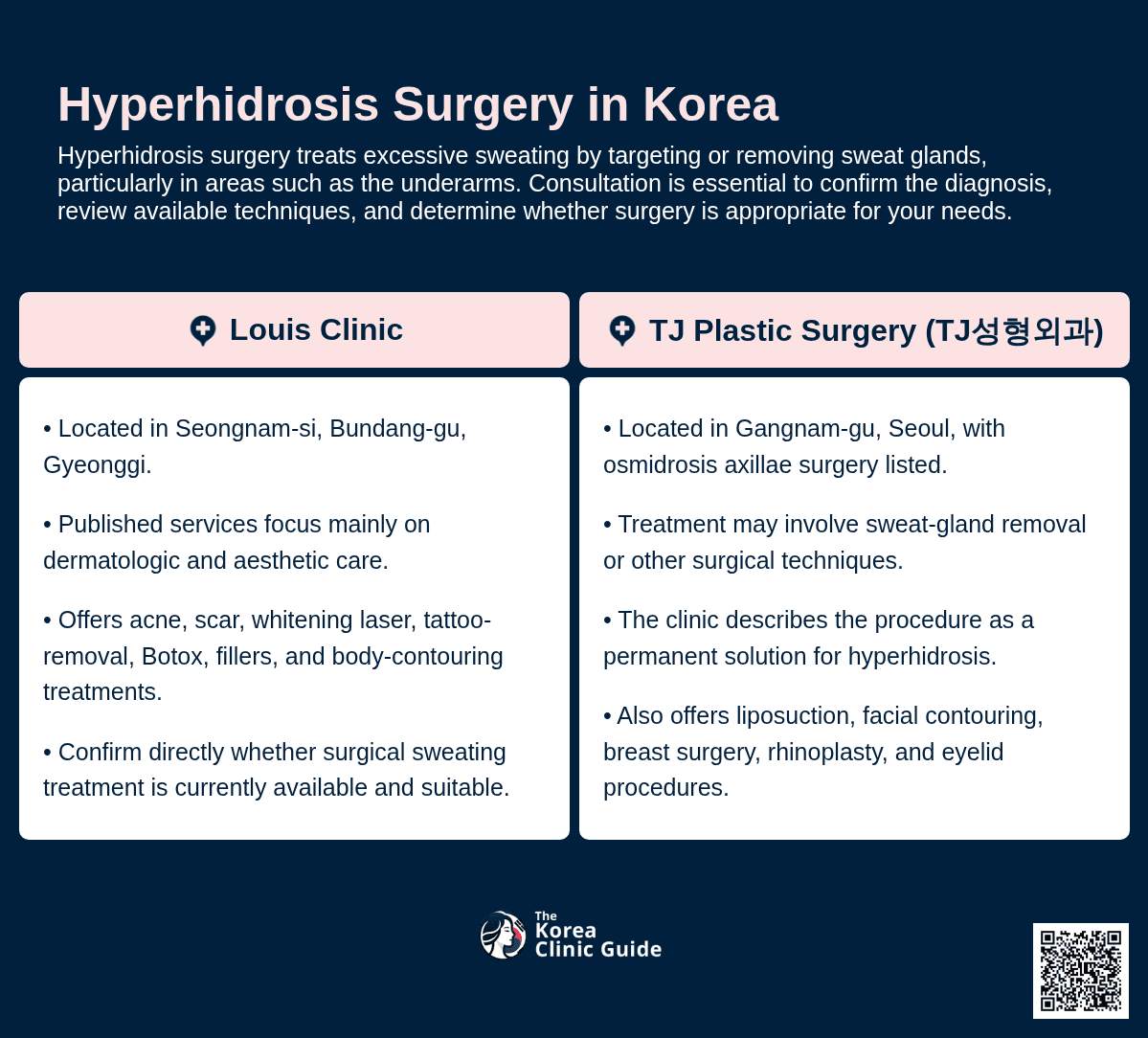
Listed below are some of the best clinics in Korea for hyperhidrosis surgery.
1. Louis Clinic
Louis Clinic’s listed services focus on aesthetic and dermatologic care rather than hyperhidrosis surgery, so you may consider it only after confirming whether it offers a surgical sweating treatment and whether that option fits your needs. Its published treatment range includes skin-focused consultations and laser-based care, which may be relevant if you also want support for related dermatologic concerns.
- URL: Louis Clinic Website
- Location: Seongnam-si Bundang-gu, Gyeonggi
- Listed skin and aesthetic services:
- Acne care may include topical or oral medications and specialized facials.
- Scar treatment is described as using laser therapy and microneedling.
- Whitening laser treatment, tattoo removal, Botox, fillers, thread lifting, and body-contouring injections are listed.
2. TJ Plastic Surgery (TJ성형외과)
For excessive underarm sweating, TJ Plastic Surgery lists osmidrosis axillae surgery, described as treating axillary sweating through sweat-gland removal or other techniques and as providing a permanent solution for hyperhidrosis. You can expect a clinic whose published surgical menu also includes a broad range of facial, breast, and body procedures, while discussing the appropriate technique, expected result, and suitability for your underarm-sweating concerns during consultation.
- URL: TJ Plastic Surgery (TJ성형외과) Website
- Location: Gangnam-gu, Seoul
- Procedure details:
- Osmidrosis axillae surgery is listed for excessive underarm sweating.
- The clinic describes treatment through removal of sweat glands or other techniques.
- The published description characterizes the procedure as a permanent solution for hyperhidrosis.
- Other surgical services:
- The clinic lists liposuction, breast reduction, facial contouring, rhinoplasty, eyelid procedures, facelifting, and fat grafting.
- Before-and-after photos are noted as available to help you review results from its procedures.
Hyperhidrosis Surgery From Start to Finish
- Remote consultation and record review — Send a focused history of sweating by body site, age of onset, functional impact, prior treatments, medicines and supplements, allergies, smoking status, BMI, anesthesia history, cardiopulmonary conditions, and previous chest surgery. Confirm whether English-language or virtual consultation support is available before travel.
- In-person diagnosis and counseling — The surgical team confirms whether the pattern fits primary focal hyperhidrosis and assesses possible secondary causes. Discuss alternatives, the intended permanent effect, scars, the planned rib level, interruption method, risk of compensatory sweating, and what happens if pleural complications occur.
- Preoperative testing and anesthesia assessment — Testing is tailored to health history and the planned general anesthetic. Fever, acute respiratory illness, or another active infection can lead to postponement.
- Bilateral thoracoscopic operation — Under general anesthesia, the thoracic surgeon uses small chest ports to access each side of the chest and interrupts the selected portion of the sympathetic chain. The lungs are re-expanded and the team checks for air leak or pneumothorax before completing the procedure.
- Recovery observation — Staff monitor pain, nausea, oxygenation, breathing symptoms, and signs of pleural air or bleeding. Hand sweating often decreases immediately or early after ETS.
- Discharge and local review — Once clinically stable, discharge is commonly the same day or next day. Attend the scheduled wound and symptom review before departure; the surgeon decides whether examination or imaging is needed for flight clearance.
- Remote follow-up after return home — Report sweating by body site, hand dryness, compensatory sweating, wound healing, resting-heart-rate symptoms, and functional benefit. Establish local medical care promptly for respiratory symptoms, wound concerns, or severe compensatory sweating.
Alternatives to Hyperhidrosis Surgery
Alternatives are usually preferable before irreversible thoracic surgery, especially for mild disease or isolated underarm sweating. Non-surgical options need repeat treatment or ongoing use but avoid permanent interruption of the thoracic sympathetic chain; local underarm procedures target axillary sweat glands and do not treat sweaty hands.
Botulinum Toxin
- Best suited to — Focal sweating in the hands or underarms when temporary, site-specific treatment is acceptable.
- Tradeoff — Treatment requires repeat injections as effects wear off. See hyperhidrosis Botox.
Iontophoresis and Medication
- Best suited to — Hand or foot sweating treated with regular iontophoresis, or patients for whom topical or oral anticholinergic therapy is clinically appropriate.
- Tradeoff — These treatments require adherence and clinician review for medicine side effects; they do not involve chest surgery.
Microwave Thermolysis
- Best suited to — Underarm-only sweating where sweat-gland destruction is the treatment goal.
- Tradeoff — It treats axillary glands only, not palmar sweating. See miraDry.
Local Axillary Sweat-Gland Procedures
- Best suited to — Persistent underarm sweating after appropriate non-surgical care.
- Tradeoff — Curettage, liposuction, excision, or combined local techniques act in the underarm and do not alter sweating in the hands. Review sweat-gland removal or axillary liposuction.
How Can I Prepare for Hyperhidrosis Surgery?
- Secondary-cause review — Provide a complete sweating history and disclose medication effects, endocrine symptoms, infection symptoms, neurologic history, and unexplained weight change or fever. ETS should not proceed until secondary or generalized sweating has been properly evaluated.
- Medicines and supplements — Give the surgeon and anesthesiologist a full list of prescription medicines, aspirin, anticoagulants, anti-inflammatory drugs, vitamins, herbal products, and supplements. Do not stop prescribed blood thinners or other medicines on your own; obtain the surgical team’s written instructions on what to continue or stop and when.
- Smoking and alcohol — Disclose nicotine use, including vaping, and alcohol intake during the anesthesia assessment. Follow the surgeon’s cessation plan before surgery and avoid alcohol when instructed around anesthesia and prescription pain medicine.
- Fasting and illness — Follow the clinic’s specific fasting instructions for general anesthesia. Report fever, cough, shortness of breath, COVID-19 or other respiratory symptoms, and new infection immediately, as surgery can require postponement.
- Travel logistics — Book flexible flights, arrange an escort for discharge, reserve accommodation close to the hospital, and avoid scheduling demanding activities during the first postoperative week.
- Documents — Bring prior treatment records, chest-operation records or imaging if relevant, medication lists, allergies, insurance information, and contact details for a clinician at home.
Travel note: Do not make a fixed return-flight commitment until the operating surgeon has reviewed postoperative recovery and addressed any chest symptoms or imaging findings.
Confirm every clinic-specific testing, fasting, medication, smoking, and travel requirement with the treating surgeon and anesthesiology team; their individualized instructions take precedence over general guidance.
Aftercare Advice
Protect lung recovery and attend the in-person postoperative review before making international travel plans.
- Walking and breathing — Start gentle walking and prescribed breathing exercises early to support recovery. Increase activity according to pain, shoulder movement, and the surgeon’s instructions.
- Work, lifting, and exercise — Desk-based work is often possible after about 4–7 days in an uncomplicated recovery. Avoid heavy lifting and strenuous exercise until the operating surgeon clears them; chest and shoulder discomfort can last days to weeks.
- Pain medicine and driving — Take prescribed or recommended pain relief exactly as directed. Do not drive while taking opioid pain medicine, feeling sedated, or unable to move the shoulders comfortably.
- Incisions and bathing — Keep port-site wounds clean and follow the clinic’s instructions on dressings, showering, and bathing. Do not apply unapproved creams or expose healing incisions to friction.
- Monitor sweating changes — Record hand dryness, residual sweating, and new sweating on the trunk, abdomen, back, groin, or legs. Compensatory sweating can begin in the first weeks or later and is the key long-term outcome to reassess.
- Urgent warning signs — Seek urgent assessment for shortness of breath, worsening chest pain, fainting, coughing blood, fever, persistent vomiting, rapidly worsening swelling, wound drainage, or spreading redness.
- Severe compensatory sweating — Contact the surgical team and a local clinician rather than pursuing marketed “reversal” claims. Evidence for unclipping, extended sympathectomy, and sympathetic-nerve reconstruction is limited and inconsistent.
Follow the treating doctor’s instructions for activity, wound care, medicines, and flying, and contact the clinic promptly when recovery appears abnormal.
Frequently Asked Questions
Related Blogs
Hyperhidrosis Laser in Korea: Methods, Recovery, Results, and Travel Planning
Laser treatment for primary axillary hyperhidrosis uses subdermal fiber ablation through tiny incisions or surface laser sessions to reduce underarm sweating, with repeat treatment sometimes needed. The article covers candidacy, Korea travel planning, preparation, recovery, warning signs, follow-up, and alternatives such as antiperspirants, Botox, microwave thermolysis, and gland removal.
Updated: Sep 18, 2026
Ear Plastic Surgery in Korea: Types, Recovery, Travel Planning and Aftercare
Ear plastic surgery includes otoplasty for prominent ears, earlobe repair, and diagnosis-specific reconstruction for conditions such as microtia, cryptotia, trauma, or constricted ears. The article explains candidacy, techniques, recovery, aftercare, international travel planning, and the recommended 7–10-day Korea stay for uncomplicated routine otoplasty.
Updated: Sep 18, 2026
NK Cell Test in Korea: Methods, Results, Travel Planning, and Limitations
NK cell testing uses a blood draw for assay-specific measures such as NK-cell count, cytotoxicity, CD107a/perforin, or stimulated IFN-γ release, typically for specialist-directed immune evaluation. International patients should confirm the exact assay, specimen handling, turnaround, English reporting, reference interval, and follow-up plan; NK Vue in Korea requires 20–24 hours of incubation and at
Updated: Sep 18, 2026
Varicose Vein Treatment in Korea: Methods, Recovery, Flight Planning, and Aftercare
Varicose vein treatment begins with standing examination and duplex ultrasound mapping, followed by options such as RFA, laser ablation, vein glue, foam sclerotherapy, phlebectomy, or stripping based on reflux anatomy and health factors. The article covers candidacy, preparation, aftercare, follow-up records, and travel planning, including individualized written clearance before long-haul flights.
Updated: Sep 17, 2026