
Medical Tourism Blog
Forehead Thread Lift in Korea: Candidacy, Recovery, Risks, and Travel Planning

Table of contents
- Forehead Thread Lift at a Glance
- What Is a Forehead Thread Lift?
- Who Is a Good Candidate for a Forehead Thread Lift?
- How Is a Forehead Thread Lift Performed?
- Why Visit Korea for a Forehead Thread Lift?
- Key Information for International Patients
- Which Are the Best Clinics in Korea for Forehead Thread Lift?
- Forehead Thread Lift From Start to Finish
- Alternatives to a Forehead Thread Lift
- How Can I Prepare for a Forehead Thread Lift?
- Aftercare Advice
Considering treatment in Korea? Everything you need to know e.g. — how to avoid scams, visas, interpreters, recovery tips — in our Medical Tourism Master Guide. Plan with confidence in minutes, not weeks!
Last updated: September 2026
Forehead Thread Lift at a Glance
- What it does — An outpatient, local-anesthetic procedure that places absorbable barbed threads through small punctures to subtly elevate the brow—often the outer brow tail—and reposition mild upper-forehead laxity.
- Best candidates — Most suitable for mild brow descent, modest upper-lid heaviness caused by brow position, and moderate skin thickness; it is not a reliable fix for true eyelid ptosis, major skin excess, or a dramatic permanent lift.
- Recovery and results — Expect swelling, bruising, tightness, tenderness, and temporary puckering or unevenness for about 1–2 weeks; allow roughly 2 weeks before an important event and assess the more settled result at about 12 weeks.
- Durability limits — The lift is temporary-to-intermediate, with no established forehead-specific duration, ideal thread count, or routine repeat schedule; reassessment after the result stabilizes should guide any retreatment.
- Key risks — Possible complications include dimpling, asymmetry, visible or migrating threads, extrusion, infection, sensory changes, and rare vascular or nerve injury; vision changes, facial weakness, severe pain, or rapidly worsening swelling need urgent in-person care.
- Korea travel plan — Stay in Korea for at least 3–5 days after treatment for an early review rather than flying out the same day, then arrange follow-up at 1–2 weeks and again around 8–12 weeks.
- Korea-specific check — Verify the clinic is registered to treat international patients and leave with English documentation of the clinician, exact thread brand and material, insertion map, medications, aftercare, and an after-hours complication plan; Korean location alone does not prove better outcomes.
What Is a Forehead Thread Lift?
A forehead thread lift uses absorbable sutures placed through small punctures to subtly raise the brow and support upper-face tissue. It aims to improve mild brow descent and related upper-lid heaviness while preserving a natural-looking expression. It is a minimally invasive procedure, usually performed as an outpatient treatment under local anesthesia.
Who Is a Good Candidate for a Forehead Thread Lift?
- Mild brow descent — Good candidates want a subtle elevation of a low or flattened brow, often the lateral brow tail, rather than a dramatic or permanent forehead lift.
- Upper-lid heaviness from brow position — The treatment can help when descended brow tissue contributes to upper-lid heaviness; it does not correct true eyelid ptosis caused by the eyelid levator muscle.
- Adequate tissue quality — Moderate skin thickness and mild upper-face laxity give threads better concealment and traction than very thin skin or markedly loose tissue.
- Realistic treatment goals — Candidates understand that absorbable barbed sutures provide a limited, temporary-to-intermediate repositioning effect and that asymmetry, dimpling, retreatment, or later surgery remain possible.
Avoid treatment during active acne, cellulitis, herpes, open wounds, or other infection of the forehead, brow, scalp, or temple. Bleeding disorders, uncontrolled hypertension, and anticoagulant or antiplatelet treatment that cannot be safely managed with the prescribing clinician require medical review; never stop aspirin, clopidogrel, warfarin, apixaban, rivaroxaban, or similar medicines independently. Marked brow ptosis, substantial forehead skin excess, severe laxity, fixed deep forehead lines, or a wish for a large and permanent lift are usually better addressed surgically. Pregnancy, breastfeeding, uncontrolled diabetes, immunosuppression, poorly controlled autoimmune disease, previous forehead surgery, implanted material, and existing forehead filler also require individualized assessment; untreated eyelid ptosis or visual symptoms warrant ophthalmic, oculoplastic, or plastic-surgery evaluation before cosmetic brow elevation.
How Is a Forehead Thread Lift Performed?
A forehead thread lift is not a standardized operation. It commonly uses small entry points near the hairline, brow, or temple to place threads that elevate the lateral brow, central brow, or upper-forehead tissue along a planned vector.
- Thread material — PDO, PLLA, and PCL are absorbable materials; permanent polypropylene is a less common, separate category. Material alone does not determine longevity or lift because tissue quality, insertion plane, vector, thread design, and technique also matter.
- Cog versus smooth threads — Barbed or cog threads mechanically engage and reposition soft tissue, making them the main option for a brow lift. Smooth or mono threads are used principally for tissue support or skin-quality goals and should not be presented as an equivalent lifting treatment.
- Lateral versus whole-brow vectors — A lateral brow-thread or temporal-thread plan targets the outer brow tail. Broader elevation can include central or medial brow components, but excessive lateral elevation can look unnatural and baseline asymmetry needs careful marking.
- Needle, cannula, and tissue plane — The clinician selects these based on anatomy. This is safety-critical in the forehead and temple, where vessels and sensory and motor nerves are present; ask why the proposed plane and vector fit the individual anatomy.
- Thread number — No evidence-based universal thread count exists for forehead lifting. A randomized PDO-thread study in the midface and lower face found no sustained advantage from more threads, but it does not establish the correct number for the brow or forehead.
Why Visit Korea for a Forehead Thread Lift?
Korea can be a practical destination for this outpatient treatment when the provider and facility are properly verified and an early in-person review is built into the itinerary. It is not possible to claim that Korean forehead-thread outcomes are superior to those in other countries: forehead-specific comparative data are lacking. Choose the clinician based on anatomical assessment, credentials, a conservative plan, and a clear complication pathway—not country branding.
- Foreign-patient registration check — Confirm that the institution is eligible to treat international patients through Korea's registered medical-institution system.
- Documented treatment details — Request an English record of the treating clinician, exact thread brand and material, whether the sutures are absorbable, insertion map, administered medicines, and written aftercare before departure.
- Appropriate evidence limits — A 2025 meta-analysis of 26 thread-lift studies involving 2,827 patients pooled different facial areas, materials, and techniques. It identifies reported complications but cannot provide a Korea-specific or forehead-specific risk rate.
- Safety planning over marketing claims — Korean clinical activity and publication authorship do not establish clinic-level quality. Ask for after-hours contact and a written plan for infection, extrusion, dimpling, asymmetry, migration, or thread removal after returning home.
Key Information for International Patients
- Minimum stay — Remain in Korea for at least 3–5 days after treatment rather than flying on procedure day. This allows an early review for bruising, asymmetry, hematoma, infection, or evolving neurologic symptoms.
- Flight timing — No high-quality evidence establishes one safe post-thread-lift flight interval. The treating clinician must clear travel according to treatment extent, swelling or bruising, sedation use, and access to follow-up at home.
- Social downtime — Allow about 2 weeks before a major social event. Tenderness, swelling, bruising, tightness, puncture marks, puckering, and temporary unevenness are common during this period.
- Meaningful result review — Do not judge symmetry or lift in the first 1–2 weeks. In a small brow-thread study included in a recent evidence review, measurements at one week were worse than baseline but improved at 12 weeks; assess the more settled result at about 12 weeks.
- Activity and itinerary — Keep the first 48–72 hours low key. Avoid strenuous exercise, heat exposure, facials, massage, and activities that place pressure on the forehead until the clinic clears them.
- Remote follow-up — Arrange photo-based follow-up at roughly 1–2 weeks and again around 8–12 weeks. Persistent dimpling, visible thread, worsening numbness, facial weakness, infection signs, or visual symptoms need in-person assessment, not messaging alone.
Travel note: Book flexible flights and accommodation near the clinic for the first several days. Obtain the clinic's emergency and after-hours contact details before treatment.
Which Are the Best Clinics in Korea for Forehead Thread Lift?
Listed below are some of the best clinics in Korea for forehead thread lift.
1. Haru Clinic
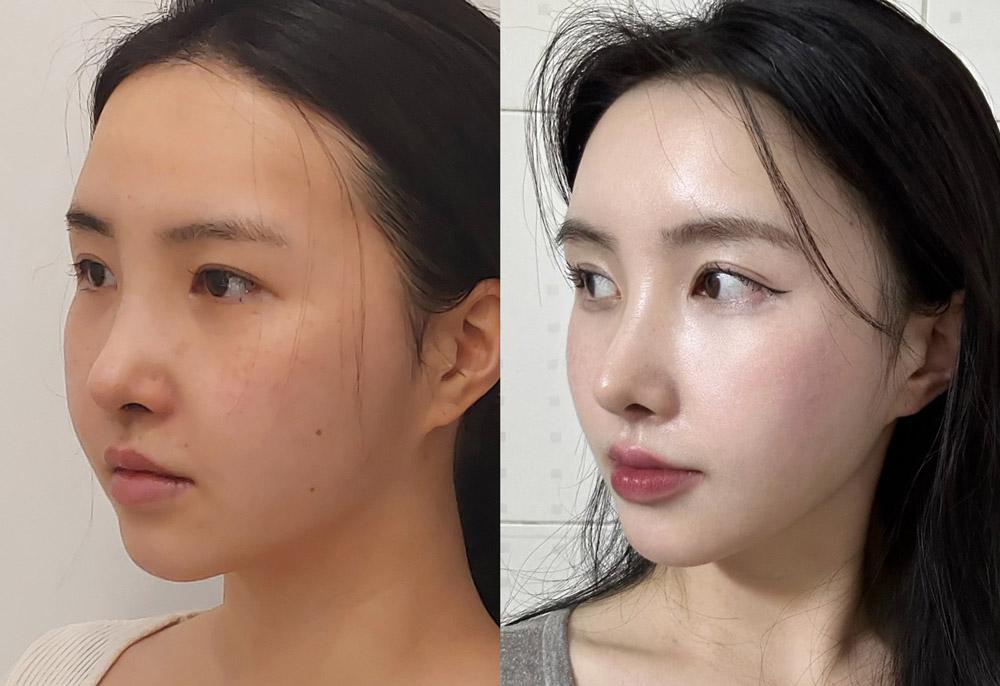
For a forehead thread lift, Haru Clinic can tailor a thread-based brow lift to raise brow position and improve the appearance of hooded upper lids while refining the forehead contour. Its lifting approach uses a firmer, less mobile fixation area behind the ear and is designed to avoid major nerves and blood vessels, with adjustments for facial volume loss and contour balance.
- URL: Haru Clinic Website
- Location: Gangnam-gu, Seoul
- Thread-lift approach:
- Uses dissolvable barbed threads for minimally invasive lifting under local anesthesia.
- Combines firm pulling with simultaneous tissue compression to support a pronounced lift without emphasizing facial width.
- May adjust the lift when volume loss beneath the cheekbones affects overall contour.
- Clinical perspective:
- Dr. Jeong is an official research physician at Merz and teaches other doctors updated filler techniques.
- Treatment planning emphasizes facial harmony and balance through non-invasive techniques.
- Related options:
- Offers thread-based or surgical eyebrow lifting, as well as collagen-tightening treatments using radiofrequency or ultrasound.
- Also provides fillers and Botox when these are relevant to volume, contour, or expression-line concerns.

2. PangPang Clinic
For a forehead thread lift, PangPang Clinic offers a thread-lifting-focused approach with individualized planning, ultrasonic visual checks, and pre-procedure design. You may be treated with its clinic-exclusive Pink Lift thread or another selection from 31 functional thread types, aiming to lift while supporting collagen production and skin quality.
- URL: PangPang Clinic Website
- Location: Gangnam-gu, Seoul
- Thread system and planning:
- Pink Lift was developed by the clinic using data from thousands of lifting procedures and is intended to provide a stronger hold, longer-lasting effect, and natural-looking lift.
- Pink Lift holds FDA, CE, and KFDA certifications.
- Uses ultrasonic visual checks, pre-operative design, physician consultation, and customized thread selection.
- Procedure details:
- Thread-lifting appointments are described as taking about 30 minutes to one hour.
- Anesthesia options include partial, Airnox, or sleep anesthesia.
- The clinic describes minimal pain and recovery, with results lasting about one year or longer; individual experiences can vary.
- Thread categories include lifting, assist, tightening, and volume threads.
- Research and comfort measures:
- Collaborates with Seoul National University Bundang Hospital on thread-lifting techniques intended to promote collagen and improve skin quality.
- Chill-Lifting uses contact-free cooling anesthesia and is designed to reduce pain, swelling, and bruising while supporting recovery.
- Offers a thread aftercare package intended to support and prolong treatment effects.
- Additional services:
- Provides a thread-lifting revision service for concerns after previous thread procedures, potentially combined with fillers, Botox, or lasers.
- Also offers customized filler and Botox treatments.
3. B.V Clinic
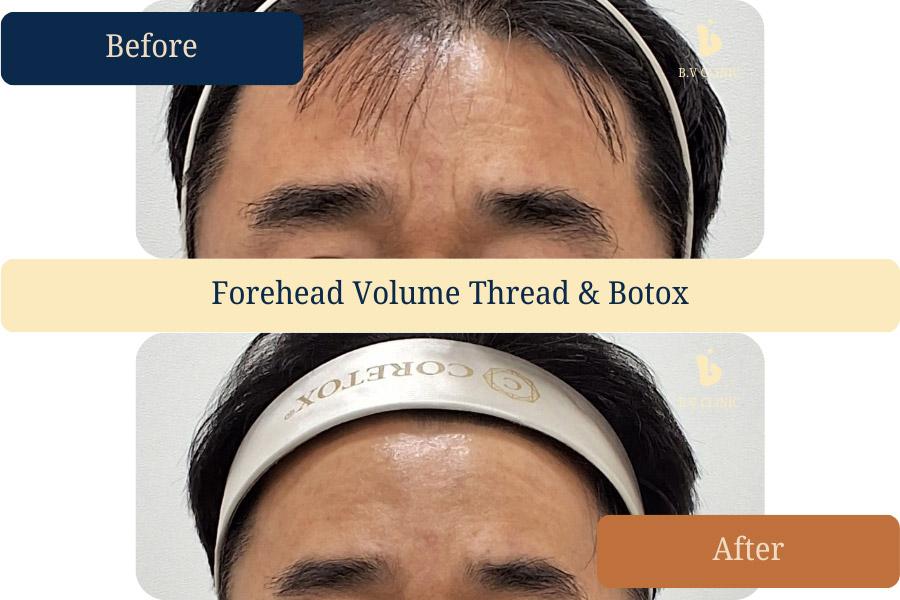
For a forehead thread lift, B.V Clinic offers non-surgical forehead wrinkle restoration using tailored threads to address upper-face concerns such as forehead wrinkles and sagging around the eyes. The clinic describes natural-looking results without visible scars or anesthesia, with Dr. Suh bringing more than 10 years focused exclusively on thread lifting and thousands of clinical cases.
- URL: B.V Clinic Website
- Location: Seoul
- Thread-lift details:
- Uses MINT Threads, which are FDA and KFDA approved.
- Premium PDO barbed threads are designed for anchoring and lifting strength.
- Threads are also intended to stimulate collagen production for ongoing skin firmness.
- Its 3D thread-lifting approach places threads strategically to lift and firm skin while targeting the SMAS layer.
- Aftercare:
- Post-treatment regeneration care is available to help minimize swelling and support elasticity.
- Aftercare may include nutritional skincare products and ultrasound-based collagen-support treatments.
- Related skin-tightening options:
- Shurink Lifting uses high-intensity focused ultrasound for deeper-layer tightening and contour refinement.
- Potenza Lifting uses radiofrequency to support collagen and elasticity while addressing scars and pore texture.
Forehead Thread Lift From Start to Finish
- Remote consultation and screening — Send makeup-free front, oblique, and profile photographs with brows relaxed and raised. Ask whether English consultation is available, and disclose previous brow or eyelid surgery, fillers, botulinum toxin, prior threads, allergies, cold sores, bleeding history, chronic conditions, and every medicine and supplement. Remote photographs cannot reliably diagnose eyelid ptosis or determine tissue thickness.
- Travel and review planning — Schedule the procedure early enough to stay locally for 3–5 days and attend an early review. Confirm the clinician's specialty and licensure, the facility's foreign-patient registration, the thread brand/material, and after-hours contact arrangements.
- In-person assessment — The clinician examines brow shape, asymmetry, hairline, forehead movement, skin thickness, tissue laxity, eyelid skin excess, and signs of eyelid ptosis. The consultation should distinguish a brow-position problem from true ptosis or excess upper-eyelid skin and set a conservative lift target.
- Medical review and testing — Blood pressure assessment, pregnancy testing where relevant, medication and coagulation review, or medical clearance are individualized rather than universal for a local-anesthetic procedure.
- Marking and anesthesia — The clinician maps entry points and lift vectors, typically toward the hairline or temple, disinfects the skin, and injects local anesthetic. If anxiolysis or sedation is planned, arrange a responsible escort and do not drive or travel alone that day.
- Thread placement — Through small punctures, the clinician passes absorbable barbed sutures—often PDO cog threads—using a needle or blunt cannula in the selected tissue plane. The barbs engage tissue, the brow is elevated along the planned vector, and excess thread is trimmed. Treatment is generally outpatient.
- Discharge and early review — Leave with written aftercare, the exact device record, prescribed or recommended medicines, warning signs, and a scheduled review. Swelling, soreness, bruising, tightness, and skin puckering can initially obscure the result.
- Overseas follow-up — Send requested photographs after returning home and keep the 1–2-week and 8–12-week review plan. Seek urgent in-person care for severe pain, rapidly increasing swelling, fever, spreading redness, drainage, skin color change, facial weakness, severe headache, or any vision change.
Alternatives to a Forehead Thread Lift
Non-surgical options offer less downtime but generally provide subtler change than surgery. Surgical brow lifting is more appropriate for substantial brow descent or excess tissue, while eyelid procedures address problems that threads cannot correct.
Botulinum Toxin
- Best for — A subtle lateral “chemical brow lift” when brow depressor muscles contribute to brow position.
- Tradeoff — Forehead Botox does not remove excess skin or structurally reposition a significantly descended brow.
Energy-Based Tightening
- Best for — Mild laxity for patients who do not want implanted sutures.
- Tradeoff — HIFU lifting, Ultherapy lifting, and Thermage lifting can offer modest tightening but do not replace a surgical brow lift for pronounced ptosis.
Forehead or Temple Filler
- Best for — Selected patients whose volume loss reduces upper-face support.
- Tradeoff — Forehead filler is not a direct brow lift and carries important vascular risks that require careful anatomical technique.
Surgical Brow or Forehead Lift
- Best for — Marked brow ptosis, excess forehead tissue, or a patient seeking a stronger and more durable correction.
- Tradeoff — Forehead lift, eyebrow lift, and temporal lift involve incisions and longer recovery but have more long-term measurement data than thread lifting, although techniques and outcomes remain heterogeneous in the surgical literature.
Eyelid Surgery or Ptosis Repair
- Best for — Hooding caused mainly by excess upper-eyelid skin or true eyelid ptosis.
- Tradeoff — Upper blepharoplasty removes excess lid skin, while ptosis correction treats eyelid-opening muscle dysfunction; neither is interchangeable with brow lifting.
How Can I Prepare for a Forehead Thread Lift?
- Medication disclosure — Provide a complete list of prescription medicines, over-the-counter drugs, vitamins, and herbal supplements well before travel. Do not stop prescribed anticoagulants or antiplatelets without explicit approval from the clinician who prescribed them.
- Bruising-risk plan — Ask the treating clinic for its individualized instructions on non-prescription agents associated with bruising, including NSAIDs, vitamin E, fish oil, ginkgo, garlic supplements, and ginseng. Published thread-lift protocols differ, so do not apply a generic medication-stop schedule.
- Medical history — Report bleeding disorders, hypertension, diabetes, autoimmune or inflammatory disease, immunosuppression, allergies, recurrent cold sores, prior forehead surgery, implanted material, fillers, and past thread complications.
- Skin condition — Arrive without active infection, acne flare, herpes outbreak, open wound, or irritation in the forehead, temple, scalp, and brow area. Inform the clinic promptly if a flare develops before the appointment.
- Alcohol, nicotine, and sun — Follow the clinic's timing instructions for alcohol and nicotine. Avoid sunburn and aggressive exfoliation or energy-based treatments in the planned treatment area before the procedure.
- Fasting and transport — Local-anesthetic treatment often does not require fasting, but follow the clinic's instructions exactly. Fast only when instructed, particularly if sedation is planned; arrange an escort and private transport after sedation.
- Travel logistics — Book flexible flights, stay in Korea for 3–5 days after treatment, and avoid scheduling demanding tours, sauna visits, or strenuous activities in the first several days.
Travel note: Save the clinic's after-hours number, bring travel insurance details where applicable, and identify how to access urgent care near the accommodation.
Confirm all clinic-specific preparation requirements with the treating doctor; their instructions take precedence over general guidance.
Aftercare Advice
Protect the newly treated upper-face tissues from pressure, traction, heat, and infection while swelling and bruising settle.
- First 48–72 hours — Keep activity light. Expect tenderness, tightness, mild headache, swelling, bruising, puncture marks, and temporary unevenness; use cold compresses only as directed and never apply hard pressure.
- No rubbing or pressure — Avoid rubbing, forceful massage, facials, gua sha, tight headwear, face-down sleeping, and pulling at thread ends until the clinic clears these activities. Do not cut, push back, or remove a visible thread yourself.
- Exercise and heat — Avoid strenuous exercise, sauna, hot baths, and other heat exposure for the interval specified by the clinic. Recovery depends on thread depth, placement vector, treatment extent, and whether combination treatments were performed.
- Skin and puncture care — Keep entry points clean and use only the products approved by the treating team. Avoid aggressive skincare, exfoliants, and treatment-area procedures until healed; use broad-spectrum SPF 50 on exposed skin once the clinic permits sunscreen application.
- Result timing — Do not assess the lift in the first 1–2 weeks. Bruising and swelling usually become less obvious during days 4–14, while a more meaningful assessment is around 12 weeks.
- Warning signs — Seek urgent in-person assessment for rapidly expanding swelling or bruising, persistent bleeding, severe or escalating pain, fever, spreading redness or warmth, pus, foul drainage, blanching or dusky skin, worsening numbness, new facial weakness, severe headache, or any visual change. Report dimpling, asymmetry, palpable or visible thread, migration, or extrusion promptly; an eyebrow-lift complication report described thread migration toward the eyelid after inadequate fixation.
Follow the treating doctor's written instructions and contact the clinic promptly whenever recovery appears to be worsening rather than settling.
Frequently Asked Questions
Related Blogs
Abdominal Thread Lift in Korea: Candidacy, Evidence, Recovery, and Travel Planning
Abdominal thread lifts place absorbable threads in superficial abdominal tissue for subtle tightening, but methods, durability, and outcomes are not standardized. The article covers candidate screening, procedure planning, Korea travel and follow-up, preparation, aftercare warning signs, and alternatives for fat, excess skin, diastasis, or hernia.
Updated: Oct 13, 2026
Breast Thread Lift in Korea: Candidacy, Safety, Recovery, and Travel Planning
Breast thread lift uses absorbable threads placed through small entry points for modest contour improvement, but techniques, durability, and complication rates are not standardized. The article covers candidacy, preparation, travel planning for Korea, aftercare, warning signs, follow-up, and surgical alternatives for significant sagging.
Updated: Oct 13, 2026
Lip Thread Lift in Korea: Methods, Recovery, Risks and Travel Planning
Lip thread lifts use absorbable smooth or barbed threads to soften upper-lip lines or provide subtle traction, with suitability based on tissue quality, goals, and medical assessment. The article covers treatment planning, recovery, aftercare, risks, alternatives, and travel guidance for international patients in South Korea.
Updated: Oct 13, 2026
Filling Threads in Korea: Types, Recovery, Risks and Travel Planning
Filling threads are absorbable volumizing thread configurations placed under local anesthesia to soften minor static lines and localized hollows in appropriately assessed patients. The article covers candidate screening, device documentation, Korea travel planning, recovery, aftercare, complications, and alternatives such as filler, fat grafting, thread lifts, and facelift surgery.
Updated: Oct 12, 2026
Clinics offering Forehead Thread Lift

Haru Clinic Korea | Fully-Customized Full-Face Non-Surgical Rejuvenation With Threads, Botox & Fillers
Sinsa

PangPang Clinic: Korea's Premier Thread Lifting and Skin Rejuvenation Specialist in Gangnam, Seoul
Sinsa

Seojin Plastic Surgery Clinic Korea: Pioneering Advanced Cosmetic Procedures for Personalized Aesthetic Transformation
Apgujeong

B.V Clinic Korea: Advanced Aesthetic Treatments for Natural Beauty Enhancement & Rejuvenation
Sinnonhyeon Station