
Medical Tourism Blog
Atrophic Scar Treatment in Korea: Types, Recovery, Travel Planning, and Alternatives
Table of contents
- Atrophic Scar Treatment at a Glance
- What Is Atrophic Scar Treatment?
- Who Is a Good Candidate for Atrophic Scar Treatment?
- What Are the Different Types of Atrophic Scar Treatment?
- Why Visit Korea for Atrophic Scar Treatment?
- Key Information for International Patients
- Which Are the Best Clinics in Korea for Atrophic Scar Treatment?
- Atrophic Scar Treatment From Start to Finish
- Alternatives to Atrophic Scar Treatment
- How Can I Prepare for Atrophic Scar Treatment?
- Aftercare Advice
Considering treatment in Korea? Everything you need to know e.g. — how to avoid scams, visas, interpreters, recovery tips — in our Medical Tourism Master Guide. Plan with confidence in minutes, not weeks!
Last updated: September 2026
Atrophic Scar Treatment at a Glance
- Scar-Type Treatment — Atrophic scar treatment is a tailored plan rather than one procedure: subcision releases tethered rolling scars, TCA CROSS or punch techniques target deep ice-pick and boxcar scars, and needling or fractional laser improves diffuse texture.
- Best Candidates — Good candidates have stable depressed facial acne scars and controlled acne, with goals of smoother texture and less visible depressions rather than complete scar removal.
- Combination Approach — Mixed scars often need staged structural correction before resurfacing; a 2026 meta-analysis of 56 randomized trials and 1,488 patients found combination treatment generally outperformed a single modality for moderate-to-severe atrophic acne scars.
- Recovery and Results — RF microneedling can cause redness, swelling, tenderness, or crusting for up to about 5 days, while fractional ablative CO2 laser usually needs 5–7 days of visible healing; collagen remodeling and final improvement continue for months.
- Key Pigment Risk — Ablative laser offers more intensive resurfacing but carries greater infection and post-inflammatory hyperpigmentation risk than standard microneedling, particularly for people with darker skin tones or prior PIH.
- Korea Travel Planning — Allow 2–4 days in Korea for a low-downtime, non-sedated treatment and about 5–7 days for subcision, punch surgery, fat grafting, medium/deep peels, or ablative CO2 laser, including an early healing review before departure.
- Korea-Specific Advantage — Korea has substantial international dermatology infrastructure—about 1.17 million international patients from 202 countries in 2024—but available data do not show Korean atrophic-scar outcomes are superior to those elsewhere.
What Is Atrophic Scar Treatment?
Atrophic scar treatment is a tailored set of dermatologic treatments that improves depressed scars by addressing tethering, lost volume, sharp edges, or uneven texture. It aims to make scars less noticeable and skin smoother, with gradual, partial improvement rather than complete removal. Treatment can be non-surgical, minimally invasive, or surgical, depending on the scar pattern and selected method.
Who Is a Good Candidate for Atrophic Scar Treatment?
- Depressed acne scars — Good candidates have stable ice-pick, boxcar, rolling, or mixed facial acne scars and want less visible depressions and smoother texture rather than complete scar removal.
- Tethered rolling scars — Scars that lift when the skin is stretched or feel bound down can be suitable for structural treatment with subcision, sometimes followed by filler, fat grafting, or resurfacing.
- Deep focal scars — Narrow ice-pick scars and sharply edged deep boxcar scars can be candidates for targeted techniques such as TCA CROSS, punch excision, or punch elevation rather than broad resurfacing alone.
- Diffuse shallow texture — People with widespread, shallow textural scars and controlled acne can be assessed for conventional microneedling, RF microneedling, fractional non-ablative laser, or fractional CO2/Er:YAG resurfacing.
Elective revision should be postponed for active inflammatory acne, folliculitis, cold-sore outbreaks, bacterial infection, open wounds, sunburn, or a recent tan in the treatment area. A history of keloids, slow healing, immunosuppression, uncontrolled diabetes, bleeding disorders, or anticoagulant or antiplatelet treatment requires a method-specific medical assessment. Pregnancy and breastfeeding also require deferral unless the clinician confirms that the selected procedure, anesthetic, and medicines are appropriate. Atrophic scar treatment is not appropriate for unexplained, painful, ulcerated, changing, or non-healing lesions until a clinician has diagnosed them; evidence is strongest for facial acne scars, not scars from trauma, surgery, chickenpox, or inflammatory disease.
What Are the Different Types of Atrophic Scar Treatment?
Atrophic scar treatment is a scar-type-directed plan, not one standardized procedure. Mixed scars commonly need staged combination treatment because tethering, volume loss, sharp edges, and surface texture require different corrections.
- Ice-pick scar treatment — TCA CROSS places high-concentration trichloroacetic acid precisely within a narrow pit to stimulate focal remodeling. Deep lesions can instead require punch excision or selected punch grafting.
- Boxcar scar treatment — Shallow and moderate boxcar scars can be treated with fractional laser, RF microneedling, conventional microneedling, or TCA CROSS. Deep, steep-edged scars often need punch elevation or excision before later resurfacing.
- Rolling scar treatment — Subcision uses a needle, cannula, or blade under local anesthetic to release fibrous bands pulling the skin downward. Hyaluronic-acid filler or fat grafting can support a true volume deficit after release.
- Diffuse textural resurfacing — Conventional microneedling, RF microneedling, fractional non-ablative laser, and fractional ablative CO2 or Er:YAG laser create controlled injury for collagen remodeling. Ablative resurfacing generally involves more visible downtime and greater infection and pigment risk; non-ablative laser and RF microneedling often require more sessions with lower downtime.
- Combination treatment — Structural correction is commonly performed before resurfacing. A 2026 network meta-analysis of 56 randomized trials involving 1,488 patients found combination approaches generally outperformed monotherapy for moderate-to-severe atrophic acne scars, but small studies, varied protocols, and limited long-term follow-up restrict firm rankings.
Why Visit Korea for Atrophic Scar Treatment?
Korea can be practical for patients seeking a dermatology-led assessment and a plan that combines structural scar revision with resurfacing. An in-person examination remains essential because photographs cannot reliably show tethering, scar depth, or skin reactivity. Korean international-patient statistics support service availability, not superior scar outcomes.
- International dermatology infrastructure — Official Medical Korea data report about 1.17 million international patients from 202 countries in 2024, with dermatology identified as the largest cumulative specialty category.
- Multimodal planning — Atrophic scars frequently require a sequence of subcision, focal chemical treatment, punch revision, filler or fat support, and resurfacing rather than a single device. Select a clinician based on scar mapping, conservative pigment-risk planning, and a documented follow-up plan.
- Realistic evidence limit — Published research does not establish that treatment in South Korea produces better atrophic-scar outcomes than treatment elsewhere. Device branding, nationality, and promised percentage improvement are not reliable measures of likely results.
Key Information for International Patients
- Minimum stay — Allow at least one in-person consultation day even after a virtual photo review. Plan 2–4 days for a low-downtime, non-sedated treatment; plan about 5–7 days for subcision, punch surgery, fat grafting, medium/deep peels, or fractional ablative CO2 resurfacing.
- Early review before departure — Do not leave after surgery or aggressive resurfacing until the clinician has reviewed healing. Stay longer for substantial crusting, drainage, increasing pain, infection concern, pigment change, or a planned staged session.
- Flights — No procedure-specific trials define one safe long-haul-flight interval after TCA CROSS, filler, subcision, punch surgery, microneedling, or ablative resurfacing. Obtain individualized clearance, especially after sedation, surgery, or aggressive resurfacing.
- Itinerary impact — RF microneedling can cause redness, mild swelling, tenderness, and occasional crusting for up to about 5 days. Fractional ablative CO2 resurfacing commonly needs 5–7 days of visible re-epithelialization, while redness and collagen remodeling can continue for months. Avoid scheduling intensive sightseeing around these recovery periods.
- Records and remote follow-up — Request an English treatment record listing the diagnosis or scar map, device and settings, TCA concentration, filler product and lot number, injected volume, anesthetics, prescriptions, aftercare, warning signs, and clinic contact details. Arrange remote photo follow-up before flying home.
Travel note: Carry medications in original packaging, the written procedure record, aftercare supplies, and the clinic’s direct contact details in hand luggage.
Which Are the Best Clinics in Korea for Atrophic Scar Treatment?
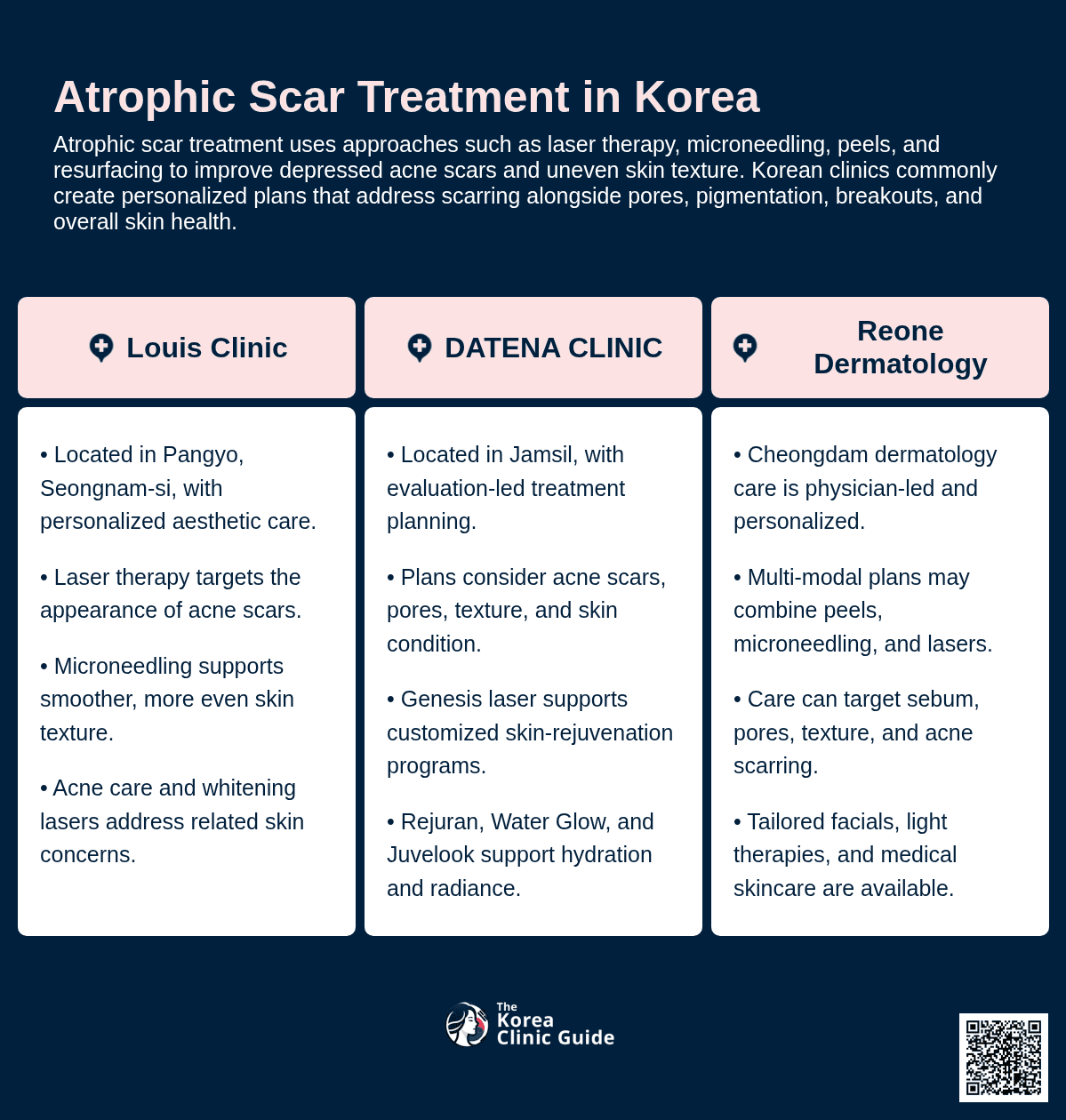
Listed below are some of the best clinics in Korea for atrophic scar treatment.
1. Louis Clinic
At Louis Clinic in Pangyo, you can pursue treatment for atrophic acne scars with laser therapy and microneedling aimed at diminishing visible scarring and improving skin texture. Your care can be guided by a personalized aesthetic treatment plan based on your needs.
- URL: Louis Clinic Website
- Location: Seongnam-si Bundang-gu, Gyeonggi
- Scar treatment:
- Laser therapy is offered to help reduce the appearance of acne scars.
- Microneedling is used to support skin-texture improvement in scar care.
- Related skin care:
- Acne treatment options include topical and oral medications as well as specialized facials.
- Whitening laser treatment is available for hyperpigmentation and uneven skin tone.
2. DATENA CLINIC
At DATENA CLINIC in Jamsil, you can expect a personalized evaluation and treatment plan for acne-related atrophic scars, with pores and skin texture considered alongside your current skin condition. Scar care is part of the clinic’s broader dermatology and skin-rejuvenation focus.
- URL: DATENA CLINIC Website
- Location: Songpa-gu, Seoul
- Scar and texture planning:
- Acne scars, pores, and skin texture are among the clinic’s main treatment concerns.
- Customized skincare is selected following a professional assessment of your current skin condition.
- Supporting skin treatments:
- Medical skincare may be combined with personalized aesthetic care as part of a clinic-directed plan.
- Genesis laser treatment is available within customized programs focused on skin rejuvenation and texture.
- Skin-booster programs include Rejuran, Water Glow, and Juvelook for hydration, texture, and overall skin radiance.
3. Reone Dermatology
At Reone Dermatology in Cheongdam, you can receive physician-led, personalized care for atrophic acne scars using a multi-modal approach that may combine peels, microneedling, laser resurfacing, and medications. Treatment is tailored to help manage breakouts, refine texture and pores, and soften the appearance of acne scars.
- URL: Reone Dermatology Website
- Location: Gangnam-gu, Seoul
- Scar-care approach:
- Multi-modal acne, pore, and scar care can incorporate peels, microneedling, laser resurfacing, and medications.
- The treatment goals include controlling sebum, minimizing visible pores, refining skin texture, and softening acne scars.
- Care setting:
- Care is physician-led and personalized.
- Treatment is provided in a private setting.
- Supporting skin treatments:
- Physician-designed facials, peels, and device-assisted treatments can be adjusted to your skin type and season.
- Tailored laser and light therapies are available for uneven tone, sunspots, and melasma, and may be paired with medical skincare.
Atrophic Scar Treatment From Start to Finish
- Remote inquiry — Send unfiltered photographs in even front and angled lighting. State the cause and duration of scars, active acne, previous treatments, post-inflammatory hyperpigmentation (PIH), keloid history, cold sores, allergies, medicines, supplements, isotretinoin dates, and pregnancy or breastfeeding status. Ask whether English or virtual consultation is available.
- In-person scar assessment — The clinician examines scars under angled light, palpates for tethering and fibrosis, evaluates skin phototype and PIH risk, and checks for active acne or infection. A test spot can be useful when prior PIH or darker skin tone raises pigment concerns.
- Plan and consent — The clinician distinguishes ice-pick, boxcar, rolling, and diffuse textural scars, explains incomplete but gradual improvement, and selects a staged plan. Active acne should be controlled alongside scar revision to reduce new scar formation.
- Testing and anesthesia — Routine blood tests are usually unnecessary for uncomplicated focal chemical treatment, needling, or laser. Tests can be requested for surgery, fat grafting, sedation, bleeding risk, or relevant medical conditions; topical anesthetic is common for needling and laser, while subcision and punch procedures commonly use injected local anesthetic.
- Structural correction when indicated — TCA CROSS, subcision, punch elevation, punch excision, filler, or fat grafting addresses focal depth, tethering, or volume loss. Structural work is often performed before a later resurfacing session.
- Resurfacing when indicated — Conventional microneedling, RF microneedling, fractional non-ablative laser, or fractional CO2/Er:YAG laser targets broader texture and scar edges. Technique intensity should reflect scar morphology, pigment risk, downtime tolerance, and prior response rather than a fixed package schedule.
- Discharge and early healing — Receive written wound-care instructions and a direct contact route before leaving. Pinpoint frosting or crusting after TCA CROSS and redness after needling are common; subcision often causes bruising and swelling, while punch procedures add a small wound and possible suture-removal appointment.
- Review and overseas follow-up — Attend any required in-person review before departure, then send photographs remotely as directed. Collagen remodeling takes months, so early swelling or redness is not the final result; the clinician sets any repeat-treatment interval based on healing and response.
Alternatives to Atrophic Scar Treatment
Non-surgical approaches improve selected scar features with less recovery but often require a series of sessions. Surgical or structural approaches can better address deep, tethered, or sharply edged scars, but they add bruising, wounds, sutures, and more demanding travel planning.
Scar-Type-Directed Acne Scar Treatment
- Broad acne-scar pathway — Acne scar treatment covers combinations selected for acne-related depressed scars, including focal and resurfacing options.
- Tradeoff — This is appropriate when acne scars are the diagnosis; scars from trauma, chickenpox, surgery, or inflammatory disease need diagnosis-specific assessment.
Laser Resurfacing
- Fractional options — Scar removal laser, CO2 laser, and Fraxel laser target diffuse texture and scar edges through controlled dermal remodeling.
- Tradeoff — Ablative CO2 can involve more visible recovery and higher PIH risk than standard microneedling, especially in people prone to pigmentation; non-ablative options usually require more sessions.
RF Microneedling
- Energy-based needling — Potenza and Secret RF microneedling deliver radiofrequency through needles for diffuse shallow textural scars.
- Tradeoff — These methods do not replace subcision for a clearly tethered rolling scar or punch revision for a deep, narrow defect.
Surgical Scar Revision
- Focal structural correction — Scar removal surgery includes approaches relevant to sharply defined or deep scars, such as punch excision and elevation.
- Tradeoff — Small wounds and possible suture removal require more time in Korea and early healing review before departure.
Volume Support
- Filler or fat grafting — Facial filler and face fat grafting can support scars with a genuine volume deficit, often after subcision.
- Tradeoff — Filler is temporary and carries rare but urgent vascular risks; fat grafting has a longer recovery and uncertain long-term volume retention. PRP is sometimes used alongside needling or laser, but variable protocols and evidence do not support presenting it as a substitute for scar-type-directed correction.
How Can I Prepare for Atrophic Scar Treatment?
- Control active disease — Postpone elective treatment for active inflammatory acne, folliculitis, cold sores, bacterial infection, open wounds, sunburn, or a recent tan. Ask the clinician whether acne needs treatment before scar revision.
- Disclose medicines and supplements — Report aspirin, NSAIDs, anticoagulants, antiplatelet medicines, fish oil, vitamin E, ginkgo, garlic, and all supplements. Do not stop prescribed anticoagulants or other medicines without approval from the clinician who manages them.
- Report isotretinoin accurately — Give the dose and final-dose date. A blanket six-month delay is not supported for many fractional lasers, superficial or medium peels, microneedling, and minor procedures, but fully ablative resurfacing and mechanical dermabrasion need specialist assessment and should not be undertaken during systemic isotretinoin therapy without it.
- Pause irritating products — Ask exactly when to stop retinoids, glycolic acid, other exfoliating acids, benzoyl peroxide, scrubs, and home peels. The required interval depends on the treatment and skin sensitivity.
- Prevent pigment risk — Avoid tanning beds, self-tanner, and deliberate sun exposure before treatment. Discuss test spots, device choice, treatment depth or density, and PIH management when darker skin tone or previous PIH raises risk.
- Plan for cold sores and sedation — Report recurrent herpes simplex, particularly for perioral laser or peel treatment; the clinician can decide whether antiviral prophylaxis is needed. Follow fasting instructions exactly if sedation is planned, and arrange a companion and transport because driving after sedatives or strong analgesics is unsafe.
- Build recovery into travel — Book clean accommodation near the clinic and flexible flights for ablative laser, surgery, fat grafting, or substantial subcision. Keep the first several days free of demanding activities.
Travel note: Do not book a non-refundable departure before the clinician has confirmed the planned technique and whether an early in-person review is required.
Confirm all medicine changes, fasting rules, skin preparation, and travel requirements with the treating doctor; individualized instructions take precedence over general guidance.
Aftercare Advice
Aftercare must match the technique: treating fresh laser-treated skin, a punch wound, a subcision bruise, and a TCA CROSS crust in the same way can worsen healing.
- Cleanse and protect the barrier — Cleanse gently and use only the prescribed ointment or emollient. Do not pick crusts, scrub treated skin, or use retinoids, exfoliating acids, benzoyl peroxide, home devices, or makeup until the clinician confirms that the skin barrier has recovered.
- Limit heat, friction, and contamination — Avoid strenuous exercise, hot yoga, sauna, swimming pools, ocean water, and contact sports until wounds are sealed and swelling has settled. Follow additional restrictions after ablative CO2 resurfacing, punch procedures, fat grafting, or extensive subcision.
- Prevent pigment change — Minimize direct sun exposure and use clinician-approved broad-spectrum SPF 50 once the skin is ready for sunscreen. This is particularly important after laser, peel, or needling treatment and for anyone prone to PIH.
- Monitor urgent warning signs — Contact the clinic urgently for escalating pain, spreading warmth or redness, pus, fever, new blisters, ongoing bleeding, black or gray discoloration, or a rapidly enlarging lump. After filler, severe pain, blanching or mottled livedo-like discoloration, or visual symptoms require emergency assessment for possible vascular compromise.
- Attend follow-up and judge results slowly — Attend planned wound or suture checks before travel, then send follow-up photographs as directed. Fractional ablative CO2 commonly has 5–7 days of visible healing, while redness and collagen remodeling can persist for months; repeat sessions should be decided after healing rather than scheduled automatically.
Follow the treating doctor’s instructions over this general advice and contact the clinic promptly when anything appears wrong.
Frequently Asked Questions
Related Blogs
Comparing Global Costs of Pico Fraxel: Why Korea is a Top Choice for Skin Rejuvenation Without Compromise
Discover the affordability of Pico Fraxel laser treatments in Korea, where cutting-edge technology meets competitive pricing. Explore why many are choosing Korea for their skincare journey and how it compares to global costs.
Updated: Oct 21, 2026
Optimize Your Wellness: See Why Vitamin Injections in Korea Offer Value Beyond Costs Compared to the USA & More
Discover the latest trends in the cost of vitamin injections in Korea, exploring factors affecting pricing and popular clinics. Learn how these wellness treatments can boost your energy and overall health.
Updated: Oct 21, 2026
Laser Tattoo Removal Costs: Is Korea Your Best Option Compared to the USA, Turkey, and Beyond?
Discover the factors influencing the cost of laser tattoo removal in Korea, from technology and expertise to session frequency. Explore why Korea is becoming a popular destination for this effective and advanced cosmetic procedure.
Updated: Oct 21, 2026
Unlock Radiant Skin: Comprehensive Cost Analysis of Steroid Injections for Scars in Korea vs USA, Turkey & More
Explore the cost of steroid injections for scars in Korea, a popular cosmetic procedure aimed at minimizing the appearance of scar tissue. This article breaks down the pricing, factors influencing cost, and potential savings compared to other countries.
Updated: Oct 21, 2026
Clinics offering Atrophic Scar Treatment

Louis Clinic Korea: Premier Aesthetic and Dermatological Solutions in Pangyo
Pangyo

DATENA CLINIC Korea | Personalized Dermatology, Lifting & Skin Rejuvenation in Seoul
Jamsil
Kangdong Sacred Heart Hospital
Gangdong

Geurim Plastic Surgery: Comprehensive Aesthetic and Reconstructive Procedures in Korea
Sinsa