Medical Tourism Blog
Nuviju in Korea: Treatment Process, Recovery, Safety, and Travel Planning
Table of contents
- Nuviju at a Glance
- What Is Nuviju?
- Who Is a Good Candidate for Nuviju?
- How Is Nuviju Performed?
- Why Visit Korea for Nuviju?
- Key Information for International Patients
- Which Are the Best Clinics in Korea for Nuviju?
- Nuviju From Start to Finish
- Alternatives to Nuviju
- How Can I Prepare for Nuviju?
- Aftercare Advice
Considering treatment in Korea? Everything you need to know e.g. — how to avoid scams, visas, interpreters, recovery tips — in our Medical Tourism Master Guide. Plan with confidence in minutes, not weeks!
Last updated: September 2026
Nuviju at a Glance
- What it treats — Nuviju is a prescription cholic-acid injection that gradually reduces moderate-to-severe pinchable fat beneath the chin; it is not a weight-loss treatment and is not approved for jowls, cheeks, jawline, or body fat.
- Best candidates — Suitable candidates are adults whose double chin is caused mainly by superficial preplatysmal fat, rather than significant loose skin, platysma bands, a recessed chin, thyroid enlargement, or another neck condition.
- Treatment schedule — A clinician uses a 1-cm injection grid, typically delivering 0.2 mL per point, with up to 50 injection points and 10 mL per session; treatments are at least 1 month apart and limited to 6 sessions.
- Results timing — Improvement is gradual rather than immediate: the pivotal trial evaluated outcomes 12 weeks after the final session, and a six-session course can span at least about 5 months before that final assessment.
- Visible recovery — Under-chin swelling, bruising, numbness, redness, firmness, pain, itching, warmth, and tightness are common; injection-site reactions occurred in 99.17% of treated phase-3 participants, so avoid scheduling important photos or events immediately afterward.
- Key safety concern — Accurate injection depth is critical: overly superficial placement can cause ulceration or skin necrosis, while other important warning signs needing urgent care include swallowing difficulty, facial weakness or asymmetric smile, infection, blistering, or black/gray skin changes.
- Korea and travel planning — Nuviju was authorized in South Korea in 2025 for adult submental fat and is not FDA-approved in the US; allow 1–2 flexible days for one visit, but monthly spacing means a full series generally requires repeat Korea trips or coordinated follow-up at home.
What Is Nuviju?
Nuviju is a prescription cholic-acid injection used to break down excess fat beneath the chin. It aims to gradually refine a double-chin contour in adults whose fullness is mainly caused by superficial under-chin fat, rather than weight loss or loose skin. Nuviju is a non-surgical injectable treatment.
Who Is a Good Candidate for Nuviju?
- Appropriate indication — Adults with moderate-to-severe, pinchable fat beneath the chin who want gradual nonsurgical improvement of submental contour.
- Realistic goal — Good candidates understand that Nuviju is not a weight-loss treatment and that a series of sessions can be required.
- Suitable anatomy — The target is preplatysmal subcutaneous fat: fat located between the skin and the platysma neck muscle.
- Assessment-first approach — Candidates need an examination to distinguish submental fat from skin laxity, prominent platysma bands, chin retrusion, thyroid enlargement, enlarged lymph nodes, salivary-gland disease, or another neck concern.
Do not receive Nuviju with an active infection in the injection area, known hypersensitivity to cholic acid or another ingredient, or during childhood; the Korean label does not establish pediatric safety or effectiveness. Defer treatment during pregnancy where possible, and discuss breastfeeding individually because transfer into human milk and effects on a nursing infant are unknown. A current or previous swallowing disorder is an important reason to avoid treatment, since local swelling, pain, and firmness can worsen dysphagia. Excess skin laxity, strong platysma bands, bleeding disorders, anticoagulant or antiplatelet use, and prior chin or neck surgery require a careful medical assessment because they can change the aesthetic outcome, bruising risk, or injection anatomy.
How Is Nuviju Performed?
Nuviju does not have patient-facing treatment types. Its outcome and risk profile depend on accurate depth, the mapped treatment area, the number of injection points, total volume, and the number of sessions within the labeled protocol.
- Active medicine — Nuviju is a prescription cholic-acid injection, also called MT921. It is distinct from deoxycholic acid products such as Kybella and should not be treated as interchangeable with them.
- Injection plane — The prescriber injects only preplatysmal subcutaneous fat. The Korean prescribing information warns that incorrect placement can injure nearby structures; injection too close to the skin can cause ulceration or necrosis.
- Mapped injection pattern — The labeled protocol uses 0.2 mL injections at 1-cm intervals, at a dose of 3 mg/cm², with up to 50 injection points and 10 mL in one session.
- Session schedule — Sessions are at least one month apart, with a maximum of six treatments. A clinician reassesses contour, tissue response, and adverse effects before deciding whether another session is appropriate.
- Pain and bleeding measures — The label permits clinician-directed local anesthetic such as lidocaine, ice packs for pain or edema, pressure to reduce bleeding, and an optional adhesive dressing.
Why Visit Korea for Nuviju?
Nuviju received South Korean marketing authorization in 2025 for adults with moderate-to-severe submental fat. Its approved use is narrowly limited to fat beneath the chin, not cheeks, jowls, the jawline, or body areas. Korea is therefore relevant for travelers seeking the labeled cholic-acid product rather than a generic “fat-dissolving” injection.
- Korean-approved indication — The Korean label specifies adult submental fat and states that safety and effectiveness outside that area have not been established.
- Defined injection protocol — Korea’s labeled protocol provides concrete limits for dose, 1-cm injection spacing, maximum injection points, session interval, and six-session maximum, helping international patients ask precise questions about the planned treatment.
- Evidence in the approved population — In the label-described phase-3 trial, assessed 12 weeks after the final session, 88.57% of Nuviju-treated participants achieved at least a one-grade improvement on both clinician and patient submental-fat ratings, compared with 32.43% receiving placebo.
- Important evidence limitation — A peer-reviewed phase-2 study reported favorable efficacy signals, but larger and longer studies remain needed. No independent randomized head-to-head trial has established that Nuviju is safer, less painful, less swollen, more durable, or more effective than deoxycholic acid, liposuction, cryolipolysis, or energy-based contouring.
- Different regulatory status abroad — Nuviju is not FDA-approved in the United States. The FDA-approved injectable for adult submental fat in the US is deoxycholic acid, as described in the Kybella prescribing information.
Key Information for International Patients
- Minimum stay — Plan at least 1–2 days in Korea for an in-person consultation and treatment, with flexibility for an early review if swelling, pain, bruising, facial asymmetry, or swallowing symptoms develop. This is a prudent travel buffer, not a formal Nuviju no-fly rule.
- Repeat-visit reality — Sessions must be at least one month apart and up to six may be used. A full six-session course spans at least about five months from the first to sixth session, so it rarely fits into one short trip.
- Flight timing — No Nuviju-specific mandatory no-fly interval was identified. Do not fly immediately after treatment if significant swelling, worsening pain, swallowing difficulty, facial weakness, or signs of infection need in-person assessment.
- Visible recovery — Injection-site reactions occurred in 99.17% of Nuviju-treated phase-3 participants. Expect the possibility of visible under-chin swelling, bruising, numbness, redness, firmness, warmth, itching, pain, and tightness; avoid placing treatment just before a wedding, filming, or important photographs.
- Activity itinerary — Nuviju is an outpatient treatment without routine bed rest, but the label does not provide evidence-based rules for exercise, alcohol, massage, heat exposure, driving, or sightseeing. Follow the treating clinician’s individualized restrictions instead of importing advice from another injectable product.
- Continuity of care — Before departure, obtain English-language aftercare, an urgent-contact number, the original product name, concentration, total volume, injection map, treatment date, and a plan for urgent evaluation in Korea or at home.
Travel note: The pivotal study assessed results 12 weeks after the final session, not a few days after injection. Schedule the first session early in a Korea trip and plan any later sessions or outcome review around the required monthly interval.
Which Are the Best Clinics in Korea for Nuviju?
Listed below are some of the best clinics in Korea for nuviju.
1. Hev Clinic
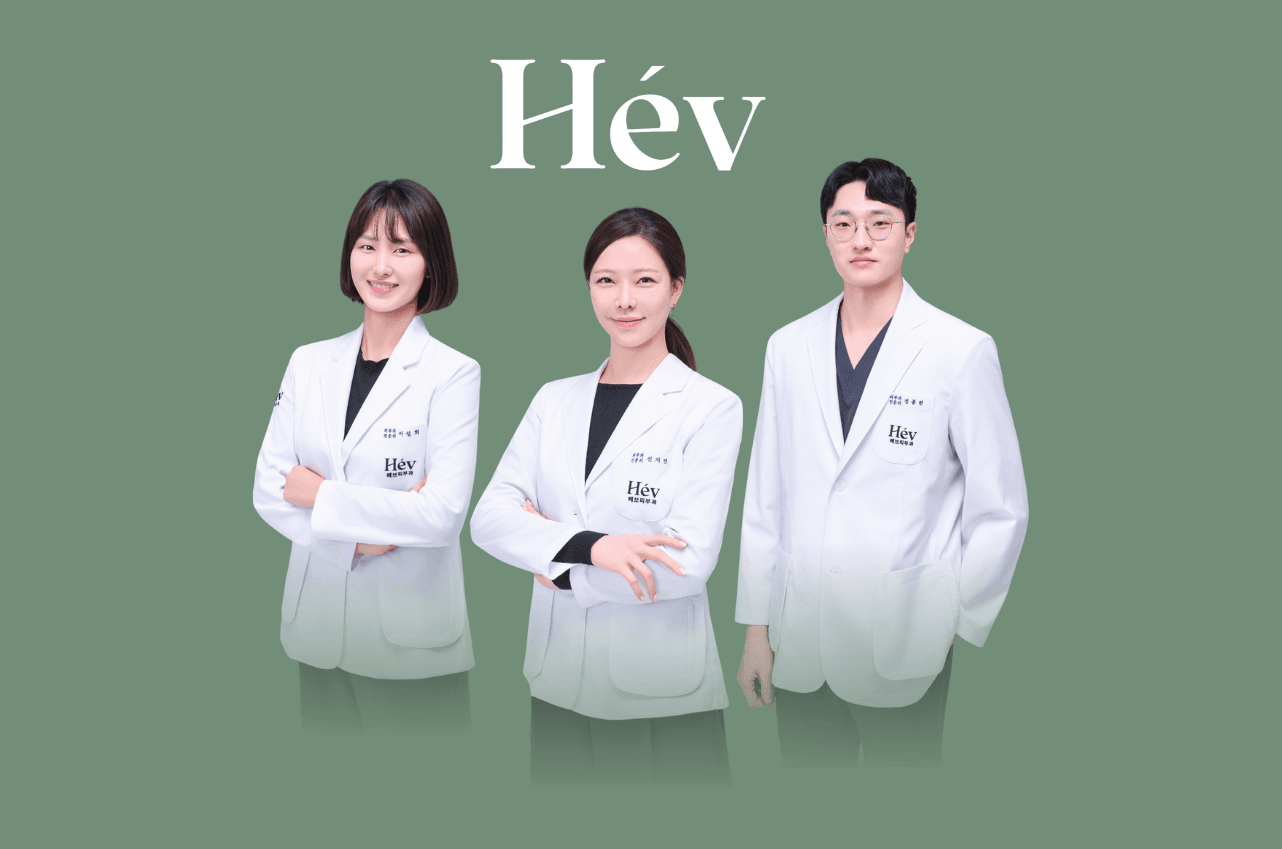
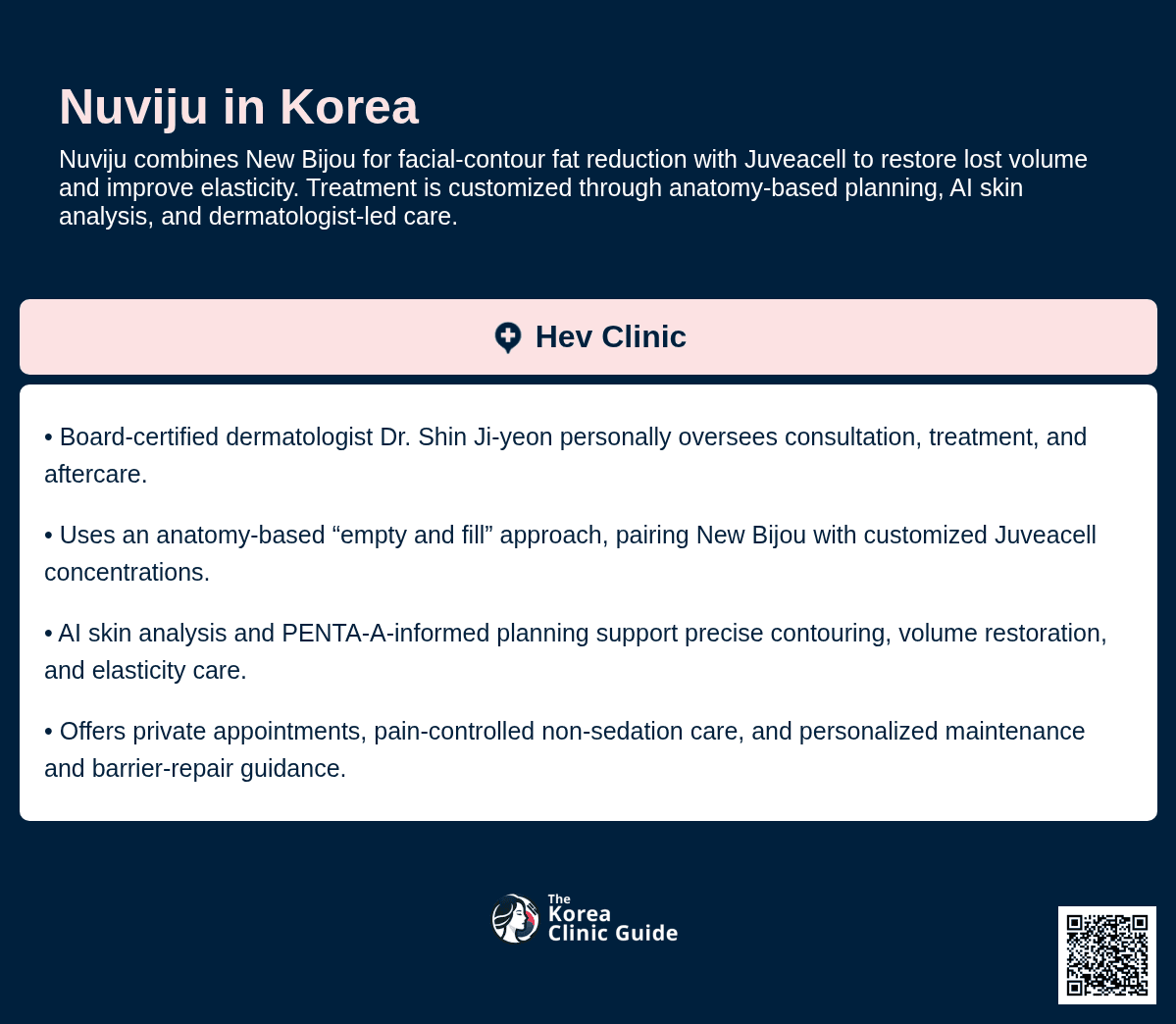
For Nuviju-focused facial contouring and regenerative care, Hev Clinic offers Dr. Shin Ji-yeon’s anatomy-based “empty and fill” approach: New Bijou is used to reduce unwanted facial-contour fat, while Juveacell is tailored in 3% or 8% concentrations to restore volume-loss areas and elasticity. Your plan is informed by AI skin analysis and is overseen by the same board-certified dermatologist from consultation through aftercare.
- URL: Hev Clinic Website
- Location: Gangnam-gu, Seoul
- Dermatologist-led planning:
- Dr. Shin Ji-yeon is a board-certified dermatologist whose practice includes well-aging, device-based lifting, dermal structure restoration, and non-surgical facial contouring.
- Her academic roles include the Academic Committee of the Association of Korean Dermatologists and the Education Committee of the Korean Society for Anti-Aging Dermatology.
- Her work with the PENTA-A Anti-Aging Aesthetic Anatomy Research Group informs customized treatment targeting intended to reduce nerve and vascular injury risk.
- Regenerative and lifting options:
- Juveacell and Re2O are among the clinic’s regenerative treatments; Re2O is described as replenishing human-derived extracellular-matrix components in the dermis.
- Thermage FLX, Ultherapy, InMode, HIFU, and ONDA are available for skin tightening, lifting, or contour-focused treatment planning.
- Other injectable and skin-focused options include Botox, hyaluronic-acid fillers, Sculptra, Profhilo, PRP, Rejuran, Juvelook, and skin Botox.
- Comfort and follow-up:
- A non-sedation, pain-controlled anesthesia system is intended to allow you to communicate during treatment, with cannula and needle techniques selected to reduce injectable discomfort.
- The clinic favors lower-irritation approaches and states that selected treatments can allow an immediate return to daily activities.
- Aftercare includes the clinic’s Repair Barrier Cream and a maintenance plan that may be timed around a roughly 3–4-week skin-cell regeneration cycle.
- Care setting:
- Care is appointment-based and private, with the attending dermatologist personally handling consultation, treatment, and aftercare rather than rotating providers.
- The clinic is located in Sinsa, about a one-minute walk from Sinsa Station.
Nuviju From Start to Finish
- Pre-travel contact — Request an English-language or virtual consultation where available. Send clear front and side photographs only if the clinic requests them, and disclose prior chin, jaw, neck, dental, or facial procedures.
- Medical screening — Provide a complete list of prescription medicines, over-the-counter drugs, vitamins, and supplements; report allergies, bleeding problems, anticoagulants or antiplatelets, pregnancy or breastfeeding, liver history, and any present or past swallowing difficulty.
- In-person examination — The prescriber confirms that the fullness is treatable preplatysmal submental fat, evaluates skin laxity and platysma bands, and checks for findings such as thyroid enlargement or cervical lymphadenopathy that require a different assessment. Baseline photographs are commonly documented.
- Treatment planning — Discuss the likely session plan, whether the labeled maximum of 50 injection points and 10 mL is relevant, expected visible swelling, and why Nuviju is limited to the submental area. Ask to see the original labeled product and confirm the documented concentration and total injected volume.
- Medication and testing review — The label recommends liver-function monitoring during administration; the prescriber decides whether baseline or follow-up testing is needed. Do not stop aspirin, clopidogrel, warfarin, apixaban, rivaroxaban, or another prescribed blood-thinning medicine unless the clinician managing that medicine approves the change.
- Marking and comfort measures — The clinician marks the submental field in a 1-cm grid, cleans the skin, and can use local anesthetic and ice according to the treatment plan.
- Mapped injections — Multiple 0.2 mL injections are placed into the mapped preplatysmal fat layer. The clinician avoids the marginal mandibular nerve, salivary glands and ducts, thyroid, blood vessels, lymph nodes, muscles, and other vulnerable structures. The visit is outpatient.
- Discharge — Pressure and an adhesive dressing can be used when clinically appropriate. Leave with written instructions and a clear emergency-contact plan; do not self-treat swelling or pain with unapproved massage, heat, cold, topical products, or medicines.
- Reassessment and further sessions — A further session cannot occur sooner than one month. The prescriber decides whether to repeat treatment based on contour, anatomy, response, and adverse effects.
- Remote follow-up — Arrange a clinic check-in after return home, but seek local urgent in-person care rather than relying on messaging for dysphagia, breathing trouble, facial weakness, spreading redness, drainage, blistering, ulceration, or black/gray skin changes.
Alternatives to Nuviju
The right alternative depends on whether the main issue is a small-to-moderate superficial fat deposit, substantial fat volume, loose neck skin, platysma banding, or a recessed chin. Surgical approaches are more invasive but can directly address structural concerns; nonsurgical approaches generally require gradual assessment and do not reliably replace surgery where excess skin or larger fat deposits are present.
Double-Chin Liposuction
- Best suited to — A larger, well-defined superficial under-chin fat deposit in a person accepting an invasive procedure.
- Tradeoff — Double-chin liposuction removes fat directly but involves incisions, anesthesia or sedation, compression, and surgical recovery.
Neck Lift
- Best suited to — Significant skin laxity, platysma banding, or neck contour problems that fat-cell injection alone cannot correct.
- Tradeoff — A neck lift, sometimes combined with liposuction, is surgery with more downtime but can address loose skin and muscle contour.
Chin Augmentation
- Best suited to — Chin retrusion that makes the chin-neck angle appear less defined despite limited fat.
- Tradeoff — A chin implant changes projection rather than dissolving fat, so it addresses a different anatomical cause.
Deoxycholic Acid Injection
- Best suited to — Adults considering a chemically distinct injectable approach for submental fat.
- Tradeoff — Deoxycholic acid is not the same medicine as Nuviju. It has its own product labeling, injection technique, adverse-effect profile, and regulatory status.
Cryolipolysis or Energy-Based Contouring
- Best suited to — Selected patients seeking a device-based nonsurgical option after anatomy-based consultation.
- Tradeoff — CoolSculpting and HIFU laser treatment use different treatment mechanisms and timelines. No robust direct comparison proves that any of these options outperforms Nuviju for submental contouring.
How Can I Prepare for Nuviju?
- Medical disclosure — Send the clinic a full medical history before travel, including allergies, liver disease, bleeding disorders, swallowing problems, pregnancy or breastfeeding, and all prior submental, neck, jaw, or facial procedures.
- Blood-thinning medicines — Report aspirin, clopidogrel, warfarin, apixaban, rivaroxaban, and similar medicines, plus supplements that can affect bruising or bleeding. Bruising occurred in 83.47% of treated trial participants. Never independently stop a prescribed anticoagulant or antiplatelet medicine; obtain approval from the prescribing clinician.
- Supplements and pain medicines — List vitamins, herbal products, fish oil, and non-prescription pain medicines. The Nuviju label does not establish a standard medicine-stop period, so follow the prescriber’s individualized plan.
- Injection-area check — Report acne, rash, wounds, shaving cuts, dental or skin infections, and any redness or tenderness below the chin before the appointment. Active infection at the planned injection site is a contraindication.
- Fasting and substances — No Nuviju-specific evidence-based fasting, smoking, or alcohol timetable was identified. Do not assume instructions from fillers, sedation, or other fat-dissolving products apply; follow the clinic’s written directions.
- Travel schedule — Book the appointment early in the trip, keep the next 1–2 days flexible, and avoid scheduling major social or photographic events immediately afterward because swelling and bruising can be conspicuous.
- Documentation — Ask in advance for English aftercare, a product and volume record, the clinic’s emergency contact route, and a brief treatment summary for a clinician at home.
Travel note: Keep flights and accommodation flexible when possible. A short stay can accommodate one session, but a multi-session course requires monthly return visits or carefully arranged follow-up at home.
Confirm the treating doctor’s clinic-specific requirements before treatment; those instructions take precedence over general guidance.
Aftercare Advice
Treat new or worsening under-chin symptoms seriously: expected local reactions are common, but swallowing, nerve, skin, or infection symptoms need prompt clinical assessment.
- Swelling and discomfort — Use ice, local measures, and pain relief only as directed by the treating clinician. The label permits clinician-directed ice packs and local anesthetic for pain or edema, but does not provide a universal home-care timetable.
- Avoid unapproved manipulation — Do not massage the under-chin area or apply heat, cold, topical products, or compression beyond the dressing plan unless the clinic specifically instructs it. Injection depth and local tissue response determine what is appropriate.
- Expect visible reactions — Numbness, bruising, redness, firmness, edema, pain, itching, warmth, tightness, and swelling masses are very common listed reactions. There is no guaranteed number of recovery days for Nuviju, so keep social plans flexible.
- Watch for urgent warning signs — Seek urgent in-person medical evaluation for trouble swallowing, breathing difficulty, asymmetric smile or facial weakness, escalating pain or tightness, spreading redness, fever, pus or drainage, blistering, ulceration, black or gray skin change, hives, or worsening or persistent numbness. Cellulitis and abscess have required intravenous antibiotics and incision and drainage in reported cases.
- Follow-up and results — Attend the planned review before another session; sessions must be at least one month apart. Do not judge the completed result immediately after treatment: the pivotal phase-3 trial assessed outcomes 12 weeks after the final session.
Follow the treating doctor’s individualized instructions and contact the clinic promptly when anything appears wrong.
Frequently Asked Questions
Related Blogs
Juveacell in Korea: Types, Safety, Recovery, and Travel Planning
Juveacell is a donor-derived hADM skin booster for gradual improvement in hydration, texture, fine lines, pores, elasticity, and dermal density, with 3% and 8% formulations documented by the manufacturer. Learn about candidate screening, injection steps, recovery, aftercare, product verification, and travel planning for treatment in Korea.
Updated: Oct 13, 2026
PRF Injection in Korea: Uses, Evidence, Recovery, and Travel Planning
PRF injections use a patient’s processed blood for facial skin or scalp treatment, typically through a series of superficial injections with short-term redness, swelling, or bruising. International patients should plan 2–3 days in Korea, arrange next-day and remote follow-up, verify the clinic’s processing protocol, and obtain English treatment records and emergency contact details.
Updated: Oct 13, 2026
Milia Under Eyes Treatment: Milia Removal Procedures in Korea for Clearer, Smoother Skin
Discover how Korea leads in safe, effective Milia removal techniques such as manual extraction, electrosurgery, and laser ablation. This blog explores the benefits of choosing Korea for milia treatment, offering advanced technology, skilled dermatologists, and affordable pricing. Perfect for medical tourists seeking quick, professional solutions to benign keratin cysts beneath the eyes and on the
Updated: Oct 12, 2026
Remove Cheek Fine Lines with Lilied Skin Booster Treatments in Korea: Smooth, Youthful Skin Solutions
Discover how Korea leads in treating cheek fine lines (rhytids) with advanced procedures like the Lilied Skin Booster. This minimally invasive treatment, utilizing hyaluronic acid and polynucleotides, offers natural, subtle rejuvenation by restoring hydration, elasticity, and skin texture. Perfect for medical tourists seeking effective anti-aging solutions in Korea, the article explains the proc
Updated: Oct 11, 2026