
Medical Tourism Blog
Chin Implant in Korea: Candidacy, Surgery, Recovery and Travel Planning
Table of contents
- Chin Implant at a Glance
- What Is a Chin Implant?
- Who Is a Good Candidate for a Chin Implant?
- What Are the Different Types of Chin Implant?
- Why Visit Korea for a Chin Implant?
- Key Information for International Patients
- Which Are the Best Clinics in Korea for Chin Implant?
- How Much Does a Chin Implant Cost in Korea?
- Chin Implant From Start to Finish
- Alternatives to a Chin Implant
- How Can I Prepare for a Chin Implant?
- Aftercare Advice
Considering treatment in Korea? Everything you need to know e.g. — how to avoid scams, visas, interpreters, recovery tips — in our Medical Tourism Master Guide. Plan with confidence in minutes, not weeks!
Last updated: September 2026
Chin Implant at a Glance
- What it does — A chin implant is a solid silicone, porous polyethylene, or ePTFE device placed over the chin bone to permanently increase projection and, with extended designs, improve pre-jowl or lateral chin contour.
- Typical cost in Korea — Chin implant surgery is quoted at ₩4,400,000–₩6,000,000, approximately US$3,300–$4,400; ask whether the quote includes the implant, anesthesia, facility, testing, medications, and follow-up visits.
- Best candidates — It is best suited to adults with an isolated weak or recessed chin, a stable bite, and a goal of improving lower-face balance rather than changing tooth position or jaw function.
- Recovery and results — Swelling, bruising, tightness, and temporary numbness are usually most visible for 7–14 days; most swelling improves by about 6 weeks, with a more settled contour at 2–3 months and possible refinement through 3–6 months.
- Permanent, but not risk-free — Implants are designed for durable projection without routine maintenance, but infection, implant shift, asymmetry, altered chin or lower-lip sensation, bone resorption, and dissatisfaction can require revision or removal.
- Korea travel planning — Plan to stay 7–10 days for assessment, surgery, and early reviews; 10–14 days is more conservative for long-haul travel, external-incision care, combined procedures, or healing concerns, and flying should wait for written surgeon clearance.
- Korea-specific check — South Korea offers a registered international-patient provider verification route, but there is no evidence of superior country-level chin-implant outcomes; verify the facility, named surgeon, implant manufacturer and size, and after-hours follow-up plan directly.
What Is a Chin Implant?
A chin implant is a solid, biocompatible device surgically placed over the chin to enhance its projection and contour. It addresses a weak or recessed chin to create better balance between the lower face and surrounding features. It is a surgical facial augmentation procedure, usually performed as outpatient surgery under sedation or general anesthesia.
Who Is a Good Candidate for a Chin Implant?
- Isolated weak chin — Good candidates have limited chin projection or mild microgenia with an otherwise stable bite and want stronger lower-face balance.
- Defined aesthetic goal — The procedure suits people seeking a permanent change in forward chin projection, and sometimes pre-jowl or lateral chin contour, rather than a change to tooth position or jaw function.
- Sufficient skeletal maturity — Candidates have completed facial skeletal growth and can make an informed decision about a permanent implanted device.
- Healthy surgical profile — Candidates can safely undergo local anesthesia with sedation or general anesthesia and can follow wound care, activity restrictions, and in-person review before flying home.
A chin implant is not appropriate during active dental, periodontal, oral, facial-skin, or systemic infection; infection around an implant can require removal. Elective augmentation is generally deferred until skeletal maturity and postponed for pregnancy, fever, acute respiratory illness, active herpes, or uncontrolled diabetes and other significant cardiac, pulmonary, bleeding, immune, or wound-healing conditions. A clinically important bite problem, obstructive jaw concern, severe retrognathia, marked asymmetry, or substantial vertical chin deficiency requires orthodontic, orthognathic, or sliding-genioplasty assessment rather than assuming an onlay implant will solve the issue. Current nicotine use, unrealistic expectations, untreated body dysmorphic disorder, and inability to meet anesthesia requirements also warrant postponement or reconsideration.
What Are the Different Types of Chin Implant?

Chin implants differ by material, footprint, incision, and how the surgeon stabilizes the implant. Final selection follows in-person assessment of chin bone shape, soft-tissue thickness, facial width, bite history, asymmetry, and the required degree of projection.
- Silicone implant — A solid silicone device used for projection and contour. In a 2023 systematic review of 39 studies and more than 3,104 patients, silicone had lower reported paresthesia rates than porous polyethylene or ePTFE, without statistically significant material-specific differences in reported infection, malposition, extrusion, revision, removal, or asymmetry.
- Porous polyethylene or ePTFE implant — High-density porous polyethylene (Medpor) and expanded polytetrafluoroethylene (Gore-Tex/ePTFE) are other established alloplastic materials. No material is proven best for every patient; published comparisons are limited and largely retrospective.
- Central versus extended shape — A central implant primarily increases forward projection. An extended or anatomic design also reaches toward the pre-jowl area and can influence lateral lower-face contour; it is not a substitute for correcting a true jaw-position problem.
- Intraoral versus submental incision — The implant can be inserted through the lower gum-lip sulcus or a small incision below the chin. The same review associated intraoral access with a higher reported removal rate but lower reported asymmetry than extraoral access; these findings do not establish that one incision is universally safer because studies differed in patients and techniques.
- Pocket and fixation — Subperiosteal placement over the chin bone is common. The surgeon may use fixation depending on implant design and anatomy. Reported differences between subperiosteal and dual-plane approaches are confounded by patient selection and inconsistent reporting, so technique should not be chosen from complication figures alone.
Why Visit Korea for a Chin Implant?
South Korea has a formal system for registered international patient services, which gives overseas visitors a route to verify providers before committing to treatment. For chin augmentation, the practical advantage is access to an in-person facial and bite assessment before implant sizing—not a proven country-level outcome advantage. Current research does not show that Korea has superior chin-implant safety, satisfaction, or revision rates compared with other countries.
- Provider verification route — Check whether the facility is listed through Medical Korea’s registered-system information, then confirm the named operating surgeon, planned facility, and after-hours contact directly rather than relying on broker or social-media claims.
- Relevant surgical literature — Korean case-series literature contributes to the broader chin-augmentation literature, but case series demonstrate local clinical experience only; they do not compare Korean results against those elsewhere.
- Material and technique discussion — Ask for the proposed manufacturer, material, implant dimensions, incision, pocket plane, and whether fixation is planned. This matters because the best available implant-specific review found no universally superior material or approach and identified predominantly retrospective evidence.
- Evidence limitation — A 2026 systematic review found heterogeneous techniques, small samples, retrospective designs, and inconsistent outcome reporting across chin augmentation research. Treat clinic-specific promises of a guaranteed shape or complication-free result with caution.
Key Information for International Patients
- Minimum stay — Plan 7–10 days in Korea for in-person assessment, any required testing, surgery, and early wound or dressing review. Plan 10–14 days for a long-haul return, combined surgery, an external incision requiring suture review or removal, substantial swelling, clot-risk factors, or a healing concern.
- Flight timing — Obtain written fitness-to-fly clearance from the operating surgeon after early review. CDC medical-tourism guidance cites a general 7–10-day wait after facial cosmetic procedures; it is not a chin-implant-specific mandatory rule. Recent surgery and prolonged immobility both increase venous-thromboembolism risk.
- Repeat visits — Expect an early check within several days and another review around one week, with the exact schedule determined by incision, dressing, swelling, and whether sutures need attention. Do not book a non-changeable flight before the clinic confirms the review plan.
- Itinerary impact — Visible swelling, bruising, tightness, tenderness, and temporary numbness are usually greatest in the first 7–14 days. Keep the first week local to the clinic, avoid strenuous sightseeing and heavy luggage, and leave room for unplanned assessment.
- First-night support — Arrange a responsible adult for the surgery day and first night after sedation or general anesthesia. Do not drive, drink alcohol, make important decisions, or travel alone immediately after discharge.
- Records and remote follow-up — Leave with the operative note, implant manufacturer/material/size, anesthesia record, prescriptions, English aftercare instructions, and a written urgent-care and video-follow-up plan. Remote review supports continuity but does not replace urgent in-person assessment for infection, displacement, or breathing symptoms.
Travel note: Buy insurance that explicitly covers postoperative complications, changed flights, and care after returning home; standard travel policies often exclude planned treatment and its consequences.
Which Are the Best Clinics in Korea for Chin Implant?
Listed below are some of the best clinics in Korea for chin implant.
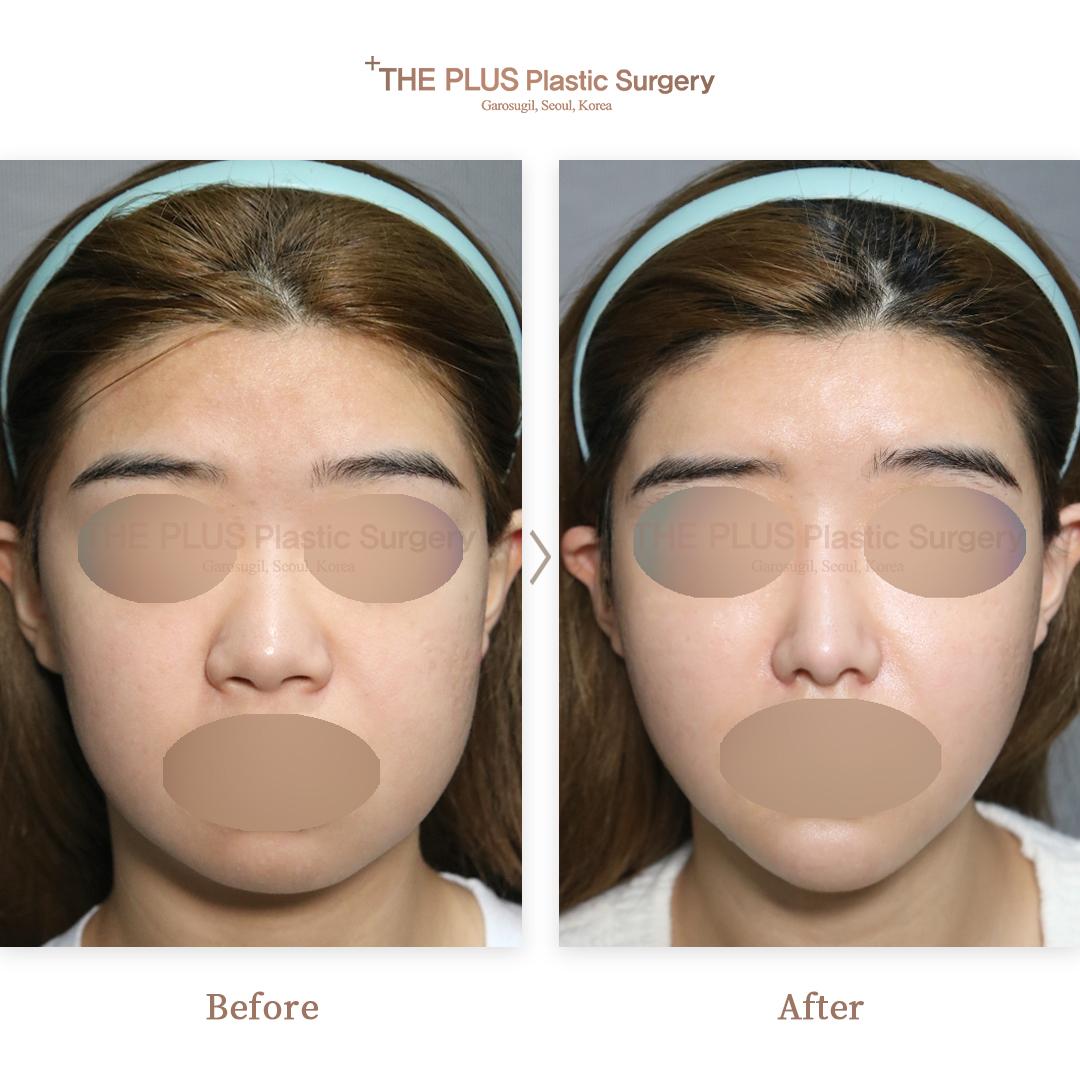
1. THEPLUS Plastic Surgery
You may consider THEPLUS Plastic Surgery for chin implant or chin-projection planning if your goal is a more balanced relationship between your chin, jawline, lips, and nose. Its facial-contouring offerings include chin surgery and facial implants, while Dr. Kim’s research recognition in 3D implants and focus on facial harmony are particularly relevant to discussions about projection and contour.
- URL: THEPLUS Plastic Surgery Website
- Location: Gangnam-gu, Seoul
- Chin and facial contouring:
- Chin surgery is offered to adjust chin size or projection for improved facial balance.
- Facial implants are offered to add structure and definition where greater projection is desired.
- Full-face contouring, cheekbone surgery, and square-jaw surgery are also listed for people considering broader facial-proportion changes.
- Relevant surgical expertise:
- Dr. Kim is described as a board-certified plastic surgeon with awards for research on 3D implants and expertise in rhinoplasty and facial contouring.
- Dr. Kim conducts annual educational sessions for other plastic surgeons and emphasizes harmonious facial balance.
- Dr. Jeong is described as President of the Korean Society of Plastic Surgeons and has a rhinoplasty practice focused on both function and appearance.
2. Made Young Plastic Surgery
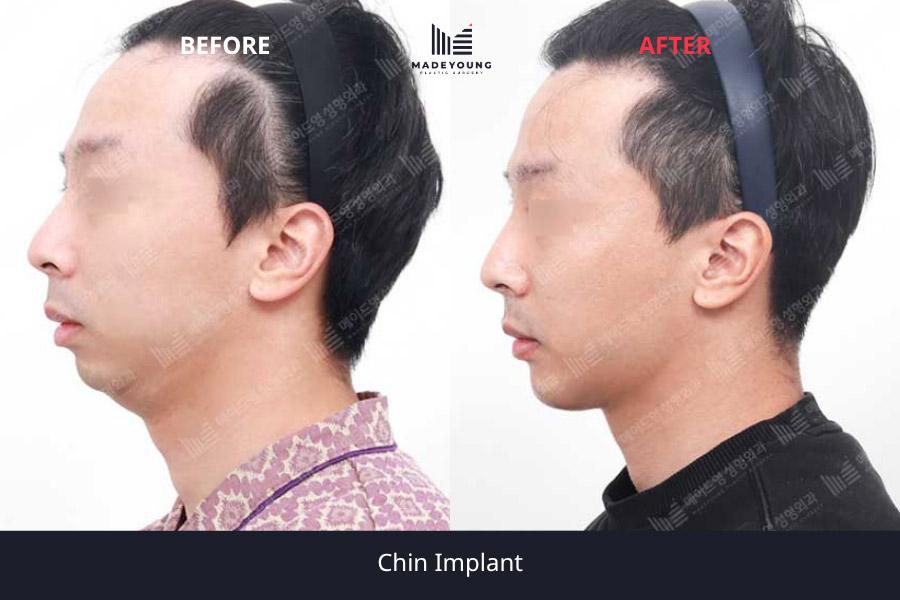
You may consider Made Young Plastic Surgery if you are exploring chin reshaping through genioplasty rather than assuming an implant is the only option. The clinic lists chin surgery for enhancing or reducing chin size and shape, alongside V-line and jaw-contouring procedures, and describes direct medical-team consultation and diagnosis before treatment.
- URL: Made Young Plastic Surgery Website
- Location: Seocho-gu, Seoul
- Chin and jawline options:
- Chin surgery (genioplasty) is offered to enhance or reduce chin size and shape for facial proportion.
- V-line surgery, jaw-reduction surgery, and cheekbone reduction are listed if you are considering changes across the lower face or facial contour.
- Its Metal-Free V-Line Surgery is described as not requiring screw fixation; the clinic states that length reduction, width reduction, and asymmetry correction can be performed without metal plates or screws.
- Monitoring and aftercare:
- Full-time board-certified anesthesiologists are listed as on site.
- The clinic describes one-to-one continuous monitoring by an anesthesiologist and a cross-check system involving multiple anesthesiologists in an emergency.
- A separate aftercare center is listed for systematic post-procedure care, and the clinic states that procedures have CCTV coverage.
3. The Regen Plastic Surgery Clinic
You may consider The Regen Plastic Surgery Clinic if you want to discuss chin augmentation, reduction, or contouring as part of an overall facial-proportion plan. The clinic lists chin surgery among its facial-contouring procedures and also offers cheekbone and square-jaw reduction for people whose concerns extend beyond the chin alone.
- URL: The Regen Plastic Surgery Clinic Website
- Location: Seocho-gu, Seoul
- Facial contouring options:
- Chin surgery is listed for augmentation, reduction, or contouring to improve facial proportion.
- Zygoma reduction is offered for prominent cheekbones, and square-jaw reduction is offered to smooth and reduce jaw width.
- The clinic also lists surgical face lifting and thread-lifting options for facial lifting concerns.
How Much Does a Chin Implant Cost in Korea?
Chin implant surgery is quoted at ₩4,400,000–₩6,000,000 (approximately US$3,300–$4,400). Individual quotes vary because the implant plan, surgical access, anesthetic approach, and any added planning or follow-up requirements differ.
| Procedure Price | Korean Won (₩) | USD ($) |
|---|---|---|
| Low Price | ₩4,400,000 | $3,300 |
| High Price | ₩6,000,000 | $4,400 |
Exchange rate as of 2026-09-06: 1 KRW = 0.000741 USD.
What Affects the Price?
- Implant material, shape, and extent — The selected silicone, HDPE/Medpor, or ePTFE implant and its dimensions affect the device and operative plan. An extended or anatomic implant that adds pre-jowl or lateral jawline contour requires more extensive pocket creation and symmetry assessment than a central projection-focused implant.
- Incision and pocket/fixation technique — An intraoral versus submental incision changes wound-management needs and surgical setup. The planned pocket plane and any fixation also add operative steps for controlled placement, position checks, and stabilization.
- Anesthesia plan — Chin implantation can be performed with local anesthesia plus sedation or with general anesthesia. Sedation or general anesthesia requires anesthesia personnel, monitoring, recovery observation, and associated facility resources.
- Pre-operative evaluation and follow-up needs — In-person assessment, indicated imaging for asymmetry, prior injury, or prior surgery, and early wound or dressing reviews require additional clinical resources. An external submental incision may also require suture review or removal before departure.
Cost tip: Request an itemized quote that states what is included, particularly the implant material and manufacturer, anesthesia, facility use, pre-operative testing or imaging, medications, dressings, and scheduled post-operative reviews.
The US$3,300–$4,400 conversion uses the exchange rate dated 2026-09-06 and is approximate. Check the exchange rate again when budgeting.
Chin Implant From Start to Finish
- Remote inquiry and preliminary screening — Submit medical history, medications, allergies, dental or orthodontic history, prior facial trauma or surgery, and clear frontal/profile photographs if requested. English-language or virtual consultation can clarify goals and travel timing, but cannot replace examination, final sizing, or consent.
- In-person facial and bite assessment — The surgeon assesses profile and frontal proportions, chin soft tissue and bone contour, facial asymmetry, neck and submental fullness, prior fillers, and dental/bite history. Imaging or further jaw evaluation is considered for prior injury, surgery, asymmetry, or suspected skeletal discrepancy.
- Planning and consent — Discuss silicone, porous polyethylene, or ePTFE material; implant shape and dimensions; intraoral or submental incision; possible fixation; anesthesia; realistic contour limits; and risks including mental-nerve symptoms, infection, malposition, bone resorption, revision, and removal.
- Pre-operative clearance — Complete required medical and anesthesia assessment and any indicated tests. The team confirms fasting instructions, medication adjustments, nicotine cessation, postoperative accommodation, companion arrangements, and the first follow-up appointment.
- Anesthesia and surgery — Chin implantation is commonly outpatient surgery under local anesthesia with sedation or general anesthesia. Through an intraoral or submental incision, the surgeon creates a controlled pocket over the bony chin, places the implant, checks position and symmetry, then closes the incision and applies tape, dressing, or compression if used.
- Recovery room and discharge — The team monitors recovery from anesthesia, reviews medications, diet, oral hygiene or incision care, and warning signs. Discharge occurs when clinical criteria are met; a companion takes the patient to nearby accommodation.
- Early Korea-based review — Attend the planned dressing and wound review before departure. The surgeon evaluates swelling, wound healing, sensation, implant position, and readiness for international travel; travel clearance remains individualized.
- Healing at home and remote follow-up — Send requested photographs or attend video review on schedule. Seek local urgent care and contact the Korean surgical team promptly for fever, rapidly increasing swelling, drainage, wound opening, a shifted implant, worsening lower-lip weakness or numbness, breathing trouble, chest pain, or shortness of breath.
Alternatives to a Chin Implant
The main tradeoff is permanence and invasiveness. An implant gives durable projection through surgery but introduces implant-related risks; temporary filler avoids an incision but needs maintenance and carries injection-specific vascular risk. Bone surgery can achieve changes an implant cannot, but has a more invasive recovery and different nerve and bone-healing risks.
Chin Filler
- Best role — A chin filler can provide a temporary projection trial when the desired degree of advancement is uncertain.
- Tradeoff — It requires repeat treatment and has rare but serious vascular complications, unlike an implant placed in a surgical pocket.
Sliding Genioplasty
- Best role — Chin surgery that repositions the patient’s own chin bone can better address larger projection changes, vertical modification, and selected asymmetry.
- Tradeoff — It is not an implant procedure. Bone cutting, fixation, healing, and neurosensory risks change the recovery and decision process. A 2025 comparison review found high satisfaction for both implant augmentation and osseous genioplasty, with different complication patterns and limited underlying evidence.
Orthognathic Treatment
- Best role — Jaw surgery and orthodontic assessment are appropriate when malocclusion, obstructive jaw issues, or true mandibular position—not isolated chin projection—is the central concern.
- Tradeoff — This is functional skeletal treatment with a substantially broader treatment pathway than cosmetic chin augmentation.
Submental Contouring
- Best role — Double chin liposuction or a neck-focused procedure addresses under-chin fat and jawline obscuring fullness rather than a recessed bony chin.
- Tradeoff — Removing fat does not advance the chin. Some patients need combined planning when both projection and submental fullness affect the profile.
Facial Implants or Fat Grafting
- Best role — Facial implant planning or fat grafting can be considered when broader lower-face or midface volume/contour imbalance is the issue.
- Tradeoff — Autologous tissue avoids a permanent synthetic chin implant but introduces donor-site considerations and less predictable volume retention.
How Can I Prepare for a Chin Implant?
- Disclose medicines completely — Give the surgeon and anesthesia team every prescription, over-the-counter drug, supplement, recreational substance, allergy, prior anesthesia reaction, and medical condition. Do not independently stop anticoagulants, antiplatelets, diabetes medicines, steroids, hormone therapy, or GLP-1 medicines; the prescribing clinician and anesthesia team must give the plan.
- Follow fasting instructions exactly — Follow the clinic’s individualized fasting times for food and liquids. Requirements depend on anesthetic type, diabetes, reflux, delayed gastric emptying, and medicines such as GLP-1 receptor agonists.
- Stop nicotine on the surgeon’s schedule — Stop cigarettes, vaping, chewing tobacco, nicotine replacement, and cannabis according to the surgical protocol. Nicotine impairs perfusion and wound healing; failure to meet the cessation requirement can lead to postponement.
- Resolve infection before surgery — Report dental pain, gum bleeding, oral ulcers, active acne or skin infection near the area, fever, herpes outbreak, and respiratory illness. Treat active oral or systemic infection before elective implantation.
- Prepare for an intraoral incision — Stock simple soft foods and confirm the prescribed oral-rinse and dental-hygiene routine. Do not assume the same diet or rinse protocol applies to a submental incision.
- Arrange practical support — Stay near the clinic, book flexible flights, arrange a responsible adult for surgery day and the first night, and prepare head elevation, hydration, and a route back to the clinic for urgent review.
- Avoid alcohol and excess sun — Avoid alcohol as instructed before surgery and completely while taking opioid pain medicine or sedatives. Avoid sunburn or irritation on the lower face before surgery.
Travel note: Schedule surgery early enough to complete the required wound review and receive written flight clearance before a long-haul departure.
Confirm all medication changes, fasting, hygiene, diet, nicotine cessation, testing, and travel requirements with the treating doctor; individualized surgical and anesthesia instructions take precedence over general guidance.
Aftercare Advice
Protect the implant pocket and incision during early healing; pressure, trauma, and premature activity can compromise positioning and wound recovery.
- Control swelling — Rest with the head elevated and use surgeon-approved cold compresses for the first 24–48 hours. Swelling, bruising, tightness, tenderness, and temporary numbness are most noticeable during the first 7–14 days.
- Protect the chin — Do not massage, press on, sleep face-down on, or expose the chin to trauma until cleared. Avoid contact-risk activity, forceful chewing, and heavy luggage in the early recovery period.
- Follow incision-specific hygiene — Use prescribed oral rinses and advance from liquid or soft foods only as comfort and the team allow after an intraoral incision. Keep a submental incision and any dressing or tape exactly as instructed; do not apply unapproved creams or remove support early.
- Limit activity and heat — Avoid vigorous exercise, heavy lifting, bending, swimming, sauna, steam rooms, and hot baths for about 4–6 weeks or until cleared. Light desk activity is often possible around days 7–10 when the surgeon agrees.
- Avoid nicotine and alcohol — Do not smoke, vape, or use nicotine during healing. Avoid alcohol while using opioid pain medicines, sedatives, antibiotics, or any medicine for which alcohol is contraindicated.
- Attend review and protect skin — Attend all scheduled checks before and after travel. Once any external incision is closed and the surgeon permits, protect it from sun with SPF 50 and physical shade to reduce scar darkening.
- Know urgent warning signs — Contact the clinic urgently for fever or chills, rapidly increasing one-sided or tense swelling, escalating pain, pus or foul drainage, spreading redness, wound opening, implant visibility, new shift or asymmetry, or worsening numbness or lower-lip weakness. Seek emergency care for trouble breathing or swallowing, chest pain, shortness of breath, coughing blood, fainting, or symptoms of deep-vein thrombosis.
- Set realistic timing — The projection change is immediate but obscured by swelling. Most swelling improves by about 6 weeks; assess a more settled result at 2–3 months, with refinement continuing for 3–6 months in some cases.
Follow the treating doctor’s instructions over this general guidance, and contact the clinic promptly when healing, sensation, implant position, or pain appears abnormal.
Frequently Asked Questions
Related Blogs
Korea Face Contouring Procedures for Round Face: Transform Your Look with Korean Medical Expertise
Discover how Korea leads in facial contouring for a "round face" with advanced procedures like V-Line surgery, buccal fat removal, and masseter botox. This comprehensive blog explores causes behind a round face, available non-invasive options, and permanent surgical solutions. Learn why Korea is the top destination for safe, affordable, and expertly tailored facial contouring, helping patients ach
Updated: Oct 12, 2026
Nasolabial Fold Hollowing Solutions: Paranasal Implant Procedures in Korea
Explore the benefits of nasal and midface enhancement with paranasal implants in Korea. This advanced surgical procedure addresses deep nasolabial folds and hollowing caused by skeletal insufficiency. In Korea, leading clinics offer expert consultations, state-of-the-art techniques, and lasting results for facial rejuvenation. Discover how paranasal implants in Korea can transform your appearance,
Updated: Oct 11, 2026
Short Chin Solutions: Chin Implant Procedures in Korea for Enhanced Facial Contours
Explore the benefits of chin augmentation procedures in Korea, including chin implant surgery and osseous genioplasty. Learn how Korea's advanced medical tourism industry offers expert treatments for micrognathia, retrognathia, and microgenia. Discover the latest techniques, implant materials like silicone and porous polyethylene, and the comprehensive process—from consultation to recovery. Korea'
Updated: Oct 10, 2026
Smile Asymmetry Solutions: Facial Asymmetry Correction Procedures in Korea for a Balanced Smile
Discover how Korea leads in facial asymmetry correction through advanced procedures like orthognathic (jaw) surgery, genioplasty (chin surgery), and facial implants. This comprehensive guide explains the causes of smile asymmetry due to skeletal differences and showcases why Korea is a top destination for medical tourism. Learn about the treatment options, surgical techniques, patient experiences,
Updated: Oct 10, 2026
Clinics offering Chin Implant

THEPLUS Plastic Surgery Korea | Eye, Nose, Face & Body Surgery
Sinsa

Made Young Plastic Surgery: Rejuvenating Aesthetic Excellence in Korea for Face Lifts, Contouring and More
Gangnam Station

The Regen Plastic Surgery Clinic in Korea: Comprehensive Aesthetic Procedures for Eye, Nose, Facial Contouring, and Face Lifting
Hakdong

Mind Plastic Surgery: Excellence in Cosmetic & Reconstructive Procedures in Korea
Sinnonhyeon Station