
Medical Tourism Blog
Double Jaw Surgery in Korea: Candidacy, Recovery, Travel Planning, and Risks

Table of contents
- Double Jaw Surgery at a Glance
- What Is Double Jaw Surgery?
- Who Is a Good Candidate for Double Jaw Surgery?
- How Is Double Jaw Surgery Performed?
- Why Visit Korea for Double Jaw Surgery?
- Key Information for International Patients
- Which Are the Best Clinics in Korea for Double Jaw Surgery?
- Double Jaw Surgery From Start to Finish
- Alternatives to Double Jaw Surgery
- How Can I Prepare for Double Jaw Surgery?
- Aftercare Advice
Considering treatment in Korea? Everything you need to know e.g. — how to avoid scams, visas, interpreters, recovery tips — in our Medical Tourism Master Guide. Plan with confidence in minutes, not weeks!
Last updated: September 2026
Double Jaw Surgery at a Glance
- What it corrects — Double jaw surgery, or bimaxillary orthognathic surgery, repositions both upper and lower jaws under general anesthesia to correct a skeletal bite discrepancy, such as an underbite, open bite, crossbite, asymmetry, or lip-incompetence.
- Best candidates — Candidates need a clinically meaningful jaw-bone imbalance with functional or bite concerns and must be able to complete coordinated orthodontics before and after surgery; braces or aligners alone cannot fully reposition the jaw bones.
- Recovery commitment — Hospital monitoring commonly lasts 1–2 nights, swelling peaks at 48–72 hours and improves substantially within 10–14 days, while a liquid/no-chew then soft diet commonly lasts about 6 weeks and sometimes up to 8 weeks.
- Final-result timeline — Initial bone healing takes about 6 weeks, but residual swelling, sensation changes, bone remodeling, and facial soft-tissue adaptation continue for roughly 9–12 months, so early photos are not the stable result.
- Numbness risk — Temporary facial sensory changes are common; a systematic review reported neurosensory disturbance in 52.8% of cases, with 92.6% of reported cases recovering by 12 months and 3.4% reported as permanent, although definitions varied across studies.
- Korea travel plan — International patients should plan to remain in South Korea for about 3–4 weeks for final planning, surgery, early bite and elastics checks, and swelling management; the surgeon—not a fixed postoperative day—should approve long-haul flying.
- Korea-specific safeguard — Qualifying Korean operating rooms must have CCTV installed, and recording is generally required for surgery on an unconscious patient when requested by the patient or guardian, subject to legal exceptions; confirm the hospital’s process because this does not measure surgeon quality.
What Is Double Jaw Surgery?
Double jaw surgery is corrective surgery that repositions the upper and lower jaws to improve how the teeth and jaws fit together. It addresses significant skeletal bite problems that affect chewing, speech, lip closure, facial balance, tooth wear, or selected breathing concerns. It is a major surgical procedure performed under general anesthesia, usually alongside orthodontic treatment.
Who Is a Good Candidate for Double Jaw Surgery?
- Skeletal bite discrepancy — Good candidates have a clinically meaningful jaw-bone imbalance, such as a Class II or Class III bite, underbite, open bite, crossbite, facial asymmetry, or difficulty closing the lips at rest.
- Functional concerns — The operation is considered when jaw position contributes to chewing difficulty, speech issues, tooth wear, or selected airway problems, not solely to change facial shape.
- Orthodontic commitment — Candidates can complete coordinated treatment with an orthodontist before and after surgery, including braces or aligners, elastics, bite checks, and months of postoperative adjustment.
- Stable health and support — Suitable patients can undergo general anesthesia, manage a liquid and no-chew diet, maintain detailed oral hygiene, and arrange reliable support and follow-up after returning home.
Elective corrective jaw surgery is generally deferred until facial growth is sufficiently complete; the surgeon and orthodontist assess skeletal maturity rather than using one universal age cutoff. It is unsuitable or postponed with uncontrolled cardiopulmonary disease, poorly controlled diabetes, significant bleeding risk, active dental, periodontal, sinus, or systemic infection, pregnancy, or an unacceptable anesthesia risk. Nicotine use, including smoking and vaping, impairs wound and bone healing and commonly delays elective surgery until cessation is achieved. Previous jaw radiation, substantial immunosuppression, and antiresorptive or antiangiogenic medicines require specialist assessment, while untreated body-image distress or an inability to complete orthodontic and long-term follow-up makes surgery inappropriate.
How Is Double Jaw Surgery Performed?
Double jaw surgery usually combines a Le Fort I osteotomy of the upper jaw with bilateral sagittal split osteotomies (BSSO) of the lower jaw. The plan determines how far each jaw moves, whether the chin also needs adjustment, and how teeth are coordinated around the new bite.
- Orthodontics-first pathway — Braces or aligners first move teeth into positions that allow the jaws to meet correctly after surgery. This remains the conventional approach and is often necessary when dental compensation is substantial.
- Surgery-first or surgery-early pathway — Carefully selected patients have surgery before full orthodontic decompensation, followed by intensive postoperative orthodontics. A 2025 systematic review found shorter total treatment time with broadly similar skeletal and TMJ outcomes at about one year, but the evidence was predominantly observational; it is not a shortcut for unsuitable cases.
- Conventional splint transfer — The surgeon uses planned dental models and CAD/CAM surgical splints to guide jaw positioning during the operation.
- Virtual planning and patient-specific transfer — CBCT imaging and digital records can create a three-dimensional plan, with CAD/CAM splints, custom cutting guides, or patient-specific plates and screws. A 2026 review and meta-analysis found smaller linear deviations from the virtual plan with patient-specific guides and fixation than with CAD/CAM splints, but no significant complication difference and inconclusive long-term outcome evidence.
- Additional procedures — Genioplasty, segmental maxillary osteotomy, bone grafting, or wisdom-tooth treatment can be added when the bite, chin position, jaw anatomy, or surgical access requires it.
Why Visit Korea for Double Jaw Surgery?
South Korea has access to orthognathic teams using digital planning, CAD/CAM splints, and patient-specific surgical-transfer systems where indicated. These tools improve planning precision or plan transfer in selected cases, but they do not replace a sound diagnosis, orthodontic coordination, or experienced postoperative care. There is no robust evidence that Korea as a country produces superior double-jaw-surgery outcomes compared with other countries.
- Digital-planning access — Virtual surgical planning, CBCT-based records, CAD/CAM splints, custom guides, and patient-specific fixation can be evaluated as part of a case-specific plan. The current evidence supports an accuracy advantage for patient-specific transfer methods, not a guaranteed better facial, functional, or safety outcome for every patient, as detailed in the comparative evidence review.
- Verifiable operating-room safeguard — Korea’s Medical Service Act requires CCTV installation in qualifying operating rooms and generally requires recording for surgery on an unconscious patient when the patient or guardian requests it, subject to statutory exceptions. Review the English text of the law and confirm the hospital’s own process; this is a procedural safeguard, not a measure of surgeon quality or outcome.
- What to verify directly — Confirm the named oral and maxillofacial surgeon, the orthodontist responsible for the full plan, hospital admission and airway-monitoring arrangements, emergency coverage, digital-planning method, and written handoff plan. These team-level details matter more than national marketing claims.
Key Information for International Patients
- Minimum stay — Plan conservatively for about 3–4 weeks in South Korea. This allows final planning, surgery, 1–2 nights of common inpatient monitoring, early swelling management, wound and bite checks, and elastics adjustment.
- Flight clearance — No reliable evidence establishes one universally safe long-haul-flight date after bimaxillary surgery. Fly only when the operating surgeon confirms stable breathing, hydration and nutrition, pain control, mobility, wound status, and bite, with no concern for bleeding or infection.
- Itinerary impact — Swelling often peaks at 48–72 hours and improves substantially over 10–14 days, but fatigue, restricted mouth opening, numbness, and a liquid/no-chew diet make sightseeing or business commitments unrealistic in the early recovery period. Recovery evidence does not support one universal diet, activity, or discharge protocol.
- Repeat care — Postoperative orthodontics commonly continues for months. Arrange a local orthodontist and oral/maxillofacial surgeon before travel for routine adjustments, bite concerns, broken elastics, and urgent review after departure.
- Records and remote follow-up — Leave with English copies of imaging, the surgical plan where applicable, operative report, plate and screw details, discharge summary, prescriptions, diet and elastics schedule, emergency contacts, and video-follow-up dates.
Travel note: Do not book a fixed return flight that forces departure on a particular postoperative day. Use flexible travel arrangements and remain in Korea longer if the surgical team identifies a healing, nutrition, bite, or airway concern.
Which Are the Best Clinics in Korea for Double Jaw Surgery?
Listed below are some of the best clinics in Korea for double jaw surgery.
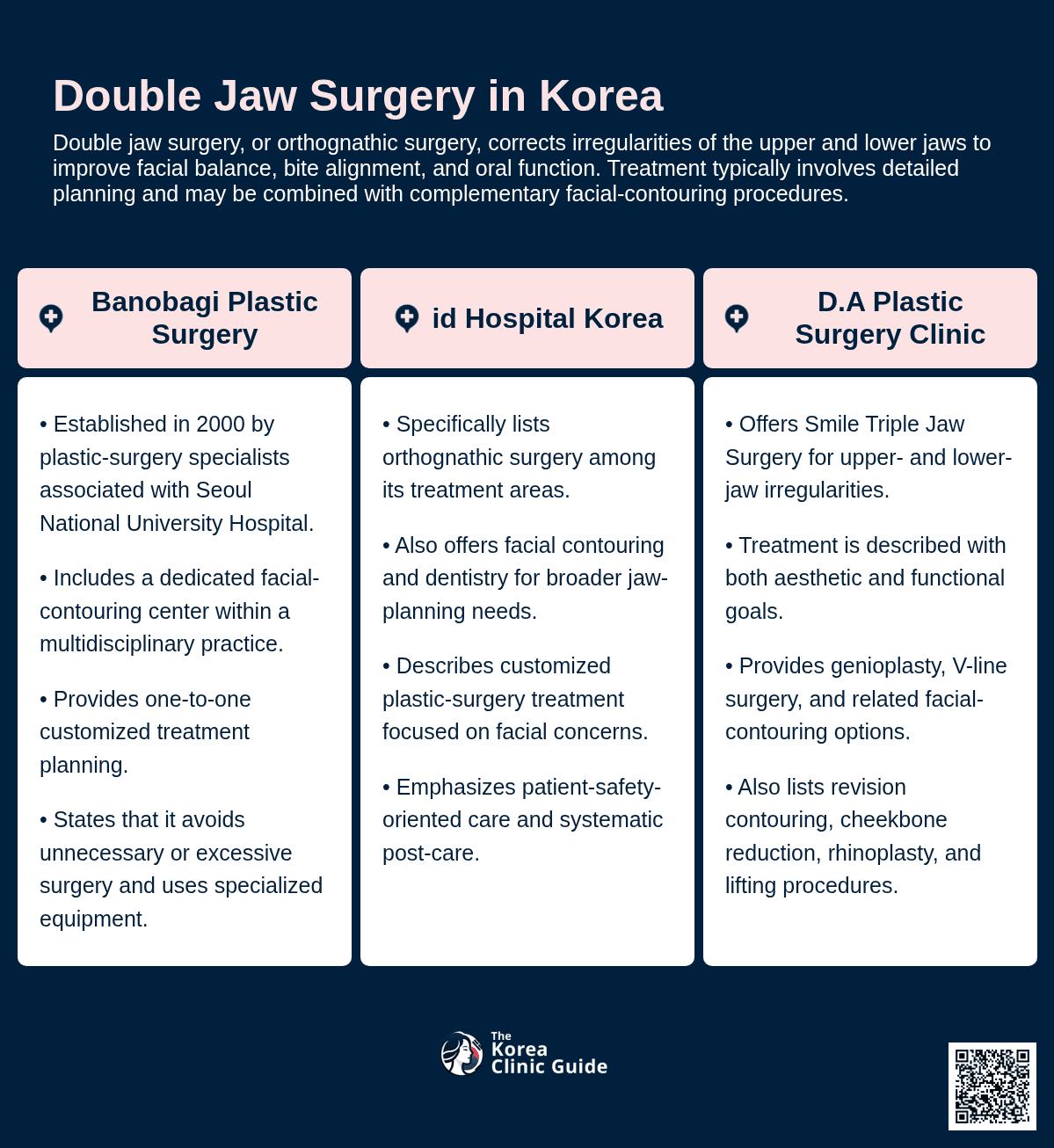
1. Banobagi Plastic Surgery
You may consider Banobagi Plastic Surgery for a double jaw surgery consultation if you value an established Seoul practice with a dedicated facial-contouring center and an individualized treatment approach. Founded in 2000 by plastic-surgery specialists associated with Seoul National University Hospital, the clinic states that it avoids recommending unnecessary or excessive surgery, which may be relevant when discussing whether jaw surgery aligns with your needs.
- URL: Banobagi Plastic Surgery Website
- Location: Gangnam-gu, Seoul
- Relevant care setting:
- The clinic includes a facial-contouring center within a multi-specialty plastic-surgery practice.
- It describes providing one-to-one customized treatment and field-specific medical equipment.
- Practice background:
- Established in 2000 by plastic-surgery specialists from Seoul National University Hospital.
- The practice operates from a six-story main building and five-story annex with multiple surgical specialty centers.
2. id Hospital Korea
You may consider id Hospital Korea for double jaw surgery because orthognathic surgery is specifically listed among its treatment areas, alongside facial contouring and dentistry. Its stated focus on customized planning, patient-safety-oriented care, and systematic post-care may be useful factors to discuss as you evaluate jaw correction for functional and facial concerns.
- URL: id Hospital Korea Website
- Location: Gangnam-gu, Seoul
- Jaw-related services:
- Orthognathic surgery is listed as a treatment area.
- Facial contouring and dentistry are also listed, which may be relevant to broader jaw and facial treatment planning.
- Care approach:
- The clinic describes customized plastic surgery, patient-safety-oriented treatment, and systematic post-care.
- Its stated focus is facial treatments.
3. D.A Plastic Surgery Clinic
You may consider D.A Plastic Surgery Clinic if you are exploring surgery for upper- and lower-jaw irregularities alongside facial-balance procedures. The clinic lists Smile Triple Jaw Surgery as a treatment intended to correct jaw irregularities involving both jaws, with potential aesthetic and functional goals, and it also offers related chin, jawline, and cheekbone contouring procedures.
- URL: D.A Plastic Surgery Clinic Website
- Location: Gangnam-gu, Seoul
- Jaw and facial procedures:
- Smile Triple Jaw Surgery is described as correcting irregularities involving the upper and lower jaws, with aesthetic and functional aims.
- V-line surgery contours the jawline and may be combined with chin surgery.
- Genioplasty is offered to enhance or reduce the chin and may be combined with other contouring procedures.
- Revision facial contouring is available for refining results from prior contouring surgery.
- Related facial balancing options:
- Turning zygoma reduction is offered to reduce cheekbone prominence through shaving and repositioning.
- The clinic also lists rhinoplasty and lifting procedures that may be considered separately when discussing overall facial proportions.
Double Jaw Surgery From Start to Finish
- Remote screening and records review — Send recent orthodontic records, dental photographs, bite photos, X-rays or CBCT files when available, medical history, medicine and supplement list, sleep-apnea history, and treatment goals. An English-language or virtual consultation can clarify feasibility, but it cannot replace the final in-person examination.
- In-person surgical-orthodontic assessment — The oral and maxillofacial surgeon and orthodontist assess facial proportions, occlusion, periodontal health, TMJ symptoms, tooth position, and jaw movement. Records commonly include dental scans, cephalometric imaging, and CBCT or three-dimensional planning when indicated.
- Definitive planning — The team confirms jaw movements, orthodontic sequence, possible genioplasty or other additions, fixation approach, hospital monitoring, diet, elastics, expected numbness, and follow-up schedule. Address dental decay, gum disease, and active infection before surgery.
- Pre-anesthesia review and admission — The anesthetist reviews medical conditions, allergies, prior anesthesia problems, sleep apnea, nicotine or cannabis use, and all prescribed and nonprescription medicines. Follow the individualized fasting and medication plan exactly.
- General anesthesia and jaw repositioning — Surgery is performed under general anesthesia, commonly with nasal intubation. Through incisions inside the mouth, the surgeon mobilizes the upper jaw with a Le Fort I osteotomy and the lower jaw with BSSO, repositions them to the planned bite, and stabilizes them with plates and screws; elastics commonly guide the bite afterward.
- Immediate monitoring — Hospital care focuses on airway, bleeding, swelling, nausea, pain, hydration, nutrition, mobility, and occlusion. Discharge depends on safe breathing, adequate oral intake for fluids and medicines, controlled symptoms, mobility, and an adequate support plan—not simply the number of days since surgery.
- Early in-Korea reviews — Attend all scheduled wound, bite, and elastics checks before departure. The team adjusts elastics and advances the diet only when healing and occlusion support it.
- Overseas follow-up — Continue video reviews with the operating team and in-person orthodontic care locally. Send clear photographs and report a shifting bite, broken elastics, poor fluid intake, fever, worsening swelling, or sensory changes promptly.
Alternatives to Double Jaw Surgery
The right alternative depends on whether the issue is dental, skeletal, functional, or primarily cosmetic. Non-surgical options can move teeth or mask selected discrepancies, but they cannot reliably reposition jaw bones; surgery has greater correction potential but requires general anesthesia, recovery, and prolonged orthodontic follow-up.
Braces or Clear Aligners
- Best fit — Primarily dental crowding, spacing, or a mild bite discrepancy without a clinically significant jaw-bone imbalance.
- Tradeoff — Orthodontics can align teeth and improve the bite but cannot fully correct skeletal jaw position, facial asymmetry caused by bone structure, or major underbite/open-bite relationships.
- Related options — Read about braces and clear aligners.
Prosthodontic Camouflage
- Best fit — Selected adults with tooth wear, missing teeth, or limited discrepancies where restorative dental work can improve tooth form and bite function.
- Tradeoff — Crowns, restorations, or bite rehabilitation can camouflage selected dental effects but do not correct the underlying jaw relationship.
Single-Jaw Orthognathic Surgery
- Best fit — A discrepancy confined sufficiently to either the upper or lower jaw after full surgical-orthodontic evaluation.
- Tradeoff — It is less extensive than bimaxillary surgery, but forcing a two-jaw discrepancy into a one-jaw plan can compromise bite, facial balance, or stability.
Maxillomandibular Advancement
- Best fit — Appropriately evaluated obstructive sleep apnea where advancing both jaws is part of an airway-focused plan.
- Tradeoff — This is corrective jaw surgery with a different primary indication; sleep testing and airway assessment are essential, and it is not a cosmetic substitute.
Observation
- Best fit — Stable jaw relationships with acceptable function, manageable tooth wear, and no compelling functional or health indication for surgery.
- Tradeoff — Observation avoids surgical risk but does not correct the skeletal discrepancy; continue dental and orthodontic monitoring where indicated.
How Can I Prepare for Double Jaw Surgery?
- Complete the orthodontic and dental work-up — Obtain clearance for gum health, caries, tooth condition, and any planned extractions. Give the surgeon and orthodontist current dental scans, imaging, and records; the final plan should be confirmed in person.
- Disclose every medicine and substance — Report anticoagulants, antiplatelets, diabetes medicines, GLP-1 medicines, hormones, corticosteroids, psychiatric medicines, allergies, cannabis, nicotine, alcohol use, and prior anesthesia problems. Do not independently stop prescribed medicines.
- Review supplements early — Ask the surgeon and anesthetist specifically about NSAIDs, fish oil, vitamin E, ginkgo, garlic, ginseng, turmeric/curcumin, St John’s wort, and other supplements that can affect bleeding, sedation, or anesthesia. Follow their individualized stop dates rather than a generic online schedule.
- Stop nicotine as required — Smoking, vaping, and nicotine replacement impair wound and bone healing. Achieve the cessation period set by the treating team before elective surgery and remain nicotine-free during recovery.
- Plan nutrition before travel — Stock approved liquid-diet supplies, a blender if useful, measuring containers, and protein- and calorie-dense options that fit the surgeon’s diet plan. Discuss dietary restrictions, diabetes, food allergies, and a low body weight or recent weight loss before surgery.
- Follow fasting instructions exactly — The anesthetist’s instructions on food, clear fluids, and day-of-surgery medicines take precedence. Incorrect fasting or medication use can delay or cancel surgery.
- Arrange support and accommodation — Stay close enough for early reviews, arrange a responsible adult to assist after discharge, and ensure access to a refrigerator, blender, prescribed rinses, and transport to the hospital.
- Protect the schedule — Avoid alcohol as directed, avoid sunburn or facial injury before surgery, and keep return flights and work commitments flexible for at least the planned 3–4-week stay.
Travel note: Establish the local orthodontist and emergency oral/maxillofacial contact before leaving home, not after a postoperative problem develops.
Confirm every clinic-specific medication, fasting, dental, nicotine, companion, and travel requirement with the treating surgeon and anesthetist.
Aftercare Advice
Protect the healing bite, maintain fluids and nutrition, and treat every scheduled review as part of the operation—not an optional extra.
- Diet and hydration — Follow the prescribed liquid or no-chew diet initially, then progress to soft/non-chew food only when cleared. A modified diet often continues for about 6 weeks and some teams restrict chewing up to 8 weeks; monitor fluid intake and body weight because dehydration and weight loss can develop.
- Elastics and oral hygiene — Wear postoperative elastics exactly as instructed and attend bite checks. Clean teeth, braces, elastics, and gums carefully; use prescribed rinses if provided. Do not change elastics or force the bite into position unless the team has taught you how.
- Swelling, sensation, and activity — Swelling is usually greatest at 48–72 hours and improves substantially over 10–14 days, while residual swelling, altered sensation, and facial adaptation can last months. Walk short distances as directed, but avoid strenuous exercise, heavy lifting, contact sports, and facial-trauma risk until cleared—commonly through at least the initial 6-week bone-healing period.
- Nose and sinus precautions — After upper-jaw surgery, do not blow the nose and sneeze with the mouth open until the surgeon clears these activities.
- Urgent warning signs — Seek urgent surgical or emergency assessment for breathing difficulty, rapidly expanding swelling, uncontrolled bleeding, inability to maintain fluids or medicines, persistent vomiting, fever, foul discharge, worsening pain or swelling after the early expected period, a shifting bite, unmanageable broken elastics, new visual symptoms, chest pain, calf swelling, severe medicine reaction, or new/worsening facial weakness.
- Result timeline and risk context — Initial bone healing is about 6 weeks, but bone remodeling and facial soft-tissue adaptation continue for roughly 9–12 months; early photographs do not show the stable result. Temporary numbness is common: a systematic review reported pooled neurosensory disturbance of 52.8%, with 92.6% of reported cases recovering by 12 months and 3.4% reported permanent, although definitions and follow-up varied substantially.
Follow the treating doctor’s instructions over general guidance and contact the clinic promptly whenever the bite, breathing, swelling, wound, nutrition, or pain appears wrong.
Frequently Asked Questions
Related Blogs
Korea Paranasal Implant: Effective Sunken Midface Treatment Solutions
Discover how Korea leads in sunken midface correction with advanced paranasal implant surgery. This minimally invasive procedure restores facial harmony, improves nasal function, and creates a natural appearance. Offered by top Korean clinics using silicone, Medpor, PTFE, and autologous grafts, paranasal implant surgery in Korea is cost-effective, scarless, and tailored to individual needs. Ideal
Updated: Oct 6, 2026

Achieve Your Facial Slimming Goal with Face Contouring Procedures in Korea
Discover how Korea leads in facial contouring with advanced procedures such as jaw reduction, cheekbone reduction, chin augmentation, and non-surgical treatments like dermal fillers and Botox. This comprehensive guide explains facial slimming goals, surgical and non-surgical options, recovery tips, and cost insights, all rooted in Korea’s reputation for expertise. Perfect for medical tourists seek
Updated: Oct 5, 2026
Korea Chin Implant Procedures for Undefined Chin: Transform Your Profile with Expert Korean Surgery
Looking to improve an undefined chin? Discover how Korea's advanced chin implant procedures, including genioplasty and sliding genioplasty, can enhance facial harmony. Learn about implant materials like silicone and Medpor, the surgical steps, recovery timeline, and why Korea is a top destination for medical tourism. Experience expert care, affordable prices, and cutting-edge technology in Korea t
Updated: Oct 4, 2026
Paranasal Depression Treatment with Paranasal Implant Procedures in Korea for Optimal Results
Discover how Korea leads in paranasal depression correction with advanced paranasal implant procedures. These innovative treatments restore facial harmony, address midface concavity, and soften nasolabial folds. As a premier medical tourism destination, Korea offers expert surgeons, cutting-edge techniques, and comprehensive packages for facial augmentation. Learn about different implant materials
Updated: Oct 4, 2026
Clinics offering Double Jaw Surgery

Banobagi Plastic Surgery: A Pioneering and Trusted Plastic Surgery Clinic in Korea
Seolleung
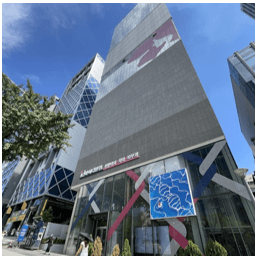
ID Hospital - Main Branch in Korea: Specializing in Safe & Customized Facial Plastic Surgery and Post-Care Services
Sinsa

D.A Plastic Surgery Clinic in Korea: Advanced Cosmetic Procedures for Natural Beauty Enhancement
Gangnam Station

Nana Plastic Surgery Clinic in Korea: Advanced Aesthetic Procedures for Face, Body, and Breast Enhancement
Sinnonhyeon Station