
Medical Tourism Blog
Butt Thread Lift in Korea: Candidacy, Techniques, Recovery and Travel Planning
Table of contents
- Butt Thread Lift at a Glance
- What Is a Butt Thread Lift?
- Who Is a Good Candidate for a Butt Thread Lift?
- How Is a Butt Thread Lift Performed?
- Why Visit Korea for a Butt Thread Lift?
- Key Information for International Patients
- Which Are the Best Clinics in Korea for Butt Thread Lift?
- Butt Thread Lift From Start to Finish
- Alternatives to a Butt Thread Lift
- How Can I Prepare for a Butt Thread Lift?
- Aftercare Advice
Considering treatment in Korea? Everything you need to know e.g. — how to avoid scams, visas, interpreters, recovery tips — in our Medical Tourism Master Guide. Plan with confidence in minutes, not weeks!
Last updated: September 2026
Butt Thread Lift at a Glance
- What it does — A butt thread lift places tensioned sutures under the skin to modestly reposition mild-to-moderately descended buttock tissue; it is not a BBL and does not reliably create major volume.
- Best candidates — Suitable candidates are medically well adults at a stable weight with adequate soft tissue, reasonably elastic skin, and mild to moderate flattening or ptosis rather than substantial loose skin.
- Not for severe laxity — Severe ptosis, major post-weight-loss skin excess, or a goal of substantial enlargement usually calls for alternatives such as a surgical lift, fat grafting, or implants; severe Grade 6 ptosis had poor outcomes in a small 60-patient series.
- Recovery expectations — Walking is generally possible the day of treatment, but expect tenderness, bruising, swelling, pulling, or temporary dimpling for 1–2 weeks; avoid gluteal pressure, traction, and strenuous lower-body exercise until cleared.
- Results and evidence — An immediate contour change may be visible from thread tension, but swelling can obscure the outcome and no reliable final-result date or longevity is established; direct evidence consists mainly of small 27- and 60-patient case series.
- Korea travel plan — International patients should plan to stay in Korea at least 7–10 days for consultation, treatment, and an in-person wound and contour check before a long-haul flight.
- Korea-specific check — Korea has published a small PDO series using 24–30 threads per buttock side, but this does not prove superior outcomes; request written confirmation of the exact thread brand, material, count, access points, and English procedure record.
What Is a Butt Thread Lift?
A butt thread lift uses implanted sutures to reposition mildly descended buttock soft tissue. It aims to create a subtle lift and improve contour or flattening, rather than add significant volume. It is a minimally invasive procedure.
Who Is a Good Candidate for a Butt Thread Lift?
- Mild to moderate descent — Good candidates have mild or moderate gluteal ptosis, flattening, or upper-buttock contour descent and want subtle soft-tissue repositioning rather than major enlargement.
- Adequate tissue and skin quality — There must be enough soft-tissue volume for threads to engage, with reasonably elastic skin and no major excess skin after weight loss.
- Stable weight and realistic goals — Candidates are medically well adults at a stable weight who understand that a butt thread lift does not transfer fat or reliably add large volume like a Brazilian butt lift.
- Able to protect the treatment area — Plan for 1–2 weeks of low-impact recovery and be able to avoid gluteal pressure, traction, and strenuous lower-body exercise until the clinician clears activity.
Do not proceed with active skin infection, cellulitis, open wounds, or significant inflammatory skin disease along the planned access points or thread paths. Pregnancy and breastfeeding are reasons to defer this elective procedure because buttock-specific safety evidence is lacking; uncontrolled diabetes, immunosuppression, serious unstable illness, bleeding disorders, and impaired healing risk require optimization or medical clearance. Do not independently stop aspirin, warfarin, apixaban, rivaroxaban, clopidogrel, or other prescribed antiplatelet or anticoagulant medicines. Severe ptosis, substantial post-weight-loss skin excess, and a request for major augmentation are poor indications: in a small 60-patient Elasticum® series, the most severe Grade 6 ptosis cases had poor outcomes, supporting surgical lifting or volume procedures instead in that limited case series. An in-person standing examination must separate true tissue descent from volume loss, hip dips, cellulite, scar tethering, asymmetry, and surrounding fat distribution.
How Is a Butt Thread Lift Performed?
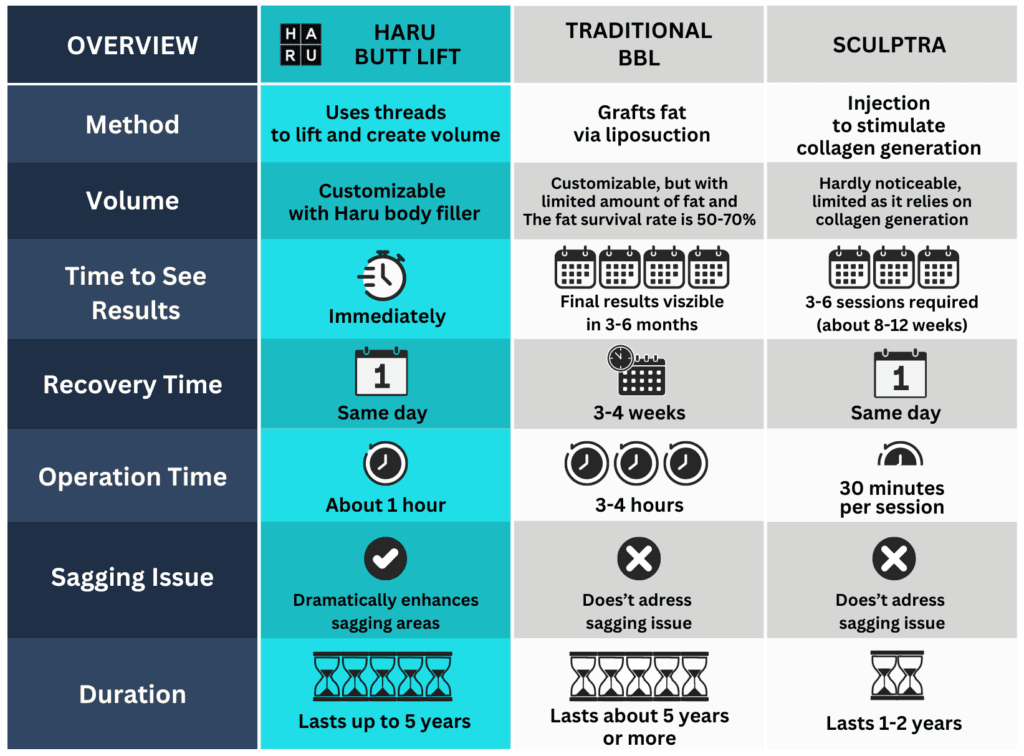
Thread material, design, number, placement vectors, and whether the system is absorbable or permanent differ substantially. Ask for the exact product, material, planned depth, entry points, thread count, and management plan for exposure, infection, visibility, pain, or removal.
- PDO multi-thread repositioning — Multiple absorbable polydioxanone (PDO) threads are placed through planned subcutaneous vectors. A Korean case series used 24–30 threads per buttock side in 27 women; its findings are uncontrolled and extend only through 8 months in the published report.
- Elastic suspension threads — Elastic systems such as Elasticum® can be arranged in circular or vector-based patterns through several small access points. The 60-patient report used five stab-incision points and proposed improved comfort with hip flexion versus nonelastic material, but no comparative trial confirms that advantage in the Elasticum® series.
- Cone or barbed staged suspension — Some systems use polypropylene sutures with absorbable polylactic-acid cones and delayed tightening after tissue fibrosis develops. This staged gluteopexy approach is not equivalent to a same-day PDO multi-thread treatment as described in the published technique.
Why Visit Korea for a Butt Thread Lift?
Korea has an established international-care infrastructure, including the national Medical Korea platform for overseas patients operated by Korea Health Industry Development Institute. That can make pre-travel communication and appointment coordination more practical. It does not establish superior buttock-thread-lift outcomes, and no Korea-specific international-patient outcome registry was identified for this procedure.
- Published Korean PDO experience — One of the few buttock-specific reports is a Korean 27-woman PDO series using 24–30 threads per side, with patient satisfaction and short-term contour observations reported through 8 months in the study. This is small, uncontrolled, and operator-specific evidence—not proof that all Korean providers or thread systems produce comparable results.
- Product and technique verification — Korea offers a broad aesthetic-treatment market, but patients need written confirmation of the thread brand, material, absorbable versus permanent status, intended use, lot details where available, anesthesia plan, and clinician credentials. These details matter more than country branding for a procedure with sparse evidence.
- Structured documentation needs — Request an English procedure record listing the clinician, date, thread product and number, access points, medicines, and emergency contact. This is particularly important when complications need assessment after returning home.
- Evidence limitation — The direct literature consists principally of small 27- and 60-patient case series. No randomized buttock-thread-lift trial or buttock-specific multicenter safety registry has been identified; pooled rates from predominantly facial thread-lift studies cannot be used as buttock risk forecasts because of their facial focus and substantial heterogeneity.
Key Information for International Patients
- Minimum stay — Plan to remain in Korea for at least 7–10 days for consultation, treatment, and an early in-person wound and contour review before a long-haul flight. This is cautious travel planning, not a mandatory evidence-based interval for every patient.
- Flight timing — Do not book an immediate long-haul return flight. The treating clinician should assess entry points, pain control, mobility, infection concerns, and personal venous thromboembolism (VTE) risk before departure.
- Clot-risk review — Recent procedures, reduced mobility, flights longer than four hours, obesity, estrogen use, pregnancy or postpartum status, prior VTE, and cancer can compound travel-clot risk according to CDC travel guidance. Walk regularly and perform calf and ankle movements during travel when medically appropriate; use compression or preventive medication only when a clinician recommends it. Do not self-start aspirin for flight-clot prevention.
- Itinerary impact — Walking is generally possible on treatment day, but bruising, swelling, tenderness, pulling, and temporary dimpling can affect sightseeing and long periods of sitting during the first 1–2 weeks. Avoid strenuous gluteal exercise and do not assume fat-grafting “no sitting” rules apply to threads.
- Follow-up plan — Book an in-person review before departure and arrange remote review after return. Identify a local clinician or urgent-care route at home in case infection, exposed thread, worsening asymmetry, or persistent pain develops.
Travel note: Buy flexible flights and accommodation that allows comfortable rest positions. Travel with the English procedure note, aftercare instructions, clinic emergency contact, and a complete list of implanted thread materials.
Which Are the Best Clinics in Korea for Butt Thread Lift?
Listed below are some of the best clinics in Korea for butt thread lift.
1. PangPang Clinic
You may consider PangPang Clinic for a butt thread lift if you want a clinic whose practice is centered on thread lifting and that specifically lists lifting for the buttocks. Its approach includes individualized thread selection and pre-operative design, with options intended to lift, support, tighten, or add volume while encouraging collagen production.
- URL: PangPang Clinic Website
- Location: Gangnam-gu, Seoul
- Butt thread-lift approach:
- Buttock lifting is listed within its thread-lifting treatments, alongside the face, neck, breasts, and abdomen.
- Treatment is described as taking about 30 minutes to one hour, with minimal pain and recovery; anesthesia options include partial, Airnox, or sleep anesthesia.
- The clinic states that results last about one year or longer.
- Its system includes ultrasonic visual checks, pre-operative design, physician consultation, customized thread planning, and an aftercare package.
- Thread options and research:
- The clinic describes 31 specialized functional threads for tailored lifting plans.
- Pink Lift is its clinic-exclusive thread, developed from data from thousands of lifting procedures and described as designed for a stronger hold and natural-looking lift.
- It collaborates with Seoul National University Bundang Hospital on thread-lifting techniques intended to support collagen regeneration and skin quality.
- The clinic states it established a Thread Lifting Research Institute and that its medical team participates in international professional conferences.
- Recovery considerations:
- Chill-Lifting uses contact-free cooling anesthesia and is described as intended to reduce pain, swelling, and bruising while supporting a quicker recovery.
- A thread-lift revision service is available for concerns following a previous thread-lifting procedure.
2. Haru Clinic
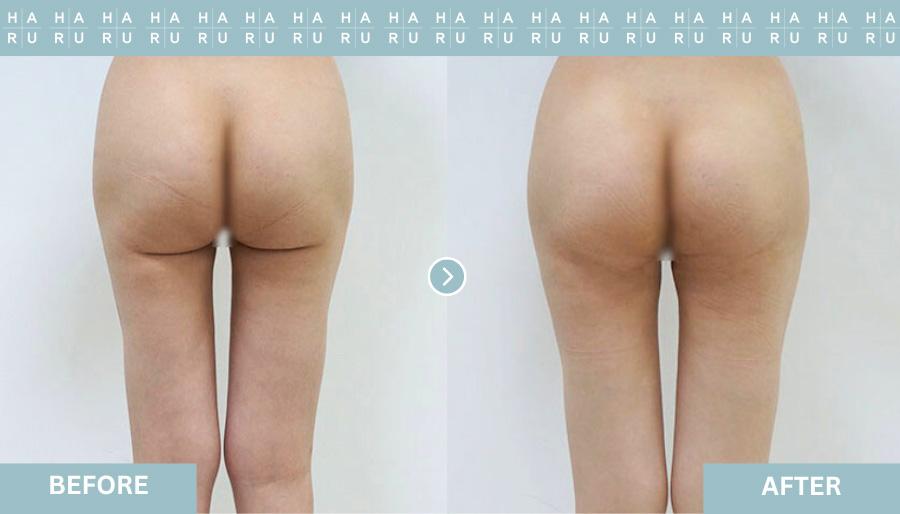
You may consider Haru Clinic for a butt thread lift if your goal is a non-surgical, rounded “apple” hip contour that combines lifting with added volume. Its Butt & Hip Lift uses threads to provide elevation and structure and filler to smooth volume, address hip dips, and enhance projection, with minimal scarring and downtime described.
- URL: Haru Clinic Website
- Location: Gangnam-gu, Seoul
- Butt and hip contouring:
- The treatment combines thread lifting and filler for a firmer, fuller, lifted buttock contour.
- Threads are used for lift and structural support, while filler is used to smooth volume and create natural curves.
- The clinic describes the procedure as addressing sagging skin as well as volume, unlike an approach focused only on volume.
- Results are described as immediately visible, without concerns about fat survival rates or filler absorption associated with some other augmentation approaches.
- Treatment planning:
- The butt and hip service focuses on projection, hip-dip smoothing, and curve enhancement.
- The treatment is presented for those seeking a more sculpted, youthful hip contour without surgery.
- Dr. Jeong is an official research physician for Merz, the company behind Belotero Filler, and teaches other doctors on filler techniques.
- Related nonsurgical options:
- Volumizing fillers are available as part of the clinic’s body-contouring approach.
- Collagen-tightening treatment using radiofrequency or ultrasound is also listed for improving skin firmness and elasticity without incisions.
3. THEPLUS Plastic Surgery
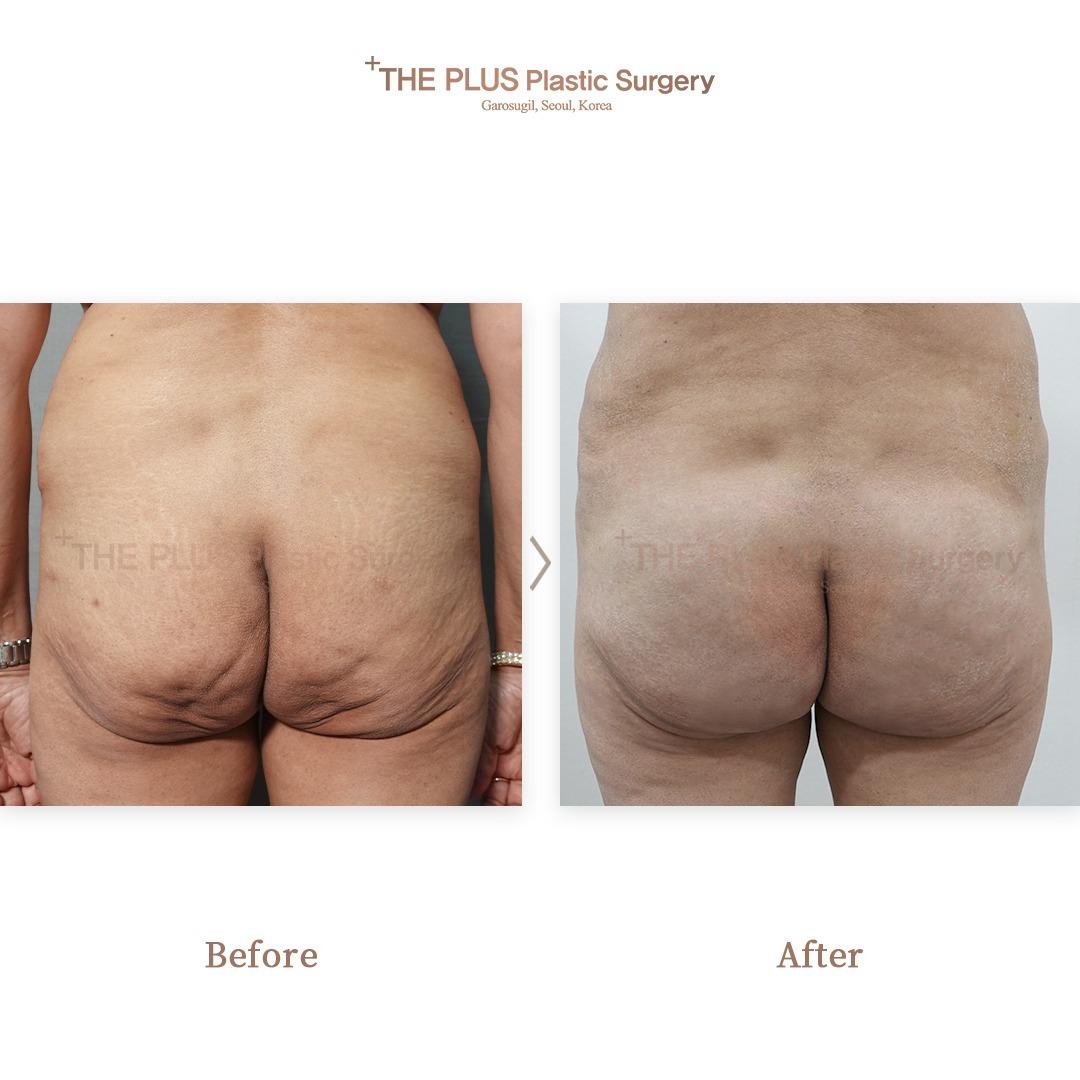
THEPLUS Plastic Surgery provides thread lifting within its facial lifting services, alongside broader surgical and nonsurgical aesthetic care. However, the supplied information does not specifically confirm a butt thread-lift service, so you should treat its suitability for this particular procedure as unconfirmed rather than assume that its facial thread-lift offering extends to the body.
- URL: THEPLUS Plastic Surgery Website
- Location: Gangnam-gu, Seoul
- Relevant lifting service:
- Its listed thread lift uses dissolvable threads for mild facial sagging and is presented as a less invasive alternative to a full facelift.
- Facelift and facial fat grafting are also listed within its face-lifting services.
- Surgical expertise:
- Dr. Kim is a board-certified plastic surgeon with research awards related to 3D implants and experience teaching other plastic surgeons.
- Dr. Jeong is identified as President of the Korean Society of Plastic Surgeons and participates in professional conferences and education.
- Dr. Lee is a board-certified plastic surgeon specializing in breast augmentation and previously worked as a surgery specialist at Seoul National University Hospital.
- Other body services:
- The clinic lists liposuction for localized body contouring.
- Breast augmentation, breast lift, and breast reduction are listed among its body-focused surgical services.
Butt Thread Lift From Start to Finish
- Remote screening and English communication — Send standardized standing photographs, goals, full medical history, medicines, supplements, allergies, nicotine use, and details of prior buttock surgery, fat grafting, implants, injections, or threads. Confirm whether the clinic offers an English-speaking coordinator, clinician consultation, or interpreter. Remote review cannot replace a physical examination.
- In-person assessment — The clinician examines buttock skin quality, fat and soft-tissue distribution, scars, asymmetry, lower-pole laxity, and degree of ptosis while standing. The consultation should determine whether threads, fat grafting, implants, liposuction, or a surgical lift better fits the anatomy.
- Medical clearance and treatment plan — Testing depends on health history and anesthesia. Local-anesthetic treatment can require limited testing, while sedation, significant medical conditions, or clot risk can require further assessment. Confirm the thread material, number, vectors, access points, expected lift, restrictions, and revision or removal plan.
- Marking and anesthesia — Markings are generally made while standing to guide planned lifting vectors. After antiseptic preparation, the clinician infiltrates local anesthetic; oral or IV sedation, if offered, changes fasting, escort, and discharge requirements.
- Thread placement and tensioning — Threads pass through subcutaneous tissue using a needle, cannula, or small stab-incision access points, then are tensioned to reposition selected soft tissue. Published approaches range from multi-PDO placement to elastic suspension through five access points in the available buttock reports. Procedure duration is technique- and thread-count dependent; the limited literature does not establish one reliable standard duration.
- Discharge and early review — Return to accommodation after observation when mobility and pain control are satisfactory. Obtain written instructions and an English procedure note with clinician details, product/material, lot information if available, thread count, anesthetic, medications, and contact route for urgent concerns.
- Overseas follow-up — Attend the scheduled wound and contour check before leaving Korea. Send requested photographs after returning home, but seek in-person assessment promptly for possible infection, extrusion, wound problems, sensory symptoms, or a significant contour change.
Alternatives to a Butt Thread Lift
Threads target modest soft-tissue repositioning, not major volume replacement or removal of substantial loose skin. Surgical and injectable options have different recovery burdens and risk profiles, but are often more appropriate when the main issue is severe ptosis, volume deficiency, or excess skin.
Fat grafting / BBL
- Best suited to — Patients seeking added buttock volume and reshaping of the waist and hips using their own fat.
- Tradeoff — A Brazilian butt lift is surgery with fat-harvesting and fat-injection risks, a longer recovery, and specific postoperative positioning instructions. It is not interchangeable with a thread lift.
Surgical buttock lift
- Best suited to — Significant skin redundancy and severe descent, especially after major weight loss.
- Tradeoff — A surgical lift removes excess skin and can achieve more meaningful repositioning, but leaves scars and requires substantially longer recovery than threads.
Buttock implants
- Best suited to — Patients needing volume when adequate donor fat is unavailable.
- Tradeoff — Buttock implants are surgical devices with wound, infection, malposition, discomfort, and revision considerations.
Fillers or biostimulatory injectables
- Best suited to — Small, selected contour deficits rather than broad lifting or large-volume augmentation.
- Tradeoff — Body fillers require careful product and anatomical selection. Avoid unregulated or large-volume injected materials.
Waist or buttock liposuction
- Best suited to — Excess fat around the waist, flanks, or buttock region that reduces apparent projection.
- Tradeoff — Buttock liposuction can improve surrounding contour but does not directly tighten or lift loose buttock skin.
How Can I Prepare for a Butt Thread Lift?
- Disclose medicines and supplements — Provide every prescription medicine, over-the-counter product, supplement, allergy, prior procedure, bleeding problem, healing issue, clot history, and anesthesia reaction. Specifically disclose vitamin E, fish oil, ginkgo, garlic, ginseng, turmeric/curcumin, St John’s wort, and weight-loss products.
- Do not stop prescribed blood thinners independently — Aspirin, warfarin, apixaban, rivaroxaban, clopidogrel, and similar medicines require an individualized plan agreed by the prescribing clinician and treating clinician. The required stop period, if any, depends on the medicine and medical reason for taking it.
- Follow fasting instructions exactly — Fast only as directed when oral, IV, or general sedation is planned; fasting is not automatic for local anesthesia alone. Confirm the cut-off time for food, liquids, alcohol, and routine medicines.
- Avoid nicotine, alcohol, and sunburn — Stop nicotine exposure and avoid alcohol for the interval specified by the clinician. Keep the buttock skin free from sunburn, irritation, shaving injury, and active rash before treatment.
- Plan transport and clothing — Wear loose, clean clothing that does not rub access points. Arrange an escort and avoid driving when sedation is used or pain medication affects alertness.
- Keep travel flexible — Schedule the procedure early enough to complete a review before departure. Choose accommodation with easy access, minimize demanding excursions, and avoid non-refundable immediate long-haul flights.
Travel note: Bring medical records and enough regular medication for the full trip plus contingency days, in original labeled packaging.
Confirm the treating clinic’s individualized medication, fasting, hygiene, transport, and travel requirements; those instructions take precedence over general guidance.
Aftercare Advice
Protect the new thread paths and arrange early review rather than trying to correct discomfort or contour changes yourself.
- Activity and pressure — Walking is generally possible on treatment day, but keep activity low impact for at least 1–2 weeks. Avoid strenuous gluteal exercise, squats, running, cycling, heavy lifting, and movements that place traction on the treated area until the clinician clears them.
- Do not manipulate threads — Tenderness, bruising, swelling, pulling sensations, and temporary dimpling or creases can occur early. Do not self-massage, press, or forcefully stretch the buttocks unless the treating clinician specifically instructs it; four dimpling cases in the 27-patient PDO series settled after clinician-directed minimal massage in that small series.
- Protect entry points — Follow the clinic’s directions for cleansing, dressings, showering, baths, swimming, sauna, heat exposure, compression, and sleeping position. No product-independent evidence defines universal rules for these measures.
- Monitor for urgent problems — Seek urgent assessment for fever, spreading redness, warmth, drainage, worsening pain, expanding swelling, skin discoloration or blistering, wound separation, exposed thread, sudden major asymmetry, persistent numbness or weakness, calf pain or swelling, chest pain, shortness of breath, fainting, or coughing blood.
- Review and results — Attend the scheduled Korean review before flying and complete remote follow-up after return. Early contour is affected by mechanical tension and swelling; the available studies are too small and short-term to define a reliable final-result date or repeat-treatment interval.
Follow the treating doctor’s individualized instructions and contact the clinic promptly when anything appears wrong.
Frequently Asked Questions
Related Blogs
Abdominal Thread Lift in Korea: Candidacy, Evidence, Recovery, and Travel Planning
Abdominal thread lifts place absorbable threads in superficial abdominal tissue for subtle tightening, but methods, durability, and outcomes are not standardized. The article covers candidate screening, procedure planning, Korea travel and follow-up, preparation, aftercare warning signs, and alternatives for fat, excess skin, diastasis, or hernia.
Updated: Oct 13, 2026
Breast Thread Lift in Korea: Candidacy, Safety, Recovery, and Travel Planning
Breast thread lift uses absorbable threads placed through small entry points for modest contour improvement, but techniques, durability, and complication rates are not standardized. The article covers candidacy, preparation, travel planning for Korea, aftercare, warning signs, follow-up, and surgical alternatives for significant sagging.
Updated: Oct 13, 2026
Lip Thread Lift in Korea: Methods, Recovery, Risks and Travel Planning
Lip thread lifts use absorbable smooth or barbed threads to soften upper-lip lines or provide subtle traction, with suitability based on tissue quality, goals, and medical assessment. The article covers treatment planning, recovery, aftercare, risks, alternatives, and travel guidance for international patients in South Korea.
Updated: Oct 13, 2026
Filling Threads in Korea: Types, Recovery, Risks and Travel Planning
Filling threads are absorbable volumizing thread configurations placed under local anesthesia to soften minor static lines and localized hollows in appropriately assessed patients. The article covers candidate screening, device documentation, Korea travel planning, recovery, aftercare, complications, and alternatives such as filler, fat grafting, thread lifts, and facelift surgery.
Updated: Oct 12, 2026
Clinics offering Butt Thread Lift

THEPLUS Plastic Surgery Korea | Eye, Nose, Face & Body Surgery
Sinsa

Haru Clinic Korea | Fully-Customized Full-Face Non-Surgical Rejuvenation With Threads, Botox & Fillers
Sinsa

PangPang Clinic: Korea's Premier Thread Lifting and Skin Rejuvenation Specialist in Gangnam, Seoul
Sinsa
Bonjung Korean Medicine Clinic Korea | Recovery, Contouring & Weight Care
Jongno