
Medical Tourism Blog
Body Fillers in Korea: Types, Safety, Recovery and Travel Planning
Table of contents
- Body Fillers at a Glance
- What Are Body Fillers?
- Who Is a Good Candidate for Body Fillers?
- What Are the Different Types of Body Fillers?
- Why Visit Korea for Body Fillers?
- Key Information for International Patients
- Which Are the Best Clinics in Korea for Body Fillers?
- Body Fillers From Start to Finish
- Alternatives to Body Fillers
- How Can I Prepare for Body Fillers?
- Aftercare Advice
Considering treatment in Korea? Everything you need to know e.g. — how to avoid scams, visas, interpreters, recovery tips — in our Medical Tourism Master Guide. Plan with confidence in minutes, not weeks!
Last updated: September 2026
Body Fillers at a Glance
- Best for focal hollows — Body fillers are injectable treatments for limited concerns such as hip dips, small buttock depressions or asymmetry, cellulite dimples, and selected post-liposuction irregularities—not major buttock or breast enlargement.
- Material determines the timeline — HA filler adds immediate volume, with the early result best judged after swelling settles at about 2 weeks; PLLA and PDLLA collagen stimulators develop gradually and may mature over several weeks to 3–6 months after the final session.
- HA is temporary — In a small systematic review of gluteal HA filler studies, estimated average durability was 16.16 months, although individual longevity and the amount needed vary substantially by area, product, and treatment plan.
- Plan 3–7 days in Korea — Treatment is usually outpatient, but international patients should allow time for consultation, injection, and an early in-person review before long-haul travel; there is no universal evidence-based safe-to-fly interval.
- Short downtime, close early monitoring — Light activity is often possible the same or next day, while tenderness, swelling, redness, and bruising commonly improve within 7 days; bruising can remain visible for about 2 weeks.
- Avoid high-volume or permanent injections — Dermal fillers should not be used as a routine substitute for surgical-scale body contouring, and liquid silicone must be avoided because it can cause migration, embolism, tissue injury, stroke, and death.
- Verify the exact Korean product use — MFDS authorization in Korea does not automatically mean a filler is approved for the proposed body site, volume, or technique; request the product name, lot number, expiry date, total mL or vial count, injection sites, and planned tissue plane before leaving.
What Are Body Fillers?
Body fillers are injectable materials used to add limited volume and smooth localized contour depressions. They can address concerns such as hip dips, small buttock asymmetries, cellulite dimples, and selected irregularities after liposuction, rather than create major enlargement. Body filler treatment is minimally invasive and usually performed without surgery.
Who Is a Good Candidate for Body Fillers?
- Localized contour concern — Good candidates want correction of a hip dip, lateral-hip hollow, small buttock depression or asymmetry, selected cellulite dimple, or a limited post-liposuction irregularity.
- Realistic scale of change — Body fillers add limited volume; they are not a dependable substitute for major buttock or breast enlargement, intermuscular filling, or surgical-scale reshaping.
- Stable health and weight — Adults in good general health with stable weight, adequate soft-tissue coverage, and the ability to attend early review and arrange care after returning home are better placed for treatment.
- Informed treatment plan — Suitable candidates understand that HA gives immediate but temporary volume, while PLLA and PDLLA develop gradually and commonly require staged sessions.
Do not treat active infection, inflamed skin, open wounds, or an inflammatory eruption in the planned area. Defer elective treatment during pregnancy or breastfeeding because safety data are inadequate. Known allergy to the selected product or lidocaine, a history of anaphylaxis or multiple severe allergies for PLLA, and a tendency to keloid or hypertrophic scars are important contraindications; Sculptra/PLLA specifically lists keloid tendency as a contraindication. Uncontrolled bleeding disorders, significant thrombocytopenia, anticoagulant or antiplatelet use, unstable autoimmune or inflammatory disease, immunosuppression, poorly controlled diabetes, or a prior severe delayed filler reaction need individualized medical assessment. Previous silicone, PMMA, polyacrylamide hydrogel, permanent filler, unknown injection material, or a prior complication in the proposed area warrants imaging and identification before any reinjection.
What Are the Different Types of Body Fillers?
“Body filler” is not one standardized product or procedure. Ask which material is proposed, whether its intended body-site use is on-label, and why it suits the specific contour concern.
- Cross-linked hyaluronic acid (HA) — A gel filler that creates immediate volume for limited contour correction. HA is the most adjustable category because hyaluronidase can be used when medically necessary, although reversal is not guaranteed. A systematic review of HA gluteal augmentation found only 168 patients across 10 reports, with a mean injected volume of 206.71 mL and estimated mean duration of 16.16 months; these figures do not predict an individual result.
- PLLA collagen stimulator — Poly-L-lactic acid particles are intended to stimulate collagen rather than act only as an immediate volumizing gel. It is used by some clinicians for hip dips, gluteal contour, texture concerns, and cellulite-related depressions. Results develop over weeks, multiple sessions are common, and the published evidence remains largely low-level.
- PDLLA collagen stimulator — Poly-D,L-lactic acid is another particulate biostimulator used in some body-contouring plans. Product reconstitution, dilution, injection depth, aliquot size, and even distribution are critical because superficial placement and overcorrection can contribute to nodules.
- Permanent materials — PMMA and other poorly reversible fillers can lead to migration, granulomas, infection, and delayed inflammation that are difficult to manage. Do not accept liquid-silicone injections: the FDA warns that injectable silicone for body contouring can cause tissue injury, embolism, stroke, and death.
Why Visit Korea for Body Fillers?
Korea offers a structured medical-device regulatory framework, but product approval alone does not confirm that a proposed body site, volume, or injection technique is approved. For body fillers, the clinical evidence from Korea is still early and should be discussed plainly rather than treated as proof of broad safety or durability.
- Product verification — Korea’s MFDS uses a four-class, risk-based device system. Its technical review includes intended purpose, instructions for use, precautions, materials, and safety information, so ask the clinic to verify the exact product’s authorization and proposed use rather than relying on a general claim of “MFDS approved.” See the MFDS device regulatory framework.
- Recent local clinical data — A 2026 single-clinic Seoul retrospective study reported 26 women treated with 200–360 mL of subcutaneous cross-linked HA for gluteal augmentation. Five had self-limited swelling, bruising, or firmness at 6 months, with no major complication reported. The study had no control group, short follow-up, and a company-affiliated author, so it cannot establish a general complication rate.
- Documentation standard to request — Before leaving, obtain the generic material and brand, lot or batch number, expiry date, total mL or vial count, anatomical sites, planned tissue plane where available, consent form, and standardized photographs. These records materially help a clinician at home assess a delayed reaction or future treatment.
Key Information for International Patients
- Minimum stay — Plan 3–7 days in Korea, even though treatment is usually outpatient. This permits consultation, injection, and an early in-person review. Small uncomplicated HA treatment can require less time; extensive gluteal or hip treatment, sedation, prior filler, uncertain prior injections, or a collagen-stimulator plan often needs a longer or staged visit.
- Flight timing — No evidence-based universal safe-to-fly interval exists after body fillers. Remain close to the clinic for the first 24–72 hours and obtain individualized flight clearance after review, especially after extensive treatment.
- Itinerary impact — Light activity is often possible the same or next day. Tenderness, swelling, redness, and bruising usually improve within hours to 7 days, but bruising can remain visible for about 2 weeks. Keep the first days free of strenuous sightseeing, gym sessions, spa heat, and body massage.
- Repeat visits — HA provides immediate volume, but judge the early aesthetic result after swelling settles at around 2 weeks. Reassess further PLLA or PDLLA treatment no sooner than about 4 weeks; collagen-stimulator results mature over several weeks to 3–6 months after the final session.
- Remote follow-up — Arrange check-ins at approximately 48–72 hours and 2–4 weeks, and identify a licensed clinician at home before travel. Keep all product and procedure records accessible.
Travel note: Do not board a long-haul flight with severe or escalating pain, rapidly increasing swelling, white, blue, gray, purple, or mottled skin, fever, chest pain, shortness of breath, coughing blood, or new neurological symptoms. Seek urgent in-person medical care.
Which Are the Best Clinics in Korea for Body Fillers?
Listed below are some of the best clinics in Korea for body fillers.
1. Haru Clinic
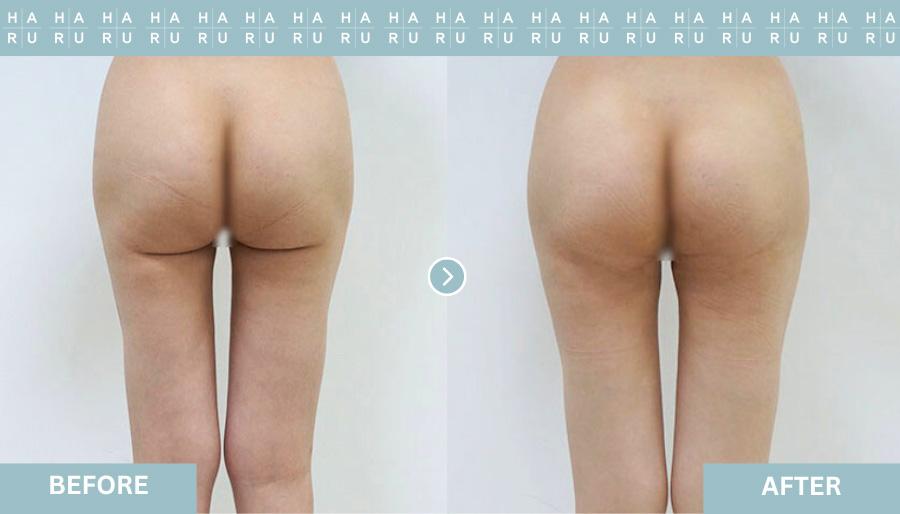
For body filler-based contouring, Haru Clinic explicitly offers buttock and hip enhancement with volumizing fillers to add fullness, improve projection, and smooth hip dips with minimal downtime. You can expect an approach centered on shaping a more balanced silhouette, with non-surgical threads also listed as an alternative or complementary lifting option.
- URL: Haru Clinic Website
- Location: Gangnam-gu, Seoul
- Body filler approach:
- Volumizing fillers are used for buttock and hip contouring, with attention to roundness, projection, and hip-dip smoothing.
- The clinic also lists non-surgical threads for a lifted buttock and hip appearance.
- Filler expertise:
- Dr. Jeong is described as an official research physician for Merz, the company behind Belotero Filler, and as an educator who teaches other doctors updated filler techniques.
- The clinic lists hyaluronic acid and biostimulatory fillers among its injectable options.
2. Modelo clinic
Modelo Clinic’s listed filler services are focused on facial volume rather than body fillers, so you may want to clarify whether it currently provides treatment for your intended body area. Its stated approach emphasizes individualized aesthetics over trends, while its broader contouring menu includes Bodytoxin for excess fat and cellulite concerns.
- URL: Modelo clinic Website
- Location: Gangnam-gu, Seoul
- Relevant contouring services:
- Bodytoxin is listed for targeting excess fat and cellulite to support a smoother, more contoured body shape.
- The clinic also offers thread lifting and radiofrequency-based Comfort Thermage for skin-firming concerns.
- Listed filler services:
- Fullface filler is offered for areas including the cheeks, lips, and forehead.
- Baby filler is listed for under-eye hollows and dark-circle concerns.
3. Three Wishes Clinic - Myeongdong
Three Wishes Clinic - Myeongdong lists dermal fillers for facial volume, fine lines, and contouring rather than specifically for body filler treatment, so you should confirm availability if you are seeking a body area procedure. Its filler service is described as customizable to your facial shape and desired result, with immediate visible volume enhancement.
- URL: Three Wishes Clinic - Myeongdong Website
- Location: Jung-gu, Seoul
- Listed filler treatment:
- Dermal fillers are listed for adding volume, smoothing fine lines, and enhancing the lips, cheeks, and chin.
- Treatment can be tailored to your facial shape and intended outcome.
- Related non-surgical options:
- Fat-dissolving injections are listed for localized fat in areas such as the chin, jowls, and jawline.
- Shurink ultrasound treatment is listed for lifting and tightening on the face or body without needles or downtime.
Body Fillers From Start to Finish
- Remote consultation and records review — Send clear standing photographs in the requested views, medical history, current medicines and supplements, and all records of prior fillers, silicone, fat grafting, implants, liposuction, or surgery. Confirm whether English consultation is available and ask for the exact proposed material, estimated volume, body sites, and expected staging.
- In-person assessment — The clinician assesses contour standing up, skin quality, scars, asymmetry, soft-tissue coverage, infection, and whether a focal volume deficit is present. Standardized photographs and treatment markings support planning.
- Imaging or medical clearance when indicated — Healthy patients receiving local-anesthetic treatment do not usually need routine blood tests. Bleeding risk, significant systemic illness, planned sedation, suspected infection, or previous unknown injections can require tests or medical clearance. Ultrasound and sometimes MRI are appropriate before reinjection into an area with unknown material, lumps, migration, or a past complication.
- Consent and treatment planning — Confirm realistic volume limits, expected duration, risks, aftercare, emergency contact arrangements, and whether the use is off-label. Large-volume buttock or breast enhancement should not be reframed as routine filler treatment; the FDA advises against dermal fillers for large-scale body contouring.
- Injection appointment — The area is marked, disinfected, and treated with local anesthetic when appropriate. Sedation is not routine but requires fasting, a companion, and no driving afterward. The clinician places filler using a needle, blunt cannula, or both, maintaining the planned tissue plane. Injection duration depends on the area, volume, product, and whether treatment is staged.
- Immediate observation and discharge — The clinician checks pain, skin color, capillary refill, symmetry, and injection sites before same-day discharge. HA can look overfull initially because of gel volume and swelling. PLLA or PDLLA can look fuller from reconstitution fluid, then temporarily reduce before collagen-related improvement develops.
- Early in-person review — Return promptly for the clinic’s scheduled assessment, ideally before long-haul travel. Report worsening pain, color change, fever, increasing swelling, drainage, or progressive asymmetry without waiting for a routine appointment.
- Overseas follow-up — Complete remote review at around 2–4 weeks and send standardized photographs if requested. Further collagen-stimulator sessions should follow the clinical plan rather than being compressed into a short trip.
Alternatives to Body Fillers
The right alternative depends on whether the concern is true focal volume loss, excess adjacent fat, loose skin, dimpling, or a goal that exceeds safe filler volume. Surgical options can create more structural change but involve anesthesia, incisions, scars, and longer recovery; non-surgical approaches generally create more limited or gradual change.
Fat Grafting
- Best fit — Body fat grafting or hip-dip fat grafting can provide greater volume using the patient’s own fat and can be paired with contouring of adjacent areas.
- Tradeoff — It is surgery. Gluteal fat grafting carries distinct serious risks; a 2026 systematic review and meta-analysis found lower pooled complication rates with ultrasound guidance and subcutaneous-only injection than with other approaches.
Brazilian Butt Lift
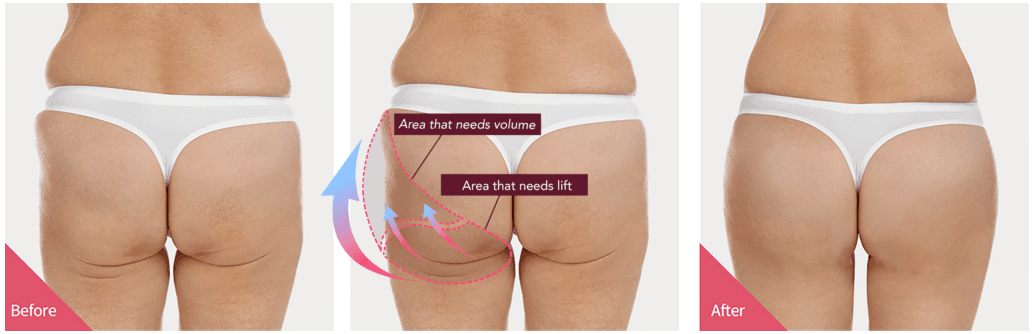
- Best fit — A Brazilian butt lift is a surgical option for people seeking a larger change in buttock projection and waist-to-hip proportion than filler can reliably provide.
- Tradeoff — It requires donor fat, anesthesia, surgical recovery, and strict safety planning; it is not a minor injectable substitute.
Buttock Implants
- Best fit — Buttock implants provide structural volume for selected patients with insufficient donor fat.
- Tradeoff — Incisions, anesthesia, scarring, and a longer recovery are required. A 2025 meta-analysis found complication rates varied materially by implant texture and placement plane.
Cellulite or Skin-Laxity Treatment
- Best fit — Subcision, targeted cellulite procedures, or skin-tightening approaches can be more appropriate when dimpling or laxity—not a localized volume deficit—is the primary concern.
- Tradeoff — These treatments do not create substantial projection and do not replace volume restoration when a true hollow is present.
Liposuction-Based Contouring
- Best fit — Liposuction can improve proportion when fullness at the waist, flanks, or thighs makes the hip or buttock contour appear less defined.
- Tradeoff — It removes fat rather than filling a depression and can itself cause contour irregularities that require careful planning.
How Can I Prepare for Body Fillers?
- Disclose every medicine and supplement — Provide prescriptions, over-the-counter drugs, injections, vitamins, and herbal products well before travel. Aspirin, NSAIDs, clopidogrel, warfarin, apixaban, rivaroxaban, fish oil, vitamin E, ginkgo, and garlic supplements can increase bruising or bleeding. Do not stop prescribed aspirin, anticoagulants, or antiplatelet drugs unless the prescribing clinician explicitly directs it.
- Send previous procedure records — Bring records and photographs of all prior injections, silicone, filler, fat grafting, implants, threads, liposuction, and surgery. Delay treatment if material in the intended area is unknown until appropriate imaging identifies it.
- Protect the treatment area — Do not attend with sunburn, a rash, folliculitis, open wounds, or active inflammatory skin disease in the planned injection area. Treat and resolve infection before rescheduling.
- Follow fasting instructions — Fasting is generally unnecessary for local anesthetic alone. Follow the clinic’s fasting instructions exactly when sedation is planned.
- Plan clothing and transport — Wear loose, clean clothing that does not rub or compress the treated region. Arrange a companion and private transport after sedatives; do not drive after sedation.
- Avoid alcohol and smoking — Avoid alcohol before treatment if the clinic instructs it because it can worsen bruising. Discuss nicotine use early, particularly when extensive treatment or sedation is planned.
- Keep travel flexible — Stay nearby overnight after extensive treatment and avoid booking a non-changeable long-haul flight before early review.
Travel note: Ask for the clinic’s emergency contact process, an English procedure summary, and digital copies of product details before treatment day.
The treating doctor’s individualized instructions take precedence over this general guidance. Confirm the clinic’s medication, fasting, alcohol, companion, and flight requirements before finalizing travel.
Aftercare Advice
Protect the treated area, monitor closely during the first 72 hours, and treat a sudden change in pain or skin color as urgent rather than cosmetic.
- Activity and heat — Avoid strenuous exercise for about 24 hours. Avoid heavy training, hot baths, saunas, intense sun, and other heat exposure until swelling and redness resolve.
- Cold and contact — Use a cloth-wrapped cold pack intermittently during the first 24 hours only when the injector approves it; never place ice directly on skin. Keep sites clean and avoid squeezing, aggressive massage, body massage, laser, radiofrequency, or further injections in the area unless approved.
- Material-specific massage — Follow only the protocol given for the injected product. Some Sculptra/PLLA plans use circular massage for 5 minutes, 5 times daily, for 5 days; this does not automatically apply to HA or PDLLA. Sitting, sleeping position, direct pressure, shapewear, compression, and exercise restrictions depend on product, volume, plane, and treated area.
- Sun protection — Once injection points are closed and skin is intact, use broad-spectrum SPF 50 on exposed treated skin to reduce inflammation-related discoloration.
- Warning signs — Seek urgent care for severe or escalating pain; white, blue, gray, purple, or mottled skin; coolness, blistering, rapidly increasing swelling, pus, fever, spreading redness, fainting, chest pain, shortness of breath, coughing blood, weakness, numbness, confusion, speech difficulty, or visual symptoms.
- Follow-up and results — Attend the early review and remote check-in. HA volume is immediate but is best assessed at around 2 weeks after swelling settles. PLLA and PDLLA changes develop gradually, with practical maturation over several weeks to 3–6 months after the final session.
Follow the treating doctor’s instructions over general advice, and contact the clinic promptly when pain, swelling, asymmetry, skin color, or systemic symptoms appear abnormal.
Frequently Asked Questions
Related Blogs
Discovering Korea's Cost Advantage: How Forehead Filler Expenses Measure Up Globally
Discover the latest trends and affordability of forehead filler treatments in Korea, where cutting-edge techniques meet competitive pricing. Explore how the cost compares internationally and what factors influence the overall expense for those seeking cosmetic enhancements.
Updated: Sep 25, 2026
Cost Comparison of Lip Fillers: Discover Why Korea is a Top Destination for Cosmetic Enhancements
Explore the affordability of lip fillers in Korea, where competitive pricing meets cutting-edge cosmetic procedures. Discover how prices compare internationally and what factors influence the overall cost of enhancing your lips in this beauty destination.
Updated: Sep 24, 2026
Forehead Filler in Korea: Safety, Recovery, Travel Planning, and Alternatives
Forehead filler uses a conservative injection plan to address selected volume loss or contour concerns, with assessment of vascular risks, prior treatments, and alternatives such as Botox, fat grafting, or a forehead lift. International patients can plan a 2–4-day stay in Korea, remain reachable for 24–48 hours, arrange follow-up, and obtain documented aftercare and emergency contacts.
Updated: Sep 23, 2026
Eyelid Filler in Korea: Tear-Trough Results, Safety, Recovery, and Travel Planning
Eyelid filler uses small, staged amounts of hyaluronic acid to soften selected lower-eyelid hollows, with assessment of puffiness, skin quality, prior procedures, and alternatives such as surgery. International patients can find guidance on Korea travel timing, treatment records, aftercare, expected swelling, and emergency warning signs.
Updated: Sep 23, 2026
Clinics offering Body Fillers

Haru Clinic Korea | Seoul Facelift, Threads, Botox & Fillers
Sinsa

Hev Clinic Korea | Sinsa Skin, Laser & Injectables
Sinsa

Seojin Plastic Surgery Clinic Korea: Pioneering Advanced Cosmetic Procedures for Personalized Aesthetic Transformation
Apgujeong

Okay Plastic Surgery Clinic in Korea: Comprehensive Aesthetic Procedures with Sincerity and Care
Cheongdam