
Medical Tourism Blog
Buttocks Implants in Korea: Surgery, Recovery, Risks and Travel Planning

Table of contents
- Buttocks Implants at a Glance
- What Are Buttocks Implants?
- Who Is a Good Candidate for Buttocks Implants?
- How Are Buttocks Implants Performed?
- Why Visit Korea for Buttocks Implants?
- Key Information for International Patients
- Which Are the Best Clinics in Korea for Buttocks Implants?
- How Much Do Buttocks Implants Cost in Korea?
- Buttocks Implants From Start to Finish
- Alternatives to Buttocks Implants
- How Can I Prepare for Buttocks Implants?
- Aftercare Advice
Considering treatment in Korea? Everything you need to know e.g. — how to avoid scams, visas, interpreters, recovery tips — in our Medical Tourism Master Guide. Plan with confidence in minutes, not weeks!
Last updated: September 2026
Buttocks Implants at a Glance
- Procedure — Buttocks implants are solid-silicone devices placed in a surgically created pocket, usually through an incision near the intergluteal cleft, to provide lasting buttock volume and projection.
- Cost in Korea — Quoted prices are about ₩10,000,000–₩13,000,000 (approximately US$7,400–$9,600); confirm whether the quote includes implants, anesthesia, facility fees, drains, observation, medicines, and follow-up.
- Recovery restrictions — Avoid direct pressure on the buttocks for at least 2 weeks; some protocols prohibit direct sitting for 3 weeks and restrict it for about 1 month, while strenuous exercise is usually deferred for 6–8 weeks.
- Result timeline — Implants provide persistent structural volume, but swelling and tissue settling continue for months, so contour is more reliably assessed around 3–6 months; revision, removal, or replacement can still be needed.
- Best candidates — Suitable candidates are healthy adults at a stable weight who want projection and may lack sufficient donor fat for grafting, have realistic expectations, and can follow sleep, sitting, walking, and wound-care instructions.
- Key risk — Infection, wound opening, seroma, implant displacement, capsular contracture, pain, visibility, or asymmetry can require revision or implant removal; thin soft-tissue coverage can increase palpability and visible edges.
- Korea travel planning — International patients should plan to stay at least 14 days after surgery, ideally 21, for wound or drain reviews and individualized flight clearance; verify foreign-patient facility registration, surgeon credentials, and the exact implant’s documentation before consenting.
What Are Buttocks Implants?
Buttocks implants are solid silicone devices surgically placed to add lasting volume and projection to the buttocks. They address a flatter contour or limited natural volume, including for people without enough donor fat for fat grafting. This is a surgical procedure performed under general anesthesia.
Who Is a Good Candidate for Buttocks Implants?
- Adults seeking structural projection — Good candidates want a lasting increase in buttock volume or projection, including when they do not have enough donor fat for fat grafting.
- Stable-weight patients — Candidates should be in generally good health, at a stable weight, and able to accept a visible recovery period with pressure and activity restrictions.
- Patients prepared for structured aftercare — Successful recovery requires early walking, prone or side sleeping, restricted sitting, wound reviews, and an adult caregiver after surgery.
- People with realistic contour goals — Implants add volume and projection but do not correct loose skin by themselves or produce the waist-shaping effect of liposuction.
Buttocks implants are unsuitable until active skin, urinary, dental, or systemic infection has resolved; an implant-related infection can require implant removal. Pregnancy, plans for imminent pregnancy, uncontrolled diabetes or hypertension, anemia, serious cardiopulmonary disease, untreated bleeding disorders, and current nicotine use require postponement or individualized medical assessment. Personal clot history, active cancer, obesity, prolonged immobility, estrogen-containing contraception or hormone therapy, and clotting disorders require a specific anesthesia and flight-risk plan. Very thin soft-tissue coverage, marked asymmetry, permanent or unknown previous injections, scarred tissue, prior infection, or prior implant complications can make the operation substantially more complex; thin coverage also increases concerns about implant visibility and palpability.
How Are Buttocks Implants Performed?
The main technical choice is the implant-pocket plane, not a consumer-facing implant “type.” The surgeon selects the approach according to gluteal anatomy, soft-tissue coverage, the desired projection, prior surgery, and whether fat grafting is being added.
- Intramuscular placement — The pocket is created within the gluteus maximus muscle, leaving muscle coverage above and below the solid silicone implant. This approach requires muscle splitting and is technically demanding.
- Submuscular placement — The implant sits beneath the gluteus maximus. It can provide substantial tissue coverage but must be planned around the patient's anatomy.
- Subfascial placement — The implant is positioned above muscle and beneath its fascia. This more superficial plane can make implant edges more visible or palpable in patients with limited tissue coverage.
- Hybrid augmentation — Selective limited fat grafting can soften implant transitions or refine localized contour. It adds donor-site liposuction and fat-grafting risks and should be justified by anatomy, not marketing.
- Implant surface and pocket discussion — A 2025 meta-analysis of 32 studies and 2,682 patients found higher pooled seroma, wound-dehiscence, capsular-contracture, and removal patterns with subfascial placement than with intramuscular or submuscular placement; textured implants also had higher pooled complication patterns than smooth implants. These pooled findings guide discussion but cannot determine the best plane or predict an individual outcome.
Why Visit Korea for Buttocks Implants?
Korea has a formal system for institutions registered to serve foreign patients, which is useful for verifying a provider before travel. That registration is not proof that a surgeon has extensive primary gluteal-implant experience. Current evidence does not establish that Korea has superior outcomes for this specialized procedure.
- Foreign-patient institution verification — Use the Medical Korea registered-institution system to check whether a proposed facility is authorized to treat international patients.
- Documented-device planning — Request the exact solid silicone implant manufacturer, model, size, surface, and lot number before consenting, then obtain the device card and operative report before departure. The facility must verify the current Korean authorization status of the exact product; this cannot be assumed from a brand name.
- Evidence limitation — The Korea-linked literature located includes an 18-case Seoul-affiliated series involving secondary augmentation and a complication report. It does not provide national primary-case volume, registry-based complication rates, or comparative outcomes.
- Surgeon and facility questions — Independently verify plastic-surgery credentials, ask who performs the critical operative steps, confirm whether overnight observation is planned, and establish transfer arrangements for an emergency. A registered facility and documented implant do not substitute for procedure-specific surgical experience.
Key Information for International Patients
- Minimum stay — Plan to remain in Korea for at least 14 days after surgery; 21 days is preferable when feasible. This allows early wound or drain reviews, mobility assessment, and a surgeon-led decision on long-haul travel.
- Flight timing — There is no evidence-based, gluteal-implant-specific date that automatically clears a long flight. Recent surgery and travel lasting 4 hours or longer both increase venous-thromboembolism risk, as outlined in the CDC medical-tourism guidance. Clearance depends on wound status, drains, mobility, pain medicines, personal clot risk, and flight duration.
- Sitting and itinerary impact — Expect no direct buttock pressure for at least 2 weeks. Some protocols prohibit direct sitting for 3 weeks and restrict sitting for about 1 month. Do not plan long city tours, extended car transfers, or seated sightseeing during the early recovery period.
- Accommodation and support — Book nearby accommodation that permits side or stomach sleeping. Arrange door-to-door transport and an adult companion for the first night and ideally several early days, when managing medicines, luggage, sitting, and wound care is difficult.
- Return-home follow-up — Before departure, secure English discharge instructions, an operative report, implant documentation, medicines list, and direct emergency contact. Arrange a clinician at home who can assess wounds if needed, while keeping the operating surgeon involved remotely.
Travel note: Do not self-start aspirin, anticoagulants, or compression stockings for the flight. Follow the operating surgeon's specific plan for walking, calf exercises, hydration, compression, and any prescribed clot-prevention medicine.
Which Are the Best Clinics in Korea for Buttocks Implants?
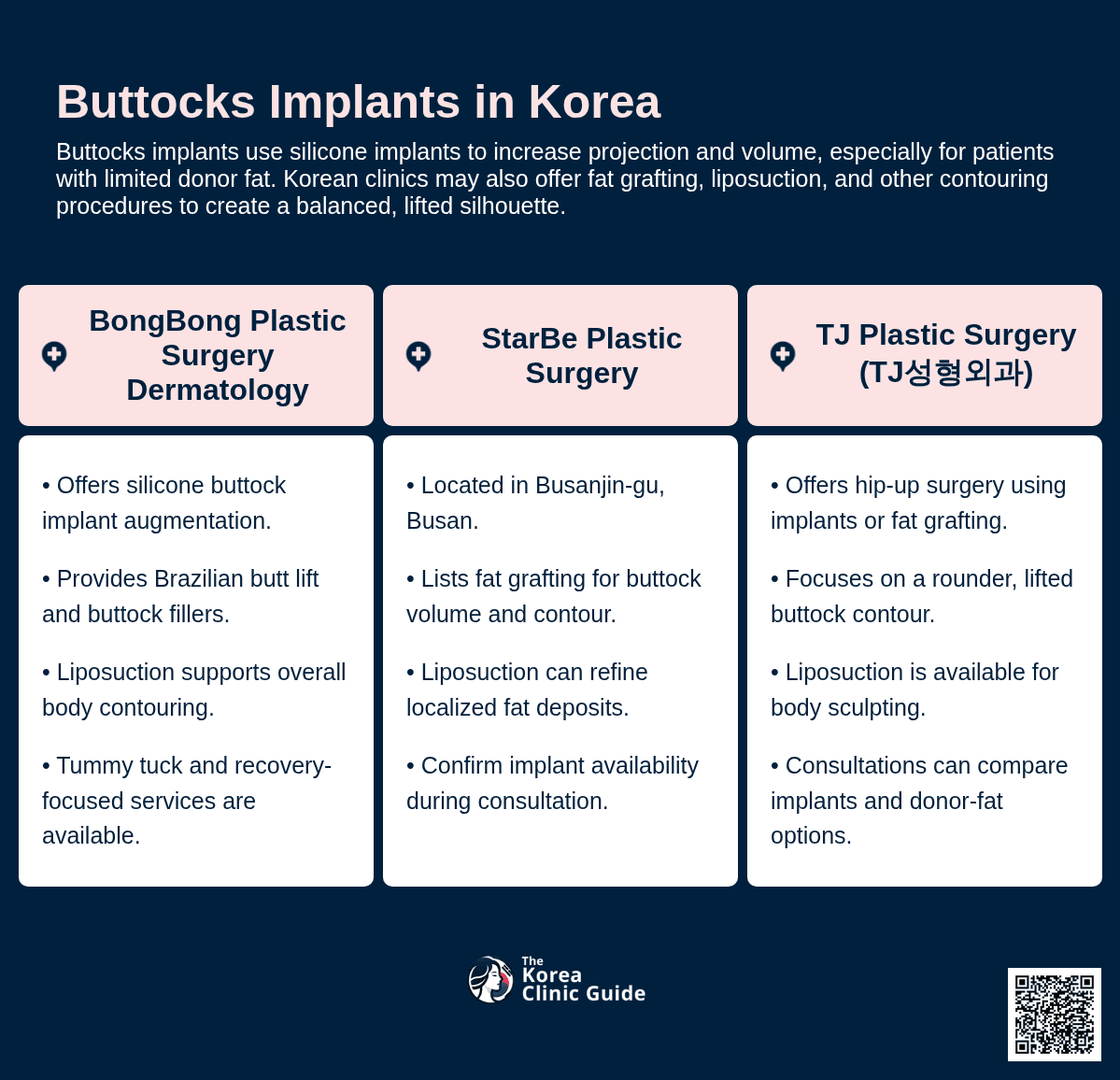
Listed below are some of the best clinics in Korea for buttocks implants.
1. BongBong Plastic Surgery Dermatology
You may consider BongBong Plastic Surgery Dermatology in Seoul if you want silicone buttock implant augmentation and do not have sufficient donor fat for a fat-transfer procedure. The clinic also offers body-contouring options that may be relevant when planning your overall silhouette.
- URL: BongBong Plastic Surgery Dermatology Website
- Location: Gangnam-gu, Seoul
- Buttock options:
- Buttock implant augmentation uses silicone implants to increase projection and volume.
- Brazilian butt lift transfers fat from areas such as the abdomen, waist, or thighs to the buttocks.
- Buttock fillers are offered for temporary volume enhancement or contour irregularities.
- Related body contouring:
- Liposuction is available to refine localized fat deposits that have not responded fully to diet and exercise.
- Tummy tuck surgery removes excess abdominal skin and fat and tightens weakened or separated abdominal muscles.
- Lymphatic drainage massage and oxygen therapy are listed among supportive recovery-focused services.
2. StarBe Plastic Surgery
You may want to know that StarBe Plastic Surgery lists fat grafting for buttock volume and contour enhancement, but the provided information does not confirm buttock implant surgery. If you are specifically seeking implants, clarify whether that procedure is available and whether fat grafting or another approach better fits your goals.
- URL: StarBe Plastic Surgery Website
- Location: Busanjin-gu, Busan
- Buttock-related treatment:
- Fat grafting harvests fat from one body area and injects it into an area needing volume, including the buttocks.
- Liposuction is available for removing resistant localized fat and contouring selected body areas.
- Relevant considerations:
- The available clinic information describes buttock fat grafting rather than silicone buttock implants.
- Ask how the clinic evaluates donor-fat availability, desired volume, and the role of liposuction in your treatment plan.
3. TJ Plastic Surgery (TJ성형외과)
You may consider TJ Plastic Surgery in Sinsa for buttock enhancement because it lists hip-up plastic surgery using implants or fat grafting to create a rounder, more lifted contour. You can expect the clinic to discuss an implant-based approach alongside fat grafting and body-contouring options based on the volume and shape you want.
- URL: TJ Plastic Surgery (TJ성형외과) Website
- Location: Gangnam-gu, Seoul
- Buttock enhancement:
- Hip-up plastic surgery is described as enhancing buttock shape and lift with implants or fat grafting.
- The stated aim is a rounder, lifted buttock contour.
- Related contouring options:
- Liposuction is offered for sculpting fat deposits in areas including the abdomen, thighs, and arms.
- Harvestjet is listed as a fat-harvesting and reinjection technique for face and body contouring.
- Planning your procedure:
- Ask whether implants or fat grafting is appropriate for your anatomy, desired projection, and available donor fat.
- Before-and-after photos are available to help you review results of the clinic's procedures.
How Much Do Buttocks Implants Cost in Korea?
Buttocks implant surgery is quoted at ₩10,000,000–₩13,000,000 (approximately US$7,400–$9,600). Individual quotes vary because the operative plan and postoperative requirements differ.
| Procedure Price | Korean Won (₩) | USD ($) |
|---|---|---|
| Low Price | ₩10,000,000 | $7,400 |
| High Price | ₩13,000,000 | $9,600 |
Exchange rate as of 2026-09-06: 1 KRW = 0.000741 USD.
What Affects the Price?
- Implant pocket plane — Intramuscular, submuscular, and subfascial placement require different dissection planes. Intramuscular placement involves muscle splitting, while deeper or anatomy-tailored pockets can require more technically demanding dissection and operating time.
- Hybrid implant plus fat grafting — Adding limited fat grafting to soften implant transitions or improve thin soft-tissue coverage adds liposuction, fat processing, graft placement, consumables, and operative time beyond implant placement alone.
- Asymmetry, prior procedures, or scarred tissue — Marked asymmetry, prior implants, injections, infection, or heavily scarred tissue can require more extensive assessment and dissection, individualized pocket planning, or corrective work to place the implants safely.
- Drain and observation plan — Implant surgery may use drains, and the plan may include outpatient recovery or overnight observation. Drain management and monitored facility time require additional clinical resources and follow-up.
Cost tip: Request an itemized quote that states what is included, particularly the implant/device, anesthesia, operating-facility use, drains, observation, medications, and scheduled wound or drain follow-up.
The US$7,400–$9,600 conversion is approximate, based on the 2026-09-06 exchange rate, and should be checked again when budgeting.
Buttocks Implants From Start to Finish
- Remote screening and virtual consultation — Send unedited front, back, side, and three-quarter photographs where requested. Disclose height and weight, nicotine exposure, previous injections or operations, prescriptions and supplements, allergies, medical conditions, anesthesia problems, pregnancy possibility, and personal or family clot history. Remote images cannot replace a physical examination.
- Travel and recovery planning — Confirm the planned length of stay, accommodation, caregiver, transport, sitting restrictions, and the policy for postoperative problems after returning home before booking non-refundable flights.
- In-person examination and consent — The surgeon assesses buttock shape, tissue thickness, skin quality, asymmetry, scars, and prior injected materials. Confirm implant dimensions, pocket plane, incision location, whether liposuction or fat grafting is proposed, expected scar, anesthesia plan, overnight observation, and revision policy.
- Preoperative assessment — Vital signs, medication review, and pregnancy testing when relevant are typical. Blood tests and specialist clearance are selected according to health history and the anesthetic plan rather than a generic checklist.
- Anesthesia and implant placement — Surgery is generally performed under general anesthesia. Through an incision commonly concealed in or near the intergluteal cleft, the surgeon creates the planned pocket, places the solid silicone implants, controls bleeding, and closes the incision. Drains may be used.
- Recovery and discharge — The team monitors pain, nausea, bleeding, mobility, and recovery from anesthesia. Leave with a responsible adult after outpatient surgery, or remain for the planned observation period. Begin short, frequent walks as directed while avoiding direct pressure on the buttocks.
- Early Korean follow-up — Attend wound and drain reviews before leaving the country. The surgeon checks healing, swelling, symmetry, sitting tolerance, medication needs, and fitness for travel.
- Overseas follow-up — Send requested photographs and attend video follow-up after returning home. Seek prompt local in-person care for wound opening, fever, rapidly worsening swelling, drainage, chest symptoms, or calf pain, and notify the operating surgeon immediately.
Alternatives to Buttocks Implants
The choice is between structural volume from an implant, volume from a patient's own fat, and less invasive options that offer more limited or temporary change. No non-surgical option reliably reproduces the projection of a well-planned implant operation, while implants require a more demanding recovery and can require future revision or removal.
Brazilian Butt Lift
Brazilian butt lift surgery uses autologous fat to augment the buttocks and can improve donor-site contour through liposuction.
- Best suited to — Patients with adequate donor fat who want combined waist, flank, or back contouring and buttock volume.
- Key tradeoff — Fat retention varies, and BBL has a distinct potentially fatal fat-embolism risk. Ask whether grafting will remain subcutaneous and whether real-time ultrasound guidance will be used.
Targeted Fat Grafting
Hip-dip fat grafting or broader body fat grafting can correct selected depressions, hip dips, or modest asymmetry.
- Best suited to — Patients needing localized contour refinement rather than the structural projection of implants.
- Key tradeoff — It requires donor fat and can need staged treatment because fat survival is variable.
Buttocks or Waist Liposuction
Buttocks liposuction removes localized fat and can change the waist-to-buttock proportion.
- Best suited to — Patients with sufficient buttock volume whose main concern is surrounding fullness.
- Key tradeoff — Liposuction does not add buttock volume or correct significant flatness.
Body Fillers
Body fillers can offer limited contour adjustment without surgery.
- Best suited to — Patients considering small, temporary contour changes who understand maintenance needs.
- Key tradeoff — Evidence for buttock augmentation is weaker, and some materials are difficult or impossible to remove. Avoid unregulated liquid-silicone injections: the FDA has warned that injectable silicone for gluteal augmentation can cause severe injury or death.
Buttock Thread Lift
A butt thread lift uses suspension threads for a modest lifting effect in selected laxity.
- Best suited to — Patients seeking limited lift rather than meaningful volume increase.
- Key tradeoff — Results are temporary and do not replace implant or fat-graft volume.
How Can I Prepare for Buttocks Implants?
- Disclose all health information — Give the surgeon and anesthesiologist a complete list of prescriptions, over-the-counter medicines, vitamins, herbal products, hormones, allergies, prior operations, prior injections, and anesthesia problems. Report personal or family clot history and any active infection.
- Manage medicines safely — Do not independently stop anticoagulants, antiplatelet medicines, diabetes medicines, blood-pressure medicines, psychiatric medicines, or hormone therapy. The surgeon and prescribing clinician must give individualized instructions on medicines and supplements that affect bleeding, anesthesia, or clot risk.
- Stop nicotine on schedule — Stop cigarettes, vaping, heated tobacco, nicotine pouches, and nicotine replacement only on the surgeon's stated timetable. Do not restart nicotine during healing because nicotine impairs wound healing.
- Follow fasting instructions — Follow the anesthesiologist's exact rules for food, clear liquids, and medicines before general anesthesia; do not rely on an internet fasting schedule.
- Protect the treatment area — Do not arrive with sunburn, folliculitis, rash, open lesions, or an untreated infection involving the buttocks. Postpone elective surgery until these problems are assessed and resolved.
- Avoid alcohol and recreational drugs — Follow the clinic's alcohol restriction and avoid non-prescribed recreational drugs, particularly around anesthesia and while using opioids or sedatives.
- Set up recovery logistics — Book accommodation that supports prone or side sleeping, arrange door-to-door transfers, and prepare for no driving while taking opioid pain medicine or until cleared. Pack loose clothing and avoid managing heavy luggage.
- Keep flights flexible — Do not book a fixed long-haul departure that conflicts with the planned 14- to 21-day stay or early follow-up appointments.
Travel note: Bring enough routine prescription medicine for the full Korea stay plus extra time for a delayed flight, in original labeled containers.
Confirm every medication change, fasting requirement, nicotine stop date, testing need, and travel plan with the treating surgeon and anesthesiologist; their individualized instructions take precedence over general guidance.
Aftercare Advice
Protect the implant pockets and incision during early healing: pressure, premature exercise, nicotine exposure, and missed wound reviews can turn a manageable recovery into a serious complication.
- Pressure and sleep — Avoid direct pressure on the buttocks for at least the first 2 weeks. Sleep on the stomach or side when instructed. Some implant-specific protocols require no direct sitting for 3 weeks and restricted sitting for about 1 month; follow the operating surgeon's written plan.
- Walking and exercise — Take short, frequent walks from the early postoperative period as directed to support mobility and clot prevention. Avoid heavy lifting, deep squats, running, cycling, gluteal training, and strenuous exercise for roughly 6 to 8 weeks or until the surgeon clears them.
- Incision and drain care — Take prescribed medicines exactly as directed and follow the clinic's instructions for dressings and drains. Do not bathe, swim, or submerge the incision until cleared. Use compression only when prescribed, particularly if liposuction was combined.
- Expected recovery — Bruising, swelling, tightness, discomfort, and altered sensation can occur during the first weeks. Swelling and tissue settling continue for months; assess contour more reliably at about 3 to 6 months, not during early recovery.
- Urgent warning signs — Seek urgent local assessment and notify the operating surgeon for fever, chills, spreading redness or warmth, pus or foul drainage, wound opening, rapidly worsening or one-sided swelling, escalating pain, sudden asymmetry, implant visibility or exposure, new weakness, or worsening numbness. Chest pain, shortness of breath, coughing blood, fainting, rapid heartbeat, or calf pain and swelling require emergency care because they can indicate a blood clot.
- Follow-up and scars — Attend all scheduled wound reviews before travel and send postoperative photographs only through the clinic's approved method. Start silicone scar products, scar massage, or sun protection only after the wound has fully closed and the surgeon approves.
Follow the treating doctor's instructions over this general guidance and contact the clinic promptly when healing appears abnormal.
Frequently Asked Questions
Related Blogs
Korean Expertise in Flank Liposuction: A Cost Comparison with USA, Mexico, Turkey, and Thailand
Discover the affordability and benefits of flank liposuction in Korea, where advanced medical facilities and experienced surgeons offer competitive prices. Learn about the cost factors, recovery process, and why Korea is becoming a top destination for cosmetic procedures.
Updated: Oct 26, 2026
Why Korea is the Go-To Destination for Diet Pills: A Global Cost Analysis
Explore the current landscape of diet pills in Korea, examining the factors influencing their pricing and accessibility. Discover how various brands compare in cost and the impact of consumer demand on market trends.
Updated: Oct 26, 2026

Explore Global Costs: Why Korea is a Leading Destination for AirSculpt Procedure Compared to the USA and Others
Discover the latest insights into the cost of AirSculpt in Korea, a cutting-edge body contouring procedure gaining popularity for its minimally invasive nature. Explore price comparisons, factors influencing costs, and what to expect from this innovative treatment.
Updated: Oct 26, 2026
Korea vs. Global Competitors: Unveiling Panniculectomy Costs and Quality in Top Medical Tourism Destinations
Discover the affordable costs of panniculectomy in Korea, where advanced medical facilities and experienced surgeons offer quality care at competitive prices. Explore the factors influencing surgery expenses and find out why Korea is becoming a popular destination for this procedure.
Updated: Oct 25, 2026
Clinics offering Buttocks Implants
BongBong Plastic Surgery Dermatology Korea | Body, Breast & Aesthetic Treatments
Nonhyeon

Mamms Clinic Plastic Surgery: Integrating Aesthetic Beauty and Functionality in Korea
Sinsa

The Line Plastic Surgery in Korea: Enhancing Natural Beauty with Advanced Cosmetic Procedures
Sinsa

StarBe Plastic Surgery: Leading Korean Clinic for Customized Beauty Enhancements and Patient Safety
Seomyeon