Medical Tourism Blog
Brow Bone Reduction in Korea: Types, Recovery, Risks and Travel Planning
Table of contents
- Brow Bone Reduction at a Glance
- What Is Brow Bone Reduction?
- Who Is a Good Candidate for Brow Bone Reduction?
- What Are the Different Types of Brow Bone Reduction?
- Which Are the Best Clinics in Korea for Brow Bone Reduction?
- Why Visit Korea for Brow Bone Reduction?
- Key Information for International Patients
- Brow Bone Reduction From Start to Finish
- Alternatives to Brow Bone Reduction
- How Can I Prepare for Brow Bone Reduction?
- Aftercare Advice
Considering treatment in Korea? Everything you need to know e.g. — how to avoid scams, visas, interpreters, recovery tips — in our Medical Tourism Master Guide. Plan with confidence in minutes, not weeks!
Last updated: September 2026
Brow Bone Reduction at a Glance
- What it changes — Brow bone reduction is a permanent surgical reshaping of the prominent bony ridge above the eyes, often also blending the central forehead, glabella, or upper orbital rims; it is not a soft-tissue brow lift or filler treatment.
- CT determines the technique — Because the frontal sinus may sit directly behind the brow ridge, CT-based planning is important: suitable anatomy may allow controlled burring, while Type III anatomy usually requires osteotomy, reshaping, and setback of the anterior sinus wall with fixation.
- Best candidates — Suitable candidates are medically fit adults with a stable concern about brow prominence, frontal bossing, upper-orbital contour, or gender incongruence who accept a scalp or hairline incision, recovery restrictions, and anatomy-based limits on reduction.
- Recovery and results — Swelling and upper-eyelid bruising commonly peak on days 2–3, sutures or staples are often reviewed or removed around days 7–10, and strenuous activity commonly waits at least 2–4 weeks; bone change is intended to be permanent, with contour best assessed at 3–6 months.
- Korea travel timeline — International patients should remain in Korea at least 10–14 days after isolated surgery, or 2–3 weeks when procedures are combined, so the surgeon can examine the incision and clear travel before departure.
- Key risk and limitation — Over-aggressive brow shaving can dangerously thin the frontal-sinus wall, so photographs alone cannot determine what is safely achievable; possible complications include numbness, contour irregularity, sinus or hardware problems, and rare cerebrospinal-fluid leakage.
- Korea-specific check — Medical Korea–registered institutions must carry malpractice liability insurance, but registration does not prove a surgeon’s frontal-sinus setback expertise; verify the operating surgeon’s relevant experience, CT plan, fixation approach, and remote follow-up arrangements.
What Is Brow Bone Reduction?
Brow bone reduction is an operation that reshapes the prominent bone above the eyes and may smooth the forehead. It addresses a strong brow ridge, forehead prominence, or facial gender incongruence by creating a softer, more balanced upper-face contour. It is a surgical procedure, usually performed under general anesthesia, with the exact approach determined by individual bone and sinus anatomy.
Who Is a Good Candidate for Brow Bone Reduction?
- Adults seeking structural contour change — Good candidates have a stable concern about brow-ridge prominence, frontal bossing, upper-orbital contour, or facial gender incongruence and want a permanent skeletal change rather than a temporary camouflage treatment.
- Patients prepared for imaging-led planning — The frontal sinus can sit directly behind the brow ridge. CT-based assessment is particularly important when a frontal-sinus setback is being considered, because photographs cannot show sinus size or anterior-wall thickness.
- People with realistic scar and recovery expectations — Access commonly requires a scalp incision behind the hairline or a hairline incision. Expect upper-face swelling, temporary numbness, a wound check, and restrictions on strenuous activity.
- International patients with recovery support — A suitable travel plan includes accommodation near the surgical facility, a responsible adult for the first night where possible, time for suture or staple review, and a reliable route to remote follow-up after returning home.
Brow bone reduction is generally for medically fit adults; it is not an appropriate treatment while facial skeletal development is incomplete. Active sinusitis, significant untreated nasal or sinus disease, and facial or scalp infection require treatment before surgery. Uncontrolled diabetes or hypertension, bleeding disorders, serious heart or lung disease, untreated obstructive sleep apnea relevant to anesthesia, nicotine exposure, pregnancy, acute illness, or inability to arrange safe follow-up can require postponement. Prior forehead surgery, trauma, implants, hardware, congenital craniofacial differences, and revision facial feminization surgery require individualized CT-based planning; do not stop warfarin, aspirin, or other prescribed anticoagulant or antiplatelet medicine without the prescribing clinician’s plan.
What Are the Different Types of Brow Bone Reduction?
The appropriate technique follows the frontal-sinus anatomy, forehead slope, bone thickness, and intended contour—not a standard “brow shave” package. The Ousterhout classification is a useful planning framework, although terminology and reported type distribution vary between studies.
- Type I — burring and contouring — When the frontal sinus is absent, small, or protected by sufficiently thick anterior bone, controlled burring can reduce and blend the supraorbital ridge.
- Type II — contour camouflage — A prominent brow with relative forehead recession above it can be balanced through limited reduction plus augmentation of the adjacent forehead. This is less commonly used.
- Type III — frontal-sinus setback — When the brow projection overlies a frontal sinus, the surgeon performs an osteotomy to remove the anterior sinus table, reshapes and sets it back, then stabilizes it, commonly with plates and screws. This avoids excessive thinning from aggressive burring alone and is often relevant in facial feminization surgery.
- Type IV — forehead augmentation — When the brow and forehead are underprojected rather than prominent, augmentation—not reduction—can be the more anatomically appropriate choice.
Published evidence on forehead feminization supports anatomy-led technique selection; it does not support choosing a technique from frontal photographs alone.
Which Are the Best Clinics in Korea for Brow Bone Reduction?
Listed below are some of the best clinics in Korea for brow bone reduction.
1. THEPLUS Plastic Surgery
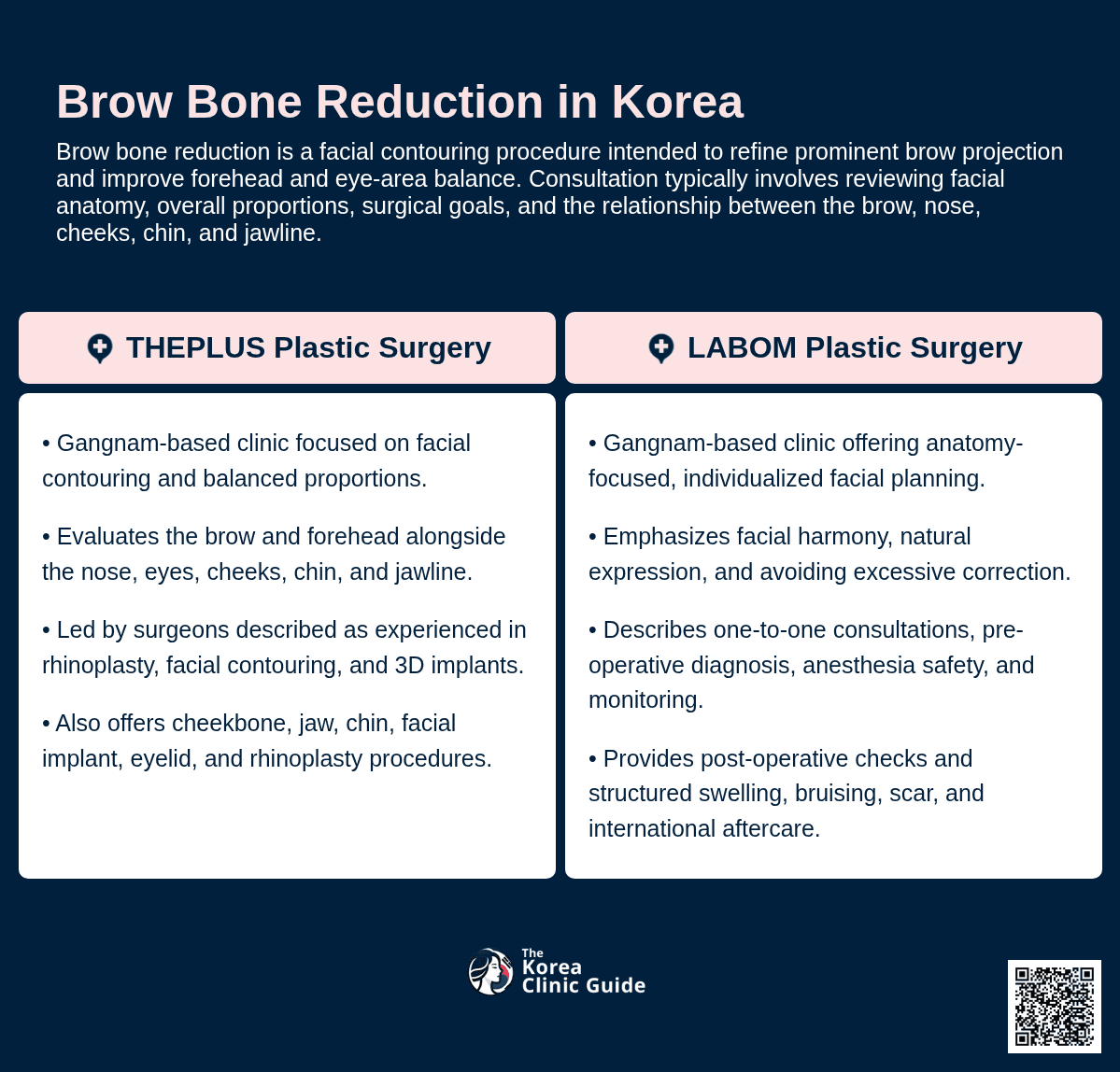
For brow bone reduction, you may consider THE PLUS Plastic Surgery if you want your forehead and brow projection evaluated as part of overall facial balance. The clinic’s documented focus on facial contouring, individualized harmony, and surgeon education may be relevant when discussing how a brow-area change could relate to your nose, eyes, cheeks, chin, and jawline; however, the provided information does not specify a brow bone reduction technique.
- URL: THEPLUS Plastic Surgery Website
- Location: Gangnam-gu, Seoul
- Facial-contouring perspective:
- Full face contouring, cheekbone surgery, square jaw surgery, chin surgery, and facial implants are listed among the clinic’s facial-contouring services.
- Its stated approach emphasizes balanced proportions and preserving your existing features rather than treating one facial feature in isolation.
- Surgeon background:
- Dr. Kim is described as a board-certified plastic surgeon with expertise in rhinoplasty and facial contouring, as well as research recognition related to 3D implants.
- Dr. Jeong is described as President of the Korean Society of Plastic Surgeons and as an educator and conference speaker in rhinoplasty.
- Dr. Lee is described as a board-certified plastic surgeon with prior experience as a Surgery Specialist at Seoul National University Hospital.
- Related services: The clinic lists rhinoplasty, eyelid procedures, facelift and thread-lift options, facial fat grafting, and facial implants in addition to facial contouring procedures.
2. LABOM Plastic Surgery
For brow bone reduction, you may consider LABOM Plastic Surgery if you value an anatomy-based, one-to-one facial plan that considers overall balance and avoids excessive correction. Although the supplied information does not describe brow bone reduction specifically, it does describe plastic-surgery specialists, individualized pre-operative diagnosis, monitoring systems, and structured recovery support that may be useful to discuss for a facial bone procedure.
- URL: LABOM Plastic Surgery Website
- Location: Gangnam-gu, Seoul
- Planning approach:
- Each surgical design is described as tailored to your facial anatomy, structure, and degree of aging rather than using a one-size-fits-all plan.
- The clinic states that it considers harmony across the entire face and aims to preserve natural expression and shape.
- Its approach is described as addressing underlying tissue position and structure while deliberately avoiding overcorrection.
- Safety and recovery support:
- The clinic describes one-to-one consultations, precise pre-operative diagnosis, anesthesia safety measures, and continuous monitoring systems.
- It provides regular post-operative checks and structured programs for recovery, swelling, bruising, and scar management.
- A dedicated, systematic aftercare system for international visitors is listed.
- Related facial services:
- Listed facial procedures include Triple Lift face and neck lifting, blepharoplasty, double-eyelid surgery, facial fat grafting, and facial liposuction.
- The clinic also lists CarGel non-surgical rhinoplasty, using a mixture of your own diced cartilage and fibrin extracted from your blood.
Why Visit Korea for Brow Bone Reduction?
Korea has a formal registration system for institutions attracting foreign patients. That system can be a useful starting safeguard for travelers, but it does not prove an individual surgeon’s experience with frontal-sinus setback or craniofacial osteotomy. No comparative study identified shows that brow bone reduction in Korea has better outcomes or safety than the same operation elsewhere.
- Registered-provider framework — Medical Korea states that registered foreign-patient institutions must carry medical-malpractice liability insurance, and its registration requirements include specialist coverage by clinical department.
- Established international-patient infrastructure — Medical Korea reported 3,114 registered foreign-patient-attraction medical institutions and 1,927 registered agencies as of March 2025. Registration is relevant to practical accountability, not a substitute for checking the operating surgeon’s credentials.
- Planning questions that matter more than location — Ask whether the team will use CT and, where appropriate, virtual surgical planning; ask who performs the osteotomy, how the supraorbital nerves and frontal sinus are protected, whether fixation hardware is anticipated, and what emergency and remote-follow-up arrangements are available.
- Important evidence limitation — A systematic review found that advanced imaging was reported in only 55% of facial-feminization studies and virtual simulation in 18%. These tools can be valuable, but their use is not yet standardized across published practice.
Key Information for International Patients
- Minimum stay — Remain in Korea for at least 10–14 days after isolated brow bone reduction. Plan 2–3 weeks when hairline advancement, brow lift, rhinoplasty, jaw surgery, or delayed healing is involved.
- In-person review — Schedule an early wound assessment and, when applicable, removal of sutures or staples around postoperative days 7–10. Obtain the operative note, medication list, imaging, and details of any plates, screws, mesh, or graft materials before departure.
- Flying home — Do not book a fixed return flight until the operating surgeon has examined the incision and explicitly cleared travel. There is no universal evidence-based flight interval after frontal-sinus setback; clearance depends on whether the sinus was entered, the extent of bone work, symptoms, and the postoperative examination.
- Itinerary impact — Swelling and bruising are commonly most visible on days 2–3 and can extend into the upper eyelids. Keep the first 1–2 weeks low-key, with no heavy lifting, vigorous exercise, contact risk, or activities that substantially raise blood pressure until cleared.
- Remote follow-up — Confirm before surgery how photo or video reviews will be arranged after departure, who answers urgent messages, and how a local doctor would be briefed if a problem develops at home.
Travel note: Book accommodation close to the surgical facility, retain flexible flight options, and arrange airport transport. Do not drive after general anesthesia or while taking sedating pain medicine.
Brow Bone Reduction From Start to Finish
- First contact and virtual consultation — Send clear standardized facial photographs, medical history, medication and supplement lists, allergies, prior operative reports, and any previous CT scans or implant records. Confirm whether English-language or virtual consultation is available and identify the operating surgeon.
- Surgical assessment in Korea — The surgeon reviews facial proportions, brow prominence, hairline position, scalp laxity, sinus symptoms, previous trauma or surgery, nicotine exposure, and whether the goal is feminization, deprojection, or asymmetry correction. Standardized photographs and thin-cut CT or three-dimensional planning can be used to define frontal-sinus anatomy.
- Technique and travel planning — The team explains whether controlled burring, Type III frontal-sinus setback, contour augmentation, or combined hairline/brow procedures fit the anatomy. Confirm incision placement, possible plates or screws, admission plan, medication arrangements, accommodation, and the required postoperative stay.
- Preoperative clearance — Complete the clinic’s examination and anesthesia assessment. Relevant testing depends on medical history, anesthetic risk, and planned surgical extent. Follow the fasting instructions and the individualized plan for anticoagulants, antiplatelets, hormone therapy, and other medicines.
- Anesthesia and incision — Brow bone reduction is generally performed under general anesthesia. The surgeon accesses the forehead through a coronal scalp incision behind the hairline or a pretrichial incision at the hairline, selected according to hairline position, scalp laxity, and planned hairline work.
- Bone contouring or reconstruction — In suitable Type I anatomy, the ridge is carefully burred and blended. In Type III anatomy, the anterior frontal-sinus table is osteotomized, reshaped, repositioned, and fixed; the supraorbital rims and nasion can also be contoured. The surgical duration depends on anatomy and combined procedures.
- Closure and monitored recovery — The scalp and forehead tissues are redraped, the incision is closed with sutures or staples, and a dressing is applied. Depending on operative extent, anesthesia recovery, and local protocol, discharge can be the same day after monitoring or after overnight observation.
- Korea-based postoperative care — Attend wound review and suture or staple removal when required. The surgeon assesses swelling, incision healing, sensation, pain control, and fitness to fly before international departure.
- Overseas follow-up — Continue scheduled photo or video follow-up after returning home. Final contour assessment is usually more meaningful at 3–6 months, while scar maturation and scalp sensation can continue improving for up to 12 months, especially after combined surgery.
Alternatives to Brow Bone Reduction
Non-surgical alternatives can change visual balance or brow position, but they cannot remove a projecting supraorbital bone. Surgical alternatives can address related proportions, although combining operations increases anesthesia time, recovery burden, and complication exposure.
Brow Lift
- What it changes — A brow lift or eyebrow lift raises or repositions soft tissue and can alter brow shape or upper-lid show.
- Tradeoff — It does not reduce frontal bossing or the underlying bone. It can be combined with bone contouring when brow position is also a concern.
Forehead Augmentation
- What it changes — Forehead filler or fat grafting can fill a shallow concavity above the brow and smooth the forehead-to-brow transition.
- Tradeoff — Augmentation adds volume rather than removing bone. Filler also carries vascular and aesthetic risks and does not provide a skeletal correction.
Hairline Surgery
- What it changes — Forehead reduction and hairline correction can lower, reshape, or improve the apparent proportion of the hairline.
- Tradeoff — These procedures do not change brow-ridge projection. Hairline position, scalp laxity, existing hair density, and incision planning determine whether they are staged or combined.
Broader Facial Feminization
- What it changes — Facial feminization surgery can combine forehead work with selected orbital, nasal, chin, jaw, or soft-tissue procedures when the goal concerns whole-face balance.
- Tradeoff — Combined surgery increases operative time, swelling, travel requirements, and the need for careful anesthetic and recovery planning.
How Can I Prepare for Brow Bone Reduction?
- Records and disclosure — Send prior forehead, sinus, facial-feminization, or trauma records; prior CT images; implant or hardware details; allergies; chronic conditions; and a complete medicine and supplement list well before travel.
- Blood-thinning medicines — Ask for a written plan for warfarin, aspirin, clopidogrel, direct oral anticoagulants, NSAIDs, vitamin E, fish oil, and herbal products. Do not independently stop, bridge, or restart prescribed anticoagulants or antiplatelets.
- Nicotine cessation — Stop cigarettes, vaping, chewing tobacco, and nicotine-containing products for the interval required by the operating surgeon. Nicotine impairs wound healing and can lead to deferral of elective surgery.
- Sinus and skin health — Report congestion, sinus pain, recurrent sinusitis, fever, a scalp rash, sunburn, active acne infection, or any open wound. Do not proceed with untreated active infection.
- Fasting and anesthesia — Follow the anesthesia team’s fasting instructions exactly. Confirm how prescribed medicines, including hormone therapy and diabetes medicines, should be handled on the day of surgery.
- Travel logistics — Reserve nearby accommodation for at least 10–14 days, local phone/data access, a responsible adult for surgery day and the first night where possible, and transport from the facility. Avoid fixed non-refundable flights.
- Alcohol and activity — Avoid alcohol according to the surgical team’s preoperative instructions and arrive rested and hydrated unless fasting instructions state otherwise.
Travel note: Bring a printed and digital copy of medical records, insurance information, clinic emergency contact details, and a plan for urgent care after returning home.
Confirm the treating doctor’s clinic-specific medication, fasting, skin-preparation, and travel requirements; those instructions take precedence over general guidance.
Aftercare Advice
Protect the incision, control swelling, and attend in-person review before leaving Korea; early healing is as important as the bone contouring itself.
- Dressings and incision care — Keep dressings, tape, drains, and the incision dry or protected exactly as instructed. Do not remove dressings, wash over the incision, use hair dye or bleach, or apply makeup, retinoids, exfoliating acids, scar products, or device-based treatments near the area until the surgeon approves.
- Swelling and sleep — Use cold compresses only as directed and never place ice directly on the incision. Sleep with the head elevated during early recovery. Swelling and bruising often peak around days 2–3; temporary forehead, scalp, or supraorbital numbness is common and, in one 220-patient series, most supraorbital numbness resolved within 2–3 weeks.
- Activity restrictions — Keep activity quiet and non-strenuous for roughly 1–2 weeks. Avoid bending, straining, heavy lifting, vigorous exercise, swimming, contact sports, facial trauma, and activities that substantially raise blood pressure until surgeon clearance, commonly at least 2–4 weeks.
- Medicines and sun protection — Take only medicines prescribed or approved by the surgical team. Avoid aspirin and NSAIDs unless the team confirms they are appropriate. Once the incision is closed and sun exposure is permitted, protect the scar and forehead with broad-spectrum SPF 50 and physical coverage.
- Urgent warning signs — Contact the surgeon urgently for fever or chills, uncontrolled bleeding, rapidly increasing or one-sided tense swelling, worsening redness or warmth, pus, malodor, wound opening, escalating pain, vision change, eye pain, confusion, fainting, weakness, seizure, chest pain, shortness of breath, or calf swelling. Persistent clear watery nasal drainage after frontal-sinus surgery requires urgent assessment because cerebrospinal-fluid leakage, though uncommon, is a recognized complication.
- Follow-up and results — Attend the wound check and suture or staple removal around days 7–10 when applicable. Bone change is intended to be permanent, but residual swelling, scar maturation, and scalp sensation can improve for months; assess results around 3–6 months and sometimes up to 12 months after combined procedures.
Follow the treating doctor’s written instructions over general advice and contact the clinic promptly when anything appears wrong.
Frequently Asked Questions
Related Blogs
Chin Surgery in Korea: Methods, Recovery, Risks, and Travel Planning
Updated: Aug 5, 2026
Face Contouring in Korea: Surgery Types, Recovery, Risks and Travel Planning
Updated: Aug 5, 2026
Double Chin Tightening in Korea: Methods, Recovery, Results and Travel Planning
Updated: Aug 5, 2026
Korea Paranasal Implant: Solution for Weak Midface Structure with Advanced Procedures
Updated: Jun 10, 2026