Medical Tourism Blog
Jawline Laxity Solutions: Liftera Lifting Procedure in Korea for a Defined Jawline

Table of contents
- Liftera Lifting: A Detailed Medical Overview
- Best Clinics in Korea for Jawline Laxity
- The Medical Tourist's Journey: Undergoing Liftera Lifting in South Korea
- Cost Analysis: Liftera Lifting in South Korea vs. Global Markets
- Patient Experiences and Outcomes with Liftera Lifting for Jawline Laxity
- Conclusion
- References
Considering treatment in Korea? Everything you need to know e.g. — how to avoid scams, visas, interpreters, recovery tips — in our Medical Tourism Master Guide. Plan with confidence in minutes, not weeks!
Jawline laxity, often known as a "blurring of the mandibular edge," is a common concern when it comes to maintaining a youthful and balanced face. As the lower edge of the jaw loses definition, the face appears less sculpted, impacting facial harmony and youthfulness.
When jawline contour weakens, the crisp line framing the bottom of the face softens. This fades the clear divide between face and neck, making individuals look older than their actual age.
Common Pseudonyms and Related Terms
There are several terms frequently relating to jawline laxity:
- Jowls: Refers specifically to the sagging skin under the jawline, giving a drooped appearance.
- Sagging Jawline/Skin: A catch-all phrase for sagging tissues along the jaw.
- Turkey Neck: Describes wrinkled or loose skin hanging under the jaw, resembling a double chin.
- Weak Jawline/Inadequate Jaw Projection: Sometimes genetic, these terms may or may not involve extensive skin sagging.
Underlying Causes of Jawline Laxity
Jawline laxity tends to develop as a part of aging, compounded by genetics and lifestyle habits. As we age, the loss of skin elasticity—much like a stretched-out elastic band—reduces the skin’s ability to remain firm. Concurrently, fat accumulates under the chin and jaw, adding weight and further stretching already weakened skin.
The underlying facial bone structure also changes due to gradual bone loss, diminishing the support beneath the skin and worsening sagging. Muscle weakening and gravity pull tissues downward, and the Superficial Musculoaponeurotic System (SMAS), a supportive layer beneath the skin, weakens and sags. Thus, laxity is a complex interplay of multiple layers—skin, fat, muscle, and bone.
Lifestyle choices also accelerate jawline changes: sun exposure speeds collagen breakdown, smoking and drinking affect skin health, and factors like weight fluctuations and hormonal imbalances can influence fat distribution and muscle tone. Even habitual sleep positions may play a role. Understanding this multi-layered process helps tailor approaches for prevention or correction—ranging from lifestyle changes to advanced treatments—for a spectrum of patients.
Liftera Lifting: A Detailed Medical Overview
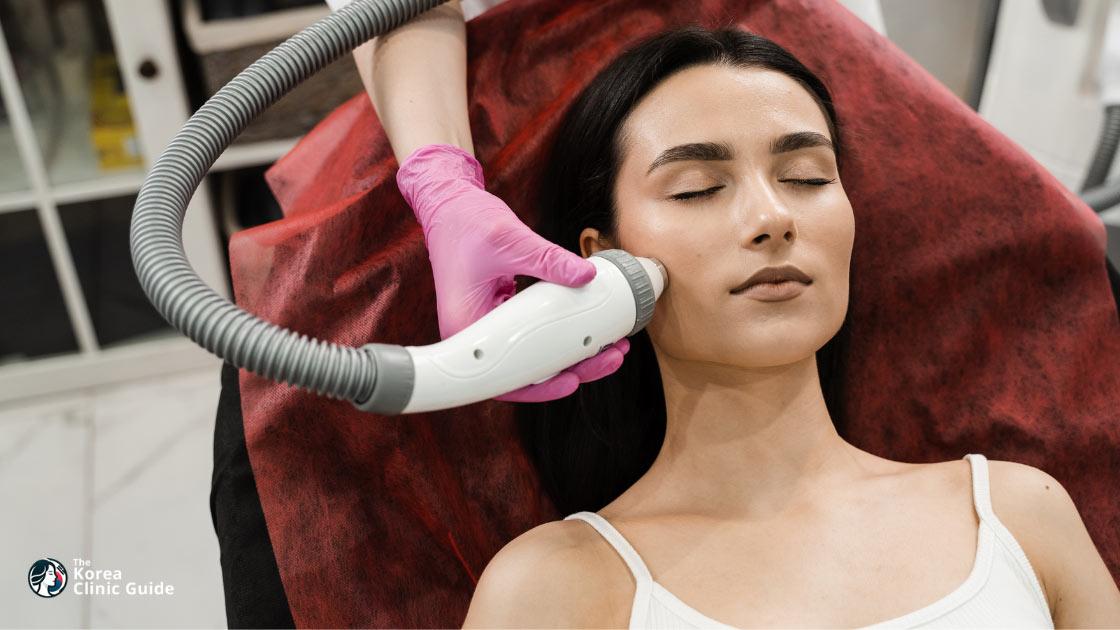
Liftera Lifting represents a modern approach to non-invasive skin lifting, using High-Intensity Focused Ultrasound (HIFU) for targeted and comfortable facial rejuvenation.
Introduction to Liftera Lifting Technology (Microfocused Ultrasound/HIFU)
Liftera uses HIFU technology to lift and tighten the skin on the face and neck, enhancing elasticity, smoothing wrinkles, and improving facial contours. Launched in new markets like Portugal recently, Liftera stands out thanks to its advanced microfocused ultrasound and specialized Thermal Diffusion Treatment (TDT™) Technology, which delivers faster results and greater comfort.
The system operates at over 10 Hz, increasing comfort and ensuring precise thermal energy application compared to older HIFU devices.
Mechanism of Action: How Liftera Lifts and Tightens
Liftera delivers focused ultrasound waves that precisely heat targeted tissue, triggering collagen production and tightening. Adjustable coagulation points allow treatment at depths between 1.5mm and 4.5mm:
- Dermis: Stimulates new collagen for firmer skin.
- Muscle (SMAS): Contracts the foundational layer for visible lifting.
- Fat: Can be used to selectively target and shrink localized fat—especially in the double chin—by using a macrofocused ultrasound setting.
Digital energy delivery with Liftera enables precise, pure targeting at a single focal point—minimizing discomfort and reducing the risk of nerve complications common with some other devices. Its precision even allows safe use on sensitive areas such as the eyes or mouth.
Key Benefits and Advantages
- Non-invasive: No incisions or injections required.
- Minimal Pain: Thanks to TDT™ technology, Liftera is often described as “almost pain-free”; most patients don’t need topical anesthesia.
- No Downtime: Normal activities—including applying makeup—are possible right after the procedure.
- Quick Treatments: Sessions last from 15 minutes to an hour.
- Safety: Liftera has a strong safety profile. Side effects like redness or swelling clear within hours, while rare complications—like scarring or pigmentation issues—are infrequently reported.
- Versatility: Treats both facial and body areas, customizable for different needs, including sensitive zones.
- Personalization: The continuous shooting pen allows tailored, refined treatments for each patient.
Expected Results and Treatment Timeline
Liftera Lifting produces a two-phase result:
- Immediate: Some tissue tightening and lifting is visible directly after treatment. This short-term effect fades slightly as tissues relax, but the area remains more lifted than before treatment.
- Deferred: Over 1-3 months, the body produces new collagen, and results gradually improve, peaking at 3-4 months. These outcomes typically last a year or more, though maintenance every 3-6 months is often advised.
Potential Side Effects and Ideal Candidate Profile
Potential Side Effects: Temporary redness, swelling, bruising, discomfort, or skin sensitivity are possible, resolving in days. Rare risks include scarring or pigmentation changes.
Ideal Candidates: Liftera is ideal for those wanting to prevent or treat early signs of aging, improve skin quality, or target small pockets of fat. It suits individuals seeking non-surgical, quick, and low-pain options for sagging, wrinkles, or mild to moderate laxity, and those not eligible for surgery.
Liftera in Context: Differences from Other HIFU and Ultherapy Treatments
Liftera stands out among HIFU treatments by featuring TDT™ technology for enhanced comfort and fast results. Its digital delivery ensures precise targeting and allows safe use on delicate areas that might be off-limits with other brands.
Compared with Ultherapy—a peer HIFU technology known for its DeepSEE™ visualization, allowing real-time monitoring—Liftera offers greater comfort for many patients. However, Ultherapy’s imaging may reduce risks like fat loss or nerve damage since practitioners can see what they’re treating. While Ultherapy has a longer track record and more independent studies, Liftera is often praised for comfort and is regarded as cutting-edge in the latest generation of ultrasound therapies. Importantly, patients should ask clinics exactly how pricing by “shots” translates into their personal treatment plan, as shot counts and coverage areas can vary.
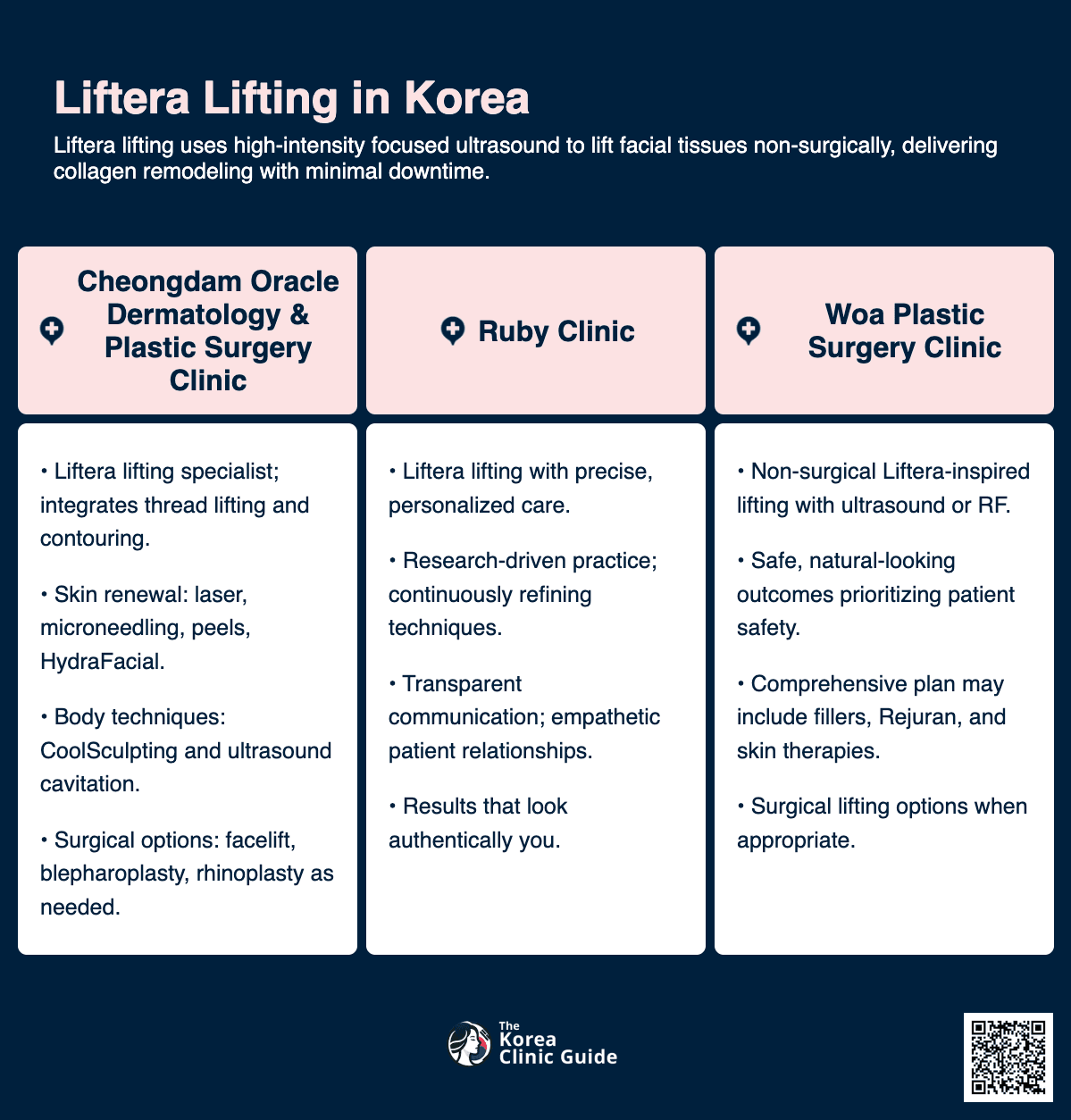
Best Clinics in Korea for Jawline Laxity
Listed below are the best clinics in Korea for jawline laxity:
| Clinic Name | Key Features | Special Techniques |
|---|---|---|
| Cheongdam Oracle Dermatology & Plastic Surgery Clinic | Comprehensive, personalized pathway from noninvasive rejuvenation to definitive surgical correction, delivered with the highest standards of care. Complementary body-contouring modalities—liposuction, CoolSculpting, and ultrasound cavitation—help refine facial and neck contours. Botox integrates into a holistic anti-aging plan. | laser resurfacing; microneedling; chemical peels; HydraFacial; thread lifting; dermal fillers; facelift; liposuction; CoolSculpting; ultrasound cavitation; Botox |
| Lienjang Clinic - Jamsil Branch | Comprehensive, personalized care for jawline laxity through a full spectrum of aesthetic and dermatological treatments. Combines noninvasive devices, petite injections, and minimally invasive thread techniques to tailor plans that refine facial contours while supporting skin health and efficient recovery. | Liftera 2 (HIFU); Ulthera; Inmode (radiofrequency and laser technologies) to contour and tighten; dissolvable-thread lifting; contour injections; dermal fillers; Botox; Sharbet injection; Potenza RF microneedling; Anafa Skin Booster |
| VS Line Clinic (VS라인의원) | Located in Apgujeong, offers personalized, technology-driven solutions for jawline laxity and lower-face contouring; multimodal approach with Ultherapy, TuneFace RF, and InMode RF for targeted tightening and contouring. | Custom Ultherapy; TuneFace radiofrequency; InMode radiofrequency; Silhouette Lifting thread procedures; Full-Face Volume Filler; Chin Botox |
Cheongdam Oracle Dermatology & Plastic Surgery Clinic
Cheongdam Oracle Dermatology & Plastic Surgery Clinic in Seolleung is the best destination in Korea for jawline laxity because it offers a comprehensive, personalized pathway from noninvasive rejuvenation to definitive surgical correction—delivered with the highest standards of care. Its dermatology suite tightens and retexturizes skin while boosting collagen through laser resurfacing, microneedling, chemical peels, and HydraFacial; anti-aging options like thread lifting and dermal fillers provide immediate lift and structural support with minimal downtime; and its plastic surgery expertise, including facelift, addresses more advanced laxity with lasting results. Complementary body-contouring modalities—liposuction, CoolSculpting, and ultrasound cavitation—help refine facial and neck contours by reducing localized fat that can blur the jawline, while Botox integrates into a holistic anti-aging plan. This breadth of advanced procedures allows the clinic to tailor a stepwise, results-driven plan for every patient’s jawline, from subtle tightening to comprehensive rejuvenation.
Find more about this clinic here: Cheongdam Oracle Dermatology & Plastic Surgery Clinic Website
Lienjang Clinic - Jamsil Branch
Lienjang Clinic’s Jamsil branch offers comprehensive, personalized care for jawline laxity through a full spectrum of aesthetic and dermatological treatments. Combining noninvasive devices, petite injections, and minimally invasive thread techniques, the clinic tailors plans that refine facial contours while supporting skin health and efficient recovery.
For lifting and definition along the jaw and neck, Liftera 2 (HIFU) stimulates collagen for firming with no downtime, Ulthera provides ultrasound-based lifting and tightening with long-lasting results and minimal downtime, and Inmode uses radiofrequency and laser technologies to contour and tighten with minimal recovery time. Thread lifting with dissolvable threads delivers immediate lift with ongoing improvements in texture and tightness, while contour injections help create a more defined jawline. Complementary options include dermal fillers to restore volume and enhance contours, Botox for quick, minimal-downtime wrinkle reduction, and Sharbet injection to safely correct overfilling or asymmetry. Skin quality can be further supported with Potenza radiofrequency microneedling and the Anafa Skin Booster to improve firmness and hydration, enabling layered, effective strategies for jawline laxity.
Find more about this clinic here: Lienjang Clinic - Jamsil Branch Website
VS Line Clinic (VS라인의원)
Located in Apgujeong, VS Line Clinic (VS라인의원) offers personalized, technology-driven solutions for jawline laxity and lower-face contouring. Their multimodal approach combines Custom Ultherapy for targeted ultrasound skin tightening, TuneFace radiofrequency to stimulate collagen and improve elasticity, and InMode radiofrequency for fat reduction, skin tightening, and muscle toning—ideal for refining jowls and softening a sagging jawline.
To enhance and stabilize results, the clinic also provides Silhouette Lifting thread procedures for immediate lift and contour definition, Full-Face Volume Filler to rebalance the lower face and sharpen the jawline, and Chin Botox to smooth dimpling and refine the chin area. Guided by experienced professionals and the latest devices, VS Line Clinic tailors each plan to the patient’s anatomy and goals for natural, lasting improvement in jawline definition.
Find more about this clinic here: VS Line Clinic (VS라인의원) Website
The Medical Tourist's Journey: Undergoing Liftera Lifting in South Korea
South Korea is a leading destination for aesthetic medicine, attracting patients worldwide with its blend of advanced technology, skilled practitioners, and value.
Why South Korea is a Hub for Aesthetic Medical Tourism
Several factors explain South Korea’s leadership in cosmetic treatments:
- Innovative Technology: Korean clinics often introduce advanced devices—like Liftera—before they’re available elsewhere.
- Expert Practitioners: High specialization and global training make Korean doctors stand out.
- Pioneering Non-Invasive Techniques: Korea's medical community has set trends in minimally invasive and non-surgical procedures.
- Value: Costs can be 40–75% less than in the West, with no sacrifice in quality.
- Comprehensive Support: All-inclusive packages offer pre- and post-treatment care, translating and transportation services, and assistance with logistics—making the entire experience seamless for foreign patients.
Step-by-Step Process for Medical Tourists
- Consultation (Online): Patients start with a virtual consultation, sharing medical history and goals, aided by reference photos. Personalized plans and timeline proposals follow.
- Treatment Booking: Patients select packages—often combining Liftera with other treatments—and secure their spot with a deposit.
- Travel & Visa Arrangements: Flights and documents—including potential medical visas—are organized. Assistance with paperwork and accommodation near clinics is standard, especially through agencies.
- Arrival & Orientation: A coordinator greets patients, arranging airport transfers and a pre-treatment wellness check.
- Treatment & Recovery: Liftera sessions are quick, and patients can return to regular activities soon after. Recovery kits and comfort measures (like IV therapies or special skincare) may be provided.
- Follow-Up & Departure: Final assessments and take-home instructions prepare patients for continued recovery, with virtual aftercare support available post-return.
Practical International Considerations
- Cultural: Tipping is rare. Korean skincare stores have great recovery products. Learning a few basic Korean phrases is always appreciated.
- Packing: Light clothing, sun protections, medical records, adapters, and comfortable shoes are recommended.
- Stay Duration: Liftera’s lack of downtime often allows fast departures, though longer “rejuvenation tours” or combination treatments might need 10-14 days.
Cost Analysis: Liftera Lifting in South Korea vs. Global Markets
Cost remains a major draw for overseas patients, with South Korea offering competitive prices without sacrificing quality.
Average Costs of Liftera Lifting in South Korea
Liftera Lifting generally costs $1,000–$2,000 USD, or roughly ₩1,452,100–₩2,903,500 KRW. A "Liftera 3000 Shots" package may cost about ₩360,000 KRW (around $248 USD)—likely a limited promotional or area-specific treatment. For comparison, 600 shots of Ultherapy for full face and neck typically run about $1,378 USD in Seoul. Note: Always verify what a "shot" refers to for your personal case.
Components Included in Procedure Cost
Usual inclusions:
- Doctor and Procedure Fees
- (If Needed) Anesthesia
- Pre-procedure Medical Tests
- Follow-Ups and Post-care
- Travel or Accommodation (in premium all-inclusive packages)
- Translation Services for foreign patients
Daily expenses like meals and sightseeing are generally not included.
Factors Influencing Pricing in South Korea
- Clinic Reputation and Location: More renowned clinics or those in districts like Gangnam may charge more.
- Practitioner Expertise: Experience often comes with a higher price tag.
- Scope of Treatment/Shots: More extensive areas or higher shot counts increase cost.
- Package Type: All-inclusive versus procedure-only affects pricing.
Comparative Costs: South Korea vs. Other Countries
| Procedure Type | Country | Cost Range (USD) |
|---|---|---|
| Liftera Lifting | South Korea | $1,000 - $2,000 |
| Liftera (3000 Shots) | South Korea | ~$248 |
| Ultherapy (600 shots) | South Korea | ~$1,378 |
| Full Face Liftera | Brazil | $2,060 - $4,480 |
| Liftera HIFU | Singapore | $470 - $1,440 |
| Liftera Hifu (Cheeks + Double Chin + Facial Lifting) | Thailand | $300 - $450 |
| Liftera Lifting | Canada | $660 - $830 |
| HIFU (General, Full Face & Neck) | Australia | $590 |
| Ulfit HIFU (Face & Neck) | Australia | $1,230 |
| Mini Facelift | South Korea | $2,000 - $11,000 |
| Facelift | USA | ~$11,000 |
| Facelift | UK | $9,000 - $14,000 |
This table highlights the value South Korea offers—not just lower prices, but cutting-edge technology and expert care. However, it’s important for patients to understand differences in price quotes—for example, the number of included shots or coverage area—before committing.
Patient Experiences and Outcomes with Liftera Lifting for Jawline Laxity
Patient feedback and studies show Liftera Lifting to be effective for skin tightening and jawline contouring, with gradual improvements over several months.
Reported Efficacy and Improvement in Jawline Definition
Liftera Lifting’s stimulation of new collagen and tissue contraction directly addresses jawline laxity, with immediate subtle lifting and enhanced definition becoming more pronounced over 1-3 months. Research supports improvements in sagging, wrinkle reduction, and overall contour—with most patients noticing visible benefits for up to a year.
Patient Testimonials and Real-World Results
Liftera, HIFU, and Ultherapy: Many report a visibly tighter jawline weeks after treatment and greater contours after several sessions. Users appreciate the confidence boost and the minimal discomfort. Some highlight positive changes in areas like the neck and eye region. Most consider it an “instant tightening” with ongoing collagen benefits.
Surgical Jowl Lifts: These offer even more dramatic contour improvement and are praised for their natural-looking, refreshed outcomes—although they require more downtime and higher costs.
Negative Experiences: Some patients undergoing HIFU technologies (especially Ultherapy) report discomfort or pain, and very rarely, overtreated areas can appear overly thin or aged due to fat destruction. Side effects like redness, numbness, or bruising are possible, and those with high skin laxity or BMI may notice lesser results.
Realistic Expectations and Longevity of Results
Immediate tightening may be seen, but the full effect takes 2-3 months to develop as collagen builds up. Results typically last 6 to 18 months, with some experiencing benefits beyond a year. Maintenance treatments every 3-6 months can help extend the improvements.
Conclusion
Jawline laxity is a complex concern, but Liftera Lifting offers a non-invasive, comfortable, and convenient solution by leveraging advanced HIFU technology. Patients can expect natural results developing gradually over a few months—with minimal pain, no downtime, and outcomes that can last a year or more. South Korea stands out as a leading destination, combining affordability, expertise, and comprehensive patient support for anyone seeking Liftera Lifting abroad. Prospective patients should ensure transparent discussions about treatment scope and pricing for the best experience and results.
References
1, 2, 3, 4, 5, 6, 7, 8, 9, 10, 11, 12, 13, 14, 15, 16, 17, 18, 19, 20, 21, 22, 23, 24, 25, 26, 27, 28, 29