
Medical Tourism Blog
Neck Wrinkle Treatment in Korea: Methods, Recovery, Travel Planning, and Alternatives

Table of contents
- Neck Wrinkle Treatment at a Glance
- What Is Neck Wrinkle Treatment?
- Who Is a Good Candidate for Neck Wrinkle Treatment?
- How Is Neck Wrinkle Treatment Performed?
- Why Visit Korea for Neck Wrinkle Treatment?
- Key Information for International Patients
- Which Are the Best Clinics in Korea for Neck Wrinkle Treatment?
- Neck Wrinkle Treatment From Start to Finish
- Alternatives to Neck Wrinkle Treatment
- How Can I Prepare for Neck Wrinkle Treatment?
- Aftercare Advice
Considering treatment in Korea? Everything you need to know e.g. — how to avoid scams, visas, interpreters, recovery tips — in our Medical Tourism Master Guide. Plan with confidence in minutes, not weeks!
Last updated: September 2026
Neck Wrinkle Treatment at a Glance
- Targeted, not one treatment — Neck wrinkle treatment is tailored to the cause: HA filler softens fixed horizontal necklace lines, botulinum toxin treats dynamic vertical platysmal bands, and RF microneedling or laser targets crepey texture and mild laxity.
- Best candidates — Non-surgical treatment is most suitable for shallow-to-moderate horizontal lines, visible muscle bands, or mild photoaging and looseness; substantial hanging skin, submental fat, or platysmal separation usually needs a surgical neck-lift assessment.
- Results and maintenance — Filler is visible immediately but is best judged after 1–2 weeks, toxin is assessed at about 2 weeks, and collagen-remodeling treatments improve gradually over weeks to months; pooled HA-filler data found 50% of patients had retreatment within 12 months.
- Recovery varies by method — Injectables usually allow normal light activity the same or next day, though bruising or swelling can last several days and occasionally 1–2 weeks; ablative fractional laser requires substantially more wound care and commonly about 7–10 days or longer of healing.
- Multiple visits for devices — A published neck RF microneedling/non-ablative laser regimen used three sessions spaced four weeks apart, so a full device-treatment course cannot usually be completed during a short Korea trip.
- Travel planning — For an injectable-only plan in Korea, allow 2–3 full days and remain locally overnight—preferably 24–48 hours—rather than flying immediately after treatment; keep flexible travel plans in case early review is needed.
- Korea-specific check — Korea offers broad access to injectables and energy devices, but no evidence proves superior outcomes; request the exact product or device name, MFDS authorization and intended-use details, treatment records, and an English-language complication contact.
What Is Neck Wrinkle Treatment?
Neck wrinkle treatment is a tailored group of non-surgical treatments for horizontal neck lines, crepey skin, mild looseness, and visible muscle bands. It aims to soften lines, improve skin texture, and reduce muscle-driven banding while preserving a natural neck appearance. It is non-surgical, using injectables or energy-based skin treatments selected for the main concern.
Who Is a Good Candidate for Neck Wrinkle Treatment?
- Static horizontal lines — Good candidates have shallow-to-moderate etched transverse neck lines, often called necklace lines, and want a targeted injectable approach such as hyaluronic acid (HA) filler.
- Vertical platysmal bands — People whose neck cords become prominent when speaking, grimacing, or contracting the neck can be assessed for carefully placed botulinum toxin.
- Crepey texture and mild laxity — Candidates seeking gradual improvement in fine wrinkles, photoaging, and mild looseness can consider a staged radiofrequency microneedling (RFMN) or fractional-laser plan.
- Combination concerns — A combination plan can be appropriate when fixed horizontal lines, texture change, and dynamic platysma activity coexist; each component should have a defined purpose.
Elective treatment is generally deferred during pregnancy or breastfeeding. Postpone treatment for active infection, inflammatory skin disease, open wounds, substantial sunburn, or an unhealed recent procedure on the neck. Product allergy, including lidocaine allergy where relevant, bleeding disorders, anticoagulant or antiplatelet treatment, poor healing, uncontrolled diabetes, a strong history of pigment change or abnormal scars, and recent isotretinoin need individualized assessment. Botulinum toxin requires particular caution or avoidance with neuromuscular-junction disorders, significant baseline neck weakness, or swallowing and breathing difficulty. Major skin excess, submental fat, a low-hanging neck, or marked platysmal separation will not be reliably corrected by wrinkle-focused treatment and warrants a surgical assessment.
How Is Neck Wrinkle Treatment Performed?
Neck wrinkle treatment is selected by the cause of the concern, not by one universal protocol. Validated photonumeric scales for horizontal lines, platysmal bands, and neck laxity exist, but differing scales and endpoints still make results across studies difficult to compare.
- HA filler for horizontal lines — A soft HA filler is placed in a superficial dermal or subdermal plane, commonly with a fine needle or cannula, to soften a fixed transverse crease. It has the most direct evidence for etched horizontal lines: a systematic review of 11 studies and 379 patients found improvement in wrinkle grading and patient/clinician aesthetic assessments, but the evidence level was low and techniques varied substantially. HA has the practical advantage of being more readily reversible than non-HA biostimulators.
- Skin boosters or mesotherapy — Intradermal, hydration-focused injectable protocols using non-cross-linked HA or mixed ingredients target fine texture and crepey skin. They are not interchangeable with dermal fillers; ingredients, doses, intended uses, and expected effects differ.
- Botulinum toxin for platysmal bands — Superficial injections into the platysma reduce muscle-driven vertical band prominence and neck tension. They do not directly fill a fixed horizontal necklace line. A phase-3 trial of onabotulinumtoxinA found improvement in moderate-to-severe platysma prominence from day 14 through day 120 (trial report).
- RFMN and non-ablative fractional laser — These treatments create controlled dermal injury for gradual collagen remodeling, with the aim of improving texture, fine wrinkles, and mild laxity. In a small randomized neck study, three treatments were given four weeks apart; the 1,550-nm erbium:glass laser performed better for investigator-rated wrinkling/elastosis, while RFMN produced a greater reduction in horizontal-line severity (direct comparison). This does not establish a universal device ranking.
- Ablative fractional laser and other energy devices — Fractional CO2 or Er:YAG laser, monopolar RF, and microfocused ultrasound/HIFU are selected according to laxity, photoaging, skin type, pigment risk, and acceptable downtime. Ablative resurfacing has materially greater wound-care recovery than non-ablative laser or RFMN. Evidence for RF overall suggests modest rejuvenation benefit, but protocols remain highly variable (evidence review).
- Biostimulators — Poly-L-lactic acid (PLLA) and diluted calcium hydroxylapatite (CaHA) are sometimes used for diffuse collagen stimulation and skin quality rather than immediate line-by-line correction. A review of 24 studies and 887 patients found heterogeneous measures, small samples, and insufficient long-term data for firm conclusions (review findings).
Why Visit Korea for Neck Wrinkle Treatment?
Korea offers access to a broad range of injectable and energy-based aesthetic treatments, but the treatment plan matters more than the destination. No direct comparative evidence shows that Korea produces better outcomes or lower complication rates for neck wrinkle treatment than other countries. Ask for a diagnosis-led plan rather than a package defined only by a device or brand.
- Product and device verification — Korea's Ministry of Food and Drug Safety (MFDS) regulates medical devices through risk-based notification, certification, and approval pathways, including review of intended use and technical documentation (MFDS regulatory framework). Ask for the exact injectable or device name, Korean authorization details, intended use, and whether neck use is on-label or off-label.
- Method-specific planning — Clinics can assess whether the dominant issue is an etched horizontal line, dynamic platysmal band, crepey skin, or structural laxity. That distinction is clinically important because toxin, filler, and collagen-remodeling devices address different mechanisms.
- Published local experience, not proven superiority — Korean experience with HA filler for horizontal neck lines supports local availability and practitioner familiarity, but it does not prove a Korea-specific outcome advantage. The broader HA literature supports short-term improvement but remains heterogeneous in product, injection plane, volume, and follow-up (current evidence limitations).
- Documented treatment records — For an overseas patient, request product lot numbers, filler volume or toxin units, injection map or device settings, consent documentation, standardized photographs, and an after-hours complication contact before leaving Korea.
Key Information for International Patients
- Minimum stay for injectables — Arrange 2–3 full days for a simple filler, skin-booster, or toxin plan. Schedule treatment early enough to allow reassessment if bruising, increasing pain, swelling, or asymmetry develops.
- Flight timing — Do not book an international flight immediately after injection. Stay locally overnight and, where feasible, for 24–48 hours so the treating team remains accessible during the early complication-recognition period. This is travel planning, not a universal medical flight ban.
- Multi-session device plans — A published RFMN/non-ablative 1,550-nm laser neck regimen used three sessions four weeks apart, so it cannot be completed during a short visit (study protocol). Plan return visits or arrange continuation with a qualified clinician at home.
- Ablative laser recovery — Remain in Korea until the clinician confirms satisfactory healing. Plan roughly 7–10 days or longer for ablative fractional resurfacing, depending on intensity and wound healing; do not treat it like a low-downtime injectable appointment.
- Itinerary restrictions — Keep the first 24–48 hours after injectables free of strenuous exercise, alcohol, sauna visits, hot baths, and aggressive massage. After RFMN or laser, avoid heavy sun exposure and activities that increase heat, friction, or infection risk.
- Remote follow-up — Confirm an English-language contact pathway before booking. Send clear photographs promptly if symptoms arise after departure, and identify a local clinician or emergency service at home in case urgent in-person assessment is needed.
Travel note: Do not schedule treatment at the end of a tightly fixed trip. Flexible flights and accommodation are especially important after filler or ablative resurfacing.
Which Are the Best Clinics in Korea for Neck Wrinkle Treatment?
Listed below are some of the best clinics in Korea for neck wrinkle treatment.
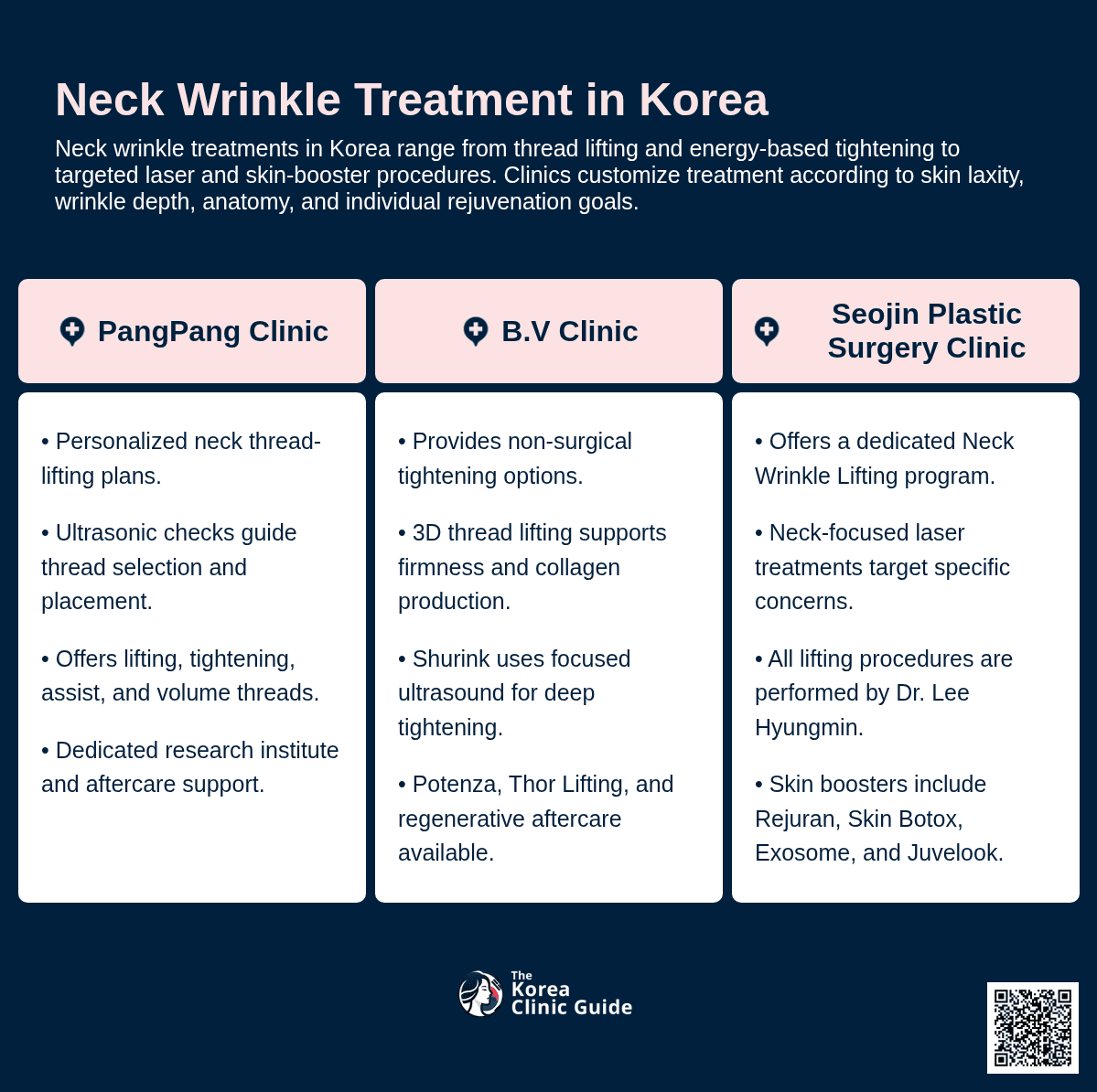
1. PangPang Clinic
For neck wrinkles associated with skin laxity, you can explore a personalized thread-lifting approach at PangPang Clinic. Its program includes thread lifting for the neck, with pre-procedure ultrasonic visual checks and treatment design intended to tailor thread selection and placement to your anatomy and goals.
- URL: PangPang Clinic Website
- Location: Gangnam-gu, Seoul
- Thread-lifting approach:
- Thread lifting is described as a 30-minute to one-hour procedure with partial, Airnox, or sleep-anesthesia options.
- The clinic uses lifting, assist, tightening, and volume thread types; tightening threads are intended to support elasticity over time.
- Reported results duration is about one year or longer, though individual outcomes and longevity can vary.
- Planning and aftercare:
- A dedicated consultation center is described as using individualized treatment planning.
- The clinic reports access to 31 specialized functional threads for customized lifting plans.
- An aftercare package is available to support and prolong treatment effects.
- Research focus:
- PangPang Clinic focuses its practice and research on thread lifting and reports operating a Thread Lifting Research Institute.
- Its medical team participates in international beauty conferences through invited lectures and presentations.
2. B.V Clinic
You may consider B.V Clinic if you want to discuss non-surgical tightening options for neck wrinkles or laxity as part of a personalized rejuvenation plan. The clinic offers thread lifting as well as radiofrequency- and ultrasound-based lifting treatments designed to support collagen and skin elasticity, with post-treatment skin-regeneration management available.
- URL: B.V Clinic Website
- Location: Seoul
- Non-surgical options:
- 3D thread lifting uses strategically placed threads to lift and firm sagging skin while supporting collagen production.
- Shurink Lifting uses high-intensity focused ultrasound for deep-layer skin tightening and contour refinement.
- Potenza and Thor Lifting use radiofrequency technology to support collagen, elasticity, and skin tightening.
- Aftercare:
- The aftercare program includes skin-regeneration management intended to minimize swelling and improve elasticity.
- Post-treatment support may include nutritional skincare products and ultrasound-based care to encourage collagen production.
3. Seojin Plastic Surgery Clinic
For a dedicated neck-wrinkle lifting program, Seojin Plastic Surgery Clinic offers targeted treatment for sagging or wrinkled neck skin rather than a one-size-fits-all lifting plan. You can expect care from Dr. Lee Hyungmin, the clinic’s lead plastic surgeon, who performs all lifting and petite procedures in this one-doctor practice.
- URL: Seojin Plastic Surgery Clinic Website
- Location: Gangnam-gu, Seoul
- Neck-focused care:
- The clinic lists a dedicated Neck Wrinkle Lifting program for sagging or wrinkled neck skin.
- Lifting laser treatments are offered for specific areas, including neck wrinkles, to tailor treatment to the concern being addressed.
- Physician-led treatment:
- All lifting and petite procedures are conducted by the lead plastic surgeon, Dr. Lee Hyungmin.
- As a one-doctor clinic, Dr. Lee Hyungmin provides end-to-end care.
- The provided information notes more than 16 years of experience and recognition among the 100 Good Doctors in Korea.
- Related skin treatments:
Neck Wrinkle Treatment From Start to Finish
- Remote consultation and photographs — Send unfiltered front, oblique, and profile photographs in a neutral position and while contracting the neck. Disclose previous filler, biostimulators, threads, energy treatments, allergies, herpes history, pigment or scar history, medical conditions, medicines, and supplements. Confirm English or virtual consultation availability.
- In-person assessment — The clinician examines horizontal-line depth, platysma movement, skin thickness and quality, laxity, submental fat, and neck anatomy. Standardized photographs and a validated baseline scale can help document the starting point. Discuss whether the proposed use is on-label or off-label and whether surgery would better address structural laxity.
- Medical review and treatment plan — Routine blood testing is not usually required for uncomplicated local-anesthetic injectables or energy treatment. Medical clearance, medication adjustments, or testing can be required for relevant medical history or planned sedation. Agree on the exact product or device, treatment target, expected recovery, maintenance plan, and complication contact process.
- Preparation on treatment day — The neck is cleansed and marked. Topical or local anesthetic can be used for filler, skin boosters, RFMN, or laser. For toxin, the clinician maps visible platysma movement before injection.
- Treatment delivery — Filler or skin booster is placed in small aliquots at the chosen depth; toxin is injected superficially into mapped platysmal areas. For RFMN, laser, RF, or ultrasound, settings are individualized to skin type, tissue thickness, pigment risk, and the planned downtime. Injectable appointments are generally brief, while device-session duration depends on the treatment area and platform.
- Immediate observation and discharge — The clinician checks the treatment area, provides written aftercare, and explains red-flag symptoms. Obtain the product name, lot number, amount or units, injection map or device settings, photographs, consent form, and after-hours contact before discharge.
- Early review and result assessment — Reassess filler after swelling settles, usually at 1–2 weeks, and toxin at about two weeks. Filler is visible immediately but cannot be judged accurately while swollen; toxin develops progressively. RFMN, non-ablative laser, and biostimulatory results evolve over weeks to months.
- Maintenance and overseas follow-up — Maintenance is common rather than evidence of failure: pooled HA-filler data found 50% retreatment within 12 months (meta-analysis). Follow the clinic's remote-review plan and share records with any clinician providing later care.
Alternatives to Neck Wrinkle Treatment
Non-surgical methods can soften selected lines, improve texture, or reduce muscle prominence, but they do not remove substantial excess skin or repair marked platysmal separation. Surgery involves scars, anesthesia, and longer recovery, yet can be the more proportionate choice for structural neck aging.
Neck Lift
A neck lift with platysmaplasty can address skin redundancy, submental fat, platysmal separation, and a poorly defined neck contour that wrinkle treatment cannot reliably correct.
- Best suited to — Marked laxity, hanging skin, substantial banding from platysmal separation, or a low-yield response expected from repeated non-surgical procedures.
- Tradeoff — More durable structural correction, with surgical risks, scars, anesthesia, and meaningful recovery time.
Neck Filler
A focused neck filler appointment is the direct alternative when the main concern is a small number of static horizontal lines rather than diffuse texture or laxity.
- Best suited to — Etched transverse creases with relatively good skin quality and limited looseness.
- Tradeoff — Immediate line softening versus bruising, swelling, vascular complications, and likely maintenance.
RF Microneedling
RF microneedling is a collagen-remodeling approach for fine wrinkles, crepey texture, and mild laxity rather than deep crease filling.
- Best suited to — Diffuse skin-quality concerns and patients prepared for a staged treatment series.
- Tradeoff — Gradual improvement and pigment-risk management versus less immediate correction of a deep horizontal line.
Fractional CO2 Laser
Fractional CO2 laser resurfacing can offer stronger treatment for photoaging and textural change when downtime and wound care are acceptable.
- Best suited to — More pronounced surface wrinkling and photoaging in patients assessed as suitable for ablative resurfacing.
- Tradeoff — Greater resurfacing intensity versus longer healing, strict sun avoidance, and higher wound-care demands.
HIFU or Monopolar RF
HIFU lifting and Thermage lifting are considered for mild laxity rather than a deeply etched necklace line.
- Best suited to — Mild tissue looseness with realistic expectations for subtle, gradual change.
- Tradeoff — No incision and limited downtime versus variable results and limited direct comparative evidence across devices.
How Can I Prepare for Neck Wrinkle Treatment?
- Share a complete history — Disclose all prior neck filler, biostimulators, threads, surgery, and energy procedures, plus allergies, herpes history, pigment or scar problems, neuromuscular disease, diabetes, bleeding issues, and pregnancy possibility.
- Review medicines early — Tell the clinic about warfarin, apixaban, rivaroxaban, clopidogrel, aspirin, anti-inflammatory drugs, steroids, diabetes medicines, and blood-pressure medicines. Do not independently stop prescribed anticoagulants, antiplatelets, or other essential medication; the prescribing clinician must direct any change.
- Discuss supplements and bruising risk — Report fish oil, vitamin E, ginkgo, garlic supplements, ginseng, turmeric/curcumin, and other supplements. The treating clinician will advise whether to pause non-essential products before an injectable procedure.
- Avoid tanning and sunburn — Avoid deliberate tanning and attend only when the neck skin is intact and calm. Recent tanning and sunburn increase pigment and healing concerns after laser or RFMN.
- Avoid alcohol and smoking — Avoid alcohol before treatment according to clinic instructions, particularly when bruising is a concern. Discuss smoking and vaping honestly, as nicotine can impair healing after resurfacing.
- Follow fasting instructions exactly — Fasting is usually unnecessary for local-anesthetic injections and most energy procedures. Follow the clinic's instructions if sedation is planned.
- Plan travel and clothing — Book flexible flights, stay near the clinic after treatment, and arrange transport if sedation is used. Wear a loose, clean collar that will not rub the neck after laser, RFMN, or injections.
Travel note: Bring a list of medicines in English, insurance details, and enough time in Korea for an early review if a concern develops.
Confirm clinic-specific requirements in writing; the treating doctor's individualized instructions take precedence over general guidance.
Aftercare Advice
Protect the treated neck from pressure, heat, friction, and sun exposure while early swelling and skin healing settle.
- Activity and heat — Avoid strenuous exercise, alcohol, sauna, hot baths, and intense heat for the interval specified by the clinician after injections. Resume normal non-strenuous activity the same or next day when feeling well.
- Do not massage or compress — Do not massage filler, use aggressive neck devices, receive neck massage, or apply sustained pressure unless the injector specifically directs it. Avoid tight collars and treatments that rub the skin.
- Laser and RFMN skin care — Use the instructed gentle cleanser, moisturizer, or wound-care ointment. Do not pick, scrub, or use exfoliating acids, retinoids, or other irritating products until the clinician confirms that the skin barrier has recovered.
- Sun protection — Use broad-spectrum SPF 50 and physical shade after energy-based treatment. Avoid deliberate sun exposure, particularly after fractional laser or RFMN, because inflammation can trigger post-inflammatory hyperpigmentation.
- Expected timing — Needle marks, tenderness, swelling, and bruising can remain visible for several days and occasionally 1–2 weeks. Judge filler at 1–2 weeks and toxin at about two weeks; collagen-remodeling results develop gradually over months.
- Urgent warning signs — Contact the clinic urgently for severe or worsening pain, blanching, dusky blue-gray mottling, cold skin, blistering, rapidly increasing swelling, fever, pus, progressive redness, visual symptoms, severe headache, weakness, speech changes, or allergy symptoms. After platysma toxin, swallowing, speaking, or breathing difficulty, generalized weakness, or a markedly weak neck requires prompt medical assessment. Although HA-filler complications reported in the neck literature were generally mild and transient, serious individual complications remain possible (safety evidence).
Follow the treating doctor's written instructions over general advice and contact the clinic promptly whenever the appearance, pain level, or function seems wrong.
Frequently Asked Questions
Related Blogs
Effective Juvelook Volume Filler for Lip Wrinkles Treatment in Korea
Discover how Korea leads in treating lip wrinkles—or perioral rhytides—with advanced procedures like Juvelook Volume Filler. Combining hyaluronic acid and PDLLA, this innovative Korean treatment offers immediate hydration and long-term collagen stimulation, effectively reducing smoker's lines and lipstick lines. Experience enhanced skin firmness, natural lip rejuvenation, and lasting results over
Updated: Oct 4, 2026
Dehydrated Lips Treatment with Hydro Injection in Korea: Effective Solutions for Moisturizing and Rejuvenation
Discover the benefits of Hydro Injection in Korea, a leading solution for dehydrated lips caused by cheilitis and related conditions. This minimally invasive procedure uses hyaluronic acid-based treatments to deeply hydrate, smooth, and rejuvenate lips, addressing issues such as chapped lips and fine lines. Korea’s advanced clinics offer expert care, streamlined processes, and cost-effective optio
Updated: Oct 3, 2026

Allergic Pigmentation Treatment with Pico Toning in Korea: Effective Solutions for Clear Skin
Discover how Pico Toning laser treatment in Korea effectively addresses Post-Inflammatory Hyperpigmentation (PIH), also known as allergic pigmentation or post-inflammatory brown spots. This advanced skin pigmentation procedure uses ultra-short pulses to break down melanin, making Korea a top destination for safe, affordable, and expert care. Learn about the treatment process, benefits, costs, and
Updated: Oct 3, 2026
Sallow Complexion Solutions: Skin Whitening Injection Treatment in Korea for Radiant Skin
Discover how Korea leads in medical tourism for skin whitening and treatment of sallow complexion. This blog explores causes like anemia and vitamin deficiencies, details Korea’s innovative skin whitening injections—featuring glutathione, vitamin C, and tranexamic acid—outlining procedures, costs, and patient experiences. Learn how Korea’s advanced clinics offer safe, effective treatments to brigh
Updated: Oct 2, 2026
Clinics offering Neck Wrinkle Treatment
Hev Clinic Korea | Premium Sinsa Clinic for Skin, Laser & Injectables
Sinsa

PangPang Clinic: Korea's Premier Thread Lifting and Skin Rejuvenation Specialist in Gangnam, Seoul
Sinsa

Seojin Plastic Surgery Clinic Korea: Pioneering Advanced Cosmetic Procedures for Personalized Aesthetic Transformation
Apgujeong

B.V Clinic Korea: Advanced Aesthetic Treatments for Natural Beauty Enhancement & Rejuvenation
Sinnonhyeon Station