
Medical Tourism Blog
Neck Filler in Korea: Methods, Recovery, Safety, and Travel Planning

Table of contents
- Neck Filler at a Glance
- What Is Neck Filler?
- Who Is a Good Candidate for Neck Filler?
- How Is Neck Filler Performed?
- Why Visit Korea for Neck Filler?
- Key Information for International Patients
- Which Are the Best Clinics in Korea for Neck Filler?
- Neck Filler From Start to Finish
- Alternatives to Neck Filler
- How Can I Prepare for Neck Filler?
- Aftercare Advice
Considering treatment in Korea? Everything you need to know e.g. — how to avoid scams, visas, interpreters, recovery tips — in our Medical Tourism Master Guide. Plan with confidence in minutes, not weeks!
Last updated: September 2026
Neck Filler at a Glance
- What it treats — Neck filler is a nonsurgical injection used mainly to soften shallow-to-moderate horizontal neck creases that remain visible at rest, often called necklace lines or tech-neck lines.
- Best candidates — Adults with intact, healthy neck skin and fixed horizontal lines tend to be the best fit; marked loose skin, substantial under-chin fat, tissue descent, or active vertical platysmal bands usually need another or combined approach.
- Material choice matters — Hyaluronic acid (HA) is commonly used for individual creases and can be dissolved with hyaluronidase if clinically needed, while CaHA or PLLA are gradual biostimulators for diffuse crepiness or mild laxity and cannot be dissolved with hyaluronidase.
- Recovery and results — Functional downtime is usually minimal, but redness, tenderness, swelling, bruising, or temporary bumps can occur; assess the early result at about 2 weeks, with maximal HA improvement often seen around 1 month and small studies documenting results up to about 360 days with touch-up treatment.
- Travel planning — International patients should stay in Korea for about 3 days after injection because vascular complications can present as late as 72 hours, even though this is a precautionary consensus recommendation rather than neck-specific flight evidence.
- Serious risk — Vascular compromise is rare but urgent: severe or worsening pain, pale or dusky/net-like discoloration, cool skin, blistering, or visual or neurologic symptoms require immediate in-person assessment rather than messaging or self-massage.
- Korea-specific check — Korean authorization and labeling are separate from US FDA status, so obtain a written record of the exact product, manufacturer, lot number, expiry date, volume, injection sites, technique, and 24-hour complication contact before leaving Korea.
What Is Neck Filler?
Neck filler is an injectable treatment that places filler into static horizontal neck creases to soften their appearance. It aims to reduce the visibility of necklace or tech-neck lines while preserving a natural-looking neck. It is a minimally invasive aesthetic procedure, not surgery.
Who Is a Good Candidate for Neck Filler?
- Static horizontal lines — Good candidates are adults with shallow-to-moderate transverse neck creases, also called necklace lines or tech-neck lines, that remain visible at rest.
- Realistic treatment goal — Filler softens an individual crease; it does not reliably erase every line or create the effect of a surgical neck lift.
- Healthy treatment area — Intact skin without sunburn, shaving cuts, rash, acne-like inflammation, dermatitis, or infection is essential.
- Full treatment history — Candidates can provide details of earlier fillers, threads, neck surgery, energy-based treatments, allergies, medicines, supplements, and previous filler reactions.
- Available for review — International patients need time in Korea for early monitoring and a plan for remote follow-up after returning home.
Elective filler should be deferred during pregnancy or breastfeeding because safety data are inadequate. Active local or systemic infection, open wounds, active inflammatory skin disease, allergy to the proposed product or lidocaine-containing syringe, and unexplained prior filler nodules or reactions require postponement or specialist assessment. Recent dental work, vaccination, invasive skin treatment, or acute illness also warrants an individualized decision because inflammatory reactions around hyaluronic acid (HA) filler have been reported. Marked loose skin, pronounced platysmal bands, substantial fat below the chin, or major tissue descent are anatomical mismatches for filling horizontal creases alone; these concerns often need a different or combined approach, as outlined in a clinical review of neck rejuvenation options.
How Is Neck Filler Performed?
“Neck filler” is not one standardized treatment. The appropriate material, injection depth, and instrument depend on whether fixed horizontal furrows, diffuse crepiness, laxity, or muscle activity is the dominant concern.
- HA filler for individual lines — Cross-linked or non-cross-linked HA can be placed within or just beneath discrete horizontal creases using small deposits or linear threading. HA is generally the most practical option for this indication because hyaluronidase can be used when clinically indicated to dissolve HA.
- Fine needle placement — A needle allows precise treatment of a narrow crease. Placement that is too superficial in thin, mobile neck skin can leave visible irregularity, lumpiness, or blue-gray Tyndall discoloration.
- Blunt cannula placement — A cannula can reduce the number of skin entry points and is used in some protocols. It does not eliminate vascular injury or vascular occlusion risk, and negative aspiration does not reliably prove that an injection is safe. A small prospective HA study used both instruments but did not establish one as superior; see the one-year neck-line study.
- Biostimulatory treatment — Hyperdiluted calcium hydroxylapatite (CaHA) or poly-L-lactic acid (PLLA) is sometimes selected for diffuse crepiness, skin quality, or mild laxity rather than one fixed line. These materials develop gradually and cannot be dissolved with hyaluronidase. In a 22-person CaHA study using two sessions 45 days apart, 86% improved by at least one neckline grade at 120 days, but the study was small and uncontrolled; read the CaHA study.
- Combination treatment — A clinician may combine HA for fixed furrows with neuromodulator for active vertical platysmal bands, or use selected energy-based treatment for mild laxity. Combination protocols have heterogeneous evidence and can increase bruising, redness, and swelling.
Why Visit Korea for Neck Filler?
There is no high-quality evidence that neck filler in South Korea is safer, more effective, or longer-lasting than comparable treatment elsewhere. The meaningful decision points are the injector’s assessment, sterile practice, product traceability, ability to manage complications, and access to follow-up. Treat Korea-specific product authorization as separate from US FDA labeling.
- Local regulatory verification — Medical-device authorization and labeling are determined locally. Ask the clinic to identify the exact product, manufacturer, current local regulatory status, lot number, expiry date, and injected volume; the MFDS overview of Korea’s medical-device system explains the separate regulatory framework.
- Product traceability — Obtain a written record before departure listing the filler material, product name, lot number, expiry date, volume, injection sites, technique, and lidocaine content. This information is important if delayed swelling, nodules, infection, or dissolution treatment occurs at home.
- International-care infrastructure — Korea operates a national Medical Korea information platform for overseas patients, but platform access does not establish an individual clinic’s injector qualifications or emergency readiness.
- Evidence limitation — Most published neck-filler evidence concerns HA and remains low-level. A systematic review of 11 studies and 379 participants found improvement in line severity and satisfaction, but techniques, products, schedules, and outcome measures differed substantially; see the review and meta-analysis.
Key Information for International Patients
- Minimum stay — Remain in South Korea for about 3 days after injection rather than booking treatment immediately before a long-haul flight. This precaution reflects expert consensus that vascular occlusion can present as late as 72 hours after filler treatment, not neck-specific flight-trial evidence.
- Flight timing — Keep flights flexible. Postpone departure and obtain urgent in-person care for evolving pain, blanching, dusky or net-like discoloration, cool skin, or rapidly increasing swelling.
- Itinerary impact — Functional downtime is usually minimal, but schedule low-key activities for the first 24–48 hours. Redness, tenderness, swelling, pinpoint bleeding, itching, bruising, temporary bumps, and asymmetry can be visible; bruising or swelling can last 1–2 weeks.
- Activity restrictions — Avoid strenuous exercise, alcohol, saunas, very hot showers, heavy sun exposure, and pressure from tight collars or massage during the first 24 hours. Do not schedule neck massage, gua sha, laser treatment, peeling, RF, or microneedling without injector approval.
- Urgent-contact plan — Leave with the injector’s 24-hour number and written emergency instructions. HA practices should have access to hyaluronidase and a pathway for escalation when vascular compromise is suspected.
- Remote follow-up — Arrange a photo or video review at about 2 weeks, when early swelling has settled. Share photographs in the same lighting and neck position used before treatment.
Travel note: Carry the treatment record in your hand luggage. Any clinician assessing a complication needs to know whether the material was HA, CaHA, PLLA, or another product; hyaluronidase does not dissolve CaHA or PLLA.
Which Are the Best Clinics in Korea for Neck Filler?
Listed below are some of the best clinics in Korea for neck filler.
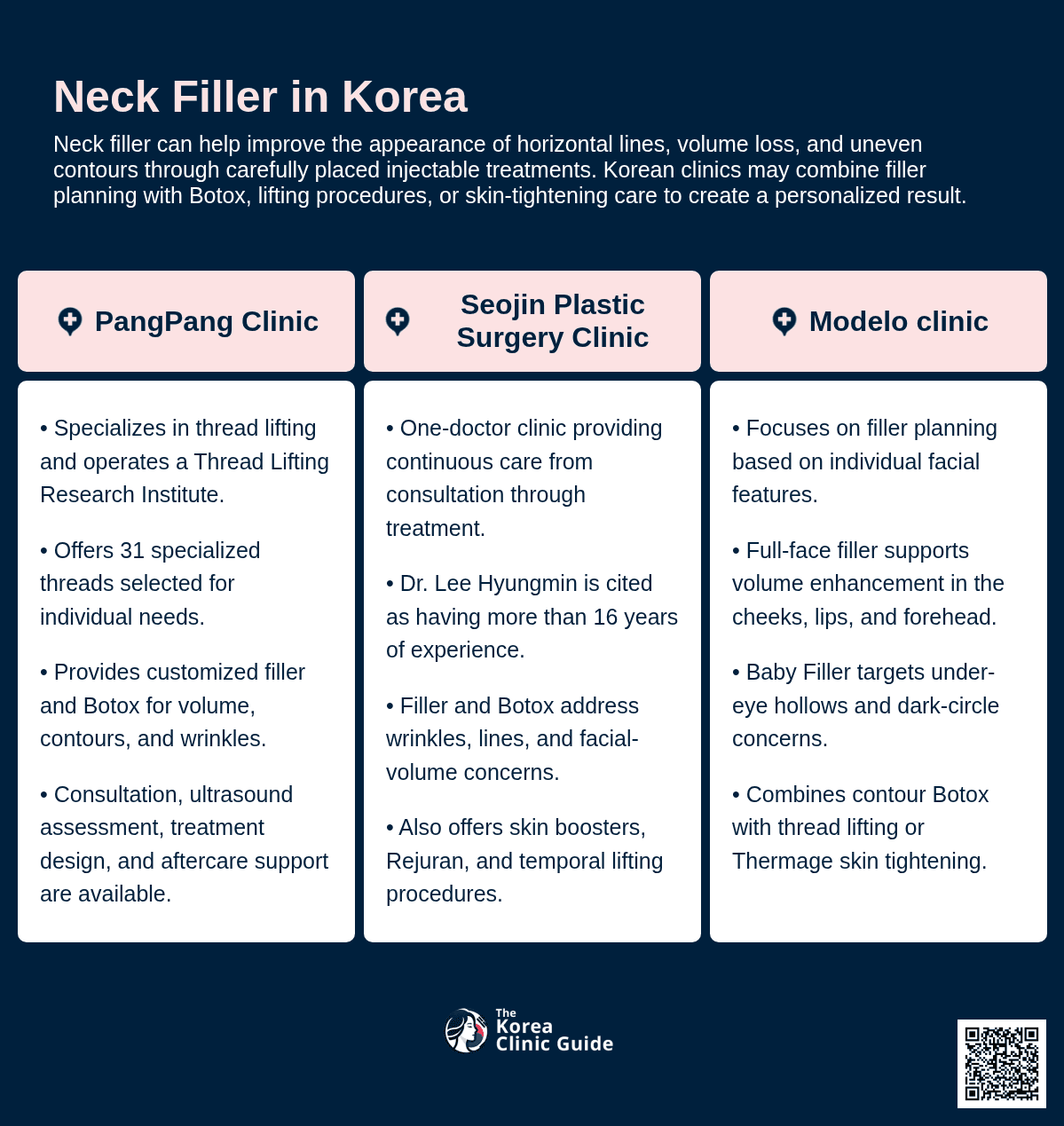
1. PangPang Clinic
You may consider PangPang Clinic if you want your neck-filler discussion placed within a personalized plan that can also address laxity and contour concerns with its specialized thread-lifting expertise. Its team uses individualized consultations and a broad selection of thread types, while also offering customized filler and Botox treatments.
- URL: PangPang Clinic Website
- Location: Gangnam-gu, Seoul
- Lifting expertise:
- The clinic focuses its research and clinical practice on thread lifting and operates a Thread Lifting Research Institute.
- Its approach includes 31 specialized functional threads, selected and customized to individual needs.
- Thread-lifting planning can include ultrasonic visual assessment and pre-procedure design.
- Related treatment options:
- Customized filler and Botox treatments are available for volume, facial-structure, and wrinkle concerns.
- Thread lifting is offered for the neck as well as facial and body areas; treatment plans may combine lifting-focused approaches with injectables when appropriate.
- A revision service is available for concerns following a previous thread-lifting procedure and may include filler, Botox, or laser treatments.
- Treatment planning and aftercare:
- A dedicated consultation center is described as tailoring treatment plans to your needs.
- Thread-lifting care includes an aftercare package intended to support and prolong treatment effects.
- The medical team participates in international beauty conferences through invited lectures and presentations.
2. Seojin Plastic Surgery Clinic
You may consider Seojin Plastic Surgery Clinic for a neck-filler consultation if you value direct, continuous care from one physician: Dr. Lee Hyungmin provides end-to-end care in this one-doctor clinic, which also offers filler and Botox among its dermatology injectables.
- URL: Seojin Plastic Surgery Clinic Website
- Location: Gangnam-gu, Seoul
- Physician continuity:
- Dr. Lee Hyungmin provides comprehensive care from consultation through treatment as part of the clinic’s one-doctor model.
- The source cites more than 16 years of experience and recognition as one of the 100 Good Doctors in Korea.
- Related injectable care:
- Filler and Botox are offered for smoothing lines and wrinkles and restoring facial volume.
- Skin-booster injections and Rejuran are also listed among the clinic’s dermatology services.
- A temporal lift is available as a lesser-invasive lifting option for the lateral brow and eye area.
3. Modelo clinic
You may consider Modelo clinic if you want filler planning centered on your individual features rather than a trend-driven look. The clinic offers full-face filler for immediate volume enhancement and combines this with contour Botox and lifting options tailored to skin characteristics and aging concerns.
- URL: Modelo clinic Website
- Location: Gangnam-gu, Seoul
- Filler and contour options:
- Full-face filler is offered for areas including the cheeks, lips, and forehead, with immediate volume enhancement described.
- Baby Filler targets under-eye hollows and dark-circle concerns.
- Contour Botox is designed to refine facial definition and balance.
- Complementary lifting care:
- Lifting treatment is tailored to your skin characteristics and aging concerns.
- Thread lifting is offered to lift and tighten sagging skin, with immediate results and collagen stimulation over subsequent months.
- Comfort Thermage uses radiofrequency energy for gradual skin tightening and smoothing.
Neck Filler From Start to Finish
- Virtual inquiry and screening — Send unfiltered front and side photographs and explain whether the concern is fixed horizontal lines, vertical bands, loose skin, or submental fullness. Request English-language or interpreter-supported consultation where needed.
- Medical-history review — Disclose prior filler, threads, surgery, energy devices, allergy history, bleeding problems, skin conditions, medicines, supplements, pregnancy or breastfeeding status, recent illness, vaccination, dental work, and skin-barrier procedures.
- Travel coordination — Book treatment early enough to remain in Korea for roughly 72 hours afterward. Confirm the clinic’s after-hours contact method, emergency pathway, and remote-review process before arrival.
- In-person assessment — The injector examines the neck at rest and in movement, assessing line depth, skin thickness, crepiness, laxity, platysmal activity, submental fat, scars, and signs of prior material. Routine laboratory tests are not generally required for an otherwise healthy filler patient; history and examination are central to safe planning.
- Consent and product confirmation — Confirm the injector’s identity, the proposed material, injection depth, instrument, expected number of sessions, risks, maintenance plan, and total volume in mL. Obtain the product name, manufacturer, lot number, expiry date, and lidocaine content in writing.
- Skin preparation and numbing — Makeup and skincare are removed, the neck is cleansed, and treatment lines are marked. Topical anesthetic can be used; fasting is generally unnecessary when only topical or local anesthetic is planned.
- Injection — The clinician injects HA with a needle or cannula into selected horizontal lines, or uses a different plan for biostimulation or combination treatment. Injection commonly takes about 15–45 minutes, although numbing and consultation extend the appointment.
- Immediate assessment and discharge — The clinician checks skin color, pain, capillary refill, swelling, and symmetry. Leave with written aftercare, emergency contacts, and a complete treatment record.
- Early recovery and review — Expect mild redness, tenderness, swelling, itching, bruising, or short-lived lumpiness. Avoid judging the result on injection day; a practical review point is around 2 weeks, while published HA studies often found maximal improvement around 1 month.
- Overseas follow-up — Send agreed photographs to the clinic after returning home and retain the record permanently. Seek urgent local assessment rather than relying on messaging for severe pain, blanching, dusky discoloration, visual symptoms, or neurologic symptoms.
Alternatives to Neck Filler
Filler is best for static horizontal furrows. Non-surgical alternatives can address muscle activity, texture, mild laxity, or submental fullness but do not physically fill a deep crease; surgical treatment offers greater correction for redundant skin and descent but involves more recovery and risk.
Neck Wrinkle Treatment
- Best for — Fine crepiness, uneven texture, pigment concerns, or superficial lines rather than a deep fixed furrow.
- Tradeoff — Neck wrinkle treatment can focus on resurfacing or skin quality but usually requires a series and does not provide the immediate structural support of HA filler.
Neuromodulator for Platysma
- Best for — Dynamic vertical platysmal bands caused by muscle contraction.
- Tradeoff — Facial Botox can reduce muscle-driven banding but is not a direct treatment for a static horizontal neck line.
Collagen Biostimulation
- Best for — Diffuse crepiness or mild laxity where gradual skin-quality improvement is more important than correcting one crease.
- Tradeoff — Collagen booster treatment with CaHA or PLLA is less readily reversible than HA and develops over weeks to months.
Energy-Based Tightening
- Best for — Selected mild laxity without substantial redundant skin.
- Tradeoff — Ultherapy lifting or Thermage lifting can support tightening but does not fill a deep horizontal furrow.
Thread Lift or Neck Lift
- Best for — Tissue descent or more substantial laxity; surgery is most relevant when redundant skin is the main problem.
- Tradeoff — Neck thread lift has a shorter recovery than surgery but limited correction for major excess skin. A neck lift is more invasive and requires a materially longer recovery period.
How Can I Prepare for Neck Filler?
- Disclose medicines and supplements — Give the injector a complete list of aspirin, NSAIDs, anticoagulants, antiplatelet drugs, corticosteroids, diabetes medicines, immunosuppressants, fish oil, vitamin E, ginkgo, garlic, and herbal products. These can affect bruising, bleeding, immunity, or healing.
- Do not stop prescriptions independently — Do not stop anticoagulants, antiplatelet drugs, corticosteroids, diabetes medicines, or immunosuppressants for a cosmetic procedure without explicit instructions from the prescribing clinician and injector.
- Avoid alcohol — Avoid alcohol for about 24 hours before and after treatment where feasible to reduce flushing and bruising risk.
- Arrive with calm skin — Do not attend with sunburn, shaving cuts, an active rash, dermatitis flare, open wound, or infection on the neck. Report recent dental work, vaccination, laser treatment, peeling, microneedling, or acute illness before travelling to the appointment.
- Fasting and transport — Fasting is usually unnecessary for topical or local anesthetic. If oral sedation is planned, follow the clinic’s fasting instructions, arrange a companion, and do not drive or travel alone afterward.
- Limit nicotine exposure — Avoid smoking and vaping where possible because nicotine can adversely affect circulation and healing.
- Plan accommodation and flights — Stay locally for about 3 days after injection, keep onward travel flexible, and save the clinic’s 24-hour contact number.
Travel note: Schedule the appointment early in the trip, not the day before an international departure. The 72-hour stay recommendation is a precaution because vascular occlusion can have delayed presentation.
Confirm the treating doctor’s clinic-specific requirements; individualized instructions take precedence over general preparation guidance.
Aftercare Advice
Protect the treated neck from pressure, heat, friction, and delayed assessment during the first days after injection.
- Control swelling — Use a clean cloth-wrapped cool compress intermittently for comfort. Mild tenderness, redness, swelling, itching, bruising, and small injection-site bumps are common temporary effects.
- Avoid pressure and manipulation — Do not rub, massage, use gua sha or neck-massage devices, wear tight collars, or apply sustained pressure unless the injector specifically instructs otherwise.
- Restrict heat and exertion — Avoid strenuous exercise, alcohol, saunas, very hot showers, substantial heat, and strong UV exposure for the first 24 hours. Use gentle skincare and apply broad-spectrum SPF 50 to exposed neck skin once the injection points are closed and calm.
- Delay aggressive skin treatments — Defer exfoliants, retinoids, laser, peeling, radiofrequency, microneedling, and other barrier-disrupting treatments until the injector confirms recovery is adequate.
- Know urgent warning signs — Seek immediate in-person assessment for severe or worsening pain; pale, white, gray, blue, dusky, or net-like purple skin; cool skin; blistering; delayed capillary refill; visual disturbance; facial weakness; speech difficulty; severe headache; dizziness; fever; drainage; or progressive redness and warmth. Do not self-massage or attempt home treatment.
- Review results at the right time — Do not judge the cosmetic outcome on injection day. Review around 2 weeks; maximal improvement in published HA neck-line studies has often been seen around 1 month. Duration depends on material, volume, line depth, skin quality, neck movement, and whether touch-up treatment is used.
Follow the treating doctor’s instructions over general advice and contact the clinic promptly when anything appears wrong.
Frequently Asked Questions
Related Blogs

Ear Filler in Korea: Candidacy, Safety, Recovery and Travel Planning
Ear filler uses small amounts of hyaluronic acid to restore soft earlobe volume or support an intact widened piercing, with results visible immediately and limited evidence suggesting 6–9 months of effect. The article covers candidate screening, procedure steps, recovery, travel planning, aftercare, urgent warning signs, and surgical alternatives for torn or structurally altered earlobes.
Updated: Oct 28, 2026
Erase Horizontal Forehead Lines with Forehead Filler: Advanced Treatments in Korea
Discover how Korea leads in treating horizontal forehead lines with advanced dermal fillers and Botox. This article explores the causes of static wrinkles, treatment options like hyaluronic acid, CaHA, and PLLA fillers, and the importance of expert practitioners in Korea’s top clinics. Learn about the procedure steps, safety considerations, and how Korea’s affordable, high-quality medical tourism
Updated: Oct 11, 2026
Bony Hands Solutions: Hand Filler Procedures in Korea for Fuller, Youthful-Looking Hands
Discover effective solutions for "bony hands" and veiny hand aging with Korea’s leading hand filler procedures. From hyaluronic acid fillers like Restylane to biostimulatory options such as Radiesse and Sculptra, Korea offers expert treatments to restore youthful volume. Enjoy short, minimally invasive treatments with immediate results, performed by certified Korean surgeons in a patient-focused m
Updated: Oct 10, 2026
Neck Wrinkles Solutions: Neck Filler Procedures in Korea for Smoother, Youthful Skin
Discover how Korea leads in neck wrinkle treatments with advanced Neck Filler procedures like hyaluronic acid, calcium hydroxylapatite, and poly-L-lactic acid. This comprehensive guide explores causes of neck aging, treatment techniques, costs, and patient experiences in Korea—a preferred medical tourism destination. Learn about Korea’s expert injectors, affordable pricing, and all-inclusive packa
Updated: Oct 8, 2026
Clinics offering Neck Filler

Hev Clinic Korea | Premium Sinsa Clinic for Skin, Laser & Injectables
Sinsa

Three Wishes Clinic - Myeongdong, Korea: Advanced Botox, Fillers, Laser, and Skin Treatments for Confidence and Care
Myeongdong

PangPang Clinic: Korea's Premier Thread Lifting and Skin Rejuvenation Specialist in Gangnam, Seoul
Sinsa

Seojin Plastic Surgery Clinic Korea: Pioneering Advanced Cosmetic Procedures for Personalized Aesthetic Transformation
Apgujeong