
Medical Tourism Blog
Lilied Skin Booster in Korea: Treatment Methods, Recovery, Safety, and Travel Planning
Table of contents
- Lilied Skin Booster at a Glance
- What Is a Lilied Skin Booster?
- Who Is a Good Candidate for a Lilied Skin Booster?
- How Is a Lilied Skin Booster Performed?
- Why Visit Korea for a Lilied Skin Booster?
- Key Information for International Patients
- Which Are the Best Clinics in Korea for Lilied Skin Booster?
- Lilied Skin Booster From Start to Finish
- Alternatives to a Lilied Skin Booster
- How Can I Prepare for a Lilied Skin Booster?
- Aftercare Advice
Considering treatment in Korea? Everything you need to know e.g. — how to avoid scams, visas, interpreters, recovery tips — in our Medical Tourism Master Guide. Plan with confidence in minutes, not weeks!
Last updated: September 2026
Lilied Skin Booster at a Glance
- What it is — Lilied M is a minimally invasive Korean-market injectable skin booster, marketed primarily for subtle hydration, radiance, suppleness, rough texture, and early fine lines rather than facial lifting or volume restoration.
- Best candidates — Adults with stable, non-inflamed skin who want gradual, temporary skin-quality improvement and accept that treatment may involve a planned series are the most suitable candidates.
- Treatment plan — An injector uses multiple superficial microinjections or a multi-needle device across selected areas such as the cheeks, forehead, perioral skin, or neck; a device changes delivery method, not proven results.
- Recovery — Normal non-strenuous activity is often possible the same day, but redness, pinpoint bleeding, swelling, tenderness, bruising, and small raised papules can be visible; allow 24–48 hours before an important event and longer if bruising occurs.
- Sessions and travel — Korean clinics commonly market 2–3 sessions spaced 3–4 weeks apart, so a full series requires repeat travel or follow-up at home; one uncomplicated session generally fits a 1–3-day Korea stay with about 24 hours of local reachability.
- Korea-specific check — Public descriptions of Lilied M conflict on whether it is pure hyaluronic acid or includes salmon-derived PN, so inspect the sealed carton and confirm the Korean IFU, ingredients, concentration, expiry date, and lot number before treatment.
- Key limitation and risk — Lilied M lacks product-specific controlled evidence establishing its ideal dose, durability, or advantage over other boosters, and facial HA injections carry a rare urgent vascular risk requiring prompt assessment for escalating pain, blanching, dusky discoloration, or visual symptoms.
What Is a Lilied Skin Booster?
Lilied Skin Booster is a hyaluronic-acid skin-quality treatment delivered through multiple small superficial injections. It aims to improve hydration, radiance, softness, rough texture, and early fine lines without reshaping the face or restoring substantial volume. It is a minimally invasive injectable procedure, not surgery.
Who Is a Good Candidate for a Lilied Skin Booster?
- Hydration and radiance goals — Good candidates are adults seeking subtle improvement in dehydrated-looking skin, dullness, rough texture, suppleness, and early fine lines rather than facial reshaping.
- Realistic expectations — Suitable patients accept a temporary, gradual skin-quality treatment and the possibility of a planned series rather than expecting a one-session lift or major volume correction.
- Stable skin condition — The treatment area should be free of sunburn, infected acne, open wounds, dermatitis, hives, rash, and an active cold-sore outbreak.
- Documented treatment history — Candidates can provide previous filler or skin-booster records, allergy history, current medicines and supplements, and details of any prior delayed swelling or nodule reaction.
Lilied M is not appropriate during pregnancy or breastfeeding because injectable hyaluronic-acid product safety has not been established in these settings. Defer treatment for active infection or inflammation, and obtain individualized assessment for immunosuppression, autoimmune or inflammatory disease, a bleeding disorder, anticoagulant or antiplatelet treatment, keloid tendency, and recent or imminent dental work, vaccination, or facial procedures. Do not independently stop prescribed aspirin, clopidogrel, warfarin, apixaban, rivaroxaban, or similar medicines for a cosmetic injection. A Lilied Skin Booster cannot replace structural lifting, scar release, treatment for active acne, rosacea or melasma, deep-volume restoration, or correction of substantial laxity.
How Is a Lilied Skin Booster Performed?
Lilied M has no confirmed patient-facing injectable subtypes. The useful distinction is how the agreed product is delivered and whether a clinic is proposing separate add-on treatments.
- Manual serial microinjections — The injector places small superficial deposits individually in selected areas such as the cheeks, forehead, perioral skin, neck, or other appropriate skin-quality targets. This permits targeted placement but can leave temporary raised papules.
- Multi-needle or stamp delivery — A multi-needle device can distribute product across a broader area more quickly. It is a delivery method, not evidence that Lilied M produces better results or less discomfort.
- Combination protocols — Some Korean clinics pair a booster injection with PN/PDRN, botulinum toxin, microneedling, lasers, or soothing care. Treat each as a separate procedure with its own product, indication, risks, evidence, regulatory status, and aftercare.
- Needle-free devices — Avoid “hyaluron pen” treatment. A pressure device does not provide the controlled medical injection technique needed for an injectable skin booster.
Why Visit Korea for a Lilied Skin Booster?
Lilied is marketed as a Korean hyaluronic-acid hydration skin-booster brand, and Lilied M is commonly encountered in Korean aesthetic-clinic menus. Korea is therefore a practical place to access the product, but access alone does not establish product superiority. The central issue for an international patient is confirming exactly what is in the sealed product and what is being injected.
- Korean-market product access — The manufacturer-facing Lilied brand site presents Lilied as a hydration-focused, hyaluronic-acid skin-booster brand operated by BMI Korea Aesthetics.
- Common course scheduling — Korean commercial materials commonly propose 2–3 sessions spaced about 3–4 weeks apart, although this is a commercial protocol rather than a universal evidence-based schedule for Lilied M, as shown in Korean clinic brand material.
- Treatment-day verification — Public marketing descriptions conflict: some describe Lilied M as HA plus salmon-derived PN, while a clinic product matrix distinguishes Lilied M as HA and PN-containing variants separately. Request the carton, Korean IFU, ingredient list, concentration, expiry date, and lot number before consenting; the discrepancy is documented in published clinic product information.
- Evidence limitation — No product-specific controlled clinical evidence located establishes Lilied M’s magnitude of benefit, duration, ideal dose, injection plane, maintenance interval, or advantage over other skin boosters. Do not treat promotional claims about collagen, pain, papules, or absorption as established outcomes.
Key Information for International Patients
- Minimum stay — An uncomplicated single treatment generally fits a 1–3-day Korea stay. Arrange consultation and treatment on day 1, then remain locally reachable for about 24 hours in case an early injection complication requires assessment.
- Repeat sessions — A 2–3-session commercial induction plan at 3–4-week intervals requires a 2–3-month stay, repeat travel, or continuation with a qualified clinician at home. There is no evidence-based requirement to complete the series in Korea.
- Flight timing — No Lilied M-specific safe-flight interval has been established. Avoid flying on treatment day and postpone travel for escalating pain, blanching, progressive dusky discoloration, visual symptoms, or substantial swelling.
- Itinerary impact — Normal non-strenuous activity is often possible the same day, but pinpoint bleeding, redness, tenderness, swelling, bruising, and injection papules can be visible. Leave 24–48 hours before an important event and longer when bruising occurs.
- Remote follow-up — Before departure, obtain an English record stating the exact product name, lot or batch number, total volume, injected areas, method, anesthetic or medicines used, photographs, after-hours contact route, and the clinic’s plan for delayed concerns.
Travel note: Facial hyaluronic-acid injection has a rare but time-sensitive vascular risk. Choose a clinic that can explain who performs the injection, how urgent complications are handled, and whether hyaluronidase is immediately available for a suspected HA-related vascular event.
Which Are the Best Clinics in Korea for Lilied Skin Booster?
Listed below are some of the best clinics in Korea for lilied skin booster.
1. ID Hospital - Sinsa
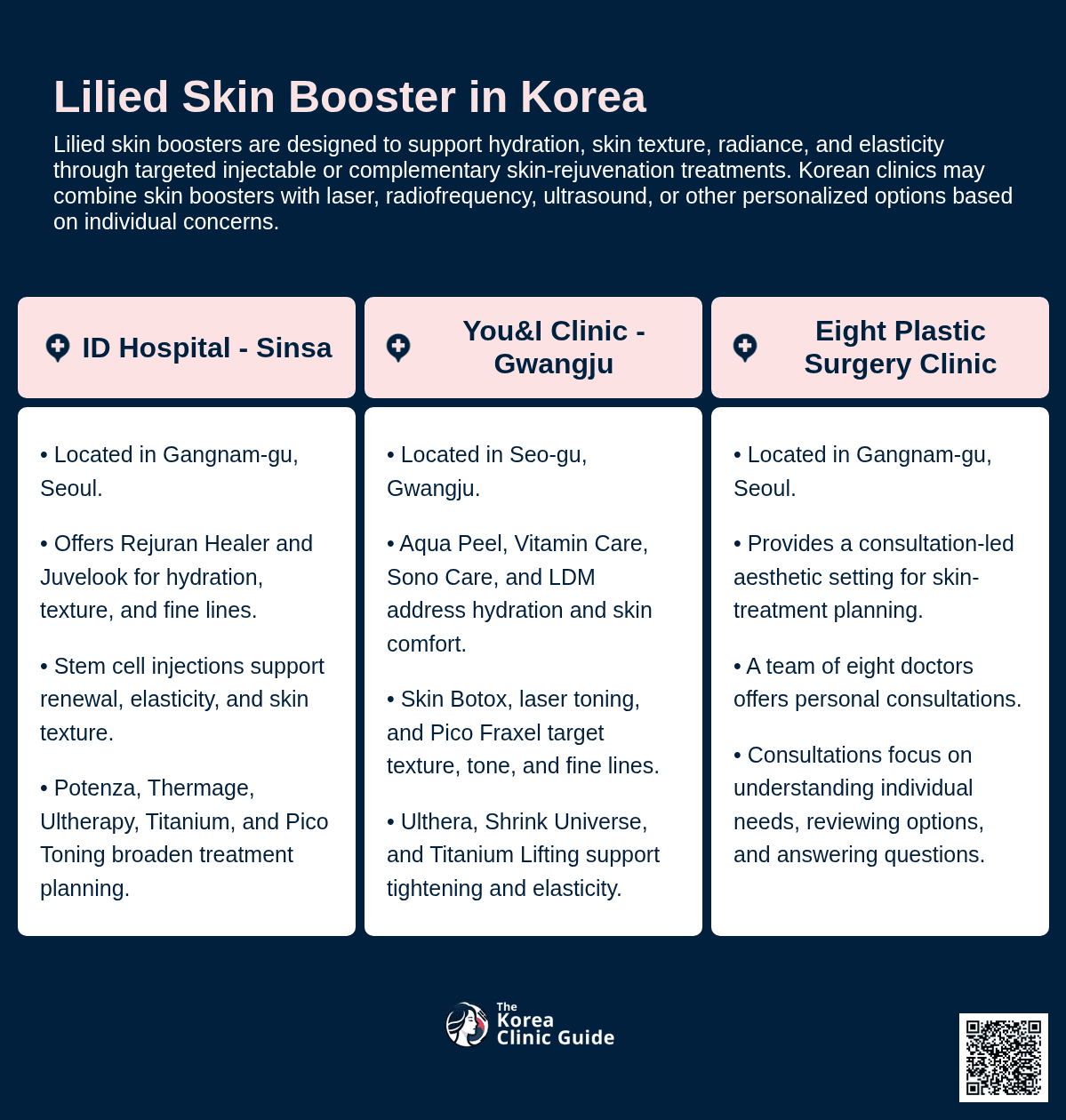
For your Lilied Skin Booster planning, ID Hospital - Sinsa offers several documented skin-rejuvenation options that can help frame a consultation around hydration, texture, fine lines, and elasticity. Its listed treatments include Rejuran Healer, Juvelook, stem cell injection, and Potenza RF microneedling, allowing you to discuss whether complementary or alternative skin-quality approaches fit your concerns.
- URL: ID Hospital - Sinsa Website
- Location: Gangnam-gu, Seoul
- Skin-quality treatments:
- Rejuran Healer is listed for skin revitalization, fine lines, wrinkles, and overall texture.
- Juvelook is listed for hydration, texture, and fine lines.
- Stem cell injection is described as delivering stem cell-derived components into the skin to support repair, renewal, elasticity, and texture.
- Potenza RF microneedling is listed as customizable for texture, pores, acne scars, and elasticity.
- Energy-based options:
- Thermage and Ultherapy are listed for collagen-focused skin tightening and elasticity support.
- Titanium is described as combining lifting, tightening, and skin-tone improvement.
- Pico Toning is listed for pigmentation and a more even skin tone.
2. You&I Clinic - Gwangju
For your Lilied Skin Booster inquiry, You&I Clinic - Gwangju has a documented mix of hydration-focused skincare, skin-smoothing injectables, laser toning, and ultrasound-based care that may be relevant when discussing dullness, texture, fine lines, or sensitive skin.
- URL: You&I Clinic - Gwangju Website
- Location: Seo-gu, Gwangju
- Skin-focused care:
- Aqua Peel is listed for cleansing, exfoliation, hydration, pore care, and removal of dead skin cells.
- Vitamin Care is described as supporting radiance and hydration.
- Sono Care uses ultrasound to support deeper penetration of skincare products and improve hydration and texture.
- LDM is listed for hydration, regeneration, and acne-related concerns.
- Texture and tone options:
- Skin Botox is listed as a microinjection treatment for subtle skin smoothing and fine lines.
- Laser Toning, Dual Toning, and Pico Toning are listed for pigmentation, texture, and overall skin clarity.
- Pico Fraxel is listed for scars, fine lines, and texture.
- Lifting treatments:
- Ulthera and Shrink Universe are listed as focused-ultrasound treatments for non-surgical lifting and tightening.
- Titanium Lifting is listed for skin tightening, elasticity, and sagging concerns.
3. Eight Plastic Surgery Clinic
You may consider Eight Plastic Surgery Clinic if you want a consultation-led aesthetic setting while exploring Lilied Skin Booster in Korea: the clinic states that a team of eight doctors provides personal consultations to understand your needs, discuss options, and address questions before you decide on treatment.
- URL: Eight Plastic Surgery Clinic Website
- Location: Gangnam-gu, Seoul
Lilied Skin Booster From Start to Finish
- Remote enquiry and screening — Send unfiltered facial photographs, treatment goals, medical and allergy history, previous injectable records, medication and supplement list, cold-sore history, and travel dates. Ask whether English consultation is available by message, video, or in person.
- Plan confirmation — Confirm that the booking is for Lilied M alone or identify every additional injection, device, or medication separately. Request the expected treatment areas, total volume, delivery method, estimated appointment time, and after-hours contact process.
- In-person assessment — The clinician examines the skin for infection, inflammation, acne lesions, dermatitis, or a herpes outbreak and decides whether the concern is suitable for hydration treatment rather than pigment, scarring, rosacea, laxity, or volume correction.
- Product and consent check — Inspect the sealed carton and verify the exact product name, ingredient list, concentration, intended use, expiry date, and lot number against the Korean IFU. This is especially important because public Lilied M ingredient descriptions are inconsistent.
- Skin preparation and anesthesia — Makeup is removed, the area is cleansed and disinfected, and topical anesthetic is often applied. Local anesthetic use depends on the product, planned areas, and injector’s technique; fasting is not usually needed unless oral or IV sedation is planned.
- Injection — The injector places multiple small intradermal or superficial deposits with serial needle injections or a multi-needle device according to the agreed plan. Treatment duration depends on area coverage, delivery method, anesthetic time, and whether separate procedures are added.
- Immediate observation and discharge — Cooling or brief observation can follow. Review expected redness, papules, swelling, tenderness, and bruising; obtain written aftercare and urgent warning signs before leaving.
- Overseas follow-up — Send standardized photographs if requested after short-term swelling has settled. Share the Korean treatment record with any clinician treating a delayed reaction at home, rather than relying on a generic description of the product.
Alternatives to a Lilied Skin Booster
The right alternative depends on the underlying concern. Injectable hydration boosters are non-surgical options for modest skin-quality goals; they do not correct major laxity, contour loss, tethered scars, active inflammatory disease, or pigment disorders. More intensive treatments can address those concerns more directly but bring different downtime, risks, and evidence.
Other HA Skin Boosters
- Best for — Patients seeking a similar hydration, texture, and radiance objective with a different hyaluronic-acid formulation or injection protocol.
- Tradeoff — Products, injection planes, treatment schedules, and supporting evidence are not interchangeable. Explore skin booster treatment or hydro injection after confirming the exact product.
Rejuran and PN/PDRN Injections
- Best for — Patients considering a polynucleotide- or PDRN-based product category rather than an HA-focused booster.
- Tradeoff — Do not assume PN/PDRN is contained in Lilied M or that outcomes are equivalent. See Rejuran Healer or PDRN injection.
PRP Facial Treatment
- Best for — Patients who prefer an autologous approach using processed blood from the patient.
- Tradeoff — PRP protocols, preparation, evidence, and suitability differ from manufactured injectable boosters. Read about PRP facial treatment.
Skin Botox
- Best for — Selected concerns involving oiliness, pores, and fine dynamic texture.
- Tradeoff — It does not replace a hydration treatment and carries botulinum-toxin-specific risks. Consider skin botox.
Collagen Boosters or Structural Treatment
- Best for — Laxity, deeper texture concerns, or structural volume loss requiring a different treatment target.
- Tradeoff — Collagen stimulators, conventional filler, energy-based devices, and surgery have different recovery periods and complication profiles. Collagen booster treatment is one non-surgical option; facial lifting or volumization needs a separate anatomical assessment.
How Can I Prepare for a Lilied Skin Booster?
- Medical disclosure — Provide every prescribed medicine, over-the-counter drug, supplement, allergy, previous filler or skin-booster treatment, bleeding or bruising history, autoimmune or inflammatory condition, and history of delayed reactions.
- Blood-thinning medicines — Tell the injector about aspirin, clopidogrel, warfarin, apixaban, rivaroxaban, NSAIDs, fish oil/omega-3, vitamin E, ginkgo, garlic, and high-dose turmeric. Do not stop prescribed anticoagulant or antiplatelet medication unless the prescribing clinician and injector provide an individualized plan.
- Skin and infection check — Reschedule for sunburn, open lesions, infected acne, dermatitis, rash, hives, an active herpes outbreak, or a significant inflammatory flare. Disclose cold sores so the clinician can decide whether prescription antiviral prophylaxis is appropriate.
- Food and alcohol — Eat and hydrate normally for topical or local-anesthetic microinjection. Fast only when oral or IV sedation is planned. Avoid alcohol when instructed because it can worsen flushing and bruising.
- Appointment day — Arrive without makeup when possible and avoid arranging waxing, peels, microneedling, lasers, or another facial procedure around the injection without agreement from the injector.
- Travel planning — Book flexible transport, avoid a treatment-day flight, and remain reachable in Korea for about 24 hours. A companion and private transport are generally unnecessary unless sedating medication is used.
Travel note: Do not schedule the injection immediately before a wedding, professional filming, or long-haul departure; bruising and visible papules can outlast same-day redness.
Confirm the clinic’s product-specific requirements and the treating doctor’s individualized instructions, which take precedence over this general guidance.
Aftercare Advice
Protect the treated skin, avoid heat and pressure, and act immediately on unusual pain or color change.
- First 24–48 hours — Use gentle skincare and avoid rubbing, massage, gua sha, vigorous exercise, sauna or steam rooms, hot yoga, very hot showers, alcohol, intense sun, and tanning.
- Skincare and procedures — Avoid abrasive exfoliation, retinoids, strong acids, facial waxing, peels, microneedling, lasers, and other facial treatments until the injector clears them. Cleanse and use makeup only according to the clinic’s instructions.
- Sun protection — Apply broad-spectrum SPF 50 once the skin tolerates normal skincare, particularly when redness or bruising is present, and avoid direct intense sun exposure.
- Expected reactions — Small raised papules, pinpoint bleeding, redness, tenderness, swelling, itch, and bruising can occur immediately. Judge the result only after early swelling settles and, where planned, after the treatment series.
- Urgent warning signs — Contact the injector urgently and seek emergency assessment for severe or escalating pain, pale or blanching skin, coolness, spreading blue-purple or netlike discoloration, blisters, skin breakdown, visual disturbance, severe headache, weakness, speech difficulty, or other neurological symptoms. These can indicate vascular compromise; pain can be absent or masked by anesthetic.
- Delayed concerns — Report persistent nodules, worsening redness or heat, pus, fever, progressive swelling, or a suspected allergic reaction. Keep the product and lot details available for any clinician assessing the problem.
Follow the treating doctor’s instructions over general advice and contact the clinic promptly when anything appears wrong.
Frequently Asked Questions
Related Blogs
Dehydrated Lips Treatment with Hydro Injection in Korea: Effective Solutions for Moisturizing and Rejuvenation
Discover the benefits of Hydro Injection in Korea, a leading solution for dehydrated lips caused by cheilitis and related conditions. This minimally invasive procedure uses hyaluronic acid-based treatments to deeply hydrate, smooth, and rejuvenate lips, addressing issues such as chapped lips and fine lines. Korea’s advanced clinics offer expert care, streamlined processes, and cost-effective optio
Updated: Oct 3, 2026
Allergic Pigmentation Treatment with Pico Toning in Korea: Effective Solutions for Clear Skin
Discover how Pico Toning laser treatment in Korea effectively addresses Post-Inflammatory Hyperpigmentation (PIH), also known as allergic pigmentation or post-inflammatory brown spots. This advanced skin pigmentation procedure uses ultra-short pulses to break down melanin, making Korea a top destination for safe, affordable, and expert care. Learn about the treatment process, benefits, costs, and
Updated: Oct 3, 2026
Sallow Complexion Solutions: Skin Whitening Injection Treatment in Korea for Radiant Skin
Discover how Korea leads in medical tourism for skin whitening and treatment of sallow complexion. This blog explores causes like anemia and vitamin deficiencies, details Korea’s innovative skin whitening injections—featuring glutathione, vitamin C, and tranexamic acid—outlining procedures, costs, and patient experiences. Learn how Korea’s advanced clinics offer safe, effective treatments to brigh
Updated: Oct 2, 2026
Effective Korea PDRN Injection Treatments for New Stretch Marks
Discover how PDRN injections in Korea offer an advanced treatment for new stretch marks (striae rubrae). Known for stimulating collagen, elastin, and skin regeneration, Korea's expert clinics provide effective solutions for early-stage stretch marks. Benefit from cutting-edge techniques in medical tourism-friendly environments, with affordable costs and proven results. Learn how Korea’s PDRN tre
Updated: Oct 1, 2026
Clinics offering Lilied Skin Booster

ID Hospital - Sinsa, Korea: Experience Advanced Cosmetic Procedures for Facial and Body Contouring, Skin Rejuvenation and More
Sinsa

VandS Dermatology Clinic - Dongtan, Korea: Comprehensive Skin Care and Cosmetic Procedures for Youthful, Radiant Skin
Hwaseong

Personal Beauty GU Clinic Ilsan, Korea - Unveiling Hidden Beauty with Tailored Treatments and Advanced Cosmetic Procedures
Ilsan
VandS Clinic - Pangyo: Leading Advanced Medical Procedures in Korea for Enhanced Beauty and Health
Pangyo