
Medical Tourism Blog
Mole Removal in Korea: Safe and Effective Mole Removal Procedures for Clearer Skin
Table of contents
- Understanding Benign Moles (Unwanted Nevi)
- Detailed Medical Procedures for Mole Removal
- Which Are the Best Clinics in Korea for Mole Removal Search?
- The Process of Getting Mole Removal in South Korea for Medical Tourists
- Costs Associated with Mole Removal in South Korea and Global Comparison
- Patient Experiences and Outcomes: Addressing Issues
- Conclusion: Making an Informed Decision
- References
Considering treatment in Korea? Everything you need to know e.g. — how to avoid scams, visas, interpreters, recovery tips — in our Medical Tourism Master Guide. Plan with confidence in minutes, not weeks!
Moles, known in medical terms as melanocytic nevi, are common skin growths caused by clusters of melanocytes, the pigment-producing cells in our skin. Most moles are benign, or non-cancerous, but many people choose to have them removed. Reasons for this can include cosmetic concerns, especially if a mole is in a highly visible spot like the face or hands, or physical discomfort if the mole gets irritated by clothing or jewelry.
This guide is intended to provide clear, expert-level information for anyone researching "mole removal," particularly for an "unwanted benign nevus," with a focus on procedures, costs, and the medical tourism experience in South Korea. Here, you'll find details on different removal methods, the patient process in Korea, costs compared internationally, and patient experiences. By the end, you'll have the knowledge you need to make well-informed and safe decisions about your skin health and cosmetic goals.
Understanding Benign Moles (Unwanted Nevi)
A benign nevus is a non-cancerous lesion made up of clusters of melanocytes. These moles usually develop during childhood or adulthood and tend to look round or oval, uniform in color (from tan and brown to pink or black), and typically range in size from 1–3 mm, though some can be larger.
Common Pseudonyms for "Benign Nevus"
Moles go by several names, such as "melanocytic nevus" or "nevocytic nevus." Some variations include:
- Common Mole
- Acquired Nevi: Develop after birth, often in childhood or adulthood.
- Compound Nevi: Raised, often skin-colored, where melanocytes are in both shallow and deep layers.
- Intradermal Nevi (also Dermal Nevi or Cellular Nevi): Flesh-colored, dome-shaped; melanocytes are deep within the dermis.
- Junctional Melanocytic Nevi: Flat, dark, and found where skin surface layers meet.
- Atypical Nevi (Dysplastic Nevi): Larger, irregular, and often monitored or removed due to melanoma resemblance.
- Blue Nevi: Small, blue or black spots, usually harmless but occasionally can turn cancerous.
- Spitz Nevi: Pink, raised, benign but often monitored for melanoma similarities.
- Seborrheic Keratoses: Waxy, rough lesions that resemble melanoma but are benign.
Distinguishing Benign Moles from Suspicious Lesions
Although most moles are harmless, some can become melanoma, a serious form of skin cancer. Atypical nevi, for instance, are more closely watched because they can look like melanoma. Cellular blue nevi or giant congenital nevi may also have a higher chance of malignancy.
Any new mole, or changes in an existing one—like growth, itching, bleeding, color, or shape changes—warrant prompt attention from a dermatologist. Only a professional, using exams, dermoscopy, or biopsy, can truly determine whether a mole is benign.
While online resources can help guide you, they can't replace a dermatologist’s expertise, especially since medical terminology can be confusing and some benign lesions may look like melanoma.
Watch for the ABCDEs of melanoma:
- A - Asymmetry: One half doesn’t match the other.
- B - Border: Irregular, ragged, or blurred edges.
- C - Color: Multiple shades or uneven coloring.
- D - Diameter: Larger than 6mm, though melanomas can be smaller.
- E - Evolution: Any changes in appearance or sensation.
Detailed Medical Procedures for Mole Removal
Choosing a mole removal method depends on the size, depth, location, and the possibility of malignancy. Dermatologists usually perform these procedures, but plastic surgeons may be involved for larger or sensitive-area moles.
Surgical Excision
This common method is used for deeper or larger moles. After numbing the area, the doctor uses a scalpel to remove the whole mole and a small margin of healthy skin. The tissue is sent for a biopsy to rule out cancer. Excision leaves a linear scar, which typically fades, but aftercare is essential.
Shave Excision
Ideal for raised, superficial moles. The doctor numbs the skin and shaves the mole flush with the surrounding skin. No stitches are needed, healing is fast, and scarring is minimal, but there's a moderate chance the mole could regrow. Not suitable if there's any suspicion of cancer.
Laser Removal
A focused laser targets and destroys mole pigment. Best for small, flat, or superficial pigmented moles where a biopsy isn’t necessary. The laser can't reach deep tissue and destroys the mole, making a biopsy impossible. There’s a higher chance of regrowth and potential pigment changes.
Cryotherapy (Liquid Nitrogen)
This non-invasive method freezes the mole, causing it to slough off over days or weeks. It’s mainly used for small, superficial moles. No incisions or stitches required, but it also prevents biopsy and may require repeat treatments.
Electrocautery
Uses heat from electrical current to target and remove mole tissue with precision. Suitable for deeper or pedunculated (stalked) moles, often leaving a small, flat scar. Tissue can still be sent for biopsy.
Comparative Overview
Each procedure balances invasiveness, scarring, and ability to provide a biopsy. More invasive methods like surgical excision are better for thorough diagnosis but can leave larger scars. Less invasive techniques, such as laser or cryotherapy, offer faster healing and a more cosmetic result but cannot confirm if a mole is truly benign.
| Procedure Type | Description | Primary Suitability | Biopsy Possible? | Typical Scarring | Recurrence Risk | Healing Time |
|---|---|---|---|---|---|---|
| Surgical Excision | Scalpel removes entire mole + margin, stitches | Deeper or suspicious moles | Yes | Linear scar (fading) | Low | 2-3 weeks |
| Shave Excision | Shaves raised mole at skin level | Raised, benign moles | Limited | Minimal, flat scar | Moderate | 7-10 days |
| Laser Removal | Destroys pigment with light | Superficial, small moles | No | Minimal; pigment changes | High | 1-2 weeks |
| Cryotherapy | Freezes off mole | Small, shallow moles | No | Minimal; temporary change | Moderate | 1-4 weeks |
| Electrocautery | Burns mole tissue with electric current | Flat/raised, deeper moles | Yes | Small, flat scar | Low | 7-14 days |
Which Are the Best Clinics in Korea for Mole Removal Search?
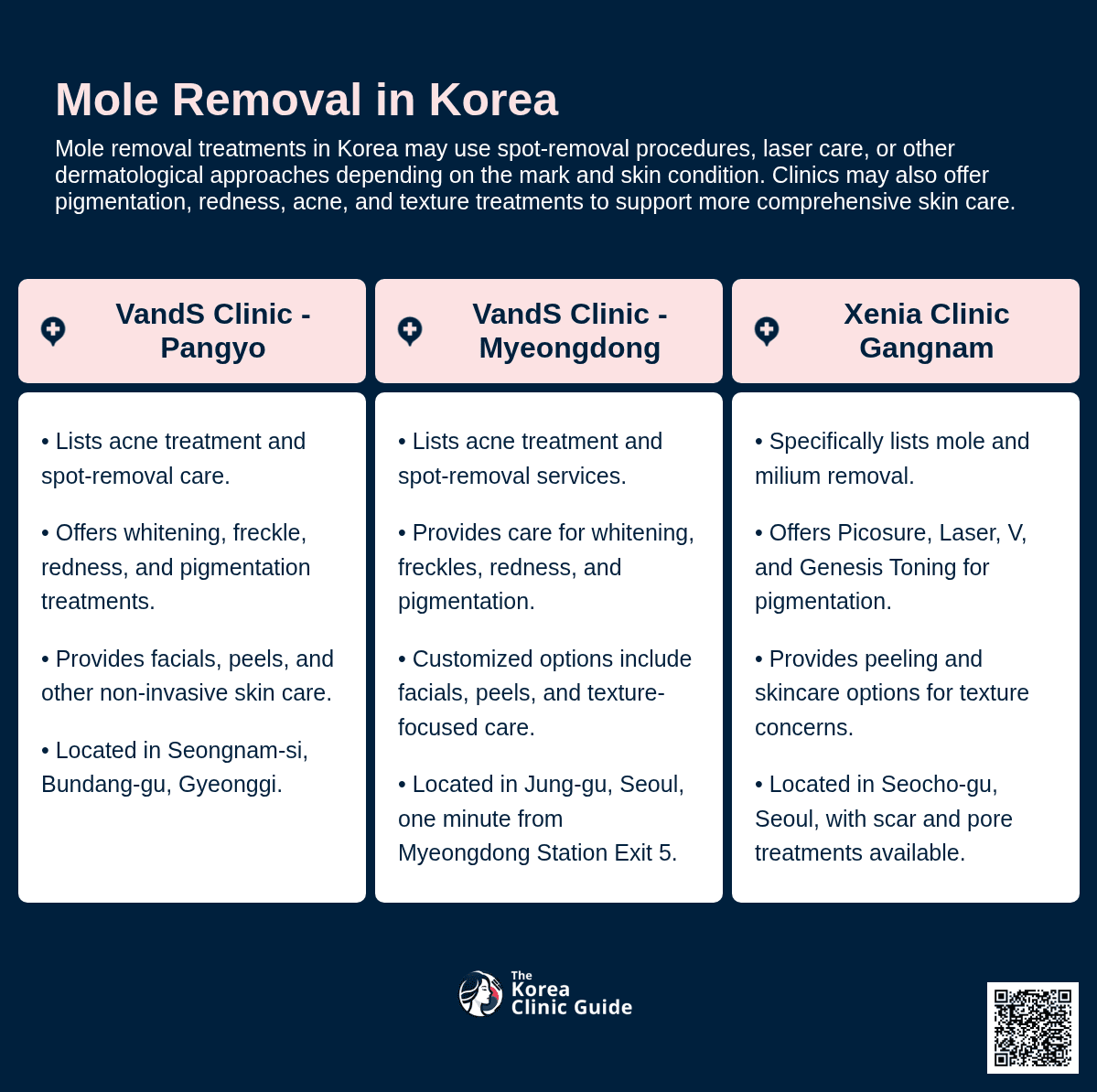
Listed below are some of the best clinics in Korea for mole removal search.
1. VandS Clinic - Pangyo
For a mole-removal search, VandS Clinic - Pangyo lists spot-removal care alongside acne-focused and pigmentation treatments. You may be able to discuss the specific mark you want addressed and whether complementary care for discoloration, redness, or overall skin texture is appropriate.
- URL: VandS Clinic - Pangyo Website
- Location: Seongnam-si Bundang-gu, Gyeonggi
- Related skin care:
- Acne treatment and spot removal are listed, using topical or laser-based approaches.
- Whitening, freckles, redness, and pigmentation treatments are available for uneven tone and visible discoloration.
- Skincare options include facials, peels, and other non-invasive treatments.
2. VandS Clinic - Myeongdong
You may consider VandS Clinic - Myeongdong for its listed acne and spot-removal services, with additional pigmentation and customized skincare options if you also want to address uneven tone, redness, freckles, or texture. The branch is described as a one-minute walk from Myeongdong Station Exit 5.
- URL: VandS Clinic - Myeongdong Website
- Location: Jung-gu, Seoul
- Related skin services:
- The clinic lists acne treatment and spot removal for blemishes and unwanted spots.
- Whitening, freckle, redness, and pigmentation care is available for tone-related concerns.
- Customized skincare may include facials, peels, and other treatments focused on skin texture and health.
3. Xenia Clinic Gangnam
For a mole-removal search, Xenia Clinic Gangnam specifically lists treatment for moles and milium within its pigmentation and redness services. You can also consider its range of toning, spot-pigmentation, peeling, and texture-focused treatments when your concerns extend beyond an individual lesion.
- URL: Xenia Clinic Gangnam Website
- Location: Seocho-gu, Seoul
- Mole removal: Moles/milium removal is specifically listed among the clinic’s pigmentation and redness procedures.
- Related pigment care:
- Picosure Toning, Laser Toning, V Laser, and Genesis Toning are listed for pigmentation and skin brightening.
- The clinic also lists melasma/spot-pigmentation and redness packages.
- Picosure tattoo removal is available separately.
- Additional skin options:
- Skincare and peeling choices include Aquapeel, PHA, Jessner, Aladdin, Black Peel, and Lhala Peel.
- Pico Fraxel, POTENZA, Fraxel, and Juvelook are listed for scar and pore concerns.
The Process of Getting Mole Removal in South Korea for Medical Tourists
South Korea is renowned worldwide for cosmetic dermatology and provides a streamlined process for international patients seeking mole removal.
- Initial Consultation & Diagnosis: Upon arrival, bring your passport and medical documents. Board-certified dermatologists will examine and use specialized tools (like dermoscopy) to assess your mole and discuss the best removal technique based on your goals and medical needs.
- Procedure Day: On procedure day, follow any pre-procedure steps (like fasting or pausing certain medicines). The area is numbed for comfort, and the chosen technique—laser, excision, shave, or cryotherapy—is performed. Post-care instructions and possible medications are provided.
- Post-Procedure & Follow-Up: Carefully adhere to care instructions and keep follow-up appointments to track healing and results. Healing times and aftercare depend on the procedure but commonly involve keeping the site clean and protected.
- Logistics: Plan your travel and accommodation for about a week to allow for consultation, treatment, and follow-up. Many clinics provide patient coordinators to assist with itineraries and translation.
Even in this efficient system, safety comes first: moles are closely examined before removal, demonstrating that high-end cosmetic care in Korea doesn’t come at the cost of thoroughness and safety.
Costs Associated with Mole Removal in South Korea and Global Comparison
South Korea offers advanced yet cost-efficient mole removal procedures, making it a top choice for medical tourists.
Cost in South Korea
Mole removal typically costs 20,000–200,000 KRW (about $30–$150 USD per mole). Small, simple procedures cost less; larger, deeper moles or multiple sessions cost more. Consultations ($10–$50) may be waived if the procedure is done the same day. Prices often bundle the procedure, consultations, and sometimes aftercare.
Factors That Affect Cost
- Size, number, and location of moles
- Removal method (laser, excision, etc.)
- Number of sessions needed
- Reputation of the clinic
- Discounts for multiple removals
International Price Comparison
There are stark differences between countries. In Korea, costs can be as low as $15 for simple treatment—much cheaper than:
| Country | Typical Cost Range (USD) | Notes |
|---|---|---|
| South Korea | $15 - $150 | Cheaper for simple moles, discounts for multiples |
| USA | $80 - $3,000 (Avg: $150-500) | Can vary widely depending on complexity, biopsy, or insurance coverage |
| UK | ~$320 - $850+ | Private clinics, extra for histology |
| Canada | $150 - $1,500 (Most: $400-650) | Often out-of-pocket for cosmetic removal |
| Australia | $50 - $500+ | Laser common, discounts for multiples |
With prices up to 90% lower than in the USA and significant savings over the UK, Canada, or Australia, South Korea’s affordability is a major draw for medical tourists. Clinics often optimize efficiency, encourage comprehensive treatment during single visits, and offer competitive pricing.
Patient Experiences and Outcomes: Addressing Issues
Most people who have mole removal, especially as medical tourists in South Korea, are pleased with the appearance and speed of recovery, and many highlight boosts in confidence and comfort. Clinics are praised for professional care, modern technology, and attentive staff. For visible areas, patients note significant satisfaction with their results and minimal scarring.
However, there are occasional drawbacks. Some patients may experience more noticeable pigmentation changes or even see their mole return, especially after non-excisional treatments. Hypertrophic or keloid scarring is rare, but possible. Very rarely, infections or a need for repeat procedures occur.
A vital patient concern is when biopsies aren’t performed, particularly after laser removal, which makes it impossible to rule out cancer. Patients should be proactive about insuring that every mole, regardless of how harmless it may seem, is properly assessed before and after removal. Cosmetic results are important, but safety and health should always come first.
Conclusion: Making an Informed Decision
When considering unwanted benign nevus removal, balance your cosmetic goals with necessary medical precautions. Always consult a qualified dermatologist to confirm the mole’s safety and discuss procedure options—including biopsy possibilities—so you can make the best, safest choice for your needs. While South Korea is an excellent option for high-quality, affordable mole removal, diligent aftercare and proactive communication with your doctor will ensure optimal, safe results.
References
1, 2, 3, 4, 5, 6, 7, 8, 9, 10, 11, 12, 13, 14, 15, 16, 17, 18, 19, 20, 21, 22, 23, 24, 25, 26, 27, 28, 29, 30, 31, 32, 33, 34, 35, 36, 37, 38, 39, 40, 41
Frequently Asked Questions
Related Blogs
Filler Dissolver in Korea: Hyaluronic Acid Reversal, Recovery, Risks, and Travel Planning
Hyaluronic acid filler dissolution uses targeted hyaluronidase injections, with ultrasound assessment when filler is old, migrated, deep, periocular, or uncertain. International patients can plan consultation, outpatient treatment, a review at about 48 hours, written treatment records, and remote follow-up; urgent pain, skin-color changes, visual symptoms, or neurological symptoms require immediat
Updated: Sep 28, 2026

Collagen Filler in Korea: Products, Safety, Recovery, and Travel Planning
Collagen filler treatment involves confirming the exact product, medical screening, possible allergy testing, outpatient injection, and follow-up planning. International patients should stay in Korea for 2–3 days, expect bruising or swelling for up to 1–2 weeks, and obtain emergency contacts and complete product records.
Updated: Sep 27, 2026
Ultracol in Korea: Candidates, Safety, Recovery, and Travel Planning
Ultracol is a PDO microsphere injectable intended in Korea for temporary improvement of bilateral nasolabial folds, delivered after eligibility review and product-label verification. The article covers candidate screening, outpatient treatment and recovery, travel planning, aftercare, warning signs, follow-up, and alternatives.
Updated: Sep 27, 2026

Korean Arginine Fluid Optimization: See How Costs Stack Up Against Germany, China, and More Countries
Explore the cost dynamics of Arginine Fluid in Korea, examining factors influencing its pricing and availability. Discover how economic and healthcare trends impact the accessibility of this essential amino acid supplement.
Updated: Sep 27, 2026
Clinics offering Mole Removal

VandS Dermatology Clinic - Dongtan, Korea: Comprehensive Skin Care and Cosmetic Procedures for Youthful, Radiant Skin
Hwaseong

Personal Beauty GU Clinic Ilsan, Korea - Unveiling Hidden Beauty with Tailored Treatments and Advanced Cosmetic Procedures
Ilsan
VandS Clinic - Pangyo: Leading Advanced Medical Procedures in Korea for Enhanced Beauty and Health
Pangyo

Ami Skin Clinic - Gangnam Branch: Premier Aesthetic Treatments and Advanced Skincare in Korea
Sinnonhyeon Station