
Medical Tourism Blog
Chin Filler in Korea: Candidacy, Recovery, Safety and Travel Planning
Table of contents
- Chin Filler at a Glance
- What Is Chin Filler?
- Who Is a Good Candidate for Chin Filler?
- How Is Chin Filler Performed?
- Why Visit Korea for Chin Filler?
- Key Information for International Patients
- Which Are the Best Clinics in Korea for Chin Filler?
- Chin Filler From Start to Finish
- Alternatives to Chin Filler
- How Can I Prepare for Chin Filler?
- Aftercare Advice
Considering treatment in Korea? Everything you need to know e.g. — how to avoid scams, visas, interpreters, recovery tips — in our Medical Tourism Master Guide. Plan with confidence in minutes, not weeks!
Last updated: September 2026
Chin Filler at a Glance
- What it does — Chin filler is a 30–60 minute nonsurgical injection, usually with hyaluronic acid (HA), that adds soft-tissue projection, height, or contour to a weak or short chin.
- Best candidates — It suits healthy adults seeking temporary improvement for mild-to-moderate chin retrusion or lower-face imbalance, not correction of major skeletal retrusion, a bite problem, or airway concerns.
- Results and longevity — Projection is visible immediately, but the contour should be judged after swelling settles at about 2 weeks; HA chin filler commonly lasts about 6–18 months.
- Recovery — Swelling, tenderness, bruising, firmness, and minor asymmetry are most noticeable for 24–72 hours; many people are socially presentable within days, though settling can take 1–2 weeks.
- Travel planning — International patients should stay in Korea at least 2–3 days, preferably 5–7 days for a first treatment or substantial correction, and should not fly home the same day.
- Key safety issue — Rare vascular occlusion can threaten skin and, rarely, vision or neurologic function, so confirm immediate hyaluronidase access and seek urgent care for escalating pain, pale or dusky skin, coolness, or visual symptoms.
- Korea-specific check — Korea’s MFDS oversees medical devices, but clinic quality varies; request the exact HA product, volume, batch/lot number, English aftercare, emergency contact, and complete treatment record before leaving.
What Is Chin Filler?
Chin filler is an injectable treatment, usually using hyaluronic acid gel, that adds temporary volume and definition to the chin. It can improve a weak or short chin, enhance projection or contour, and balance the profile and lower face without changing the underlying bone. Chin filler is a minimally invasive, non-surgical procedure.
Who Is a Good Candidate for Chin Filler?
- Mild-to-moderate retrusion — Good candidates want temporary improvement in a weak, short, or under-projected chin without surgery.
- Profile and lower-face balance — HA chin augmentation can increase forward projection or vertical height and soften a prejowl shadow to balance the lips, nose, and jawline.
- Specific, realistic goals — Suitable patients understand that filler changes soft tissue; it cannot move chin bone, correct a bite, or treat airway problems.
- Healthy adult with follow-up access — Candidates need an in-person assessment, a complete injectable history, and access to urgent care and remote follow-up after returning home.
Avoid elective treatment during pregnancy or breastfeeding, with an active acne cyst, open wound, herpes outbreak, dental/oral infection, cellulitis, or systemic illness. Severe allergy to the planned product or lidocaine, a bleeding disorder, uncontrolled anticoagulation, significant immunosuppression, and an inability to obtain urgent follow-up require postponement or individualized medical assessment. Previous permanent, unknown, or non-HA filler, facial implants, chin surgery, or prior filler complications make injection and possible correction more complex. Marked chin ptosis or skin laxity, major skeletal retrusion, malocclusion, and obstructive-airway concerns need maxillofacial, orthodontic, or surgical evaluation rather than filler camouflage.
How Is Chin Filler Performed?

Most first-time nonsurgical chin augmentation uses hyaluronic acid (HA), a temporary gel selected for its structural support and potential reversibility with hyaluronidase when clinically indicated. Injection pattern, instrument, plane, and volume depend on chin anatomy, soft-tissue thickness, mentalis activity, existing filler, and the amount of projection sought.
- Structural HA filler — Firmer cross-linked HA gel is commonly placed in deep and/or subcutaneous planes to support projection, height, and chin shape. HA is generally preferable to permanent or unverified injectable materials for a first treatment because those materials are harder to remove.
- Deep support and superficial refinement — Deep placement targets projection; superficial placement can refine a prejowl transition or soft-tissue contour. The chin is not a risk-free injection area, so exact planes must be individualized.
- Needle or blunt microcannula — Either instrument can be appropriate when matched to anatomy and injector training. A cannula does not eliminate vascular-injury risk.
- Staged correction — A conservative first session followed by reassessment at about two weeks is useful for substantial change, tight tissues, previous filler, or international travel. Do not assume a top-up is needed while swelling remains.
- Mentalis Botox adjunct — Chin Botox can reduce mentalis strain or peau d’orange dimpling in selected patients, but it does not create meaningful skeletal-style projection.
A 2026 meta-analysis found a 94% pooled GAIS responder rate for a two-to-three-point HA approach, but its limited evidence base does not establish one universally superior pattern, volume, injection plane, or instrument.
Why Visit Korea for Chin Filler?
Korea has an established medical-device regulatory framework relevant to dermal fillers. This does not prove that chin filler in Korea is safer or produces better results than treatment elsewhere; the clinician, authentic product, and emergency plan remain decisive.
- Medical-device oversight — Korea’s MFDS framework includes premarket authorization pathways, labeling and advertising management, adverse-event reporting, recalls, and postmarket safety management, as described in its medical-device regulatory overview.
- Product traceability — Request the exact filler name, manufacturer, amount in mL, batch/lot number, injection sites, and date. Current MFDS status and product labeling must be verified at the time of treatment rather than assumed from marketing.
- Complication readiness — For HA filler, confirm that hyaluronidase and a written protocol for suspected vascular occlusion are immediately available. This is more meaningful than broad claims about national standards.
- Cross-border documentation — Obtain English-language consent, aftercare, clinic emergency contact details, photographs, and a complete treatment record before leaving Korea.
Key Information for International Patients
- Minimum stay — Plan at least 2–3 days for consultation, treatment, and an early review if needed. A 5–7 day stay is preferable for first-time filler, prior filler, substantial correction, concern about bruising, or limited qualified follow-up at home.
- Do not fly the same day — No universal evidence-based no-fly interval exists after uncomplicated chin filler, but same-day departure leaves little margin for assessment of vascular compromise. Fly only after the treating clinician confirms normal skin appearance and circulation.
- Itinerary impact — The appointment commonly takes 30–60 minutes, and normal light activity is generally possible immediately. Redness, tenderness, swelling, bruising, firmness, and minor asymmetry are most evident during the first 24–72 hours.
- Public-facing recovery — Many patients are socially presentable within several days, but bruising, swelling, or a temporarily firm or overfilled appearance can take 1–2 weeks, and occasionally up to 3 weeks, to settle.
- Remote follow-up — Arrange photo or video review at 24–72 hours and an aesthetic review at about two weeks. Give any home clinician the complete record before seeking further injections.
Travel note: Keep the clinic’s emergency number available throughout the trip. Severe or increasing pain, blanching, dusky or net-like discoloration, cool skin, visual symptoms, weakness, or speech difficulty require immediate assessment—not a flight home or a routine remote appointment.
Which Are the Best Clinics in Korea for Chin Filler?
Listed below are some of the best clinics in Korea for chin filler.
1. Haru Clinic
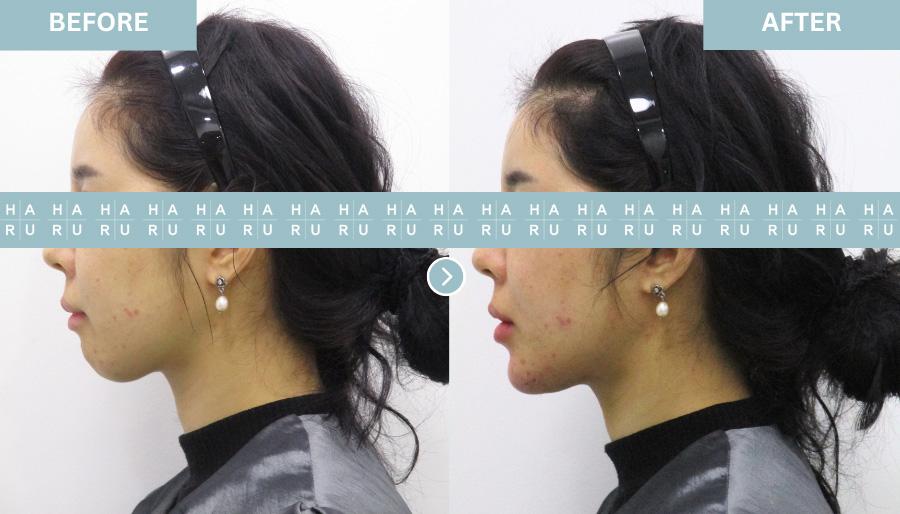
For chin filler, Haru Clinic offers tailored hyaluronic-acid or biostimulatory filler contouring intended to add chin definition while keeping your overall facial balance in view. Dr. Jeong’s work as an official Merz research physician and educator in current filler techniques supports a non-surgical approach designed around your individual features, with immediate, adjustable contouring results.
- URL: Haru Clinic Website
- Location: Gangnam-gu, Seoul
- Filler approach:
- Fillers are offered for facial definition including the chin and jawline.
- Hyaluronic-acid and biostimulatory filler options are described.
- Treatment planning emphasizes facial harmony and a natural, refreshed-looking result.
- Clinical background:
- Dr. Jeong is an official research physician at Merz, the company behind Belotero Filler.
- He teaches other doctors on current filler techniques.
- Related contouring options:
- Thread lifting and double-chin treatments are available for jawline and lower-face contour concerns.
- Botox is offered for a square jaw and facial lines.
2. PangPang Clinic
You may consider PangPang Clinic for chin filler if you want injectable facial-structure enhancement planned alongside a clinic-wide focus on non-surgical lifting. The clinic provides customized filler and Botox treatments, while its consultation process and extensive thread-lifting practice can be relevant if your chin projection is being considered as part of broader lower-face contouring.
- URL: PangPang Clinic Website
- Location: Gangnam-gu, Seoul
- Facial contour planning:
- Customized filler treatments are offered to enhance facial structure.
- Personalized doctor consultation is part of the clinic’s thread-lifting system.
- A Thread Lifting Consultation Center is described as listening to your needs for tailored treatment planning.
- Thread-lifting specialization:
- The clinic focuses exclusively on thread lifting and uses 31 specialized functional threads.
- Its system includes ultrasonic visual checks and pre-operative design.
- PangPang established a Thread Lifting Research Institute and reports ongoing procedure development based on research and clinical data.
- Complementary treatments:
- Botox and laser treatments are available alongside lifting and injectable services.
- The Thread Lifting Revision Center may incorporate fillers, Botox, and lasers when addressing unsatisfactory prior thread-lifting results.
3. Three Wishes Clinic - Myeongdong
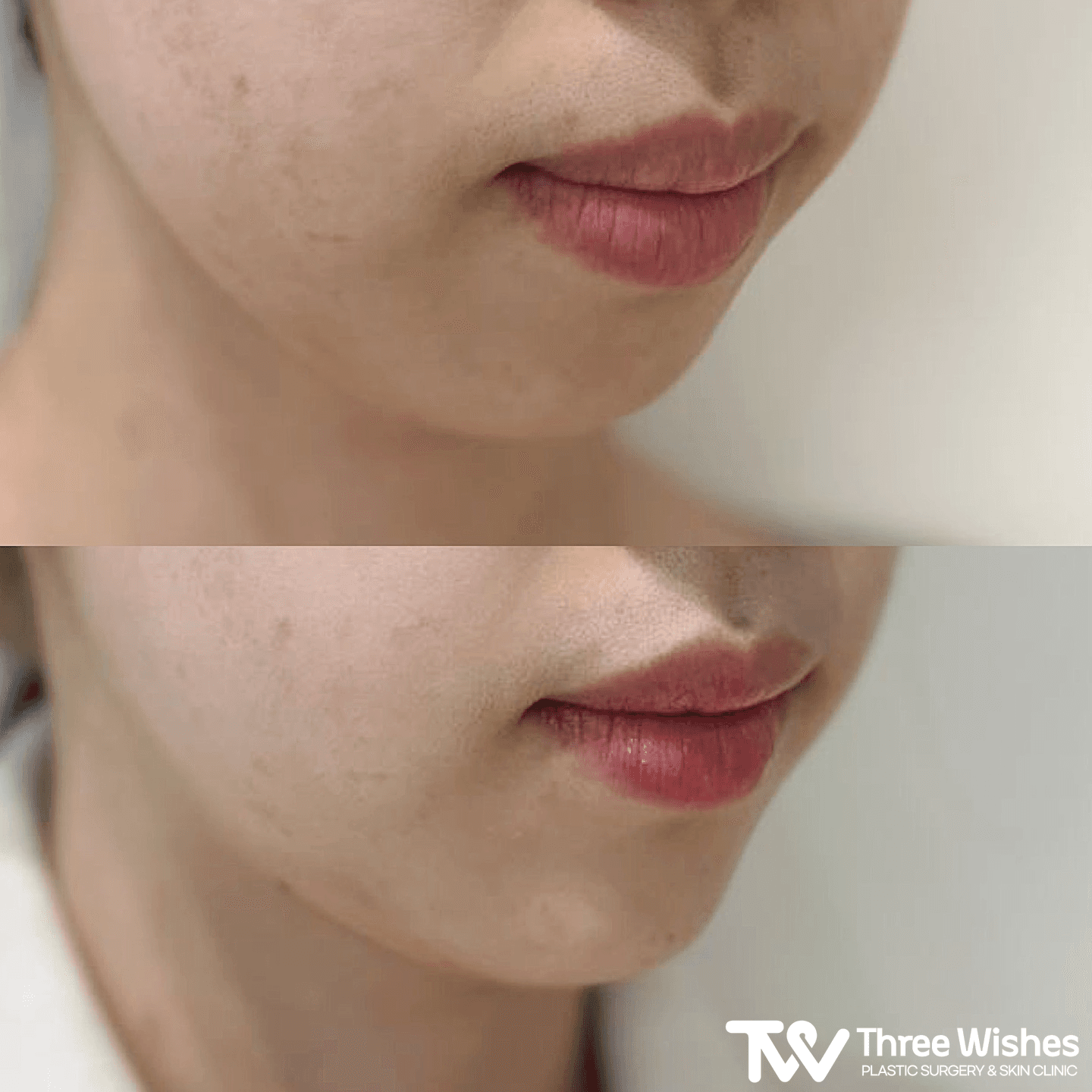
For chin filler, Three Wishes Clinic - Myeongdong offers dermal filler treatment that can enhance chin contour and be tailored to your facial shape and desired result. You can expect immediate volume and contouring effects with minimal downtime, within a menu of non-surgical facial treatments that also includes fat-dissolving injections and thread lifting.
- URL: Three Wishes Clinic - Myeongdong Website
- Location: Jung-gu, Seoul
- Procedure details:
- Dermal fillers are used to enhance facial contours including the chin.
- Treatment can be tailored to your facial shape and desired outcome.
- The clinic describes filler results as immediate with minimal downtime.
- Related lower-face options:
- Fat-dissolving injections are offered for localized fat in the chin, jowls, or jawline.
- Thread lifting is available to lift sagging tissue and stimulate collagen production.
- Shurink ultrasound treatment is offered for non-needle skin lifting and tightening.
Chin Filler From Start to Finish
- Send records before travel — Request an English or virtual consultation where available. Share clear front, three-quarter, profile, and smiling photographs; disclose prior fillers, implants, chin surgery, allergies, medicines, and any bite or airway concerns.
- Complete the in-person assessment — The clinician assesses facial proportions at rest and in movement, chin soft-tissue thickness, mentalis activity, chin ptosis, jowls, occlusion, jaw discrepancy, and all previous filler sites. Standardized photographs and facial mapping help define a conservative plan.
- Confirm product and safety planning — Discuss the exact HA product, planned amount, expected limits, risks, and whether hyaluronidase is immediately available. Sign consent only after receiving information in a language understood clearly.
- Prepare the skin and numb the area — Makeup is removed, the chin is cleansed with antiseptic, and markings are made. Topical anesthetic, ice, local anesthetic block, or lidocaine-containing filler can be used; fasting is not generally required for local treatment alone.
- Receive controlled injections — The injector places small amounts with a needle and/or microcannula, reassessing projection, contour, symmetry, and chin movement as treatment progresses. The injection itself is brief; the full visit commonly lasts 30–60 minutes.
- Check circulation before discharge — The clinic observes the treated area and gives written aftercare. Do not leave with escalating pain, white or dusky skin, livedoid mottling, coolness, delayed capillary refill, or visual or neurologic symptoms.
- Recover locally and review remotely — Use the clinic’s emergency contact during the first nights in Korea, complete the agreed early review, then send photographs or attend video follow-up at 24–72 hours and around two weeks. Assess elective refinement only after swelling resolves, commonly at 2–4 weeks.
Alternatives to Chin Filler
Chin filler is temporary and changes soft-tissue contour. Surgical choices provide more durable structural change but involve incisions, anesthesia or sedation considerations, and longer recovery; alternatives should match the degree of skeletal deficiency, bite function, skin laxity, and desired permanence.
Chin Implant
- Best tradeoff — A chin implant provides durable projection for patients seeking a surgical structural option rather than recurring filler.
- Key limitation — It requires an incision and surgical recovery and does not replace assessment of significant malocclusion or airway concerns.
Genioplasty
- Best tradeoff — Chin surgery reshapes or advances the chin bone and is more appropriate for meaningful skeletal deficiency or a permanent bone-based change.
- Key limitation — Recovery and planning are substantially more involved than an injectable procedure.
Double-Jaw Surgery
- Best tradeoff — Double-jaw surgery addresses jaw discrepancy or malocclusion when appearance overlaps with functional bite or airway issues.
- Key limitation — It is major surgery, not a cosmetic substitute for minor projection enhancement.
Facial Fat Grafting
- Best tradeoff — Face fat grafting uses the patient’s own fat and can offer longer-lasting volume than HA.
- Key limitation — Retention is variable and treatment requires donor-site liposuction.
Broader Facial Filler
- Best tradeoff — Facial filler can balance the chin with selected jawline, prejowl, cheek, or lip treatment when a chin-only plan would look disproportionate.
- Key limitation — More injection sites and product volume do not correct skeletal or functional jaw problems.
How Can I Prepare for Chin Filler?
- Disclose every injectable and operation — List all prior filler sites, product names if known, facial implants, chin surgery, and any past nodules, infection, delayed swelling, or vascular complication.
- Review medicines before changing anything — Report aspirin, NSAIDs, warfarin, other antiplatelet or anticoagulant medicines, vitamins, and herbal supplements because they can increase bruising or bleeding. Do not stop prescribed blood-thinning medication unless the prescribing clinician instructs it.
- Report infection and dental plans — Tell the clinic about acne cysts, rash, cuts, cold sores, fever, oral ulcers, dental infection, recent illness, vaccination, and planned dental work. Defer elective injection until active infection has resolved.
- Avoid closely timed facial procedures — Do not schedule chemical peels, laser resurfacing, microneedling, aggressive facials, or other invasive facial treatments near the appointment without injector approval; they can provoke inflammation around HA filler.
- Food, alcohol, and nicotine — Fasting is usually unnecessary for topical or local anesthesia alone. Avoid alcohol for at least 24 hours before and after treatment when instructed, and avoid nicotine where possible because it can impair healing.
- Plan accommodation and flights — Stay within easy reach of the clinic for the first night or two, keep a flexible itinerary, and do not book a same-day departure.
Travel note: Bring a list of medicines and allergies in English, and leave Korea with the product and lot record, written aftercare, and emergency contact details.
Confirm the treating doctor’s clinic-specific requirements, which take precedence over general guidance.
Aftercare Advice
Protect the treated chin from pressure and seek urgent help promptly for circulation-related symptoms; early swelling is common, but worsening pain or color change is not routine recovery.
- Cold and contact — Use intermittent wrapped cold packs for the first 24 hours if instructed. Do not rub, press, massage, use gua sha, apply facial devices, or sleep face-down or directly on the chin for the period specified by the injector.
- Activity and heat — Resume gentle daily activity, but avoid strenuous exercise, sauna, steam rooms, high heat, extensive sun/UV exposure, and alcohol for at least 24–48 hours when advised.
- Skincare and procedures — Cleanse gently and use bland moisturizer. Apply SPF 50 once injection sites are intact, and postpone nonessential dental work, laser treatment, chemical peels, microneedling, energy devices, and aggressive facials until the injector confirms timing.
- Pain and appearance — Use acetaminophen/paracetamol when medically appropriate; ask before taking aspirin or NSAIDs if bruising is a concern. Visible projection is immediate, but judge symmetry and final contour after swelling settles at about two weeks.
- Urgent warning signs — Contact the clinic immediately for severe or increasing pain, white, blue-gray, dusky, or net-like skin discoloration, coolness, blisters, pus, fever, spreading redness, or a painful new nodule. Blurred vision, vision loss, severe headache, facial weakness, numbness, speech difficulty, or confusion are emergencies because intravascular filler events can cause skin necrosis and, rarely, visual injury or stroke.
- Longevity and repeat treatment — HA chin filler commonly persists about 6–18 months, depending on product, volume, placement, anatomy, metabolism, and repeat treatment. Discuss elective repeat deep treatment carefully: an exploratory prospective controlled CT study associated HA chin injection with imaging-detected mental bone resorption at 6–12 months, but its long-term clinical importance and reversibility remain uncertain.
Follow the treating doctor’s individualized instructions and contact the clinic promptly when anything appears wrong.
Frequently Asked Questions
Related Blogs
Ear Filler in Korea: Candidacy, Safety, Recovery and Travel Planning
Ear filler uses small amounts of hyaluronic acid to restore soft earlobe volume or support an intact widened piercing, with results visible immediately and limited evidence suggesting 6–9 months of effect. The article covers candidate screening, procedure steps, recovery, travel planning, aftercare, urgent warning signs, and surgical alternatives for torn or structurally altered earlobes.
Updated: Oct 28, 2026
Erase Horizontal Forehead Lines with Forehead Filler: Advanced Treatments in Korea
Discover how Korea leads in treating horizontal forehead lines with advanced dermal fillers and Botox. This article explores the causes of static wrinkles, treatment options like hyaluronic acid, CaHA, and PLLA fillers, and the importance of expert practitioners in Korea’s top clinics. Learn about the procedure steps, safety considerations, and how Korea’s affordable, high-quality medical tourism
Updated: Oct 11, 2026
Bony Hands Solutions: Hand Filler Procedures in Korea for Fuller, Youthful-Looking Hands
Discover effective solutions for "bony hands" and veiny hand aging with Korea’s leading hand filler procedures. From hyaluronic acid fillers like Restylane to biostimulatory options such as Radiesse and Sculptra, Korea offers expert treatments to restore youthful volume. Enjoy short, minimally invasive treatments with immediate results, performed by certified Korean surgeons in a patient-focused m
Updated: Oct 10, 2026
Neck Wrinkles Solutions: Neck Filler Procedures in Korea for Smoother, Youthful Skin
Discover how Korea leads in neck wrinkle treatments with advanced Neck Filler procedures like hyaluronic acid, calcium hydroxylapatite, and poly-L-lactic acid. This comprehensive guide explores causes of neck aging, treatment techniques, costs, and patient experiences in Korea—a preferred medical tourism destination. Learn about Korea’s expert injectors, affordable pricing, and all-inclusive packa
Updated: Oct 8, 2026
Clinics offering Chin Filler

Haru Clinic Korea | Fully-Customized Full-Face Non-Surgical Rejuvenation With Threads, Botox & Fillers
Sinsa

Hev Clinic Korea | Premium Sinsa Clinic for Skin, Laser & Injectables
Sinsa

Three Wishes Clinic - Myeongdong, Korea: Advanced Botox, Fillers, Laser, and Skin Treatments for Confidence and Care
Myeongdong

PangPang Clinic: Korea's Premier Thread Lifting and Skin Rejuvenation Specialist in Gangnam, Seoul
Sinsa